How Do Dress Shirts Combine Fit and Fabric Attributes to Serve Formal Functions?
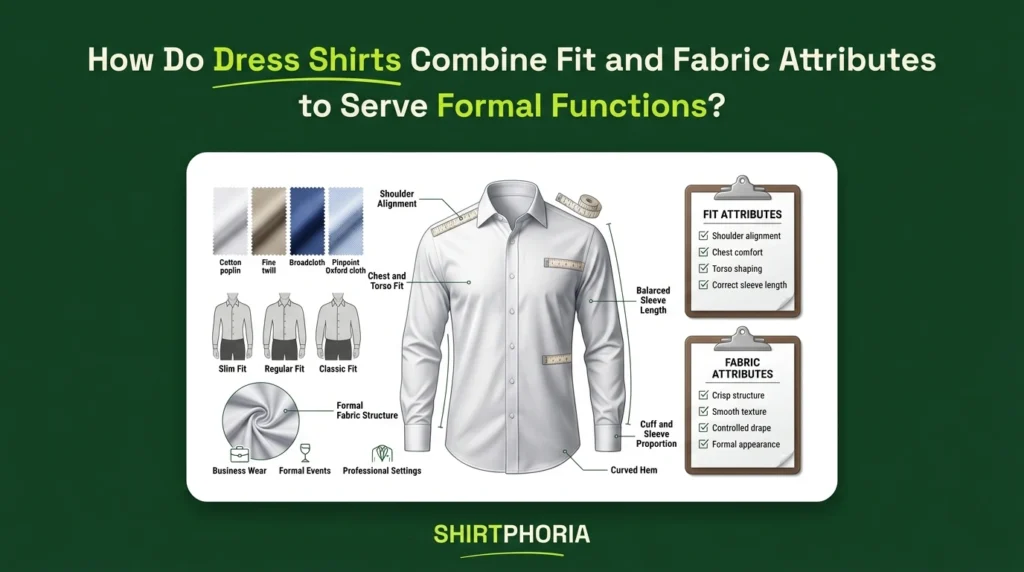
A dress shirt serves formal functions by combining appropriate fabric attributes with controlled fit attributes, so the garment looks clean, structured, and suitable for the required professional or ceremonial setting.
Many men choose dress shirts mainly by color, brand, price, or a thread-count number printed on the label. Those details can influence a purchase, but they do not determine whether the shirt is appropriate for a particular setting. Formal suitability depends more directly on fabric texture, opacity, weave, weight, collar structure, cuff style, shirt-front design, fit, jacket compatibility, and occasion.
The fit and fabric attributes of dress shirts operate as one connected sartorial system. Fabric controls the shirt’s visible texture, weight, drape, opacity, hand-feel, and surface appearance. Fit and construction control how the shirt sits across the neck, shoulders, chest, waist, sleeves, cuffs, and shirt front.
This guide explains how fabric structure and tailored fit interact to help a dress shirt meet Business Formal, Black Tie, White Tie, and smart-dress expectations.
Quick Fit-and-Fabric Summary
The Fabric: Smooth shirtings such as broadcloth/poplin and fine twill are commonly associated with formal dress shirts, while visibly heavier and more textured fabrics often feel more relaxed.
The Thread Count: Thread count can indicate fabric fineness, but quality also depends on ply, cotton quality, yarn consistency, weave, finish, mill standards, fabric weight, and construction.
The Fit: A formal dress shirt should sit cleanly beneath a jacket without shoulder strain, chest pulling, waist billow, sleeve restriction, or excess fabric around the armholes.
The Collar: A collar needs enough structure to frame the face, stay beneath the jacket collar, and support neckwear without collapsing or creating uncomfortable pressure.
The Cuff: Barrel cuffs work well for practical business use, while French cuffs and linked cuffs are commonly associated with dressier business, ceremonial, and evening contexts.
The Shirt Front: Ordinary business fronts, concealed fronts, pleated fronts, piqué or Marcella fronts, and stud-fastened fronts serve different levels of formality.
The Occasion: Business Formal, Black Tie, White Tie, and smart-casual settings require different combinations of fabric, fit, collar, cuff, fastening, and shirt-front attributes.
Why Do Dress Shirt Fit and Fabric Attributes Dictate Formal Suitability?
Dress shirt fit and fabric attributes shape formal suitability because they control how clean, structured, opaque, smooth, and intentional the shirt appears under professional or ceremonial clothing.
Fit and fabric do not establish formality alone. They work with shirt color, collar configuration, cuff treatment, placket design, neckwear, jacket type, trousers, footwear, invitation wording, and the dress code of the event.
A smooth white shirt may work with a business suit, dinner jacket, or ceremonial tailcoat, but the appropriate shirt front, collar, cuffs, and fastening system differ across those settings. The complete outfit determines whether the shirt is properly aligned with the occasion.
How Dress Shirt Fit Signals Intentionality in Formal Contexts
In formal contexts, a controlled dress shirt fit signals intentionality because it reduces excess fabric, keeps the torso line cleaner, and helps the shirt sit properly beneath a jacket.
A shirt that billows heavily around the waist can form visible folds below the jacket button. Excess fabric may also gather at the lower back and push above the trouser waistband when the wearer sits or moves.
A shirt that is too tight creates different problems. Pulling across the chest may open gaps between buttons. Tight shoulders can restrict arm movement and pull the collar away from its intended position. A narrow back can create horizontal tension lines, while tight cuffs can prevent the sleeves from falling naturally.
The best formal fit is close enough to stay clean under tailoring, but not so tight that it pulls across the chest, shoulders, buttons, or cuffs.
A regular fit may support comfort, mobility, or broader body proportions when it does not create excessive fabric beneath the jacket. A tailored fit usually removes some volume from the torso while preserving practical movement. A tapered fit narrows toward the waist and may produce a cleaner tucked silhouette for wearers whose waist is noticeably smaller than their chest.
A close-fitting shirt can work when the shoulder seams, chest, armholes, sleeves, and collar remain comfortable. A close fit stops serving its function when it strains at the buttons, restricts movement, or causes the fabric to pull away from the body in visible lines.
Fit labels are not standardized across every manufacturer. A “tailored fit” from one company may resemble a “slim fit” or “regular fit” from another. Actual neck, shoulder, chest, waist, sleeve, and cuff measurements provide more useful information than the label alone.
Practical Fit Test
A suitable formal dress-shirt fit should pass the following checks:
- The shoulder seams should sit near the natural shoulder edge.
- The collar should close without choking or leaving a large visible gap.
- The chest should remain smooth when standing naturally.
- The buttons should not pull apart when the wearer sits.
- The waist should tuck cleanly without large folds.
- The sleeves should allow the elbows to bend without pulling the cuff upward excessively.
- The cuff should pass over the hand when unbuttoned but stay controlled when fastened.
- The shirt should remain comfortable beneath the intended jacket.
Contextual Formality Standards
Formal suitability changes by context because Business Formal, Black Tie, and White Tie each require different levels of fabric smoothness, shirt-front structure, collar formality, cuff treatment, and jacket compatibility.
Business Formal generally centers on a conservative dress shirt worn with a suit, tie, and restrained professional accessories. The shirt should support the jacket and neckwear without distracting transparency, excessive texture, visible strain, uncontrolled looseness, or strongly casual construction.
Black Tie is formal eveningwear commonly built around a dinner jacket or tuxedo, formal white shirt, black bow tie, formal trousers, and coordinated evening accessories.
White Tie is the highest formal dress code; Black Tie is formal eveningwear below White Tie but above standard business attire. The Emily Post guide separates Business Formal, Black Tie, and White Tie and identifies the principal garments associated with each level.
The foundational rules for formal construction are directly applied when choosing formal shirts.
A shirt suitable for a corporate office may not contain the formal front, studs, linked cuffs, or ceremonial collar associated with evening dress. In the opposite direction, an evening shirt with a specialized bib or stud system may look unnecessarily ceremonial in an ordinary office.
Dress-code wording should take priority over general assumptions. An invitation marked “Black Tie,” “White Tie,” “Business Formal,” or “Black Tie Optional” gives clearer direction than fabric quality alone.
The formality and construction rules here also explain the contrast between a Oxford comparison.
Which Fabric Attributes Define a High-Functioning Formal Dress Shirt?
A high-functioning formal dress shirt is shaped by fabric attributes such as weave, texture, opacity, thread count, ply, weight, color, finish, and laundering behavior.
No single fabric attribute determines formal suitability. A high thread count cannot compensate for distracting transparency, poor fit, unsuitable collar construction, weak stitching, or a shirt front that conflicts with the dress code.
The fabric should instead be evaluated as part of the shirt’s complete design and intended use.
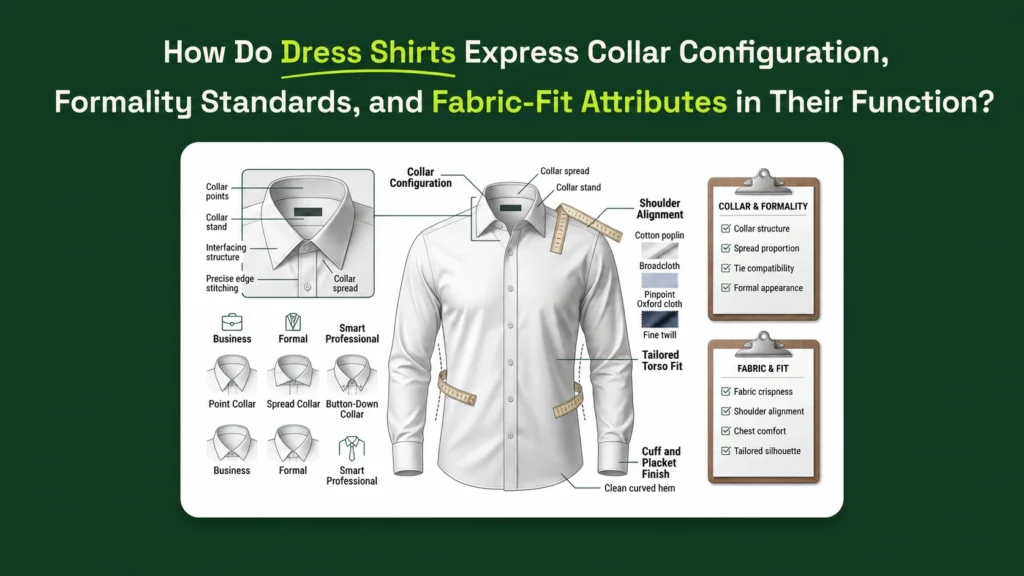
Weave Selection and Surface Texture
Weave selection affects formality because smoother, finer, and less textured fabrics often create a cleaner dress-shirt appearance than heavier or more rugged casual fabrics.
Broadcloth, often called poplin, is a plain-weave shirting with a smooth, flat surface and relatively little texture. Broadcloth/poplin often works well for crisp business shirts because it creates a controlled visual field beneath a suit and tie. Its smooth surface may also make wrinkles or transparency more visible.
Twill uses a diagonal weave that creates a subtle visible pattern. Fine twill often works well when the wearer wants a softer drape, a restrained sheen, and slightly more surface character than broadcloth.
Pinpoint Oxford is finer and smoother than traditional Oxford cloth. It can work for everyday office shirts, although its visible texture usually places it below smooth broadcloth or fine twill in stricter dress-shirt contexts.
Oxford cloth generally uses a heavier basketweave construction with a more noticeable texture. It is commonly associated with casual or smart-casual shirts, especially the Oxford cloth button-down. Its final suitability still depends on its weight, color, collar, fit, jacket, tie, and the specific dress code.
The fabric guide explains the practical differences among broadcloth, twill, pinpoint Oxford, and Oxford cloth, as well as the roles of texture, thread count, ply, transparency, and wrinkle tendency.
Lower texture often reads as more formal in dress-shirt contexts, but the final result depends on the whole outfit. A refined twill shirt with a clean fit may suit an important business setting better than a transparent or poorly fitted poplin shirt.
Piqué is another textured fabric category relevant to formal shirting. In evening shirts, piqué or Marcella may be used for the visible front panel rather than the entire shirt. This is a specialized formal-shirt treatment and should not be interpreted to mean that all textured fabrics are casual or that every formal shirt needs a piqué front.
Practical Fabric Direction by Use
| Fabric or Weave | Common Surface Character | Practical Direction | Main Point to Check |
|---|---|---|---|
| Broadcloth/Poplin | Smooth, flat, and clean | Business Formal, weddings, refined dress shirts | Opacity and visible wrinkling |
| Fine Twill | Subtle diagonal texture and softer drape | Business, travel, refined daily wear | Weight, sheen, and finish |
| Pinpoint Oxford | Fine but noticeable texture | Everyday office and business-casual use | Whether the workplace accepts texture |
| Oxford Cloth | Heavier basketweave texture | Smart casual and relaxed office wear | Collar style and overall outfit formality |
| Piqué/Marcella | Structured visible texture | Selected formal-evening shirt fronts | Correct dress code and shirt-front design |
Thread Count, Ply, Opacity, and Fabric Quality
Thread count can influence how smooth and fine a dress shirt fabric feels, but it should not be used as the only measure of formality or quality.
Thread count is only one fabric indicator. Ply, cotton quality, yarn consistency, mill standards, weave, finish, weight, color, opacity, and garment construction also affect how the finished shirt feels and performs. The same fabric guidance treats thread count and ply as parts of a broader assessment rather than complete quality verdicts.
Higher thread counts can feel smoother, silkier, and more refined when other fabric variables are strong, but opacity depends on weave, yarn, ply, color, and fabric weight.
Ply describes how the yarn is formed. A two-ply yarn combines two strands, while a single-ply yarn uses one. Ply may influence feel and performance, but neither category automatically establishes quality or formal suitability.
Opacity is especially important in white and pale shirts. A fabric can feel fine and luxurious while appearing too sheer under daylight, office lighting, photography, or strong indoor illumination. The wearer should inspect the shirt under realistic lighting rather than judging it only inside a dim fitting room.
Fabric color also affects perceived opacity. White and pale-blue shirts may reveal the skin, undershirt edge, trouser waistband, or chest hair more readily than darker fabrics made from the same weave.
A lower-count fabric may be durable, structured, and practical for frequent office wear. A mid-to-fine shirting may create a smoother appearance for professional or dress use. Very fine shirtings can feel luxurious, but they may require more careful laundering, pressing, storage, and handling.
Thread count should therefore be treated as one useful clue rather than a standalone quality score or formality rating.
Visual Support: Thread Count and Fabric Quality Comparison
| Fabric Indicator | What It Can Suggest | What It Does Not Prove | Best Use as Guidance |
|---|---|---|---|
| 80s–100s shirting | Practical business weight, durability, and everyday structure | It does not automatically mean poor quality or low formality | Useful for daily office dress shirts when the weave, color, and fit are appropriate |
| 100s–140s shirting | Finer hand-feel, smoother surface, and more refined appearance | It does not guarantee opacity, luxury, or wrinkle resistance | Useful for refined business shirts, weddings, and dressier settings |
| 160s+ shirting | Very fine, delicate, and potentially luxurious fabric | It does not automatically make a shirt Black Tie-appropriate | Best treated as a premium-fabric choice that requires careful evaluation |
| Ply, mill, yarn, weave, and weight | Overall fabric quality and performance context | No single factor determines formal suitability alone | Evaluate these factors together before judging the shirt |
These ranges are practical shopping heuristics rather than universal formality grades. Mills and retailers may also describe yarn fineness differently, so shoppers should compare the complete fabric specification and inspect the actual garment.
How Fabric Weight and Opacity Affect Suitability
Fabric weight affects formal suitability because it changes drape, transparency, breathability, layering comfort, and the amount of visible structure in the shirt.
A very lightweight white fabric may be comfortable in warm conditions but become visibly sheer or cling to the torso. A heavier fabric can provide more opacity and structure, yet it may feel bulky beneath close-fitting tailoring.
The correct balance depends on climate, lighting, jacket weight, laundering expectations, and the wearer’s comfort needs. Formal suitability does not require the heaviest or lightest available shirt. It requires a fabric that remains controlled and sufficiently opaque in the intended setting.
How Do Fit and Construction Attributes Support the Formal Function of a Dress Shirt?
The formal function of a dress shirt depends on construction attributes that help the collar, cuffs, placket, and shirt front look clean under a suit, tuxedo, or formal jacket.
These components remain visible even when most of the shirt is covered. The collar frames the tie and face, the cuffs extend beyond the jacket sleeves, and the front remains visible between the lapels.
Construction should support the occasion without becoming unnecessarily stiff, decorative, bulky, or restrictive.
Collar Structure, Interlining, and Configuration
Collar structure supports formal presentation because the collar must frame the face, sit cleanly under the jacket collar, and support neckwear without collapsing.
Interlining is the inner support layer placed between the collar’s outer fabric layers.
Interlining can help a collar feel firmer or softer, but final collar behavior depends on the outer fabric, interlining weight, collar shape, construction method, pressing, laundering, fit, and manufacturing quality.
A fused collar bonds the interlining to the outer collar fabric. A non-fused collar allows the layers to remain less rigidly bonded. These methods can affect collar feel and movement, but neither is automatically more formal or better in every shirt.
Firmer collar construction can support a cleaner collar stance when the shirt is worn with a tie. Softer construction may work well in open-collar, relaxed-tailoring, or less structured settings.
Excessive stiffness can feel harsh around the neck or look inconsistent with a soft jacket. Insufficient support may allow the collar points to curl, collapse beneath the lapels, or spread unevenly around the tie knot.
Collar configuration also matters:
- A point collar creates a narrower opening and often works with conservative business styling.
- A semi-spread collar balances moderate openness with standard tie compatibility.
- A spread collar creates more room around the tie knot and may coordinate with wider lapels.
- A cutaway collar creates a very wide opening and needs careful tie-knot and jacket coordination.
- A button-down collar is commonly associated with Oxford shirts and less strict dress contexts.
- A formal turndown collar is common in modern Black Tie.
- A wing collar is more strongly associated with White Tie and selected traditional eveningwear.
The collar should close without visible strain. It should sit close enough to the neck to remain controlled, but it should not create choking pressure, skin folding, or restricted head movement.
This general construction section is the foundation for all collar guide.
Collar Construction Matrix: Structured vs. Soft Collar Behavior
| Collar Attribute | More Structured Direction | Softer Direction | Practical Decision |
|---|---|---|---|
| Interlining | Firmer internal support | Lighter internal support | Match firmness to neckwear and jacket |
| Collar stance | More upright and controlled | More relaxed and flexible | Use enough structure to prevent collapse |
| Tie support | Usually stronger | May be less controlled | Check collar behavior with the intended knot |
| Open-neck use | Can appear rigid | Often sits more naturally | Match collar structure to styling method |
| Main failure | Harshness or excessive rigidity | Curling or collapsing | Avoid either extreme |
How Cuff and Placket Attributes Define Formality in Dress Shirts
Cuff and placket attributes affect formal suitability because visible fastening details become more controlled as the shirt moves from office use toward eveningwear.
Barrel cuffs are common for daily business dress shirts because they fasten with buttons and remain practical. They can appear polished when the cuff size, stitching, button placement, and sleeve length coordinate with the jacket.
French cuffs fold back and use cufflinks rather than ordinary cuff buttons. They are commonly associated with dressier shirts, eveningwear, ceremonies, and selected Business Formal settings. Their suitability still depends on the jacket, accessories, event, workplace, and local dress conventions.
French cuffs are not automatically the best choice for every formal situation. A refined barrel cuff can be appropriate for many business and wedding settings, while French cuffs may appear excessive when the rest of the outfit is relatively relaxed.
A placket is the reinforced strip surrounding the shirt’s front opening. A visible front placket is common on everyday business shirts. A cleaner front, concealed placket, or formal fastening system may create a more restrained surface in certain evening shirts.
No placket style is universally more formal in every setting. The front must be judged together with the collar, cuffs, buttons or studs, fabric, jacket, and dress code.
Cuff exposure should remain controlled. A small amount of shirt cuff commonly appears beyond the jacket sleeve. Excessive exposure can indicate that the shirt sleeve is too long or the jacket sleeve is too short. A cuff hidden completely inside the jacket may indicate the opposite problem.
These formal cuff and placket rules contrast with the cultural, decorative, and highly visible construction of Guayabera shirts.
How Shirt-Front Design Changes Formal Function
Shirt-front design changes formal function because the front remains visible between the jacket lapels and may carry buttons, studs, pleats, piqué texture, or a covered fastening system.
An ordinary business shirt commonly uses visible buttons and a standard placket or cleaner French-front construction. Formal evening shirts may use studs, covered buttons, pleated fronts, piqué or Marcella panels, or restrained concealed treatments.
These details should be selected according to the actual dress code. A specialized evening front can look misplaced in a daily office, while ordinary business details may appear too casual with stricter ceremonial clothing.
How Do Fit and Fabric Attributes Serve Business Professional Environments?
In Business Professional environments, dress shirt fit and fabric attributes must balance clean presentation, comfort, opacity, durability, and compatibility with a suit or blazer.
The shirt needs enough structure to remain composed through normal movement, but it should not feel ceremonial or unnecessarily rigid. It may need to support sitting, standing, commuting, reaching, presenting, dining, and extended jacket wear.
The Corporate Performance Synergy
A strong business dress shirt combines a clean fabric surface with a fit that stays neat through sitting, standing, reaching, and jacket wear.
Broadcloth/poplin can create a crisp professional appearance when pressed. Its smooth surface works well with conservative ties and tailored suits, although it may display visible creases more readily than some textured weaves.
Twill may resist the appearance of wrinkling better than certain smoother fabrics because its diagonal texture can make minor creasing less obvious. Actual performance depends on yarn, weight, finish, laundering, pressing, movement, humidity, and wear conditions.
Pinpoint Oxford can serve everyday office wardrobes where moderate texture is accepted. Traditional Oxford cloth usually works more naturally in business-casual or smart-casual offices, especially when combined with a button-down collar or relaxed blazer.
Opacity should be checked before purchase. A white business shirt that reveals the undershirt, skin, trouser waistband, or pocket contents under office lighting may weaken an otherwise professional outfit.
For office wear, the goal is not a wrinkle-proof shirt; the goal is a shirt that remains presentable under normal movement and jacket wear.
A wrinkle-resistant finish may reduce visible creasing in some garments, but its actual performance varies with fabric, treatment, washing, drying, pressing, and use. It should not replace proper fit or garment care.
How Fit Silhouette and Fabric Interaction Maintain Formality in Business Environments
Fit silhouette and fabric interaction maintain business formality by reducing visual clutter around the waist, chest, sleeves, and collar.
A regular fit may work well for comfort or broader body types when excess fabric does not billow beneath the jacket. It should still align at the shoulders and remain controlled when tucked.
A tailored fit generally removes some torso volume while retaining usable movement. It can balance comfort with a cleaner suit line.
A tapered fit may work well when the wearer needs less waist fabric and a cleaner tucked appearance. It is useful only when the chest, shoulders, back, and armholes remain comfortable.
A close fit can look controlled when the seams align properly and the fabric lies smoothly. It becomes unsuitable when the buttons pull, the collar strains, the sleeves restrict movement, or horizontal tension lines form across the chest or back.
Fabric weight affects these fit results. A very light fabric may cling to the body, while a heavier fabric can create bulk if the pattern contains too much ease. The correct balance depends on both the fabric and the wearer’s proportions.
Business Dress-Shirt Decision Guide
| Business Need | Fabric Direction | Fit Direction | Collar and Cuff Direction | Main Risk |
|---|---|---|---|---|
| Daily suit wear | Broadcloth, poplin, or refined twill | Regular, tailored, or tapered | Structured turndown collar and barrel cuff | Choosing a shirt that wrinkles or billows excessively |
| Client meeting | Smooth, sufficiently opaque shirting | Clean but unrestricted | Point, semi-spread, or spread collar | Distracting transparency or collar collapse |
| Long workday | Practical fabric weight and finish | Enough movement for sitting and reaching | Comfortable collar and controlled cuff | Over-tight fit or harsh collar pressure |
| Business ceremony | Refined broadcloth or twill | Clean jacket compatibility | Barrel or French cuff as appropriate | Using specialized eveningwear details unnecessarily |
| Relaxed office | Pinpoint Oxford or controlled texture | Comfortable but intentional | Softer collar or button-down if accepted | Looking too casual for the workplace |
How Do Fit and Fabric Attributes Serve Black Tie and White Tie Environments?
Black Tie and White Tie environments require more controlled shirt attributes than standard business dress, but White Tie remains the higher and more ceremonial dress code.
Black Tie is formal eveningwear below White Tie. It may include a formal white shirt with a piqué or pleated front, shirt studs or covered buttons, cufflinks, and a black bow tie. White Tie follows a stricter ceremonial system with more specific shirt, collar, waistcoat, bow-tie, and tailcoat expectations. These distinctions are outlined in established formal-attire guidance.
A fine fabric or high thread count alone cannot turn an ordinary business shirt into an evening shirt. Formal-evening suitability comes from the combined shirt front, collar, cuffs, fastening system, color, fit, and relationship with the dinner jacket or tailcoat.
The Formal Shirt Front: Piqué, Pleated Fronts, and Studs
Formal evening shirts may use a more structured shirt front, such as a piqué or pleated front, to create a cleaner surface for studs, bow ties, and evening jackets.
Marcella, often discussed alongside piqué in formal shirting, is commonly associated with textured formal shirt fronts, but exact usage depends on dress code and event.
A pleated front uses controlled vertical folds to add surface structure. A piqué or Marcella front creates visible texture through the fabric or front panel. A plain formal front may also work in selected Black Tie contexts, especially when it uses concealed buttons, removable studs, or another restrained treatment.
Black Tie commonly allows formal white shirts with piqué or pleated-front options, while White Tie is traditionally more ceremonial and more specific in its shirt requirements.
Piqué or Marcella should not be treated as mandatory for every Black Tie event. Invitation wording, regional customs, venue, host expectations, jacket style, and the degree of tradition can influence the correct choice.
The shirt should fit cleanly enough to reduce bunching under the jacket, but not so tightly that it pulls at the chest, shoulders, or studs.
Structural Requirements for Formal Evening Shirts
Formal evening shirts require controlled construction because the shirt front, cuffs, collar, and fastening system remain visible beneath the tuxedo or tailcoat.
Studs may replace or cover ordinary front buttons in many evening shirts. Their scale and finish should coordinate with the cufflinks and should not compete visually with the bow tie or jacket.
Cufflinks are commonly used with French cuffs or other formal linked cuffs. The cuffs should stay controlled beneath the jacket sleeves without rotating excessively or extending too far beyond the sleeve opening.
A formal turndown collar is common in modern Black Tie. A wing collar is more strongly associated with White Tie, although specific eveningwear traditions can vary. A wing collar should not be treated as a universal Black Tie requirement.
The shirt front needs enough room across the chest to lie flat. Pulling between studs or buttons can distort the front, expose gaps, interfere with the bow tie, and weaken the clean opening created by the jacket.
The collar, bib, cuffs, studs, bow tie, waist covering, jacket, and trousers should be evaluated as one system. Correct individual components can still look inconsistent when they belong to different levels of formality.
Data Support Table: Occasion-Specific Attribute Matrix
| Occasion | Suitable Fabric Direction | Suitable Fit Direction | Key Component | Failure Mode |
|---|---|---|---|---|
| White Tie | White formal shirting with ceremonial structure | Clean fit that supports the shirt front without bunching | Formal collar, white bow tie, studs, and formal shirt front | Using a casual dress shirt weakens the ceremonial standard |
| Black Tie | Formal white shirt with piqué or pleated-front option | Clean chest and waist fit under a dinner jacket | Formal front, studs or covered buttons, cufflinks, bow tie | Ordinary business-shirt details can look too casual |
| Business Formal | Smooth broadcloth/poplin or refined twill | Regular, tailored, or tapered fit with clean jacket compatibility | Structured collar, conservative cuff, tie compatibility | Excess billow, sheer fabric, or collapsed collar lowers professionalism |
| Smart Casual | Pinpoint, Oxford cloth, end-on-end, or relaxed shirting | Comfortable fit that still looks intentional | Softer collar, open neck, button-down option | Too much stiffness can look forced in a relaxed setting |
What Common Dress-Shirt Selection Mistakes Reduce Formal Suitability?
Common dress-shirt selection mistakes reduce formal suitability when one visible attribute conflicts with the wearer’s body, jacket, dress code, or occasion.
Choosing Thread Count Instead of Evaluating the Shirt
A high thread-count label cannot confirm opacity, durability, comfort, fit, construction quality, or dress-code suitability.
The safer approach is to inspect the complete fabric, including weave, ply, weight, finish, transparency, surface texture, and recovery after light creasing.
Choosing the Tightest Available Fit
A tighter shirt does not automatically create a cleaner formal silhouette. Excessive tightness produces button strain, shoulder restriction, collar pressure, raised cuffs, and visible tension lines.
The safer fit follows the body while preserving movement and smooth fabric behavior.
Ignoring Opacity in White Shirts
A white shirt may appear sufficiently opaque on a hanger but become transparent against the skin or under bright lighting.
The safer approach is to inspect the shirt while wearing it, preferably under daylight and strong indoor lighting.
Matching the Shirt to the Jacket but Not the Dress Code
A smooth white shirt can fit properly beneath a dinner jacket while still using business-shirt details that are too casual for a traditional Black Tie event.
The shirt should match both the jacket and the event’s stated level of formality.
Assuming French Cuffs Solve Every Formality Problem
French cuffs can support a dressier presentation, but they cannot correct unsuitable fabric, poor fit, a casual collar, incorrect shirt front, or an outfit that does not support cufflinks.
Cuff style should be selected as part of the complete garment system.
Treating Oxford Cloth as Universally Inappropriate
Traditional Oxford cloth is generally more casual than smooth broadcloth or fine twill, but it can still work in business-casual and selected office settings.
The decision depends on weave fineness, color, collar construction, fit, jacket, tie, workplace norms, and occasion.
What Is the Final Checklist for Evaluating Fit and Fabric Attributes of Dress Shirts?
Evaluating a dress shirt’s formal suitability requires checking fabric, fit, opacity, collar structure, cuff style, shirt front, and occasion alignment as one connected system.
Formal Dress-Shirt Fit-and-Fabric Evaluation Checklist
| Evaluation Area | Pass Condition | Warning Sign |
|---|---|---|
| Fabric | Appropriate texture, weight, and opacity | Sheerness, excessive bulk, or unsuitable texture |
| Shoulder | Seam sits near the natural shoulder edge | Drooping seam or visible pulling |
| Chest | Front lies cleanly with no button gaps | Strain lines or opening between buttons |
| Waist | Tucks cleanly with controlled ease | Large billows or restrictive tightness |
| Collar | Supports neckwear and jacket cleanly | Collapse, curling, choking, or large neck gap |
| Sleeves | Permit movement and finish at the wrist | Pulling, excessive gathering, or wrong length |
| Cuffs | Coordinate with jacket and occasion | Hidden cuffs, excessive exposure, or wrong formality |
| Shirt Front | Matches the intended dress code | Business front used where formal evening details are expected |
| Occasion | Fits the invitation and complete outfit | Shirt is more casual or ceremonial than the setting |
Frequently Asked Questions About Dress Shirt Fit and Fabric
These answers clarify common questions about fabric quality, fit, cuffs, shirt fronts, and formal suitability.
Smooth broadcloth or poplin and refined twill are common formal choices because they create a clean surface beneath tailoring. Pinpoint Oxford can suit many offices, while heavier Oxford cloth usually reads as more relaxed. Opacity, color, collar construction, fit, and dress code still matter.
No. Thread count can suggest fineness, but it does not prove opacity, durability, comfort, construction quality, or occasion suitability. Ply, yarn quality, weave, weight, finish, mill standards, and the complete shirt design must be evaluated together.
The shoulder seams should sit near the natural shoulder edge, the chest should remain smooth without button gaps, and the waist should tuck cleanly without excessive billow. Sleeves must allow movement, while the collar and cuffs remain controlled beneath the jacket.
French cuffs suit dressier business, ceremonial, and evening settings, but they are not required for every formal occasion. A refined barrel cuff can work well when the fabric, collar, jacket, and dress code are coordinated.
A business shirt usually uses a standard button front, practical cuffs, and a structured turndown collar. An evening shirt may add studs, covered buttons, French cuffs, pleats, piqué or Marcella panels, or a specialized collar according to Black Tie or White Tie requirements.
Terms Explained
These terms make it easier to compare formal dress shirts by construction and performance rather than by labels alone.
| Term | Definition |
|---|---|
| Broadcloth / Poplin | A smooth plain-weave shirting with a flat surface and relatively little visible texture. |
| Twill | A weave with subtle diagonal ribs that can create softer drape and restrained surface character. |
| Pinpoint Oxford | A finer, smoother Oxford weave commonly used for office and business-casual shirts. |
| Oxford cloth | A heavier basketweave fabric generally associated with relaxed office and smart-casual shirts. |
| Piqué / Marcella | A structured textured fabric or panel used in selected formal-evening shirt fronts. |
| Thread count | A fabric-fineness indicator that must be assessed with ply, yarn, weave, weight, and finish. |
| Ply | The number of strands combined to form a yarn, such as single-ply or two-ply. |
| Opacity | The degree to which fabric prevents skin, undershirts, or layers beneath it from showing. |
| Interlining | The internal support layer placed between the outer fabric layers of a collar or cuff. |
| Fused collar | A collar whose interlining is bonded to the outer fabric with heat and adhesive. |
| French cuff | A folded-back cuff fastened with cufflinks instead of ordinary cuff buttons. |
| Shirt front | The visible front construction, which may use buttons, studs, pleats, piqué, or concealed fastening. |
Conclusion
In conclusion, the fit and fabric attributes of a dress shirt work together to define whether the garment is suitable for business, formal eveningwear, or ceremonial dress.
Fabric controls texture, opacity, hand-feel, drape, weight, and surface appearance. Fit and construction control collar shape, cuff behavior, shirt-front discipline, fastening, movement, and compatibility with a suit, dinner jacket, or tailcoat.
Broadcloth/poplin, fine twill, pinpoint Oxford, Oxford cloth, piqué, and Marcella create different visual and functional effects. Thread count can contribute to fineness, but it must be evaluated alongside ply, yarn, weave, fabric weight, finish, mill quality, opacity, and durability.
Regular, tailored, tapered, and close-fitting silhouettes can all serve formal functions when they match the wearer’s body and preserve clean jacket compatibility. No fit label is automatically superior.
Collar interlining, fused or non-fused construction, barrel cuffs, French cuffs, plackets, pleated fronts, piqué fronts, and studs should be treated as parts of a complete garment system rather than isolated signs of quality or formality.
A strong dress shirt is not chosen by thread count alone, brand alone, color alone, or cuff style alone. It must match the wearer’s body, the jacket, the dress code, and the level of formality required.
By understanding fit and fabric attributes, a wearer can choose a dress shirt that supports the right level of formality, comfort, and visual discipline for the occasion.