How Should a Guayabera Shirt Express Identity Through Cultural Design and Occasion Fit?
A Guayabera expresses regional design tradition and occasion fit through the combined interaction of its alforzas or embroidery, pockets, fabric, sleeve length, color, workmanship, straight hem, and untucked proportion rather than through any single authenticity rule.
Quick Answer: How Does a Guayabera Express Cultural Design and Occasion Fit?
A Guayabera communicates cultural design and occasion suitability through its complete construction: regional detailing, pockets, fabric, sleeve length, color, workmanship, straight hem, and fit. These elements can reference established regional traditions, but they do not prove the wearer’s personal heritage, authenticity, or cultural identity.
Reducing every Guayabera to a vacation shirt ignores its much wider role. Depending on regional convention and construction, the garment can appear in weddings, ceremonies, government functions, business settings, social events, warm-weather everyday dress, and relaxed leisure contexts.
This guide explains the Guayabera’s regional design language, distinguishes traditional features from modern variation, and provides a repeatable framework for matching fabric, color, sleeves, workmanship, fit, and length to the occasion.
The precise geographic origin of the Guayabera remains disputed. The garment is deeply associated with Cuba, Mexico—especially Yucatán—and wider Latin American and Caribbean communities, but competing origin stories and regional development prevent one country from being treated as the universally proven source. HistoryMiami Museum documents this broad cultural reach and the uncertainty surrounding its origin.
The article therefore evaluates garment design and occasion alignment rather than making claims about the cultural identity of the wearer.
How Does Guayabera Cultural Design Express Regional Identity?
Guayabera cultural design expresses regional identity through a shared garment vocabulary—lightweight construction, untucked wear, vertical detailing, pockets, and tropical practicality—combined with variations developed across Cuba, Mexico, the Caribbean, and other communities.
The Guayabera evolved through regional exchange and adaptation rather than from one perfectly uniform pattern. Variations in pockets, pleats, embroidery, sleeve length, fabric, and tailoring can reflect different communities, makers, and occasions.
HistoryMiami documents the Guayabera across Latin American and Caribbean settings and presents its history as broader than a single undisputed national origin.
Unlike performance shirts, which are primarily classified through activity-oriented features such as moisture handling and movement design, the Guayabera is interpreted through cultural construction, regional variation, craftsmanship, climate suitability, and occasion context.
How the Guayabera Represents Latin American and Caribbean Sartorial Heritage
The Guayabera represents Latin American and Caribbean sartorial heritage through its long-standing use across multiple countries, where regional communities adapted its construction for climate, work, ceremony, politics, weddings, business, and everyday dress.
Cuba holds an important place in its documented development and cultural identity.
Yucatán became another major center of Guayabera tailoring and production, developing refined formal and everyday versions.
The garment and related forms also appear across wider Caribbean and Latin American communities. Regional terminology includes names such as Chacabana, particularly in Dominican contexts.
These traditions should not be collapsed into one origin claim.
Wearing a Guayabera can acknowledge the garment’s cultural history when its regional context, construction, and occasion are understood. It does not automatically prove that the wearer belongs to a particular cultural community or understands every regional tradition associated with the shirt.
In some locations, refined Guayaberas can serve functions that elsewhere might be filled by a jacket-and-tie ensemble, particularly for selected weddings, ceremonial events, political functions, business occasions, and warm-weather formal settings.
That does not make the Guayabera universally equivalent to a tuxedo or business suit.
Cultural Boundary: A Guayabera can carry strong cultural meaning without every version following the same pocket count, pleat pattern, fabric, or degree of formality.
How Alforzas, Embroidery, Pockets, and Yokes Shape Guayabera Cultural Design
Alforzas, embroidery, pockets, straight hems, side vents, and optional yoke treatments shape the Guayabera’s visual language, but their number and arrangement vary by region, maker, and intended occasion.
Alforzas are narrow stitched folds or pintuck-like vertical details used to create controlled texture.
The term can overlap with pintucks, although makers and regional traditions may distinguish between fine pleats, stitched decorative folds, and other narrow vertical constructions.
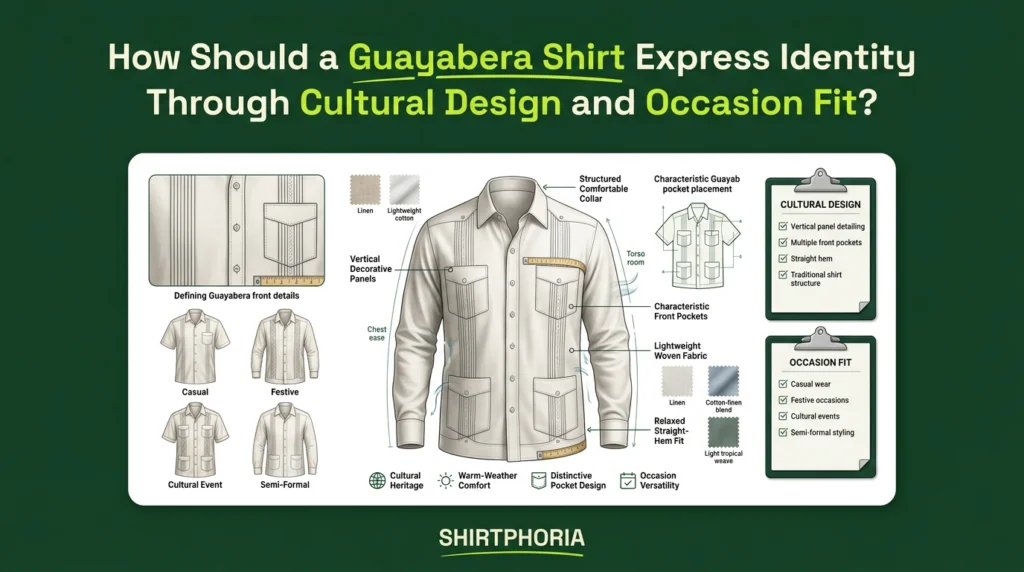
Classic Guayabera anatomy commonly includes:
- vertical rows of pleating or embroidery;
- a straight hem;
- side vents;
- two or four front pockets;
- decorative or functional buttons;
- lightweight fabric;
- and construction intended for untucked wear.
HistoryMiami documents many of these features as characteristic parts of the garment.
Four Patch Pockets are one of the most recognizable Guayabera configurations, especially in classic Cuban-style construction. Four pockets are not, however, a universal requirement for a legitimate Guayabera.
Regional variation is substantial.
Some Cuban-style garments use four prominent front pockets.
Some Yucatecan gala or Presidential Guayabera configurations may use fewer or more restrained pockets.
Some Mexican versions place greater visual emphasis on Embroidery.
Contemporary versions may simplify pockets, pleats, or decorative details.
A Shoulder Yoke can also appear in some constructions, but it is not mandatory.
Yucatecan tailoring should not be reduced to a plain or minimally decorated front. Regional Yucatecan styles may feature skilled alforzas, fine Linen, Embroidery, long sleeves, Presidential configurations, and simplified everyday forms.
Yucatán Today describes both formal and casual Yucatecan variations and highlights workmanship, pintucks, fabric, and Presidential styling.
The practical relationship is:
Fine, aligned detailing → demonstrates controlled construction → may increase the garment’s visual refinement and occasion suitability.
Quality should therefore be judged by workmanship rather than a universal pleat count.
Check for:
- consistent width;
- even spacing;
- straight alignment;
- secure stitching;
- symmetrical placement;
- no loose threads;
- and no twisting.
How Should Guayabera Cultural Design Match Formal and Casual Occasions?
Guayabera cultural design can suit formal, business, smart-casual, or relaxed occasions when fabric, sleeve length, color, front detailing, pocket treatment, workmanship, and complete styling align with the event.
The central rule is:
Fabric and color are important signals, but neither determines formality alone.
The same fibre can appear in a formal regional garment, a business Guayabera, an everyday shirt, a tourist-oriented product, or a contemporary fashion interpretation.
How Fabric and Construction Define Guayabera Occasion Fit
Guayabera occasion fit is defined by the combined quality of its fabric, sleeve length, cut, detailing, opacity, pressing, and finishing rather than by a simple Linen-equals-formal and Cotton-equals-casual rule.
Linen may provide a breathable, crisp, visibly textured surface that works well in refined warm-weather Guayaberas. Quality still depends on the textile, construction, finishing, and event.
Cotton Poplin can provide a smooth surface, good opacity, easier care, and sufficient refinement for business or formal use when workmanship is strong.
Cotton-Linen blends can balance texture, structure, comfort, and practical maintenance.
Rayon and Rayon blends can provide fluid drape and softness. Rayon should not automatically be classified as casual because its appearance depends on fabric quality, opacity, finish, tailoring, and event context.
Synthetic and mixed fabrics also range from inexpensive casual products to carefully finished contemporary garments.
Formal Guayabera signals often work in combination:
- long sleeves;
- clean or classic collar construction;
- fine fabric;
- controlled or light coloring;
- refined alforzas or Embroidery;
- restrained pocket treatment;
- secure buttons;
- careful pressing;
- and balanced untucked drape.
Relaxed versions may combine:
- short sleeves;
- stronger or brighter colors;
- larger Patch Pockets;
- more decorative contrast;
- softer construction;
- simplified finishing;
- and casual trousers or footwear.
Country-specific rules must remain country-specific.
Cuba established a white, long-sleeved Guayabera as official dress for certain state and diplomatic ceremonies. This is a defined Cuban protocol and should not be converted into a universal rule for Guayaberas everywhere. Cubadebate
The white-Linen, long-sleeved Presidential Guayabera is also recognized as a high-formality Yucatecan configuration, but it is one regional model rather than the only legitimate formal Guayabera. Yucatán Today provides this regional tailoring context.
How Color Choices Influence Guayabera Cultural Design and Formality
Guayabera color choices influence perceived formality and regional styling, but color must be evaluated with sleeve length, fabric quality, detailing, time of day, and event expectations.
White, ivory, ecru, cream, and related light neutrals are among the safest traditional choices in many Cuban and Yucatecan formal contexts.
White can align with specific ceremonial or official traditions.
Ivory and ecru can create a softer traditional appearance.
Pale blue, sage, sand, and restrained pastel shades may work for weddings, business occasions, or elevated social events where local convention permits them.
Stronger blues, greens, warm colors, prints, or contrasting embroidery often move the garment toward social or relaxed use.
Darker colors are not automatically casual.
The event, region, host instructions, and complete construction should override a simplistic color hierarchy.
The relationship is:
Restrained color combined with refined construction → reduces visual informality → may support ceremonial or business use.
Color also demonstrates why no single feature should control classification.
An all-white Guayabera with poor stitching, weak fabric, distorted pockets, and uncontrolled fit can still look casual or low quality.
A colored Guayabera with long sleeves, fine material, skilled detailing, precise fit, and appropriate regional context can still support a formal event.
Occasion Rule: Evaluate at least four signals together—fabric, sleeve length, detailing, and fit—before classifying the Guayabera as formal or casual.
How Should Guayabera Fit and Cut Align with Its Cultural Design and Occasion?
Guayabera fit and cut should preserve a straight, breathable, untucked silhouette while keeping the shoulders, chest, sleeves, pockets, hem, and vertical detailing stable and proportionate.
A Guayabera should not be judged according to slim modern dress-shirt standards.
Traditional construction needs enough ease to support:
- airflow;
- sitting;
- walking;
- arm movement;
- pocket alignment;
- straight Alforzas or Embroidery;
- and stable untucked wear.
Relaxed fit does not mean oversized.
How to Achieve an Ideal Guayabera Fit for the Wearer’s Body
An ideal Guayabera fit remains relaxed without appearing oversized, sits cleanly across the shoulders, allows comfortable chest and arm movement, and falls vertically without severe pulling or uncontrolled billowing.
Start with the shoulders.
The shoulder seams should align reasonably with the wearer’s structure.
The collar should remain even.
Where a Shoulder Yoke is present, it should not twist.
The sleeves should allow normal movement without pulling the entire shirt upward.
Across the chest and torso:
- buttons should remain centered;
- the front should not gape;
- Alforzas or Embroidery should remain vertical;
- pockets should not flare outward;
- the torso should allow airflow;
- and the garment should not taper aggressively like a slim dress shirt.
The correct amount of ease also depends on the wearer’s proportions and the maker’s pattern, so one universal numerical chest allowance should not be prescribed.
Observable Guayabera Fit Zones
#### Ideal Fit Zone
- Shoulder area lies cleanly.
- Collar remains centered.
- Buttons do not strain.
- Alforzas or Embroidery remain vertical.
- Pockets stay flat or naturally shaped.
- Torso has controlled ease.
- Normal reaching and sitting remain comfortable.
- Hem remains level.
- Garment neither clings nor balloons.
#### Transition Zone
- Minor pulling appears during large arm movements.
- Light folds collect at the sides.
- One pocket lifts slightly.
- The hem shifts but returns to position.
- The shirt appears somewhat full without overwhelming the wearer.
- Small alterations or a different size may improve the result.
#### Correction-Required Zone
- Shoulder seams sit far outside or inside the natural shoulder.
- Buttons strain or open.
- Pockets flare strongly.
- Alforzas become distorted.
- The shirt billows like outerwear.
- Chest or arms feel restricted.
- The hem exposes the waistband during normal movement.
- The collar twists.
- Front-to-back balance becomes visibly distorted.
The dual failure mode is straightforward:
Too little ease restricts movement and distorts the detailing, while excessive ease hides the garment’s structure and creates uncontrolled volume.
How to Choose the Correct Guayabera Length for Occasion Fit
Correct Guayabera length is determined by balanced untucked proportion: the straight hem should cover the waistband during normal movement without extending so low that it overwhelms the pockets, legs, or overall silhouette.
A traditional Guayabera is constructed to be worn untucked.
HistoryMiami documents the straight hem, side vents, and untucked construction as characteristic elements of the garment.
This is more precise than saying a Guayabera can never be tucked. Uniform systems, costume styling, and contemporary designer interpretations can differ, but untucked wear remains the traditional reference.
Useful length checks include:
- the hem covers the waistband when standing;
- the waistband remains covered during normal reaching;
- front and back hems appear balanced;
- pocket placement remains proportional to the torso;
- Side Vents open around the hip area without sitting excessively high;
- the shirt does not extend so far down the thigh or seat that it resembles a tunic unless that is the intended regional design;
- and the garment is not so short that pockets and vertical detailing appear compressed.
Formality does not require one universal longer hem.
Precision of construction and proportion matter more than length alone.
Validation Step: Check the Guayabera with the intended trousers, footwear, belt where used, and both standing and seated positions.
What Key Characteristics Distinguish Formal and Casual Guayabera Cultural Design?
The key characteristics distinguishing formal and casual Guayabera cultural design are the combined treatment of fabric, sleeves, color, detailing, pockets, fit, hem, workmanship, and regional convention.
| FeatureFormal Occasion Identity (Wedding/Business)Casual Occasion Identity (Weekend/Beach)Identity Implication | |||
|---|---|---|---|
| Fabric | Fine Linen, high-quality Cotton Poplin, Cotton-Linen blend, or another refined and sufficiently opaque fabric | Standard Cotton, Rayon blend, relaxed Linen, or other lightweight materials | Fabric contributes to formality but does not determine it alone |
| Sleeve Length | Long sleeves are a strong formal signal in Cuban and Yucatecan ceremonial traditions | Short sleeves are common for everyday, warm-weather, and relaxed social use | Sleeve length changes occasion tone; regional rules still apply |
| Color | White, Ivory, Ecru, Cream, restrained pastels, or regionally appropriate controlled colors | Stronger colors, deeper tones, contrast embroidery, prints, or playful combinations | Color signals styling direction but does not prove respect or authenticity |
| Alforzas or Embroidery | Fine, aligned, evenly stitched detailing; density varies by regional style | Fewer, wider, simplified, machine-made, or decorative treatments may be used | Workmanship and alignment matter more than a universal pleat count |
| Pockets | May use one discreet pocket, two pockets, or a refined four-pocket system depending on regional model | Two or four larger Patch Pockets are common | Pocket count identifies variation, not cultural validity by itself |
| Yucatecan Variation | Presidential styles may use white Linen, long sleeves, fine Pintucks, and restrained pocket treatment | Everyday Yucatecan styles may use Cotton, short sleeves, brighter colors, or simplified detailing | Yucatecan style includes multiple formal and casual constructions |
| Fit | Straight, controlled, breathable, and precisely proportioned without severe tapering | Slightly fuller ease may be acceptable, but uncontrolled billowing remains a fit problem | Formality increases with precision, not tightness |
| Hem | Straight, level, properly pressed, and balanced over formal trousers | Straight untucked hem with relaxed trousers or warm-weather styling | Traditional untucked construction applies across formality levels |
| Workmanship | Clean seams, secure buttons, symmetrical detailing, controlled pocket placement, and careful pressing | Construction may be simpler, but it should remain secure and coherent | Quality influences refinement across both formal and casual uses |
| Regional Context | Follow the event’s Cuban, Yucatecan, Caribbean, governmental, wedding, or local convention | Greater personal variation may be accepted in relaxed settings | Regional context overrides a universal hierarchy |
Key Classification Rule: No Single Guayabera Feature Determines Formality or Cultural Validity
Linen alone does not guarantee formal quality.
Cotton alone does not imply casual use.
White alone does not prove cultural respect.
Four pockets alone do not prove authenticity.
Fewer pockets do not invalidate Presidential or regional forms.
More Alforzas do not automatically create greater formality.
The complete garment and event context determine the outcome.
Guayabera Cultural Design and Occasion Outcomes
| OutcomeRequired EvidenceInterpretation | ||
|---|---|---|
| Formal Regional or Ceremonial Pass | Refined fabric, appropriate sleeves, controlled color, skilled detailing, clean fit, strong finishing, and documented regional or event context | The Guayabera supports high-formality regional, wedding, governmental, diplomatic, or ceremonial use |
| Business or Smart-Formal Pass | Clean long- or context-appropriate sleeves, refined construction, balanced color, precise fit, and restrained detailing | The garment supports professional or elevated social use without claiming universal suit equivalence |
| Smart-Casual Pass | Controlled fit, coherent detailing, lighter construction, flexible coloring, and suitable trousers and footwear | The Guayabera communicates relaxed refinement |
| Casual or Social Pass | Short sleeves or relaxed styling, casual fabric or color, stable fit, and suitable warm-weather context | The garment supports weekend, beach, family, or informal social use |
| Valid Regional Variation | Features differ from the classic four-pocket model but align with documented regional construction or maker tradition | The garment is a legitimate variation rather than an incomplete Guayabera |
| Mixed or Unclear Classification | Fabric, sleeves, detailing, color, fit, and event signals conflict | Confirm the event and regional context before assigning formality |
| Fit Correction Required | Button strain, excessive volume, twisted yoke, distorted Alforzas, flaring pockets, unstable hem, or restricted movement | Alter the fit, size, or garment construction |
| Insufficient Evidence | Regional context, fabric, construction, or event requirements cannot be verified | Do not make a confident cultural or formality claim |
Guayabera Condition Zones
Ideal Zone
- Regional design is identifiable or accurately described as blended.
- Fabric information is verified.
- Detailing remains aligned.
- Pockets remain stable.
- Shoulders sit cleanly.
- Torso ease is controlled.
- Hem remains level.
- Waistband remains covered.
- Garment allows normal movement.
- Styling aligns with the event.
Transition Zone
- Regional identity is uncertain but the construction remains coherent.
- Minor pleat variation appears.
- One pocket lifts slightly.
- The shirt is somewhat full or short but remains functional.
- Color or sleeve length creates mixed formal and casual signals.
- Pressing or minor alteration may improve the result.
Correction-Required Zone
- A regional style is claimed without supporting evidence.
- Fabric composition is falsely described.
- Strong pulling distorts buttons or detailing.
- Pockets flare severely.
- Alforzas twist.
- The Shoulder Yoke or collar rotates.
- The waistband becomes exposed during normal movement.
- Excessive length overwhelms the wearer.
- The garment conflicts with an explicit event requirement.
Error-Proof Verification Protocol
Use the same sequence each time:
- Identify the event and location.
- Check whether the host provided a dress code.
- Identify the garment’s claimed regional style.
- Separate documented history from origin legend.
- Record the fabric and sleeve length.
- Inspect Alforzas, Embroidery, pockets, hem, vents, and yoke.
- Evaluate workmanship.
- Check shoulders and collar.
- Check torso ease.
- Check untucked length.
- Test sitting, standing, reaching, and walking.
- Evaluate color and complete styling.
- Select one outcome from the classification table.
- Correct one conflicting variable at a time.
- Repeat the full inspection.
Correction Hypothesis: When a Guayabera looks inappropriate, isolate the event code, regional styling, sleeve length, color, fabric, fit, and workmanship before rejecting the entire garment.
Repeatability Rule: The outcome remains consistent only when the same regional boundaries, garment definitions, fit checks, and occasion criteria are applied each time.
Cultural-Safety Rule: When regional evidence is incomplete, describe the garment’s observable features without assigning an unsupported cultural origin.
The Guayabera Cultural Design and Occasion-Fit Checklist
Before attending an event, verify the Guayabera’s regional context, construction, workmanship, fabric, sleeves, color, fit, length, and complete styling rather than relying on one cultural stereotype.
Frequently Asked Questions
No. Four pockets are a recognizable classic configuration, especially in Cuban-style construction, but legitimate regional and formal variations may use fewer or more restrained pockets.
No. White is a safe traditional choice in several formal traditions, but ivory, ecru, cream, restrained pastels, and other context-appropriate colors can also work depending on region and event.
Long sleeves are a strong formal signal in Cuban and Yucatecan ceremonial traditions, but event and regional conventions should determine the final choice.
Traditional Guayabera construction is designed for untucked wear with a straight hem and side vents, although defined uniform, regional, or designer conventions can differ.
Workmanship and overall coherence matter most: aligned detailing, secure stitching, stable pockets, balanced fit, appropriate fabric, clean finishing, and suitability for the intended occasion.
Terms Explained
| TERM | DEFINITION |
|---|---|
| Guayabera | A lightweight shirt associated with Latin American and Caribbean traditions, typically featuring vertical detailing, pockets, a straight hem, and untucked wear. |
| Alforzas | Narrow stitched folds or pintuck-like vertical details used to create controlled texture. |
| Pintucks | Fine stitched folds used decoratively or structurally on a shirt front. |
| Patch Pocket | A pocket formed from a separate piece of fabric sewn onto the outside of the garment. |
| Straight Hem | A level shirt hem designed to support untucked wear. |
| Side Vents | Openings at the lower side seams that improve movement and help the shirt hang cleanly over the hips. |
| Shoulder Yoke | A shaped upper-back or shoulder panel used in some Guayabera constructions. |
| Presidential Guayabera | A refined Yucatecan formal configuration often associated with white fabric, long sleeves, fine detailing, and restrained construction. |
| Chacabana | A regional term used for related Guayabera-style garments, particularly in Dominican contexts. |
| Occasion Fit | The degree to which the garment’s fabric, sleeves, color, detailing, fit, and workmanship align with a specific event. |
Conclusion
The final occasion-fit rule for Guayabera cultural design is to evaluate regional context, construction quality, fabric, sleeve length, color, fit, and event expectations together rather than treating one feature as proof of formality or authenticity.
The Guayabera has broad Latin American and Caribbean cultural significance, while its precise origin remains debated. Classic construction commonly includes untucked wear, a Straight Hem, vertical detailing, Side Vents, and pockets, but legitimate regional versions vary considerably.
Alforzas and Embroidery should be judged by workmanship rather than one universal count. Four pockets are classic but not compulsory. Linen can be a strong formal signal in many contexts, but Cotton Poplin, Rayon, blends, and other fabrics cannot be classified from fibre identity alone.
White remains a safe traditional choice in specific formal traditions without becoming universal proof of respect. Long sleeves often increase formality, and correct fit requires controlled ease rather than tightness.
Excessively tight construction distorts the Guayabera’s detailing and restricts movement, while excessive volume, poor workmanship, or unsupported cultural claims weaken its visual and contextual coherence.
By understanding regional variation, construction quality, and occasion fit, you can wear a Guayabera with informed respect, accurate context, and balanced style.