What Functional Purpose Does a Muscle Shirt Serve in Casual or Athletic Wear?
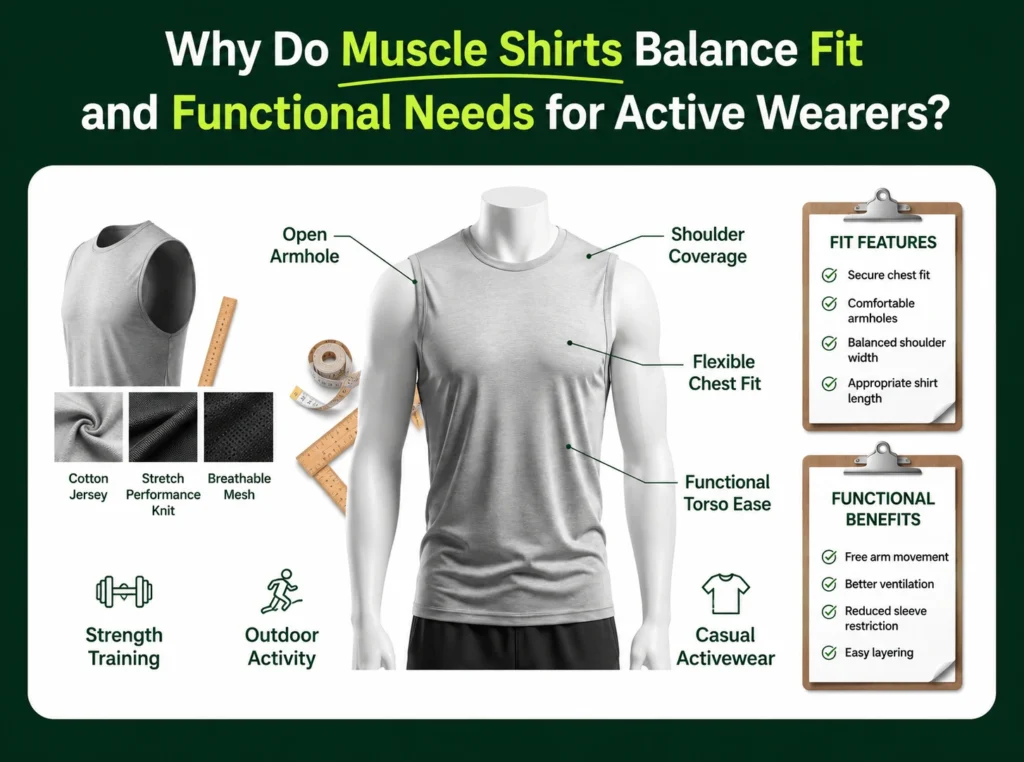
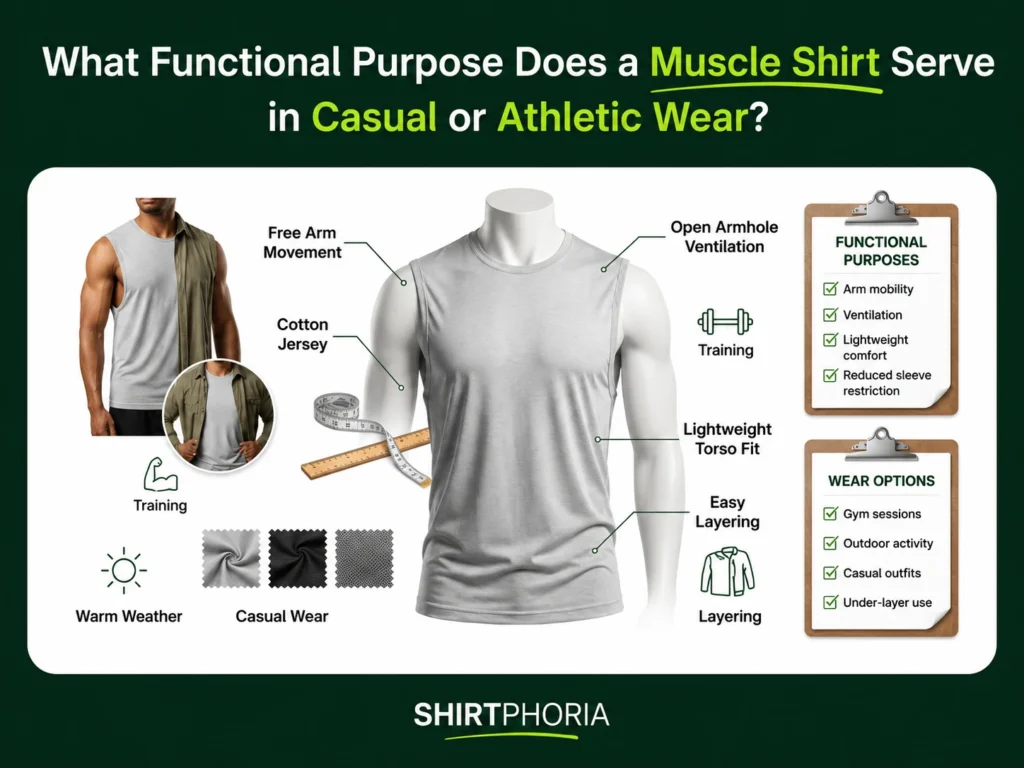
The functional purpose of a muscle shirt is to reduce sleeve-related restriction, increase underarm airflow, support sweat management, and create a low-bulk upper-body garment for casual or athletic wear.
Many people view the muscle shirt mainly as a style garment that exposes the arms and shoulder area. Its practical value, however, comes from how its sleeveless construction changes movement comfort, ventilation, sweat handling, visual form checking, and layering.
The functional purpose of a muscle shirt depends on more than removing the sleeves from a standard T-shirt. Armhole depth, shoulder coverage, torso fit, fabric construction, stretch, climate, activity, and personal coverage preferences all influence how well the garment works.
A muscle shirt also differs slightly from a basic tank top. The terms are sometimes used interchangeably, but a muscle shirt commonly has wider shoulder straps and greater upper-torso coverage than a narrow-strapped tank. Exact naming varies between brands, so the garment’s cut is more useful than its label when judging function.
This guide explains how the functional purpose of a muscle shirt depends on shoulder freedom, armhole openness, sweat evaporation, fabric choice, and use context.
Quick Functional Summary
The Cut: A sleeveless cut can reduce fabric resistance around the upper arm and shoulder.
The Airflow: Open armholes can increase ventilation around the axillary area.
The Sweat Factor: Moisture-wicking fabric can move sweat toward the garment surface, where it has a better opportunity to evaporate.
The Movement Factor: Open shoulder and upper-back designs can reduce fabric bunching during some upper-body movements.
The Layering Factor: A muscle shirt can work as a low-bulk base layer because it avoids sleeve bunching beneath outerwear.
Why Is the Functional Purpose of a Muscle Shirt Important for Performance?
The functional purpose of a muscle shirt is important for performance comfort because the sleeveless cut can reduce fabric resistance around the shoulder, while open armholes can improve ventilation during heat and sweat exposure.
A muscle shirt is not a medical device or a guaranteed athletic enhancer. It does not automatically improve strength, exercise technique, joint mobility, endurance, or injury prevention.
Its practical benefit comes from removing fabric that might otherwise bunch, pull, or retain moisture around the shoulders and underarms. Whether that benefit is noticeable depends on the cut, fit, fabric, activity, climate, and wearer.
Reducing Sleeve-Related Shoulder Restriction
A sleeveless muscle shirt can reduce sleeve-related restriction because there is no sleeve fabric pulling across the upper arm during overhead, forward, or pulling movements.
Sleeve-related resistance may become noticeable when a standard T-shirt has:
A narrow shoulder fit
Tight sleeve openings
Limited fabric stretch
A restrictive shoulder seam
An armhole that does not match the wearer
Excess fabric that bunches during movement
This pulling or bunching may appear during overhead presses, pull-ups, rows, vertical pulls, push exercises, or repeated reaching.
The standard T-shirt itself is not automatically restrictive. A properly fitted standard tee made from flexible fabric may allow comfortable movement. The problem arises when sleeve shape, shoulder width, fabric behavior, and body proportions do not work together.
A muscle shirt does not create athletic mobility by itself, but it can remove one common source of garment resistance: sleeve fabric around the shoulder and upper arm.
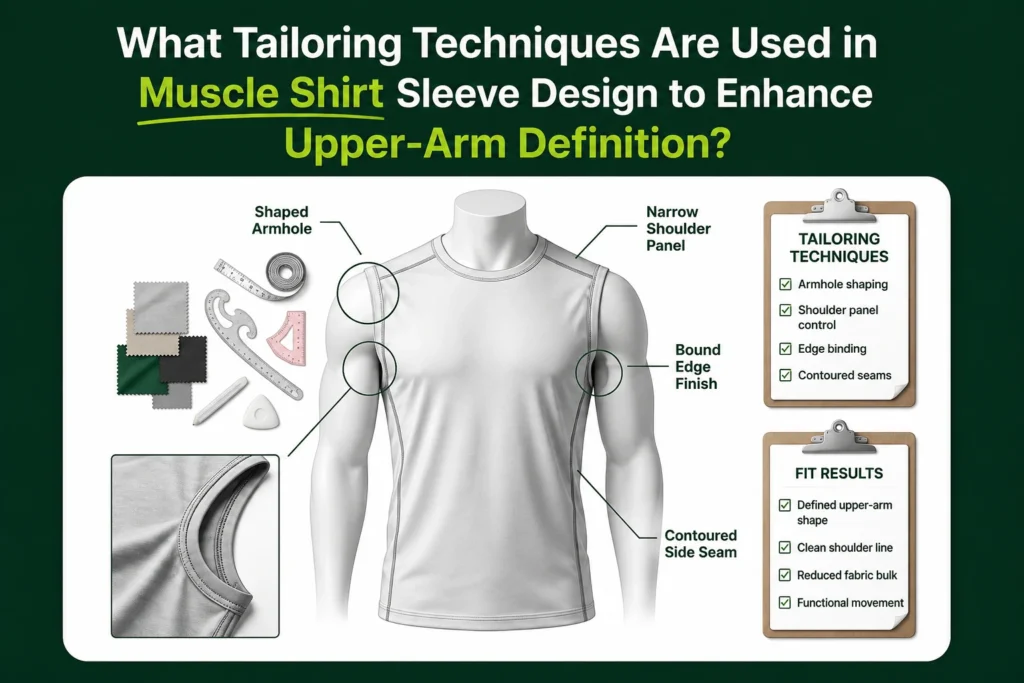
Armhole shape still matters. A deep armhole may provide more openness, but a narrow or badly finished opening can pinch the axillary area. An excessively large opening may shift, reveal more of the torso than intended, or feel unstable during vigorous activity.
Airflow and Sweat Evaporation
Open armholes can support thermal comfort because they expose the axillary area to more airflow and may help sweat evaporate more easily from the skin or fabric surface.
The axillary area is the underarm region, where sweat, friction, and trapped heat can become noticeable during physical activity.
Thermoregulation is the process through which the body balances heat production and heat loss to regulate body temperature. When body temperature rises, sweating is one response that supports heat loss. Sweat evaporation removes heat as liquid water changes into vapor. heat-loss overview explains the role of sweating and evaporation in human heat loss.
A muscle shirt cannot control thermoregulation by itself. Its sleeveless construction may support heat comfort by reducing fabric coverage near a high-sweat area, but actual cooling depends on:
Air temperature
Relative humidity
Air movement
Exercise intensity
Sweat production
Fabric thickness
Fabric moisture behavior
Garment fit
Evaporation becomes less effective when surrounding air is already humid. A muscle shirt may therefore improve ventilation without ensuring that the wearer stays cool or dry.
The same functional logic is expanded in muscle-shirts guide.
What Functional Purpose Does a Muscle Shirt Serve in Athletic Training?
In athletic training, the functional purpose of a muscle shirt is to support movement comfort, sweat management, and visual form checking by reducing sleeve coverage around the shoulders and upper arms.
These potential benefits depend on the garment. A loose cotton muscle shirt, a close-fitting polyester training top, and a deep-cut bodybuilding shirt can behave very differently despite sharing a sleeveless shape.
The garment should therefore be evaluated through its cut, fabric, armhole shape, torso fit, and intended activity rather than through the “muscle shirt” label alone.
Scapular Movement During Training
Deep-cut armholes and racerback-style designs can reduce fabric bunching around the upper back, which may make shoulder-blade movement feel less obstructed during rows, pull-ups, and other back-intensive exercises.
The scapula is the shoulder blade. Scapular protraction describes the shoulder blade moving forward around the rib cage, while scapular retraction describes it moving back toward the spine.
The scapula participates in six principal movements: protraction, retraction, elevation, depression, upward rotation, and downward rotation. These movements contribute to upper-extremity function, as described in scapula anatomy.
Scapular protraction and retraction are body movements, not garment functions. A muscle shirt cannot produce, correct, or fully unlock those movements.
Its role is limited to fabric management. A muscle shirt may feel more comfortable during scapular movement because it removes sleeve or upper-back fabric that can bunch or pull in certain shirt cuts.
Racerback-style construction may expose more of the upper back than a wide-backed muscle shirt. Neither design guarantees better lifting mechanics, greater range of motion, or correct scapular movement.
Visual Form Feedback During Lifts
By exposing more of the shoulder and upper-back area, a muscle shirt can help lifters or coaches visually check posture, shoulder position, and upper-body movement during some exercises.
Visible landmarks may include the:
Shoulder line
Deltoid area
Trapezius area
Upper-back outline
Position of the scapulae
Relationship between the arms and torso
The deltoid and trapezius are used here as visual landmarks. Seeing these areas does not prove that the muscles are working correctly or that exercise technique is safe.
Visible shoulder and upper-back landmarks can make form checking easier, but they do not prove correct technique or muscle activation by themselves.
A mirror may provide a limited front or side view. Video, multiple viewing angles, or feedback from a qualified coach may provide a clearer assessment when technique matters.
What Functional Purpose Does a Muscle Shirt Serve in Casual Environments?
Beyond the gym, the functional purpose of a muscle shirt includes low-bulk base layering and warm-weather wear because the garment covers the torso without adding sleeve fabric around the arms.
Casual muscle shirts commonly provide more moderate armhole depth and greater side coverage than bodybuilding stringers. That balance can make them easier to wear beneath outer layers or as standalone warm-weather tops.
The preferred coverage level depends on personal comfort, climate, setting, activity, and applicable dress expectations.
Low-Bulk Base Layering
A muscle shirt can work as a low-bulk base layer because it provides torso coverage without adding sleeve fabric beneath jackets, sweaters, overshirts, or button-down shirts.
Removing the sleeves can reduce:
Fabric bunching around the upper arms
Overlapping sleeve seams
Bulk inside narrow outer sleeves
Visible inner-sleeve ridges
Pulling caused by misaligned layers
This may help outerwear feel cleaner through the sleeve area, depending on the fit of both garments.
The muscle shirt should still lie smoothly across the torso. Very loose armholes can fold or gather under outerwear, while an excessively tight body can ride upward or create visible tension.
A low-bulk base layer is particularly useful when the wearer wants torso coverage or a barrier between skin and outerwear without adding another complete set of sleeves.
Warm-Weather Comfort and Underarm Ventilation
In warm or humid conditions, a muscle shirt can improve comfort by reducing fabric coverage around the underarm and allowing more direct airflow across the upper body.
A standard T-shirt may retain more moisture around the underarm when its fabric is heavy, close-fitting, absorbent, or slow to dry. This is a possible fabric-and-fit outcome rather than a universal weakness of standard tees.
A lightweight standard T-shirt made from a suitable technical fabric may manage moisture effectively. A heavy muscle shirt may still feel warm despite its sleeveless construction.
Coverage creates another trade-off. A muscle shirt exposes more skin to air, but it also provides less coverage from sunlight and offers less concealment in settings where a standard tee may be more suitable.
The benefit depends on climate, fabric, activity level, and whether the wearer wants more coverage or more ventilation.
How Does Material Selection Influence the Functional Purpose of a Muscle Shirt?
Material selection shapes the functional purpose of a muscle shirt because fabric influences sweat handling, drying behavior, stretch, softness, drape, shape retention, and daily comfort.
Material does not determine performance by itself. Armhole shape, torso fit, seam construction, fabric thickness, activity intensity, and climate also affect the wearer’s experience.
The best fabric is therefore the one that matches the intended use rather than the one with the most technical-sounding fiber label.
Performance Synthetics for Intense Sweat
Performance synthetics can support intense sweat management because polyester-based training fabrics may be constructed to spread moisture and dry more readily than some cotton-heavy casual shirts.
Common synthetic fibers and blends include:
Polyester
Nylon
Elastane
Polyester–elastane blends
Nylon–elastane blends
Synthetic and cotton combinations
Polyester is widely used in active garments, but polyester fiber alone does not prove that a shirt will wick moisture effectively. Yarn construction, knitting method, fabric treatment, thickness, fit, and garment design influence the result.
Elastane primarily contributes stretch and recovery. It may help the garment move with the body, but its presence does not automatically improve sweat transfer or comfort.
Polyester-based performance fabrics can support sweat movement when their structure is designed for wicking, but the result depends on yarn structure, knit construction, treatment, fit, and activity level.
Before choosing a performance muscle shirt, check the manufacturer’s current product information for:
Fiber composition
Moisture-management claims
Mesh or ventilation zones
Fabric stretch
Seam design
Drying instructions
Care requirements
A product labelled “moisture wicking” should still be judged through actual wear because performance can change with climate, sweat volume, garment saturation, laundering, and fit.
How Moisture-Wicking Fabric Supports Sweat Management
Moisture-wicking fabric supports sweat management by moving moisture toward the fabric surface, where evaporation can help the garment feel drier during activity.
Wicking commonly uses capillary action, in which liquid travels through small spaces within yarns and fabric structures. The size and arrangement of these spaces influence how moisture spreads.
The American Chemical Society explains that sweat-wicking materials use capillary action to move liquid through spaces in fabric. Fiber properties, yarn construction, blends, and textile design influence how moisture travels, and cooling still depends on evaporation from the garment surface. wicking guide provides a detailed explanation of these mechanics.
Polyester can be hydrophobic, meaning that the fiber itself has limited attraction to water. That does not mean every polyester fabric wicks efficiently. Fabric geometry, surface treatment, blended fibers, and yarn arrangement can be used to control moisture movement.
Polyester, nylon, elastane blends, and treated fabrics can support moisture movement, but wicking performance depends on fabric construction rather than fiber name alone.
Wicking and evaporation are also different stages:
Sweat reaches the skin or inside of the garment.
Fabric spreads or transports the moisture.
Moisture reaches a larger outer surface area.
Airflow and surrounding conditions allow evaporation.
If the garment becomes saturated or the surrounding air is highly humid, evaporation may slow even when moisture has spread across the fabric.
Cotton and Cotton-Blend Comfort for Casual Wear
Cotton and cotton-blend muscle shirts can be useful for casual wear because they often prioritize softness, familiar hand-feel, opacity, and everyday comfort over rapid drying.
Cotton-rich muscle shirts may suit:
Low-output daily wear
Relaxed indoor use
Warm-weather casual outfits
Base layering
Light training
Wearers who prefer a familiar fabric feel
A cotton-heavy shirt may absorb and retain noticeable moisture during high-sweat activity. It can become heavier, remain damp longer, or cling more closely after absorbing sweat.
A cotton blend may balance different properties. Polyester may alter drying behavior, while elastane may provide stretch. The final result depends on blend percentages, fabric construction, thickness, treatment, and garment fit.
For low-output wear, cotton and cotton-blend muscle shirts may feel softer and more relaxed. For high-output sweating, performance synthetics may dry more readily when the fabric is specifically constructed for moisture transport.
This is a use-case distinction, not a universal ranking. Some wearers may still prefer cotton during exercise, while others may dislike the feel or odor retention of particular synthetic materials.
Scenario Guide
- 🔥 Humid Climate: Choose lightweight, quick-drying synthetics when sweat management and drying speed matter most.
🏋️ Strength Training: Choose a fabric and cut that allow shoulder movement without pulling across the upper back.
🧥 Casual Layering: Choose cotton or cotton-blend muscle shirts when softness and low sleeve bulk matter more than rapid drying.
🏃 High-Output Training: Compare muscle shirts with technical running shirts if the activity requires advanced ventilation zones, reflective details, anti-chafe seams, or sport-specific fabric engineering.
How Does a Muscle Shirt Compare to Other Athletic Tops?
The functional purpose of a muscle shirt differs from that of standard T-shirts and compression tops because it prioritizes sleeve-free airflow and shoulder exposure rather than complete shoulder coverage or compressive fit.
A muscle shirt is usually a simpler casual or athletic garment than a specialized running shirt. A technical running shirt may include reflective elements, mapped ventilation, low-profile seams, sun-related coverage, or sport-specific pattern shaping.
Compare this with running-shirt features for a more engineered performance-shirt breakdown.
Table 1: Performance Matrix — Comparing Muscle Shirts vs. Alternatives
| Feature | Muscle Shirt | Standard T-Shirt | Compression Top |
|---|---|---|---|
| Shoulder Mobility | High sleeve-free comfort when the armhole is cut well | Moderate; depends on sleeve cut, shoulder seam, and fabric stretch | High in stretch-supported designs, but close fit may feel restrictive to some wearers |
| Cooling and Ventilation | High underarm ventilation due to open armholes | Moderate; depends on fabric weight, sleeve fit, and construction | Moderate to high when made from a wicking technical fabric |
| Sweat Management | Depends on fabric; synthetic versions may wick and dry more readily | Depends on fabric; cotton-heavy shirts may retain more moisture | Often activity-specific when designed as technical performance gear |
| Visual Form Checking | Helpful for viewing shoulder and upper-arm movement | Less visible because more fabric covers the shoulder and arm | Body outline may be visible, but the shoulders remain covered |
| Primary Use | Lifting, hot weather, casual wear, and base layering | General fitness and everyday wear | Sport-specific wear, layering, warm- or cold-weather activity, or recovery use depending on product design |
| Coverage | Low arm coverage and moderate torso coverage | Moderate arm and torso coverage | High upper-body coverage with a close fit |
Muscle Shirt vs. Standard T-Shirt
A muscle shirt removes sleeve coverage and often provides more direct underarm ventilation. It may also reduce sleeve-related pulling during shoulder-intensive movement.
A standard T-shirt provides greater arm and shoulder coverage. It can be suitable for a broader range of everyday environments and may offer more protection from direct sunlight.
A well-designed standard tee can still provide comfortable athletic movement. The comparison depends on shoulder width, sleeve circumference, armscye shape, stretch, fabric weight, and intended activity.
Neither option is universally better. Choose the muscle shirt when ventilation and sleeve-free movement are priorities. Choose the standard tee when coverage and everyday versatility matter more.
Muscle Shirt vs. Compression Top
A compression top covers the shoulders and usually the arms while fitting closely against the body. It commonly uses stretch-supported material and may be designed for sport-specific wear, layering, warm conditions, cool conditions, or close-to-skin use.
A muscle shirt creates openness by removing sleeves rather than by stretching tightly over the arms. It often provides greater underarm ventilation but less coverage.
Compression tops are not used only for recovery or cold weather. Their intended functions vary by product design, fabric, sleeve length, climate, and sport.
Wearers who dislike close pressure may prefer the openness of a muscle shirt. Those who want full coverage or a close-fitting base layer may prefer a compression top.
Muscle Shirt vs. Running Shirt
A technical running shirt may be shaped around repetitive arm swing, prolonged sweat exposure, outdoor visibility, and extended wear.
Depending on the product, running-shirt features may include:
Lightweight technical fabric
Reflective details
Mesh ventilation
Low-profile seams
Body-mapped panels
Greater sun coverage
Activity-specific pocket placement
Chafe-reduction construction
A muscle shirt can still be used for running, particularly when underarm ventilation is a priority. It does not automatically include the technical features of a purpose-built running shirt.
The choice should consider distance, climate, sun exposure, visibility, friction risk, coverage preference, and verified product details.
Key Functional Takeaways When Choosing a Muscle Shirt
Choosing the right muscle shirt requires identifying the main functional need—mobility comfort, airflow, sweat management, layering, or casual styling—and matching that need to the correct cut and fabric.
The deepest armholes, tightest torso, or lightest material are not automatically the best options. A functional muscle shirt should provide the required openness without causing pinching, shifting, excessive exposure, friction, or loss of coverage.
User Decision Matrix
| Main Priority | Choose | Avoid or Reconsider |
|---|---|---|
| Shoulder Freedom | Sleeveless cuts with armholes that do not pull across the upper back | Narrow openings that pinch during reaching or overhead movement |
| Airflow | Open armholes and lightweight fabrics that reduce underarm coverage | Heavy fabric that remains warm or saturated during activity |
| Sweat Management | Moisture-wicking synthetics supported by current product information | Choosing by fiber name alone without checking construction |
| Casual Comfort | Softer cotton or cotton-blend shirts with moderate armhole depth | Extreme gym cuts that provide less coverage than the setting requires |
| Base Layering | Smooth, low-bulk cuts that sit beneath outerwear | Loose armholes that fold or bunch under a jacket |
| Sport-Specific Performance | Technical running shirts or compression tops when specialist features matter | Assuming every sleeveless garment provides the same performance |
| Visual Form Checking | Cuts that expose enough of the shoulder and upper back for observation | Treating visibility as proof of correct exercise technique |
If you prioritize shoulder freedom: Choose sleeveless cuts with armholes that do not pull across the upper back.
If you prioritize airflow: Choose open armholes and lightweight fabrics that reduce underarm coverage.
If you prioritize sweat management: Choose moisture-wicking synthetics supported by verified product pages.
If you prioritize casual comfort: Choose softer cotton or cotton-blend muscle shirts with moderate armhole depth.
If you prioritize base layering: Choose low-bulk cuts that sit smoothly beneath jackets, overshirts, or sweaters.
If you prioritize sport-specific performance: Compare the muscle shirt with technical running shirts or compression tops before choosing.
Practical Movement Test
Before buying or keeping the shirt, test it through several movements:
Raise both arms overhead.
Reach both arms forward.
Pull the elbows behind the torso.
Rotate the shoulders slowly.
Simulate a row or pulling movement.
Simulate an overhead press.
Allow the garment to return to rest.
The shirt passes when it moves without harsh pulling, underarm pinching, persistent bunching, severe riding, or unwanted torso exposure.
A small amount of hem movement may be normal. Strong twisting or repeated upward movement suggests that the armhole, torso length, chest fit, or fabric may not suit the wearer.
Practical Airflow and Coverage Test
Stand naturally with both arms lowered.
Check whether:
The armhole remains comfortable.
The opening provides the intended ventilation.
The sides of the torso are not exposed beyond your preference.
The neckline remains stable.
The shoulder straps sit flat.
The shirt does not collapse into large underarm folds.
Then reach forward and overhead. The opening should not shift so dramatically that the garment becomes uncomfortable or unsuitable for its intended setting.
Practical Sweat and Fabric Test
Review the product label and manufacturer description before selecting a muscle shirt for high-output activity.
A suitable training fabric should:
Match the expected sweat level.
Avoid becoming excessively heavy when damp.
Provide sufficient stretch for the activity.
Return close to shape after movement.
Feel comfortable against the skin.
Use seams or binding that do not create immediate irritation.
Remain compatible with the recommended washing and drying method.
A moisture-wicking claim should be treated as garment-specific. Real-world performance may vary with humidity, sweat rate, laundering, garment saturation, and fit.
Final Functional Score
Give the shirt one point for each statement that is true:
The armholes do not pinch.
The upper back does not pull during movement.
The torso does not twist excessively.
The fabric matches the intended sweat level.
The garment provides acceptable side coverage.
The fabric returns close to shape after stretching.
The armhole edges do not rub immediately.
The shirt works beneath the intended outer layer.
The fabric weight suits the climate.
The design fits the intended athletic or casual setting.
8–10 points: Strong functional match.
5–7 points: Usable, but review the warning areas.
0–4 points: The cut, fabric, or coverage probably does not match the intended use.
This score is a practical shopping aid rather than a medical or athletic-performance assessment.
Final Checklist: Choosing the Right Functional Fit
Frequently Asked Questions About Muscle-Shirt Function
No. A muscle shirt may reduce sleeve interference, improve ventilation and make movement easier to observe, but it does not automatically improve strength, technique, endurance, joint mobility or injury prevention.
No. Deeper armholes can increase openness and airflow, but they may also shift, expose more of the torso than intended or feel unstable. The opening should remain comfortable, controlled and suitable for the activity and setting.
No. Polyester fibre alone does not guarantee effective wicking. Moisture transport also depends on yarn structure, knit construction, fabric treatment, thickness, fit and the finished garment design.
Yes, but it may not include the reflective details, anti-chafe seams, mapped ventilation, sun coverage or other features found in a purpose-built running shirt. Distance, climate, visibility and friction risk should guide the choice.
Yes. Its sleeveless shape can reduce sleeve bunching and bulk beneath jackets, sweaters or overshirts. The torso and armholes should still lie smoothly so they do not fold, gather or ride upward under the outer layer.
Terms Explained
| TERM | DEFINITION |
|---|---|
| Muscle Shirt | A sleeveless upper-body garment, usually with wider shoulder coverage than a narrow-strapped tank. |
| Axillary Area | The underarm region where heat, sweat and friction may become noticeable. |
| Thermoregulation | The body’s process of balancing heat production and heat loss. |
| Sweat Evaporation | The change of liquid sweat into vapour, which removes heat when environmental conditions permit. |
| Moisture Wicking | Movement of liquid through yarn and fabric spaces toward a larger surface area. |
| Capillary Action | Liquid movement through small spaces within yarns or fabric structures. |
| Scapular Retraction | Movement of the shoulder blade back toward the spine. |
| Scapular Protraction | Movement of the shoulder blade forward around the rib cage. |
| Racerback | A back shape that exposes more of the shoulder-blade area than a conventional wide-backed top. |
| Compression Top | A close-fitting stretch garment that covers more of the upper body than a muscle shirt. |
| Low-Bulk Layer | A garment designed to provide coverage without adding substantial fabric volume beneath outerwear. |
Conclusion
In conclusion, the muscle shirt serves a functional purpose by reducing sleeve interference, increasing underarm ventilation, supporting sweat management, and offering low-bulk coverage for athletic or casual wear.
Its value comes from the interaction between the sleeveless cut, armhole openness, shoulder visibility, fabric behavior, torso fit, and layering simplicity.
For sweat-heavy training, a deeper-cut muscle shirt made from lightweight, purpose-built synthetic fabric may provide a useful balance of ventilation, drying behavior, and movement comfort.
For casual layering or warm-weather daily wear, a moderately cut cotton or cotton-blend muscle shirt may provide more suitable coverage, softness, and everyday versatility.
Neither option is universally better. The correct garment depends on climate, activity, fabric construction, body proportions, intended coverage, and personal comfort.
A good muscle shirt should match the wearer’s real use case. It should reduce unwanted fabric interference without introducing underarm pinching, excessive exposure, unstable fit, or unsuitable material behavior.
“By understanding the functional purpose of a muscle shirt, wearers can choose a cut and fabric that supports movement, airflow, sweat comfort, and everyday practicality without relying on style alone.”