Why Is Contrast-Colored Collar Trimming a Signature Feature of Ringer Shirt Construction?
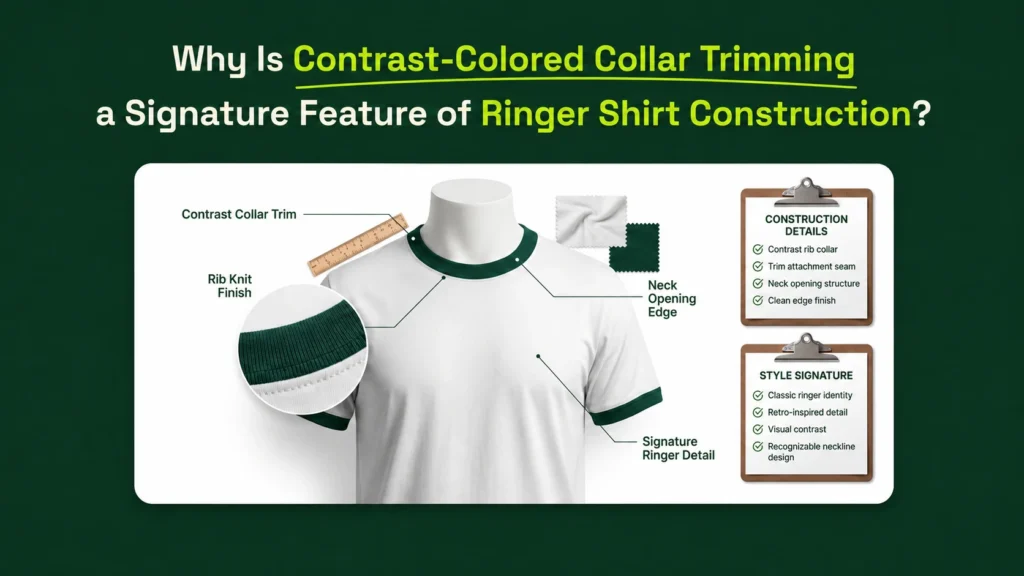
Contrast-colored collar trimming is a signature feature of ringer shirt construction because it defines the shirt’s visual identity while finishing the neckline with ribbed fabric that may support stretch recovery and cleaner edge structure.
Many people recognize a Ringer Shirt by its colored collar and Sleeve Bands, but fewer understand how these bands work as both visual framing and garment-edge finishing. The contrasting trim is not simply decoration. It finishes the neck and sleeve openings while creating the color contrast that separates a ringer shirt from a plain T-shirt.
Merriam-Webster defines a ringer T-shirt as a T-shirt with ribbed fabric in a contrasting color on the collar and sleeves. This means the Contrast Collar and matching sleeve trim are defining features of the design rather than optional additions. (Merriam-Webster)
This guide explains why Contrast-Colored Trimming defines ringer shirts, how Ribbed Binding is attached, how Color-Blocking changes the shirt’s visual identity, and how buyers can evaluate construction quality, fit, and care risks.
Contrast trim does not automatically make a shirt stronger or better than a standard T-shirt. Quality still depends on fabric, rib structure, stitching, seam tension, color stability, comfort, and care.
How Did Contrast Trimming Become Associated with Ringer Shirt Design?
Contrast trimming became associated with ringer shirt design through retro athletic styling and later casual-fashion associations, but exact origin claims should be made only when supported by reliable evidence.
The contrasting collar and sleeve rings resemble the colored edges used in vintage athletic and team-inspired clothing. They give the garment a sporty appearance even when the shirt is intended only for casual wear.
The same trim later became closely linked with graphic T-shirts, music-inspired clothing, retro youth style, and relaxed outfits associated with the late 1960s and 1970s.
How Should the Athletic-Origin Claim Be Handled?
The athletic-origin claim should be handled cautiously because ringer shirts have a retro athletic look, but a precise 1950s team-sports origin requires direct historical sourcing.
Contrast collars and Sleeve Bands can resemble vintage sportswear trim. Color combinations such as cream with green, white with navy, or grey with burgundy may suggest collegiate, varsity, or team-inspired clothing.
However, this resemblance does not prove that all ringer shirts were originally created as athletic training garments. It would be inaccurate to state that their contrast bands were designed for player identification, sports drills, or high-contact activity without reliable documentation.
Ringer shirts are often read as athletic-inspired because their contrast collar and sleeve bands resemble retro sportswear trim, but a precise origin story should not be invented.
The relationship should be understood as:
Contrast trim → retro athletic signal → historical claim must remain source-supported.
How Did Ringer Shirts Become Associated with 1960s and 1970s Casual Culture?
Ringer shirts became strongly associated with 1960s and 1970s casual culture because their high-contrast trim and simple T-shirt body suited the graphic, relaxed, and youth-oriented styling of the period.
Ringer shirts are commonly linked with vintage casualwear, band-tee aesthetics, countercultural fashion, and retro youth clothing. Modern fashion coverage also connects their revival with renewed interest in the clothing styles of the 1960s and 1970s. (GQ)
The contrast rings made a basic T-shirt more visually distinctive without requiring complicated construction. When combined with printed graphics, slogans, music references, or washed fabrics, the trim helped create a recognizable casual style.
This does not mean that all ringer shirts carried the same cultural meaning. Their appearance depended on the graphic, fit, colors, wearer, and outfit context.
The styling relationship can be summarized as:
Retro trim → casual counterculture association → recognizable ringer Silhouette.
How Does Contrast-Colored Trimming Work Structurally in Ringer Shirts?
Contrast-colored trimming works structurally in ringer shirts by using Ribbed Binding to finish the neckline and sleeve openings while adding a visibly different color at the garment edges.
The main shirt body is generally cut from cotton jersey, a cotton blend, or another knit fabric suitable for T-shirt construction. Separate pieces of rib trim are then prepared for the collar and sleeve openings.
The binding must be attached with controlled stretch and balanced seam tension. If it is stretched too much during sewing, it may pull the surrounding fabric into gathers. If it is too loose, it may wave, stand away from the body, or lose its clean shape.
Twin-Needle Topstitching refers to two parallel rows of stitching made together. This method may be used to secure hems, bindings, and knitwear edges, but it is not required in every ringer shirt.
Other construction methods may include single-needle stitching, coverstitching, overlocking, or a combination of different seam finishes.
From Fabric to Frame: The Construction Flow
Jersey Pattern Cutting: The shirt body and sleeves are cut from jersey or another appropriate T-shirt fabric.
Ribbed Binding Preparation: The contrast rib trim is cut for the neckline and sleeve edges.
Binding Alignment: The trim is aligned with the raw neck or sleeve opening.
Controlled Attachment: The binding is sewn using suitable stretch and seam tension so the finished edge lies flat.
Topstitching or Finishing: Additional stitching may secure the trim and help control rolling, puckering, or loose seam allowances.
The relationship between the trim length and the garment opening affects the final result. Binding that is too short may pull the opening inward. Binding that is too long may become loose or wavy.
How Does Ribbed Binding Affect Ringer Shirt Edge Recovery?
Ribbed binding can affect ringer shirt edge recovery because rib-knit structures generally stretch and recover more effectively than many flat jersey edges.
Rib knit contains vertical columns that allow the fabric to expand across its width. This makes it suitable for openings that must stretch during dressing and movement, including collars, cuffs, waistbands, and Sleeve Bands.
On a ringer shirt, the collar must expand when the garment passes over the head. The sleeve rings may also stretch as the wearer moves the arms through them.
Ribbed Binding can support this movement, but it does not prevent stretching permanently. Neckline Recovery depends on:
- Fiber composition
- Rib-knit structure
- Knit density
- Binding width
- Seam tension
- Stitching quality
- Frequency of wear
- Washing and drying conditions
A weak or loose rib may remain stretched after wear. A rib that is too firm may recover well but feel uncomfortable or distort the shirt body.
Binding Quality Checklist
✅ Rib Density: Check whether the trim feels stable enough to recover after gentle stretching.
✅ Stretch Recovery: Stretch the trim lightly and check whether it returns close to its original form.
✅ Seam Alignment: Look for a smooth transition between the main fabric and the trim.
✅ No Puckering: Avoid collars and Sleeve Bands that already show ripples before washing.
✅ Comfort: Make sure the sleeve trim does not pinch or restrict the upper arm.
These checks provide useful shopping guidance, but they cannot guarantee long-term performance.
How Can Stitching Quality Be Identified in Ringer Shirt Trimming?
Stitching quality in ringer shirt trimming can be identified by checking whether the trim lies flat, the seam is secure, and the inside edges are finished cleanly.
The stitching should follow the collar or sleeve opening consistently. Skipped stitches, loose thread, uneven rows, or sudden changes in seam width may indicate weaker construction.
An Overlock Interior uses loops of thread to finish or secure the raw fabric edges inside the shirt. This type of finish may help control loose threads and keep the seam allowance organized.
However, overlocking alone does not prove that a shirt is well made. The stitching must still be balanced, secure, and comfortable.
Stitching Evaluation Points
✅ Twin-Needle Topstitching: Look for two clean parallel stitch rows when this method is used.
✅ Overlock Interior: Check whether the interior edge is enclosed or finished without excessive loose thread.
✅ Tension Balance: The trim and body fabric should lie flat without severe puckering or waving.
✅ Thread Security: Avoid loose stitches, broken thread, skipped sections, or visibly uneven tension.
✅ Comfort Check: Interior stitching should not scratch the neck or upper arm.
The construction relationship is:
Jersey body + Ribbed Binding → balanced seam tension → cleaner edge structure.
Why Do Contrast Colors Shape the Visual Impact of Ringer Shirts?
Contrast colors shape the visual impact of ringer shirts because the collar and Sleeve Bands create color-blocked edge lines that attract attention to the neckline and arms.
Color-Blocking means placing visibly different colors next to one another within a garment. On a ringer shirt, the body forms the largest color area, while the collar and sleeve rings create smaller contrasting areas.
A stronger difference between the body and trim generally makes the rings more noticeable. A white shirt with black trim creates a stronger visual break than a charcoal shirt with black trim.
This effect is visual rather than anatomical. Contrast trim does not physically change the wearer’s jaw, shoulders, arms, or chest. It changes the visual focus of the garment.
How Does the “Frame” Effect Affect Ringer Shirt Silhouette?
The “frame” effect affects ringer shirt Silhouette by making the collar and sleeve edges more visually noticeable than they are on a plain T-shirt.
The frame effect is a styling phrase. It describes the way the contrasting bands outline the shirt openings.
✅ Neckline Framing: A high-contrast collar can draw attention to the neck opening and make the upper shirt area look more defined.
✅ Sleeve Framing: Contrast Sleeve Bands can draw attention to sleeve length, arm position, and the upper part of the shirt.
The strength of this effect depends on the trim width, fit, color difference, and seam quality.
A collar that sits flat usually creates a cleaner visual line than one that twists or ripples. Sleeve rings that lie comfortably around the arm may look more deliberate than bands that pinch or flare outward.
The frame effect may support an athletic-inspired appearance, but it does not guarantee a particular body shape.
How Should Color Theory Be Applied to Ringer Shirt Construction?
Color theory should be applied to ringer shirt construction by matching the trim contrast with the intended style mood, outfit setting, and desired visual emphasis.
Certain color combinations are often associated with particular styling directions.
🎨 Vintage Varsity: A white or cream body with navy, red, green, or burgundy trim creates a strong retro-sport signal.
🎨 Counterculture-Inspired: A yellow, faded, cream, or graphic body with dark trim can support a bolder 1970s-inspired look.
🎨 Modern Minimalist: Grey, charcoal, navy, or black bodies with tonal trim create a quieter contemporary effect.
🎨 Soft Casual: A cream body with olive, brown, rust, or muted trim produces a softer everyday style.
A bold ringer shirt often works best when the rest of the outfit remains simple. A tonal version may be easier to combine with patterned trousers, layered jackets, or stronger accessories.
The design relationship is:
Color-Blocking → changes visual weight → shapes ringer shirt styling mood.
How Do Ringer Shirts Compare to Standard T-Shirt Silhouettes?
Ringer shirts compare to standard T-shirt silhouettes by adding contrast trim to the collar and sleeve edges, while standard T-shirts usually keep those areas matching or less visually emphasized.
| Feature | Ringer Shirt | Standard T-Shirt | Pocket Tee |
|---|---|---|---|
| Collar Construction | Contrast Ribbed Binding | Matching rib, self-fabric, or subtle collar finish | Usually matching rib or standard collar finish |
| Sleeve Edge | Contrast Sleeve Band | Open hem, folded hem, or matching trim | Open hem, folded hem, or matching trim |
| Visual Focus | Stronger focus on neckline and sleeve edges | Quieter and more neutral edge definition | Focus may shift toward the chest pocket |
| Aesthetic Vibe | Retro, athletic-inspired, graphic, casual | Basic, minimalist, casual, or adaptable | Workwear-inspired, casual, utility-oriented |
| Durability | Depends on rib quality, stitching, fabric, and care | Depends on fabric, stitching, collar construction, and care | Depends on fabric, pocket stitching, collar construction, and care |
| Main Risk | Contrast may look too loud, tight, or costume-like | May look plain or less distinctive | Pocket may sag, distort, or affect drape |
None of these shirt constructions is automatically better.
A ringer shirt may suit outfits that need stronger visual emphasis around the neck and sleeves. A standard T-shirt may work better as a quiet base beneath a jacket or patterned overshirt.
A Pocket Tee creates visual focus through its chest pocket rather than through contrast trim.
The correct choice depends on style goals, fabric, construction quality, fit, comfort, and care.
What Are the Key Quality Markers in Ringer Shirt Construction?
Key quality markers in ringer shirt construction include trim recovery, seam flatness, fabric weight, color stability, stitching quality, and comfort around the neck and arms.
Contrast color alone is not proof of quality. A visually attractive shirt may still have weak rib recovery, poor stitching, unstable dye, an uncomfortable collar, or uneven seam tension.
The main shirt body may be made from cotton jersey, a cotton blend, synthetic fibers, or another knit fabric.
Combed Cotton is cotton that has been processed to remove shorter fibers and align the remaining fibers more consistently. It may create a smoother fabric, but it does not guarantee excellent garment construction.
The rib trim may contain cotton, polyester, Elastane, Spandex, or a mixture of fibers. The body fabric and trim can have different compositions.
A shirt body may be labelled 100% cotton while its separate rib trim contains Elastane. However, the same fabric cannot accurately be described as both 100% cotton and five per cent elastane.
How Should Fabric Weight and Elastane Content Be Evaluated?
Fabric weight and elastane content should be evaluated as context clues, not as universal proof of premium ringer shirt quality.
GSM means grams per square meter. It describes fabric weight by measuring how much one square meter of the material weighs.
A higher GSM generally indicates heavier fabric, while a lower GSM indicates lighter fabric. However, GSM does not independently measure softness, breathability, durability, stitching quality, or comfort.
A midweight shirt may produce a more structured drape. A lightweight shirt may feel softer, cooler, or more similar to a vintage tee.
Neither option is automatically superior. Climate, layering needs, and styling purpose should guide the choice.
Elastane and Spandex refer to the same general type of stretch fiber. They may be included in Ribbed Binding to support recovery, but not every quality ringer shirt contains them.
A cotton rib may perform well without Elastane, while a poorly made elasticated rib may still twist, stretch, or feel uncomfortable.
Instead of treating one GSM or elastane percentage as a gold standard, evaluate whether the body fabric suits the intended style and whether the trim returns close to shape after gentle stretching.
The stronger quality relationship is:
Fabric weight + rib recovery + seam quality → better quality signal than GSM alone.
How Can the “Snap Test” Evaluate Ringer Shirt Cuffs?
The “Snap Test” can evaluate ringer shirt cuffs by checking whether the Sleeve Band returns close to its original shape after a gentle stretch.
This is a practical shopping test, not a laboratory textile test. It cannot confirm how the trim will perform after months of wear.
Use this process:
Gently stretch the Sleeve Band outward.
Release it without overstretching the fabric.
Check whether the band returns close to its original shape.
Look for ripples, distortion, puckering, or loose stitching.
Avoid shirts where the trim remains stretched or feels uncomfortable.
The trim does not need to snap back instantly or perfectly. Recovery speed varies by fiber content and knit structure.
Do not assume that the trim contains Spandex unless the label confirms it.
The practical relationship is:
Gentle stretch → recovery observation → practical trim-quality signal.
How Should Ringer Shirts Be Cared for to Protect Contrast Trimming?
Ringer shirts should be cared for by reducing heat, friction, and color-transfer risk so the Contrast Collar and Sleeve Bands remain cleaner over time.
The garment’s care label should control the final washing and drying decisions because fibers, dyes, prints, and finishes vary.
Cold water may help reduce shrinkage and Dye Transfer risk. High washing temperatures, strong agitation, and high dryer heat may increase distortion or shrinkage in susceptible materials.
Dark trim does not always bleed into a lighter shirt body. Dye Transfer depends on dye quality, fiber content, washing temperature, detergent, garment age, and other items in the wash.
Ringer Shirt Care Checklist
✅ Follow the care label: Use the garment’s washing, drying, ironing, and bleaching instructions.
✅ Wash cold when unsure: Cold water may reduce shrinkage and color-transfer risk when the label permits it.
✅ Wash inside out: Turning the shirt inside out can reduce direct abrasion on the trim, body fabric, and printed graphics.
✅ Separate strong colors: Wash dark or highly saturated trim with similar colors during the first few washes.
✅ Avoid high heat: High dryer temperatures can increase shrinkage risk and may damage elastic fibers when present.
✅ Air dry or use low heat: Gentler drying may help preserve fabric dimensions and rib recovery.
✅ Check after the first wash: Inspect the collar and Sleeve Bands for Dye Transfer, rippling, twisting, or distortion.
Avoid hanging a heavily soaked shirt from the collar because the water weight may pull on the neckline.
The shirt should not be twisted aggressively during washing or drying. Strong wringing may place uneven pressure on the trim and seams.
When Can Contrast-Colored Trimming Fail in Ringer Shirts?
Contrast-colored trimming can fail in ringer shirts when the trim, stitching, color, or fabric does not work with the shirt body.
| Intended Benefit | Possible Failure Mode | Correction |
|---|---|---|
| Strong visual frame | Contrast looks too loud or costume-like | Choose tonal or muted trim |
| Better edge recovery | Rib trim stretches out or waves | Check trim recovery before buying |
| Clean neckline | Collar ripples, twists, or “bacons” | Select better rib quality and wash gently |
| Sleeve definition | Sleeve Band pinches the upper arm | Choose softer ribbing or a roomier sleeve |
| Construction durability | Stitches skip, loosen, or pucker | Inspect seam tension and inside finishing |
| Color contrast | Dark trim transfers dye to a light body | Wash cold, separate colors, and follow the label |
| Structured drape | GSM feels too heavy or stiff | Match fabric weight to climate and outfit use |
| Stretch recovery | Elastane loses recovery if overheated | Avoid high dryer heat and follow the label |
A strong contrast may look attractive on the shirt by itself but feel excessive when combined with a large graphic, patterned trousers, bright shoes, and several accessories.
Trim can also be poorly proportioned. A very wide collar may dominate the neckline, while an extremely narrow ring may provide little visual separation.
Poor seam tension can cause the collar to wave or pull the shirt body into gathers.
Dye Transfer may be more visible when dark trim is attached to a pale body, but it is not guaranteed to happen.
The success of contrast-colored trimming depends on balance: rib quality, seam tension, fabric weight, dye stability, fit, and care must work together.
Final Ringer Shirt Buying Checklist
Evaluating a ringer shirt requires checking whether the contrast trim looks intentional, feels comfortable, and is sewn cleanly into the shirt body.
Before buying, place the shirt on a flat surface and compare the two sleeves. The Sleeve Bands should be similar in width, and the collar should appear centered.
When trying it on, move both arms forward and overhead. The sleeve rings should remain comfortable, and the neckline should return close to its normal position.