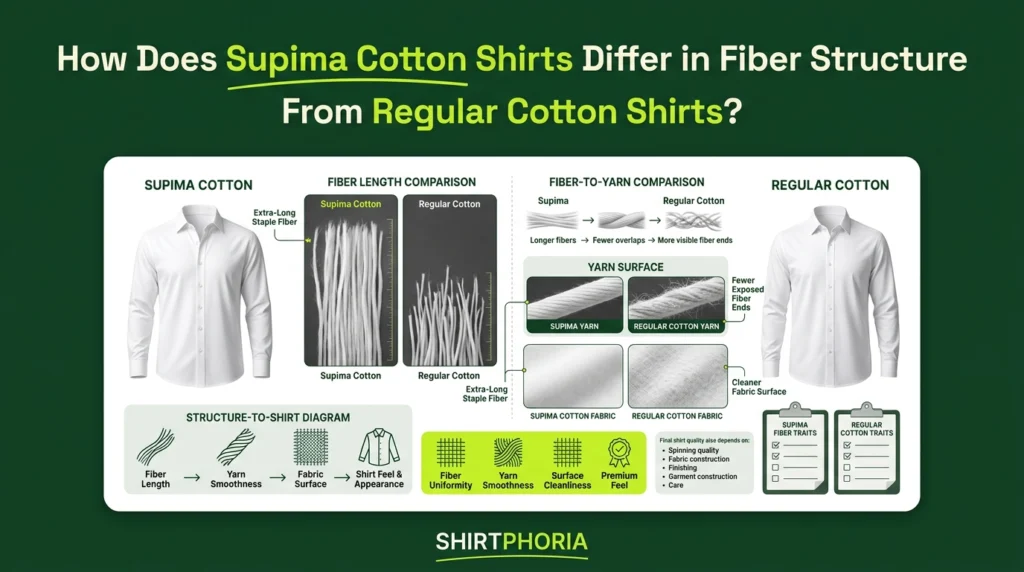
How does Supima Cotton Shirts differ in fiber structure from regular Cotton Shirts?
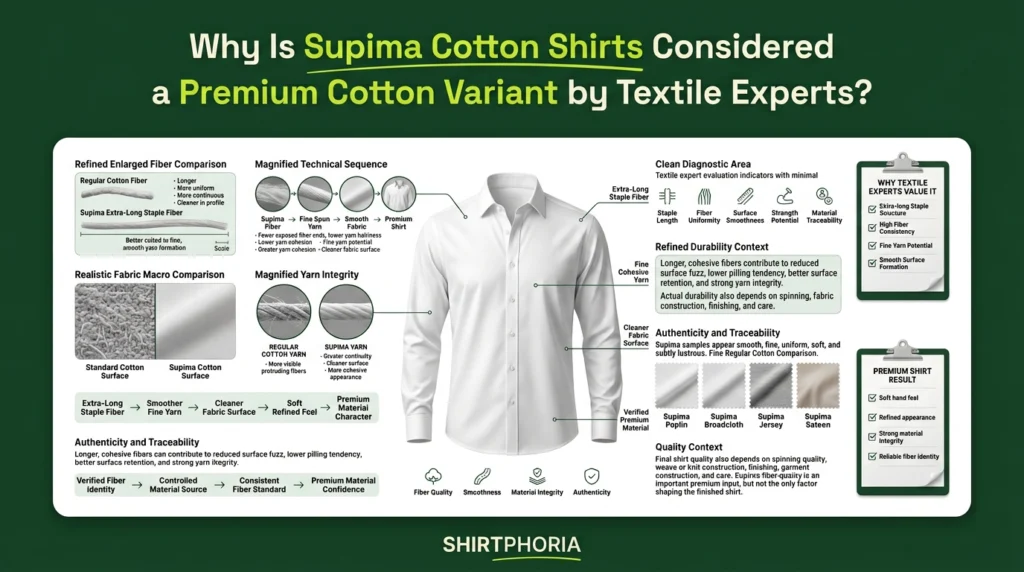
Supima cotton shirts differ from typical regular/Upland cotton shirts primarily because Supima uses American-grown extra-long-staple Pima cotton, providing a more tightly defined fiber foundation that can support greater yarn cohesion, cleaner surfaces, and refined textile performance when manufacturing preserves those advantages.
The structural comparison begins with cotton fiber properties, not shirt silhouette, fit, pattern cutting, or styling.
Four fiber-level characteristics are especially important:
- staple length;
- fiber fineness;
- fiber strength; and
- fiber-length uniformity.
These properties influence what happens during spinning and yarn formation. Their effects can then move into the fabric and, eventually, the finished shirt.
The correct structural sequence is:
Fiber Structure → Spinning Behavior → Yarn Structure → Fabric Characteristics → Finished Shirt
Fiber-end opportunity is also important, but it should not be confused with a standardized cotton-classification property. It is mainly a downstream structural consequence of fiber length and yarn formation.
The central limitation is equally important:
Supima’s fiber architecture creates premium material potential; manufacturing determines how much of that potential reaches the finished shirt.
This guide explains how Supima differs structurally from typical regular/Upland cotton, how measurable fiber properties influence spinning and yarn formation, how those effects can appear in finished shirt fabrics, and which manufacturing factors can preserve, hide, or override the raw-fiber advantage.
What Structurally Defines Supima Cotton Compared With Regular Cotton?
Supima cotton is structurally defined by its use of American-grown extra-long-staple Pima cotton, while “regular cotton” in this comparison refers primarily to the broader and more variable category of typical Upland cotton.
Two ideas must be separated:
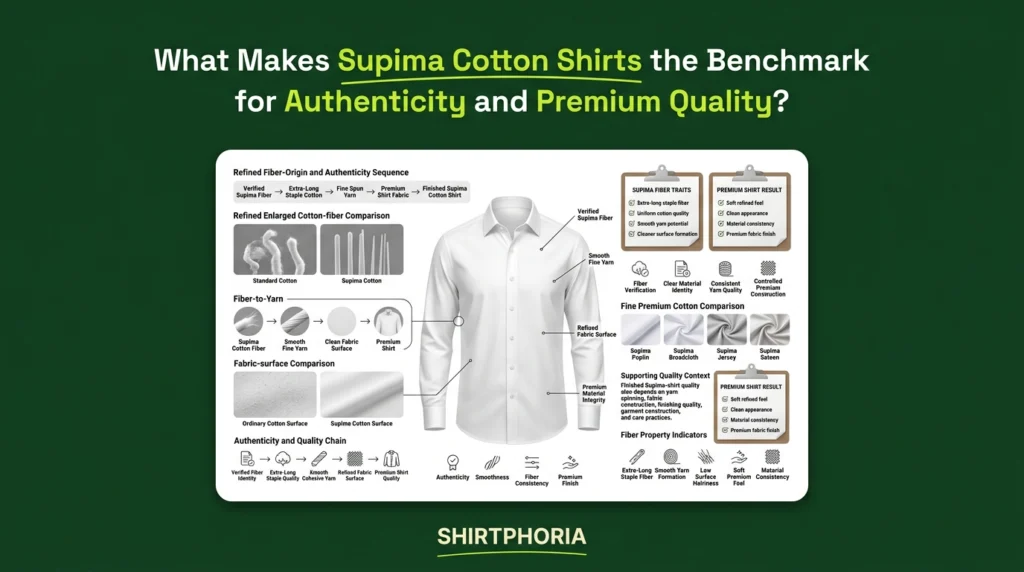
SUPIMA® identity = commercial and provenance framework
while:
ELS classification = physical fiber-length category
SUPIMA® identifies a controlled commercial cotton identity. Extra-long staple, or ELS, describes a physical fiber-length classification.
They are related, but they are not interchangeable.
What Fiber Category Does Supima Cotton Belong To?
Supima cotton belongs to American-grown Pima cotton and is marketed as an extra-long-staple cotton, making fiber length a central structural feature of the material.
Extra-long staple refers to a fiber-length category.
It describes a measurable characteristic of the cotton fiber rather than a brand name, fabric construction, or finished-shirt property.
The structural relationship is:
Supima Cotton → Uses → American-Grown ELS Pima Cotton
The SUPIMA® trademark itself does not physically make cotton fibers longer. Instead, the trademark identifies cotton within a controlled commercial and provenance framework built around American-grown Pima cotton.
What Does “Regular Cotton” Mean in This Comparison?
“Regular cotton” refers here primarily to typical Upland cotton, a broad category containing many varieties, grades, and measurable fiber-quality levels rather than one structurally uniform material.
Upland cotton can vary in:
- fiber length;
- fiber-length uniformity;
- fiber strength;
- maturity;
- micronaire;
- growing conditions;
- cotton grade; and
- processing quality.
For that reason, the comparison should not be reduced to:
Supima = good
and:
Regular cotton = bad
High-quality Upland cotton can produce excellent textiles when suitable raw material is combined with controlled spinning, fabric construction, and finishing.
The important distinction is that Supima begins with a more tightly defined ELS Pima fiber foundation, while Upland cotton represents a broader range of measurable fiber characteristics.
Why Is Staple Classification the Logical Starting Point?
Staple classification is the logical starting point because fiber length influences spinning possibilities, yarn structure, and the number of fiber segments required across a given yarn distance.
The causal sequence is:
Staple Classification → Measured Fiber Length → Spinning Possibilities → Yarn Structure
Fiber length therefore influences yarn-formation potential.
It does not independently guarantee softness, strength, durability, or premium finished-shirt quality.
How Does Fiber Length Differ Between Supima Cotton and Regular Cotton Shirts?
Supima uses extra-long-staple cotton fibers, while typical Upland cotton generally occupies shorter fiber-length ranges, creating different structural opportunities during spinning and yarn formation.
Fiber length is one of the most important measurable differences because it affects how individual fibers interact inside a yarn.
Cotton classification can express fiber length through measurements such as upper-half mean length.
Interpretive categories classify upper-half mean length approximately as:
| Upper-Half Mean Length | Interpretation |
|---|---|
| Below 0.99 in | Short |
| 0.99–1.10 in | Medium |
| 1.11–1.26 in | Long |
| Above 1.26 in | Extra long |
These categories describe a raw-fiber property.
They do not mean that every fabric made from extra-long-staple cotton is automatically softer, stronger, more durable, or better manufactured.
What Does Staple Length Measure in Cotton Fibers?
Staple length describes the length of cotton fibers, while instrument-based cotton classification commonly expresses fiber length through measurements such as upper-half mean length.
Measurements at different textile levels should not be confused:
Fiber length = raw-fiber property
Yarn count = yarn property
Fabric weight = fabric property
A fine yarn does not by itself prove that the cotton fibers were extra long.
Likewise, a lightweight fabric does not reveal the cotton’s staple length.
Why Is Supima Classified as Extra-Long Staple?
Supima is categorized as extra-long staple because the American Pima cotton used under the SUPIMA® identity belongs to the ELS class rather than the fiber-length profile generally associated with typical Upland cotton.
This does not mean every individual Supima fiber has exactly the same physical length.
Cotton is a natural agricultural material, so measurable variation exists within samples.
The relevant distinction is the overall fiber class and structural profile.
How Does Longer Supima Fiber Increase Overlap Potential Inside Yarn?
Longer Supima fibers can increase overlap potential because each fiber can maintain contact with neighboring fibers across a greater distance during yarn formation.
The mechanism is:
Longer Fiber → Greater Potential Contact Distance → Favorable Conditions for Cohesion
A longer fiber can extend through a greater portion of the yarn structure before reaching its end.
This provides more opportunity for contact and interaction with neighboring fibers.
Suitable spinning and twist can then convert that contact potential into a cohesive yarn structure.
However, overlap potential is a mechanistic textile relationship, not a direct cotton-classing measurement.
It also should not automatically be translated into a longer shirt lifespan.
Why Can Shorter Regular Cotton Fibers Require More Fiber Segments Across the Same Yarn Length?
Shorter fibers require more individual fiber segments to span a comparable yarn distance, increasing the structural opportunities for fiber ends within and near the yarn surface.
The structural tendency is:
Shorter Fiber → More Segments Required → Greater Fiber-End Opportunity
If fibers are longer, fewer individual segments may be needed across an equivalent yarn distance.
When fibers are shorter, more segments may be necessary.
Every additional segment creates additional fiber ends.
Some remain controlled within the yarn, while others can occur closer to the surface.
This does not mean every Upland yarn is fuzzy.
Carding, combing, spinning method, yarn twist, yarn count, cotton selection, and process control can substantially alter the final result.
The boundary remains:
Fiber length establishes processing potential; yarn engineering and manufacturing determine its final expression.
How Does Fiber Fineness Differ Between Supima Cotton and Regular Cotton?
Fiber fineness describes the mass or relative thickness of individual cotton fibers, while Supima’s premium fiber profile can support refined yarn structures when fineness is combined with adequate length, strength, maturity, and controlled spinning.
Fineness must remain separate from both yarn fineness and micronaire.
What Does Fiber Fineness Mean in Supima Cotton?
Fiber fineness describes the physical fineness of individual cotton fibers rather than the linear density of the finished yarn.
Three concepts need to be separated:
Fiber fineness describes an individual fiber characteristic.
Yarn fineness describes the resulting yarn.
Micronaire is influenced by both cotton fiber fineness and maturity.
Therefore:
Fiber fineness ≠ yarn fineness
and:
Micronaire ≠ pure fiber fineness
Micronaire should not be treated as though it measures physical fiber thickness alone.
How Can Fine Supima Fibers Support More Refined Yarn?
Fine fibers can support refined yarn structures when sufficient length, strength, maturity, and spinning control allow those fibers to be processed effectively.
The better model is:
Fineness + Length + Strength + Maturity + Processing → Refined Yarn Potential
Fineness can contribute to refined spinning because suitable fine fibers can be organized into controlled yarn structures.
However, fineness works as part of a larger fiber system.
The relationship is:
Fiber Fineness → Contributes To → Yarn Refinement Potential
It does not independently guarantee softness.
Why Does Typical Regular Cotton Show Wider Variation in Fiber Fineness?
Upland cotton can display substantial variation because cultivar, maturity, growing conditions, grade, and processing history influence the raw material.
The important point is variation.
It would be inaccurate to assume that every Upland cotton sample must be coarser than every Supima sample without direct measurement.
Two Upland cotton lots can have materially different fiber characteristics.
Why Must Fineness Be Evaluated Together With Strength?
Fine fibers are most useful for refined spinning when they also possess sufficient structural strength and maturity to tolerate textile processing.
Different properties serve different functions:
Fineness → Refinement Potential
Strength → Break-Resistance Input
Maturity → Processing and Structural Context
Finished softness belongs to a later system:
Fiber + Yarn + Fabric + Finishing → Finished Hand Feel
How Does Fiber Strength Differ Between Supima Cotton and Regular Cotton?
Fiber strength measures resistance to breaking at the raw-material level and contributes to yarn-strength potential, but it cannot by itself determine the durability or lifespan of a finished shirt.
The structural chain is:
Fiber Strength → Yarn-Strength Potential → Fabric Performance Potential → Garment Outcome
Cotton fiber strength can be reported in grams per tex.
Interpretive categories include:
| Fiber Strength | Interpretation |
|---|---|
| 23 g/tex and below | Weak |
| 24–25 g/tex | Intermediate |
| 26–28 g/tex | Average |
| 29–30 g/tex | Strong |
| 31 g/tex and above | Very strong |
These classifications apply to raw-fiber measurements.
They are not finished-shirt lifespan categories.
What Does Cotton Fiber Strength Measure?
Cotton fiber strength measures the force required to break a standardized bundle of fibers and is commonly expressed in grams per tex.
It is a fiber-level measurement.
It should not be directly equated with:
- seam strength;
- fabric tear strength;
- abrasion resistance;
- garment lifespan; or
- overall shirt durability.
Those outcomes involve additional textile levels.
How Does Supima Fiber Strength Complement Extra-Long Staple Length?
Fiber length and strength contribute through different mechanisms.
Length → Overlap Potential
Strength → Break Resistance
Together:
Length + Strength → Favorable Conditions for Yarn Integrity
Long fiber does not replace the need for strength.
Likewise, high strength does not replace the structural benefits of sufficient fiber length.
Why Does Regular Cotton Fiber Strength Vary?
Upland cotton strength varies because genetics, maturity, growing conditions, harvesting, ginning, grade, and cotton selection affect measurable raw-fiber quality.
Upland should therefore be viewed as variable, not inherently weak.
Some Upland cotton samples can provide strong material inputs for yarn production.
How Can Fine and Strong Supima Fibers Support Refined Yet Structurally Capable Yarn?
Fine fibers combined with sufficient strength can support refined yarn designs while retaining the raw-material capability needed to tolerate spinning stresses.
But:
fine + strong ≠ guaranteed longer-lasting shirt
Fiber strength remains one material input.
Garment lifespan is the outcome of an entire textile system.
How Does Fiber Uniformity Distinguish Supima Cotton From Regular Cotton?
Fiber uniformity describes the consistency of fiber-length distribution within a cotton sample and must be evaluated separately from average fiber length.
Two cotton samples can have similar average length but different levels of variation.
Cotton classification expresses this through a length uniformity index.
Interpretive categories include:
| Length Uniformity Index | Interpretation |
|---|---|
| Below 77 | Very low |
| 77–79 | Low |
| 80–82 | Average |
| 83–85 | High |
| Above 85 | Very high |
These values classify consistency at the fiber level.
They do not guarantee premium finished fabric.
What Does Cotton Fiber Uniformity Measure?
Cotton fiber uniformity indicates how consistently fiber lengths are distributed within a sample and helps reveal variation between longer and shorter fibers.
Two samples could have similar average fiber lengths.
One might contain fibers clustered relatively closely around that average, while another could contain a much wider mixture of lengths.
That distinction matters during processing.
How Can More Consistent Fiber Lengths Support Controlled Yarn Formation?
Greater length uniformity can support more predictable spinning behavior by reducing extreme variation in how fibers align and move through yarn formation.
The relationship is:
Higher Uniformity → More Predictable Fiber Distribution → More Even Yarn Potential
More consistent raw material can be easier to manage during spinning.
But yarn evenness still depends on preparation and process control.
How Can Lower Uniformity Affect Yarn Structure?
Lower length uniformity can indicate greater short-fiber variation and can contribute to less predictable yarn evenness, strength, and surface behavior.
The correct wording is can contribute.
Modern preparation and spinning can compensate for some fiber variation.
Why Should Uniformity Always Be Interpreted Alongside Staple Length?
Fiber length identifies the general length profile.
Uniformity identifies how consistently fibers conform to that profile.
A useful distinction is:
Length = how long?
Uniformity = how consistent?
Neither measurement independently determines finished-shirt quality.
How Do Supima Cotton Fibers Create Fewer Protruding Ends Than Typical Regular Cotton?
Longer Supima fibers can reduce the number of fiber segments required across a given yarn distance, lowering the structural opportunity for fiber ends to occur near the yarn surface.
The mechanism is:
Longer Fiber → Fewer Segments Required → Lower Fiber-End Opportunity
Fiber-end opportunity is a mechanistic concept.
It is not a standardized cotton-classing variable.
Why Does Fiber-Segment Frequency Matter Inside Yarn?
Each additional fiber segment introduces fiber ends, so shorter average fiber length can increase the number of ends present within an equivalent yarn distance.
Those ends may remain inside the yarn or appear closer to its surface.
The final position depends heavily on yarn formation and twist.
How Can Supima’s Longer Fibers Reduce Fiber-End Opportunity?
Longer fibers can reduce fiber-end opportunity because fewer individual fibers are required to span the same yarn distance.
In simplified form:
Greater Fiber Length → Reduces → Required Segment Count
Fewer required segments can create fewer opportunities for fiber ends across an equivalent structural distance.
How Can Exposed Fiber Ends Affect Yarn and Fabric Surfaces?
Fiber ends near the yarn surface can contribute to:
- hairiness;
- tactile irregularity;
- visible fuzz;
- visual haze; and
- loose surface fibers.
However:
fiber end ≠ pill
Pilling requires additional interactions involving abrasion, fiber migration, entanglement, and fiber retention.
Why Does Extra-Long-Staple Cotton Not Eliminate Pilling?
Extra-long-staple cotton does not eliminate pilling because pill formation also depends on yarn structure, fabric construction, friction, finishing, laundering, and how strongly entangled fibers remain attached.
The complete mechanism is:
Fiber Structure + Yarn Structure + Fabric Construction + Abrasion + Fiber Retention + Care → Pilling Behavior
Lower fiber-end opportunity can reduce one contributor to fuzziness.
It cannot make ELS cotton pill-proof.
How Do Supima and Regular Cotton Fiber Structures Change Yarn Formation?
Supima’s length, strength, fineness, uniformity, and associated surface characteristics can provide favorable inputs for controlled yarn formation, while spinning technology determines how effectively those inputs become actual yarn quality.
At this stage, the fiber properties work together.
The question becomes:
How effectively can the spinning system convert raw-fiber potential into yarn structure?
How Do Supima’s Length and Uniformity Work Together During Spinning?
Fiber length provides overlap potential, while length uniformity influences how consistently that opportunity is distributed throughout the fiber mass.
Length → Overlap
Uniformity → Consistency
Together:
Length + Uniformity → Controlled Yarn-Formation Potential
How Do Fineness and Strength Support Refined Yarn Structures?
Fiber fineness supports refinement potential, while sufficient fiber strength helps the raw material withstand spinning stresses.
Successful refined yarn therefore depends on a combination of properties rather than one isolated characteristic.
How Can Lower Fiber-End Opportunity Influence Supima Yarn Surfaces?
Lower fiber-end opportunity can support a cleaner yarn surface by reducing one structural source of protruding fiber ends.
Thus:
Lower Fiber-End Opportunity → Supports → Cleaner Yarn Surface
Actual yarn hairiness still depends on spinning method, twist, preparation, and process control.
How Can Regular Upland Cotton Still Produce Excellent Yarn?
High-quality Upland cotton can produce excellent yarn when suitable raw material is combined with effective:
- carding;
- combing;
- ring spinning;
- compact spinning;
- yarn twist control;
- yarn count selection; and
- process management.
Carding separates and organizes fibers.
Combing can remove some short fibers and improve alignment.
Ring spinning can create versatile and cohesive cotton yarn.
Compact spinning can improve fiber integration and yarn-surface control.
Different fiber architecture therefore does not prevent Upland cotton from producing high-quality yarn.
Why Does Spinning Method Still Matter After Fiber Structure Is Established?
Fiber properties define raw-material potential, while spinning determines how effectively that potential becomes an even, cohesive, and controlled yarn.
The principle is:
Fiber defines potential.
Spinning realizes or loses potential.
Premium fiber can lose much of its advantage through poor spinning.
Why Can Supima Cotton Shirts Feel Smoother Than Regular Cotton Shirts?
Supima cotton shirts can feel smoother because ELS fibers can support cleaner yarn surfaces and refined fabric construction, although finishing, yarn design, weave or knit structure, and garment washing can strongly alter final hand feel.
Smoothness is therefore a finished-textile outcome, not proof of cotton identity.
How Does a Cleaner Yarn Surface Reduce Tactile Roughness?
A cleaner yarn surface can reduce tactile irregularity by limiting the number and prominence of uneven surface features contacting the skin.
The mechanism is:
Cleaner Yarn Surface → Reduces → Tactile Irregularity
How Does Fiber Fineness Reinforce Tactile Refinement?
Fiber fineness can support tactile refinement when yarn engineering and fabric construction preserve the benefit rather than masking it.
Final touch also depends on:
- yarn twist;
- fabric density;
- weave or knit;
- finishing; and
- garment washing.
Why Can a High-Quality Regular Cotton Shirt Sometimes Feel Equally Soft?
A high-quality Upland cotton shirt can feel equally soft because fiber selection, combing, spinning method, fine yarn design, fabric construction, mechanical finishing, chemical finishing, and garment washing can substantially modify hand feel.
This demonstrates the difference between raw-fiber architecture and finished sensory performance.
Why Should Smoothness Not Be Used as Proof of Supima Identity?
Smoothness cannot authenticate Supima because hand feel is a finished-textile outcome influenced by many variables rather than a unique indicator of cotton provenance.
Therefore:
Smoothness = outcome
not:
Smoothness = authentication
Why Can Supima Cotton Shirts Have Greater Material-Integrity Potential?
Supima cotton can provide a favorable material-integrity foundation when strong ELS fibers are converted into cohesive yarn and stable fabric, but the durability of a finished shirt remains a system-level outcome.
How Do Fiber Length and Strength Combine to Support Yarn Integrity?
Fiber length supports cohesion through overlap potential, while fiber strength provides resistance to breakage.
Length → Cohesion Potential
Strength → Break Resistance
These two characteristics act as complementary inputs to yarn integrity.
How Can Fewer Loose Surface Fibers Help Preserve Surface Integrity?
A cleaner, better-controlled yarn surface can reduce visible fuzz and surface disturbance during wear.
Abrasion and laundering still influence long-term appearance, however.
Why Is Material Integrity More Than Fiber Strength?
Material integrity reflects the combined behavior of:
- fiber characteristics;
- yarn twist;
- yarn count;
- fabric density;
- weave or knit construction;
- finishing;
- garment construction;
- abrasion; and
- care.
The complete progression is:
Fiber → Yarn → Fabric → Garment → Wear
Why Must Supima Durability Be Described as Potential Rather Than Certainty?
Supima durability should be described as potential because premium raw fiber cannot automatically compensate for poor spinning, unstable fabric construction, weak garment assembly, or damaging care.
The correct distinction is:
Fiber Architecture → Establishes → Material Foundation
while:
Manufacturing + Use → Determine → Realized Durability
How Do Structural Differences Between Supima and Regular Cotton Affect Shirt Fabric?
Supima’s fiber and yarn characteristics can support cleaner, smoother, and more refined shirt fabrics, while fabric construction, density, finishing, and garment design determine the final textile expression.
How Can Supima Yarn Support a Cleaner Fabric Surface?
Cleaner yarn can support a cleaner fabric face because lower yarn-surface irregularity removes one source of visible fuzz and unevenness.
Fabric construction and finishing can either preserve or reduce that advantage.
How Can Cohesive Supima Yarn Support Stable Fabric Construction?
Cohesive yarn provides a favorable input for woven and knitted fabrics, although actual dimensional and structural stability depends on textile architecture and finishing.
A knitted Supima shirt and woven Supima shirt can therefore behave differently despite using the same fiber category.
How Can Supima Fiber Structure Influence Tactile Fabric Refinement?
Fiber fineness, controlled yarn surfaces, and effective spinning can combine to support tactile refinement in Supima shirt fabrics.
But tactile refinement remains a fiber-to-fabric outcome.
How Can Supima Fiber Structure Influence Appearance Over Repeated Wear?
A cleaner, cohesive textile foundation can support surface-retention potential during wear, while abrasion, laundering, finishing, and construction determine actual long-term appearance.
How Do Supima and Regular Cotton Shirts Compare From Fiber to Finished Fabric?
Supima provides a more tightly defined ELS fiber foundation, while typical Upland cotton represents a broader material range whose finished performance varies with both measurable fiber quality and manufacturing.
| Attribute | Supima Cotton Shirts | Typical Regular/Upland Cotton Shirts | Why It Matters | What It Does Not Guarantee |
|---|---|---|---|---|
| Fiber category | American-grown ELS Pima under SUPIMA® identity | Predominantly Upland cotton | Defines comparison baseline | Finished garment quality |
| Fiber length | ELS foundation | Broader, generally shorter range | Influences spinning and overlap potential | Automatic softness |
| Fiber-end opportunity | Lower structural opportunity from longer fiber | Can be higher with shorter fiber | Can influence yarn surface | Zero pilling |
| Fiber fineness | Refined fiber potential when properly measured | Varies | Influences spinning potential | Softness without processing |
| Micronaire | Must reflect fineness + maturity | Also varies | Useful cotton-classing property | Pure fineness |
| Fiber strength | Favorable raw-material potential | Varies by sample or grade | Supports yarn-strength potential | Garment lifespan |
| Length uniformity | Must be verified rather than assumed | Varies | Influences spinning consistency | Defect-free fabric |
| Yarn cohesion potential | Favorable with suitable spinning | Can also be excellent | Influences yarn integrity | Strong seams |
| Yarn surface potential | Cleaner when fiber and spinning support it | Broad variability | Influences appearance and hand | Guaranteed comfort |
| Fabric surface potential | Refined when upstream advantages survive | Broad variability | Influences textile quality | Superior construction |
| Finished-shirt quality | Manufacturing-dependent | Manufacturing-dependent | Fiber is one stage of the system | Universal Supima superiority |
The correct conclusion is:
Supima provides a tightly defined ELS fiber foundation with favorable structural potential.
It is not:
Every Supima shirt must outperform every Upland cotton shirt.
Which Fiber-Structure Differences Matter Most When Choosing Supima vs. Regular Cotton Shirts?
The most important property depends on the buyer’s desired outcome because smoothness, surface cleanliness, structural strength, refinement, and long-term quality depend on different combinations of fiber and manufacturing attributes.
Use:
Priority → Relevant Property → Expected Benefit → Limitation
If Smoothness Is the Priority, Which Structural Properties Matter Most?
Smoothness is supported by fiber length, fineness, yarn-surface control, fabric construction, and finishing rather than one property alone.
Prioritize:
Length + Fineness + Yarn Surface
If Surface Cleanliness Is the Priority, Which Structural Properties Matter Most?
Surface cleanliness depends particularly on fiber length, length uniformity, fiber-end opportunity, and controlled yarn formation.
Prioritize:
Length + Uniformity + Yarn Surface Control
If Structural Strength Is the Priority, Which Fiber Properties Matter Most?
Structural strength begins with measurable fiber strength and suitable fiber length but must be translated through yarn and fabric engineering.
Prioritize:
Fiber Strength + Length + Yarn Engineering
If Visual Refinement Is the Priority, Which Properties Matter Most?
Visual refinement depends on:
- fiber fineness;
- fiber uniformity;
- yarn evenness;
- surface cleanliness;
- fabric construction;
- dyeing; and
- finishing.
If Balanced Long-Term Material Quality Is the Priority, What Matters Most?
Balanced long-term quality depends on the complete fiber-to-garment system rather than a single Supima property.
Prioritize:
Length + Fineness + Maturity + Strength + Uniformity + Spinning + Fabric Construction + Finishing + Garment Construction
| Buyer Priority | Examine First | Expected Structural Benefit | Critical Limitation |
|---|---|---|---|
| Smooth hand | Length + fineness + yarn surface + finishing | Refined tactile potential | Finishing can mask differences |
| Surface cleanliness | Length + uniformity + yarn-surface control | Lower fuzziness potential | Abrasion still matters |
| Strength | Fiber strength + length + yarn engineering | Strong textile foundation | Garment durability is system-level |
| Refined appearance | Fineness + uniformity + yarn evenness | Controlled surface potential | Dyeing and finishing alter appearance |
| Long-term material quality | Full fiber-to-garment chain | Balanced performance potential | Manufacturing and care remain decisive |
The buyer rule is:
Choose by verified construction and desired outcome, not by the Supima name alone.
What Can Hide or Override the Fiber-Structure Advantages of Supima Cotton Shirts?
Supima’s raw-fiber advantages can be reduced, hidden, or overridden when spinning, fabric construction, finishing, garment assembly, or care fails to preserve them.
How Can Poor Spinning Reduce Supima’s Fiber Advantage?
Poor spinning can reduce Supima’s advantage by converting premium fiber into uneven, damaged, excessively hairy, poorly balanced, or unsuitable yarn.
Potential problems include:
- excessive twist;
- inadequate twist;
- poor fiber alignment;
- yarn unevenness;
- unsuitable yarn count; and
- processing damage.
The mechanism is:
Premium Fiber + Poor Spinning → Reduced Yarn Advantage
How Can Fabric Construction Override Fiber Differences?
Fabric construction can override part of the raw-fiber advantage because density, yarn count, fabric weight, weave or knit architecture, and dimensional control strongly influence textile behavior.
Excellent fiber inside a poorly engineered fabric can still produce disappointing results.
How Can Finishing Mask the Natural Differences Between Supima and Regular Cotton?
Finishing can make different cotton fabrics feel or look more similar because softeners, mechanical treatments, mercerization where applicable, brushing, washing, and other processes alter surface character.
A highly finished Upland fabric may feel smoother than an unfinished Supima fabric.
That does not mean their raw-fiber structures are identical.
How Can Garment Construction Allow Regular Cotton to Outperform Supima?
Excellent yarn engineering, fabric construction, finishing, and sewing can allow a high-quality Upland cotton shirt to outperform a poorly manufactured Supima shirt.
Thus:
Manufacturing Quality → Can Override → Raw-Fiber Advantage
How Can Care Affect the Long-Term Expression of Fiber Structure?
Abrasion, aggressive washing, excessive heat, unsuitable drying, and disregard for care instructions can reduce the long-term textile advantages established during manufacturing.
Raw-material quality cannot prevent every care-related form of damage.
What Fiber-Structure Mistakes Should You Avoid When Comparing Supima and Regular Cotton Shirts?
Accurate comparison requires separating measurable fiber properties from yarn, fabric, and garment outcomes and avoiding blanket claims about either Supima or Upland cotton.
Why Should You Avoid Treating Every Regular Cotton Fiber as Structurally Identical?
Upland cotton is a broad category with measurable variation in:
- fiber length;
- uniformity;
- strength;
- maturity;
- micronaire;
- grade;
- growing conditions; and
- processing history.
Why Should You Avoid Treating Supima and Generic Pima as Identical Commercial Terms?
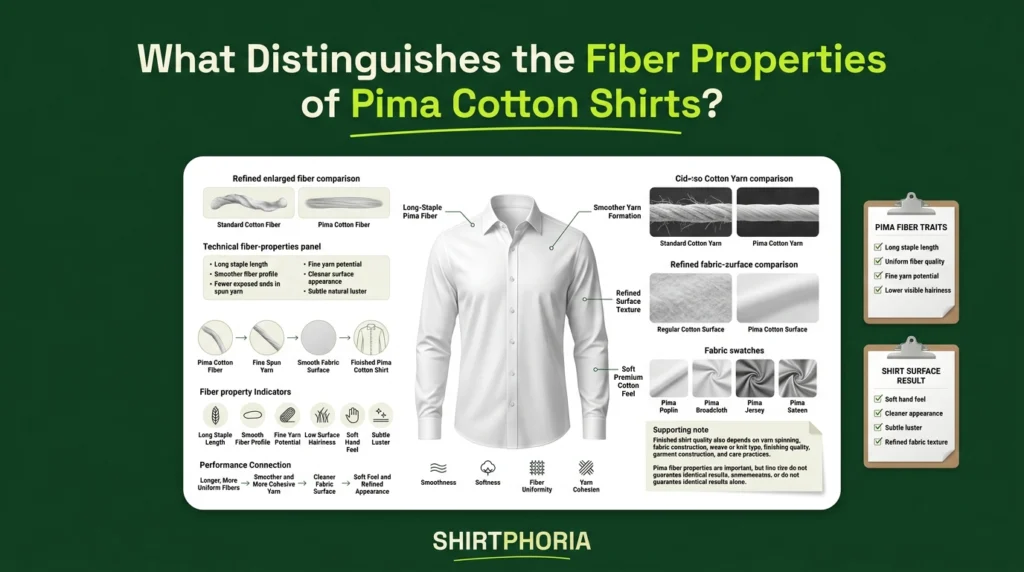
Pima describes a broader cotton category, while SUPIMA® is a controlled trademark associated with American-grown ELS Pima cotton and a licensed supply chain.
Why Should You Avoid Assuming Extra-Long Staple Automatically Means Softer Fabric?
Extra-long-staple fiber creates favorable conditions for refined yarn, but yarn engineering, fabric construction, and finishing determine final softness.
Use:
ELS Fiber → Refinement Potential
not:
ELS Fiber → Guaranteed Softness
Why Should Longer Fiber Not Be Interpreted as Immunity From Pilling?
Longer fiber can reduce one contributor to surface fuzziness, but pilling remains a multi-variable outcome involving yarn structure, fabric construction, abrasion, finishing, fiber retention, and care.
Why Should Fiber Strength Not Be Compared Directly With Garment Durability?
Fiber strength is measured at the raw-material level, while garment durability reflects fiber, yarn, fabric, seams, construction, wear, and maintenance.
Why Should “Regular Cotton” Not Be Interpreted as “Low-Quality Cotton”?
Upland cotton should not be interpreted as low quality because high-grade Upland fiber combined with strong textile engineering can produce excellent shirts.
Structural difference ≠ quality insult.
How Can You Evaluate Supima vs. Regular Cotton Shirts Structurally?
A reliable Supima-versus-regular-cotton comparison should verify identity and measurable fiber properties first, then trace their effects through yarn, fabric, garment manufacturing, and actual use.
Supima vs. Regular Cotton Structural Checklist
Fiber Structure → Spinning → Yarn → Fabric → Garment → Wear/Care
How Can You Test a Fiber-Structure Claim Step by Step?
A structured check helps separate verified fiber facts from assumptions about finished-shirt performance.
Step 1: Identify the Claim
Classify the statement as a claim about:
- fiber identity;
- measurable fiber property;
- yarn outcome;
- fabric outcome;
- garment outcome; or
- sensory perception.
For example:
“This cotton has extra-long staple fibers” is a fiber-property claim.
“This shirt feels smoother” is a sensory claim.
They require different evidence.
Step 2: Match the Evidence to the Claim
Use:
- provenance evidence for SUPIMA® identity;
- instrument-based cotton data for measurable fiber properties;
- textile-engineering evidence for yarn and fabric mechanisms;
- garment testing or wear evidence for finished-product performance.
Step 3: Isolate Other Variables
Do not attribute a finished result to Supima alone if any of these could explain it:
- yarn count;
- twist;
- combing;
- spinning technology;
- fabric density;
- weave or knit structure;
- finishing;
- garment washing;
- construction; or
- care.
Step 4: Decide How Strong the Claim Really Is
A claim can fall into one of four practical categories:
Directly Verified
The attribute has been measured or authenticated with suitable evidence.
Mechanistically Supported
The claim follows a recognized textile mechanism but was not directly measured in the specific garment.
Manufacturing-Dependent
The result is plausible only when later processing stages preserve the raw-fiber advantage.
Unsupported
Appropriate evidence does not establish the claimed relationship.
Step 5: Inspect the Next Textile Layer
If premium fiber does not produce the expected result, inspect the next stage:
Fiber verified → inspect yarn → inspect fabric → inspect finishing → inspect garment construction → inspect care
A rough-feeling shirt made from verified Supima, for example, does not automatically disprove the refinement potential of ELS fiber.
The roughness may originate from yarn twist, fabric architecture, finishing, or garment processing.
Step 6: Validate the Explanation
A correction is useful only if the relevant measurable or observable outcome supports it.
Do not validate a technical claim merely because a shirt “feels premium.”
What Are the Key Takeaways About Supima vs. Regular Cotton Fiber Structure?
The key structural difference is that Supima uses a tightly defined American-grown ELS Pima cotton foundation, while typical Upland cotton represents a broader range of measurable fiber characteristics and manufacturing outcomes.
Supima vs. Regular Cotton Key Takeaways
Length + Fineness/Maturity + Strength + Uniformity
Fiber Structure → Spinning → Yarn → Fabric → Garment → Wear/Care
Supima should therefore be understood as a premium ELS fiber foundation with measurable and structurally relevant advantages, not as a guarantee that every finished Supima shirt will outperform every Upland cotton shirt.
Disclaimer
| Area | What to Know |
|---|---|
| Purpose | This article compares Supima and typical Upland cotton at the fiber, yarn, fabric, and garment levels using measurable structure and manufacturing-dependent outcomes. |
| Comparison boundary | “Regular cotton” refers primarily to typical Upland cotton in this comparison. Upland cotton is a broad category and should not be treated as structurally uniform or inherently low quality. |
| Performance boundary | Supima’s extra-long-staple fiber architecture creates favorable textile potential, but it does not guarantee that every finished Supima shirt will outperform every Upland cotton shirt. |
Frequently Asked Questions
Supima uses American-grown extra-long-staple Pima cotton under the SUPIMA® identity, while regular cotton in this comparison refers mainly to the broader and more variable Upland cotton category.
No. ELS fiber can support greater overlap, cleaner yarn surfaces, and refined yarn potential, but spinning, fabric construction, finishing, and garment manufacture determine the final result.
Fiber length describes how long the fibers are, while length uniformity describes how consistently fiber lengths are distributed within a sample. Two samples can have similar average length but different uniformity.
Yes. Strong yarn engineering, fabric construction, finishing, sewing, and care can allow a high-quality Upland shirt to outperform a poorly manufactured Supima shirt because manufacturing can preserve or waste raw-fiber advantages.
Terms Explained
| Term | Definition |
|---|---|
| Extra-long staple (ELS) | A physical cotton fiber-length classification associated with longer staple fibers. |
| Upper-half mean length | An instrument-based cotton measurement used to characterize fiber length. |
| Fiber fineness | The fineness or relative mass/thickness characteristic of an individual cotton fiber. |
| Micronaire | A cotton measurement influenced by both fiber fineness and maturity rather than pure fineness alone. |
| Fiber strength | A raw-fiber property commonly expressed in grams per tex that contributes to yarn-strength potential. |
| Length uniformity index | A measure describing the consistency of fiber-length distribution within a cotton sample. |
| Fiber-end opportunity | A mechanistic textile concept describing structural opportunities for fiber ends within or near a yarn surface; it is not a standardized cotton-classing variable. |
| Yarn cohesion | The structural ability of fibers within a yarn to remain integrated through overlap, twist, friction, and yarn engineering. |
Conclusion
In conclusion, Supima cotton shirts differ from typical regular/Upland cotton shirts primarily because Supima begins with a tightly defined American-grown extra-long-staple Pima cotton foundation whose measurable fiber properties create favorable conditions for refined yarn and fabric production.
The meaningful difference begins at the fiber level.
Fiber length can be evaluated through measurements such as upper-half mean length. Fiber strength can be measured in grams per tex. Fiber-length uniformity indicates consistency within a cotton sample, while fineness-related analysis must distinguish true fiber fineness from micronaire, which reflects both fineness and maturity.
These raw-fiber properties influence the next textile stage.
Longer fibers can increase overlap potential during spinning and reduce the number of separate fiber segments required across a comparable yarn distance. Suitable strength provides resistance to breakage. Favorable uniformity can support more controlled processing, while appropriate fineness and maturity can contribute to refined yarn design.
But the structural chain does not end with the fiber:
Fiber Structure → Spinning → Yarn → Fabric → Garment → Wear/Care
Carding, combing, ring spinning, compact spinning, yarn twist, yarn count, woven or knitted construction, fabric density, finishing, garment assembly, abrasion, laundering, and care all influence how much of the initial fiber advantage remains visible in the finished shirt.
The accurate conclusion is therefore:
Supima provides a tightly defined premium raw-material foundation with favorable structural potential.
It does not mean every Supima garment automatically outperforms every Upland cotton shirt.
High-quality Upland cotton combined with excellent yarn engineering, controlled fabric construction, effective finishing, and strong garment manufacturing can produce an outstanding shirt. Conversely, premium Supima fiber can lose much of its structural advantage if later production stages are poorly controlled.
The most accurate distinction is not that Supima is automatically better than every regular cotton shirt, but that its American-grown extra-long-staple fiber foundation provides measurable and structurally meaningful textile potential that skilled manufacturing can preserve, weaken, or waste.