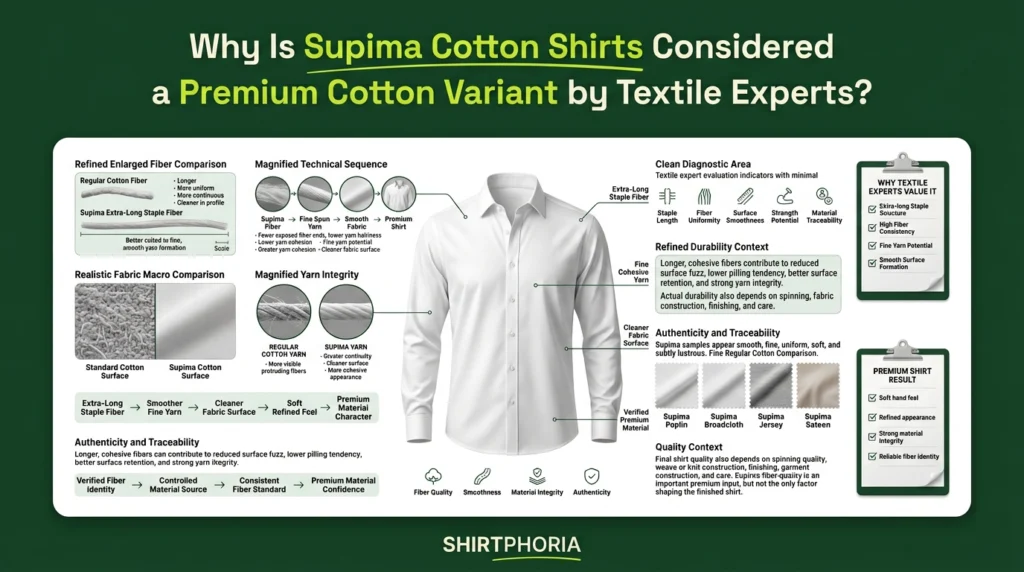
Why Are Supima Cotton Shirts Considered a Premium Cotton Variant by Textile Experts?
Supima cotton shirts are considered premium primarily because they begin with a controlled American-grown extra-long-staple Pima cotton material whose measurable fiber properties can support refined textile production, while provenance and authentication strengthen confidence in the SUPIMA® material claim.
Consumer perception of premium cotton often begins with softness, prestige, exclusivity, or price. Textile evaluation begins somewhere more specific: measurable fiber characteristics, successful textile manufacturing, verified material identity, and finished-garment execution.
Supima’s premium position can therefore be understood through four separate layers:
- measurable fiber quality;
- conversion of fiber into yarn and fabric;
- provenance and authentication;
- finished-shirt construction and performance.
Important raw-fiber characteristics include fiber length, strength, length uniformity, and fineness/maturity. USDA cotton-classing instrumentation measures properties including upper-half mean fiber length, length uniformity, strength in grams per tex, and micronaire. Micronaire reflects the combined influence of fineness and maturity rather than pure fineness alone.
However, premium raw fiber does not automatically create a premium shirt.
The physical quality chain remains:
Fiber → Preparation → Spinning → Yarn → Fabric → Dyeing/Finishing → Garment → Wear/Care
A strong Supima shirt is created when the material’s upstream potential survives each of those stages.
What Criteria Make Supima Cotton Shirts a Premium Cotton Variant?
Textile evaluation places Supima in a premium material category through a combination of measurable fiber characteristics, useful textile-processing potential, controlled identity, and successful downstream manufacturing rather than luxury language alone.
“Premium” should therefore not mean merely:
- expensive;
- rare;
- luxurious;
- prestigious;
- soft; or
- branded.
Those signals can influence consumer perception, but they do not independently establish textile capability.
A more complete premium assessment asks:
What can be measured?
What can be verified?
How successfully was the material converted into yarn and fabric?
How well was the finished shirt constructed?
How Do Textile Experts Distinguish Measurable Cotton Quality From Luxury Marketing?
Technical textile evaluation distinguishes material quality from luxury marketing by using characteristics that can be measured, inspected, tested, or independently verified.
Marketing language may emphasize:
- prestige;
- exclusivity;
- luxury;
- high price;
- heritage.
Technical evaluation instead examines:
- fiber length;
- fiber strength;
- length uniformity;
- fineness and maturity;
- yarn quality;
- fabric stability;
- provenance;
- authentication;
- garment construction.
This difference matters because an expensive shirt can still contain poorly converted yarn, unstable fabric, weak seams, or unsuitable finishing.
Likewise, a material can possess excellent measurable properties without being promoted with luxury language.
Why Does Premium Cotton Evaluation Begin With Measurable Fiber Properties?
Premium-cotton evaluation begins with measurable fiber properties because length, strength, length uniformity, and fineness/maturity affect what the raw material can support during textile processing.
USDA cotton-classing instruments measure fiber length as upper-half mean length, length uniformity through a uniformity index, strength in grams per tex, and micronaire as a property influenced by fineness and maturity.
Cotton Incorporated’s technical interpretation ranges classify upper-half mean length approximately as:
| Upper-Half Mean Length | Interpretation |
|---|---|
| Below 0.99 in | Short |
| 0.99–1.10 in | Medium |
| 1.11–1.26 in | Long |
| Above 1.26 in | Extra long |
These ranges describe the fiber property. They do not mean that any shirt made from fibers above 1.26 inches automatically qualifies as a premium finished garment.
Why Does Yarn Capability Matter When Experts Evaluate Supima Cotton?
Yarn capability matters because high-quality raw fiber becomes practically valuable only when preparation and spinning convert its properties into useful yarn characteristics.
Relevant yarn characteristics include:
- evenness;
- cohesion;
- surface control;
- suitable twist;
- appropriate yarn count.
The relationship is:
Fiber Potential → Must Survive → Yarn Conversion
Excellent fiber processed poorly can become irregular yarn.
Well-controlled fiber preparation and spinning are therefore necessary before raw-material quality can appear in the fabric.
Why Does Fabric Performance Matter Beyond Raw Fiber Quality?
Fabric performance matters because the wearer experiences the textile created from the yarn rather than the raw cotton fiber in isolation.
Fabric evaluation includes:
- surface refinement;
- structural stability;
- tactile character;
- dimensional behavior;
- appearance retention;
- suitability for the intended shirt.
Cotton identity alone does not predetermine these outcomes.
Why Do Provenance and Authentication Strengthen Premium Status?
Provenance and authentication strengthen confidence in the SUPIMA® material identity, but they do not physically improve the fiber or garment.
This distinction is essential:
Textile evidence evaluates material capability.
Authentication evidence evaluates identity credibility.
A shirt can contain genuine Supima cotton yet still be poorly spun, poorly constructed, or poorly finished.
Authentication tells the buyer what material is being represented.
It does not independently tell the buyer how well the finished garment was manufactured.
How Does Extra-Long Staple Fiber Support the Premium Classification of Supima Cotton Shirts?
Supima’s ELS fiber foundation supports its premium material position because longer cotton fibers provide different spinning and yarn-engineering possibilities than shorter-fiber systems.
What Does Extra-Long Staple Mean in Supima Cotton?
Extra-long staple describes a long cotton-fiber category, while instrument classification measures cotton length through upper-half mean length.
Fiber length should remain separate from other textile measurements:
Fiber length ≠ yarn count ≠ fabric weight
A fine yarn is not the same thing as a fine individual cotton fiber.
A lightweight fabric is not evidence of ELS cotton by itself.
Cotton Incorporated classifies upper-half mean lengths above 1.26 inches as extra long in its fiber-property interpretation chart.
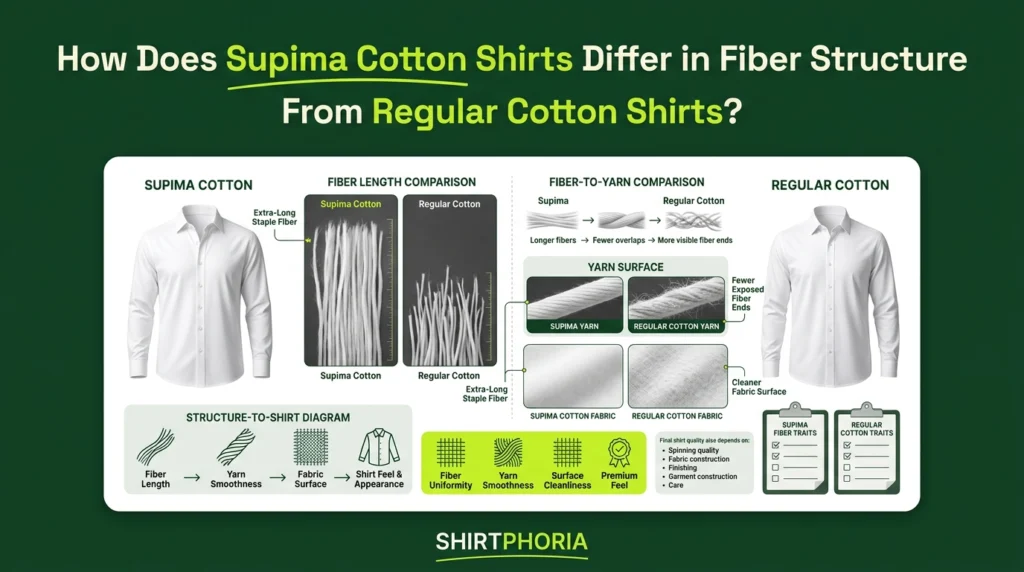
How Does Longer Supima Fiber Increase Fiber Overlap During Spinning?
Longer cotton fibers can maintain contact with neighboring fibers across greater distances, increasing overlap potential during yarn formation.
The mechanism is:
Longer Fiber → Greater Contact Distance → Greater Overlap Potential
Longer individual fibers provide more length through which neighboring fibers can interact within the yarn structure.
This can create favorable conditions for cohesion when suitable preparation, alignment, twist, and spinning technology are used.
Overlap potential, however, is a textile mechanism rather than an official USDA cotton-classing variable.
How Can Longer Fibers Reduce Potential Fiber-End Frequency?
Longer fibers can reduce the number of individual fiber segments needed across an equivalent yarn distance, which can reduce structural opportunities for fiber ends.
The simplified pathway is:
Longer Fiber → Fewer Required Segments → Lower Fiber-End Opportunity
Fiber ends near the yarn surface can contribute to visible fuzz or hairiness.
But this does not mean every longer fiber produces a perfectly smooth yarn.
Spinning method, combing, yarn count, twist, fiber alignment, and process control still matter.
Why Is Staple Length Important but Insufficient for Defining Premium Cotton?
Fiber length alone cannot define premium cotton because strength, uniformity, fineness/maturity, preparation, and spinning also influence textile capability.
A more complete model is:
Length + Strength + Uniformity + Fineness/Maturity + Processing
not:
Longer Fiber = Automatically Better Shirt
How Do Fiber Fineness and Strength Reinforce the Premium Classification of Supima Cotton Shirts?
Fineness and strength can reinforce a premium fiber profile because fineness influences refinement potential while strength influences resistance to breakage during processing.
How Does Fiber Fineness Contribute to Textile Refinement?
Fine fibers can support refined yarn engineering when their length, strength, maturity, and processing conditions are suitable.
The relationship is:
Fineness + Length + Strength + Maturity + Processing → Refined-Yarn Potential
Fineness should not be confused with micronaire.
USDA identifies micronaire as a measurement reflecting both fiber fineness and maturity, rather than pure fineness by itself.
This also means a lower micronaire value cannot automatically be interpreted as “better cotton.”
Context matters.
Why Does Strength Matter When Fibers Are Fine?
Fiber strength matters because refined fibers still need enough break resistance to tolerate preparation and spinning.
Different properties contribute differently:
Fineness → Refinement Potential
Strength → Break-Resistance Input
One property cannot substitute for the other.
How Does Fiber Strength Complement Supima’s ELS Structure?
Fiber strength complements length through a separate mechanism: length influences overlap potential while strength measures resistance to bundle breakage.
USDA reports cotton fiber strength in grams per tex. Cotton Incorporated’s interpretation categories include:
| Fiber Strength | Interpretation |
|---|---|
| 23 g/tex and below | Weak |
| 24–25 g/tex | Intermediate |
| 26–28 g/tex | Average |
| 29–30 g/tex | Strong |
| 31 g/tex and above | Very strong |
These ranges describe a measured fiber property rather than garment lifespan.
The useful distinction is:
Length → Overlap Potential
Strength → Break Resistance
Why Should Uniformity Be Evaluated Alongside Length, Fineness, and Strength?
Length uniformity matters because average fiber length does not show how consistently individual fibers are distributed around that length profile.
The distinction is:
Length = How long?
Uniformity = How consistent?
Cotton Incorporated classifies uniformity index values below 77 as very low, 77–79 as low, 80–82 as average, 83–85 as high, and above 85 as very high. These categories describe raw-fiber distribution rather than finished-shirt quality.
Greater uniformity can support more predictable spinning behavior.
It should not be assumed, however, that every retail Supima shirt has one particular uniformity value without material-specific test data.
How Does Supima Cotton Fiber Structure Create Refined and Cohesive Yarn?
Supima’s ELS fiber foundation can support refined and cohesive yarn when fiber preparation and spinning preserve the raw-material advantages.
How Do Long and Consistent Fibers Support Supima Yarn Cohesion?
Fiber length can support overlap while length uniformity can improve consistency in fiber behavior during spinning.
The mechanisms are complementary:
Length → Overlap Potential
Uniformity → Processing Consistency
Together:
Length + Uniformity → Controlled Yarn-Formation Potential
Cotton Incorporated notes that fiber length affects spinning efficiency, yarn strength, yarn evenness, and the fineness of yarn that can successfully be produced. It also identifies length uniformity as relevant to yarn evenness, strength, and spinning efficiency.
How Can Lower Fiber-End Opportunity Improve Supima Yarn Surfaces?
Lower fiber-end opportunity can reduce one structural source of yarn-surface irregularity, although actual hairiness also depends on spinning and yarn design.
The actual system is closer to:
Fiber-End Opportunity + Spinning Method + Twist → Yarn-Surface Outcome
Extra-long staple cotton should not be described as producing hairiness-free yarn automatically.
How Can Strong, Fine Supima Fibers Support Refined Yarn Counts?
Strong, fine, sufficiently long fibers can increase the spinner’s options for engineering refined yarn.
However, actual yarn count remains a manufacturing choice.
Supima identity alone does not mean every Supima shirt uses extremely fine yarn.
Why Does Spinning Quality Remain Critical Even With Supima Fiber?
Spinning remains critical because raw fiber defines input potential while preparation, combing, spinning system, yarn count, twist, and process control determine the finished yarn.
Fiber defines input potential.
Spinning determines yarn realization.
Yarn twist demonstrates why balance matters.
Too little or otherwise unsuitable twist can provide insufficient cohesion for a particular yarn design.
Appropriate twist can provide the intended balance.
Too much or unsuitable twist can change hand feel, torque, liveliness, and fabric behavior.
There is no single universal twist number that defines premium Supima yarn.
How Does Supima Cotton Yarn Translate Into Refined Shirt Fabric?
Refined yarn can support refined Supima shirt fabric when construction, density, finishing, and dimensional control preserve rather than waste the yarn’s quality.
How Can Smoother Supima Yarn Create a Cleaner Fabric Surface?
More even and controlled yarn can reduce one source of visible surface irregularity in the finished fabric.
The pathway is:
Yarn-Surface Control → Supports → Cleaner Fabric Face
This is one reason raw-fiber advantages matter beyond the fiber itself: they can influence yarn behavior, which can influence the visible textile surface.
How Can Cohesive Yarn Support Fabric Structural Integrity?
Cohesive yarn provides a controlled input for fabric construction, while actual fabric integrity still depends on:
- textile architecture;
- density;
- yarn design;
- weaving or knitting;
- finishing.
Strong yarn does not automatically equal a durable shirt.
How Can Refined Yarn Contribute to Tactile Quality?
Refined yarn contributes to tactile quality only in combination with fabric structure and finishing.
The complete relationship is:
Yarn Surface + Fabric Architecture + Finishing → Hand Feel
A smooth yarn used in an unsuitable fabric construction may not produce the desired tactile result.
How Can Cleaner Yarn Improve Long-Term Surface Appearance?
Cleaner yarn can reduce one source of initial fuzz and irregularity, while long-term appearance depends on abrasion, pilling, laundering, finishing, and accumulated wear.
The relevant timeline is:
Initial Surface Condition + Repeated Friction/Laundering → Long-Term Surface Condition
An initially smooth surface does not guarantee lifetime smoothness.
Why Are Softness, Material Integrity, and Color Performance Associated With Supima Cotton Shirts?
Softness, material integrity, and color performance are downstream textile outcomes that may be strong in a well-engineered Supima shirt, but none should be attributed to fiber identity alone.
Why Can Supima Cotton Shirts Feel Softer?
An ELS fiber foundation can support smooth yarn and fabric surfaces, while final hand depends on yarn design, fabric structure, finishing, and garment washing.
The full mechanism is:
Fiber + Yarn + Fabric + Finishing → Final Hand Feel
This is also why softness cannot authenticate Supima.
A non-Supima textile can be made very soft through suitable raw material, fine yarn, fabric design, and finishing.
Why Can Supima Cotton Shirts Support Greater Material Integrity?
A favorable fiber foundation can support material-integrity potential when spinning, fabric construction, sewing, and care preserve it.
The physical chain is:
Fiber → Yarn → Fabric → Garment → Wear/Care
A strong upstream input can still fail downstream.
For example:
Good Fiber → Poor Yarn Conversion → Weak Fabric Outcome
or:
Good Fabric → Weak Seam Construction → Reduced Garment Life
How Can Supima Fiber Characteristics Support Color Performance?
Supima cotton can serve as a high-quality substrate for coloration, but shade depth, uniformity, and colorfastness depend strongly on:
- pretreatment;
- dye chemistry;
- process control;
- fixation;
- finishing;
- laundering.
Therefore:
Substrate + Pretreatment + Dye System + Process Control + Finishing + Care → Color Performance
SUPIMA® identity alone does not prove superior colorfastness.
Why Should These Attributes Be Evaluated as Outcomes of a Material System?
Softness, integrity, and color performance are system outcomes because each emerges after multiple manufacturing and use stages.
The correct principle is:
Material Identity ≠ Automatic Finished Performance
Why Does Limited Supima Cotton Supply Reinforce Its Premium Market Position?
Limited Supima availability can reinforce exclusivity, but scarcity is a market characteristic rather than a mechanical textile property.
Why Can Limited Supply Reinforce Premium Market Positioning?
Limited availability can strengthen market exclusivity when combined with differentiated material characteristics, controlled identity, and demand.
The commercial relationship is:
Specialized Material + Limited Supply + Demand → Market Exclusivity
Scarcity can therefore reinforce the premium market position of a material.
It does not create the fiber’s physical properties.
Why Does Scarcity Not Prove Textile Quality?
Scarcity measures availability, whereas technical textile quality requires fiber, yarn, fabric, or garment evidence.
A rare material is not automatically:
- stronger;
- finer;
- more uniform;
- smoother;
- more durable.
The correct distinction is:
Rare ≠ Mechanically Superior
How Does Controlled American Provenance Strengthen the Premium Identity of Supima Cotton Shirts?
Controlled American provenance strengthens the specificity of the SUPIMA® material claim by defining the cotton’s origin, while remaining separate from physical textile performance.
Provenance refers to the documented origin and history of a material.
Why Is Supima More Specific Than a Generic Pima Cotton Claim?
Pima describes a broader cotton category, while SUPIMA® is a controlled brand identity for American-grown Pima cotton used within the Supima system.
The useful distinction is:
Pima = Broader Cotton Category
SUPIMA® = Controlled American-Grown Material Identity
This does not mean generic Pima cotton is necessarily low quality.
The difference concerns material identity and control.
Why Does Defined Geographic Growing Origin Matter?
Defined growing origin clarifies where the raw cotton was produced without implying that the yarn, fabric, or finished shirt was manufactured in the United States.
These stages should remain separate:
- cotton-growing origin;
- spinning location;
- fabric-manufacturing location;
- garment-assembly location.
Therefore:
American-grown cotton ≠ automatically American-made shirt
How Does Trademark Control Support Identity Consistency?
Controlled authorization for SUPIMA® trademark use helps connect the brand claim to Supima’s current supply-chain requirements.
Supima currently states that products carrying the SUPIMA® trademark must move through its AQRe™ system and TextileGenesis™ platform.
The relationship is:
Controlled Trademark Authorization → Supports → Consistent Material Representation
Why Does Technical Quality Need a Clearly Defined Material Identity?
Technical evidence becomes easier to interpret correctly when the material being evaluated is clearly identified.
Testing answers:
“How does this material perform?”
Provenance answers:
“Which material is this?”
These are different questions.
Why Does Authentication Matter to the Premium Status of Supima Cotton Shirts?
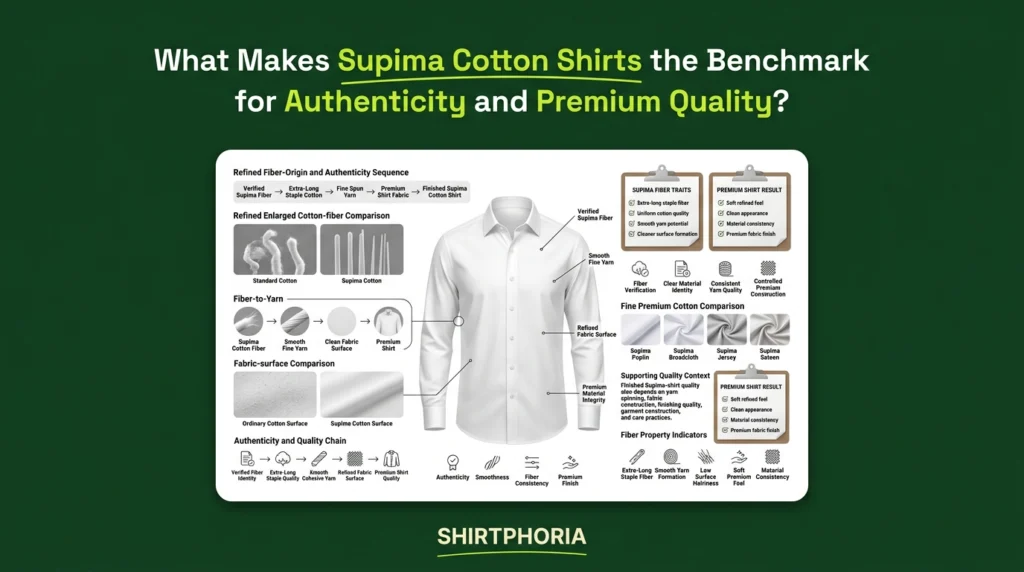
Authentication strengthens confidence in the SUPIMA® claim through an end-to-end system combining digital transaction traceability and physical origin verification, while remaining separate from finished-shirt quality evaluation.
Supima’s current system uses AQRe™ for authorization, TextileGenesis™ for supply-chain transaction traceability, and Oritain™ for physical origin verification on selected samples. Supima also states that the previous paper Proof of License or “certificate” process has been discontinued.
Why Does a Premium Material Name Create Authentication Risk?
A commercially valuable material claim creates a reason to establish identity assurance because unsupported substitution or misrepresentation would weaken the credibility of the name.
The general relationship is:
Higher Commercial Value → Increases → Need for Verification
This does not imply wrongdoing by any specific company.
It explains why a controlled material identity benefits from verification.
How Does Controlled SUPIMA® Use Help Preserve the Material Claim?
Current SUPIMA® trademark authorization depends on participation in the AQRe™ authentication system rather than the former annual paper-license model.
Supima states that all segments of the relevant branded supply chain must participate in the TextileGenesis platform and record transactions for authorized SUPIMA® products.
That system addresses material identity.
It does not certify:
- sewing quality;
- fit;
- seam strength;
- collar construction;
- fabric stability;
- garment lifespan.
How Do Digital Traceability and Physical Verification Strengthen Material Assurance?
Digital transaction traceability and physical origin verification address different parts of material assurance.
TextileGenesis™ → Records/Connects → Supply-Chain Transactions
Oritain™ → Tests → Physical Origin Consistency of Selected Samples
Together:
Digital Traceability + Physical Verification → Stronger Material-Identity Assurance
Supima describes the Oritain component as randomized forensic testing of samples against supply-chain transaction records.
Why Does Authentication Complement Rather Than Replace Textile-Quality Evaluation?
Authentication addresses whether the SUPIMA® material claim is credible.
Textile and garment evaluation address how successfully the material was processed.
Therefore:
Authentication → Identity
Textile Testing → Performance
Garment Inspection → Execution
How Can You Learn More About Supima Authentication?
Premium classification and material-claim verification are related but separate questions.
This article explains why Supima occupies a premium material position.
The authentication topic asks how the SUPIMA® claim is currently authorized, traced, and verified.
The premium status of Supima relies on consumer assurance, detailed in Supima authentication.
How Does Supima Cotton Compare With Typical Regular Cotton on Premium-Quality Criteria?
Supima differs from typical regular/Upland cotton primarily through its narrowly defined American-grown ELS material identity and premium-processing potential, while Upland cotton covers a broader range of fiber and textile quality.
| Expert Criterion | Supima Cotton | Typical Regular/Upland Cotton | Why It Matters | What It Does Not Prove |
|---|---|---|---|---|
| Material identity | Controlled American-grown SUPIMA® Pima identity | Broad cotton category | Clarifies comparison | Garment quality |
| Staple category | ELS foundation | Broader, generally shorter range | Influences spinning possibilities | Better tailoring |
| Fiber length | Long/ELS identity; exact value requires data | Varies | Influences yarn engineering | Automatic softness |
| Fiber-end opportunity | Can be lower with longer fibers | Can be greater with shorter fibers | Influences surface potential | Zero pilling |
| Fineness | Exact value requires measurement | Varies | Influences refinement potential | Automatic softness |
| Micronaire | Must include fineness + maturity context | Varies | Useful classing property | Pure fineness |
| Fiber strength | Requires measurement for exact claims | Varies | Influences yarn potential | Garment lifespan |
| Length uniformity | Must be measured, not assumed | Varies | Influences processing consistency | Defect-free fabric |
| Yarn smoothness | Depends on fiber + spinning | Can also be excellent | Influences fabric surface | Guaranteed comfort |
| Surface stability | Manufacturing- and wear-dependent | Manufacturing- and wear-dependent | Influences appearance | Abrasion immunity |
| Color performance | Dyeing-system dependent | Dyeing-system dependent | Influences visual quality | Automatic colorfastness |
| Supply | Specialized and limited | Broadly available | Reinforces exclusivity | Technical quality |
| Provenance | Defined American-grown identity | Varies | Supports identity specificity | Better construction |
| Authentication | AQRe™ architecture | Depends on material claim/system | Supports identity confidence | Better sewing |
| Finished-shirt quality | Manufacturing-dependent | Manufacturing-dependent | Requires full evaluation | Universal Supima superiority |
The accurate conclusion is:
Supima provides a narrowly defined American-grown ELS material and identity foundation; Upland cotton represents a broader category that can produce both ordinary and excellent textile outcomes.
How Do Textile Experts Evaluate Whether Supima Cotton Becomes a Truly Premium Shirt?
A finished Supima shirt should be evaluated by separating verified material identity from fiber potential, yarn quality, fabric quality, finishing, and garment execution.
Stage 1: How Should the Supima Fiber Foundation Be Evaluated?
Evaluation begins by distinguishing what is actually verified about the cotton from what is merely inferred from the SUPIMA® name.
Useful evidence can include:
- authenticated material identity;
- confirmed ELS category;
- fiber measurements where genuinely available.
Do not invent specific strength, uniformity, fineness, or micronaire values for a retail shirt when the relevant material data is unavailable.
Stage 2: How Should Supima Yarn Quality Be Evaluated?
Yarn evaluation asks whether spinning preserved the material’s potential through suitable:
- evenness;
- twist;
- yarn count;
- cohesion;
- surface control.
Visible inspection can identify obvious irregularities, but it cannot replace appropriate laboratory yarn testing where precise performance claims are required.
Stage 3: How Should Supima Fabric Construction Be Evaluated?
Fabric evaluation determines whether yarn was converted into a stable textile appropriate for the shirt’s intended use.
Assess:
- woven or knitted architecture;
- density;
- weight;
- surface consistency;
- dimensional behavior;
- finishing.
“More dense” is not automatically “better.”
Fabric construction should be judged relative to the desired function.
Stage 4: How Should the Finished Supima Shirt Be Evaluated?
Finished-shirt evaluation examines whether cutting, sewing, seams, collars, cuffs, trims, finishing, and dimensional control preserve the value of the textile.
The physical evaluation chain is:
Fiber → Yarn → Fabric → Garment → Wear/Care
The identity chain remains separate:
Provenance → Traceability → Authentication
A manufacturing problem can reduce finished-shirt value without disproving the authenticity of the Supima cotton itself.
Which Supima Cotton Shirt Characteristics Matter Most When Choosing a Premium Garment?
Buyers should evaluate the evidence most relevant to their actual priority rather than treating the SUPIMA® name as a universal quality score.
If Textile Refinement Is the Priority, What Matters Most?
Textile refinement depends most directly on yarn surface, fabric evenness, tactile consistency, and controlled textile construction.
Prioritize:
Fiber Potential + Yarn Control + Fabric Surface + Finishing
If Material Integrity Is the Priority, What Matters Most?
Material integrity requires attention to:
- yarn cohesion;
- fabric stability;
- seams;
- construction;
- intended use;
- accumulated wear.
Fiber strength alone is insufficient.
If Long-Term Appearance Is the Priority, What Matters Most?
Long-term appearance depends on initial surface quality plus abrasion, pilling behavior, finishing, laundering, drying, and care over time.
Initial Condition + Accumulated Exposure → Long-Term Appearance
If Authenticity Is the Priority, What Matters Most?
Authenticity should be established through appropriate SUPIMA® material-claim evidence rather than inferred from:
- softness;
- price;
- packaging;
- visual appearance.
Current supply-chain traceability and authentication evidence is more relevant to this question.
If Overall Premium Value Is the Priority, What Matters Most?
Overall premium value depends on combining credible material identity with good textile conversion, appropriate performance, and competent garment execution.
Use:
Verified Identity + Good Yarn + Appropriate Fabric + Competent Garment Construction
not:
High Price + Soft Hand = Premium Proof
What Can Prevent Supima Cotton From Delivering Premium Shirt Quality?
Supima can fail to deliver expected premium shirt quality when downstream manufacturing or accumulated use prevents the material’s raw potential from being expressed.
How Can Poor Spinning Reduce Supima’s Fiber Advantages?
Poor spinning can reduce the usable value of premium raw fiber through:
- irregularity;
- unsuitable twist;
- processing damage;
- poor fiber control.
The failure chain can be:
Premium Fiber → Poor Spinning → Irregular Yarn → Reduced Fabric Refinement
How Can Weak Fabric Construction Reduce Material Performance?
Unsuitable fabric construction can limit performance even when the yarn itself is high quality.
For example:
Good Yarn → Unsuitable Density/Architecture → Poor Functional Balance
Higher fabric density is not automatically better.
How Can Aggressive Finishing Alter Expected Supima Fabric Character?
Finishing can improve, stabilize, mask, or damage textile characteristics depending on chemistry, mechanics, intensity, and intended outcome.
Appropriate finishing can support the intended textile character.
Unsuitable treatment can contribute to:
- dimensional instability;
- altered hand feel;
- strength loss;
- unwanted surface change;
- appearance change.
How Can Weak Garment Construction Undermine a High-Quality Textile?
Poor garment engineering can waste high-quality fabric through:
- weak seams;
- distortion;
- unstable collars;
- unstable cuffs;
- inconsistent stitching;
- unsuitable trims.
A premium textile does not compensate for weak garment construction.
Why Does High-Quality Raw Cotton Not Guarantee Long Garment Life?
Garment life reflects cumulative behavior across:
Fiber → Yarn → Fabric → Garment → Repeated Wear/Care → Observed Lifespan
Abrasion, laundering, drying, heat, construction quality, and maintenance all affect the final lifespan.
What Supima Cotton Premium-Quality Claims Should Buyers Avoid Misinterpreting?
Buyers should avoid treating any single Supima-associated signal as independent proof of complete garment superiority.
Why Should Supima Not Be Interpreted Simply as “Very Soft Cotton”?
Softness is one downstream sensory outcome and cannot define or authenticate Supima by itself.
Why Should Buyers Avoid Assuming All Pima Cotton Is SUPIMA®?
Pima is a broader cotton category, while SUPIMA® is a controlled American-grown Pima material identity operating under its own authorization and authentication system.
Why Does Rarity Not Independently Prove Quality?
Scarcity measures availability rather than textile capability.
Scarcity → Market Context
not:
Scarcity → Fiber Performance
Why Does Authentication Not Guarantee Perfect Garment Construction?
Authentication supports identity confidence, while testing and inspection evaluate different questions.
Authentication Verifies Identity
Testing Evaluates Performance
Inspection Evaluates Construction
Why Should Regular Cotton Not Automatically Be Treated as Inferior?
Upland cotton covers a broad measurable quality range, and high-quality Upland combined with strong textile engineering can produce excellent shirts.
Why Should “Premium” Not Mean Guaranteed Superiority in Every Use Case?
Premium material refinement does not make one cotton system optimal for every:
- climate;
- weave;
- shirt purpose;
- care routine;
- performance requirement.
The useful interpretation is:
Premium = Evidence-Based Value Within Context
not:
Premium = Universal Best
How Can You Run a Final Premium Supima Cotton Shirt Check?
A reliable Supima evaluation identifies the claim, matches it to appropriate evidence, isolates competing variables, checks likely failure points, and validates the conclusion.
Supima Cotton Shirt Quality Checklist
How Can You Diagnose a Supima Premium-Quality Claim?
Start by identifying exactly what is being claimed.
Fiber Property
Use standardized measurement or suitable technical evidence.
Material Identity
Use current SUPIMA® authorization, provenance, traceability, or authentication evidence.
Yarn or Fabric Performance
Use suitable textile-engineering evidence or testing.
Garment Construction
Use physical inspection or relevant performance tests.
Market Scarcity
Use current market or production information.
One evidence type should not substitute for another.
For example, authentication cannot prove colorfastness.
A softness test cannot verify provenance.
A high price cannot prove fiber strength.
Separate Competing Variables
Before attributing an outcome to Supima fiber, consider:
- raw-fiber properties;
- combing;
- spinning method;
- yarn count;
- yarn twist;
- yarn evenness;
- fabric architecture;
- density;
- weight;
- dyeing;
- finishing;
- sewing;
- abrasion;
- washing;
- drying;
- use history.
Diagnose the First Plausible Failure Layer
Use:
Identity → Fiber Evidence → Yarn → Fabric → Finishing → Garment → Wear/Care
Do not automatically blame the raw cotton for a downstream problem.
For example:
Uneven surface
→ investigate yarn evenness, construction, and finishing.
Excessive fuzz
→ investigate yarn hairiness, abrasion, textile structure, and laundering.
Poor dimensional stability
→ investigate fabric construction, finishing, washing, and drying.
Weak seam
→ investigate sewing and seam construction rather than cotton fiber strength.
Poor color retention
→ investigate dye chemistry, fixation, finishing, and washing.
What Are the Key Takeaways About Why Supima Cotton Shirts Are Considered Premium?
Supima’s premium material position is best understood by separating measurable ELS fiber properties, textile-conversion potential, identity assurance, market exclusivity, and finished-shirt execution.
The two essential chains are:
Physical quality:
Fiber → Yarn → Fabric → Garment → Wear/Care
Identity assurance:
Provenance → Traceability → Physical Verification → Authentication
Supima’s premium classification is strongest when measurable textile capability, credible identity evidence, and competent downstream manufacturing are evaluated separately before being combined into a complete shirt-quality judgment.
Disclaimer
| Area | What to Know |
|---|---|
| Purpose | This article explains why Supima occupies a premium material position by separating measurable fiber quality, textile conversion, identity assurance, market exclusivity, and finished-shirt execution. |
| Evidence boundary | SUPIMA® identity, softness, price, scarcity, or authentication should not be used as substitutes for fiber measurements, textile testing, or garment inspection. |
| Performance boundary | Authentic Supima cotton provides a premium raw-material foundation, but downstream spinning, fabric construction, finishing, sewing, wear, and care determine finished-shirt performance. |
Frequently Asked Questions About Supima Cotton Premium Quality
Supima is considered premium because it combines a controlled American-grown ELS Pima cotton identity with a fiber foundation capable of supporting refined textile production, while finished-shirt quality still depends on downstream manufacturing.
Supima provides a more narrowly defined ELS material identity than typical Upland cotton, but one finished shirt cannot be declared superior solely from the cotton name. High-quality Upland cotton combined with excellent textile engineering can also produce an excellent garment.
No. Limited availability can reinforce market exclusivity, but technical premium value must come from fiber, yarn, fabric, or garment evidence.
No. Pima is a broader cotton category, while SUPIMA® is a controlled identity for American-grown Pima cotton operating within Supima’s authorization and authentication system.
No. An ELS fiber foundation can support refined textile surfaces, but final softness depends on yarn engineering, fabric construction, finishing, and garment washing.
No. Authentication addresses cotton identity. Finished-shirt quality depends on spinning, fabric construction, dyeing, finishing, cutting, sewing, dimensional stability, use, and care.
Terms Explained
| Term | Definition |
|---|---|
| Premium cotton | A cotton material position supported by measurable fiber capability, successful textile conversion, identity evidence, and contextual finished-product quality rather than price or prestige alone. |
| Extra-long staple (ELS) | A cotton fiber-length classification associated with longer staple fibers and expanded spinning possibilities. |
| Upper-half mean length | An instrument-based cotton measurement used to characterize fiber length. |
| Micronaire | A cotton measurement influenced by both fiber fineness and maturity rather than pure fineness alone. |
| Provenance | The documented origin and history of a material. |
| Traceability | The ability to connect material movement through recorded supply-chain transactions. |
| Authentication | Evidence used to strengthen confidence that the material identity being claimed is credible. |
| Material integrity | A system-level textile outcome involving fiber, yarn, fabric, garment construction, wear, and care. |
Conclusion
Supima cotton shirts occupy a premium material position because they begin with a controlled American-grown ELS Pima cotton foundation that offers measurable textile potential, while modern provenance and authentication systems strengthen confidence in material identity.
The technical foundation begins with fiber properties.
Length affects spinning possibilities and overlap potential. Strength contributes resistance to breakage during processing. Length uniformity helps describe how consistently fibers are distributed. Fineness and maturity add further context to the fiber’s suitability for refined textile production.
But these advantages must move through the full physical chain:
Fiber → Yarn → Fabric → Garment → Wear/Care
Strong fiber can be weakened by poor spinning.
Good yarn can be undermined by inappropriate fabric construction.
High-quality fabric can lose value through poor finishing, weak seams, unstable garment construction, or damaging care.
Supima also has a separate identity-assurance chain:
Provenance → Digital Traceability → Physical Verification → Authentication
Supima’s current AQRe™ system uses TextileGenesis™ transaction traceability and Oritain™ physical verification to strengthen confidence that authorized SUPIMA® material claims correspond to the intended American-grown cotton supply chain.
That authentication strengthens material identity.
It does not independently certify sewing, fabric stability, softness, durability, or colorfastness.
Limited availability similarly reinforces exclusivity without mechanically producing longer, stronger, finer, or more durable cotton.
The final premium judgment therefore requires all of the relevant evidence to remain in its proper role.
Supima’s premium position is strongest when its measurable ELS material potential, controlled identity, and downstream textile execution are evaluated as separate forms of evidence and then combined into one complete shirt-quality judgment.