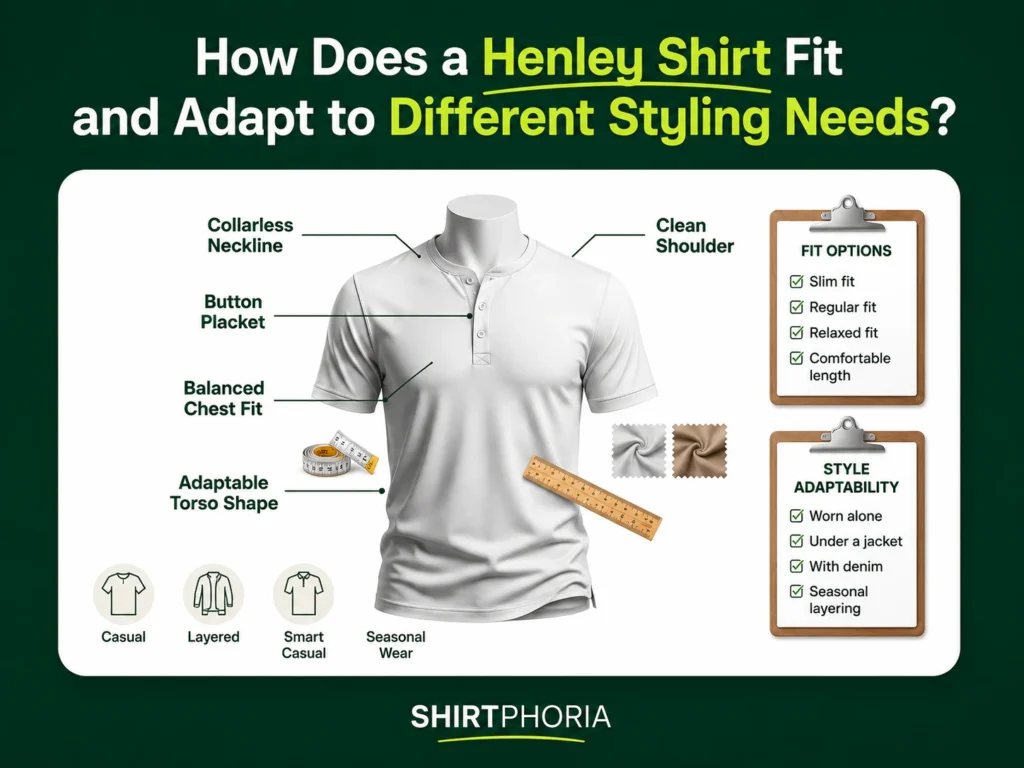
How Does a Henley Shirt Fit and Adapt to Different Styling Needs?
A Henley shirt fits and adapts to different styling needs by combining the comfort of a knit pullover with the adjustable detail of a short button placket.
Because the Henley sits between a basic T-shirt and a more structured buttoned shirt, styling it well requires more than choosing a size. The wearer must evaluate Placket depth, Button Stance, Torso Drape, sleeve fit, fabric weight, knit texture, and layering context.
A Henley is generally understood as a pullover Knit Fabric shirt with a short buttoned opening at the neck. It usually has a Collarless Neckline, which gives it a cleaner and less structured neck area than a polo or traditional buttoned shirt.
The Placket adds both function and styling control. It allows the wearer to open or close the neckline, adjust chest exposure, and change how casual or polished the shirt appears.
This guide breaks the Henley into three major fit zones:
- Chest and Torso Drape
- Sleeve length and Cuff Finish
- Placket behavior and Button Stance
It then explains how those zones adapt for standalone casual wear, elevated layering, warm-weather outfits, and cool-season styling.
The main questions covered include:
- How the Placket changes neckline openness and styling mood.
- How Torso Drape changes Silhouette and layering ability.
- How sleeve length and Cuff Finish affect comfort and proportion.
- How the Collarless Neckline changes layering under outerwear.
- How Waffle Knit, Slub Knit, and Thermal Knit change seasonal use.
- How to choose between slim, standard, relaxed, thermal, and short-sleeve Henleys.
Because of its blend of knit comfort and buttoned detail, the Henley connects naturally to broader T-shirts fit, styling, and wardrobe-use principles.
Why Does the Henley’s Construction Support Styling Adaptation?
The Henley’s construction supports styling adaptation because its buttoned neckline, knit body, sleeve design, and fabric texture can be adjusted for different outfit roles.
A smooth, close-fitting Henley may work as a clean Layering Base beneath a jacket. A relaxed Waffle Knit version may work better as a standalone casual garment. A short-sleeve Henley can function similarly to a T-shirt while adding visual detail through its Placket.
These versions belong to the same garment category, but they do not produce the same styling result. Fabric weight, torso cut, sleeve finish, and Placket depth can all change the Henley’s appearance and comfort.
The Placket as the Primary Fit and Style Adjustment Point
The button Placket acts as the primary fit and style adjustment point on a Henley because it lets the wearer adjust neckline openness, chest exposure, and styling mood.
A Placket is a reinforced opening at the centre front of a garment. On a Henley, it usually supports buttons and buttonholes, although some designs may use snaps or other fasteners.
Placket construction requires accurate alignment and stable stitching because the area is repeatedly opened, closed, stretched, and handled. A sewing guide from Thread Theory shows how a Henley Placket can be assembled, reinforced, aligned, and prepared for fasteners.
The Placket length and button count often influence how much of the upper chest becomes visible when the top buttons are opened.
A Henley may include:
- Two buttons
- Three buttons
- Four buttons
- More than four buttons in deeper Placket designs
No single button count is a universal standard. A short two-button Placket may create a compact neckline adjustment, while a deeper four-button Placket may offer more styling range and chest exposure.
The useful relationship is:
Henley Button Placket → allows neckline openness control → influences formality, layering, and casualness.
The Placket does not determine formality on its own. Fabric texture, colour, fit, sleeve length, outerwear, footwear, and the number of open buttons also influence the final outfit.
A smooth navy Henley with most buttons closed may look cleaner beneath a jacket than a heavily textured Waffle Knit Henley with several buttons open.
Differentiating the Henley’s Collarless Neckline from Other Knitwear
The Collarless Neckline differentiates the Henley from collared knitwear by reducing collar structure at the neck and often making it easier to layer under jackets, overshirts, or chore coats.
A polo shirt includes a visible collar that can add structure around the neck. Depending on fabric thickness, collar construction, and outerwear shape, that collar may sit neatly or create noticeable bulk.
The Henley removes this extra collar layer. Its neckline can create a cleaner transition beneath outerwear, especially when the Placket lies flat and the fabric is not excessively thick.
This does not mean every Henley layers better than every collared knit shirt. A heavy Thermal Knit Henley with a thick Placket may create more bulk than a fine-gauge polo.
Layering success depends on:
- Shoulder fit
- Fabric thickness
- Placket depth
- Button size
- Neckline width
- Outerwear structure
- Available layering space
A close or standard-fit Henley may sit neatly beneath:
- Chore coats
- Denim jackets
- Field jackets
- Overshirts
- Casual blazers
- Lightweight coats
A relaxed Waffle Knit or Thermal Knit Henley may layer more comfortably beneath roomier outerwear.
To understand why the Henley layers differently from collared knitwear, compare it with the structure explained in polo shirt collar construction.
What Are the Three Critical Fit Zones of the Henley Shirt?
The three critical fit zones of the Henley shirt are the torso, the Placket and neckline, and the sleeves with their Cuff Finish.
These areas must work together. A well-shaped torso cannot fully compensate for a twisting Placket. Comfortable sleeves cannot correct excessive chest tension. A clean neckline may still look unbalanced when the body is too long, too short, or too loose.
The Henley should therefore be judged as one complete garment rather than through a single measurement.
How Does Optimal Torso Drape Control Henley Shirt Silhouette?
Torso Drape controls the Henley’s Silhouette by determining how closely the fabric follows the chest, waist, and midsection.
Torso Drape describes the way the shirt hangs and moves across the body. It is affected by:
- Garment width
- Fabric weight
- Fabric stretch
- Body proportions
- Side-seam shape
- Shirt length
- Wearer preference
The practical relationship is:
Henley Torso Drape → controls fabric tension and ease → shapes a closer or more relaxed Silhouette.
Slim or Close Fit
A slim or close-fit Henley often works well for clean layering when the fabric follows the torso without pulling sharply across the chest or stomach.
The shirt should sit close enough to reduce bunching beneath outerwear. It should not create strong horizontal tension lines, pull the Placket open, or restrict sitting and reaching.
A close fit may create a cleaner line beneath a blazer, chore coat, or overshirt when the Knit Fabric remains soft and comfortable.
Standard Fit
A standard-fit Henley works well for many everyday outfits because it provides shape while retaining moderate ease.
This fit can usually move between standalone wear and layering. It often gives more comfort than a slim cut while preserving enough structure to keep the Placket and neckline visible.
A standard fit may be the most adaptable choice for wearers who want one Henley for casual use, light layering, and transitional weather.
Relaxed Fit
A relaxed-fit Henley often works well for casual standalone outfits, especially when the fabric has visible texture such as Slub Knit, Waffle Knit, or Thermal Knit.
The extra ease can allow thicker fabric to move more comfortably. It may also support a rugged, vintage, or workwear-influenced appearance.
Relaxed should not mean shapeless. The shoulder seam, sleeve length, Placket alignment, and hem position should still look deliberate.
General knit-shirt fit principles suggest checking shoulder placement, torso ease, sleeve shape, and shirt length rather than relying only on the size label. The SANVT fit guide provides useful reference points for shoulder seams, chest width, sleeve fit, and garment length, although Henley Placket construction and fabric texture can change the final fit.
Torso Fit Warning Signs
A Henley may be too tight when:
- The Placket pulls open while closed
- Horizontal tension lines appear across the chest
- The fabric clings sharply around the stomach
- The shoulder seams pull toward the neck
- Sitting causes the shirt to ride upward
A Henley may be too loose when:
- The Placket collapses into excess fabric
- The torso billows heavily around the waist
- The shoulder seams fall far down the arms
- The hem gathers excessively under outerwear
- The shirt twists during normal movement
The correct fit depends on fabric, styling purpose, and personal comfort.
How Do the Henley Placket and Button Stance Frame the Face and Neckline?
The Placket and Button Stance frame the face and neckline by controlling how much vertical opening appears below the neck.
Button Stance describes the position of the buttons and how the shirt appears when they are opened or closed.
The Placket should usually lie flat enough to avoid twisting, gaping, or pulling unless the shirt is intentionally made with a distressed or heavily textured finish.
Opening one or two buttons may create a more open neckline and stronger vertical visual line. It does not physically change the neck or body.
Leaving all buttons closed creates a compact neckline and may work better for cleaner layering.
Button Stance Guide
All buttons closed
This creates the cleanest and most compact neckline. It often works well beneath jackets, overshirts, and other outer layers.
One button open
This creates a slightly more relaxed neckline while keeping chest exposure limited.
Two buttons open
This creates a more casual appearance and stronger vertical opening. It often works well for standalone outfits.
Several buttons open
This can look relaxed but may become overly exposed or unstable depending on Placket depth, chest coverage, and setting.
After adjusting the buttons, the wearer should move the shoulders and arms. If the Placket twists, pulls sharply, or gaps at the chest, the shirt may be too tight or incorrectly constructed.
How Do Sleeve Length and Cuff Finishes Affect Henley Shirt Fit?
Sleeve length and Cuff Finish affect Henley fit by changing arm proportion, wrist coverage, comfort, and seasonal function.
Henleys may have:
- Short sleeves
- Three-quarter sleeves
- Full-length sleeves
- Ribbed Cuffs
- Open hems
- Bound sleeve finishes
Each design creates a different relationship between movement, warmth, ventilation, and styling.
Long-Sleeve Henley Fit
A long-sleeve Henley often works well when the sleeve reaches the wrist area without heavy bunching.
The sleeve should allow the wearer to reach forward and overhead without pulling tightly across the shoulders or upper back.
A Ribbed Cuff can help hold the sleeve near the wrist. Its comfort depends on stretch, recovery, wrist size, and fabric construction.
A suitable cuff should:
- Sit near the wrist
- Recover after gentle stretching
- Avoid restricting circulation
- Avoid swallowing the hand
- Hold the sleeve without excessive pressure
A thick Thermal Knit sleeve may require more ease than a lightweight jersey sleeve because the fabric occupies more space.
Short-Sleeve Henley Fit
A short-sleeve Henley should usually follow general T-shirt sleeve principles.
The sleeve should sit cleanly around the upper arm without cutting into the Bicep Fit area or flaring outward excessively.
Bicep Fit describes how the sleeve opening sits around the upper arm.
A closer sleeve may create a more defined line. A looser sleeve provides a softer and more relaxed appearance.
Neither style is universally correct. The best Bicep Fit depends on:
- Upper-arm proportions
- Fabric stretch
- Sleeve length
- Styling goal
- Personal comfort
Rib knit is commonly used in cuffs, necklines, and other garment openings that need stretch and recovery. Waffle, thermal, and other knit structures can produce different textures, fabric weights, and seasonal effects. The CottonWorks Digital Cotton Basics resource explains cotton Knit Fabric structures and knit trim behaviour.
How Can Henley Fit Be Adapted for Specific Styling Needs?
Henley fit can be adapted for different styling needs by adjusting Torso Drape, Button Stance, fabric texture, and sleeve construction.
Adaptation does not mean that one fit is correct for every use.
A Henley worn as a Layering Base may require less fabric volume than one worn as a rugged standalone shirt. A summer short-sleeve Henley may need a lighter fabric than a winter Thermal Knit version.
The intended outfit function should guide the final fit.
Styling the Henley for Casual, Standalone Wear
Styling the Henley for casual standalone wear usually works best when the shirt has enough ease to move naturally without collapsing around the Placket.
A standard or slightly relaxed fit often works well for casual use.
This provides enough room for comfort while preserving visible shape through the chest and torso.
Textured fabrics can add visual interest when the Henley is worn without a jacket.
Slub Knit Henleys
Slub Knit contains intentional variations in yarn thickness. These variations create an irregular and lightly textured surface.
A Slub Knit Henley may work well with:
- Straight-leg jeans
- Casual trousers
- Chinos
- Shorts
- Lightweight boots
- Canvas trainers
The texture can make the shirt look more visually detailed without requiring graphics or patterns.
Waffle Knit Henleys
Waffle Knit has a raised grid-like surface.
It often creates a rugged and textured appearance that works well with workwear-inspired clothing, denim, canvas trousers, and casual outerwear.
A Waffle Knit Henley may benefit from standard or slightly relaxed ease because the fabric can feel bulkier than smooth jersey.
Casual Button Guidance
For many casual outfits, leaving one or two buttons open can create a relaxed neckline without making the shirt look overly exposed.
The right amount depends on:
- Placket depth
- Chest coverage
- Setting
- Fabric stability
- Wearer preference
A deep Placket may require fewer open buttons than a short one.
The hem should also support standalone use. A hem that is too long may bunch around the hips, while a very short hem may rise during sitting or reaching.
Styling the Henley as an Elevated Layering Base
Styling the Henley as an elevated Layering Base usually requires a cleaner fit that sits close enough to layer under outerwear without bunching.
A close or standard fit often works better beneath:
- Blazers
- Chore coats
- Overshirts
- Field jackets
- Denim jackets
- Casual coats
The fit does not need to be strictly slim. It should reduce excess fabric without restricting movement.
For elevated layering, the buttons are usually best kept mostly closed or only slightly open. A cleaner Placket line can help the Henley sit more neatly beneath outerwear.
Fabric and Layering Compatibility
Fine-gauge knit
A fine-gauge Henley usually layers more easily beneath fitted jackets because the fabric creates less bulk.
Smooth jersey
Smooth jersey works well beneath overshirts, denim jackets, and casual blazers.
Midweight cotton
Midweight cotton can work beneath chore coats and field jackets.
Waffle Knit
Waffle Knit may require roomier outerwear because its texture and thickness can add volume.
Thermal Knit
Thermal Knit often works best beneath heavy jackets, overshirts, or casual coats rather than tightly fitted blazers.
If the Henley pulls across the chest, twists at the Placket, or bunches heavily at the waist, it is too tight, too long, or too bulky for clean layering.
The complete outfit should be tried on before making a final fit decision. A Henley that looks correct alone may feel crowded beneath a jacket.
Seasonal Styling Adaptations for Henley Shirts
Seasonal styling adaptations depend on fabric weight, knit texture, breathability, insulation, and the amount of ease built into the Henley.
No Henley fabric is automatically suitable for every climate.
Cool-Weather Henleys
Waffle Knit and Thermal Knit Henleys are often used in cooler conditions because their textured structures can create more fabric volume and warmth.
A Thermal Knit is commonly associated with textured fabric intended for insulation, although actual warmth depends on fibre, density, garment weight, fit, and layering.
Cool-weather Henleys often benefit from enough ease for:
- Movement
- Comfort
- Air space
- Layering
- Sleeve flexibility
They do not need to be oversized. Excessive tightness may make a thick Henley feel restrictive.
Cool-weather combinations include:
- Waffle Henley with a chore coat
- Thermal Henley with a field jacket
- Midweight Henley beneath a denim jacket
- Long-sleeve Henley beneath a casual coat
- Ribbed-cuff Henley with workwear trousers
Warm-Weather Henleys
Lightweight cotton, cotton blends, Slub Knit, and fine-gauge knits often work better in warm weather.
The fabric should allow comfortable movement and avoid clinging sharply when the wearer becomes warm.
Short-sleeve Henleys provide more arm exposure, while lightweight long-sleeve versions can provide coverage during mild weather.
Warm-weather combinations include:
- Short-sleeve Henley with chinos
- Lightweight Henley with shorts
- Slub Henley with linen-blend trousers
- Fine-gauge Henley beneath an open overshirt
- Light cotton Henley with minimal trainers
Transitional Henleys
Midweight Henleys can work across multiple seasons when the fit is clean enough for layering but relaxed enough for standalone wear.
A standard-fit Henley may be worn alone in mild weather and layered beneath outerwear when temperatures fall.
Ribbed Cuffs can help hold the sleeves near the wrist or allow them to be pushed slightly upward when more airflow is needed.
Seasonal comfort depends on:
- Fabric composition
- Knit structure
- Fabric weight
- Layering
- Activity level
- Personal temperature preference
Comparison of Henley Fit Variables and Styling Outcomes
Comparing Henley fit variables shows how fabric texture, Torso Drape, sleeve construction, and Placket behaviour shape different styling outcomes.
The following fit zones are practical styling guidelines, not universal rules. The best Henley fit depends on body proportions, fabric weight, stretch, Placket depth, and the outfit context.
| Henley Fit Variable | Primary Styling Goal | Optimal Fit Zone | Layering Potential |
|---|---|---|---|
| Slim or Fine-Gauge Henley | Elevated casual or layering | Close through the shoulders and chest without pulling | Often high beneath jackets, overshirts, or blazers when the fabric is not bulky |
| Standard-Fit Henley | Everyday versatility | Light shape through the chest and torso with moderate ease | Moderate to high depending on fabric weight |
| Relaxed Slub Knit Henley | Casual comfort or standalone wear | Looser chest and torso with natural drape | Moderate beneath roomy outerwear; usually strongest as a standalone garment |
| Thermal or Waffle Knit Henley | Rugged casual or cool-weather utility | Neutral or slightly relaxed for comfort and movement | Moderate beneath heavy jackets or overshirts |
| Short-Sleeve Henley | Warm-weather casual or athletic casual | Clean upper-arm fit without cutting into the bicep | Limited under fitted layers; better with overshirts or lightweight jackets |
A slim or fine-gauge Henley can create a clean layer beneath structured outerwear, but it should not pull across the body.
A standard-fit Henley offers wide styling range because it can move between standalone and layered outfits.
A relaxed Slub Knit version often looks strongest when its texture and drape remain visible.
A Thermal Knit or Waffle Knit Henley may need more physical space because the fabric is thicker.
A short-sleeve Henley can work as a warm-weather alternative to a standard T-shirt, but the sleeve opening and Bicep Fit still need careful evaluation.
To translate the fit variables into actionable styling decisions, the checklist below distils the essential takeaways.
Common Henley Fit Problems and Practical Corrections
Henley fit problems usually appear when the Placket, torso, sleeves, fabric, or outerwear do not work together.
| Fit or Styling Goal | Possible Problem | Practical Correction |
|---|---|---|
| Clean neckline | Placket twists or gaps | Try a roomier chest fit or a more stable Placket |
| Close layering fit | Fabric pulls across the chest | Move to a standard fit or lighter stretch fabric |
| Relaxed standalone wear | Torso looks shapeless | Choose a relaxed cut with cleaner shoulder placement |
| Long-sleeve comfort | Cuffs feel tight | Select softer ribbing or a larger cuff opening |
| Clean Bicep Fit | Short sleeve cuts into the arm | Choose a wider sleeve opening or stretchier Knit Fabric |
| Warm-weather comfort | Fabric feels heavy or clingy | Select lightweight cotton, Slub Knit, or fine-gauge fabric |
| Cool-weather utility | Thermal Henley feels restrictive | Choose slightly more torso and sleeve ease |
| Layering under outerwear | Fabric bunches at the waist | Choose a shorter hem, lighter fabric, or cleaner torso fit |
| Casual Button Stance | Too much chest is exposed | Close one button or choose a shorter Placket |
| Collarless layering | Neckline disappears under jacket | Use a slightly more open Button Stance or stronger fabric contrast |
The best correction depends on the garment rather than the size label alone.
A larger size may solve chest tension but create excessive sleeve length. A different cut or fabric may therefore work better than simply sizing up.
Final Checklist for Mastering Henley Shirt Fit and Styling
Mastering Henley shirt fit requires checking whether the Placket, Torso Drape, sleeves, fabric, and layering role work together.
The Button Stance should also be tested after movement. A Placket that lies correctly when fully closed may behave differently when one or two buttons are open.
Frequently Asked Questions About Henley Shirt Fit
The shirt should follow the torso without sharp pulling, strong horizontal tension lines, heavy waist billowing, or a placket that is forced open. A close fit can suit layering, a standard fit offers broad versatility, and a relaxed fit can suit textured standalone wear.
There is no universal number. All buttons closed creates the cleanest compact neckline, one button open looks slightly relaxed, and two buttons open creates a more casual vertical opening. The correct choice depends on placket depth, chest coverage, setting, and fabric stability.
Yes. A fine-gauge, smooth-jersey, close, or standard-fit Henley can layer cleanly beneath blazers, chore coats, overshirts, field jackets, and denim jackets when the placket lies flat and the torso does not bunch.
Lightweight cotton, cotton blends, slub knit, and fine-gauge knits often suit warm conditions. Waffle knit, thermal knit, and heavier midweight fabrics can suit cooler weather when the garment has enough ease for movement and layering.
Short sleeves should sit cleanly around the upper arm without cutting into the bicep or flaring excessively. Long sleeves should reach the wrist without heavy bunching, and ribbed cuffs should recover after stretching without swallowing the hand or restricting circulation.
Terms Explained
| Term | Definition |
|---|---|
| Henley Shirt | A knit pullover shirt with a short buttoned or fastened opening at the front neckline and usually no collar. |
| Placket | The reinforced centre-front opening that supports the Henley buttons, buttonholes, or snaps. |
| Button Stance | The position and visual effect of the buttons when they are closed or opened. |
| Torso Drape | The way fabric hangs and moves across the chest, waist, and midsection. |
| Collarless Neckline | A neckline without a separate shirt or polo collar, helping the Henley sit cleanly under many outer layers. |
| Layering Base | A garment worn beneath outerwear with controlled fabric volume and stable fit. |
| Cuff Finish | The construction used at the sleeve end, such as ribbed cuffs, open hems, or bound edges. |
| Ribbed Cuff | A stretch-knit sleeve finish designed to hold the sleeve near the wrist and recover after movement. |
| Slub Knit | A knit surface made with intentional yarn-thickness variations that create subtle irregular texture. |
| Waffle Knit | A knit fabric with a raised grid-like texture that often feels bulkier and more rugged than smooth jersey. |
| Thermal Knit | A textured knit commonly used for cooler-weather garments, with warmth depending on fibre, weight, density, and layering. |
| Fine-Gauge Knit | A relatively smooth, low-bulk knit made with finer yarns or tighter construction, often useful for layering. |
| Bicep Fit | The way a short sleeve opening sits around the upper arm. |
| Silhouette | The overall visual outline created by the garment’s shoulder, torso, sleeve, and hem proportions. |