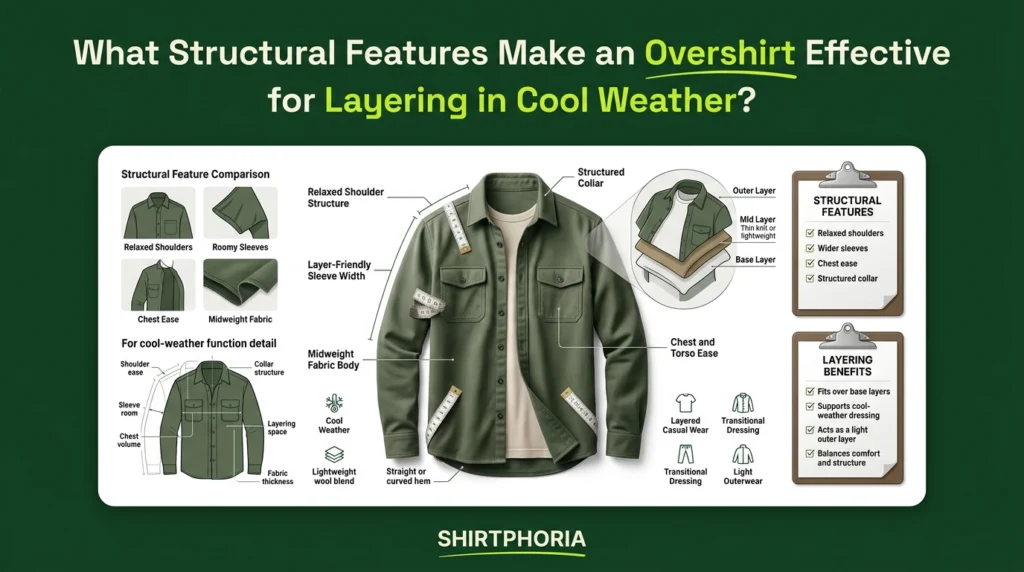
What Structural Features Make an Overshirt Effective for Layering in Cool Weather?
An overshirt becomes effective for cool-weather layering when its garment ease, fabric mass, shoulder and sleeve capacity, placket stability, hem control, and thermal properties work together without creating excessive bulk.
A useful cool-weather overshirt needs room for a realistic base layer such as a T-shirt, shirt, or lightweight knit. It also needs enough fabric substance to provide useful coverage while remaining comfortable beneath a heavier coat if mid-layer use is required.
The goal is balance.
A garment that fits too closely may pull across the chest and upper back when another layer is added. A garment that is excessively roomy can bunch beneath outerwear and reduce movement.
Fabric weight matters as well, but weight alone does not determine warmth or layering quality.
A Day’s March advises that an overshirt should fit comfortably over a base layer without restricting movement and should remain neither excessively tight nor excessively loose. A Day’s March
This guide explains how fit allowance, shoulders, armholes, sleeves, fabric mass, thermal air gaps, placket structure, hem stability, and layer compatibility determine whether an overshirt works effectively in cool weather.
For the broader garment category, see how overshirts function between conventional shirts and light outerwear.
Quick Answer: What Makes an Overshirt Effective for Cool-Weather Layering?
An overshirt works well for cool-weather layering when it has controlled room for the garments underneath, enough shoulder and sleeve mobility, suitable fabric mass, a stable front and hem, and enough thermal contribution for the intended conditions.
The most important structural features are:
- Controlled layering ease
- Comfortable shoulder width
- Adequate upper-back room
- Movement-compatible armholes
- Sufficient sleeve capacity
- Appropriate fabric mass
- Suitable weave and fiber
- Stable placket construction
- Controlled hem behavior
- Manageable under-coat bulk
No single feature makes the garment effective.
The overshirt works as a complete layering system.
Why Is Layering Ease the Starting Point for a Cool-Weather Overshirt?
Layering ease is the starting point because the overshirt needs usable internal space for the garments worn underneath it.
Layering ease is the difference between the finished dimensions of the overshirt and the dimensions of the wearer’s planned layer stack.
A layer stack might include:
- T-shirt + overshirt
- Dress shirt + overshirt
- Thermal base layer + overshirt
- Lightweight knit + overshirt
- T-shirt + knit + overshirt
The amount of room required changes with the stack.
An overshirt intended for a thin T-shirt does not need the same internal capacity as one intended for a substantial sweater.
This is why one universal fit measurement cannot define every cool-weather overshirt.
The functional relationship is:
Layering Ease → Accommodates Base Layers → Reduces Pulling and Compression
What Happens When an Overshirt Has Too Little Layering Ease?
Too little layering ease causes the base garment to occupy more space than the overshirt can comfortably accommodate.
Common warning signs include:
- Placket gaping
- Chest compression
- Horizontal tension lines
- Upper-back pulling
- Armhole binding
- Restricted reaching
- Base-layer bunching
- Excessive hem lift
The garment may look acceptable while standing still but fail once the arms move.
A useful overshirt must therefore be tested in motion.
What Happens When an Overshirt Has Too Much Layering Ease?
Too much layering ease creates a different problem.
Excess internal volume can cause:
- Persistent folds
- Shoulder collapse
- Wide sleeves
- Torso bulk
- Under-coat bunching
- Uncontrolled silhouette
- Excess fabric around the armholes
That may be acceptable if the overshirt is intended only as outerwear.
It becomes a problem if the same garment also needs to fit beneath a coat.
Extra room is useful only when it matches the planned layer stack.
How Should the Shoulders and Upper Back Fit for Layering?
The shoulders and upper back should provide enough room for movement over the intended base layers without creating uncontrolled volume.
Shoulder fit cannot be judged from seam position alone.
Some overshirts use a conventional shoulder seam.
Others intentionally extend the shoulder slightly.
A dropped shoulder can also be part of the design.
None of those constructions is automatically superior.
What matters is whether the shoulder area works with:
- Base-layer thickness
- Upper-back movement
- Armhole shape
- Sleeve shape
- Fabric stiffness
- Intended silhouette
The shoulder system should allow the garment to move without forcing the front open.
Forward-Reach Test
Wear the intended base layer beneath the overshirt.
Reach both arms directly forward.
Watch for:
- Tightness between the shoulder blades
- Severe horizontal pulling
- Placket opening
- Sleeve restriction
- Painful pressure
Mild temporary tension can occur in many garments.
Persistent restriction means the layer system may be too tight.
Cross-Body Test
Move one arm across the chest.
Repeat with the other.
This tests the relationship between:
- Shoulder
- Upper back
- Armhole
- Sleeve
If the fabric blocks normal movement or pulls the opposite side of the garment sharply forward, more upper-body ease may be needed.
Why Does Armhole Construction Matter for Cool-Weather Layering?
Armhole construction matters because every garment underneath the overshirt adds thickness around the shoulder and armpit area.
An overshirt worn directly over a T-shirt may feel comfortable.
Add a knit, and the available armhole space decreases.
The goal is adequate armhole comfort, not maximum depth.
A very tight armhole can bind.
A very low or oversized armhole can create excess fabric that bunches beneath a coat.
The useful relationship is:
Adequate Armhole Capacity → Accommodates Layers → Preserves Movement
What Are Signs of an Armhole That Is Too Tight?
An armhole may lack layering capacity when:
- Fabric presses sharply into the armpit
- The base layer bunches underneath
- Raising the arm feels restricted
- The shoulder lifts excessively
- The placket pulls during movement
Can an Armhole Be Too Large?
Yes.
Too much armhole volume can create:
- Hanging fabric
- Sleeve bulk
- Reduced precision
- Under-coat compression
- Uncomfortable folding around the armpit
A deeper armhole therefore does not automatically make an overshirt better for layering.
Shape and volume must match the intended garments underneath.
How Should Overshirt Sleeves Support Cool-Weather Layers?
Overshirt sleeves should provide enough internal capacity for the planned base layer while remaining streamlined enough to enter another coat sleeve if needed.
Sleeve width is particularly important when layering over:
- Flannel shirts
- Lightweight sweaters
- Thermal shirts
- Sweatshirts
- Knits
A narrow sleeve can compress those garments.
An excessively wide sleeve can bunch beneath outerwear.
Sleeve Compatibility Test
Wear the overshirt over the thickest realistic base layer.
Bend the elbows.
Reach forward.
Raise the arms.
Then, if mid-layer use matters, put on the intended coat.
Check whether:
- Sleeves enter easily
- Fabric twists
- Base layers drag upward
- Elbows remain mobile
- Armholes become compressed
- Outer sleeves feel overfilled
The correct sleeve capacity depends on the complete layer stack.
How Does Fabric Mass Affect Cool-Weather Overshirt Performance?
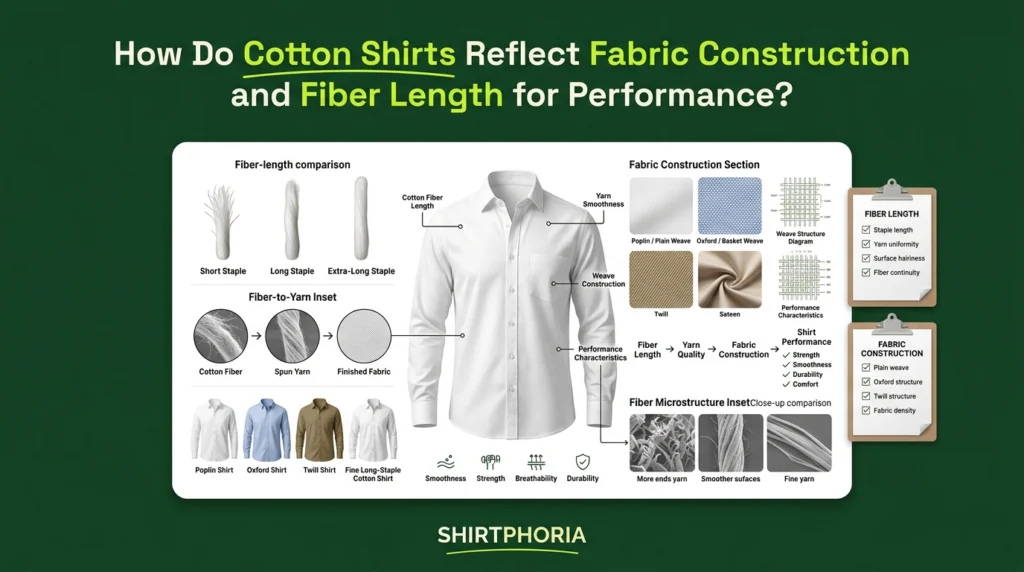
Fabric mass affects how substantial the overshirt feels and can influence its suitability as a transitional or cool-weather layer.
One common fabric specification is GSM, meaning grams per square metre.
ISO 3801 provides a standardized basis for determining textile mass per unit area. ISO 3801
The relationship is straightforward:
GSM → Measures Fabric Mass per Unit Area → Supports Textile Weight Comparison
If two textile samples cover the same area, the higher-GSM sample has greater mass.
But GSM is not a complete performance rating.
What Does Higher GSM Not Automatically Mean?
Higher GSM does not automatically guarantee:
- More warmth
- Greater durability
- Better quality
- Better drape
- Greater thickness
- Better wind resistance
- Better structure
- Better layering performance
A fabric’s behavior also depends on:
- Fiber
- Yarn
- Weave
- Thickness
- Density
- Surface finish
- Brushing
- Loft
- Lining
- Pattern construction
Two overshirts with similar GSM values may therefore behave differently.
One may be dense and firm.
Another may be soft and lofty.
Another may be lined.
GSM helps describe mass, not the full garment.
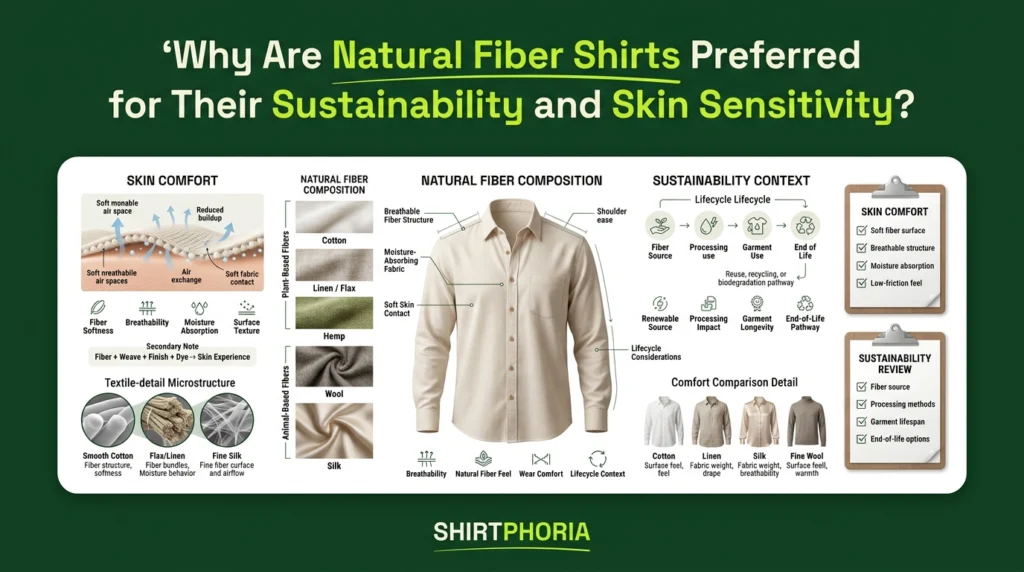
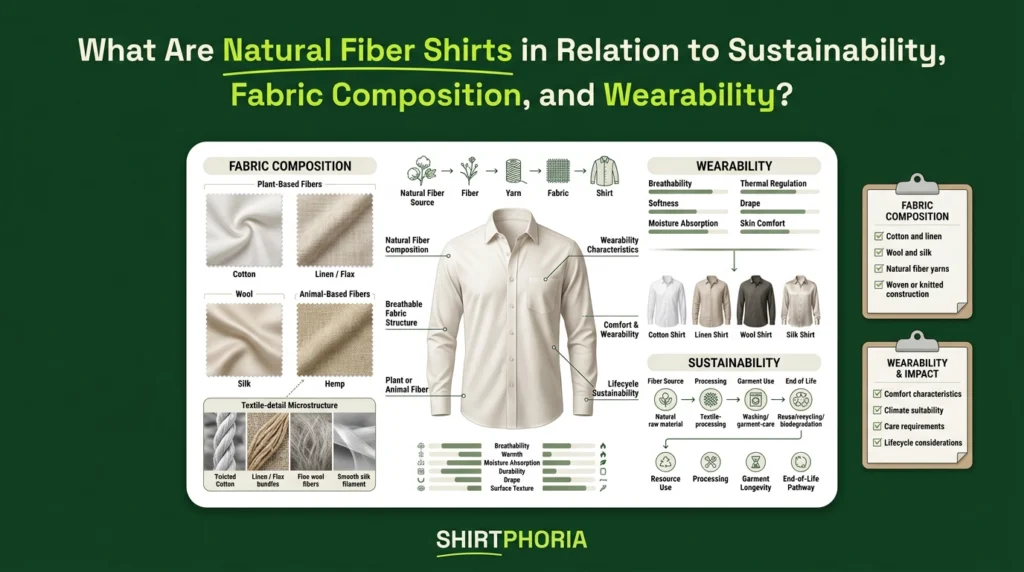
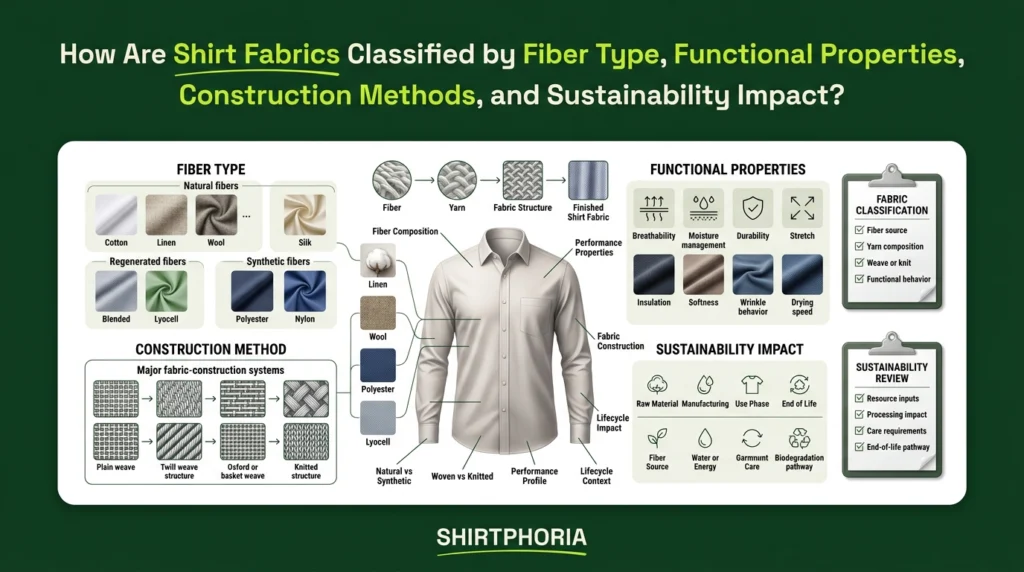
How Do Fiber and Weave Change Cool-Weather Layering?
Fiber and weave change how an overshirt manages warmth, airflow, drape, moisture, and structure.
Different cool-weather overshirts may use:
- Cotton twill
- Flannel
- Moleskin
- Wool
- Wool blends
- Brushed cotton
- Denim
- Canvas
- Quilted constructions
Each behaves differently.
A dense cotton twill may provide good structural control.
Brushed fabric may trap more air around its surface.
Wool can perform differently from cotton because its fiber properties and textile construction differ.
A quilted overshirt may add substantially more thickness.
The important rule is:
Evaluate the actual fabric system rather than choosing by fiber name or GSM alone.
How Does Thermal Insulation Affect Overshirt Layering?
Thermal insulation affects overshirt layering because the garment adds material and changes the air spaces between the body, base layers, overshirt, and outerwear.
Clothing-fit research shows that garment fit can change clothing air gaps and that the relationship between air-gap size and thermal insulation is not simply linear. Clothing Fit and Thermal Insulation Research
That means more empty space does not always create more warmth.
Thermal behavior can depend on:
- Air-gap distribution
- Fabric thickness
- Fiber
- Loft
- Moisture
- Openings
- Wind
- Movement
- Layer compression
- Activity level
The practical relationship is:
Additional Layer + Controlled Air Space → May Increase Thermal Resistance → May Improve Cool-Weather Comfort
The word may is important.
Why Can Excessive Looseness Reduce Thermal Efficiency?
An oversized garment can create larger and less controlled air spaces.
Movement may circulate air inside those spaces.
Open hems, cuffs, collars, and plackets can also allow warm air to escape and cooler air to enter.
This is why an overshirt that is dramatically oversized is not automatically warmer.
Why Can an Overshirt That Is Too Tight Also Reduce Layering Comfort?
A tight overshirt can compress the garments underneath.
It may also:
- Restrict movement
- Flatten lofted layers
- Cause discomfort
- Create tension around openings
- Make temperature regulation more difficult
The useful range sits between compression and uncontrolled looseness.
Because warmth depends on fabric construction, trapped air, garment fit, and the complete layer stack, compare the overshirt’s role with thermal shirt insulation.
Why Does Placket Structure Matter in Cool Weather?
Placket structure matters because the overshirt front needs to remain stable when buttoned for coverage and controlled when opened indoors or during transitional weather.
The placket is the reinforced front-opening area that carries:
- Buttons
- Snaps
- Other closures
A cool-weather overshirt may be worn closed outside and open indoors.
The front needs to work in both states.
The relationship is:
Controlled Placket → Stabilizes Front Opening → Supports Open and Closed Layering
Under-Structured Placket
Too little support can cause the placket to:
- Curl
- Twist
- Collapse
- Distort around buttons
- Lose visual control when open
Balanced Placket
A balanced placket should:
- Close without forced tension
- Support the closures
- Remain relatively controlled when open
- Move naturally with the fabric
Over-Structured Placket
Too much reinforcement can:
- Create stiffness
- Increase bulk
- Press beneath a coat
- Reduce natural movement
A firm placket is therefore useful only when it remains proportional to the rest of the garment.
Why Does Hem Stability Matter for an Overshirt?
Hem stability matters because the overshirt is commonly worn outside the trousers, making the lower edge part of the visible silhouette and layering system.
The hem should remain reasonably controlled when the wearer:
- Walks
- Reaches
- Sits
- Layers beneath a coat
- Wears the garment open
Controlled Hem Movement
Normal movement may cause the hem to rise or shift temporarily.
That is not automatically a problem.
A controlled hem returns close to its natural position after the wearer relaxes.
Structural Hem Distortion
More serious problems include:
- Persistent twisting
- Severe flare
- Permanent displacement
- Uneven collapse
- Excess fabric trapped beneath outerwear
These problems may result from pattern balance, fabric behavior, laundering, construction, or excessive fit volume.
How Does Front Closure Spacing Affect Cool-Weather Coverage?
Front closure spacing affects how well the overshirt controls gaps along the torso when worn closed.
Buttons or snaps placed too far apart can allow the front to gape when the garment stretches across:
- Chest
- Abdomen
- Base layers
However, adding more closures does not automatically improve performance.
Too many heavy closures can:
- Increase placket stiffness
- Add weight
- Slow fastening
- Create pressure beneath outerwear
The closure system should control the front without overwhelming the fabric.
When Does an Overshirt Work as a Cool-Weather Mid-Layer?
An overshirt works as a cool-weather mid-layer when it provides useful thermal and structural support while still fitting comfortably beneath a heavier outer garment.
A mid-layer overshirt should pass several tests.
Base-Layer Test
It should close over the intended base garments without:
- Forced gaping
- Severe compression
- Painful restriction
Movement Test
The wearer should retain useful:
- Forward reach
- Cross-body reach
- Overhead reach
- Elbow movement
Under-Coat Test
The actual intended coat should fit over the overshirt.
Check:
- Coat closure
- Sleeve compression
- Shoulder bulk
- Hardware pressure
- Chest restriction
- Bunching
A thick overshirt can succeed over a sweater but fail beneath a coat.
That does not necessarily make it a bad garment.
It means it is functioning primarily as an outer layer.
When Does an Overshirt Work as a Cool-Weather Outer Layer?
An overshirt works as a cool-weather outer layer when its fabric, fit, front structure, and hem provide enough substance for standalone use over lighter garments.
It may work over:
- T-shirt
- Thermal base
- Shirt
- Lightweight knit
- Sweatshirt
Useful descriptions include:
- Light outer layer
- Cool-weather layer
- Transitional layer
- Wind-buffering layer
An ordinary overshirt should not automatically be described as windproof, rainproof, or weatherproof.
That requires specific materials, treatments, membranes, coatings, seam construction, or testing.
If dependable protection from strong wind or rain is required, dedicated weather outerwear is more appropriate.
Comparison: Cool-Weather Overshirt vs Casual Shirt vs Light Jacket
A cool-weather overshirt sits between conventional shirting and dedicated outerwear by combining shirt construction with additional layering capacity and fabric substance.
| Feature | Casual Shirt | Cool-Weather Overshirt | Light Jacket |
|---|---|---|---|
| Fit Intent | Usually fits the body or a light base garment | Uses controlled room for planned layers | Usually allows enough room for exterior-layer use |
| Fabric Mass | Commonly uses lighter shirting | Often uses more substantial fabric | May use heavier, lined, coated, or insulated construction |
| Layering Role | Usually base or light mid-layer | Can function as mid-layer, light outer layer, or both | Primarily outerwear |
| Shoulder Capacity | Designed mainly around ordinary shirt movement | Must account for base-layer thickness | May accommodate more outer-layer volume |
| Sleeve Capacity | Usually relatively streamlined | Balances base-layer room with under-coat compatibility | May be too bulky for use under another coat |
| Thermal Contribution | Usually limited unless specialized | Can add useful warmth within a layer stack | May provide stronger insulation or weather protection |
| Front Structure | Primarily shirt-oriented | Needs enough stability for open and closed wear | Usually prioritizes outer-layer control |
| Failure Point | Too light or close-fitting for planned layering | Too tight over layers or too bulky beneath outerwear | Too substantial to work as a practical mid-layer |
The overshirt is therefore effective when it preserves role flexibility.
Cool-Weather Overshirt Measurement Protocol
A useful fit evaluation combines measurements with movement tests.
Measure the Finished Chest
- Button the overshirt.
- Lay it flat.
- Smooth the fabric without stretching it.
- Measure from underarm to underarm.
- Double the flat measurement to estimate chest circumference.
Measure the Planned Layer Stack
Wear the thickest realistic combination you expect beneath the overshirt.
Measure around the fullest chest area.
Do not heavily compress the clothing with the tape.
Calculate Available Chest Margin
Use:
Finished Overshirt Chest Circumference − Planned Layer-Stack Chest Circumference = Available Chest Margin
Do not interpret this number by itself.
Also check:
- Fabric stiffness
- Placket behavior
- Shoulder movement
- Upper-back tension
- Sleeve capacity
- Intended silhouette
There is no single universal margin that works for every fabric, body, and layer stack.
Cool-Weather Layering Diagnostic Checklist
Use these checks instead of a point-based scoring system.
Base-Layer Fit Check
The overshirt should close over the actual planned base layer without severe compression or forced gaping.
Upper-Back Check
Forward reaching should not create persistent tension that prevents practical movement.
Shoulder Check
The shoulder construction should accommodate the planned layers without severe binding or uncontrolled collapse.
Armhole Check
Armholes should provide enough room for the layers without painful pressure or excessive loose fabric.
Sleeve Check
Sleeves should accommodate the base garment and still fit into outerwear if mid-layer use is intended.
Fabric-Mass Check
Use GSM as textile-mass information rather than as a warmth, quality, or durability score.
Placket Check
The front should remain controlled when open and should close without severe tension.
Hem Check
The lower edge should avoid persistent twisting, excessive flare, and structural imbalance.
Thermal Check
The garment may contribute warmth, but that contribution should be interpreted within the complete layer stack.
Under-Coat Check
If the overshirt needs to function as a mid-layer, test it beneath the actual coat rather than assuming compatibility.
What Failure Modes Reduce Cool-Weather Layering Performance?
Cool-weather layering performance declines when the overshirt moves too far toward either insufficient capacity or excessive bulk.
| Attribute | Too-Low Failure | Transition Zone | Too-High Failure | Practical Fix |
|---|---|---|---|---|
| Chest Ease | Base layer is compressed and placket gaps | Works over T-shirt but not intended knit | Excess fabric bunches under coat | Choose size or pattern according to real layer thickness |
| Upper-Back Ease | Reaching creates strong tension | Works only over thin layers | Excess back fabric folds beneath outerwear | Repeat movement tests with intended layers |
| Armhole Capacity | Armpit binds | Comfortable with shirt but not knit | Excess armhole fabric bunches | Choose balanced armhole capacity |
| Sleeve Volume | Base garment compresses inside sleeve | Works with thin knit only | Sleeve becomes difficult to fit inside coat | Match sleeve volume to full layer stack |
| Fabric Mass | Garment lacks desired cool-weather substance | Works mainly in mild conditions | Becomes hot and too bulky for mid-layer use | Match fabric to climate and primary role |
| Placket Structure | Front curls or collapses | Stable mainly when fully closed | Becomes rigid beneath outerwear | Choose balanced reinforcement |
| Thermal Contribution | Adds little useful warmth | Relies strongly on surrounding layers | Creates overheating or excess indoor bulk | Match fiber, lining, fabric, and activity |
| Outer-Layer Structure | Garment behaves like a regular shirt | Works only in calm mild weather | Becomes a jacket rather than a layerable overshirt | Define the primary role before purchase |
Two Common Layering Failure Cascades
Problems often combine rather than remaining isolated.
Insufficient Fit Capacity
Insufficient Chest Ease → Placket Tension → Upper-Body Restriction → Reduced Layer Compatibility → Cool-Weather Layering Failure
A chest-fit problem can therefore affect the whole garment.
Excessive Garment Volume
Excess Torso and Sleeve Volume → Under-Coat Bunching → Compression → Movement Loss → Mid-Layer Failure
In that situation, the garment may need to be used as a light outer layer instead.
How to Choose an Overshirt for Cool-Weather Layering
Choose the overshirt according to the layers and weather conditions you actually expect to use.
If You Mainly Wear a T-Shirt Underneath
Prioritize:
- Moderate layering ease
- Clean shoulder alignment
- Useful fabric substance
- Stable open-wear structure
You may not need large sleeve or torso capacity.
If You Mainly Wear a Knit Underneath
Prioritize:
- More chest room
- Upper-back movement
- Armhole comfort
- Sleeve capacity
- Placket stability
Always test the overshirt with the actual knit.
If You Need the Overshirt Beneath a Coat
Prioritize:
- Streamlined bulk
- Smooth sleeve entry
- Moderate hardware
- Comfortable armholes
- Controlled torso volume
Avoid assuming that a heavier overshirt will automatically work better.
If You Mainly Want Light Outerwear
Prioritize:
- Fabric substance
- Front stability
- Hem control
- Enough room for base layers
- Appropriate cool-weather coverage
Under-coat compatibility may be less important.
Final Cool-Weather Overshirt Checklist
Before buying or choosing an overshirt for cool-weather layering, check the complete system.
- Primary Role: Decide whether the overshirt is mainly a mid-layer, outer layer, or both.
- Base Layer: Identify the thickest garment realistically worn underneath.
- Chest Fit: Close the overshirt over that layer and check for gaping or compression.
- Shoulders: Make sure the upper garment allows useful movement.
- Upper Back: Perform a forward-reach test.
- Armholes: Check for binding or excessive looseness.
- Sleeves: Make sure the planned base layer fits without compression.
- Under-Coat Compatibility: Test the actual coat if mid-layer use matters.
- Fabric Mass: Use GSM as a weight measure rather than a universal performance score.
- Fabric Construction: Consider fiber, weave, thickness, finish, and lining.
- Placket: Confirm the front remains stable open and closed.
- Hem: Check for twisting, severe flare, or persistent distortion.
- Thermal Role: Judge warmth as part of the full layer stack.
- Weather Boundary: Do not assume untreated fabric is windproof or waterproof.
- Movement: Confirm practical forward, cross-body, and overhead reach.
Educational note: This guide explains overshirt fit, layering, textile mass, and thermal behavior for general educational purposes. Actual comfort and performance vary by body shape, layer thickness, fabric, construction, activity, weather, and outerwear.
Interactive Cool-Weather Overshirt Checklist
FAQ: Cool-Weather Overshirt Layering
An overshirt should have enough room for its planned base layers, but it does not need to fit excessively loose. Too little room creates pulling and binding, while too much volume can bunch beneath a coat. Fit should be tested with the actual layers the wearer intends to use.
No. GSM measures fabric mass per unit area, not complete garment performance. Higher GSM does not automatically guarantee more warmth, durability, quality, or weather resistance. Fiber, weave, thickness, lining, fit, and the complete layer stack also affect cool-weather performance.
An overshirt can work as a light outer layer in suitable cool-weather conditions, but it should not automatically replace an insulated winter jacket. Protection depends on fabric, lining, wind, moisture, temperature, activity, and the layers worn underneath.
Common options include a T-shirt, long-sleeve shirt, thermal base layer, or lightweight knit. The appropriate combination depends on temperature, activity, overshirt fabric, and outerwear. The overshirt should be fitted using the thickest realistic base layer planned for regular use.
Terms Explained
| TERM | DEFINITION |
|---|---|
| Layering Ease | The usable difference between finished overshirt dimensions and the dimensions of the planned layer stack. |
| GSM | Grams per square metre, a standardized measure of textile mass per unit area. |
| Armhole Capacity | The usable space around the sleeve-to-body junction for movement and underlying layers. |
| Thermal Resistance | Resistance to heat transfer within a clothing system, influenced by fabric, air gaps, fit, openings, movement, and surrounding layers. |
| Placket | The reinforced front-opening area that carries buttons, snaps, or other closures. |
| Controlled Hem Movement | Normal temporary hem movement that returns close to its resting position after movement. |
| Mid-Layer | A garment worn between a base layer and heavier outerwear. |
| Light Outer Layer | A garment worn over lighter layers in cool or transitional weather without necessarily providing technical weather protection. |
Conclusion
In conclusion, the structural features that make an overshirt effective for layering in cool weather are controlled garment ease, movement-compatible shoulders and armholes, sufficient sleeve capacity, appropriate fabric mass, stable front construction, controlled hem behavior, and compatibility with the complete layer stack.
Fit comes first.
The overshirt needs enough internal room for the garments underneath without creating uncontrolled bulk.
The shoulder and upper back must allow practical movement.
Armholes and sleeves need enough capacity for the planned layers while remaining streamlined if another coat will be worn above them.
Fabric mass contributes substance, but GSM should remain a weight measurement rather than a shortcut for judging warmth or quality.
Fiber, weave, thickness, finish, lining, and garment construction determine how that fabric actually behaves.
Thermal performance also depends on the clothing system.
An additional overshirt layer and controlled air spaces may improve cool-weather comfort, but excessive looseness, openings, movement, and wind can reduce the expected benefit.
Placket and hem stability complete the structure by helping the garment remain controlled when worn open, buttoned, or layered.
The most useful overshirt is therefore not simply the thickest or loosest option.
It is the garment whose structure matches the base layers, outerwear, movement requirements, climate, and role the wearer actually needs.
For cool-weather layering, an overshirt works best when its space, fabric, movement capacity, and structure support the complete layer system without unnecessary compression or bulk.