Why Are Natural Fiber Shirts Preferred for Their Sustainability and Skin Sensitivity?
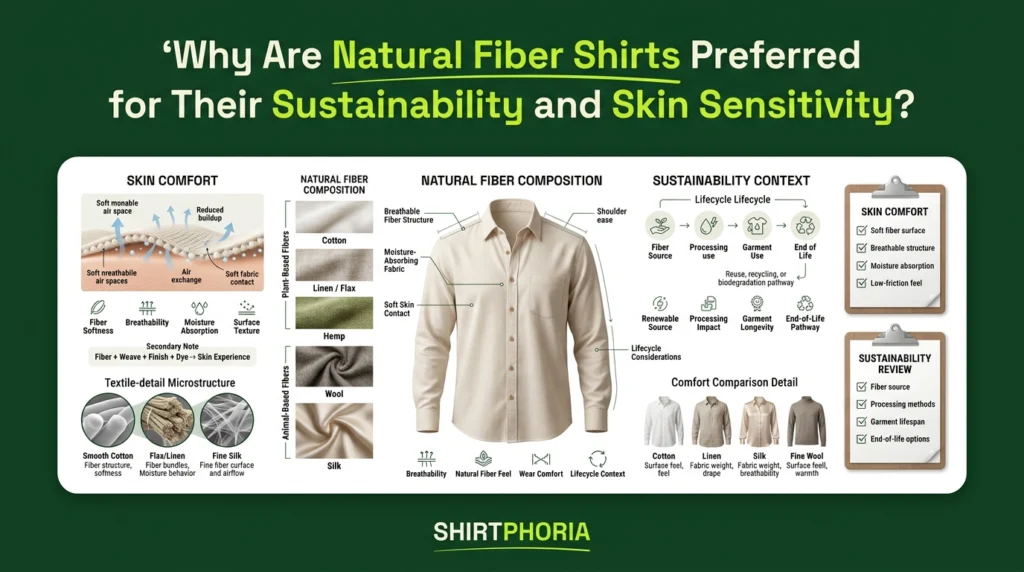
Natural fiber shirts are often preferred because plant- and animal-derived fibers can provide renewable raw-material sources and textile properties that support moisture management, thermal comfort, and suitable skin feel, but sustainability and skin compatibility depend on sourcing, composition, construction, finishing, care, durability, wearing conditions, and individual sensitivity.
The word “natural” accurately describes fiber origin, but it reveals much less about the finished shirt than many buyers assume. A cotton, linen, silk, or wool shirt is not automatically sustainable, breathable, hypoallergenic, irritation-free, durable, biodegradable as a complete garment, or better for every wearer.
The actual outcome depends on the complete textile system. Fiber percentages, yarn design, weave or knit construction, fabric weight, density, thickness, finishing treatments, garment fit, care requirements, sourcing practices, climate, activity level, and useful wear-life can all modify the expected benefits.
This guide explains why natural fiber shirts are often preferred for sustainability and skin comfort, which textile mechanisms create those benefits, when those advantages genuinely apply, and how to choose a natural-fiber shirt without relying on the word “natural” alone.
The preference for natural fibers summarizes their Sustainability and Skin Sensitivity benefits within What Are Natural Fiber Shirts in Relation to Sustainability, Fabric Composition, and Wearability?.
Why Do Sustainability and Skin Sensitivity Drive Preference for Natural Fiber Shirts?
Sustainability and skin sensitivity can drive preference for natural fiber shirts because biological fiber origins may offer renewable sourcing opportunities while moisture, thermal, tactile, and structural characteristics may support comfortable skin contact under suitable textile and wearing conditions.
These are two different reasons for preference.
Sustainability concerns how the material is sourced, processed, used, maintained, and eventually managed at end-of-life. Skin comfort concerns how the finished textile interacts with the wearer through moisture, heat, friction, surface texture, fit, and finishing.
Neither benefit can be established from the fiber name alone.
Why Can Natural Fiber Origin Matter for Shirt Sustainability?
Natural fiber origin can matter for shirt sustainability because plant- and animal-derived materials come from renewable biological systems, although renewable sourcing alone does not establish a low-impact lifecycle profile.
Cotton, flax, hemp, wool, silk, and other natural textile materials can be replenished through biological production rather than being derived primarily from finite petroleum-based feedstocks.
That distinction creates a potential sourcing advantage.
However:
Renewability is an input characteristic, not a complete sustainability judgment.
Producing renewable materials can still involve land, irrigation, fertilizers, pesticides, animal husbandry, energy, processing chemicals, dyeing, finishing, transportation, laundering, and disposal impacts.
A sustainability assessment must therefore extend beyond fiber origin to consider:
- sourcing;
- agricultural or animal-production practices;
- processing;
- dyeing;
- finishing;
- durability;
- actual garment use;
- repairability;
- care;
- and end-of-life.
Natural origin establishes where the fiber comes from. It does not establish the total environmental outcome.
Why Can Natural Fiber Properties Matter for Skin Comfort?
Natural fiber properties can matter for skin comfort because moisture interaction, textile airflow, thermal behavior, fiber diameter, surface texture, and finishing influence heat, dampness, friction, and tactile sensation where the shirt contacts the body.
Cotton, linen, wool, silk, hemp, and ramie do not create identical skin-contact experiences.
Cellulose fibers such as cotton and linen can absorb moisture. Wool can interact with moisture vapor and contribute moisture buffering. Silk can produce a relatively smooth surface in suitable constructions.
Yet these inherent characteristics are only part of the finished result.
Comfort also depends on:
- yarn structure;
- weave or knit;
- fabric weight;
- density;
- thickness;
- finishing;
- garment fit;
- climate;
- activity;
- laundering;
- and individual sensitivity.
Moisture absorption is especially easy to misunderstand. An absorbent fabric can help take up moisture, but high absorption does not guarantee fast drying. If moisture accumulates faster than the textile can transport, evaporate, or release it, the fabric can remain damp.
Likewise:
Natural fiber ≠ automatically hypoallergenic.
Natural fiber ≠ guaranteed irritation-free.
Dyes, textile finishes, friction, perspiration, garment components, and individual sensitivity can all influence skin response. DermNet’s textile contact dermatitis guidance provides useful context for distinguishing fiber identity from reactions associated with dyes, finishing agents, and other textile-contact factors.
Natural-fiber selection should therefore support comfort rather than be treated as prevention or treatment for a medical skin condition.
How Can Natural Fiber Shirts Provide Sustainability Advantages?
Natural fiber shirts can provide sustainability opportunities through renewable sourcing, reduced reliance on virgin fossil-derived textile inputs, useful garment longevity, repairability, and certain end-of-life pathways, but each advantage depends on how the shirt is produced, used, maintained, and disposed of.
No single benefit establishes overall sustainability.
A renewable fiber can involve resource-intensive production. A highly durable shirt can still have substantial manufacturing impacts. A biodegradable fiber can form part of a garment that contains synthetic thread, elastane, coatings, or other components.
Lifecycle context is therefore essential.
How Does Renewable Fiber Sourcing Influence Natural Fiber Shirt Sustainability?
Renewable fiber sourcing can create a sustainability opportunity because cotton, flax, hemp, wool, silk, and other biological materials can be replenished through agricultural or animal-production systems, although regeneration alone does not establish resource efficiency.
Renewability describes the ability of the biological source to be replenished.
It does not automatically mean:
- low water demand;
- low land use;
- low emissions;
- low chemical inputs;
- biodiversity protection;
- efficient production;
- or ethical sourcing.
Cotton production, for example, can vary according to geography, irrigation, agricultural inputs, soil management, and production efficiency.
Flax and hemp also vary according to cultivation and processing systems.
Animal-derived fibers such as wool and silk introduce additional sourcing considerations, including animal husbandry, land management, feed systems, and production practices.
Two shirts made from the same natural fiber can consequently have different environmental profiles.
The correct question is not simply whether the source is renewable, but how that renewable material was produced.
How Can Natural Fiber Shirts Reduce Dependence on Fossil-Based Textile Inputs?
Natural fiber shirts can reduce reliance on virgin fossil-derived main-fabric inputs when biological fibers replace petroleum-derived synthetic fibers in the textile composition, although other garment components may still contain synthetic materials.
A 100% cotton main fabric, for example, does not use polyester as its primary textile fiber.
That does not mean the entire finished shirt is necessarily petroleum-free.
Synthetic materials can still appear in:
- sewing thread;
- elastane;
- interlinings;
- coatings;
- blended yarns;
- labels;
- trims;
- and some buttons or other components.
A garment described as “100% cotton” may therefore accurately describe the main textile composition while containing other manufactured components.
The sustainability advantage should be stated precisely: natural-fiber composition can reduce reliance on virgin fossil-derived fibers in the relevant textile component. It should not be expanded into an unsupported claim that the complete garment is fossil-free.
How Do Durability and Garment Lifespan Affect the Sustainability Benefit of Natural Fiber Shirts?
Durability and useful wear-life influence natural fiber shirt sustainability because longer-lasting garments can reduce replacement demand, and when that longer lifespan results in more actual wears, production impacts can be distributed across a larger number of wear events.
Useful wear-life is the period during which a garment remains functional and acceptable for its intended purpose.
Four related concepts should remain distinct:
- technical durability;
- potential lifespan;
- realized useful wear-life;
- actual number of wears.
A technically strong shirt provides little longevity advantage if it remains unworn in a wardrobe.
Conversely, a well-constructed shirt that withstands regular use, laundering, repair, and continued wear may delay replacement.
Relevant factors include abrasion resistance, seam durability, dimensional stability, shrinkage, shape retention, repairability, and appropriate care.
Fiber strength alone does not determine garment lifespan. Yarn quality, fabric construction, seams, finishing, garment design, laundering, and actual wearer behavior matter as well.
Durability is therefore valuable when it translates into continued use rather than merely theoretical longevity.
How Can End-of-Life Characteristics Affect Natural Fiber Shirt Sustainability?
End-of-life characteristics can influence natural fiber shirt sustainability because some natural-fiber textiles can biodegrade under suitable conditions, while blends, dyes, finishes, trims, garment components, and disposal environments can substantially change that behavior.
Natural fibers such as cotton, linen, wool, and silk have material characteristics that differ from conventional synthetic polymers, but the behavior of an isolated fiber should not automatically be assigned to a complete shirt.
Several variables can influence real-world decomposition:
- synthetic blends;
- elastane;
- dyes;
- resin finishes;
- coatings;
- sewing thread;
- labels;
- buttons;
- adhesives;
- trims;
- and disposal conditions.
The necessary boundary is:
Fiber biodegradability ≠ textile biodegradability ≠ complete-garment biodegradability ≠ environmentally harmless disposal.
A natural fiber may be capable of biodegradation under suitable conditions while the complete garment contains materials that behave differently.
Landfill conditions also differ from controlled composting, soil, aquatic environments, and industrial treatment systems.
Biodegradability should therefore be treated as one end-of-life property rather than a universal environmental verdict.
How Can Natural Fiber Shirts Support Skin Comfort and Sensitive-Skin Wearability?
Natural fiber shirts may support sensitive-skin comfort when the finished textile provides suitable moisture handling, air exchange, thermal behavior, surface smoothness, and low-friction contact, but individual response and finishing chemistry remain important modifiers.
The finished processed textile contacts the skin-not an abstract fiber category.
That distinction explains why two shirts made from the same natural fiber can produce different wearer experiences.
How Does Moisture Absorption Affect Skin Comfort in Natural Fiber Shirts?
Moisture absorption and buffering can influence skin comfort by temporarily managing moisture near the skin, although an absorbent fabric can become uncomfortable when moisture accumulates faster than it is transported, evaporated, or released.
Cotton and linen can absorb moisture. Wool interacts with moisture differently and can contribute buffering of changes in surrounding humidity.
Moisture buffering is the ability of a material or textile system to absorb and release moisture as surrounding conditions change.
Several moisture mechanisms should remain separate:
Moisture absorption describes uptake into the material.
Moisture transport describes movement through the textile.
Wicking describes liquid movement along or through textile structures through mechanisms such as capillary action.
Evaporation removes moisture as vapor.
Drying time describes how long retained moisture takes to leave the textile under defined conditions.
Drying rate describes how quickly that moisture loss occurs.
These properties interact, but they are not interchangeable.
High moisture absorption does not by itself establish rapid drying.
An absorbent shirt can become increasingly damp during heavy perspiration if moisture uptake exceeds transport and evaporation.
The practical value of absorption therefore depends on climate, activity, textile structure, and drying behavior.
How Do Airflow and Thermal Regulation Affect Sensitive-Skin Comfort?
Air exchange and thermal behavior can influence skin comfort because textile structures that limit excessive heat and trapped moisture may reduce hot, damp, or friction-prone wearing conditions.
Air movement depends strongly on physical fabric structure.
Important variables include:
- yarn arrangement;
- weave or knit construction;
- fabric density;
- weight;
- thickness;
- finishing;
- and garment fit.
For example, a dense cotton twill may have lower air permeability than a more open linen fabric, depending on the actual textile constructions being compared.
That does not mean cotton is inherently non-breathable or linen is automatically highly breathable.
Construction changes the result.
Air permeability is one measurable textile property, not a universal comfort score.
A test can quantify air passing through fabric under defined conditions, but wearer comfort also depends on humidity, heat, perspiration, activity, clothing layers, fit, moisture management, and personal preference.
How Do Softness and Surface Texture Affect Natural Fiber Shirt Skin Feel?
Softness and surface texture influence natural fiber shirt skin feel because fiber diameter, yarn quality, surface structure, finishing, and construction affect friction and tactile roughness at the garment-skin interface.
Different natural fibers have characteristic tendencies.
Cotton can feel soft in suitable yarn and fabric constructions.
Linen commonly has a crisper initial hand.
Silk can provide a smooth surface and fluid tactile character.
Wool varies substantially according to fiber diameter. Fine wool can feel very different from coarser wool against the skin.
Hemp commonly produces a more structured textile feel, while processing and finishing can modify its surface.
Ramie can also produce a crisp, structured hand.
These are tendencies rather than fixed rankings.
Fiber processing, yarn design, finishing, laundering, fabric construction, and wearer sensitivity can change the perceived softness of every category.
A fabric does not need to be the softest possible textile to be comfortable, and natural origin does not guarantee softness.
How Can Dyes and Finishes Change the Skin-Sensitivity Profile of a Natural Fiber Shirt?
Dyes and finishing treatments can change the skin-contact profile of a natural fiber shirt because the wearer interacts with the processed textile surface and garment components rather than with untreated raw fiber alone.
Natural fibers can undergo substantial processing after harvest or collection.
A finished shirt may involve:
- dyes;
- wrinkle-resistant finishes;
- stain-resistant treatments;
- coatings;
- softeners;
- antimicrobial treatments;
- resins;
- adhesives;
- and elastic components.
Therefore:
100% natural fiber composition ≠ untreated textile.
A 100% cotton shirt can still be dyed, softened, coated, or treated for wrinkle performance.
Some wrinkle-resistant textiles may use formaldehyde-based finishing resins, but the chemistry of an individual garment should never be assumed when it has not been disclosed.
Likewise, a named finish should not automatically be described as irritating or harmful.
The correct evaluation considers disclosed treatment information, the finished surface, garment care, and the individual wearer.
How Do Plant-Based Natural Fiber Shirts Contribute to Sustainability and Skin Comfort?
Plant-based natural fiber shirts can combine renewable cellulose-based sourcing with useful moisture and wearability characteristics, but sustainability and skin comfort vary substantially across cotton, linen, hemp, ramie, production systems, and finished textile constructions.
Plant-derived describes biological origin. It does not automatically mean sustainable, ethically sourced, vegan under every product definition, or universally suitable for sensitive skin.
How Do Cotton, Linen, Hemp, and Ramie Differ in Sustainability Factors?
Cotton, linen, hemp, and ramie differ in sustainability profiles because agricultural practices, water demand, land use, processing, energy systems, durability, and garment lifespan can vary substantially across fibers, geographies, and production systems.
Cotton can involve different irrigation systems, agricultural inputs, yields, sourcing standards, and processing systems.
Linen begins with flax but still requires cultivation, fiber extraction, retting or related preparation, spinning, weaving, dyeing, and finishing.
Hemp production similarly varies according to farming and fiber-processing methods.
Ramie has its own cultivation and processing profile.
These differences make simplistic rankings unreliable.
Statements such as “linen always uses less water” or “hemp is always the most sustainable” require evidence based on genuinely comparable production systems and lifecycle boundaries.
Environmental comparisons should therefore examine compatible factors such as:
- agricultural inputs;
- water requirements;
- land use;
- processing;
- energy;
- textile durability;
- care;
- and actual wear-life.
Variation can exist within a fiber category as well as between different fibers.
How Do Plant-Based Fibers Differ in Skin Feel and Wearability?
Plant-based fibers differ in wearability because cotton, linen, hemp, and ramie have different characteristic moisture, texture, flexibility, strength, and drape tendencies that are further modified by yarn design, construction, processing, and finishing.
Cotton is widely associated with useful moisture absorption and a potentially soft hand.
Linen combines absorbency with a more characteristically crisp feel and can offer useful airflow potential in appropriate open constructions.
Hemp can provide strength and a structured textile character.
Ramie can be strong, crisp, absorbent, and relatively low in elasticity.
None of these characteristics independently determines complete shirt comfort.
A lightweight cotton poplin differs from cotton Oxford or heavy cotton twill. An open linen construction differs from dense linen. Processed and softened hemp can differ substantially from a more rustic hemp textile.
Fiber-level strength must also remain separate from finished-shirt durability.
A strong bast fiber cannot compensate automatically for poor yarn, weak seams, unsuitable fabric construction, or damaging care.
How Does Ethical Sourcing Affect the Preference for Plant-Based Fiber Shirts?
Ethical sourcing can influence preference for plant-based fiber shirts because agricultural practices, labor conditions, chemical inputs, land management, certifications, and supply-chain transparency affect how responsibly a plant-derived textile is produced.
Several terms that are often merged should remain distinct.
Plant-based refers to biological material origin.
Vegan concerns the absence of animal-derived materials under the applicable product definition.
Sustainable concerns environmental performance across relevant lifecycle dimensions.
Ethically sourced concerns sourcing, labor, production, or supply-chain practices.
These concepts can overlap, but they are not synonyms.
Certification can provide evidence about specified requirements within its scope. For example, the Global Organic Textile Standard (GOTS) establishes requirements for qualifying organic textile processing and supply chains, but certification should not be treated as proof of universal environmental superiority across every lifecycle metric.
The preference is based on the general category, which is analyzed by the ethical sourcing of How Do Plant-Based Fiber Shirts Address Ethical Sourcing and Misconception in Vegan Fashion?.
How Do Animal-Based Natural Fiber Shirts Differ in Comfort, Sustainability, and Care?
Animal-based natural fiber shirts differ from plant-based natural fibers because protein fibers such as wool and silk can provide distinctive moisture, insulation, tactile, and drape characteristics while creating different sourcing, ethical, and maintenance considerations.
Performance and sourcing ethics should be evaluated independently.
A fiber can provide useful textile performance while still requiring separate examination of how it was produced.
Why Can Wool Be Valued for Thermal Regulation and Moisture Buffering?
Wool can be valued in shirts because its fiber structure and moisture interaction can contribute insulation, moisture buffering, resilience, and thermal adaptability across suitable lightweight and heavier constructions.
Wool can interact with moisture vapor, helping a textile buffer changing moisture conditions.
Its fiber structure and crimp can also contribute trapped air and insulation.
However, “wool shirt” covers a wide range of textiles.
Lightweight shirting wool can behave very differently from thick wool used in outerwear.
Skin feel varies as well.
Important factors include:
- fiber diameter;
- yarn structure;
- construction;
- finishing;
- garment fit;
- and individual sensitivity.
Fine wool may feel substantially smoother against the skin than a coarser wool textile.
Care also matters. Heat, agitation, and unsuitable laundering can contribute to felting or dimensional change in certain wool textiles.
A specific garment may therefore require careful washing or specialist maintenance.
Wool should not be described universally as warm, itchy, sensitive-skin friendly, or difficult to care for without considering the finished textile.
Why Can Silk Be Valued for Smoothness and Lightweight Drape?
Silk can be valued for shirt wearability because its fine protein filaments can create a smooth surface, fluid drape, and lightweight textile character in appropriate constructions.
Its filament structure can help create a comparatively smooth surface.
Silk is also well suited to fluid drape, which can make it useful where a refined and less structured shirt silhouette is desired.
Lightweight performance still depends on construction. Not every silk textile has the same mass, density, or thermal behavior.
Possible limitations include:
- abrasion;
- snagging;
- staining;
- demanding laundering;
- and specialist care.
Silk’s market positioning as a luxury fiber is not technical evidence of superior sustainability or universal skin compatibility.
The relevant question is whether the finished silk textile suits the intended wearer and use.
What Sustainability and Ethical Factors Affect Animal-Based Natural Fiber Shirts?
Sustainability and ethical evaluation of animal-based natural fiber shirts should account for land use, animal husbandry, feed systems, processing, sourcing standards, garment longevity, and care rather than treating renewable animal fiber as inherently low impact or inherently unethical.
Animal-derived fibers come from renewable biological systems, but renewability does not answer every environmental or ethical question.
Evaluation can include:
- land use;
- animal husbandry;
- feed systems;
- processing;
- sourcing standards;
- garment longevity;
- and care requirements.
Ethical sourcing must remain separate from physical textile performance.
A wool textile can possess useful insulation and moisture characteristics regardless of whether the sourcing system satisfies a particular buyer’s ethical preferences. Conversely, a sourcing certification does not determine softness, thermal behavior, or durability.
Animal origin should therefore be neither automatically praised nor automatically rejected without relevant sourcing evidence.
The preference for natural fabrics also extends to animal-derived materials, whose natural composition and care requirements are addressed in Why Are Animal-Based Fiber Shirts Valued for Their Natural Composition and Delicate Care?.
What Determines Whether the Sustainability and Skin-Comfort Advantages of Natural Fiber Shirts Actually Apply?
The sustainability and skin-comfort advantages associated with natural fiber shirts apply only when composition, textile construction, fabric weight, density, finishing, sourcing, climate, care, and intended use support those advantages in the finished garment.
This qualification is essential because the same natural fiber can produce substantially different garments.
How Does Fabric Construction Modify Natural Fiber Shirt Benefits?
Fabric construction modifies natural fiber shirt performance because yarn organization influences air permeability, mechanical stretch, thickness, friction, stability, moisture movement, and thermal behavior independently of fiber identity.
Fiber identity ≠ construction.
Cotton can be woven into poplin, Oxford, or twill, or knitted into jersey.
These structures do not behave identically.
Poplin generally produces a different surface and structure from Oxford.
Twill uses a diagonal interlacing pattern and can create a denser or more draping textile depending on specifications.
Jersey is knitted rather than woven and can provide different mechanical stretch.
An open plain weave creates yet another textile profile.
Two 100% cotton shirts can therefore differ significantly in airflow, drape, stretch, friction, thickness, moisture movement, and warmth.
The fiber label remains accurate, but construction changes how the fiber’s characteristics appear in use.
How Do Fabric Weight and Density Modify Natural Fiber Shirt Wearability?
Fabric weight and density modify natural fiber shirt wearability because lighter or more open textiles can produce different airflow, heat exchange, opacity, drape, and skin-contact characteristics from heavier or denser textiles made from the same fiber.
Fabric weight and fabric density are related but not interchangeable.
Weight concerns the mass of the fabric, often expressed per unit area.
Density concerns how closely yarns or structural elements are arranged.
A lightweight textile can still be relatively dense.
A heavier textile can use a construction with different air spaces.
Therefore:
Lightweight does not automatically mean highly air-permeable.
For warm-weather wear, a light, open structure may provide useful air exchange but can sacrifice opacity or structure.
For cooler conditions, a heavier or denser textile may provide greater coverage or insulation.
Both variables should be evaluated alongside fiber type.
How Do Finishing Treatments Modify Sustainability and Skin Sensitivity?
Finishing treatments modify natural fiber shirt performance because easy-care, wrinkle-resistant, stain-resistant, antimicrobial, and softening treatments can improve selected properties while changing chemistry, maintenance, durability, skin-contact characteristics, or end-of-life behavior.
Finishing exists because untreated textile characteristics do not always provide the performance manufacturers or wearers want.
An easy-care treatment may reduce maintenance.
A wrinkle-resistant finish can help a shirt recover from creasing.
Stain-resistant treatments can help protect appearance.
Softeners can change tactile feel.
Antimicrobial treatments may be added for specific performance purposes.
These benefits should be assessed alongside trade-offs.
A finish can modify chemical composition, laundering behavior, recyclability, tactile characteristics, durability, or end-of-life pathways.
However, it is equally inaccurate to conclude that all finishing treatments are harmful or irritating.
The chemistry of an undisclosed finish should remain unknown rather than being guessed.
How Do Climate and Intended Use Change Which Natural Fiber Shirt Is Preferable?
Climate and intended use influence which natural fiber shirt is preferable because the relative value of airflow, insulation, wrinkle resistance, drying behavior, softness, durability, and drape changes according to the wearing situation.
For hot conditions, airflow and moisture behavior may receive greater weight.
For cooler weather, insulation and moisture buffering may become more important.
Office wear can place greater value on wrinkle response and a structured appearance.
Direct-skin wear may increase the importance of surface texture and friction.
Frequent laundering can increase the value of dimensional stability and manageable care.
Formal clothing can place more emphasis on drape and visual character.
One shirt cannot maximize every characteristic simultaneously.
A highly open structure may improve airflow while reducing opacity. An absorbent textile may support moisture uptake while drying more slowly. A delicate smooth fabric may feel pleasant but require more maintenance.
The appropriate natural fiber therefore depends on the use case rather than on a universal hierarchy.
How Do Major Natural Fiber Shirts Compare for Sustainability and Skin Comfort?
Major natural fiber shirts differ in characteristic skin-contact strengths, sustainability opportunities, sourcing requirements, maintenance demands, and limitations, making conditional comparison more useful than an absolute ranking.
The following matrix compares opportunities and limitations rather than declaring a universal winner.
Sustainability + Skin-Comfort Matrix
| Natural FiberTypical Skin-Comfort StrengthSustainability OpportunityImportant LimitationBest Evaluation Question | ||||
|---|---|---|---|---|
| Cotton | Often soft and absorbent in suitable constructions | Renewable plant origin; verified sourcing systems may address selected agricultural criteria | Farming inputs, drying behavior, dimensional change, and finishing vary | How was the cotton sourced, constructed, finished, and cared for? |
| Linen | Crisp, low-cling feel with useful airflow potential in open constructions | Renewable flax origin; final impact depends on cultivation, processing, durability, and care | Crispness, wrinkling, density, and finishing affect wearer acceptance | Does the finished construction provide the required airflow and tactile comfort? |
| Hemp | Structured feel with useful airflow potential in suitable fabrics | Renewable bast-fiber origin and potential for long wear-life where garment quality and actual use support it | Hand-feel and processing vary substantially | Is the finished textile comfortable, durable, and supported by credible sourcing evidence? |
| Silk | Smooth surface and fluid drape | Renewable animal-derived protein fiber; realized garment longevity may contribute to lifecycle value | Delicate care and sourcing considerations | Do sourcing, durability, care, and tactile performance match the user’s priorities? |
| Wool | Moisture buffering and thermal adaptability in suitable constructions | Renewable animal fiber with potential for long useful wear-life where the garment is kept and worn | Tactile sensitivity, husbandry, care, and processing vary | Are fiber fineness, sourcing, construction, and care appropriate for the intended wearer and use? |
These are representative tendencies rather than guaranteed outcomes. Fiber quality, yarn design, construction, finishing, garment fit, individual sensitivity, actual wear frequency, care, sourcing, climate, and activity can materially change the result.
What Misconceptions About Natural Fiber Shirt Sustainability and Skin Sensitivity Should You Avoid?
The most important misconceptions about natural fiber shirts arise when biological origin is treated as proof of sustainability, hypoallergenic performance, breathability, or equal environmental value across every garment.
How Can You Avoid Assuming “Natural” Automatically Means Sustainable?
You can avoid assuming “natural” automatically means sustainable by treating fiber origin as one lifecycle characteristic rather than a complete environmental verdict.
Rule: Natural origin establishes raw-material source, not total environmental impact.
Reason: Farming, animal production, processing, dyeing, finishing, energy use, transportation where relevant, durability, care, recycling, and disposal can all influence the final lifecycle profile.
Example: Two shirts can both contain 100% cotton while using different agricultural systems, processing methods, finishing treatments, manufacturing energy, care requirements, and garment quality.
The correct comparison therefore requires lifecycle context.
How Can You Avoid Assuming Natural Fiber Shirts Are Automatically Hypoallergenic?
You can avoid assuming natural fiber shirts are automatically hypoallergenic by evaluating textile texture, dyes, finishes, garment components, friction, laundering products, and individual sensitivity rather than relying on fiber origin alone.
Rule: Natural fiber does not guarantee allergy- or irritation-free wear.
Reason: Textile contact can involve fiber diameter, texture, dyes, finishing agents, adhesives, elastic components, friction, moisture, laundering products, and individual sensitivity.
Example: A coarse wool shirt may feel uncomfortable to one wearer even though wool is a natural fiber, while a finer wool textile may produce a different tactile experience.
This is a textile-comfort consideration rather than a medical diagnosis.
How Can You Avoid Assuming Breathability Comes From Fiber Type Alone?
You can avoid assuming breathability comes from fiber type alone by evaluating air permeability, textile construction, fabric weight, density, thickness, finishing, and garment fit alongside the underlying fiber.
Rule: Air movement depends on the complete textile structure.
Reason: Dense construction can restrict airflow even where the underlying fiber has useful moisture characteristics.
Example: A dense cotton twill may have lower air permeability than a more open linen construction, depending on the actual fabrics compared.
Consumer “breathability” is broader than laboratory air permeability and should not be reduced to fiber identity.
How Can You Avoid Assuming Every 100% Natural Fiber Shirt Has the Same Environmental Advantage?
You can avoid assuming every 100% natural fiber shirt has the same environmental advantage by looking beyond fiber percentage to sourcing, processing, finishing, durability, actual wear-life, care, and end-of-life.
Rule: Fiber percentage and sustainability evidence answer different questions.
Reason: Composition establishes material content. Sustainability requires lifecycle evaluation.
Example: Two 100% cotton shirts can differ in sourcing systems, finishing treatments, garment durability, useful wear-life, washing requirements, and replacement frequency.
A composition label is therefore important evidence, but it cannot independently establish environmental performance.
How Can You Choose a Natural Fiber Shirt for Sustainability and Sensitive-Skin Comfort?
Choosing a natural fiber shirt for sustainability and sensitive-skin comfort requires verifying composition, evaluating the finished textile against the wearer, matching moisture and thermal behavior to climate, reviewing finishes and care, assessing lifecycle evidence, and balancing those factors against the shirt’s intended use.
The following six-step process converts broad material claims into a practical evaluation.
Step 1 – Verify the Shirt’s Actual Fiber Composition
The first step is to verify whether the shirt uses a single natural fiber, a natural-natural blend, or a natural-synthetic blend and to record exact fiber percentages where they are available.
Read the garment’s fiber-content label.
Identify every listed fiber.
For example:
- 100% cotton – single-fiber natural.
- Cotton + linen – natural-natural blend.
- Cotton + polyester – natural-synthetic blend.
- Cotton + elastane – natural-synthetic blend.
The product name should not replace this verification.
A “cotton stretch shirt” can contain elastane. A shirt marketed around linen may contain other fibers.
When composition cannot be verified, record it as Uncertain rather than guessing.
Step 2 – Evaluate Skin-Contact Comfort
The second step is to evaluate the finished shirt’s softness, surface texture, seams, friction, moisture conditions, and tactile response against the intended wearer’s skin rather than assuming natural origin guarantees compatibility.
Check how the inside surface feels.
Consider:
- softness;
- smoothness;
- roughness;
- seams;
- fit;
- movement;
- prolonged skin contact;
- perspiration conditions;
- and known personal sensitivities.
Subjective tactile response is valid for garment selection even when it cannot be turned into a universal textile ranking.
A shirt that feels comfortable to one person may not suit another.
If persistent skin reactions are involved, garment evaluation should not substitute for appropriate professional assessment.
Step 3 – Match Moisture and Thermal Behavior to the Climate
The third step is to match the shirt’s air exchange, moisture absorption, transport, drying, insulation, fabric weight, and construction to the climate and activity conditions in which it will be worn.
Evaluate moisture properties separately.
Ask:
- Does the fabric absorb moisture?
- Can moisture move through the textile?
- Does the structure support wicking?
- How quickly does retained moisture dry?
- How much air can move through the fabric?
- Does the textile provide insulation?
- Is the fabric light, dense, open, or thick?
For hot or humid conditions, airflow and moisture release may be particularly important.
For cool conditions, insulation and moisture buffering can become more useful.
Activity level also changes requirements.
A shirt used for active outdoor wear faces different heat and moisture conditions from a shirt worn in a climate-controlled office.
Objective textile measurements should be interpreted within their test conditions. AATCC Standard Test Methods and Procedures provide recognized frameworks for evaluating textile characteristics rather than relying on unsupported universal performance claims.
Step 4 – Examine Dyes, Finishes, and Care Requirements
The fourth step is to examine disclosed finishing and maintenance requirements because dyes, easy-care treatments, antimicrobial finishes, stain resistance, laundering, drying, and ironing can modify both skin-contact and lifecycle characteristics.
Check available product information for treatments such as:
- easy-care finishes;
- wrinkle-resistant finishes;
- antimicrobial treatments;
- stain resistance;
- coatings;
- and softeners.
Then review the care label.
Consider washing temperature, drying requirements, ironing, and specialist-care instructions.
Care can affect both convenience and lifecycle performance.
A shirt that requires frequent ironing or specialist cleaning may create a different maintenance profile from a machine-washable textile.
Do not infer undisclosed chemistry.
If finishing information is unavailable, record it as Unknown.
Step 5 – Evaluate Sustainability Across the Shirt’s Life Cycle
The fifth step is to evaluate sustainability across sourcing, production, useful wear-life, repairability, care, certification, and end-of-life rather than assigning environmental value from fiber origin alone.
Review:
- available sourcing information;
- manufacturing or processing information;
- credible certification;
- garment construction quality;
- expected durability;
- realized wear-life;
- repairability;
- washing;
- drying;
- and end-of-life options.
Certification should be interpreted within its actual scope.
Missing information should remain unknown.
Do not combine unrelated water, carbon, land, toxicity, durability, or recycling figures into one sustainability score unless the underlying methodologies allow that comparison.
Step 6 – Balance Sustainability and Skin Comfort Against the Intended Use
The final step is to balance sustainability and skin comfort against climate, activity, formality, maintenance demands, actual wear frequency, and verified textile trade-offs.
Several trade-offs are especially important:
- softer does not necessarily mean more durable;
- absorbent does not necessarily mean fast drying;
- easy care may involve textile finishing;
- renewable origin can still involve substantial resource inputs;
- technical durability provides greater lifecycle value when it contributes to actual continued use;
- strong sustainability credentials do not guarantee tactile comfort for every wearer.
Consider two examples.
A lightweight linen shirt may suit a wearer prioritizing warm-weather airflow and a crisp tactile character, but someone who dislikes wrinkling or firm initial texture may prefer another construction.
A fine wool shirt may suit variable temperatures and provide useful moisture buffering, yet it may be unsuitable for someone who dislikes its tactile feel or does not want specialist-care requirements.
Neither textile is universally better.
The best choice is the shirt whose verified properties match the user’s actual priorities.
Natural Fiber Preference Profile
| Evaluation FieldRequired Output | |
|---|---|
| Fiber Composition | Single-fiber natural / Natural-natural blend / Natural-synthetic blend |
| Fiber Percentages | Record exact label percentages where available |
| Construction Profile | Woven / Knit + structure, weight, density, and thickness where known |
| Skin-Comfort Profile | Softness, texture, friction, moisture conditions, fit, finishing |
| Climate Performance | Air exchange, absorption, transport, drying, insulation |
| Finishing Profile | Known finishes / No disclosed finish / Unknown |
| Sustainability Profile | Sourcing, production, durability, realized wear-life, repairability, care, certification, end-of-life |
| Primary Benefit | Strongest verified reason for preference |
| Main Trade-Off | Most important limitation |
| Intended Use | Climate, activity, formality, wear frequency |
| Evidence Confidence | Confirmed / Evidence-Supported / Probable / Uncertain |
| Preference Verdict | Strong Fit / Conditional Fit / Weak Fit / Insufficient Evidence |
A successful evaluation should end with a conditional preference verdict supported by textile characteristics, evidence, actual wearing conditions, and user priorities rather than by the word “natural.”
Uncertainty and Correction Protocol
If material, performance, sourcing, certification, or finishing information remains Probable, Uncertain, or Unknown:
- Re-check the garment fiber-content and care labels.
- Check the manufacturer’s official product or technical specification.
- Verify certification claims with the relevant certification body.
- Use credible retailer documentation when primary documentation is unavailable.
- Do not infer undisclosed finishes, sourcing practices, or environmental performance.
- Where exact fiber identity or composition is materially important and documentation is insufficient, use professional textile identification or laboratory analysis rather than guessing.
- Update the Natural Fiber Preference Profile when stronger evidence contradicts the original assessment.
What Is the Quick Checklist for Evaluating Why a Natural Fiber Shirt Is Preferable?
A natural fiber shirt is genuinely preferable for sustainability and skin comfort only when its verified composition, sourcing, construction, finishing, wearability, durability, care, actual wear-life, and end-of-life profile support those priorities.
Natural Fiber Sustainability and Skin-Comfort Checklist
Frequently Asked Questions
They can provide renewable biological fiber sources and may reduce reliance on virgin fossil-derived main-fabric inputs, but actual sustainability still depends on sourcing, processing, durability, care, useful wear-life, and end-of-life.
No. Skin comfort also depends on fiber diameter, surface texture, moisture conditions, friction, garment fit, dyes, finishes, laundering products, and individual sensitivity.
No. Moisture absorption and drying are different properties. An absorbent textile can remain damp when moisture accumulates faster than it can be transported, evaporated, or released.
No. A shirt can be made from 100% natural fiber and still be dyed, softened, wrinkle-resistant, coated, or otherwise finished.
No. Fiber biodegradability, textile biodegradability, complete-garment biodegradability, and environmentally harmless disposal are different concepts. Blends, trims, finishes, and disposal conditions can change the outcome.
Verify the fiber composition and percentages, evaluate construction and skin feel, match moisture and thermal behavior to climate, review finishes and care, assess sustainability evidence, and weigh the main trade-offs against the intended use.
Terms Explained
| TERM | DEFINITION |
|---|---|
| Renewability | The ability of a biological material source to be replenished through plant growth or animal production. |
| Useful Wear-Life | The period during which a garment remains functional and acceptable for its intended purpose. |
| Moisture Buffering | The ability of a material or textile system to absorb and release moisture as surrounding conditions change. |
| Moisture Absorption | Moisture uptake into a fiber or textile material. |
| Moisture Transport | The movement of moisture through a textile. |
| Wicking | Liquid movement along or through textile structures through mechanisms such as capillary action. |
| Air Permeability | The measurable ability of air to pass through a textile under defined conditions. |
| Fiber Composition | The fibers present in a textile and their stated percentages. |
| Natural-Natural Blend | A textile combining two or more natural fibers. |
| Natural-Synthetic Blend | A textile combining one or more natural fibers with synthetic fibers. |
| Skin-Contact Comfort | The perceived comfort created by surface texture, friction, moisture, heat, fit, finishing, and individual sensitivity. |
| Lifecycle Sustainability | Environmental performance considered across sourcing, production, use, care, durability, repair, and end-of-life. |
| Evidence Confidence | A stated level showing how strongly product or textile claims are supported by available evidence. |
Conclusion
In conclusion, natural fiber shirts are often preferred for sustainability and skin sensitivity because certain plant- and animal-derived textiles can combine renewable sourcing opportunities with useful moisture, thermal, tactile, and wearability characteristics, but those advantages remain conditional rather than automatic.
Sustainability and skin comfort represent separate reasons for preference.
Renewable biological origin can create a sourcing opportunity, but it does not determine the total lifecycle impact of a shirt. Agriculture, animal husbandry, processing, dyeing, finishing, durability, care, useful wear-life, repairability, and end-of-life all contribute to the environmental profile.
Skin comfort is similarly multi-variable. Moisture absorption, moisture buffering, air exchange, thermal behavior, fiber diameter, surface texture, construction, finishing, fit, and individual sensitivity can influence how a shirt feels without guaranteeing hypoallergenic or irritation-free performance.
Plant-based materials such as cotton, linen, hemp, and ramie also differ from animal-based protein fibers such as wool and silk in structure, tactile behavior, moisture interaction, care, and sourcing considerations.
Even within one fiber category, textile construction can substantially change performance. Weight, density, thickness, weave or knit structure, finishing, garment fit, laundering, and climate determine whether expected fiber-level advantages appear in actual wear.
Fiber percentages provide valuable composition evidence, but they do not independently establish comfort or sustainability.
The strongest evaluation therefore combines verified composition with measurable or observable textile performance, appropriate evidence, sourcing and lifecycle context, skin-contact experience, care requirements, actual wear-life, and the intended use.
The Natural Fiber Preference Profile converts those variables into a practical verdict while Evidence Confidence and the uncertainty-correction process prevent incomplete information from being presented as fact.
The strongest reason to prefer a natural fiber shirt is not the ‘natural’ label itself, but a verified combination of responsible sourcing, suitable textile construction, comfortable skin interaction, useful wear-life, manageable care, and lifecycle characteristics that match the wearer’s priorities.