How Do Plant-Based Fiber Shirts Address Ethical Sourcing and Misconception in Vegan Fashion?
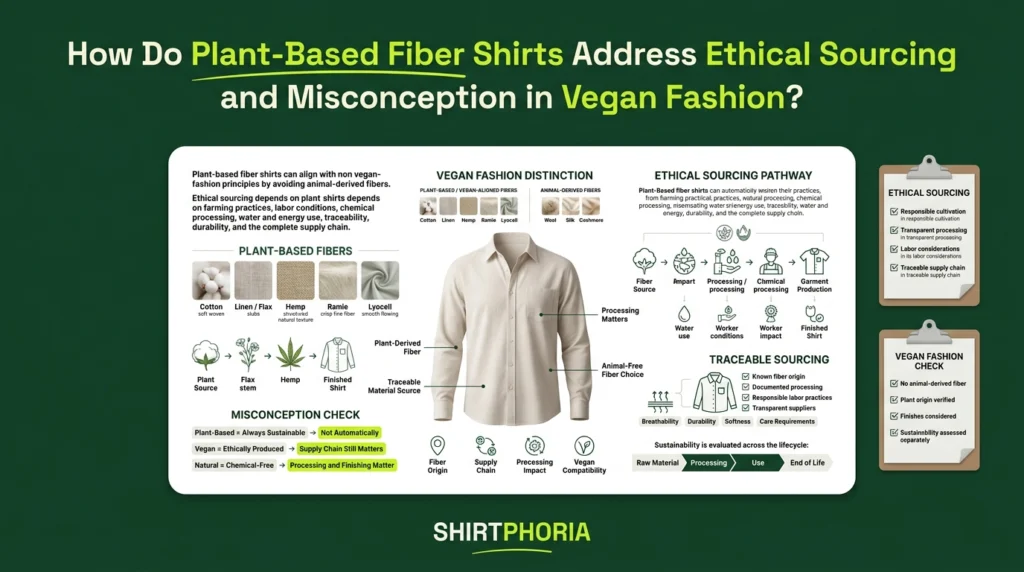
Plant-based fiber shirts can align with vegan fashion because their primary fibers come from plants rather than animals, but plant origin alone does not guarantee ethical sourcing, low environmental impact, fair labor, complete traceability, or an entirely animal-free finished garment.
Terms such as plant-based, vegan, ethical, organic, traceable, and responsibly sourced answer different questions. Treating them as interchangeable can turn a valid material claim into a much broader claim that available evidence does not support.
A cotton shirt, for example, can genuinely use a plant-derived textile while its farming practices, labor conditions, dyeing, finishing, garment components, purchasing systems, and supply-chain traceability remain separate questions.
The distinction matters at the garment level too. A plant-based main fabric does not identify the material source of every button, trim, label, patch, coating, adhesive, interlining, or decorative component.
This guide explains how cotton, linen, hemp, ramie, and related plant fibers fit within vegan fashion, how ethical sourcing should be evaluated, what traceability evidence matters, and which common material and sourcing assumptions should be avoided.
The evaluation follows a clear sequence:
material origin → whole-garment classification → sourcing → labor → traceability → misconception correction → verification
Missing evidence should remain Unverified rather than being converted into either a positive or negative conclusion.
Ethical sourcing is a core Sustainability concern of What Are Natural Fiber Shirts in Relation to Sustainability, Fabric Composition, and Wearability?.
Why Does Ethical Sourcing Matter for Plant-Based Fiber Shirts in Vegan Fashion?
Ethical sourcing matters for plant-based fiber shirts because avoiding animal-derived fibers addresses material origin, while labor conditions, agricultural practices, processing, purchasing systems, due diligence, and supply-chain evidence determine whether broader ethical claims are supported.
A vegan-material preference and an ethical-sourcing evaluation can overlap, but they perform different tasks.
A fiber-content label can help establish what material is present. It cannot tell the buyer how workers were treated, how a crop was cultivated, whether a supplier was traced, or how risks were identified and addressed.
How Does Plant-Based Fiber Origin Support the Material Logic of Vegan Fashion?
Plant-based fiber origin supports the material logic of vegan fashion because cotton, flax, hemp, ramie, and related fibers originate from plants rather than animal-derived fiber sources such as wool or silk.
Cotton is produced by a plant and is primarily cellulose. Linen comes from flax. Hemp and ramie are also plant-derived fibers.
At the primary-fiber level, these materials can support the principle of avoiding animal-derived textile fibers.
That establishes a useful classification, but several levels must remain separate:
Plant-based fiber identifies the biological origin of an individual fiber.
Plant-based textile composition identifies the materials present in the textile.
Vegan-compatible garment requires sufficient evidence about relevant materials across the complete garment.
Ethically sourced garment requires evidence about sourcing and production practices.
Sustainable garment requires environmental evaluation across relevant lifecycle stages.
A cotton shirt can therefore have a plant-based main fabric without automatically satisfying every broader garment-level claim.
Whole-garment vegan compatibility should be verified rather than inferred.
Why Does Plant Origin Alone Not Prove Ethical Sourcing?
Plant origin alone does not prove ethical sourcing because a plant-derived shirt can still involve weak labor protections, harmful worker exposure, irresponsible purchasing practices, limited transparency, or environmentally intensive farming and processing.
Ethical sourcing can include evidence relating to:
- labor conditions;
- farmer welfare;
- forced-labor risk;
- child-labor risk;
- freedom of association;
- occupational safety;
- discrimination;
- agricultural chemical exposure;
- land management;
- purchasing practices;
- and supply-chain transparency.
A 100% cotton shirt illustrates the distinction clearly. The fiber label can establish declared cotton composition, but it does not reveal where the cotton was grown, which farm produced it, how workers were treated, which textile mill processed it, or which purchasing practices shaped the supplier relationship.
The same applies to linen, hemp, and ramie.
Two boundaries are therefore essential:
Plant-based ≠ automatically ethical.
Vegan ≠ automatically sustainable.
A legitimate plant-origin claim should not be expanded into an ethical or environmental conclusion without corresponding evidence.
How Are Plant-Based Fiber Shirts Classified Within Vegan Fashion?
Plant-based fiber shirts are classified first by the origin and composition of their textile fibers and then by whether the complete garment provides sufficient material evidence to support a broader vegan-fashion claim.
The main fabric and the finished garment are related but separate levels of classification.
A fiber-content label can establish textile composition with relatively high confidence, while whole-garment verification may require additional material disclosures.
How Are Cotton, Linen, Hemp, and Ramie Classified as Plant-Based Shirt Fibers?
Cotton, linen, hemp, and ramie are classified as plant-based shirt fibers because each originates from plant material, although their botanical sources, fiber structures, cultivation systems, processing requirements, and performance characteristics differ.
Cotton is a seed fiber composed primarily of cellulose.
Linen is the textile fiber produced from flax stems.
Hemp is a bast fiber.
Ramie is also a bast fiber.
A bast fiber is a textile fiber obtained primarily from the inner stem or phloem region of certain plants.
Shared botanical origin does not make these fibers identical.
Cotton, flax, hemp, and ramie can differ in:
- cultivation;
- harvesting;
- fiber extraction;
- processing;
- textile construction;
- durability potential;
- tactile character;
- regional production;
- and supply-chain structure.
Botanical origin establishes the plant-fiber category. It does not establish ethical performance.
How Does Fiber Composition Affect Whether a Shirt Is Fully Plant-Based?
Fiber composition affects whether the shirt textile is fully plant-based because the fabric may contain one plant fiber, multiple plant fibers, or mixtures of plant and synthetic materials in defined percentages.
A useful composition classification separates four possibilities.
A 100% plant-fiber textile can contain one plant fiber, such as 100% cotton.
A plant-plant blend combines plant fibers, such as cotton and linen.
A plant-synthetic blend can combine cotton with polyester.
A plant-elastane blend can combine cotton with elastane for elastic performance.
Polyester and elastane are synthetic fibers rather than animal-derived materials. Therefore, their presence does not automatically conflict with animal-fiber avoidance, but they do mean the textile is not composed entirely of plant fibers.
Marketing terminology should not replace label evidence.
A shirt prominently marketed as “cotton” can contain another fiber. A product called a “linen blend” may combine linen with cotton, polyester, viscose, or another textile material.
Record actual percentages whenever they are disclosed.
A dominant-fiber marketing phrase and a complete fiber-content declaration are different kinds of evidence.
How Does Whole-Garment Construction Affect a Vegan-Fashion Claim?
Whole-garment construction affects a vegan-fashion claim because the main textile represents only one part of the shirt, while trims, buttons, patches, interlinings, coatings, labels, adhesives, decorative elements, and other disclosed components may use different material sources.
A rigorous garment-level claim therefore requires more than main-fabric verification.
Relevant components can include:
- buttons;
- labels;
- decorative patches;
- trims;
- interlinings;
- coatings;
- adhesives;
- embellishments;
- and structural components.
The correct approach is evidence-based in both directions.
Do not infer that an undisclosed button or adhesive is animal-derived.
Likewise, do not infer complete vegan compatibility when a relevant component’s material source remains unknown.
A useful verification system is:
Verified Vegan-Compatible – relevant material evidence supports the claim.
Evidence-Supported – substantial evidence exists but complete direct verification may be limited.
Partially Verified – some relevant garment components are verified while others are not.
Unverified – available evidence is insufficient.
Contradicted – verified information conflicts with the vegan-material claim.
Importantly, Unverified does not mean Non-Vegan. It means the evidence is insufficient for a firm conclusion.
How Should Ethical Sourcing of Plant-Based Fiber Shirts Be Evaluated?
Ethical sourcing of plant-based fiber shirts should be evaluated across raw-material production, labor conditions, textile processing, purchasing practices, supply-chain transparency, due diligence, and verifiable standards rather than reduced to a single “ethical” label.
Environmental responsibility and social responsibility should also remain separate dimensions.
A crop can have favorable characteristics under a particular production system while the associated supply chain still requires independent labor evaluation.
Likewise, strong labor policies do not automatically establish low environmental impact.
How Do Farming and Raw-Material Practices Affect Ethical Plant-Fiber Sourcing?
Farming and raw-material practices shape ethical plant-fiber sourcing because irrigation, chemical inputs, soil management, biodiversity, worker exposure, land practices, and regional production conditions can affect environmental and human outcomes before the fiber reaches a textile mill.
Relevant farm-level questions can include:
- How is irrigation managed?
- What pesticide or fertilizer inputs are used?
- How is soil managed?
- How are land and biodiversity affected?
- What protections exist for agricultural workers?
- What exposure controls exist where agricultural chemicals are used?
- What geographic or climatic conditions shape production?
Two shirts using the same plant fiber can have different sourcing profiles.
Cotton grown under one agricultural system should not automatically be treated as equivalent to cotton grown under another.
The same principle applies to flax, hemp, and ramie.
Universal crop claims should therefore be avoided. Statements such as “cotton always uses too much water” or “hemp requires no chemicals” erase variation in geography, production method, yield, processing, and management.
Strong quantitative comparisons require compatible methods and production contexts.
How Do Labor Conditions Affect Ethical Plant-Based Shirt Sourcing?
Labor conditions shape the social sourcing profile of plant-based shirts across farming, harvesting, fiber preparation, spinning, textile manufacturing, dyeing, finishing, and garment assembly.
Ethical sourcing therefore extends well beyond the farm.
Worker conditions can matter at:
Farm → Fiber Preparation → Spinning → Weaving/Knitting → Dyeing → Finishing → Garment Assembly
The ILO Fundamental Principles and Rights at Work provide an authoritative baseline that includes freedom of association and collective bargaining, elimination of forced labor, abolition of child labor, non-discrimination, and a safe and healthy working environment.
These principles provide an important labor-rights reference layer, but an ethical sourcing assessment can extend further to purchasing relationships, wages where credible evidence exists, working hours, supplier management, worker voice, and other material risks.
Environmental material performance and social sourcing performance must remain separate.
A textile can have favorable environmental characteristics without that establishing fair labor.
Likewise, an allegation about poor labor practices should not be made against a country, producer, or supplier without credible supporting evidence.
How Does Supply-Chain Transparency Strengthen Ethical Sourcing Claims?
Supply-chain transparency strengthens ethical-sourcing verification by revealing identifiable stages, facilities, suppliers, or origins that can then be evaluated against the relevant ethical criteria.
A useful disclosure may identify:
- country or region of fiber origin;
- farm or producer;
- processor;
- spinner;
- textile mill;
- dyeing or finishing facility;
- garment manufacturer;
- supplier relationships;
- and certification chain.
Specific disclosure usually supports stronger verification than broad language such as “globally sourced” or “responsibly produced.”
But transparency is evidence of visibility, not automatically evidence of good performance.
More transparency can improve verifiability, but transparency alone does not prove ethical performance.
A company can disclose a supplier and still require an assessment of that supplier’s actual environmental and labor practices.
Transparency creates a path to ask better questions.
Traceability creates a deeper documentary connection between stages of that path.
How Should Certifications and Standards Be Used When Evaluating Plant-Based Fiber Shirts?
Certifications and standards should be used as evidence for the specific requirements within their verified scope rather than as universal proof that a shirt satisfies every environmental, social, vegan, or traceability criterion.
Standards can address very different subjects, including:
- organic agriculture;
- organic-material content;
- chain of custody;
- chemical management;
- labor requirements;
- recycled content;
- fiber composition;
- or other defined criteria.
Every certification should therefore be tested with three questions:
What does the standard verify?
Which product or supply-chain stage does it cover?
What does it not verify?
The Organic Content Standard (OCS) provides a useful example. It supports verification of certified organic material and associated chain-of-custody integrity. Its presence should not automatically be expanded into proof of every labor, chemical, vegan, or lifecycle-environmental criterion.
The correct question is:
“What exactly does this certification verify?”
A certification logo should carry no more evidentiary meaning than the standard’s defined scope supports.
Why Is Cotton a Key Ethical-Sourcing Case for Plant-Based Fiber Shirts?
Cotton is a key ethical-sourcing case for plant-based shirts because its widespread use, diverse production systems, complex supply chains, measurable variation in fiber quality, and broad manufacturing footprint demonstrate why “100% cotton” cannot function as a complete ethical or sustainability claim.
Cotton allows several often-confused attributes to be separated clearly:
- composition;
- agricultural sourcing;
- fiber quality;
- labor;
- processing;
- traceability;
- technical durability;
- and actual wear-life.
How Do Cotton Growing Practices Change the Ethical and Environmental Profile of a Shirt?
Cotton growing practices shape the farm-level sourcing profile of a shirt because irrigation, pesticide use, soil management, harvesting systems, labor conditions, geography, and farm-level transparency vary across production systems.
Cotton should not be treated as one homogeneous agricultural system.
Variation can occur in:
- irrigation dependence;
- pesticide inputs;
- fertilizer and soil-management practices;
- harvesting systems;
- labor arrangements;
- geography;
- climate;
- and producer-level traceability.
Organic cotton should not be treated as one homogeneous production system either. Certification can establish defined criteria, but farms and supply chains can still vary in geography, yield, processing, worker conditions, and downstream garment manufacturing.
The central distinction is:
“100% cotton” reveals composition, not the complete sourcing story.
The fiber label answers a material question. Agricultural and ethical claims require additional evidence.
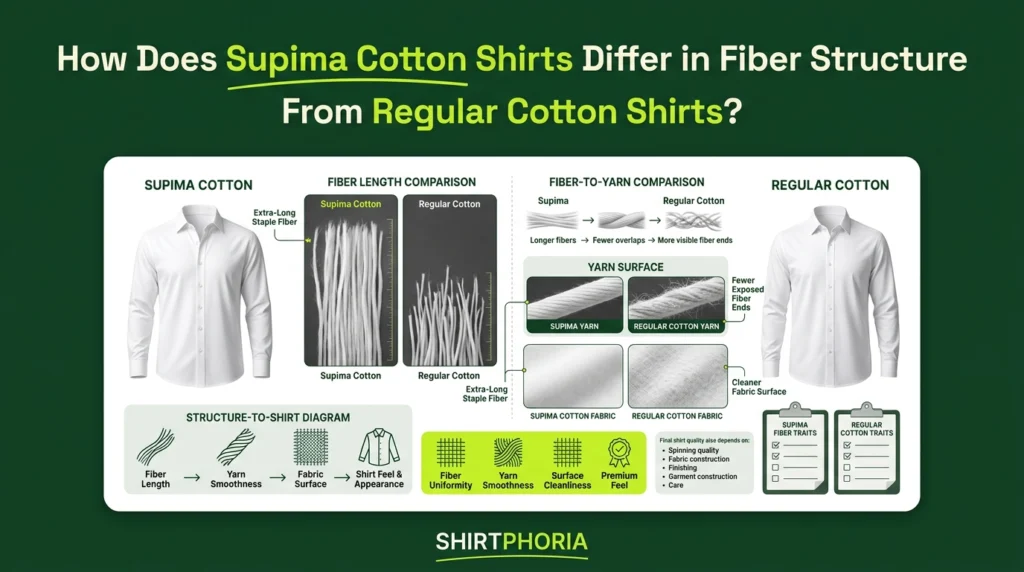
How Does Cotton Fiber Quality Affect Shirt Durability and Resource Efficiency?
Cotton fiber quality can influence shirt durability potential because measurable fiber properties can affect yarn formation and textile performance, but realized garment lifespan also depends on yarn design, fabric construction, finishing, sewing quality, care, fit-for-purpose use, and actual wear frequency.
Useful cotton-quality variables include:
- fiber length;
- fiber-length uniformity;
- fiber strength;
- and micronaire.
The USDA Agricultural Marketing Service cotton-classing system uses instrument testing to measure cotton properties including fiber length, length uniformity, strength, and micronaire.
These measurements describe material characteristics rather than ethical performance.
Fiber length can influence yarn-engineering opportunities.
Uniformity helps characterize consistency of fiber length.
Fiber strength describes resistance to breakage at the fiber-bundle level under the specified measurement system.
Micronaire relates to characteristics of fiber fineness and maturity.
Material-quality characteristics can contribute to textile-performance potential, but the relationship to sustainability involves several additional stages:
Fiber Property → Yarn/Fabric Performance Potential → Technical Garment Durability → Realized Wear-Life → Possible Reduction in Replacement Demand
The chain can fail at any point.
Good fiber can be made into a poorly constructed shirt.
A technically durable shirt can be poorly maintained.
A long-lasting shirt may still be discarded after limited use.
Therefore, higher technical lifespan contributes greater lifecycle value only when it results in more actual use.
Long-staple, strong, or “premium” cotton should never be translated directly into an environmental or ethical conclusion.
Sourcing is linked to the base fiber: Why does longer fiber length enhance the lifespan of Cotton Shirts?.
Why Should Cotton Quality and Ethical Sourcing Be Evaluated Separately?
Cotton quality and ethical sourcing should be evaluated separately because measurable fiber characteristics describe material properties, while ethical sourcing requires independent evidence about farming, labor, processing, purchasing practices, transparency, and due diligence.
High-quality cotton does not automatically prove:
- fair labor;
- responsible farming;
- organic production;
- responsible purchasing;
- supply-chain transparency;
- or traceability.
The inverse is also important.
Ethically sourced cotton is not automatically a higher-performing textile material.
A supply chain can demonstrate strong labor or sourcing practices while using cotton with ordinary physical characteristics.
Material quality and ethical performance answer different questions.
Premium-quality language should therefore never function as an ethical shortcut.
How Do Linen, Hemp, and Ramie Differ From Cotton in Ethical Sourcing?
Linen, hemp, and ramie differ from cotton in ethical sourcing because each crop uses different cultivation, fiber-extraction, processing, regional supply, labor, and traceability systems that should be evaluated on their own terms.
Plant fibers should not inherit ethical reputations from broad assumptions about their crops.
The production pathway matters.
How Does Linen Sourcing Differ From Cotton Sourcing?
Linen sourcing differs from cotton sourcing because linen originates from flax stems and depends on cultivation, retting, fiber extraction, processing, energy, labor, and traceability systems that differ from cotton production.
Flax provides the bast fibers used to make linen.
An important production stage is retting, a controlled biological or chemical process used to loosen bast fibers from the surrounding stem tissues so they can be separated.
A linen sourcing evaluation can therefore consider:
- flax cultivation;
- retting method;
- fiber extraction;
- mechanical or other processing;
- energy requirements where credible evidence exists;
- labor conditions;
- processing facilities;
- traceability;
- and finished-textile durability.
A favorable characteristic at the crop level cannot establish the complete ethical profile.
Flax may perform well under certain agricultural systems while poor processing, limited worker protections, or weak traceability can remain separate concerns.
The actual production pathway is more useful than linen’s general reputation.
How Does Hemp Sourcing Affect Ethical and Sustainability Claims?
Hemp sourcing shapes ethical and sustainability claims because crop characteristics alone do not reveal how the fiber was cultivated, processed, chemically or mechanically treated, handled by workers, or traced through the supply chain.
Hemp is a plant-derived bast fiber.
Its material characteristics can support durable textile applications, but durability potential should not be treated as proof of ethical production.
Relevant sourcing questions include:
- Where was the hemp grown?
- How was it cultivated?
- How were the fibers separated?
- Was processing mechanical, chemical, or a combination?
- What worker protections existed?
- Which processor and mill handled the fiber?
- Can the material be traced through the supply chain?
A crop-level advantage does not automatically survive every downstream manufacturing stage.
Hemp should therefore not be labeled environmentally or ethically superior without process-specific evidence.
How Should Ramie Be Evaluated Within Ethical Plant-Based Shirting?
Ramie should be evaluated within ethical plant-based shirting by examining its botanical origin together with processing requirements, labor conditions, production geography, supply-chain disclosure, durability potential, and actual garment composition.
Ramie is a plant-derived bast fiber.
Its fiber strength is a physical material characteristic rather than ethical evidence.
Processing requirements are particularly relevant because raw fiber origin does not reveal how workers, chemicals, energy, or industrial processes were managed after harvest.
Where public supply-chain disclosure is limited, the correct conclusion is greater uncertainty.
Limited information does not prove poor sourcing.
The relevant boundary is:
Raw-material origin cannot replace process-level sourcing analysis.
How Does Traceability Strengthen Ethical Claims for Plant-Based Fiber Shirts?
Traceability strengthens ethical evaluation of plant-based fiber shirts by creating documented connections between the finished garment and identifiable stages of its fiber, processing, textile-manufacturing, finishing, and garment-production chain.
Traceability is useful because it makes other claims easier to examine.
But traceability, transparency, chain of custody, certification, due diligence, and ethical performance are separate concepts.
What Does Traceability Mean in a Plant-Based Shirt Supply Chain?
Traceability in a plant-based shirt supply chain means being able to connect the garment through documented information to specific stages through which its fiber and textile components move from source to finished product.
A simplified supply path is:
Fiber Source → Processor → Spinner → Textile Mill → Dye/Finish Facility → Garment Maker → Brand
Traceability can operate at different levels.
A brand may know only the country of fiber origin.
Another may identify a region.
More detailed systems can identify processors, textile mills, individual facilities, producers, farms, transactions, or lots.
Country-level origin is therefore not equivalent to complete producer-level traceability.
A related term is chain of custody.
Chain of custody is the documented system used to track or control material as it moves through supply-chain stages under a defined model.
ISO 22095 provides generic terminology and a framework for different chain-of-custody models.
The distinction matters:
Traceability → provides documentary connection and visibility.
Chain of custody → documents control or movement of material under a defined model.
Neither, by itself, proves that all production practices were ethical.
What Evidence Makes a Plant-Based Fiber Shirt More Traceable?
A plant-based fiber shirt becomes more traceable when specific origin disclosures, supplier records, chain-of-custody documentation, independent certification, lot tracking, or manufacturing information connect the product to identifiable supply-chain stages.
Useful evidence can include:
- country or regional origin;
- producer identification;
- supplier names;
- processing facilities;
- textile mills;
- dyeing or finishing facilities;
- chain-of-custody records;
- independent certification;
- transaction certificates;
- lot records;
- and manufacturing documentation.
These forms of evidence are stronger than unsupported phrases such as:
“responsibly sourced,”
“premium material,”
“carefully selected,”
“ethical cotton,”
or “fully traceable.”
A marketing phrase may communicate an intended position. Documentary evidence establishes what can actually be verified.
The correct interpretation of missing information is equally important:
No public traceability evidence → limited or unverified transparency, not automatic proof of unethical sourcing.
Traceability also differs from due diligence.
A supply chain can be traceable while still containing risks that need to be identified, prevented, mitigated, monitored, communicated, or addressed.
The OECD Due Diligence Guidance for Responsible Supply Chains in the Garment and Footwear Sector provides a framework for identifying and addressing labor, human-rights, environmental, and integrity risks across garment and footwear supply chains.
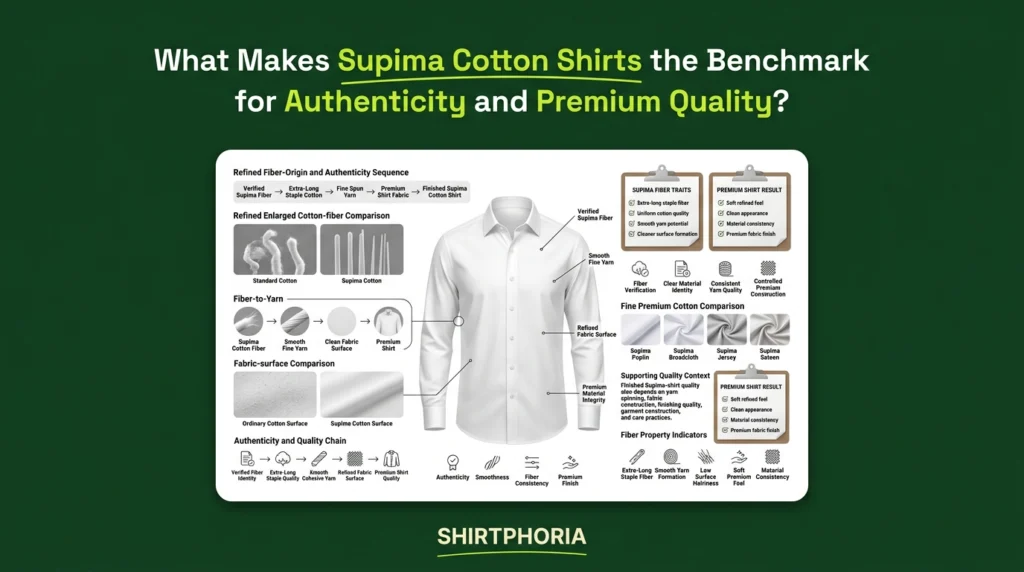
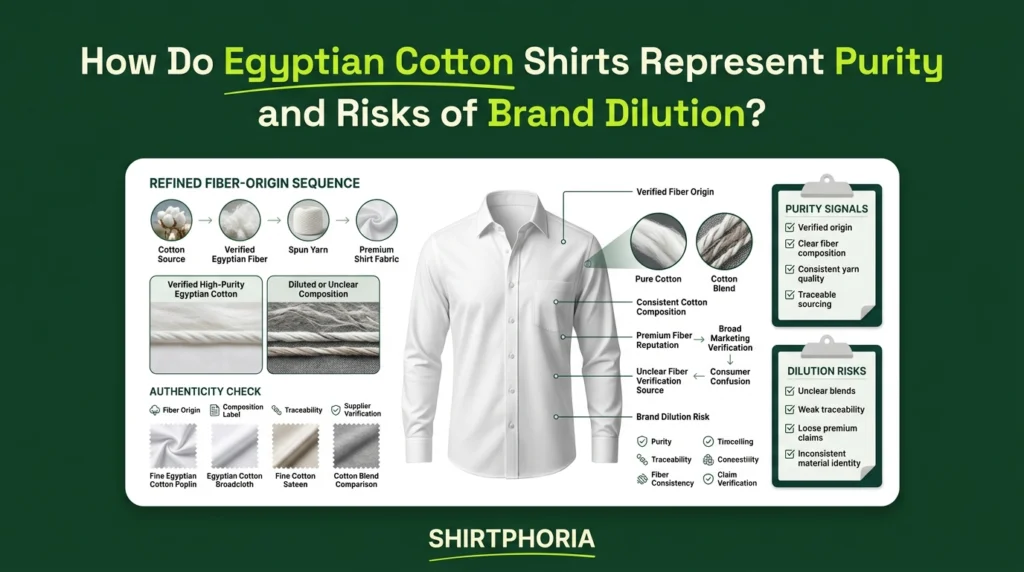
Does a Premium Cotton Name Automatically Prove Traceability or Ethical Sourcing?
A premium cotton name does not automatically prove traceability or ethical sourcing because cotton-category and fiber-quality terminology describes material attributes, while origin, labor practices, agricultural systems, and chain of custody require separate evidence.
Fiber name and sourcing evidence are different attributes.
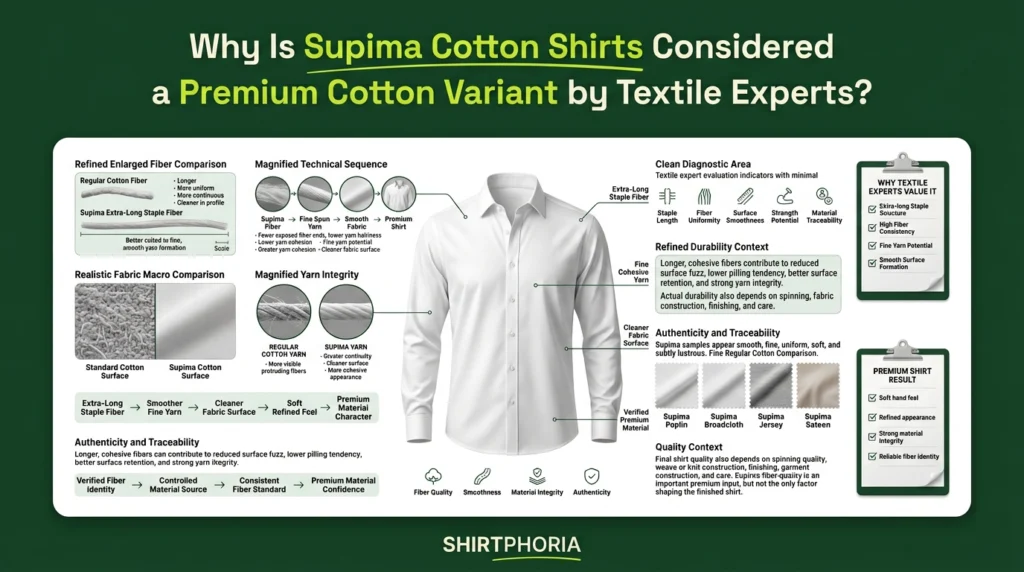
Pima cotton illustrates this distinction.
Pima terminology relates to a cotton material category associated with extra-long-staple characteristics, but the name alone does not prove:
- exact farm origin;
- organic cultivation;
- ethical farming;
- labor performance;
- chain-of-custody documentation;
- supplier transparency;
- or lifecycle superiority.
Those claims need their own evidence.
A buyer evaluating Pima cotton ethically should therefore verify material quality and sourcing separately.
The focus on basic cotton ethics leads to a related analysis of premium cotton quality and material integrity: Why Are Pima Cotton Shirts Known for Their Silky Feel and Material Integrity?.
What Vegan-Fashion Misconceptions About Plant-Based Fiber Shirts Should You Avoid?
The most important vegan-fashion misconceptions about plant-based fiber shirts occur when botanical origin is incorrectly treated as proof of whole-garment vegan compatibility, environmental sustainability, ethical sourcing, traceability, or complete material integrity.
Correcting these assumptions makes garment evaluation more precise.
How Can You Avoid Assuming Plant-Based Automatically Means Vegan in Every Garment Component?
You can avoid assuming plant-based automatically means fully vegan by verifying the complete garment rather than inferring whole-product composition from the primary shirt fabric.
Rule: Verify the complete garment, not only the main textile.
Reason: Buttons, trims, labels, patches, coatings, adhesives, interlinings, embellishments, and other components can use different material sources.
Example: A shirt can contain 100% cotton main fabric while some non-textile components remain undisclosed.
If the relevant component materials cannot be verified, classify the whole-garment claim as Unverified or Partially Verified rather than guessing.
How Can You Avoid Assuming Vegan Automatically Means Sustainable?
You can avoid assuming vegan automatically means sustainable by recognizing that animal-material avoidance and environmental lifecycle performance answer different questions.
Rule: Vegan compatibility and environmental sustainability are separate dimensions.
Reason: A garment can avoid animal-derived materials while involving intensive manufacturing, virgin fossil-derived synthetic fibers, short useful wear-life, pollution concerns, or difficult end-of-life recovery.
Example: A polyester vegan shirt and a cotton vegan-compatible shirt can both avoid animal fibers while having very different sourcing, manufacturing, durability, laundering, and end-of-life profiles.
Neither should be ranked solely from the word “vegan.”
How Can You Avoid Assuming Plant-Based Automatically Means Ethically Sourced?
You can avoid assuming plant-based automatically means ethically sourced by requiring evidence about labor, farming, occupational exposure, purchasing systems, due diligence, and supply-chain transparency in addition to fiber origin.
Rule: Plant origin does not establish fair or transparent production.
Reason: Worker conditions, agricultural practices, sourcing relationships, purchasing practices, and transparency vary among supply chains.
Example: A 100% cotton label confirms declared textile composition but does not identify farm labor conditions, textile-mill conditions, or brand purchasing practices.
Composition evidence and ethical evidence should remain separate.
How Can You Avoid Assuming Organic, Premium, or Long-Staple Cotton Solves Every Ethical Question?
You can avoid assuming organic, premium, or long-staple cotton resolves every ethical question by evaluating agricultural certification, measurable fiber quality, labor practices, processing, traceability, due diligence, and durability as separate attributes.
Rule: Fiber quality, agricultural certification, chain of custody, and ethical sourcing are independent evidence dimensions.
Reason: Verification of one attribute cannot automatically establish unrelated labor, environmental, vegan, traceability, or quality claims.
Example: Long-staple or Pima cotton can possess identifiable material characteristics without independently proving fair-labor conditions or supply-chain traceability.
The same scope discipline applies to organic-content standards. A standard verifying organic material integrity should not automatically be presented as evidence for criteria it does not cover.
No label should carry more evidentiary meaning than its defined scope supports.
How Do Plant-Based Shirt Fibers Compare Across Vegan and Ethical-Sourcing Criteria?
Plant-based shirt fibers differ not in whether they originate from plants, but in the sourcing questions, processing systems, traceability priorities, material characteristics, and whole-garment verification requirements that determine how confidently ethical and vegan-fashion claims can be supported.
The comparison below evaluates verification requirements, not an ethical ranking.
Ethical Sourcing + Vegan Fashion Matrix
| Plant FiberPlant-Based OriginKey Shirt StrengthMain Ethical-Sourcing QuestionsVegan-Fashion BoundaryTraceability Priority | |||||
|---|---|---|---|---|---|
| Cotton | Seed fiber | Softness, versatility, broad shirting use | Farming inputs, labor, irrigation, purchasing practices, origin, processing | Main fiber can be plant-derived; verify complete garment before making whole-product claims | High where complex supply chains make origin difficult to verify |
| Linen / Flax | Bast fiber | Airflow potential, strength, warm-weather use | Cultivation, retting, processing, labor, mill transparency | Plant-derived main fiber; verify relevant trims and other components | Verify flax origin, processor, and textile chain where evidence exists |
| Hemp | Bast fiber | Durability potential, airflow, structured feel | Cultivation, processing method, labor, geographic sourcing | Plant-derived fiber; whole garment still requires verification | Verify actual fiber source, processor, and chain-of-custody evidence |
| Ramie | Bast fiber | Strength, crispness, absorbency | Processing requirements, working conditions, origin transparency | Plant-derived main fiber; unknown components remain unverified | Important where public supply-chain disclosure is limited |
| Plant-Fiber Blend | Mixed plant or plant + other fibers | Performance balancing | Identity, source, and percentage of every constituent fiber | Vegan compatibility depends on all relevant material inputs, not dominant fiber alone | Trace material inputs according to the level of claim being made |
Qualification: The presence or absence of traceability information is an evidence condition rather than automatic proof of ethical or unethical production. Material origin, traceability, certification scope, labor evidence, and ethical performance must remain separate evaluation dimensions.
How Can You Verify an Ethically Sourced Plant-Based Shirt for Vegan Fashion?
Verifying an ethically sourced plant-based shirt for vegan fashion requires checking complete fiber composition, relevant whole-garment materials, geographic and supply-chain origin, environmental sourcing practices, labor evidence, certification scope, traceability documentation, durability, and real-world use.
The following seven-step process prevents marketing language from substituting for evidence.
Step 1 – Verify the Shirt’s Complete Fiber Composition
The first step is to verify every listed fiber and its percentage so the textile can be classified accurately as a single plant fiber, plant-plant blend, plant-synthetic blend, or another material combination.
Read the garment’s fiber-content label.
Record every disclosed fiber and percentage.
For example:
100% cotton → single plant fiber.
Cotton + linen → plant-plant blend.
Cotton + polyester → plant-synthetic blend.
Cotton + elastane → plant-synthetic blend.
Composition verifies textile identity.
It does not prove sourcing ethics.
If material percentages cannot be confirmed, record the composition evidence as Unverified.
Step 2 – Verify the Whole Garment for Vegan-Fashion Compatibility
The second step is to evaluate disclosed garment components rather than assuming the primary plant fabric establishes whole-garment vegan compatibility.
Check available information for:
- buttons;
- trims;
- labels;
- patches;
- decorative elements;
- interlinings;
- coatings;
- adhesives;
- and structural materials.
Do not infer what an undisclosed component contains.
Record the result as:
Verified Vegan-Compatible
Evidence-Supported
Partially Verified
Unverified
or Contradicted
depending on the evidence.
Remember that Unverified means insufficient evidence. It does not automatically mean the garment contains animal-derived materials.
Step 3 – Identify the Fiber’s Geographic and Supply-Chain Origin
The third step is to identify the most specific available origin information for the fiber and garment, including country, region, producer, processor, mill, supplier, or facility where those details are disclosed.
Look for evidence identifying:
- country;
- region;
- farm or producer;
- processor;
- spinner;
- textile mill;
- dyeing or finishing facility;
- supplier;
- and garment factory.
Specific information provides stronger traceability than phrases such as “globally sourced.”
Granularity matters.
Knowing the country of garment assembly is different from knowing the country of fiber origin.
Knowing the fiber-origin country is less specific than identifying the farm, processor, textile mill, and transactions connecting them.
Missing origin information should be recorded as limited or unverified transparency, not proof of unethical sourcing.
Step 4 – Evaluate Environmental and Agricultural Sourcing Practices
The fourth step is to evaluate environmental and agricultural evidence relevant to the specific plant fiber, including farming inputs, water, chemical use, land management, processing methods, and durability potential.
Adapt the questions to the crop.
For cotton, relevant evidence may concern irrigation, pesticides, fertilizers, soil management, harvesting, and farm systems.
For flax, retting and fiber extraction become particularly relevant.
For hemp and ramie, processing methods can require their own evaluation.
Do not automatically apply cotton-specific assumptions to every plant fiber.
Environmental comparisons also require compatible evidence. Water, land, carbon, energy, pesticide use, toxicity, and other indicators should not be combined into a universal ranking when their methods and boundaries differ.
Step 5 – Evaluate Labor and Social Sourcing Evidence
The fifth step is to evaluate whether meaningful evidence exists about worker protections, supplier standards, labor practices, purchasing relationships, or independently verified social criteria across relevant stages of the shirt’s supply chain.
Look for evidence addressing issues such as:
- freedom of association;
- collective bargaining;
- forced labor;
- child labor;
- discrimination;
- safe and healthy working conditions;
- supplier requirements;
- responsible purchasing practices;
- and corrective action.
Evidence quality differs.
A general corporate policy indicates stated expectations.
Supplier-specific disclosure provides more direct visibility.
Facility-level auditing or certification may add another layer.
Corrective-action and due-diligence reporting can indicate whether identified risks are actually being managed.
The OECD’s garment-sector guidance treats responsible sourcing as an ongoing due-diligence process rather than a single certification or supplier list.
Due diligence is broader than traceability because it asks not only where production occurred, but also how risks and adverse impacts are identified and addressed.
Step 6 – Verify Certifications and Traceability Claims
The sixth step is to identify what each certification, chain-of-custody, or traceability claim actually covers and whether its documentation connects the shirt to the specific material, environmental, social, or sourcing criteria being claimed.
For each certification, ask:
- What standard is being used?
- What does it verify?
- Which supply-chain stages are covered?
- Does it concern agriculture?
- Material content?
- Chemical processing?
- Labor?
- Chain of custody?
- Another defined criterion?
Then identify what remains outside its scope.
Certification, traceability, chain of custody, and due diligence should not be treated as interchangeable.
A certification can verify defined requirements.
Traceability can connect stages.
Chain-of-custody evidence can document material movement.
Due diligence evaluates and responds to relevant risks.
One certification should not stand in for every ethical, vegan, environmental, labor, or traceability claim.
Step 7 – Balance Ethics With Durability and Real-World Use
The final step is to balance sourcing evidence with durability, repairability, maintenance, functional suitability, and actual expected use because an ethical purchasing decision should consider both how the shirt was sourced and whether it is likely to remain useful.
Consider:
- intended use;
- shirt construction;
- technical durability;
- repairability;
- washing and maintenance;
- fit;
- expected wear frequency;
- and likelihood of continued ownership.
Potential durability and realized useful wear-life are different.
A shirt can technically last for years but generate little practical longevity value if it is rarely worn.
The central principle is:
Greater durability supports reduced replacement demand only when the shirt remains in actual use for longer.
Sourcing credentials and realized wear-life are separate but complementary factors.
A final purchase decision should therefore emerge from the complete evidence profile rather than from one “plant-based,” “vegan,” “organic,” “premium,” “traceable,” or “ethical” label.
Plant-Based Shirt Ethical & Vegan Verification Profile
| Evaluation FieldRequired Output | |
|---|---|
| Fiber Composition | Single plant fiber / Plant-plant blend / Plant-synthetic blend / Other |
| Fiber Percentages | Record exact label percentages where available |
| Whole-Garment Material Status | Verified / Partially Verified / Unverified |
| Vegan Compatibility | Verified / Evidence-Supported / Partially Verified / Unverified / Contradicted |
| Fiber Origin | Country / Region / Producer where verified |
| Supply-Chain Visibility | High / Partial / Limited / Unknown – with supporting evidence |
| Chain-of-Custody Evidence | Present / Partial / Absent / Unknown |
| Environmental Sourcing Evidence | Verified findings + unresolved unknowns |
| Labor / Social Evidence | Verified findings + unresolved unknowns |
| Certification Scope | Exact criteria and supply-chain stages covered |
| Cotton Quality Data | Fiber length / uniformity / strength / micronaire where relevant and available |
| Durability Profile | Technical durability evidence + construction/care modifiers |
| Realized Wear-Life Potential | Expected actual use based on fit, maintenance, durability, and wearer need |
| Primary Ethical Strength | Strongest verified positive sourcing attribute |
| Primary Unresolved Risk | Most important missing or adverse evidence |
| Evidence Confidence | Confirmed / Evidence-Supported / Probable / Unverified |
| Final Verdict | Strong Fit / Conditional Fit / Insufficient Evidence / Contradicted |
A successful verification should produce a structured verdict that keeps plant-based composition, vegan compatibility, traceability, certification scope, sourcing evidence, labor evidence, and durability separate rather than collapsing them into one ethical label.
Uncertainty and Correction Protocol
If a sourcing, vegan, origin, labor, certification, quality, or traceability claim remains Probable, Unverified, Partially Verified, or Unknown:
- Re-check the garment fiber-content and component disclosures.
- Check the manufacturer’s official product information.
- Check supplier or facility disclosures where available.
- Verify certification through the relevant certification body or official database where possible.
- Review chain-of-custody documentation appropriate to the claim.
- Check origin, producer, lot, or transaction records where supplied.
- Do not infer undisclosed component materials.
- Do not infer good or bad labor performance from absence of disclosure alone.
- Do not infer ethical sourcing from premium fiber terminology.
- Update the verification profile when stronger evidence contradicts the initial classification.
What Is the Quick Checklist for Evaluating Plant-Based Fiber Shirts in Vegan Fashion?
A plant-based fiber shirt supports a credible ethical and vegan-fashion preference only when its material origin, full composition, garment components, sourcing, labor evidence, processing, traceability, certification scope, durability, actual wear-life, and marketing claims have been evaluated separately.
Plant-Based Shirt Ethical Sourcing and Vegan Fashion Checklist
Frequently Asked Questions
Not always at the whole-garment level. Cotton, linen, hemp, and ramie are plant-derived fibers, but buttons, trims, labels, coatings, adhesives, interlinings, and other components may require separate verification.
No. Ethical sourcing requires evidence about farming, labor, processing, purchasing practices, supplier management, due diligence, and supply-chain transparency.
No. Vegan compatibility concerns animal-material avoidance, while sustainability requires environmental evaluation across sourcing, manufacturing, durability, care, and end-of-life.
Traceability means having documented connections between the garment and identifiable supply-chain stages such as fiber source, processor, spinner, textile mill, finishing facility, garment maker, and brand.
No. Certifications should be interpreted only within the criteria and supply-chain stages they actually verify.
No. Terms such as Pima, long-staple, or premium describe material categories or quality characteristics and do not independently prove labor conditions, farm practices, chain of custody, or traceability.
Terms Explained
| TERM | DEFINITION |
|---|---|
| Plant-Based Fiber | A textile fiber originating from plant material, such as cotton, linen, hemp, or ramie. |
| Vegan-Compatible Garment | A garment supported by sufficient evidence that relevant materials do not contain animal-derived components. |
| Ethical Sourcing | Evaluation of sourcing and production practices such as labor conditions, worker protections, purchasing systems, transparency, and due diligence. |
| Traceability | Documented connections linking a product to identifiable supply-chain stages. |
| Chain of Custody | A documented system used to track or control material movement through supply-chain stages under a defined model. |
| Due Diligence | A process for identifying, assessing, preventing, mitigating, tracking, communicating, and addressing relevant supply-chain risks and impacts. |
| Bast Fiber | A textile fiber obtained primarily from the inner stem or phloem region of certain plants. |
| Retting | A controlled biological or chemical process used to loosen bast fibers from surrounding stem tissues. |
| Fiber Composition | The textile fibers present in a garment and their stated percentages. |
| Plant-Plant Blend | A textile combining two or more plant-derived fibers. |
| Plant-Synthetic Blend | A textile combining plant-derived fibers with synthetic fibers such as polyester or elastane. |
| Micronaire | A cotton measurement associated with characteristics of fiber fineness and maturity. |
| Evidence Confidence | A stated level describing how strongly a material, sourcing, vegan, labor, or traceability claim is supported. |
Conclusion
In conclusion, plant-based fiber shirts can align with vegan fashion because cotton, linen, hemp, ramie, and related fibers originate from plants, but ethical sourcing requires a broader evaluation of composition, farming, labor, purchasing practices, processing, traceability, certification, durability, actual use, and whole-garment construction.
Plant-based, vegan, sustainable, ethical, transparent, traceable, and certified are related concepts, but they are not interchangeable.
Plant origin establishes the biological source of a textile fiber.
Whole-garment vegan compatibility requires relevant component-level material evidence.
Sustainability requires lifecycle-oriented environmental evaluation.
Ethical sourcing requires evidence relevant to the actual sourcing and labor criteria being assessed.
Transparency creates visibility, while traceability creates documentary connections among supply-chain stages.
Chain of custody can document material movement under a defined model, but it does not independently prove responsible production.
Due diligence goes further by identifying, assessing, preventing, mitigating, tracking, communicating, and where relevant addressing adverse risks or impacts.
Certification adds another evidence layer, but its meaning must remain within its defined scope.
Cotton demonstrates why these distinctions matter. Fiber length, uniformity, strength, and micronaire describe measurable material properties. They do not reveal farm labor, agricultural practices, chain-of-custody documentation, purchasing behavior, or complete environmental performance.
Likewise, premium terminology such as Pima or long-staple cotton cannot replace traceability evidence.
Linen, hemp, and ramie require their own crop- and process-specific sourcing evaluations rather than inheriting broad ethical assumptions from their plant origin.
The strongest verification system therefore preserves uncertainty. Missing evidence should remain Unverified instead of being interpreted automatically as positive or negative.
The Plant-Based Shirt Ethical & Vegan Verification Profile brings the required evidence together while keeping composition, whole-garment vegan compatibility, environmental sourcing, labor, traceability, certification, material quality, and useful wear-life as separate decision fields.
The strongest plant-based shirt choice is not the one carrying the most ethical-sounding labels, but the one whose fiber composition, vegan compatibility, sourcing practices, traceability evidence, production conditions, and useful wear-life can be evaluated together.