How Are Shirt Fabrics Classified by Fiber Type, Functional Properties, Construction Methods, and Sustainability Impact?
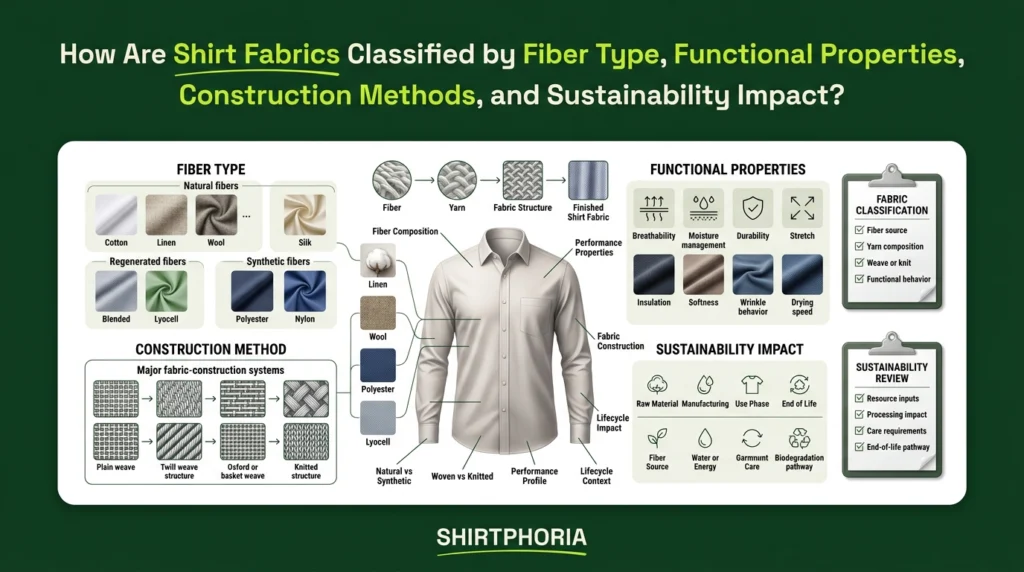
Shirt fabrics are systematically understood through four connected dimensions: fiber type and composition identify what the textile contains, construction identifies how its yarns are organized, functional properties describe how the finished fabric behaves, and lifecycle analysis evaluates its sustainability impact.
A familiar fabric name alone cannot reliably tell you how a shirt will feel, manage moisture, exchange heat, stretch, resist repeated wear, require care, or perform environmentally. Two shirts can look similar yet behave very differently because of differences in fiber percentages, yarn design, construction, fabric weight, density, finishing, or manufacturing quality.
This guide explains how shirt fabrics are classified by what they are made from, how they are constructed, how they perform, and how their sustainability impact is evaluated. Fiber type and composition establish material identity. Construction explains how the textile is physically formed. Functional properties describe what the finished fabric actually does in use. Sustainability adds a lifecycle perspective that includes sourcing, manufacturing, garment life, care, pollution pathways, recycling, and disposal.
Understanding these dimensions together creates a more accurate way to compare shirt fabrics and match them to a particular climate, activity, level of formality, maintenance preference, or performance requirement.
Why Does Understanding Shirt Fabric Classification Matter When Evaluating a Shirt?
Understanding shirt fabric classification matters because material composition, textile construction, functional performance, and lifecycle considerations collectively influence how a shirt feels, performs, lasts, requires care, and suits a particular use.
A label such as cotton, polyester, Oxford, or jersey provides useful information, but each term describes only part of the textile. Cotton identifies a fiber. Oxford describes a type of textile construction. Jersey identifies a knitted structure. None of these terms, by itself, completely predicts the behavior of the finished shirt.
A classification system therefore improves evaluation by separating the variables that create fabric identity from the variables that influence textile performance.
How Does Shirt Fabric Classification Help Predict Wearability and Daily Comfort?
Shirt fabric classification helps predict wearability and daily comfort by revealing the material and structural variables that influence moisture behavior, airflow, thermal response, softness, drape, stretch, and skin feel.
Fiber chemistry affects the way a textile interacts with moisture and contributes to characteristics such as hand-feel. Construction, yarn structure, fabric weight, and density can alter airflow, drape, opacity, and mechanical stretch.
These characteristics should not be treated as interchangeable.
A soft fabric is not necessarily highly air-permeable. A fabric that allows substantial airflow does not automatically provide effective moisture management. Similarly, a textile that absorbs a large amount of moisture may retain that moisture longer instead of drying rapidly.
Consider two visually similar shirts. One may use a relatively dense woven cotton construction, while another may use a lighter cotton blend with a different yarn structure or finish. Although both may appear similar from a distance, they can differ in airflow, moisture behavior, stretch, wrinkle response, and drying characteristics.
The practical result depends on the wearing environment. A property that is useful during low-activity indoor wear may not provide the same advantage in high heat, high humidity, or physically demanding conditions.
Comfort therefore cannot be predicted from fiber type alone.
How Does Shirt Fabric Classification Help Predict Durability, Care Needs, and Environmental Impact?
Shirt fabric classification helps predict durability, care requirements, and environmental considerations because fiber identity, composition, construction, finishing, garment lifespan, laundering, and end-of-life pathways influence how a shirt wears and is maintained.
Durability itself contains several separate characteristics. Abrasion resistance describes how well a textile withstands rubbing. Pilling resistance concerns the formation of small fiber balls on the surface. Dimensional stability concerns whether the textile maintains its dimensions after use and laundering. Appearance retention describes how well the shirt preserves its visual character over time.
Wrinkle resistance is another property, but it should not be confused with durability. A textile can resist wrinkles yet perform differently under abrasion or repeated laundering. Conversely, a durable textile can still wrinkle easily.
Finishing also matters. Treatments applied after fabric construction can modify softness, wrinkle response, moisture behavior, water resistance, appearance, or ease of care. These effects mean that two fabrics with similar fiber composition and construction can still behave differently.
Environmental evaluation adds another layer. Sustainability cannot be determined from appearance or fiber name alone because raw-material sourcing, processing, finishing, laundering, garment lifespan, recycling, and disposal all contribute to the final environmental profile.
How Are Shirt Fabrics Classified by Fiber Type and Composition?
Shirt fabrics are classified by material identity through two related but distinct dimensions: fiber type identifies the nature and origin of each constituent fiber, while fiber composition identifies which fibers are present and in what proportions.
Fiber type can broadly include natural fibers, regenerated cellulosic fibers, and synthetic fibers. Composition then describes whether the finished fabric contains one fiber or a combination of fibers.
A cotton-polyester shirt, for example, is not a separate fiber-origin class. It is a blended composition containing fibers from two different categories.
The percentage of each constituent fiber matters because changing the blend ratio can change the behavior of the textile. Even so, composition must still be considered alongside yarn design, construction, fabric weight, density, and finishing.
How Are Natural Shirt Fibers Categorized by Plant and Animal Origin?
Natural shirt fibers are categorized according to biological origin, with plant-derived materials such as cotton and flax-derived linen distinguished from animal-derived fibers such as silk and wool.
Natural fibers originate from biological materials rather than being formed entirely as manufactured polymer fibers.
Cotton is plant-derived. Linen is produced from flax. Silk and wool are animal-derived fibers.
Their physical and chemical structures can influence moisture absorption, hand-feel, thermal behavior, resilience, and care requirements. Those general tendencies, however, should not be interpreted as universal finished-fabric characteristics.
A cotton textile can be light or heavy, open or dense, knitted or woven, brushed or smooth, untreated or heavily finished. Each of these variables can alter how the final shirt feels and performs.
Likewise, describing a fiber as natural does not automatically establish that it is more breathable, softer, more durable, or environmentally preferable than every manufactured alternative.
Understanding foundational fabric classification also requires examining the sustainability and wearability of natural fiber shirts.
How Are Regenerated Cellulosic Fibers Classified in Shirt Textiles?
Regenerated cellulosic fibers form a distinct manufactured-fiber category because naturally derived cellulose is processed, dissolved, and regenerated into textile fibers rather than being used in its original biological fiber form.
A regenerated cellulosic fiber is therefore manufactured from cellulose-based raw material that has undergone chemical and industrial processing to form a new textile fiber.
Viscose, modal, and lyocell are major examples.
These materials differ from cotton because cotton fibers are used in their naturally occurring fibrous form after processing, while regenerated cellulose is dissolved and reformed. They also differ from synthetic fibers such as polyester, which are based on manufactured polymers rather than regenerated cellulose.
Regenerated cellulosic textiles can differ in strength, softness, drape, moisture behavior, manufacturing pathway, resource use, chemical recovery, and environmental profile.
Lyocell is a generic regenerated-cellulosic fiber category. TENCEL™ is a Lenzing brand rather than a generic synonym for every lyocell fiber. The brand includes TENCEL™ Lyocell and TENCEL™ Modal products.
This distinction is important because production claims relating to a particular manufacturer or branded process should not automatically be generalized to every viscose, modal, or lyocell textile. Manufacturer-specific terminology and branded fiber information can be verified through Lenzing’s official TENCEL™ information.
How Are Synthetic Shirt Fibers Categorized by Engineered Performance?
Synthetic shirt fibers are manufactured from engineered polymers and can contribute properties such as resilience, rapid drying, abrasion resistance, elastic extension, shape retention, or reduced maintenance depending on the specific fiber and textile system.
Polyester, nylon, and elastane illustrate how synthetic fibers can serve different roles.
Polyester is frequently used where dimensional stability, easy-care characteristics, durability, or relatively low moisture absorption are useful. Nylon can contribute strength and abrasion-related performance. Elastane is typically added in smaller proportions when elastic extension and recovery are required.
These fibers should not be treated as one uniform performance category.
Low moisture absorption, for example, is not identical to fast drying. Likewise, synthetic composition does not automatically guarantee moisture transport, airflow, comfort, or exceptional durability.
Yarn engineering, construction, fabric density, weight, finishing, and blend ratio can all change the final result.
Synthetic origin alone is also insufficient for making a complete sustainability judgment. Raw-material sourcing, energy demand, garment lifespan, microfiber shedding, recycled content, laundering, recyclability, and end-of-life pathways must also be considered.
Engineered performance becomes clearer when comparing the properties of synthetic fiber shirts.
How Are Blended Shirt Fabrics Classified by Fiber Composition?
Blended shirt fabrics are classified by fiber composition because they combine two or more constituent fibers in defined proportions rather than forming a separate fiber-origin category.
A blend describes what fibers have been combined and how much of each fiber is present.
Poly-cotton combines cotton and polyester. Cotton-linen combines two plant-derived fibers. Cotton-elastane combines cotton with an elastic synthetic fiber.
The exact percentages matter.
A shirt made from 98% cotton and 2% elastane can behave differently from another textile containing much more elastane, even though both can be described as cotton-elastane blends.
Blend ratio can influence softness, wrinkle behavior, stretch, recovery, drying behavior, durability, maintenance requirements, cost, and recyclability. The final behavior also depends on yarn structure, fabric construction, weight, density, and finishing.
Blending can be useful because it allows manufacturers to combine selected characteristics from different fibers. At the same time, mixed-material construction can make fiber separation and recycling more difficult.
A small percentage of one fiber should therefore not automatically be assumed to control the behavior of the entire textile.
Combining different fiber characteristics creates the functional trade-offs found in blended fabric shirts.
How Do Construction Methods Define Shirt Fabric Categories?
Construction methods define shirt fabric categories by determining how yarns are organized into woven or knitted structures, which then influence stretch, stability, drape, texture, airflow, opacity, and typical use.
Fiber identity and construction must remain separate.
Cotton can be woven into poplin or Oxford fabric, but it can also be knitted into jersey. Polyester can also appear in woven or knitted textiles. The construction name therefore does not automatically reveal what fiber the shirt contains.
How Do Woven Structures Create Distinct Shirt Fabric Categories?
Woven shirt fabrics are created by interlacing lengthwise warp yarns with crosswise weft yarns, while differences in interlacing pattern, yarn size, density, and finishing create distinct woven structures and fabric characteristics.
Warp refers to the yarns that normally run lengthwise through a woven textile. Weft refers to the yarns that cross them.
Different methods of interlacing these yarn systems create recognizable structures.
Poplin commonly uses a relatively plain, closely constructed weave that can produce a smooth and structured surface.
Twill uses an interlacing sequence that creates a characteristic diagonal effect.
Oxford commonly uses a basket-like construction that produces a distinctive texture.
Herringbone creates a directional pattern in which diagonal lines reverse direction, often through a broken or alternating form related to twill structures.
The weave name alone does not establish exact performance. Yarn size, thread arrangement, weight, density, fiber composition, and finishing can alter stability, texture, drape, airflow, opacity, and appearance.
An Oxford shirt, for example, can be made from cotton, polyester, or a cotton-polyester blend. “Oxford” therefore describes the textile structure rather than its fiber origin.
The relationship between yarn interlacing and fabric behavior is explored further in weave shirts.
How Do Knitted Shirt Fabrics Differ From Woven Shirt Fabrics?
Knitted shirt fabrics differ from woven fabrics because yarns form interconnected loops rather than perpendicular warp-and-weft intersections, producing different structural behavior in stretch, recovery, drape, texture, and dimensional stability.
Jersey is one of the most familiar knitted structures used for shirts and T-shirts. Piqué can also be produced as a knitted structure with a characteristic textured surface.
Because knitted fabrics depend on loops, they can often extend mechanically even when elastane is absent. This structural stretch differs from elastic extension supplied by elastane fibers.
A cotton jersey shirt can consequently stretch and drape differently from a cotton poplin shirt despite both containing the same basic fiber.
That does not mean every knit is highly stretchy or every woven textile is rigid. Yarn design, density, fabric weight, knit or weave structure, finishing, and fiber composition can significantly modify normal structural tendencies.
Recovery must also be evaluated independently. A textile may stretch substantially but fail to return fully to its original dimensions after repeated use.
How Are Shirt Fabrics Classified by Functional Performance Properties?
Shirt fabrics can be profiled by functional performance through separate behaviors such as moisture management, thermal response, stretch and recovery, wrinkle resistance, abrasion resistance, pilling resistance, dimensional stability, and easy-care performance.
These characteristics describe how the finished textile behaves rather than creating another fiber-origin category.
Performance emerges from interactions among fiber chemistry, yarn structure, construction, fabric weight, density, finishing, and blend ratio. For that reason, functional claims should be evaluated property by property rather than summarized with vague labels such as “high performance.”
Where objective values are used, the relevant test method and testing conditions matter. AATCC Standard Test Methods and Procedures provide standardized methods for evaluating a range of textile characteristics.
How Is Moisture Management Classified in Shirt Fabrics?
Moisture management in shirt fabrics is evaluated through several separate behaviors, including liquid absorption, moisture transport, wicking, evaporation, and drying speed.
Moisture absorption describes the uptake of moisture into or by textile material.
Moisture transport describes the movement of moisture through the textile system.
Wicking specifically refers to liquid movement through or along textile structures, often through capillary mechanisms.
Evaporation concerns the transition of moisture into vapor.
Drying speed describes how quickly the textile loses retained moisture under particular conditions.
These properties interact, but they are not identical.
Hydrophilic fibers can absorb substantial moisture, yet high absorption does not automatically produce rapid drying. Conversely, relatively low-absorbency fibers can be engineered into yarn and fabric systems that move liquid effectively along textile surfaces.
Fiber chemistry, yarn geometry, fabric construction, density, and finishing can all influence the process.
For this reason, the phrase “moisture-wicking” should not be used as a general substitute for every type of moisture management.
How Is Thermal Regulation Classified in Shirt Fabrics?
Thermal performance in shirt fabrics is evaluated through interacting variables such as air permeability, insulation, fabric weight, thickness, moisture behavior, construction openness, and the wearer’s climate and activity conditions.
Air permeability is the ability of air to pass through a textile under defined conditions. The consumer term “breathability” is broader and is often used less precisely.
Airflow is also different from insulation.
A fabric may limit airflow yet still perform differently in heat transfer depending on thickness, fiber characteristics, trapped air, moisture, layering, and environmental conditions.
Light weight alone does not guarantee high air permeability. A thin but densely constructed textile can restrict air movement, while another structure may allow greater exchange.
Construction also introduces trade-offs. A more open textile may improve airflow but reduce opacity, structure, or protection.
Thermal suitability should therefore be evaluated in relation to season, temperature, humidity, activity, layering, and intended use rather than through universal claims such as one fiber always being the best option for warm weather.
How Are Stretch and Recovery Classified in Shirt Textiles?
Stretch and recovery are evaluated separately because a shirt fabric may extend substantially under force but differ in how completely and repeatedly it returns to its original dimensions.
Stretch describes the degree to which the textile extends.
Recovery describes its ability to return toward its original shape and dimensions after the force is removed.
Stretch can originate from more than one mechanism.
A knitted structure can provide mechanical extension through its loops even without elastane. Elastane, by contrast, contributes elastic extension through the properties of the fiber itself.
High initial stretch does not guarantee strong long-term recovery. Poor recovery can result in bagging, growth, deformation, or permanent distortion around areas that repeatedly experience tension.
Exact stretch or recovery percentages should therefore be interpreted only when the measurement method and test conditions are known. There is no single elastane percentage that is ideal for every shirt design or use case.
How Are Wrinkle Resistance, Durability, and Easy-Care Performance Classified?
Wrinkle resistance, durability, and easy-care performance are evaluated through separate indicators such as wrinkle recovery, abrasion resistance, pilling resistance, dimensional stability, color retention, laundering tolerance, and structural wear-life.
Abrasion resistance concerns the textile’s ability to withstand surface wear produced by rubbing.
Pilling resistance concerns its resistance to the formation of entangled fiber balls on the surface.
Dimensional stability refers to the fabric’s ability to maintain its dimensions during wear, laundering, drying, and other relevant conditions.
Wrinkle resistance is different from each of these properties.
A fabric can withstand substantial physical wear while wrinkling easily. Another textile can show good wrinkle recovery while still being susceptible to surface abrasion or pilling.
Fiber choice, yarn engineering, fabric construction, blending, finishing, and care conditions can influence each characteristic differently.
Easy-care finishing can reduce maintenance requirements, but it should not automatically be described as superior. Improvements in wrinkle performance or convenience can involve trade-offs involving hand-feel, finishing chemistry, comfort, appearance, or long-term textile behavior.
How Do You Assess the Sustainability Impact of Shirt Fabrics?
The sustainability impact of shirt fabrics should be assessed across the complete material and garment life cycle rather than inferred from fiber type, certification, or marketing language alone.
Neither “natural equals sustainable” nor “synthetic equals unsustainable” provides a complete environmental evaluation.
Sustainability analysis requires consideration of raw-material sourcing, manufacturing, processing, energy, water, chemical use, durability, laundering, pollution, recyclability, and end-of-life pathways.
Different environmental indicators should also remain separate. Carbon emissions, water consumption, chemical impacts, microfiber release, lifespan, and recyclability cannot responsibly be collapsed into one unsupported environmental score.
How Is the Environmental Footprint of Shirt Fabrics Assessed Across the Material Life Cycle?
The environmental footprint of shirt fabrics is assessed across raw-material sourcing, fiber production, textile processing, dyeing and finishing, garment manufacture, use and laundering, product lifespan, pollution pathways, recycling, and final disposal.
The material life cycle describes the stages through which a material or product passes from raw-material sourcing through manufacturing, use, and end-of-life.
For shirts, the process begins with the fiber source.
Cotton production can involve agricultural variables. Polyester begins with a different raw-material and polymer-production pathway. Regenerated cellulose introduces yet another system involving cellulose sourcing and industrial regeneration.
Textile processing adds spinning, yarn preparation, fabric formation, dyeing, finishing, cutting, and garment manufacture.
The use phase matters as well. Washing temperature, washing frequency, drying, ironing, repair, and length of ownership can change the environmental profile of a garment.
Durability is particularly important because a shirt that remains usable for longer can create a different lifecycle outcome from one that is replaced frequently, even when the two begin with similar materials.
Synthetic textiles can also involve microfiber or microplastic shedding concerns. End-of-life outcomes vary depending on fiber composition, local recycling infrastructure, material separation, product condition, and available disposal pathways.
Geography and manufacturing energy sources can further alter results.
Life Cycle Assessment, or LCA, can help evaluate environmental impacts across defined lifecycle boundaries, but comparisons must use compatible scopes and functional bases. Results from unrelated studies should not be directly combined to rank fabrics without examining their assumptions.
How Do Organic, Recycled, Regenerated, and Conventional Shirt Textiles Compare?
Organic, recycled, regenerated, and conventional shirt textiles differ in sourcing and processing pathways, but their overall environmental profiles depend on production systems, durability, pollution pathways, use phase, recycling options, and lifecycle boundaries.
Organic-textile certification can verify specific sourcing and processing requirements. The Global Organic Textile Standard (GOTS) establishes requirements for certified organic textile processing. Certification, however, should not be interpreted as proof that one product is environmentally superior across every possible metric.
Recycled polyester, often abbreviated as rPET when sourced from recycled PET material, can reduce demand for virgin feedstock in relevant applications. It still involves manufacturing impacts, and synthetic textiles can remain associated with microfiber shedding and end-of-life challenges.
Regenerated cellulosic materials also differ substantially according to raw-material sourcing and production processes. Viscose, modal, and lyocell should therefore not be treated as environmentally identical.
Biodegradability claims require similar caution because decomposition depends on the specific material and environmental conditions.
Blended textiles introduce another challenge. Combining materials can improve wear performance, but mixed-fiber construction can complicate separation and recycling.
Environmental evaluation should therefore compare defined products and systems rather than assigning universal labels such as “low impact,” “high impact,” or “most sustainable” to entire fiber categories.
How Do Different Shirt Fabric Categories Compare Across the Four Classification Dimensions?
Different shirt fabric categories can be compared accurately only when fiber type and composition, construction method, functional performance, and sustainability considerations are evaluated together.
A comparison based only on fiber origin ignores construction. A comparison based only on construction ignores material composition. A comparison based only on comfort overlooks durability and care. A sustainability comparison without lifecycle boundaries can also produce misleading conclusions.
The following matrix therefore treats each fabric as a representative profile rather than a universal specification.
| Fabric Category | Primary Fiber Type / Composition | Common Construction | Key Functional Traits | Sustainability Considerations |
|---|---|---|---|---|
| Cotton Poplin | Natural, plant-derived cotton; commonly single-fiber or cotton-rich | Commonly plain weave | Smooth surface, structured hand, absorbent; wrinkle and airflow behavior vary with weight, density, yarn, and finishing | Impact varies with cultivation, irrigation, processing, energy, finishing, garment lifespan, care, and certification |
| Linen Shirt Fabric | Natural, flax-derived linen | Commonly woven | High moisture absorption; airflow, texture, opacity, drape, and wrinkle behavior vary with weight and construction | Profile depends on flax cultivation, retting, processing, finishing, durability, care, and end-of-life |
| Performance Polyester | Synthetic, polyester polymer | Knit or woven | Low moisture regain and often rapid drying; moisture transport, airflow, hand, and stretch depend on yarn, structure, and finishing | Virgin feedstock, energy use, microfiber shedding, durability, recycled content, and end-of-life are relevant |
| Poly-Cotton Blend | Blend, cotton + polyester in defined proportions | Plain weave, twill, or other structures | Can combine cotton-related absorption and hand with polyester-related dimensional or easy-care properties; results depend on ratio and construction | Blending can support useful wear characteristics while complicating fiber separation and recycling |
| Lyocell | Regenerated cellulosic; branded examples include TENCEL™ Lyocell | Woven or knitted | Often smooth, absorbent, and fluid in drape; exact behavior depends on yarn, construction, fabric weight, and finishing | Wood sourcing, production process, chemical recovery, energy, durability, care, certification, and end-of-life require product-specific evaluation |
These descriptions represent common profiles, not universal specifications.
Individual textiles can differ according to fiber grade, constituent percentages, yarn design, construction, fabric weight, density, finishing, manufacturing quality, and care history.
There is therefore no universal winner. The appropriate textile depends on what the shirt needs to do.
How Can You Classify a Shirt Fabric Step by Step?
A shirt fabric can be classified step by step by identifying its fiber type, verifying its composition, determining its construction, evaluating its functional performance, assessing sustainability criteria, and matching the completed textile profile to its intended use.
The process should rely on confirmed label information, observable textile characteristics, product specifications, and credible evidence wherever possible. Visual or tactile clues can narrow possibilities, but they should not be presented as proof when they cannot establish an exact classification.
Step 1: Identify the Shirt Fabric’s Fiber Type and Origin
The first step in shirt fabric classification is to determine whether each constituent fiber is natural, regenerated cellulosic, synthetic, or another clearly defined textile-fiber type.
Start with the broad category and then identify the specific fiber when reliable information permits.
Examples include:
- Cotton, natural and plant-derived.
- Linen, natural and flax-derived.
- Wool, natural and animal-derived.
- Silk, natural and animal-derived.
- Viscose, regenerated cellulosic.
- Modal, regenerated cellulosic.
- Lyocell, regenerated cellulosic.
- Polyester, synthetic.
- Nylon, synthetic.
- Elastane, synthetic elastic fiber.
The garment label should take priority over assumptions based on sight or touch.
Do not confuse poplin, Oxford, twill, jersey, or piqué with fiber names. These terms concern fabric or construction characteristics.
Touch alone should not be used to claim an exact fiber identity.
Step 2: Determine the Shirt Fabric’s Fiber Composition
The second step is to determine whether the shirt fabric contains one fiber or multiple fibers and to record the percentage of each constituent material where reliable composition information is available.
Check the garment composition label.
A shirt marked 100% cotton is a single-fiber textile. A shirt marked 98% cotton and 2% elastane is a blend.
The distinction matters because even a relatively small addition of an elastic fiber can alter stretch and recovery characteristics, although its exact influence still depends on yarn and fabric structure.
Record the stated percentages rather than estimating composition from appearance or hand-feel.
Remember that “blend” describes the textile’s composition, not the origin of the constituent fibers.
Step 3: Identify the Shirt Fabric’s Construction Method
The third step is to determine whether the textile is woven or knitted and then identify a more specific structure such as poplin, twill, Oxford, herringbone, jersey, or piqué where reliable evidence permits.
Begin with the broad construction family.
A woven structure generally shows yarn systems crossing one another. A knitted structure is produced from interconnected loops.
Once the broad family is established, look for more specific structural clues. Diagonal lines can indicate a twill structure. A basket-like surface can suggest Oxford construction. Looped, flexible fabric may indicate knitting.
These clues should be used carefully.
Visual inspection can narrow the possibilities without always proving the exact construction. Fiber identity must also remain separate from the structural diagnosis.
Step 4: Evaluate the Shirt Fabric’s Functional Performance
The fourth step is to evaluate how the finished shirt fabric manages moisture, air and heat exchange, stretch, recovery, wrinkles, repeated wear, dimensional change, and care under realistic conditions.
Evaluate moisture properties separately:
- How much moisture is absorbed?
- How effectively is liquid transported?
- Does the fabric wick?
- How quickly does retained moisture dry?
Then evaluate thermal behavior:
- How much air can move through the textile?
- How much insulation does its thickness and structure provide?
- How does it behave in the intended climate and activity?
Assess stretch and recovery independently.
A fabric that extends easily may not recover completely. Examine whether repeated stretching causes bagging or distortion.
Wrinkle response, abrasion, pilling, dimensional stability, laundering tolerance, and maintenance requirements should also be considered individually.
Where credible laboratory or manufacturer test information is available, objective measurements are preferable to assumptions.
Hand-feel should be recorded as a user-perception characteristic rather than treated as an objective performance metric.
Step 5: Evaluate the Shirt Fabric’s Sustainability Criteria
The fifth step is to assess the fabric’s sourcing, production pathway, durability, laundering demands, certifications, pollution concerns, recycling potential, and end-of-life limitations.
Start with raw-material sourcing.
Then review the available information about manufacturing and textile processing.
Check certifications, but understand what each certification actually covers rather than treating the presence of a logo as proof of overall environmental superiority.
Consider durability because garment lifespan affects how frequently replacement may be required.
Review care requirements. Frequent high-temperature washing, tumble drying, ironing, or specialist cleaning can change use-phase impacts.
For relevant synthetic materials, consider microfiber or microplastic release.
Then examine recyclability. A mono-material shirt may present different recycling possibilities from a multi-fiber blend, although infrastructure and garment design remain important.
Unknown information should remain marked as unknown. Do not fill environmental evidence gaps with assumptions based solely on the fiber name.
Step 6: Match the Classified Shirt Fabric to Its Intended Use
The final step is to match the completed shirt fabric profile to the intended climate, activity level, formality, maintenance tolerance, performance requirements, and expected wear frequency.
No single fabric is ideal for every situation.
A structured woven textile with strong appearance retention may be useful when formality and shape are priorities, but the same structure may provide less mechanical stretch than a knit intended for movement.
A highly absorbent textile may feel comfortable in some conditions but can be less suitable where rapid drying is the dominant requirement.
Likewise, a fabric engineered for easy maintenance may suit frequent travel or workwear even if another textile offers a different hand-feel or aesthetic.
The decision should therefore combine all four analytical dimensions.
Record the completed result in this sequence:
Fiber Type → Composition → Construction → Functional Profile → Sustainability Considerations → Care Requirements → Intended Use
Any uncertain identification should remain clearly marked as uncertain rather than being presented as established fact.
What Shirt Fabric Classification Mistakes Should You Avoid?
The most common shirt fabric classification mistakes occur when fiber identity, fiber composition, construction, finishing, functional performance, or sustainability are incorrectly treated as interchangeable concepts.
Avoiding these errors makes textile comparisons more accurate.
How Can You Avoid Confusing Fiber Content With Fabric Construction?
You can avoid confusing fiber content with fabric construction by asking two separate questions: what material forms the textile, and how are its yarns physically organized?
Rule: Fiber identifies what the textile is made from; construction identifies how yarns are organized into fabric.
Reason: Cotton, polyester, and lyocell are fiber terms, while Oxford, twill, poplin, jersey, and piqué describe construction or textile structure.
Example: Do not buy an Oxford shirt expecting it to be automatically 100% cotton. Oxford construction can be produced from cotton, polyester, or a blend.
How Can You Avoid Treating Fiber Blends as a Separate Fiber Origin?
You can avoid misclassifying fiber blends by identifying the origin of each constituent fiber separately and then describing the finished textile as a blended composition.
Rule: A blend describes composition, not raw-material origin.
Reason: Cotton-polyester combines a natural fiber with a synthetic fiber rather than creating a third independent origin category.
Example: Poly-cotton should not be positioned beside cotton and polyester as though all three represented equivalent fiber-origin categories.
How Can You Avoid Judging Shirt Fabric Performance From Fiber Type Alone?
You can avoid performance misclassification by evaluating yarn structure, textile construction, fabric weight, density, finishing, and blend ratio alongside fiber identity.
Rule: Fiber identity does not fully determine textile behavior.
Reason: Finished performance emerges from interacting material, yarn, structural, and finishing variables.
Example: Do not assume every polyester shirt is highly air-permeable. A dense polyester textile can restrict air exchange even though a more open polyester structure may behave differently.
Construction alone is also insufficient. Two textiles using similar weave structures can perform differently when their fiber composition, yarn design, density, weight, or finishing differs.
How Can You Avoid Treating Finishing Effects as Inherent Fiber Properties?
You can avoid misclassifying finishing effects by separating properties inherent to the fiber or construction from performance changes introduced during textile finishing.
Rule: Determine whether a property arises mainly from fiber chemistry, textile structure, or an applied finish.
Reason: Wrinkle resistance, water repellency, softness, moisture behavior, and surface appearance can change after the base textile has already been formed.
Example: Do not assume that every polyester shirt naturally provides the same moisture-management characteristics. Yarn engineering and finishing can substantially alter the way different polyester textiles move moisture.
Finishing effects can also change after repeated laundering and wear.
How Can You Avoid Oversimplifying the Sustainability Impact of Shirt Fabrics?
You can avoid sustainability oversimplification by evaluating environmental impact across sourcing, processing, use, durability, pollution pathways, recycling infrastructure, and final disposal.
Rule: Sustainability requires lifecycle context.
Reason: Fiber origin alone does not account for agriculture, polymer production, energy, chemistry, finishing, garment lifespan, laundering, microfiber release, recyclability, or disposal.
Example: A poly-cotton shirt should not automatically be considered environmentally preferable simply because part of its cotton content is certified organic.
One environmental advantage can coexist with a disadvantage elsewhere in the product lifecycle.
Sustainability labels therefore require a defined basis of comparison.
What Is the Quick Checklist for Classifying Shirt Fabrics?
A complete shirt fabric classification should verify material identity, composition, construction, performance, sustainability considerations, care requirements, uncertainty, and intended use before a final evaluation is made.
Shirt Fabric Classification Checklist
Frequently Asked Questions
Shirt fabrics are classified through fiber type and composition, construction methods, functional performance, and sustainability impact.
No. Oxford describes a textile construction. The fabric itself can be made from cotton, polyester, or a blend.
No. Yarn structure, construction, fabric weight, density, finishing, and blend ratio can all change finished textile behavior.
Knitted structures often provide mechanical stretch through loops, but exact stretch and recovery still depend on structure, density, fibers, and finishing.
No. Sustainability requires lifecycle context, including sourcing, processing, use, garment lifespan, pollution pathways, recycling, and disposal.
Start with the garment label, verify composition, determine whether the textile is woven or knitted, then evaluate performance and sustainability without treating visual clues as proof.
Terms Explained
| TERM | DEFINITION |
|---|---|
| Fiber Type | The nature and origin of a textile fiber, such as natural, regenerated cellulosic, or synthetic. |
| Fiber Composition | The fibers present in a textile and their stated proportions. |
| Natural Fiber | A fiber originating from biological material, such as cotton, linen, wool, or silk. |
| Regenerated Cellulosic Fiber | A manufactured fiber made by dissolving cellulose-based material and regenerating it into textile fiber. |
| Synthetic Fiber | A manufactured fiber formed from engineered polymers, such as polyester, nylon, or elastane. |
| Blend | A textile composition containing two or more constituent fibers in defined proportions. |
| Warp | The yarn system that normally runs lengthwise in a woven textile. |
| Weft | The yarn system that crosses the warp in a woven textile. |
| Woven Fabric | A textile formed by interlacing warp and weft yarn systems. |
| Knitted Fabric | A textile formed from interconnected yarn loops. |
| Moisture Absorption | The uptake of moisture into or by textile material. |
| Wicking | The movement of liquid through or along textile structures, often through capillary action. |
| Air Permeability | The ability of air to pass through a textile under defined conditions. |
| Stretch | The degree to which a textile extends under force. |
| Recovery | The ability of a textile to return toward its original shape after extension. |
| Dimensional Stability | The ability of a textile to maintain its dimensions during wear, laundering, and drying. |
| Life Cycle Assessment | A method for evaluating environmental impacts across defined stages of a product or material life cycle. |
Conclusion
In conclusion, shirt fabrics are classified most accurately when fiber type and composition establish material identity, construction explains yarn organization, functional properties describe textile behavior, and lifecycle evaluation provides sustainability context.
Material identity starts with identifying the fibers present and their proportions, but that information cannot completely describe a finished shirt fabric. Construction changes how yarns interact, while fabric weight, density, yarn design, blending, and finishing further modify the textile’s final profile.
Keeping these dimensions separate prevents common classification errors. Cotton is a fiber rather than a weave. Oxford is a construction rather than a fiber. A blend describes composition rather than a new raw-material origin. Moisture management, stretch, durability, wrinkle response, and thermal behavior should each be evaluated independently rather than compressed into vague performance labels.
Sustainability requires the same discipline. Fiber names alone cannot represent sourcing, processing, garment lifespan, laundering, pollution pathways, recycling, and final disposal.
The six-step classification method turns these textile principles into a practical process: identify the fiber type, verify composition, determine construction, evaluate functional performance, assess lifecycle considerations, and match the completed profile to the intended use.
Accurate classification therefore makes shirt fabrics easier to identify, compare, evaluate, and select according to real performance requirements rather than assumptions based on material names alone.
Once these four dimensions are understood together, a shirt fabric becomes more than a material name; it becomes a textile profile that can be accurately identified, compared, evaluated, and matched to its intended use.