Why Does an Overshirt Adapt Its Role Through Layering Capability and Fit?
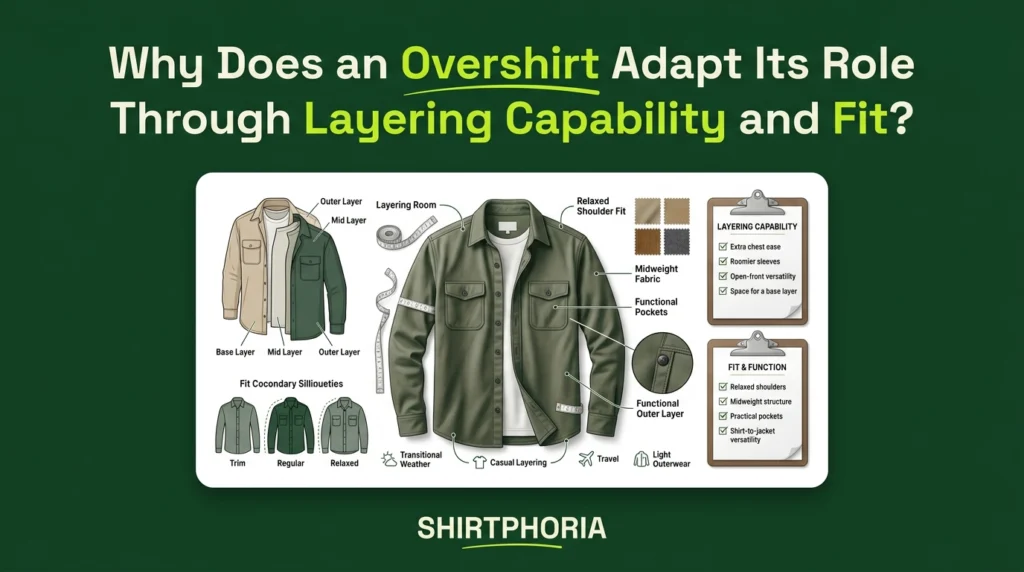
An overshirt adapts its role because it uses controlled extra room, heavier-than-shirt fabric, and enough structure to layer over a base garment while still remaining wearable under heavier outerwear.
The adaptive role of an overshirt comes from balance.
It needs more internal room than a close-fitting everyday shirt because it may need to accommodate a T-shirt, knit, or other base layer. At the same time, it cannot become so bulky that another coat cannot fit comfortably over it.
Fabric plays an equally important role. An overshirt normally needs enough weight and structure to remain controlled when worn open, but fabric weight alone does not make a garment jacket-like.
Fit, fabric, weave, placket construction, hem stability, armhole ease, and intended layering role work together.
A Day’s March describes an overshirt as a garment that should fit comfortably over a base layer without restricting movement, with the shoulders aligned naturally rather than fitting excessively tight or loose.
This guide explains how the overshirt uses fit volume, fabric weight, armhole ease, and placket structure to work as both a mid-layer and a light outer layer.
This adaptive role separates the overshirt from a standard casual shirt.
How Does Volumetric Fit Drive the Overshirt’s Adaptive Role?
Volumetric fit drives the overshirt’s adaptive role by giving the garment enough internal room to sit over a base layer without pulling, bunching, or losing its intended silhouette.
Volumetric Fit means controlled internal room through the:
- Chest
- Waist
- Shoulders
- Upper back
- Armholes
- Sleeves
This extra room is intentional.
It should not be confused with simply buying an ordinary shirt several sizes too large.
A larger conventional shirt may create excessive shoulder width, sleeves that are too long, an unstable hem, and unnecessary fabric around the waist.
An overshirt should instead distribute its additional room in areas where layering requires it.
A Day’s March recommends enough room for a base layer while keeping the shoulders naturally aligned. Burrows & Hare similarly advises that an overshirt should have sufficient room through the chest and waist to sit comfortably over a mid-weight knit without pulling across the back.
The practical goal is:
Enough room for layers, but enough control to preserve shape.
What Is Negative Space in Overshirt Fit?
Negative space in overshirt fit is the intentional gap between the wearer’s body or base layer and the overshirt fabric.
The term describes usable internal space.
A fitted shirt may sit close to the torso because it is expected to function as a base garment.
An overshirt needs more separation.
That separation allows another garment to occupy the space without immediately pushing the overshirt outward.
The relationship is:
Controlled Negative Space → Allows Layering → Prevents Pulling and Distortion
Imagine wearing an overshirt over a lightweight knit.
If there is almost no negative space, several problems can appear:
- Front placket pulls apart
- Chest fabric strains
- Upper back becomes tight
- Sleeves bind
- Armholes feel restrictive
- Hem lifts during reaching
Too much negative space creates the opposite problem.
The overshirt may:
- Hang away from the body
- Look unintentionally oversized
- Create excessive bulk under a coat
- Lose shoulder definition
- Pool around the waist
The useful fit sits between those extremes.
Summary: negative space is not a fit error when it allows layering without distorting the overshirt.
How Do Shoulders and Armholes Affect Overshirt Layering?
Shoulders and armholes affect overshirt layering because they control whether the garment can move over a T-shirt, knit, or light sweatshirt without binding.
The Shoulder Seam helps indicate how the upper garment is positioned relative to the wearer’s natural shoulder.
Some overshirts use a conventional shoulder position.
Others use slightly relaxed or extended shoulders.
A dropped shoulder is not mandatory.
What matters more is whether the shoulder construction accommodates the intended base layers while preserving an intentional silhouette.
The Armhole Ease is equally important.
Armhole ease refers to the room available around the sleeve-to-body junction.
The basic relationship is:
Shoulder and Armhole Ease → Reduces Binding → Improves Layer Compatibility
Too little ease creates pulling under the arms and across the upper back.
Too much ease can create a low, loose armhole that adds unnecessary fabric and bulk.
A practical test is simple.
Layer Test
Wear the overshirt over the thickest base layer you realistically plan to use.
Then:
- Button the front.
- Reach both arms forward.
- Raise the arms.
- Bend the elbows.
- Sit down.
- Rotate the shoulders.
If the placket pulls, shoulders bind, upper back strains, or sleeves restrict normal movement, the overshirt lacks enough adaptive fit.
How Does Layering Capability Define the Overshirt’s Changing Role?
Layering capability defines the overshirt’s changing role because the garment can sit over lighter base layers or under heavier outerwear depending on weather, fabric weight, and fit allowance.
This is what separates the overshirt from a garment with one fixed role.
A lighter overshirt might work:
T-shirt → Overshirt
A medium-weight version might work:
T-shirt → Knit → Overshirt
In cooler weather, the same garment may move inward:
Base Layer → Overshirt → Coat
Burrows & Hare describes the overshirt as flexible enough to function as a light outer piece in mild conditions while still working beneath a coat in colder weather.
That adaptability is conditional.
A lightweight cotton overshirt behaves differently from:
- Heavy flannel
- Moleskin
- Wool
- Quilted fabric
- Dense twill
- Canvas
The more fabric mass and insulation increase, the harder the garment may become to use beneath another layer.
When Does an Overshirt Work as a Mid-Layer?
An overshirt works as a mid-layer when it adds warmth under a heavier coat without creating uncomfortable bulk at the chest, sleeves, or armholes.
A good mid-layer overshirt needs several properties.
Streamlined Bulk
The overshirt should fit beneath outerwear without bunching heavily.
Controlled Hardware
Buttons or snaps should not press uncomfortably against the body when another garment compresses them.
Thermal Support
Fabric can add warmth, but warmth is influenced by more than weight.
Fiber, weave, density, trapped air, lining, and surrounding layers all contribute.
Movement Comfort
The combination of overshirt and coat should still allow ordinary arm movement.
Burrows & Hare specifically describes overshirts being worn under heavier coats and notes that successful layering should avoid excessive shoulder bulk.
A very thick overshirt can cross the boundary.
If it works well over a sweater but cannot comfortably fit beneath any heavier outerwear, it is functioning more like a shirt jacket or light jacket than a highly adaptive mid-layer.
When Does an Overshirt Work as a Light Outer Layer?
An overshirt works as a light outer layer when its fabric weight, front structure, and fit allow it to sit cleanly over a T-shirt, shirt, sweater, or hoodie.
The word light matters.
An ordinary overshirt should not automatically be described as:
- Waterproof
- Windproof
- Rainproof
- Weatherproof
- A protective shell
Those properties require appropriate materials and construction.
An untreated overshirt can instead function as a:
- Transitional outer layer
- Light outer layer
- Cool-weather layer
- Wind-buffering layer
Fabric density, weave, weight, fiber, and finish influence how much moving air reaches the wearer.
An overshirt may reduce the direct feeling of cool air without providing the sealed protection of technical outerwear.
Layering capability also connects the overshirt to a work shirt, where fabric and fit must support practical movement.
What Structural Features Support Overshirt Adaptation?
Overshirt adaptation depends on structural features such as fabric weight, weave, placket support, hem stability, and enough fit allowance for realistic layering.
No single feature creates adaptability.
The garment works as a system:
Fit Volume + Fabric Weight + Fabric Behavior + Armhole Ease + Placket + Hem + Layer Compatibility
If one element moves too far out of balance, the role changes.
A very thin garment with generous fit may simply behave like an oversized casual shirt.
A very thick garment with heavy hardware and insulation may behave more like a jacket.
The overshirt works in the space between those extremes.
How Does GSM Affect Overshirt Structure?
GSM affects overshirt structure by identifying fabric weight, which can influence how heavy, warm, and stable the garment feels.
GSM means grams per square meter.
It describes how much one square meter of a textile weighs.
SANVT explains that a higher GSM means a heavier fabric, while also noting that fabric quality and behavior depend on factors such as material and weaving technique rather than GSM alone.
This distinction is essential.
A higher GSM does not automatically mean:
- Better fabric
- More durable fabric
- Warmer garment in every situation
- Stiffer garment
- Better overshirt
- Better weather protection
Two fabrics can have similar weight while behaving differently because of:
- Fiber
- Yarn
- Weave
- Knit structure
- Density
- Finishing
- Brushing
- Lining
- Pattern construction
GSM is therefore one input.
The useful relationship is:
Higher Fabric Weight → More Physical Mass → Potentially More Substantial Drape
But the word potentially matters.
A heavy soft fabric can still drape fluidly.
A lighter dense fabric can feel crisp.
Summary
GSM helps describe fabric weight, but the full overshirt structure depends on the whole fabric and pattern system.
How Do Placket and Hem Structure Support Jacket-Like Use?
Placket and hem structure support jacket-like use by helping the overshirt front and lower edge stay visually controlled when the garment is worn open.
A Placket is the reinforced front area that supports buttons, snaps, or another closure system.
When an overshirt is worn closed, the placket helps organize the shirt front.
When worn open, the two front edges become highly visible.
A weak front edge may:
- Curl
- Twist
- Collapse
- Roll inward
- Flap excessively
A controlled placket helps preserve a cleaner open silhouette.
The relationship is:
Reinforced Placket → Controls Front Edge → Supports Open-Wear Structure
Too much reinforcement creates another problem.
An excessively stiff placket can:
- Feel rigid
- Add unwanted bulk
- Press beneath outerwear
- Prevent natural drape
The hem also matters.
A stable overshirt hem should sit cleanly around the body rather than twisting or flaring unpredictably.
The fabric needs enough weight and pattern control to behave intentionally when the garment is worn outside the trousers.
How Does the Adaptive Overshirt Compare With Static Garments?
The adaptive overshirt differs from static garments because it is designed to move between base-layer, mid-layer, and light outer-layer contexts instead of serving one fixed role.
| Feature | Casual Shirt | Adaptive Overshirt | Work Shirt |
|---|---|---|---|
| Fit Intent | Usually fits closer to the body for ordinary everyday wear | Uses controlled extra room to accommodate realistic base garments | Prioritizes movement and task comfort |
| Fabric Weight | Often uses lighter shirting fabrics | Often uses medium or heavier fabric to support layering and open wear | Often uses durable fabrics selected for repeated practical use |
| Layering Role | Commonly works as a base garment or light layer | Can work as a mid-layer or light outer layer depending on fabric and fit | Can work as a task layer but may prioritize durability over flexible layering |
| Internal Space | Usually requires less layering allowance | Uses deliberate negative space through the body and sleeves | Uses functional ease according to the intended task |
| Structure | Often prioritizes softness and everyday comfort | Balances softness with placket, hem, and fabric stability | May emphasize reinforcement, abrasion resistance, or utility construction |
| Outer Use | Can be worn alone but usually retains clear shirt behavior | Can replace light outerwear in suitable conditions | May work as outerwear when fabric and cut support it |
| Under-Coat Use | Usually fits easily beneath outerwear | Should remain compact enough to work as a mid-layer | Heavy or reinforced versions may become bulky beneath outerwear |
| Failure Point | Fails as an overshirt when too thin or too close-fitting for layers | Fails when too tight over base garments or too bulky under outerwear | Fails as adaptable layering when construction becomes too stiff or task-specific |
The difference is not that one garment is universally better.
Each is designed around a different use range.
The overshirt’s advantage is the width of that range.
Adaptive Overshirt Diagnostic Checklist
An adaptive overshirt can be evaluated by checking whether the garment has enough fit allowance, structure, and layering compatibility to function between a shirt and a jacket.
Layer Fit Check
Wear the overshirt over a realistic base garment.
That could be:
- T-shirt
- Long-sleeve shirt
- Lightweight knit
- Thin sweatshirt
The chest and back should remain controlled without visible pulling.
Under-Coat Check
Try the overshirt under the outerwear you actually use.
Look for:
- Sleeve bunching
- Shoulder compression
- Chest bulk
- Armhole pressure
- Hardware discomfort
If the overshirt makes normal outerwear feel significantly too small, its mid-layer usefulness is limited.
Armhole Ease Check
Raise and rotate the arms.
The armhole should provide enough space for the base layer without creating excessive loose fabric.
Shoulder Check
The shoulder line should support relaxed layering without looking accidentally several sizes too large.
Slight extension can work.
Large uncontrolled shoulder drop is not a requirement.
Fabric Weight Check
The fabric should have enough substance for the intended role.
Do not judge this from GSM alone.
Also inspect:
- Drape
- Weave
- Density
- Fiber
- Finish
- Lining
- Stiffness
Placket Check
Wear the garment open.
The front edges should remain reasonably controlled.
Then close it over a layer.
The placket should not strain or become uncomfortably rigid.
Hem Stability Check
The hem should sit cleanly around the body and over the base garment.
Watch for:
- Twisting
- Excessive flare
- Severe curling
- Uneven collapse
Role-Switching Check
Wear the overshirt:
- Closed over a T-shirt.
- Open over a knit.
- Under a heavier coat.
A highly adaptive version should remain practical across more than one configuration.
Weather Claim Check
Do not assume that fabric thickness automatically makes an overshirt weatherproof.
Unless the garment has documented weather-resistant materials or treatments, describe it as a light or transitional outer layer.
What Failure Modes Can Distort an Adaptive Overshirt?
An adaptive overshirt fails when its main attributes move too far in either direction, because both underbuilt and overbuilt construction can reduce layering comfort, structure, and role flexibility.
| Attribute | Too-Low Failure | Too-High Failure | Corrective Hypothesis |
|---|---|---|---|
| Fit Volume | Overshirt pulls over sweaters and behaves like a tight casual shirt | Overshirt becomes sloppy, boxy, or difficult to wear under outerwear | Match chest and torso allowance to the base layers actually worn |
| Negative Space | No usable internal room remains for layering | Excess space creates pooling and unnecessary bulk | Choose controlled internal space rather than simple oversizing |
| Armhole Ease | Armhole binds during reaching or when layers are added | Armhole feels excessively low, loose, or imprecise | Select enough ease for movement without uncontrolled sleeve drop |
| Shoulder Position | Shoulder area pulls across a base layer | Shoulder extends so far that the garment loses intentional shape | Match shoulder allowance to the cut and layer thickness |
| Fabric Weight | Fabric collapses or behaves like lightweight shirting | Garment becomes hot, stiff, or too jacket-like for layering | Match fabric behavior and mass to climate and intended role |
| Placket Structure | Front edges curl or collapse when worn open | Placket becomes rigid and uncomfortable beneath outerwear | Balance reinforcement with flexibility |
| Hem Stability | Lower edge twists, flares, or loses control | Heavy hem creates unnecessary stiffness | Match hem construction to fabric and garment length |
| Thermal Function | Garment adds little useful insulation for the intended season | Garment creates excessive warmth or indoor bulk | Match fiber, weave, weight, and layers to real conditions |
| Outer-Layer Use | Garment looks and behaves too much like a thin shirt outdoors | Garment becomes a full jacket and loses mid-layer practicality | Choose structure according to the desired shirt-to-jacket balance |
| Silhouette Balance | Garment lacks enough presence to read as an overshirt | Garment looks unintentionally oversized | Balance shoulder width, body volume, length, and fabric behavior |
The most important failures happen at both extremes.
Too little room removes layering capacity.
Too much room removes under-coat compatibility.
Too little structure makes the garment behave like a loose shirt.
Too much structure pushes it toward jacket territory.
Adaptability exists between those limits.
Checklist for Evaluating Overshirt Role Adaptability
To evaluate overshirt role adaptability, test whether the garment can layer over realistic base garments while still fitting under outerwear and holding a clean silhouette.
Decision Matrix
If the garment is too tight to button over a light knit or planned base layer:
Fail as an adaptive overshirt for that layer system. It behaves more like a thick casual shirt.
If the garment is comfortable over a knit but too bulky to fit beneath your normal coat:
Its mid-layer role is limited. It behaves more like a light jacket or shirt jacket.
If the garment works over a base layer and beneath heavier outerwear:
It demonstrates the core adaptive overshirt role.
If the garment works only as outerwear and cannot reasonably sit beneath another coat:
Classify it closer to a shirt jacket or light jacket rather than a fully adaptive overshirt.
Final Purchase Checklist
- Volume: The fit should float slightly over the body or base layer without looking unintentionally oversized.
- Chest: The front should close without pulling across the torso.
- Shoulders: The shoulder position should support the intended layers without obvious strain or uncontrolled drop.
- Armholes: Normal movement should remain comfortable with the planned base layer underneath.
- Sleeves: Sleeve width should accommodate the base garment without creating unnecessary bulk.
- Fabric Weight: The material should have enough substance for the intended role without turning the garment into an impractical mid-layer.
- GSM: Use GSM to understand weight, not as a standalone quality or warmth score.
- Structure: The fabric should hang cleanly and cooperate with the garment pattern.
- Placket: The front should remain controlled when open and comfortable when closed.
- Hem: The lower edge should sit cleanly over base layers without severe twisting or flare.
- Open Wear: The overshirt should maintain a coherent silhouette when unbuttoned.
- Closed Wear: It should still close over the layers you genuinely intend to wear.
- Under-Coat Fit: The garment should fit beneath heavier outerwear if mid-layer use is part of the goal.
- Climate Match: Fabric, fiber, and weight should correspond to the wearer’s actual climate and activity.
- Weather Claims: Do not treat an untreated overshirt as waterproof or windproof merely because the fabric feels heavy.
Educational note: This guide explains overshirt fit, layering, fabric behavior, and garment structure for general educational purposes. Actual performance varies by fiber, weave, weight, finish, pattern, construction, climate, and intended use.
Interactive Overshirt Adaptability Checklist
Frequently Asked Questions About Overshirts
An overshirt should have controlled extra room through the chest, waist, shoulders, armholes, and sleeves so it can sit over a realistic base layer without pulling, while still remaining streamlined enough to fit beneath heavier outerwear.
Negative space is the intentional internal gap between the wearer or base layer and the overshirt fabric. It allows layering without immediately distorting the placket, shoulders, upper back, sleeves, or hem.
No. GSM only describes fabric weight. Overshirt quality and behavior also depend on fiber, yarn, weave, density, finishing, brushing, lining, and pattern construction.
Yes, when its fit and fabric are balanced. A suitable overshirt can sit over a base layer in mild weather and beneath a heavier coat in cooler conditions without excessive bulk.
Terms Explained
| TERM | DEFINITION |
|---|---|
| Overshirt | A shirt-like garment designed with enough room and structure to layer over a base garment and, in many cases, under heavier outerwear. |
| Volumetric Fit | Controlled internal room distributed through the chest, waist, shoulders, upper back, armholes, and sleeves. |
| Negative Space | Intentional internal space between the wearer or base layer and the overshirt fabric. |
| Armhole Ease | The room available around the sleeve-to-body junction that supports movement and layering. |
| GSM | Grams per square meter, a measurement describing textile weight rather than overall quality. |
| Placket | The reinforced front area that supports buttons, snaps, or other closures and helps control the shirt front. |
| Mid-Layer | A garment layer worn between a base garment and heavier outerwear. |
| Light Outer Layer | A garment worn over base clothing in mild or transitional conditions without necessarily providing technical weather protection. |
Conclusion
In conclusion, the overshirt’s adaptive role comes from the balance between controlled fit allowance, fabric weight, and enough structure to move between shirt and jacket contexts.
Negative space provides the room needed for realistic base layers.
That space must remain controlled so the garment can still fit beneath heavier outerwear.
Shoulder and armhole ease allow the layer stack to move without excessive binding.
Fabric weight contributes physical mass and can help an overshirt maintain a more substantial silhouette, but GSM alone cannot determine how structured, warm, or durable the garment will be.
Fiber, weave, density, finish, lining, and pattern construction remain important.
The placket helps control the front when the garment is worn open.
The hem helps maintain the lower silhouette.
Together, these details allow the same overshirt to operate differently as conditions change.
Over a T-shirt, it can function as a light outer layer.
Under a coat, a suitably streamlined version can become a mid-layer.
Over a knit, it can occupy the transitional space between those roles.
The balance can fail in either direction.
Too little room turns the garment into a thick shirt.
Too much room makes it difficult to layer beneath outerwear.
Too little fabric structure makes it collapse.
Too much weight and stiffness push it toward jacket territory.
An overshirt can improve layering comfort and provide useful light outer-layer coverage, but it is not automatically weatherproof or universally warm.
Mastering the overshirt means choosing the right amount of space, weight, and structure for the layers you actually wear.