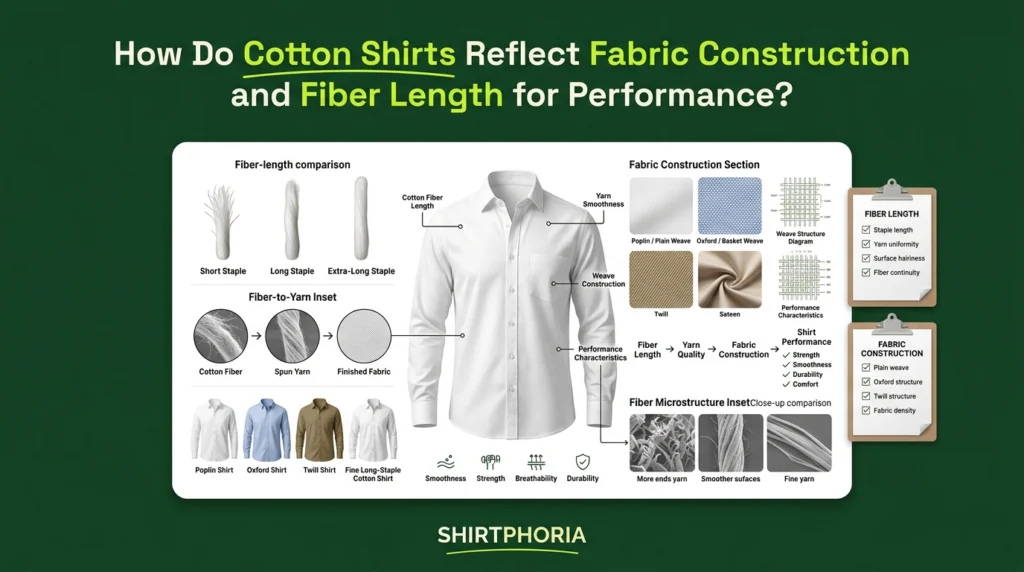
How Do Cotton Shirts Reflect Fabric Construction and Fiber Length for Performance?
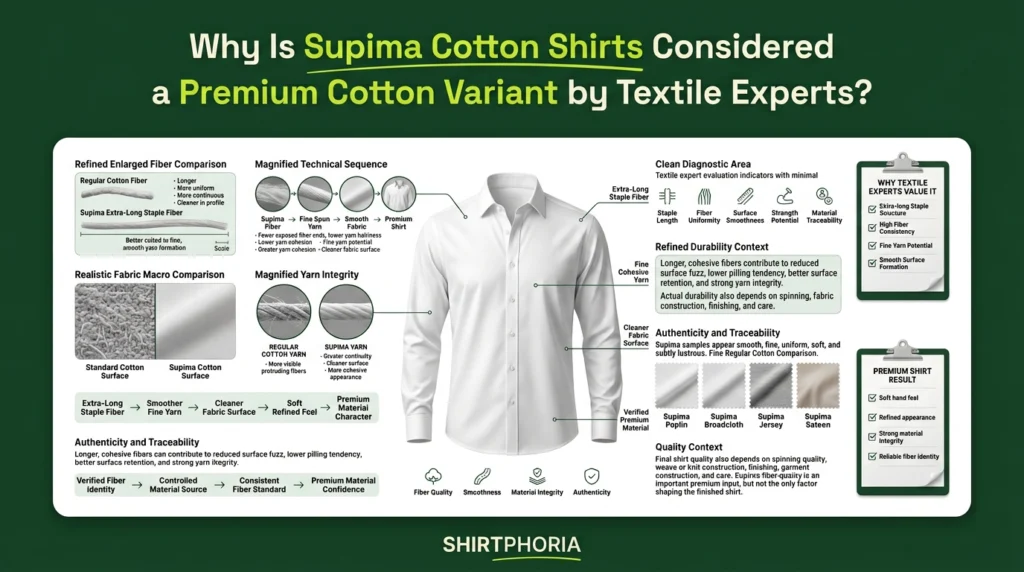
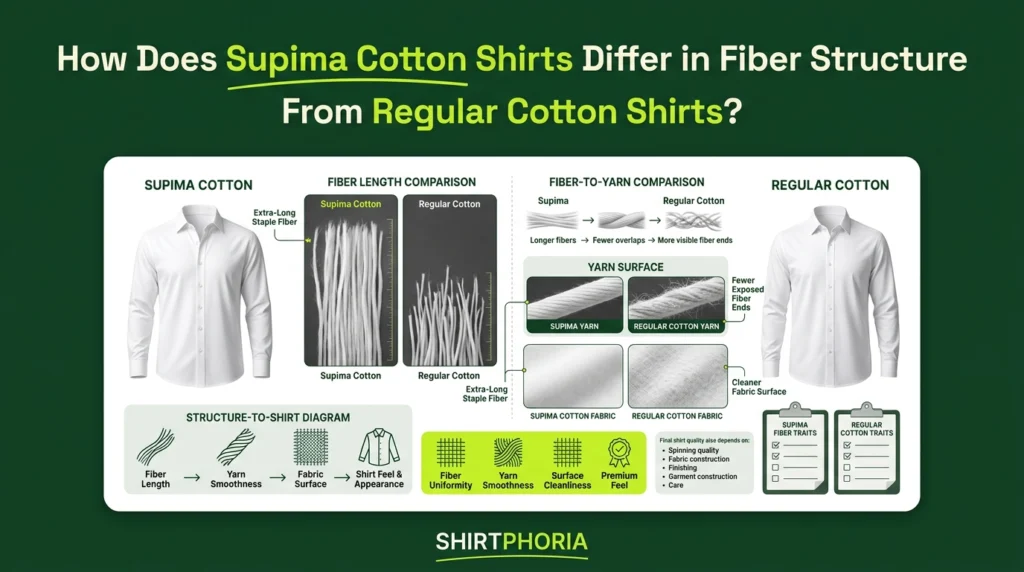
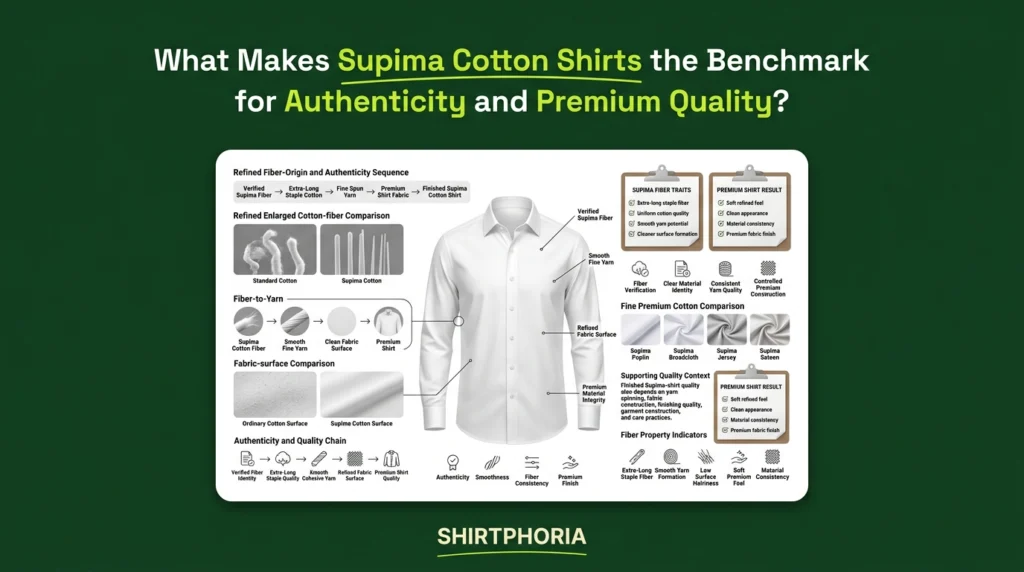
Cotton-shirt performance develops through a connected textile chain: fiber length and uniformity influence yarn-making potential, yarn engineering translates those fiber properties into usable yarn characteristics, fabric construction organizes those yarns into cloth, and finishing and garment construction further shape durability, airflow, smoothness, drape, opacity, comfort, and long-term wear.
Fiber length is therefore a raw-material performance input, not a guaranteed shirt-quality score.
A cotton shirt does not become durable, smooth, breathable, soft, or refined simply because its cotton fibers are long. Those fibers must first be spun into yarn. The yarn then needs an appropriate size, twist, ply, and level of evenness. Those yarns must be organized into a particular fabric structure. Finishing can then modify the surface or dimensional behavior, while seams, collars, cuffs, reinforcement, and overall assembly determine whether the resulting cloth becomes a durable garment.
The complete causal model is:
Fiber Properties → Yarn Engineering → Fabric Construction → Finishing → Garment Construction → Shirt Performance
Different stages have stronger direct influence over different outcomes.
Fiber length can influence yarn-making potential. Fabric openness has a more direct relationship with airflow through the textile. Finishing can strongly influence initial softness or wrinkle behavior. Seam and reinforcement quality can materially affect garment durability.
Measured textile characteristics must also remain separate from subjective impressions. Air permeability can be measured under defined conditions, while perceived comfort depends on additional factors such as moisture behavior, temperature, humidity, fit, and activity. Likewise, softness is a useful wearer perception but cannot verify exact cotton staple length.
The practical rule is simple:
Evaluate the system, not the marketing term.
How Do Fiber Length, Yarn Engineering, and Fabric Construction Form the Cotton-Shirt Performance Chain?
Cotton-shirt performance forms through sequential textile layers: measurable fiber properties influence spinning potential, yarn engineering converts those fibers into yarn, fabric construction organizes the yarn into cloth, and finishing and garment assembly further modify the final shirt.
An upstream material characteristic creates possibilities rather than guaranteed downstream outcomes.
Cotton fiber length, for example, exists before spinning. Air permeability exists at the fabric level. Seam strength becomes relevant after the material has been converted into a garment.
Understanding those layers prevents one variable from being credited with performance created elsewhere in the system.
Where Does Cotton Fiber Length Sit in the Shirt-Performance Chain?
Cotton fiber length sits at the raw-material stage of shirt production, where it influences yarn-making potential rather than directly determining the finished shirt’s breathability, drape, softness, or durability.
Cotton is a staple fiber, meaning individual fibers have finite lengths rather than forming one continuous natural filament.
Fiber length describes a measurable length characteristic of those staple fibers.
The USDA Agricultural Marketing Service cotton-classing system measures several separate cotton characteristics, including fiber length, length uniformity, strength, and micronaire. USDA describes micronaire as reflecting a combination of fiber fineness and maturity rather than pure fineness alone.
Fiber length therefore belongs beside several other raw-cotton characteristics rather than standing above them as a universal quality score.
Fiber-length uniformity describes how consistent the fiber lengths are within the measured population.
Fiber strength concerns the resistance of cotton fiber bundles under the relevant measurement method.
Micronaire reflects the combined response of fineness and maturity.
Short-fiber content can provide additional information where reliable testing is available.
These characteristics influence processing differently.
The central relationship is:
Fiber Length → Influences → Yarn-Making Potential
Cotton still needs to be spun into usable yarn before any shirt fabric can exist.
Where Does Yarn Engineering Sit Between Fiber and Fabric?
Yarn engineering acts as the bridge between cotton-fiber potential and fabric behavior because spinning establishes yarn size, twist, and ply while fiber properties and process control jointly influence cohesion, evenness, and surface character.
A yarn is an engineered assembly of fibers used to form textile structures.
Several yarn variables matter.
Yarn size or count describes the scale or fineness of the yarn according to a particular count system.
Twist describes how fibers are rotated together to develop cohesion.
Ply describes whether one yarn strand is used alone or multiple strands are combined.
Evenness concerns the consistency of yarn mass or thickness along its length.
Cohesion describes how effectively the fiber assembly holds together under the relevant conditions.
The same cotton fiber supply can therefore produce different yarns.
A spinner can alter yarn size, twist, ply arrangement, and process settings. Those choices influence how the yarn behaves when woven and how the eventual fabric looks and performs.
No single yarn specification is universally superior.
A fine yarn can support refined constructions, but finer does not automatically mean stronger or better.
A higher-twist yarn may gain cohesion under suitable conditions while producing a different hand or flexibility.
A plied yarn may offer useful stability in one construction without automatically being superior to a well-engineered single yarn.
Yarn engineering therefore translates raw fiber potential into a form that fabric construction can use.
Where Does Fabric Construction Influence Finished-Shirt Behavior?
Fabric construction strongly influences many observable cotton-shirt characteristics by controlling how warp and weft yarns interlace, how closely they are spaced, how open the textile structure remains, and how much substance the fabric carries.
In woven cloth, warp refers to the lengthwise yarn system.
Weft refers to the crosswise yarn system that interlaces with the warp.
A weave structure is the organized pattern through which these two yarn systems cross.
Fabric behavior then depends on variables such as:
- weave pattern;
- yarn density;
- yarn size;
- structural openness;
- fabric weight;
- fabric thickness;
- and finishing.
These variables influence:
- air permeability;
- surface texture;
- opacity;
- drape;
- flexibility;
- structural stability;
- yarn exposure;
- and abrasion behavior.
A dense textile can provide greater cover and opacity while reducing continuous airflow pathways.
A more open structure can increase potential air movement while sacrificing opacity or structural substance.
A heavier textile can feel more substantial without automatically being more durable.
Finishing can further modify smoothness, wrinkle recovery, surface polish, hand feel, or dimensional behavior.
None of these finished-fabric properties can be predicted reliably from cotton staple length alone.
Fiber-to-Shirt Performance Diagram
Fiber Properties → Yarn Engineering → Fabric Construction → Finishing → Garment Construction → Shirt Performance
The arrows represent stages of influence rather than universal one-to-one causation; each downstream stage can preserve, redirect, amplify, or limit upstream material potential.
How Does Cotton Fiber Length Influence Yarn Performance?
Cotton fiber length primarily influences yarn-making potential because longer and more uniform usable fibers can support fiber overlap, cohesion, finer yarn formation, improved evenness, and a more refined yarn surface, although fiber strength, maturity, short-fiber content, spinning conditions, and yarn design still influence the final result.
The important word is potential.
Fiber length can create favorable conditions for certain spinning objectives without guaranteeing the finished yarn or shirt.
Average length, uniformity, strength, short-fiber content, and micronaire describe different aspects of the cotton supply and should not be merged into one “premium cotton” score.
How Do Shorter and Longer Cotton Fibers Behave During Yarn Formation?
Cotton staple fibers rely on overlapping contact and twist during spinning, so greater usable fiber length can provide more opportunity for fibers to interact within the yarn while other fiber and spinning variables still affect cohesion.
Fiber overlap describes the way finite cotton fibers extend alongside neighboring fibers within the spun yarn.
Because individual staple fibers are not continuous, the yarn relies on numerous overlapping fibers and the cohesion created through spinning.
Greater usable length can provide more opportunity for this interaction.
That does not mean shorter fibers automatically produce weak yarns.
The result still depends on:
- spinning system;
- yarn twist;
- yarn fineness;
- fiber strength;
- fiber maturity;
- fiber-length distribution;
- short-fiber content;
- and process control.
Higher short-fiber content can complicate processing or contribute to irregularity under some spinning conditions, but it should be treated as an additional variable rather than simply the opposite of average fiber length.
The technically accurate conclusion is:
Greater usable fiber length can support yarn cohesion potential, but spinning design determines how that potential is converted into yarn.
How Can Longer Cotton Fibers Support Finer and More Even Yarns?
Longer and more uniform cotton fibers can support finer and more even yarn production because sufficient fiber interaction can help maintain cohesion when smaller yarn sizes are engineered.
Fine-yarn production places different demands on the fiber assembly than coarse-yarn production.
As less material occupies a given yarn cross-section, maintaining sufficient interaction among the constituent fibers becomes important.
Longer usable fibers can contribute to that opportunity.
Uniformity matters as well because a population containing many fibers of substantially different lengths can behave differently from one with a more consistent distribution.
This gives a useful causal relationship:
Usable Fiber Length + Uniformity → Fiber Overlap and Spinning Potential → Fine/Even Yarn Possibility
Again, the final word is possibility.
Finer yarn does not automatically mean:
- higher quality;
- greater strength;
- greater softness;
- better comfort;
- or more durable fabric.
Yarn twist, spinning method, cotton strength, count, fabric construction, finishing, and intended use remain important.
Finer and more even yarn simply provides designers with additional options for producing refined textile structures later in the performance chain.
Why Does Fiber-Length Uniformity Matter Alongside Average Fiber Length?
Fiber-length uniformity matters because two cotton samples with similar average fiber lengths can differ in the consistency of their fiber-length distributions and therefore in their spinning behavior.
An average value compresses a population into one figure.
That figure does not reveal how widely individual fiber lengths are distributed around the average.
One cotton sample may have a relatively consistent length distribution.
Another can share a similar average while containing more variation.
Fiber-length uniformity helps describe that distinction.
More consistent fiber lengths can support more predictable spinning behavior under appropriate conditions, but uniformity is still only one input.
It does not independently prove yarn evenness, strength, or finished-shirt quality.
The most useful evaluation therefore considers:
Fiber Length + Length Uniformity + Strength + Micronaire + Spinning Requirements
rather than length alone.
Which Cotton-Shirt Performance Attributes Can Fiber Length Influence Indirectly?
Fiber length most directly influences yarn-making potential and affects finished-shirt characteristics only through downstream yarn, fabric, finishing, garment-construction, care, and use variables.
Its strongest indirect relationships involve potential for:
- yarn strength;
- yarn evenness;
- finer yarn formation;
- and surface refinement.
Those yarn characteristics can then contribute to particular fabric possibilities.
However, several familiar shirt attributes are controlled much more strongly downstream.
Air permeability depends heavily on fabric openings, yarn arrangement, density, thickness, and finishing.
Drape depends on yarn and textile architecture as well as finishing.
Opacity is strongly influenced by yarn size, density, structure, and fabric weight.
Softness can be influenced by fiber properties but also by yarn fineness, construction, finishing, and laundering.
Abrasion resistance depends on the complete textile architecture.
Garment lifespan also depends on seams, reinforcement, care, use intensity, and wearer behavior.
The correct chain is therefore:
Fiber Property → Yarn Effect → Possible Fabric Outcome → Finished-Shirt Modifier
Jumping directly from staple length to a finished-shirt claim skips too many stages.
How Does Yarn Engineering Translate Cotton Fiber Properties Into Shirt Fabric?
Yarn engineering translates cotton-fiber properties into fabric-ready characteristics by controlling yarn size, twist, and ply while fiber quality and spinning consistency influence evenness, cohesion, and surface character.
This middle stage explains why similar cotton can produce different shirts.
How Does Yarn Size Influence Cotton-Shirt Fabric Weight and Refinement?
Yarn size influences the scale and potential refinement of cotton-shirt fabric because finer and coarser yarns interact differently with fabric density, weight, thickness, surface appearance, and flexibility.
Yarn count systems describe yarn size in different ways, so an unexplained numerical count should not be treated as a universal quality score.
A fine yarn can support a relatively refined or lightweight textile when paired with suitable construction and density.
A coarser yarn can provide greater visual texture or substance.
Neither is automatically better.
The intended result matters.
For a dress shirt, finer yarn may support a smooth, controlled fabric.
For a more casual Oxford, greater yarn substance can contribute to the desired texture.
Yarn size must therefore be interpreted with:
- weave;
- density;
- fabric weight;
- thickness;
- and intended use.
A finer yarn used in a very dense construction can create a different fabric from the same yarn used in a more open one.
How Does Yarn Twist Change Strength, Flexibility, and Hand?
Yarn twist changes fiber cohesion, compactness, flexibility, and surface character, creating an optimization tradeoff rather than a simple “more twist is better” relationship.
Staple fibers need sufficient cohesion to function together as yarn.
Twist helps create that cohesion by bringing fibers into a more integrated assembly.
Changing twist can alter:
- compactness;
- surface hairiness;
- flexibility;
- hand;
- fiber interaction;
- and strength behavior.
The exact outcome depends on yarn size, spinning system, fiber characteristics, and fabric structure.
More twist should therefore not be interpreted as universally superior.
Likewise:
Less twist ≠ universally softer or better.
A yarn is engineered for a specific textile objective.
The correct twist level is the one that supports that objective while balancing the required hand, flexibility, cohesion, and fabric performance.
How Do Single-Ply and Multi-Ply Yarns Influence Cotton-Shirt Fabric?
Ply describes how yarn strands are combined and can influence yarn stability, bulk, and surface character, but ply count is not a universal grade of cotton-shirt quality.
A single-ply yarn consists of one spun yarn strand used as the yarn unit.
A plied yarn combines two or more yarn strands.
Plying can modify stability, surface appearance, bulk, or behavior depending on how the component yarns are engineered.
But “two-ply” by itself does not establish superiority.
The result depends on:
- the size of each component yarn;
- twist;
- ply twist;
- final yarn size;
- fabric construction;
- and intended use.
Two-ply yarns with one set of specifications can behave very differently from other two-ply yarns.
Likewise, a well-engineered single yarn may be highly suitable for a particular shirting fabric.
Ply therefore describes construction of the yarn rather than serving as a universal quality grade.
How Does Yarn Evenness Affect the Finished Cotton-Shirt Surface?
Yarn evenness influences surface consistency because variations in yarn mass or thickness can appear as local differences in texture, visual regularity, and fabric uniformity.
An uneven yarn can contain local thick and thin areas.
When many such yarns are organized into cloth, those variations can become visible or influence the fabric surface.
A more even yarn can support a more consistent textile appearance where that is the design objective.
Intent matters here as well.
Some fabrics deliberately use slub yarns or controlled irregularities to create texture.
That should not be confused with unintended spinning irregularity.
Yarn evenness is influenced by both fiber characteristics and manufacturing control, but these are not identical variables.
Good fiber does not guarantee perfect yarn evenness, and process control cannot erase every upstream fiber limitation.
How Does Fabric Construction Change Cotton-Shirt Performance?
Fabric construction changes cotton-shirt performance by controlling how yarns interlace, how closely they are spaced, and how open, dense, heavy, or flexible the cloth becomes, which strongly influences texture, air permeability, opacity, drape, abrasion exposure, and structural stability.
Many characteristics consumers immediately notice belong primarily to this layer rather than directly to the cotton fiber.
How Does Weave Structure Change Cotton-Shirt Texture and Durability Orientation?
Weave structure changes cotton-shirt behavior by altering the pattern, frequency, and distribution of warp-weft interlacings.
Yarn interlacing describes how warp and weft yarns pass over and under one another to create woven cloth.
Changing the interlacing pattern modifies:
- surface appearance;
- yarn exposure;
- flexibility;
- drape;
- abrasion pathways;
- and structural stability.
Plain weave uses frequent intersections.
Twill produces diagonal structural lines.
Basket-like structures used in Oxford cloth organize yarns differently again.
Those differences can create recognizable fabric tendencies.
However, weave pattern alone does not determine durability.
A fair strength or wear comparison should control or account for:
- yarn material;
- yarn size;
- yarn strength;
- density;
- fabric weight;
- finishing;
- and test conditions.
A dense, robust plain weave can outperform a poorly engineered twill for one property, while the reverse may be true under another set of specifications.
Weave therefore creates durability orientation, not an automatic durability ranking.
How Does Yarn Density Change Cotton-Shirt Opacity, Airflow, and Substance?
Yarn density influences how completely yarns cover the fabric area, which can modify opacity, body, airflow pathways, and structural substance.
Closer yarn spacing generally creates greater textile cover.
That can increase opacity and produce a more substantial surface.
Wider spacing can create more continuous openings through which air can move.
Several related terms should not be treated as synonyms:
Yarn density concerns yarn spacing or count within the structure.
Thread count summarizes yarn counts according to a stated method.
Fabric weight describes mass per unit area.
Thickness describes fabric depth.
These variables can interact, but each measures a different feature.
Two fabrics can have the same yarn density while using yarns of different sizes.
The resulting cover, weight, texture, and airflow can therefore differ.
This is why one density or thread-count number should never function as a complete cotton-shirt quality score.
How Does Structural Openness Affect Cotton-Shirt Breathability?
Structural openness affects cotton-shirt air permeability by changing the size, number, and continuity of pathways through which air can move through the fabric.
Air permeability is the measurable passage of air through textile fabric under specified test conditions.
The current active ASTM D737 Standard Test Method for Air Permeability of Textile Fabrics covers measurement of textile-fabric air permeability and notes that construction and finishing can materially affect airflow behavior.
A fabric with more continuous openings can provide greater pathways for air movement than a tightly packed structure, all else being comparable.
But air permeability should not be converted automatically into total wearer comfort.
Broader thermal comfort can also involve:
- moisture absorption;
- evaporation;
- humidity;
- temperature;
- fit;
- activity;
- heat exchange;
- and individual wearer response.
Structural openness can also create trade-offs.
More open cloth may provide greater airflow while offering:
- less opacity;
- less wind resistance;
- reduced structural substance;
- or greater exposure of individual yarns.
Two misconceptions should therefore be avoided:
Staple length does not determine warm-weather comfort.
Lightweight does not automatically mean highly air-permeable.
A thin fabric can still be densely constructed.
Why Can Two Cotton Shirts Made From Similar Fibers Still Perform Differently?
Two cotton shirts made from similar fibers can perform very differently because yarn size, twist, ply, weave, density, fabric weight, finishing, and garment construction can each alter the final textile system.
Imagine two shirts using cotton with broadly similar fiber properties.
The first uses fine yarn, a relatively open lightweight plain weave, controlled finishing, and a relaxed garment fit.
The second uses coarser or differently twisted yarn, a denser twill, greater fabric mass, and a more structured fit.
Although the cotton source may be similar, the shirts can differ materially in:
- airflow;
- opacity;
- surface texture;
- drape;
- heat retention;
- structure;
- flexibility;
- and abrasion behavior.
This relationship can be summarized as:
Similar Fibers + Different Downstream Engineering → Produce → Different Shirt Performance
Fiber identity establishes only part of the story.
How Do Fiber Length and Fabric Construction Work Together in Cotton Shirts?
Fiber length and fabric construction work together hierarchically: fiber characteristics establish part of the yarn-making potential, while yarn engineering and fabric architecture control whether and how that potential appears in the finished cotton shirt.
The relationship is upstream-to-downstream rather than equal and simultaneous.
Fiber creates possibilities.
Spinning translates those possibilities.
Construction organizes them.
Finishing and garment assembly modify the result further.
How Can Suitable Longer Fibers Support Fine, Smooth Cotton-Shirt Constructions?
Longer and more uniform cotton fibers can support fine and even yarn production that makes refined fabric constructions possible, but weave, density, finishing, laundering, and garment processing still shape the final surface and hand.
The useful relationship is:
Longer / More Uniform Fibers → Fine / Even Yarn Potential → Refined Fabric Possibilities
Potential matters because a favorable raw material can be undermined downstream.
Long cotton fibers spun poorly do not guarantee even yarn.
Even yarn used in an unsuitable construction does not automatically create the desired shirt.
An excellent fabric can be altered substantially through finishing or poor garment assembly.
Softness also cannot be inferred directly from fiber length.
Longer fibers may contribute to opportunities for smooth yarn formation, but finishing, yarn size, fabric structure, surface treatment, and laundering strongly influence the hand a wearer actually experiences.
How Can Fabric Construction Amplify or Limit Fiber-Level Advantages?
Fabric construction can amplify, redirect, or limit fiber-level advantages because finished textile behavior depends on how engineered yarn is organized rather than on raw-fiber characteristics alone.
Consider several controlled relationships:
Strong fiber/yarn potential + poorly matched construction ≠ automatically durable shirt.
Fine yarn + dense construction behaves differently from fine yarn + open construction.
Refined fiber cannot compensate for every finishing or assembly weakness.
High-quality fabric cannot compensate for every garment-construction weakness.
A long-staple cotton yarn placed in a dense structure may create a smooth, opaque fabric with modest airflow.
A similar fine yarn in a more open structure can create different air-permeability and opacity characteristics.
The cotton remains similar. Architecture changes the outcome.
This is why the shortcut:
Better Fiber = Better Shirt
should be rejected.
The technically useful question is:
How effectively did each downstream stage use the material potential for the intended purpose?
Which Shirt Attributes Are Influenced Most by Fiber, Yarn, Fabric, Finishing, or Garment Construction?
Different cotton-shirt attributes are influenced more strongly by different stages of the textile system, so identifying the dominant layer is more useful than assigning one universal quality score.
The following matrix is a directional editorial model rather than laboratory data.
Relative Influence Matrix
| Cotton-Shirt Attribute | Fiber Properties | Yarn Engineering | Fabric Construction | Finishing | Garment Construction |
|---|---|---|---|---|---|
| Yarn-strength potential | High | High | Low | Low | Low |
| Surface smoothness | Medium-High | High | High | High | Low |
| Air permeability | Low | Medium | High | Medium | Low-Medium |
| Fabric durability | Medium | High | High | Medium | Low |
| Garment durability | Medium | High | High | Medium | High |
| Drape | Low-Medium | Medium | High | High | Medium |
| Texture | Low | Medium | High | High | Low |
| Softness / hand | Medium | High | Medium-High | High | Low |
High, Medium, and Low express relative causal influence within this article’s model; they are not laboratory scores, percentages, or universal effect sizes.
Influence can shift according to yarn specification, fabric structure, finishing treatment, and intended use.
For example, aggressive surface finishing can become a dominant influence on initial softness, while fabric construction can dominate airflow.
The table is therefore a reasoning tool, not a fixed formula.
How Do Poplin, Twill, and Oxford Compare for Cotton-Shirt Performance?
Poplin, twill, and Oxford create different cotton-shirt performance tendencies because their fabric architectures organize yarns differently, producing different combinations of surface texture, body, drape, airflow potential, abrasion exposure, and visual refinement.
The construction name gives useful information, but it does not provide the complete performance specification.
Yarn size, density, fabric weight, finishing, and garment construction remain modifiers.
How Does Poplin Prioritize Smoothness and Lower Bulk?
Poplin commonly creates a clean, smooth, relatively low-bulk shirting surface through a plain-weave structure, although its exact airflow, opacity, drape, and durability still depend on yarn size, density, weight, and finishing.
Poplin generally relies on a plain-weave architecture with frequent warp-weft intersections.
This can contribute to:
- a clean surface;
- controlled texture;
- a crisp appearance;
- and relatively low bulk in many shirting versions.
Lightweight and medium-weight poplins are common, making the construction useful for dress shirts and warm-weather applications where the particular fabric specifications support those purposes.
Poplin is not automatically:
- more breathable;
- lighter;
- more durable;
- smoother;
- or higher quality
than every twill or Oxford.
A dense poplin can restrict airflow.
A lightweight twill can differ from a heavy twill.
Actual fabric specifications matter more than the category name alone.
How Does Twill Change Drape, Surface Structure, and Durability Orientation?
Twill changes cotton-shirt character through diagonal interlacing, producing a distinct surface architecture and often different drape, body, and yarn-exposure patterns from comparable plain-weave shirtings.
The defining structural feature is the diagonal pattern created through the progression of warp-weft interlacings.
This architecture can influence:
- surface appearance;
- yarn exposure;
- drape;
- flexibility;
- and abrasion pathways.
Depending on yarn size, density, weight, and finishing, some twill shirtings can feel more substantial or produce robust wear characteristics.
Those tendencies should not be converted into a universal rule that twill is always stronger.
A durability comparison still needs compatible fabric variables.
Analyzing cotton’s strength leads to a comparison with its primary natural rival in terms of durability: Why Are Linen Shirts Ideal for Breathability and Exceptional Fabric Strength?.
How Does Oxford Construction Create Texture and Substance?
Oxford cloth commonly creates a visibly textured and relatively substantial shirt surface through a basket-weave-type construction, although Oxford fabrics can vary significantly in yarn size, density, weight, and finishing.
Oxford construction groups or organizes yarn interlacings in a way that creates its recognizable texture.
Typical characteristics can include:
- visible surface texture;
- greater apparent substance;
- a less sleek hand than fine poplin;
- casual visual character;
- and common use in button-down shirts.
But the name “Oxford” does not reveal exact:
- weight;
- air permeability;
- yarn quality;
- opacity;
- durability;
- or softness.
One Oxford can be light and relatively open, while another can be heavier and denser.
Construction family provides orientation rather than complete specification.
Cotton-Shirt Construction Comparison Table
| Construction | Typical Surface | Relative Structure | Airflow Tendency | Durability Orientation | Typical Use |
|---|---|---|---|---|---|
| Poplin | Smooth, clean | Often light-medium | Can be relatively high in lighter/open variants | Moderate tendency; varies with yarn/density | Dress and warm-weather shirts |
| Twill | Diagonal, smooth-to-textured | Often medium-substantial | Commonly moderate, but highly construction-dependent | Can support robust wear where yarn/density are suitable | Dress, work, everyday shirts |
| Oxford | Textured | Often medium-substantial | Commonly moderate, but varies widely | Can support everyday durability in suitable constructions | Casual and button-down shirts |
Yarn size, yarn density, fabric weight, thickness, finishing, and garment construction can materially alter every row.
This table describes common tendencies rather than a universal quality ranking.
How Should You Choose Cotton Shirts for a Specific Performance Goal?
Choosing a cotton shirt by performance requires matching fiber, yarn, fabric, finishing, and garment characteristics to the specific outcome you value rather than looking for one universal quality signal.
A buyer prioritizing airflow should examine different variables from one prioritizing formal refinement or repeated abrasion.
Performance selection works best when the objective comes first.
How Should You Choose Cotton Shirts for Smoothness and Refinement?
Cotton shirts intended for smoothness and refinement should prioritize fine, even yarns and a controlled fabric surface rather than relying on a premium cotton name alone.
Useful signals can include:
- fine yarn where appropriate;
- strong yarn evenness;
- a smooth surface;
- refined fabric construction;
- credible long- or extra-long-staple information where actually disclosed;
- and controlled finishing.
Longer and more uniform fibers can support fine-yarn possibilities, but the visible refinement comes from how that potential is converted downstream.
A poor finish can reduce the benefit of excellent yarn.
Likewise, a highly polished finish can temporarily make an ordinary textile appear smoother than its underlying construction might suggest.
Trade-off: Very fine, lightweight, or refined constructions can require greater care during wear and laundering.
Refinement should therefore be matched to actual maintenance tolerance.
How Should You Choose Cotton Shirts for Durability and Repeated Wear?
Cotton-shirt durability depends on the combined performance of fiber quality, yarn cohesion, weave, density, fabric weight, finishing, seams, reinforcement, care, and actual use rather than staple length alone.
For repeated wear, prioritize:
- suitable fiber quality;
- cohesive yarn;
- appropriate yarn twist;
- robust fabric construction;
- appropriate yarn density;
- suitable fabric weight;
- strong seams;
- reinforced stress areas;
- secure buttons;
- and care requirements compatible with intended use.
Fiber length can support yarn-making potential but should never function as the sole durability criterion.
Three levels should remain separate:
Technical Durability → Potential Lifespan → Realized Useful Wear-Life
A technically strong shirt creates greater practical lifecycle value only when it remains useful and continues to be worn.
An extremely durable garment that does not fit, feels uncomfortable, or receives little actual wear does not realize its full potential lifespan.
How Should You Choose Cotton Shirts for Warm-Weather Comfort?
Warm-weather cotton shirts should prioritize fabric architecture and fit that support air and heat exchange, especially suitable structural openness and fabric mass for the intended conditions.
Prioritize:
- appropriate structural openness;
- air permeability where reliable test data is available;
- suitable weight;
- moisture behavior;
- garment fit;
- activity level;
- and humidity.
Staple length should receive much less emphasis here because fiber length does not directly create airflow pathways.
Fabric construction does.
A lighter and relatively open poplin can be useful in warm weather, but not every poplin has that specification.
Likewise, other cotton constructions can perform effectively when weight and openness support airflow.
Trade-off: More openness or lower fabric mass can reduce opacity, wind resistance, or structural substance.
Warm-weather comfort is therefore an optimization problem rather than a search for the longest cotton staple.
How Should You Choose Cotton Shirts for a Soft or Premium Hand?
A soft cotton-shirt hand develops from interacting fiber, yarn, fabric, finishing, laundering, and surface variables, so softness alone cannot verify long-staple cotton or superior durability.
Evaluate:
- fiber characteristics where known;
- yarn fineness;
- yarn evenness;
- weave or knit structure;
- surface texture;
- finishing;
- and laundering behavior.
Initial softness can be strongly influenced by finishing.
A treated surface may feel exceptionally soft when new even if the effect changes after repeated laundering.
Conversely, some natural cotton fabrics can become softer over time.
Softness is still a valid preference.
It simply should not be used as proof of exact fiber length, cotton category, strength, or longevity.
Trade-off: Very soft initial hand does not automatically indicate strong long-term structural stability.
Cotton-Shirt Performance Decision Matrix
| Performance Goal | Fiber Priority | Yarn Priority | Fabric Priority | Main Tradeoff |
|---|---|---|---|---|
| Smooth refinement | Longer/uniform fibers can support yarn potential | Fine, even yarn | Smooth, controlled construction | Fine/light structures may need greater care |
| Everyday durability | Consistent fiber quality supports potential | Cohesive, suitably engineered yarn | Robust weave + suitable density/weight | May increase structure or weight |
| Warm-weather comfort | Secondary to downstream structure | Suitable yarn scale | Open/light architecture where appropriate | Can reduce opacity or substance |
| Soft hand | Supporting influence | Fine/even yarn can contribute | Flexible, smooth construction | Finishing may dominate initial feel |
| Casual texture | Secondary | Suitable yarn character | Oxford or other textured construction | Less sleek surface |
This matrix is a selection tool, not a quality ranking.
The correct priority depends on intended use, climate, maintenance requirements, and acceptable trade-offs.
What Cotton-Shirt Performance Misconceptions Should You Avoid?
The most common cotton-shirt performance mistakes come from treating one variable-fiber length, softness, thread count, fabric weight, weave name, or cotton variety-as if it independently determines overall quality.
A better evaluation separates the claim from its technical boundary.
Why Doesn’t Longer Cotton Fiber Automatically Create a Better Shirt?
Longer cotton fiber can increase yarn-making potential, but the finished shirt still depends on fiber uniformity, spinning, yarn engineering, fabric construction, finishing, garment construction, care, and intended use.
Use this relationship:
Longer Fiber → Greater Yarn Potential → Downstream Engineering Shapes Finished Result
Do not use:
Longer Fiber = Automatically Superior Shirt
Fiber length matters, but it matters at a specific stage.
The rest of the textile system decides what becomes of that advantage.
Why Isn’t Softness Proof of Long-Staple Cotton?
Softness cannot reliably prove cotton staple length because yarn characteristics, fabric construction, finishing, laundering, and surface treatments can all change hand feel.
Touch is a subjective evaluation of the finished surface.
Staple length is a measurable characteristic of raw cotton.
Those are not the same evidence type.
A soft shirt could use long-staple cotton, but softness alone cannot prove it.
Finishing is especially important because softeners, polishing, mechanical treatments, and other processes can significantly change the initial hand.
Softness still matters for consumer preference.
It simply cannot verify fiber length.
Why Shouldn’t Thread Count Alone Be Used to Judge Cotton-Shirt Quality?
Thread count alone provides insufficient information about cotton-shirt performance because yarn size, weave structure, density, fabric weight, finishing, and garment construction determine how the textile actually behaves.
Thread count summarizes yarn quantities according to a particular counting approach.
But the same total number can involve different:
- yarn sizes;
- yarn arrangements;
- weave structures;
- thicknesses;
- weights;
- and finishing systems.
A figure commonly emphasized in bedding marketing therefore should not be transferred directly into a universal shirt-quality scale.
Thread count is not meaningless.
It is simply incomplete without structural context.
Why Aren’t Heavier Cotton Shirts Always More Durable?
Greater fabric weight does not automatically create greater durability because resistance to wear also depends on fiber and yarn strength, yarn engineering, weave, density, abrasion exposure, finishing, seams, and garment construction.
Fabric weight tells you how much material exists per unit area.
It does not tell you how effectively that material has been engineered.
A heavier shirt may provide:
- greater substance;
- greater opacity;
- more body;
- or a different thermal profile.
Those properties can be useful without guaranteeing superior abrasion resistance or longer garment life.
Likewise, lightweight fabric should not automatically be considered fragile.
A well-engineered lightweight fabric can provide strong performance for its intended purpose.
Why Doesn’t Cotton Type or Variety Guarantee Garment Performance?
Cotton names can describe species, variety, origin, staple category, or marketed material identity, but they do not independently reveal how the finished shirt was spun, woven, finished, sewn, or used.
Whenever a cotton name appears, ask:
Which measurable or verified property does this cotton name actually establish?
The name may communicate meaningful information.
It may identify origin, fiber class, brand-controlled material, or another characteristic.
But that evidence should remain distinct from:
- measured fiber properties;
- yarn engineering;
- fabric construction;
- finishing;
- and final shirt performance.
A cotton identity claim can be valid without being a complete quality score.
How Can You Evaluate Cotton Fiber and Construction Claims Before Buying?
Evaluating cotton-shirt performance before purchase requires checking what the seller actually discloses, inspecting the fabric and garment separately, distinguishing verified specifications from inferred qualities, and matching those findings to the performance you need.
The practical workflow is:
Disclosure → Fabric Inspection → Garment Inspection → Use-Case Matching → Evidence Confidence → Final Fit
Routine shopping does not require a laboratory.
The purpose is simply to know what is confirmed, what is observable, and what remains unknown.
What Should You Check on the Cotton-Shirt Label or Product Page?
A cotton-shirt label or product page provides useful evidence when it identifies specific composition, fiber, fabric, construction, weight, or care information instead of relying only on broad premium terminology.
Look for:
- fiber composition;
- cotton type where stated;
- staple-length claim where stated;
- weave or fabric name;
- fabric weight where available;
- care instructions;
- and garment-construction details.
Then classify each claim.
Verified Specification – supported by a clear label, test result, certification, or suitable technical documentation.
Manufacturer Claim – explicitly stated by the producer but not independently measured in the information available to the buyer.
Observed Characteristic – something you can reasonably inspect, such as visible texture or drape.
Unknown – information that has not been disclosed or cannot be verified.
Missing technical information does not automatically mean poor quality.
It simply lowers evidence confidence for that specific characteristic.
How Should You Inspect the Shirt Fabric Itself?
Physical inspection can reveal surface and structural characteristics that marketing language may not communicate clearly, but observation cannot substitute for technical measurement when an exact fiber property is being claimed.
Inspect:
- surface evenness;
- texture;
- apparent density;
- opacity;
- drape;
- hand feel;
- visible yarn irregularity;
- and overall structural consistency.
A buyer can often tell whether a shirt looks smooth, textured, dense, sheer, crisp, soft, or fluid.
Those observations are useful.
Their limitation is equally important.
Physical inspection cannot verify exact staple length.
Softness cannot prove a cotton category.
Apparent density cannot replace measured yarn density.
Perceived airflow cannot substitute for standardized air-permeability testing.
Use observation for observable characteristics and documentation for technical claims.
Why Should Garment Construction Be Inspected Separately From Fabric Quality?
Garment construction must be evaluated separately because excellent fabric can still produce a short-lived shirt when seams, stitching, reinforcement, buttons, collars, or cuffs are poorly assembled.
Check:
- seam consistency;
- stitch quality;
- loose threads;
- stress-point reinforcement;
- button attachment;
- buttonholes;
- collar construction;
- cuff construction;
- pattern or seam alignment;
- and overall finishing.
Fabric quality and garment quality are related but separate.
The core relationship is:
Good Fabric + Poor Assembly → Can Still Produce → Poor Garment Durability
Likewise, strong garment assembly cannot completely rescue unsuitable fabric for a demanding use case.
Both layers matter.
How Should You Match Construction to the Performance You Actually Need?
The most useful buying method begins with the intended use and then identifies the textile characteristics and tradeoffs most relevant to that goal.
Use this framework:
Need → Construction Priority → Likely Tradeoff
For example:
Warm weather → open/light textile architecture → potentially lower opacity or substance.
Repeated wear → robust yarn/fabric/garment construction → potentially greater weight or structure.
Formal refinement → fine/smooth construction → potentially greater care sensitivity.
Casual texture → Oxford-type construction → less sleek surface.
The goal is not to find one universally best cotton shirt.
It is to find the textile system whose strengths and trade-offs best match the intended use.
Cotton-Shirt Performance Profile
| Evaluation Field | Required Output |
|---|---|
| Fiber Composition | Cotton percentage + other fibers if present |
| Cotton Identity Claim | Cotton type/variety/origin claim where stated |
| Fiber Length Evidence | Verified / Claimed / Unknown |
| Fiber Uniformity Evidence | Verified / Claimed / Unknown |
| Other Fiber Measurements | Strength / Micronaire / Other where reliably available |
| Yarn Profile | Size/count, twist, ply, evenness where known |
| Fabric Construction | Poplin / Twill / Oxford / Other |
| Fabric Structure | Weight, density, openness, thickness where known |
| Finishing Profile | Known / Partially Known / Unknown |
| Garment Construction | Strong / Acceptable / Weak / Insufficient Evidence |
| Primary Performance Need | Durability / Airflow / Refinement / Softness / Other |
| Strongest Evidence-Supported Attribute | Main confirmed performance advantage |
| Main Tradeoff | Most important limitation |
| Evidence Confidence | Confirmed / Evidence-Supported / Probable / Uncertain |
| Performance Fit | Strong Fit / Conditional Fit / Weak Fit / Insufficient Evidence |
A successful evaluation should end with a performance conclusion based on the complete textile system and intended use, not one fiber, weave, weight, softness, or marketing claim.
Uncertainty and Correction Protocol
If a staple-length, cotton-type, yarn, fabric-weight, weave, finishing, construction, or performance claim remains Probable, Uncertain, or Unknown:
- Re-check the garment label.
- Review the manufacturer’s official specification.
- Check technical product documentation where available.
- Separate manufacturer claims from independently measured data.
- Do not infer staple length from softness.
- Do not infer long-staple cotton from price or broad marketing terminology alone.
- Do not infer air permeability from fabric weight alone.
- Do not infer durability from weight or weave name alone.
- Do not infer exact yarn density, fiber strength, or micronaire from visual inspection.
- Where exact technical verification matters, use recognized textile testing or authoritative documentation rather than guessing.
- Update the Cotton-Shirt Performance Profile when stronger evidence contradicts the earlier classification.
Where measurable fabric behavior needs formal testing, AATCC Standard Test Methods and Procedures include recognized methods for characteristics such as laundering effects, dimensional change, wrinkle recovery, abrasion, and other textile-performance variables.
What Is the Final Checklist for Evaluating Cotton-Shirt Performance?
A reliable cotton-shirt evaluation checks the complete textile system from verified fiber claim through yarn, fabric, finishing, and garment construction before matching those characteristics to the intended performance goal.
Cotton-Shirt Performance Evaluation Checklist
Frequently Asked Questions
No. Longer usable fibers can improve yarn-making potential, but spinning, yarn design, fabric construction, finishing, garment construction, care, and intended use determine the finished result.
No. Softness is influenced by yarn characteristics, fabric construction, finishing, laundering, and surface treatments, so touch alone cannot verify staple length.
No. Thread count is incomplete without yarn size, weave structure, density, fabric weight, finishing, and garment construction.
No. Fabric weight describes mass per unit area, while durability also depends on fiber and yarn strength, weave, density, abrasion exposure, finishing, seams, and garment construction.
Fabric architecture, including structural openness, yarn arrangement, density, thickness, finishing, and fit, has a more direct relationship with airflow than cotton staple length.
Evaluate the complete system: fiber properties, yarn engineering, fabric construction, finishing, garment assembly, care, intended use, trade-offs, and evidence confidence.
Terms Explained
| TERM | DEFINITION |
|---|---|
| Fiber Length | A measurable length characteristic of cotton staple fibers. |
| Fiber-Length Uniformity | The consistency of fiber lengths within a measured cotton population. |
| Micronaire | A cotton measurement reflecting a combination of fiber fineness and maturity. |
| Yarn Engineering | The design of yarn characteristics such as size, twist, ply, cohesion, and evenness. |
| Yarn Size / Count | A system describing the scale or fineness of yarn. |
| Twist | The rotation applied to fibers in a yarn to create cohesion and modify yarn behavior. |
| Ply | The number of yarn strands combined to form a yarn unit. |
| Yarn Evenness | The consistency of yarn mass or thickness along its length. |
| Warp | The lengthwise yarn system in woven fabric. |
| Weft | The crosswise yarn system interlacing with the warp. |
| Weave Structure | The organized pattern by which warp and weft yarns interlace. |
| Air Permeability | The measurable passage of air through textile fabric under specified test conditions. |
| Fabric Weight | The mass of a textile per unit area. |
| Structural Openness | The extent and continuity of openings within a textile structure. |
| Technical Durability | The material and construction ability of a garment to resist wear under defined use conditions. |
| Realized Useful Wear-Life | The actual period during which a garment remains functional, appropriate, and in real use. |
Conclusion
Cotton-shirt performance emerges from a connected textile system in which fiber length and uniformity influence yarn-making potential, yarn engineering translates that potential into usable yarn characteristics, fabric construction shapes much of the cloth’s behavior, and finishing and garment construction modify the final shirt.
Fiber length matters because cotton staple fibers must be converted into yarn before they can become shirt fabric.
Longer usable fibers can support particular spinning opportunities, but fiber length is not a universal shirt-quality score.
Fiber-length uniformity provides separate information about the consistency of the fiber population.
Fiber strength is another independent measurement.
Micronaire must also remain distinct because it reflects a combination of fineness and maturity rather than pure fiber fineness.
Once fibers are spun, yarn engineering becomes the bridge between raw material and cloth. Yarn size, twist, ply, evenness, and cohesion shape the material that the weaving process receives.
Fabric construction then exerts strong direct influence over many visible and measurable shirt attributes. Weave structure, yarn density, openness, weight, and thickness affect texture, opacity, drape, substance, and airflow.
Air permeability is therefore a measurable fabric-airflow property rather than a complete wearer-comfort score. Moisture behavior, heat exchange, fit, climate, activity, and personal response remain relevant to total comfort.
Finishing introduces another layer. It can modify softness, surface smoothness, wrinkle behavior, appearance, and dimensional characteristics without changing the underlying cotton identity.
Garment construction must then be evaluated separately because seams, stitching, reinforcement, buttons, collars, cuffs, and assembly determine whether good fabric becomes a durable shirt.
Durability also needs a final distinction:
Technical Durability → Potential Lifespan → Realized Useful Wear-Life
A technically durable garment delivers its greatest practical value only when it remains functional, appropriate, and actually worn over a longer period.
The Cotton-Shirt Performance Profile provides a practical way to bring those variables together by recording fiber evidence, yarn information, fabric construction, finishing, garment assembly, intended use, trade-offs, and evidence confidence.
The central principle remains:
Evaluate the system, not the marketing term.
The strongest way to evaluate a cotton shirt is to determine how fiber properties, yarn engineering, fabric construction, finishing, garment construction, and intended use work together as one performance system.