How Do Thermal Shirts Generate Insulation Through Fabric Construction?
Thermal shirts do not generate body heat; they add thermal resistance by using fabric structure, retained air, moisture behavior, suitable fit, and surrounding layers to slow heat transfer between the body and the environment.
A thick or heavy fabric may still provide limited insulation if it compresses easily, becomes wet, permits uncontrolled airflow, or performs poorly within the complete clothing system.
The construction principles discussed here apply broadly to thermal shirts, but fabric composition alone does not tell you how warm a finished garment will be.
Reliable thermal evaluation separates several different properties. Thermal Resistance describes resistance to dry heat transfer through a material. Evaporative Resistance describes resistance to water-vapor heat transfer. Air Permeability measures how readily air can move through a fabric under defined conditions. A CLO Rating, by contrast, is used to express the insulation of a garment or clothing ensemble.
ASTM F1868 provides laboratory methods for measuring thermal resistance, evaporative resistance, and total heat loss of clothing materials. ASTM D737 addresses controlled air-permeability testing of textile fabrics. ASTM F1291 measures garment or ensemble insulation using a heated manikin and can report results in SI units or CLO.
Sources: ASTM F1868 — Thermal Resistance, Evaporative Resistance, and Total Heat Loss of Clothing Materials, ASTM D737 — Air Permeability of Textile Fabrics, and ASTM F1291 — Measuring the Thermal Insulation of Clothing Using a Heated Manikin
This guide explains the heat-transfer pathways, fabric constructions, material properties, test methods, and practical checks that determine thermal-shirt insulation.
How Must Thermal-Shirt Construction Address the Four Heat-Transfer Pathways?
Thermal-shirt construction affects four relevant heat-transfer pathways—conduction, convection, evaporation, and radiation—but no fabric eliminates any pathway completely.
Heat generally moves from a warmer region toward a cooler one because of a Thermal Gradient.
In cold weather, the body is usually warmer than the surrounding air and surfaces. Clothing changes the rate at which heat moves across that difference.
The four heat-transfer pathways occur at the same time. A thermal shirt therefore works by modifying several mechanisms simultaneously rather than by switching them off one by one.
How Does a Thermal Shirt Reduce Conductive Heat Transfer?
A thermal shirt can reduce conductive heat transfer by adding fabric and retained-air resistance between the warm body and colder surrounding materials.
Conduction is heat transfer through direct contact.
Relatively still air has low thermal conductivity compared with many solid and liquid materials. A fabric that retains stable air within its yarns, pores, and raised surfaces can therefore add resistance to heat transfer.
The basic relationship is:
Fabric thickness and retained air → add thermal resistance → reduce the rate of dry heat transfer.
Fabric construction determines how effectively this air is held.
A thick, lofted knit may maintain more relatively still air than a thin flat structure. However, thickness alone does not guarantee performance.
Compression can flatten the textile and reduce loft.
Moisture can occupy spaces that previously contained air and can change the thermal behavior of the material.
Large or unstable air gaps are not automatically beneficial either. If air begins circulating freely within the garment, internal convection and ventilation can increase heat loss.
A thermal shirt therefore reduces the rate of conductive transfer rather than preventing it completely.
How Does Thermal-Shirt Construction Affect Convective Heat Loss?
Thermal-shirt construction affects convection by controlling air movement within the fabric and through garment openings, while the Outer Shell normally provides the main defense against strong wind.
Convection involves heat transfer through moving air or fluid.
A warm layer of air can develop near the body inside clothing. If wind or garment movement repeatedly replaces that warmed air with colder air, heat loss can increase.
Several design variables influence this process:
- Fabric Air Permeability
- Neck openings
- Cuffs
- Hems
- Zippers
- Garment fit
- Movement
- Outer-layer protection
A dense fabric face may reduce airflow through the textile, but low Air Permeability is not always desirable.
During high-output activity, a more breathable Base Layer can allow useful ventilation and moisture transport, especially when the wearer has a wind-resistant Outer Shell available.
Movement also matters. Running, climbing, reaching, or bending can pump air through clothing openings.
The Base Layer should therefore not automatically be expected to provide full wind protection by itself.
A thermal system works best when insulation and wind protection are assigned to the appropriate clothing layers.
How Do Moisture and Evaporation Affect Thermal-Shirt Insulation?
Moisture and evaporation affect thermal-shirt insulation because liquid accumulation can alter fabric Thermal Resistance while evaporation removes heat from the body–clothing system.
Evaporation occurs when liquid water changes into vapor.
This phase change requires energy, so evaporation can produce cooling.
Moisture also changes the physical condition of the textile.
The relationship can be summarized as:
Moisture accumulation → alters fabric structure and heat transfer → may increase discomfort or chilling when activity decreases.
Wicking can help manage this process, but it should not be misunderstood.
Wicking may:
- Spread liquid across a wider area
- Reduce concentrated wetness near the skin
- Transport liquid through capillary pathways
- Move moisture toward an outer fabric surface
- Support drying when the environment permits evaporation
However, wicking does not eliminate evaporation.
It also does not guarantee rapid drying.
A better explanation is:
The final result depends on humidity, wind, fabric structure, surrounding clothing, sweat rate, activity level, and drying opportunity.
A garment that moves moisture efficiently in dry air may perform differently beneath a low-permeability shell.
Similarly, a thermal shirt that feels comfortable during activity may become noticeably colder when movement stops and metabolic heat production falls.
How Does Radiation Contribute to Heat Loss Through Clothing?
Radiation contributes to heat exchange between the body, clothing surfaces, and surrounding environment, although ordinary thermal-shirt insulation is usually dominated by combined fabric, air, moisture, and convection effects.
Every warm surface emits thermal radiation.
Clothing changes the surface from which this energy is exchanged with the environment.
That does not mean ordinary thermal shirts should be evaluated mainly through color or appearance.
Fabric color alone does not determine cold-weather insulation.
Likewise, reflective materials require product-specific evidence before claims about radiative performance should be accepted.
For ordinary Base Layers, radiation is one part of a combined heat-transfer system rather than the only mechanism that determines warmth.
With all four heat-transfer pathways defined, the next step is to examine how fabric structure controls retained air, thickness, and airflow.
How Does Thermal-Shirt Fabric Construction Trap Insulating Air?
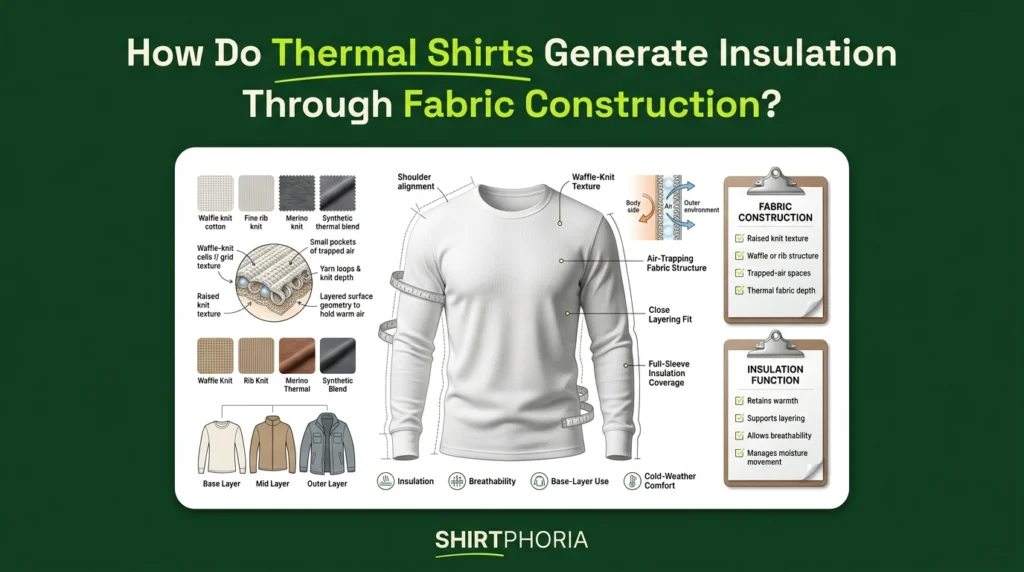
Thermal-shirt fabric construction traps insulating air through knit geometry, fabric thickness, raised surfaces, and controlled porosity rather than through fabric mass alone.
The phrase fabric construction is important because thermal textiles can be made in different ways.
For knitted thermal garments, terms such as knit structure, waffle knit, fleece, or Grid Knit are more accurate than calling every material a weave.
Fleece, for example, is not automatically a woven textile.
Different constructions control thickness, loft, porosity, compression, and airflow in different ways.
How Do Brushed and Napped Finishes Affect Thermal Insulation?
Brushed and napped finishes raise surface fibers, increasing fabric thickness, softness, and the volume of air held near the textile surface.
Mechanical brushing or napping can lift fiber ends away from the main fabric body.
This may:
- Increase apparent loft
- Increase fabric thickness
- Increase surface area
- Improve softness
- Hold more relatively still air
- Change drying behavior
- Change pilling behavior
A Brushed Fleece or brushed knit may therefore provide greater dry Thermal Resistance than a flatter version of a similar fabric when other variables remain controlled.
The mechanism is straightforward:
Raised surface fibers → increase loft and retained air → can increase dry thermal resistance.
However, the raised structure is not permanent under every condition.
Compression from tight clothing or outer layers can flatten it.
Repeated laundering may change the nap.
Long-term wear can reduce loft.
Wind can also decrease effective insulation if moving air passes through the structure.
Greater thickness may contribute warmth, but it does not establish a CLO Rating by itself.
How Do Grid and Waffle Knits Balance Loft and Ventilation?
Grid and waffle knits use raised zones and recessed channels to combine localized loft, reduced bulk, and controlled air movement.
A Grid Knit does not create one uniform layer of thickness.
Instead, raised sections can hold more air while recessed channels reduce material volume or allow greater moisture and air movement.
The structural relationship is:
Raised and recessed knit geometry → redistributes loft and airflow → changes warmth-to-weight and ventilation performance.
Performance depends on several variables:
- Grid dimensions
- Fabric mass
- Raised-pile height
- Channel openness
- Yarn type
- Stretch
- Fit
- Surrounding layers
A large open grid may behave very differently from a small dense grid.
Likewise, a lightweight grid Base Layer and a heavy Grid Fleece may have very different roles.
Polartec Power Grid is one branded example of a commercial grid-fleece construction.
Its presence demonstrates how a grid geometry can be used in technical apparel, but manufacturer-specific claims about Power Grid should not be generalized automatically to every Grid Fleece or Grid Knit.
A grid can support ventilation and localized loft, but it does not universally maximize insulation-to-weight performance.
What Is the Correct Density-versus-Loft Trade-Off?
Density and loft influence different but overlapping performance properties, so neither can be treated as the single measure of thermal efficiency.
Greater loft can increase thickness and retained air.
Lower Air Permeability can reduce airflow through the textile.
Higher fabric density may reduce breathability, but a dense face can also exist on a lofted material.
Likewise, a dense textile may contain internal structures that still retain air.
This means density and loft are not simple opposites.
Several other variables modify their effect:
- Compression
- Moisture
- Wind
- Yarn structure
- Layering
- Garment fit
A thick Base Layer may provide useful insulation at low activity levels but become uncomfortable during sustained movement if it causes excessive sweating.
A lower-loft fabric may be more comfortable during intense activity but require additional Mid-Layer insulation when the wearer stops.
Layering often works well because separate garments can divide moisture management, insulation, and wind protection between the Base Layer, Mid-Layer, and Outer Shell.
After fabric structure, the next question is how fiber properties contribute without independently determining garment warmth.
How Do Thermal-Shirt Materials Compare for Insulation?
Thermal-shirt materials should be compared through fiber shape, crimp, moisture sorption, yarn construction, durability, drying behavior, and the structure of the completed fabric.
A fiber name gives only part of the information needed to understand insulation.
Performance develops through several levels.
At the fiber level, chemistry, crimp, cross-sectional shape, density, and moisture sorption matter.
At the fabric level, yarn arrangement, thickness, knit geometry, loft, fabric mass, Air Permeability, Thermal Resistance, and Evaporative Resistance become important.
At the garment level, fit, seams, openings, coverage, and compression modify those textile properties.
Finally, the clothing-system level adds the Mid-Layer, Outer Shell, activity, weather, and individual physiology.
One fiber property should therefore never be treated as proof of complete garment performance.
How Do Specialized Hollow or Shaped Synthetic Fibers Affect Insulation?
Certain specialized synthetic fibers use hollow or shaped cross-sections that may reduce fiber mass, alter air retention, or modify moisture transport within a specific fabric construction.
Not every polyester or nylon fiber is hollow.
Hollow-Core Fibers are specialized fiber constructions.
Some contain internal voids. Others use shaped cross-sections designed to change bulk, surface area, capillary behavior, or weight.
These features may contribute to fabric performance, but fiber cross-section is only one variable.
Yarn bulk may be equally or more important.
Knit structure can strongly influence loft.
Fabric thickness, compression, and moisture can change the result further.
A manufacturer describing a fiber as hollow-core therefore has not automatically established the garment’s Thermal Resistance or CLO Rating.
The defensible conclusion is:
Garment insulation should not be inferred from fiber geometry alone.
How Does Merino Wool Contribute to Thermal-Shirt Insulation?
Merino Wool contributes to insulation through natural fiber crimp, yarn bulk, moisture sorption, and the structure of the completed knit.
Crimp refers to the natural waviness of wool fibers.
This structure can:
- Increase fiber bulk
- Create spaces between fibers
- Support fabric loft
- Influence resilience
- Help create a three-dimensional yarn structure
These characteristics can contribute to retained air and therefore Thermal Resistance.
Merino Wool can also absorb water vapor within the fiber.
This moisture-sorption behavior can buffer changes in humidity inside the clothing Microclimate.
However, these properties should not be overstated.
Wool does not remove all vapor before condensation.
It does not prevent Evaporation.
Every Merino garment does not maintain the same level of insulation when damp.
A thin Merino jersey, dense knit, brushed Merino fabric, and wool-synthetic blend may all behave differently.
Fiber identity therefore contributes to performance without determining it alone.
How Should GSM and Thermal Ratings Be Compared?
GSM helps classify fabric mass, but Thermal Resistance and CLO must be evaluated separately because fabrics of equal weight can differ substantially in structure and insulation.
GSM means grams per square meter.
It measures the mass of a fabric per unit area.
It does not directly measure warmth.
Two fabrics with the same GSM can differ in:
- Thickness
- Loft
- Air Permeability
- Moisture behavior
- Compression response
- Knit geometry
- Thermal Resistance
The table below shows useful retail categories without treating them as universal technical standards.
| Material or ConstructionIllustrative GSM CategoryLikely Structural PriorityRequired Performance Boundary | |||
|---|---|---|---|
| Lightweight Synthetic Knit | Approximately 100–170 GSM | Low bulk, moisture transport, rapid drying | Retail range only; not a standardized warmth class |
| Lightweight or Midweight Merino Knit | Approximately 150–220 GSM | Moisture buffering, comfort, moderate insulation | Fiber and GSM alone do not establish warmth |
| Midweight Grid or Brushed Knit | Approximately 180–260 GSM | Localized loft, retained air, variable ventilation | Insulation depends on thickness, permeability, fit, and shell |
| Heavyweight Thermal Knit | Approximately 250 GSM and above | Greater fabric mass and potential thickness | May overheat during high output; not automatically higher CLO |
| Fleece Mid-Layer | Variable | Higher loft and adjustable system insulation | Often a Mid-Layer rather than a next-to-skin shirt |
These ranges are illustrative retail categories, not universal technical standards.
Several measurements must be kept separate.
GSM measures fabric mass.
Thickness describes physical depth, but meaningful comparisons require a stated test pressure and method.
Thermal Resistance measures resistance to dry heat flow through a material.
Evaporative Resistance concerns resistance to heat transfer associated with water vapor.
ASTM F1868 can be used to evaluate thermal and evaporative properties of clothing materials.
A CLO Rating is different.
CLO is a unit used to express the thermal insulation of garments or clothing ensembles. ASTM F1291 uses a heated manikin to measure clothing insulation under defined conditions.
Therefore:
- GSM does not establish CLO.
- Fiber type does not establish CLO.
- Thickness alone does not establish CLO.
- Hand feel does not establish CLO.
- A consumer compression test does not establish CLO.
Reliable garment-level insulation values require appropriate testing or a clearly documented estimation method.
How Can Thermal-Shirt Insulation Performance Be Evaluated Reliably?
Thermal-shirt insulation should be evaluated through a hierarchy that begins with documented laboratory data, continues through garment inspection, and ends with condition-specific wear testing.
Not every piece of evidence has equal value.
A practical evidence hierarchy is:
- Standardized laboratory measurement
- Documented product specification with a stated test method
- Complete-garment testing
- Controlled comparison wear test
- Consumer visual and hand inspection
- Marketing claim without test conditions
Consumer observations can still be useful.
They simply should not be presented as standardized measurements.
What Can the Consumer Loft Check Actually Reveal?
A consumer loft check can reveal obvious resilience, flattening, or permanent compression, but it cannot measure Thermal Resistance or CLO.
A simple comparison can be performed carefully:
- Select comparable dry sections of two fabrics.
- Gently compress them with similar pressure.
- Release both at approximately the same time.
- Observe rebound speed and final thickness.
- Look for permanent flattening.
- Repeat after laundering only when the care history is comparable.
This rough check may reveal:
- Loss of loft
- Uneven padding
- Permanent crushing
- Weak recovery
- Changes caused by wear or washing
It does not establish:
- Rct
- CLO
- Wind resistance
- Wet insulation
- Whole-garment warmth
A fabric that rebounds rapidly may retain its shape well, but rebound is not itself a Thermal Resistance measurement.
The test is therefore useful for inspection, not for assigning a technical warmth value.
What Can a Consumer Breath Check Reveal About Airflow?
A consumer breath check may provide a rough relative impression of airflow between two fabrics, but it is not a standardized Air Permeability measurement.
In this informal test, a person may hold fabric near the mouth and try to blow through it.
The method has major limitations:
- Blowing pressure is uncontrolled.
- Test area varies.
- The fabric may stretch.
- Orientation can change.
- Moisture can affect results.
- Human perception is subjective.
- Results cannot be compared reliably across different testers.
ASTM D737 provides a standardized approach for measuring textile Air Permeability under controlled conditions.
The method can be applied to different textile constructions, including knitted, woven, napped, pile, layered, and treated fabrics.
A standardized test specifies important conditions such as pressure difference and sample configuration.
A breath check cannot reproduce that precision.
Higher permeability may allow more airflow, but actual wind performance also depends on wind speed, garment fit, openings, and Outer Layers.
A breathable Base Layer can therefore still work well in windy conditions if an appropriate wind-resistant shell is worn over it.
How Should Insulation Strategies Be Compared?
Insulation strategies should be compared by identifying which mechanism the fabric emphasizes and which surrounding layer supplies the missing function.
Different textiles solve different parts of the thermal problem.
| MechanismPrimary ContributionBest-Fit RoleMain Limitation | |||
|---|---|---|---|
| Fabric Loft | Increases thickness and retained air | Cold, dry, or lower-output insulation | Can compress, retain moisture, or lose efficiency in wind |
| Lower Air Permeability | Reduces airflow through the textile | Wind-exposed conditions or shell fabrics | May limit ventilation during high output |
| Grid Construction | Combines localized loft with open channels | Variable-output Base Layer or light Mid-Layer | Requires product- and layer-specific assessment |
| Wool Crimp and Yarn Bulk | Supports loft and moisture buffering | Variable activity and odor-sensitive use | Drying, durability, and feel vary |
| Specialized Hollow or Shaped Fiber | May reduce mass or change fabric behavior | Lightweight engineered textiles | Fiber design alone does not establish garment insulation |
| Outer Wind Shell | Reduces wind-driven heat loss | Windy or exposed environments | May trap moisture if ventilation is inadequate |
The table shows why a single fabric does not need to maximize every property.
A highly breathable Base Layer may rely on the Outer Shell for wind control.
A lofty Mid-Layer may focus on insulation rather than skin-adjacent moisture transport.
A lightweight synthetic may prioritize drying and moisture movement while the surrounding clothing provides most of the warmth.
What Checklist Verifies Thermal-Shirt Insulation Claims?
Use this checklist to separate measurable thermal-shirt properties from unsupported marketing language.
Technical Insulation Verification Checklist
- Garment-Role Check: Confirm whether the item is a Base Layer, light Mid-Layer, or insulating Mid-Layer.
- Fiber Check: Verify the actual fiber percentages rather than relying on labels such as “thermal,” “technical,” or “hollow technology.”
- Construction Check: Identify whether the material is a smooth knit, waffle knit, Grid Knit, brushed knit, fleece, or layered construction.
- GSM Check: Record GSM only as fabric mass.
- Thickness Check: Use thickness data only when the applied pressure and measurement method are stated.
- Thermal-Resistance Check: Prefer Rct or comparable Thermal Resistance data linked to a named test.
- Evaporative-Resistance Check: Prefer Ret or comparable Evaporative Resistance data linked to a named method.
- CLO Check: Accept a CLO value only when it applies to a tested garment or ensemble and the method is disclosed.
- Air-Permeability Check: Prefer standardized airflow measurements over informal consumer breath tests.
- Dry-versus-Wet Check: Determine whether reported test results apply to dry, damp, or wet conditions.
- Compression Check: Determine whether the intended Mid-Layer or Outer Shell compresses the fabric’s loft.
- Fit Check: Confirm that the shirt does not restrict circulation or leave large unstable openings.
- Coverage Check: Confirm that the neck, cuffs, sleeves, and hem remain positioned during movement.
- Seam Check: Treat flatlock and other low-profile seams primarily as comfort and chafing features rather than major insulation mechanisms.
- Wind Check: Determine whether the clothing system needs a separate wind-resistant Outer Shell.
- Activity Check: Match the insulation strategy to the wearer’s metabolic output.
- Evidence Check: Reject exact warmth, temperature, or CLO claims that do not disclose methods and conditions.
Thermal-Shirt Insulation Diagnostic Outcomes
| OutcomeRequired EvidenceInterpretation | ||
|---|---|---|
| Lofted Base-Layer Match | Moderate loft, close non-restrictive fit, moisture control, compatible shell | Suitable for low-to-moderate-output cold activity |
| High-Output Base-Layer Match | Lower bulk, controlled permeability, moisture transport, fast drying | Suitable for sustained movement with adjustable Outer Layers |
| Insulating Mid-Layer Match | Greater loft and measured or documented Thermal Resistance | Better suited over a Base Layer than directly against the skin |
| Wind-Shell Required | Useful insulation but relatively high Air Permeability | Add wind control rather than rejecting the Base Layer |
| Over-Insulated | Excess sweating, low adjustability, or excessive bulk | Reduce insulation or increase ventilation |
| Loft-Durability Concern | Permanent flattening, uneven recovery, or severe pilling | Insulating performance may decline with continued use |
| Moisture-Performance Concern | Persistent wetness, slow drying, or high Evaporative Resistance | Review fabric and layering compatibility |
| Unsupported CLO Claim | CLO stated without garment test, ensemble definition, or method | Treat the claim as insufficient evidence |
| Insufficient Evidence | GSM, fiber name, breath check, or hand feel used as the only proof | Do not assign a technical insulation rating |
Thermal-Shirt Condition Zones
Ideal Performance Zone
A thermal-shirt system is closer to the ideal zone when:
- Fabric role is clearly identified.
- GSM is not confused with warmth.
- Thermal data includes a test method.
- CLO refers to an appropriate garment or ensemble.
- Fit remains close but unrestricted.
- Fabric loft remains stable.
- Moisture does not remain concentrated.
- Wind control comes from the appropriate clothing layer.
- The wearer can adjust insulation as activity changes.
These conditions provide a stronger basis for judging the garment than marketing language alone.
Transition Zone
A thermal shirt may be in a transition zone when:
- Minor loft compression occurs.
- Air Permeability is relatively high but manageable with an Outer Shell.
- The fabric becomes mildly damp during activity.
- Only limited technical product data is available.
- Consumer checks appear positive but standardized testing is unavailable.
- Layer adjustments continue to maintain acceptable comfort.
These conditions do not automatically indicate failure.
They mean the user should treat conclusions cautiously and rely more heavily on the complete layer system and real-world testing.
Correction-Required Zone
A thermal-shirt evaluation requires correction when:
- CLO is inferred directly from GSM.
- Hollow-Core Fiber language is used without supporting fiber documentation.
- Breath testing is presented as scientific Air Permeability measurement.
- Loft rebound is presented as proof of warmth.
- The garment restricts circulation.
- Wind passes through the complete clothing system excessively.
- Moisture remains trapped.
- Fabric loft becomes permanently flattened.
- Product temperature ratings lack stated conditions.
- Technical claims lack a defined test method.
These problems indicate either a clothing-system mismatch or insufficient evidence.
Error-Proof Verification Protocol
A repeatable insulation evaluation should follow the same order each time.
- Identify whether the garment is a Base Layer or Mid-Layer.
- Verify the fiber composition.
- Identify the knit and finishing structure.
- Record GSM without converting it into warmth.
- Record thickness only when test conditions are stated.
- Look for ASTM F1868 or equivalent material-level thermal data.
- Look for ASTM F1291 or equivalent garment-insulation data.
- Confirm whether a CLO Rating refers to one garment or a complete clothing ensemble.
- Look for standardized Air Permeability data.
- Separate dry-state and wet-state test results.
- Check whether intended outer layers compress the fabric.
- Check fit, coverage, movement, and garment openings.
- Use consumer loft and airflow comparisons only as rough inspections.
- Add the intended Outer Shell.
- Test the complete clothing system during the planned activity.
- Monitor warmth, sweating, wind penetration, and comfort.
- Assign one diagnostic outcome.
- Change one variable at a time.
- Repeat the test and limit the conclusion to the conditions actually evaluated.
When insulation is inadequate, isolate fabric thickness, retained air, moisture, compression, garment fit, Air Permeability, wind exposure, activity, and outer-layer performance before blaming fiber type or GSM.
A thermal result is repeatable only when garment size, moisture condition, environment, activity, layer system, and measurement method remain comparable.
A numerical thermal claim without a named test, unit, specimen condition, garment configuration, and comparison baseline must be classified as insufficient evidence.
Technical Insulation Verification Checklist
Frequently Asked Questions
No. Thickness can help, but compression, moisture, airflow, fit, and fabric construction determine how much insulation remains in use.
No. GSM measures fabric mass per square meter, not thermal performance by itself.
Not reliably. CLO should apply to a tested garment or clothing ensemble and should not be inferred directly from GSM, thickness, hand feel, or fiber name.
No. It can provide only a rough impression. Standardized air-permeability testing requires controlled pressure and sample conditions.
Terms Explained
| TERM | DEFINITION |
|---|---|
| Thermal Resistance | Resistance to dry heat transfer through a material or clothing system. |
| Evaporative Resistance | Resistance to water-vapor heat transfer through a material or clothing system. |
| Air Permeability | The rate at which air moves through a fabric under defined test conditions. |
| CLO Rating | A unit used to express thermal insulation of garments or clothing ensembles. |
| Thermal Gradient | The temperature difference that drives heat from a warmer region toward a cooler region. |
| Grid Knit | A knit using raised zones and recessed channels to redistribute loft, bulk, airflow, and moisture movement. |
| Brushed Fleece | A fabric with raised surface fibers that can increase apparent loft, softness, thickness, and retained air. |
| Hollow-Core Fibers | Specialized fibers with internal voids or shaped cross-sections that may alter bulk, mass, air retention, or moisture behavior. |
| GSM | Grams per square meter, a measure of fabric mass per unit area rather than warmth itself. |
Conclusion
The final rule for thermal-shirt insulation is that fabric structure contributes Thermal Resistance, but garment fit, moisture, compression, Air Permeability, activity, and surrounding layers determine how that insulation performs in real conditions.
Thermal shirts do not create body heat.
They modify the rate at which heat moves through conduction, convection, evaporation, and radiation.
Relatively still air contributes to insulation, but there is no universal percentage that can be assigned to retained air across all garments.
Brushed and napped finishes can increase surface loft and thickness.
Grid Knits redistribute loft and airflow through raised zones and channels.
Neither construction is automatically superior because performance depends on fabric mass, structure, wind, moisture, fit, and clothing layers.
Density and loft should also not be treated as simple opposites.
A dense textile can contain internal loft.
A lofty fabric can use a relatively dense surface.
Compression, wetness, and garment construction can alter both properties.
Specialized Hollow-Core Fibers may influence mass, air retention, or moisture behavior, but they are not features of every synthetic textile and do not establish garment CLO by themselves.
Merino Wool crimp can support bulk and fabric loft, while moisture sorption may influence the clothing Microclimate.
However, Merino fiber identity alone cannot determine garment warmth.
GSM measures mass rather than insulation.
Two fabrics with the same GSM can have very different thickness, loft, Air Permeability, moisture behavior, and Thermal Resistance.
CLO applies primarily to garments or clothing ensembles and should not be inferred from GSM, thickness, hand feel, or fiber name.
ASTM F1868 can provide controlled measurements of thermal and evaporative properties of clothing materials.
ASTM F1291 can measure clothing insulation with a heated manikin.
ASTM D737 provides standardized Air Permeability measurement.
Consumer loft and breath checks remain useful only as rough comparisons.
Flatlock seams mainly support comfort and reduced chafing rather than providing meaningful whole-garment insulation.
The Base Layer also does not need to provide complete wind resistance.
In many cold-weather systems, the Outer Shell supplies the main defense against wind while the Mid-Layer supplies much of the adjustable loft.
The ventilation and heat-release priorities found in running-shirt features provide the clearest contrast with insulation-focused thermal construction.
No single fabric property guarantees cold-weather performance.
The most reliable thermal-shirt choice is based on measured fabric properties, correct garment classification, suitable fit, and testing within the complete layer system rather than on GSM, fiber names, or marketing claims alone.