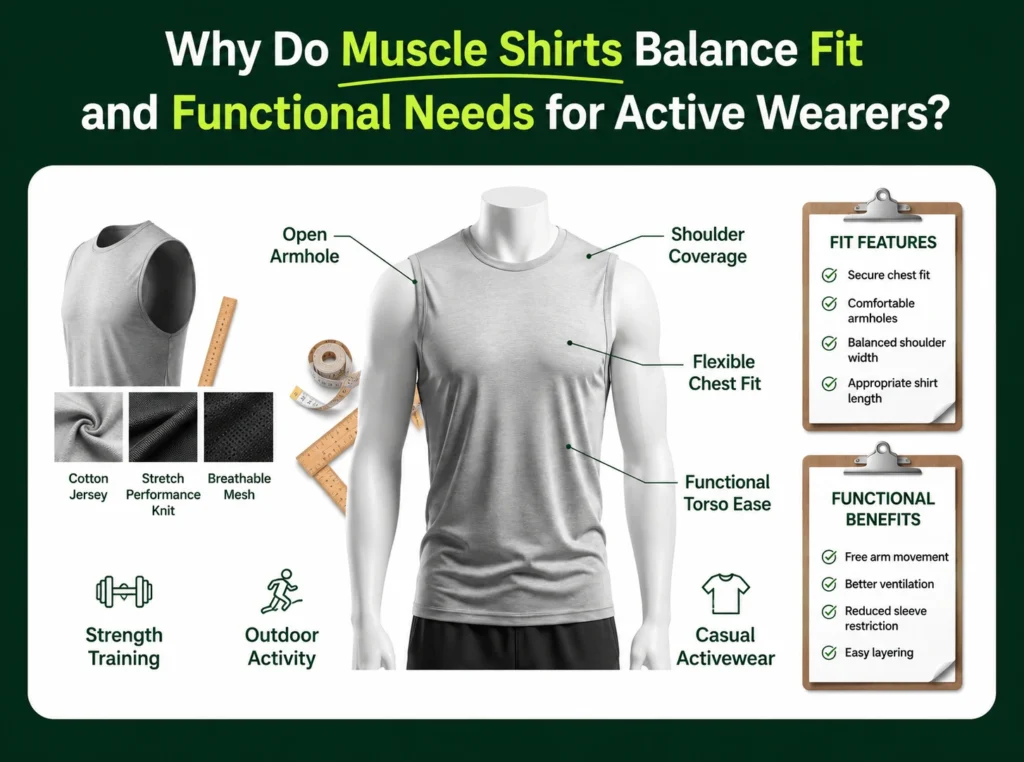
Why Do Muscle Shirts Balance Fit and Functional Needs for Active Wearers?
Muscle shirts balance fit and functional needs for active wearers by combining a close-fitting sleeveless silhouette with arm freedom, ventilation, and visual definition.
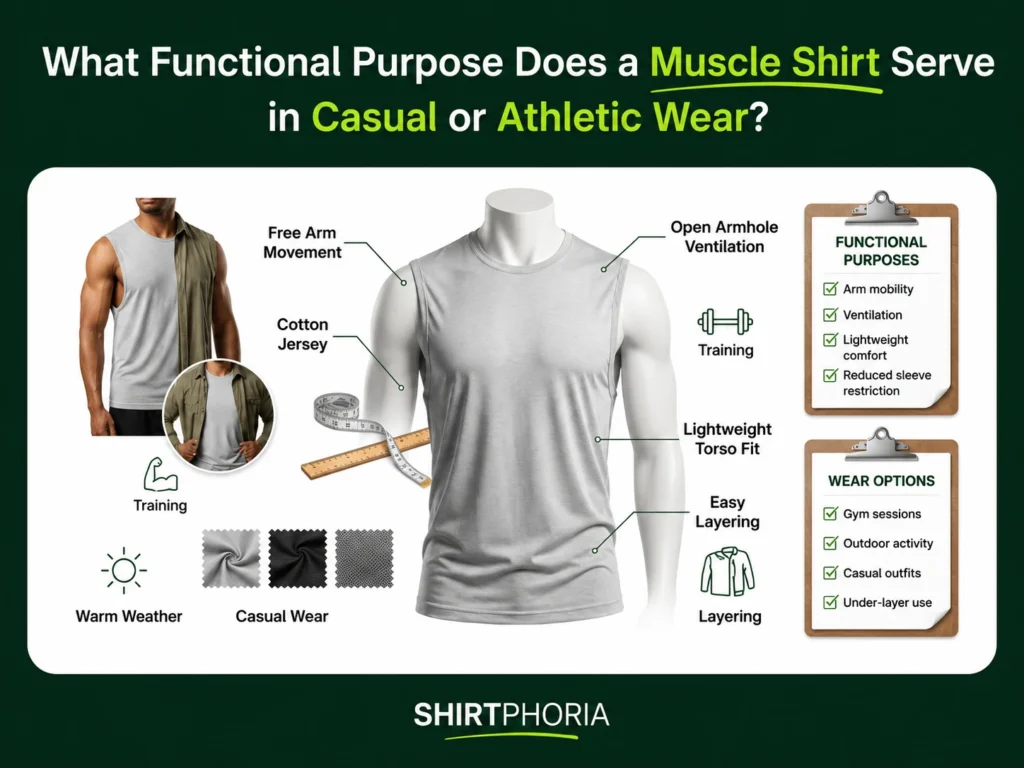
Many people associate Muscle Shirts only with displaying the shoulders, chest, and arms. Their practical value, however, comes from reduced sleeve coverage, easier upper-arm movement, increased skin exposure around the underarm, and a fit that can work for lifting, gym training, casual wear, and warm-weather activity.
A muscle shirt is commonly understood as a close-fitting, usually sleeveless T-shirt. This basic definition distinguishes it from a standard short-sleeve tee while allowing considerable variation in neckline shape, Armhole Depth, torso fit, fabric, and coverage. The Merriam-Webster similarly describes it as a close-fitting, usually sleeveless T-shirt.
This guide explains what muscle shirts are, how their sleeveless construction affects comfort and movement, which fabrics and seam details matter, and how to choose the right muscle shirt for lifting, training, casual wear, or warm-weather activity.
Readers comparing muscle shirts with broader T-shirt fit guide principles should consider how sleeve coverage, fabric weight, neckline shape, and torso fit affect comfort.
A muscle shirt should not be treated as athletic equipment that automatically improves performance. Its usefulness depends on its fit, Armhole Depth, fabric, seam finish, coverage, climate, and intended activity.
Why Do Active Wearers Choose Muscle Shirts?
Active wearers choose muscle shirts because the sleeveless design can reduce upper-arm fabric coverage while allowing more airflow and clearer Visual Feedback during training.
Removing sleeve fabric changes how the garment feels around the shoulders, arms, and underarm area. Some wearers prefer this because ordinary sleeves can bunch, hold sweat, rub against the upper arm, or feel restrictive during pressing, pulling, and overhead movements.
Muscle shirts may also expose more of the shoulders and arms, allowing the wearer to observe movement in a mirror. This can be useful during controlled exercises, although mirror visibility should not be confused with improved athletic ability or internal body awareness.
The garment can therefore serve several practical purposes:
- Reduced sleeve coverage
- Greater skin exposure near the underarm
- Easier visual observation of arm and shoulder position
- A closer torso fit
- Warm-weather comfort
- Gym-to-casual styling
These benefits remain dependent on the garment. A badly cut armhole or unstable neckline can create more distraction than a standard T-shirt.
How Can Muscle Shirts Provide Visual Form Feedback?
Muscle shirts can provide Visual Feedback by exposing the shoulders and arms, allowing some wearers to monitor movement and muscle engagement in a mirror.
Visual Feedback means information the wearer receives by watching their own movement. During a lateral raise, curl, press, or controlled row, exposed arms and shoulders may make elbow position, shoulder height, and upper-arm movement easier to see.
This should be separated from proprioception. Proprioception is the body’s internal awareness of position, movement, and force without relying only on sight. The Cleveland Clinic describes it as the sense that helps the body understand where it is and how it is moving.
A muscle shirt does not enhance proprioception merely because more skin is visible. It may instead help some wearers use mirrors more effectively during controlled training.
For example, a wearer may notice:
- One shoulder rising higher than the other
- Elbows moving unevenly during curls
- Arms rotating differently during raises
- Excessive shoulder elevation during pressing
- Uneven upper-back movement during rowing
Mirror observation is not a substitute for coaching, pain assessment, or proper exercise instruction. It is simply one source of practical visual information.
The relationship is:
Exposed shoulders and arms → clearer mirror visibility → practical form observation.
How Can Muscle Shirts Reduce Sleeve-Related Distraction?
Muscle shirts can reduce sleeve-related distraction by removing sleeve fabric from the underarm and upper-arm area, where some wearers feel bunching, rubbing, or heat buildup.
The Axilla is the underarm area where the arm joins the torso. On a short-sleeve shirt, this area may contain several layers of fabric and stitching. During repeated arm movement, those layers can sometimes feel warm, damp, tight, or irritating.
A Sleeveless T-Shirt removes the sleeve itself, but it does not automatically eliminate rubbing. The armhole edge may still contact the Axilla, chest, shoulder, or upper back.
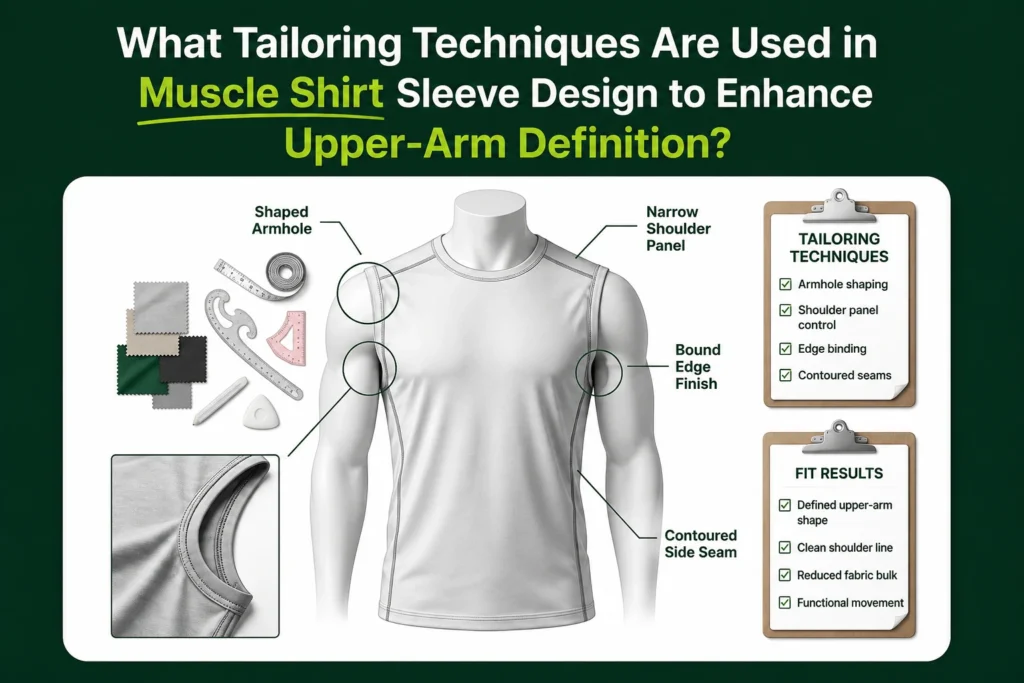
Armhole design therefore matters more than sleeveless construction alone.
The 30-Second Mirror Check
Put on the muscle shirt and stand in a normal, relaxed posture.
Raise both arms overhead without forcing the movement.
Perform a slow lateral raise or gentle shoulder rotation.
Check whether the armhole rubs the Axilla, exposes too much chest, or pulls the neckline sideways.
Choose another size or armhole design if the garment gaps, pinches, twists, or repeatedly distracts you.
| Result | What the Wearer Sees or Feels | Recommendation |
|---|---|---|
| Pass | The armhole stays stable, there is no rubbing, the neckline does not pull, and chest exposure feels controlled | Keep this armhole shape |
| Warning | Slight gaping, mild underarm contact, or neckline movement appears during an overhead reach | Try another size, fabric, or armhole cut |
| Fail | Pinching, major chest exposure, fabric twisting, neckline pulling, or repeated distraction occurs | Choose a different muscle shirt design |
This check does not measure athletic performance. It evaluates whether the shirt remains comfortable and stable during basic movement.
What Defines the Fit and Aesthetic of Modern Muscle Shirts?
The fit and aesthetic of modern muscle shirts are defined by a sleeveless cut, close or athletic torso fit, visible shoulder line, and a Silhouette that may emphasize the upper body.
Not every muscle shirt is tight. Some designs follow the chest and waist closely, while others use a regular, relaxed, oversized, cropped, or vintage-inspired cut.
A close-fitting version can display the wearer’s existing V-Taper more clearly. A V-Taper describes the visual relationship between a broader upper torso and a narrower waist. The garment does not physically create that body shape.
The visual result depends on:
- Shoulder width
- Chest fit
- Waist fit
- Side-seam shape
- Fabric stretch
- Fabric thickness
- Armhole width
- Garment length
A shirt that fits closely at the chest but falls slightly straighter through the waist may create a different Silhouette from one that tapers strongly toward the hem.
How Does the Tapered Silhouette of Muscle Shirts Compare with Standard Activewear?
The tapered silhouette of some muscle shirts can look more defined than boxier activewear because the torso fit reduces loose fabric around the waist and midsection.
A tapered muscle shirt may follow the chest and waist more closely, while a boxier sleeveless tee creates a looser casual shape.
Side seams influence this effect. Curved or shaped side seams may allow the garment to sit closer to the torso, while straighter seams create more room from the chest to the hem.
Fabric stretch also changes the drape. A soft cotton jersey may relax against the body, while a polyester-Elastane blend may sit closer and recover more strongly after movement.
Not all muscle shirts use specialised pattern shaping. Many are simply standard T-shirt bodies with the sleeves removed or redesigned. Others are purpose-built activewear garments with narrower waists, wider shoulders, or deeper armholes.
The right silhouette depends on the wearer’s goal:
- A closer fit can provide stronger visual definition.
- A regular fit can balance movement and coverage.
- A relaxed fit can suit casual wear and warm conditions.
- An oversized fit can create a streetwear or vintage-gym appearance.
A shirt should follow the torso without twisting, pulling across the chest, or billowing excessively during movement.
How Do Muscle Shirts Move from Gym Wear to Casual Lifestyle Wear?
Muscle shirts can move from gym wear to casual lifestyle wear when the fabric, neckline, Armhole Depth, and color choice make the garment look intentional outside training spaces.
A highly technical, glossy, or heavily branded shirt may look strongly associated with gym clothing. A matte cotton or blended jersey with clean hems and restrained branding can be easier to wear casually.
Muted colors often increase casual versatility. Black, charcoal, navy, olive, cream, white, and washed earth tones can be combined with shorts, denim, casual trousers, overshirts, or lightweight jackets.
Moderate armholes also matter. Very deep openings may provide considerable ventilation in a gym but expose too much chest or torso for restaurants, shopping areas, transport, or family settings.
A casual muscle shirt often works best when it includes:
- Clean neckline finishing
- Moderate Armhole Depth
- Adequate chest coverage
- Matte or softly textured fabric
- Minimal graphics
- Stable lower hem
- A regular or athletic torso fit
The outfit can be completed with clean trainers, relaxed trousers, denim, an open overshirt, or a light jacket.
How Do Muscle Shirts Support Functional Movement?
Muscle shirts can support functional movement by removing sleeve fabric from the shoulder and upper-arm area, but movement comfort still depends on armhole shape, fabric, fit, and activity type.
Sleeveless construction may reduce fabric contact around the deltoids and upper arms. This can make reaching, pressing, pulling, curling, or rotating feel less restricted for some wearers.
However, the absence of sleeves does not completely free every part of the shoulder. The neckline, upper back, chest width, and armhole seam can still influence comfort.
A shirt that is too narrow across the upper back may pull during rows. A tight neckline may shift during pressing. A low armhole may twist or expose too much of the chest.
Range of Motion should therefore be evaluated by moving in the garment rather than assuming every sleeveless shirt provides equal freedom.
How Can Sleeveless Construction Affect Shoulder Movement?
Sleeveless construction can affect shoulder movement by reducing fabric around the deltoids, Axilla, and upper arm during reaching, pressing, pulling, or rotational exercises.
Scapular Retraction is the movement of the shoulder blades toward each other. It commonly occurs during rows and other pulling movements.
The Glenohumeral Joint is the shoulder’s ball-and-socket joint. It allows the upper arm to move in several directions, including flexion, extension, rotation, and abduction.
A muscle shirt does not guarantee freedom for the Glenohumeral Joint or shoulder blades. It simply removes the sleeve fabric that would otherwise cover part of the moving area.
The perceived benefit may be noticeable during:
- Overhead pressing
- Lateral raises
- Pull-ups
- Rows
- Bench pressing
- Dynamic warm-ups
- Shoulder rotation drills
The armhole should be large enough to avoid pulling but not so deep that it becomes unstable.
The practical relationship is:
Open armhole → less sleeve fabric near the shoulder → improved perceived movement comfort.
How Do Muscle Shirt Features Relate to Running-Shirt Performance Criteria?
Muscle shirt features relate to running-shirt performance criteria when they are evaluated through comfort, ventilation, fabric weight, sweat management, and movement stability.
Readers comparing gym-focused sleeveless shirts with running-shirt performance should remember that running apparel also depends on breathability, fabric stability, sweat management, and chafe control.
Lifting and running place different demands on clothing.
A lifter may prioritise:
- Shoulder visibility
- Arm freedom
- Stable torso fit
- Barbell or bench contact comfort
- Coverage during bending and overhead movement
A runner may prioritise:
- Repeated-motion chafe control
- Lightweight fabric
- Moisture Management
- Hem stability
- Reduced bouncing
- Fast drying
A loose muscle shirt may feel comfortable during strength training but move excessively during longer runs. A fitted running top may stay stable but provide less of the relaxed gym appearance some wearers prefer.
The correct garment depends on the activity rather than the category name alone.
Which Fabric Technologies Can Improve Muscle Shirt Functionality?
Fabric technologies can improve muscle shirt functionality by affecting stretch, sweat movement, drying speed, Odor Control, seam comfort, and long-term shape recovery.
Some Muscle Shirts use basic cotton jersey. Others use polyester, nylon, Elastane blends, mesh panels, antimicrobial finishes, or moisture-management treatments.
Technical features should be evaluated according to the activity. A casual cotton muscle shirt may be suitable for low-intensity lifting or everyday wear, while a quick-drying synthetic blend may be more comfortable during high-sweat sessions.
Fabric technology does not automatically produce better athletic results. It changes how the garment handles moisture, heat, stretching, washing, and repeated use.
How Can Open Armholes Improve Ventilation?
Open armholes can improve ventilation by exposing more skin near the underarm and upper torso, which may help sweat evaporate more easily during warm or high-effort activity.
Compared with a sleeved shirt, a muscle shirt may feel cooler because it has less fabric around the underarm and upper arm, but cooling still depends on fabric, humidity, airflow, sweat rate, and activity intensity.
Thermoregulation is the body’s process of maintaining a suitable internal temperature. Clothing can influence thermal comfort by affecting heat transfer, sweat movement, evaporation, and air circulation.
Research on sports clothing shows that garment properties can influence thermal comfort, sweat evaporation, and heat exchange during exercise, especially in warm conditions. This does not mean that every muscle shirt improves performance or prevents overheating. The sports-clothing review explains how fabric and clothing design can affect comfort and heat transfer during exercise.
An open armhole may expose more skin, but cooling remains limited when:
- The air is hot and still
- Humidity is high
- The fabric holds sweat
- The garment is too tight
- The wearer is exercising intensely
- The environment has poor ventilation
A muscle shirt should therefore be treated as one clothing option within a larger heat-management strategy.
How Should Elastane, Spandex, and Lycra Be Evaluated in Muscle Shirts?
Elastane, Spandex, and Lycra should be evaluated as stretch-and-recovery fibres that may improve movement comfort in some muscle shirts, not as mandatory premium standards.
Elastane and Spandex are general names used for a stretch fibre. Lycra is a branded form of elastane or Spandex.
When blended into fabric, these fibres may help a garment stretch around the torso and recover after movement. Their presence can be useful in fitted activewear, but a quality muscle shirt does not need to contain a specific percentage.
The garment label should confirm whether a stretch fibre is present.
| Fabric Type | Common Example | Functional Benefit | Limitation |
|---|---|---|---|
| Cotton Jersey | Combed cotton or ring-spun cotton | Soft hand feel and casual comfort | Can hold sweat and dry more slowly than many synthetics |
| Polyester | Recycled polyester or performance polyester | Lightweight, quick-drying, and common in activewear | Can retain Odor if not treated or washed well |
| Nylon | Nylon or nylon blends | Smooth feel, stretch potential, and abrasion resistance | Can feel warm depending on knit and weight |
| Elastane / Spandex / Lycra | Stretch fibre blended into fabric | Improves stretch and recovery when used | Can degrade through heat, chlorine, or harsh care |
| Silver-Ion Treated Fabric | Silver-ion or antimicrobial finish | May reduce odor-causing microbial activity when present | Effectiveness depends on treatment quality, washing, and garment age |
Cotton may be appropriate for casual wear, short gym sessions, or lower-sweat activity. Polyester and nylon blends may suit more intense training because they often dry faster.
A fabric containing Elastane may follow the body more closely, but excessive compression can feel restrictive. The right amount of stretch depends on the garment design and wearer preference.
How Can Flatlock Seams and Odor-Control Treatments Affect Comfort?
Flatlock seams and Odor-Control treatments can affect comfort by changing how the garment contacts the skin and manages odor retention.
Flatlock Seam Construction joins fabric edges in a relatively low-profile seam. Flatlock seams may reduce raised seam bulk in areas that experience repeated movement.
They do not eliminate all chafing. Friction can still result from sweat, poor fit, rough thread, repetitive motion, garment movement, or sensitive skin.
Flatlock seams may be especially useful near:
- Side seams
- Shoulder seams
- Neckline edges
- Armhole edges
- Upper-back panels
Silver-Ion Technology or other antimicrobial treatments may be added to some fabrics to limit the growth of odor-causing microorganisms.
These treatments do not prevent sweating or guarantee that a shirt will remain odor-free. Their effectiveness depends on the treatment, fabric, washing method, sweat level, and age of the garment.
The label should confirm the presence of Silver-Ion Technology or another antimicrobial finish. Marketing language alone should not be treated as proof.
How Do Muscle Shirts Compare to Other Activewear Silhouettes?
Muscle shirts sit between standard T-shirts and stringer tanks because they usually offer more arm exposure than a T-shirt but more coverage than an extreme bodybuilding stringer.
| Feature | Muscle Shirt | Standard T-Shirt | Stringer Tank |
|---|---|---|---|
| Shoulder Coverage | Partial to open shoulder coverage | Full sleeve coverage | Minimal shoulder and upper-back coverage |
| Range of Motion Feel | Often feels freer around the upper arm | Depends on sleeve cut and fabric | Usually very open, but exposure is higher |
| Aesthetic Fit | Can emphasize the upper body and arms | Depends on cut, sleeve length, and fabric | Strong bodybuilding or gym-focused appearance |
| Ventilation | More underarm exposure than a tee | More fabric coverage | Maximum exposure but less coverage |
| Best Use Case | Lifting, gym training, warm-weather casual wear | Casual wear, running, layering, and general training | Bodybuilding, posing, and high-heat gym sessions |
| Main Risk | Armhole gaping, overexposure, or underarm rubbing | Sleeve bunching or heat buildup | Too much exposure for casual or public settings |
None of these garments is automatically best for every active wearer.
A Standard T-Shirt provides more coverage and may be more appropriate for mixed settings, outdoor sun exposure, public spaces, or layering.
A stringer tank offers the greatest shoulder and upper-back exposure but may feel too revealing outside specialised gym environments.
A muscle shirt often offers a moderate option, although actual coverage varies widely between designs.
Activewear Decision Tree
Want arm exposure without extreme stringer coverage? → Choose a muscle shirt.
Need maximum casual versatility? → Choose a standard T-shirt.
Prioritise bodybuilding visibility above coverage? → Choose a stringer tank.
Training in heat but want more coverage than a stringer? → Choose a breathable muscle shirt.
Running longer distances? → Compare chafe control, fabric stability, Moisture Management, and hem movement before choosing.
What Should You Look for When Buying High-Quality Muscle Shirts?
Buying a high-quality muscle shirt requires checking armhole comfort, fabric behaviour, seam finish, torso fit, sweat handling, and coverage level.
No single Armhole Depth, fabric blend, seam type, or technical treatment guarantees quality. The shirt should be evaluated while worn and moved through the positions required by the intended activity.
Anatomy of a Practical Muscle Shirt Armhole
A practical armhole balances four areas:
- Underarm clearance: The edge should not repeatedly rub the Axilla.
- Chest coverage: The opening should not expose more of the chest than the wearer wants.
- Shoulder exposure: The cut should provide the desired amount of deltoid and upper-arm visibility.
- Neckline stability: Raising the arms should not pull the neckline strongly toward one side.
There is no universal rule requiring the armhole to sit a specific number of inches below the Axilla. Body proportions, shirt size, fabric stretch, and garment purpose all affect the correct position.
The Anatomy of a High-Quality Muscle Shirt
🧵 Low-Profile Seam Construction: Flatlock or smooth seams may reduce rubbing in high-movement areas.
📐 Stable Armhole Shape: The armhole should allow shoulder movement without exposing too much chest or rubbing the Axilla.
🏋️ Torso Fit: The body should follow the wearer’s shape without clinging, twisting, or billowing excessively.
🌬️ Breathable Fabric: The fabric should match the activity, climate, and expected sweat level.
🧪 Odor-Control Treatment: Silver-Ion Technology or another antimicrobial treatment may help reduce odor retention when the garment label confirms its presence.
📏 Hem Coverage: The hem should provide enough lower-back coverage during squats, deadlifts, overhead reaches, and stretching.
🔁 Stretch Recovery: If the fabric contains Elastane or Spandex, it should recover after normal movement without excessive bagging.
How Should Armhole Depth Be Evaluated?
Armhole Depth should be evaluated through coverage, comfort, movement, and exposure control rather than one universal measurement.
A higher armhole generally provides more chest and side-torso coverage. It may work better for public gyms, casual wear, running, or wearers who prefer less exposure.
A deeper armhole provides more open space near the underarm. It may increase ventilation and shoulder visibility but can also expose more chest, back, or torso.
The correct Armhole Depth should:
- Avoid pinching
- Avoid repeated rubbing
- Stay stable when arms are raised
- Provide acceptable chest coverage
- Avoid pulling the neckline
- Match the activity and setting
Testing the garment during movement is more useful than judging it only on a hanger.
When Can Muscle Shirts Fail for Active Wearers?
Muscle shirts can fail for active wearers when the armholes, fabric, seams, or coverage level do not match the activity or body movement.
| Intended Benefit | Possible Failure Mode | Correction |
|---|---|---|
| More arm freedom | Armhole gaps too much or exposes the chest | Choose a higher armhole or better-cut silhouette |
| Less sleeve fabric | Underarm edge rubs the Axilla | Choose softer edging or smoother seams |
| More ventilation | Too much skin is exposed for sun, cold, or public settings | Match coverage to climate and setting |
| Visual definition | Fit feels too tight or makes the wearer self-conscious | Choose a regular fit or heavier drape |
| Sweat management | Cotton holds sweat during intense training | Choose synthetic or blended fabric for high-sweat workouts |
| Odor Control | Synthetic fabric retains odor | Wash promptly or choose treated fabric when needed |
| Stretch comfort | Elastane bags out or loses recovery | Avoid high heat and harsh washing |
| Gym-to-street use | Shirt looks too revealing outside the gym | Choose muted colors, clean hems, and moderate armholes |
| Movement comfort | Neckline shifts during overhead movement | Check neckline stability during reach tests |
A muscle shirt may also fail when its torso is too tight. Excessive tightness can cause the shirt to ride upward, twist around the body, or pull strongly across the chest.
A shirt that is too loose may swing, expose the torso, or interfere with benches and equipment. Loose fabric may also hold sweat against the skin or move excessively during running.
Climate creates another limitation. Open armholes may feel comfortable indoors but provide less protection from sun, cold air, rough surfaces, or outdoor debris.
Cotton can be comfortable for light training but may become heavy during high-sweat activity. Synthetic fabrics may dry faster but retain odor when they are not washed promptly or when the fabric develops long-term buildup.
The best muscle shirt works only when armhole shape, fabric, seam finish, torso fit, and coverage level match the wearer’s activity.
Actionable Muscle Shirt Buying Checklist
Use this checklist while trying on a muscle shirt. Your checked items are stored on this device.