Why Does Wing Collar Design Signal the Highest Level of Formality in White-Tie Attire?
The Wing Collar signals the highest level of traditional evening formality because its upright band and folded points form part of the White-Tie system worn with a stiff formal shirt, white bow tie, white waistcoat, and black tailcoat.
Quick Answer: Why Is the Wing Collar So Formal?
The Wing Collar is highly formal because it belongs primarily to White Tie. Its upright neckband, folded wing points, historical link to stiff evening shirts, and role in framing a white bow tie create a full-dress signal. It is not simply a more formal version of every modern tuxedo collar.
The most common mistake is treating the Wing Collar as the default formal upgrade for any tuxedo. Modern formalwear separates the two evening systems more clearly.
White Tie uses a tailcoat and Wing Collar, while modern Black Tie uses a dinner jacket or tuxedo and generally favors a Turndown or Spread Collar. Debrett’s distinguishes the White-Tie Wing Collar from the Turndown Collar used for Black Tie, while Emily Post identifies White Tie as the more formal dress code.
The Wing Collar belongs primarily to White Tie, while modern tuxedo shirts generally use softer Turndown or Spread Collars for Black Tie.
This guide explains the Wing Collar’s construction, historical development, White-Tie ownership, difference from modern Black-Tie collars, and the practical rules required to wear it correctly.
What Structural Requirements of the Wing Collar Signal White-Tie Formality?
The structural requirements of the Wing Collar signal White-Tie formality through an upright neckband, small folded front points, controlled rigidity, and a close but comfortable fit that preserves the collar’s standing silhouette.
Its formal effect comes from both physical construction and dress-code ownership. The collar should be evaluated as one part of the complete White-Tie shirt and evening ensemble.
How the Wing Collar’s Upright Design Creates a Formal Silhouette
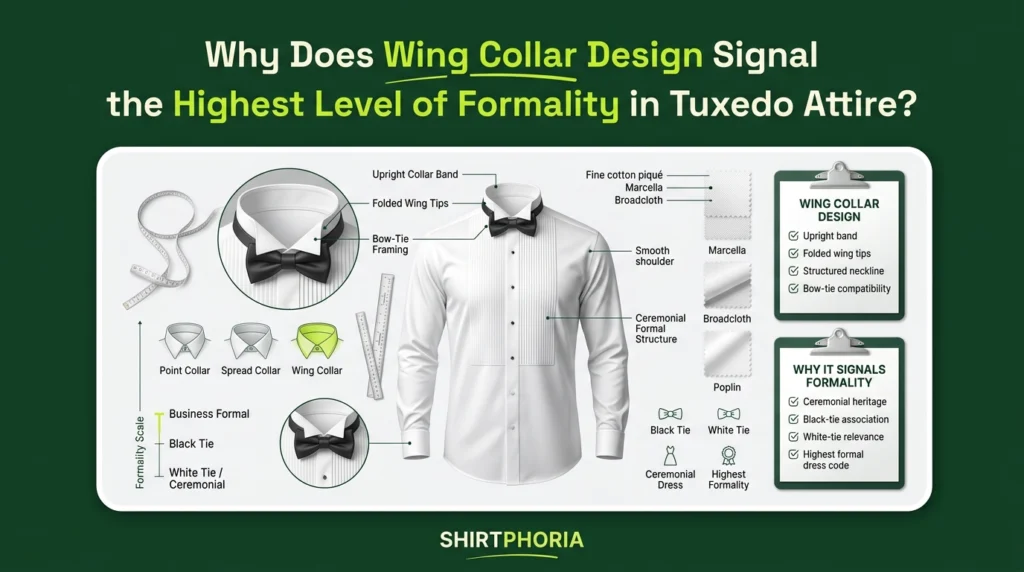
The Wing Collar uses an upright neckband with small folded points that project outward at the front, creating a standing silhouette distinct from the rolled or folded shape of a Turndown Collar.
The collar has several separate structural parts.
An Upright Neckband is the vertical section that surrounds the neck.
The Wing Points, also called collar wings or folded points, are the two small front sections that fold outward.
Interlining or starch provides structural support and helps the collar retain its intended shape.
A Detachable Collar is separate from the shirt body and attaches using collar studs.
An Attached Wing Collar is permanently sewn to the shirt and reproduces the general visual form without necessarily copying the height or rigidity of a traditional detachable collar.
Traditional White Tie favors a tall, stiff, often detachable Wing Collar. Contemporary attached versions may imitate that appearance, but their proportions and rigidity can differ substantially.
The important mechanical distinction is simple:
The neckband remains upright; the wing points fold or project outward rather than standing vertically themselves.
The resulting relationship is:
Upright neckband → maintains a standing neckline → signals traditional full-evening-dress structure.
A Turndown Collar behaves differently because its collar leaves fold over the band and cover more of the neck structure.
How the Wing Collar Coordinates with a White-Tie Shirt Front
The Wing Collar coordinates with a Stud-Ready White-Tie shirt front because both features belong to the same full-evening-dress system, although the collar does not mechanically determine the placket construction.
Each component has a separate function.
The Wing Collar frames the neck and White Bow Tie.
The Stud-Ready Placket replaces ordinary visible sewn buttons with formal shirt studs.
A stiff or Marcella shirt front creates the controlled chest panel associated with traditional full evening dress.
A Stud-Ready front is the safest traditional White-Tie choice. Debrett’s describes the White-Tie shirt as fastened with studs and worn with a detachable Wing Collar and white bow tie.
A Fly-Front Placket serves a different purpose. It conceals functional buttons and is accepted within Black Tie, but it should not be presented as the strict traditional White-Tie standard.
Standard office-style buttons can weaken the full-dress effect when paired with a traditional Wing Collar. The issue is not mechanical failure of the collar; it is inconsistency between the shirt front and the White-Tie system.
How the Wing Collar’s Folded Points Frame Formal Neckwear
The Wing Collar’s folded points frame formal neckwear by opening the front of the collar around the bow tie and leaving more of the neckband visible than a Turndown Collar.
The wing points should appear:
- symmetrical;
- firm;
- free from curling;
- aligned with the bow-tie knot;
- and free from severe collapse or bending.
The points visually separate around the bow tie and contribute to a more rigid, ceremonial neckline.
Their purpose should not be confused with jacket-lapel clearance. The collar wings and jacket lapels occupy different structural zones.
There is also no single universal rule requiring the points always to sit behind the bow tie.
A safer instruction is:
Arrange the wing points symmetrically according to the collar’s construction and the selected White-Tie convention; the points should not twist, float unevenly, or disappear beneath the knot.
The points also have useful size and stiffness boundaries.
Points that are too soft may curl or collapse.
Points that are excessively large may compete visually with the bow tie.
Points that are too small may lose definition and weaken the collar’s full-dress character.
How Did Historical Context Make the Wing Collar a White-Tie Formality Signal?
Historical context made the Wing Collar a White-Tie formality signal because it developed from the stiff standing and detachable collars used in nineteenth- and early-twentieth-century evening dress.
Its present meaning developed gradually rather than appearing as one timeless collar form.
How Detachable Evening Collars Shaped the Wing Collar’s White-Tie Role
The Wing Collar inherited its rigid appearance from detachable evening collars, which could be heavily finished or starched and replaced separately from the shirt body.
The broad historical progression can be understood in stages.
Stiff standing collars were already established in nineteenth-century formal and day dress.
Detachable collars made separate laundering and replacement practical.
Folded front points developed into the recognizable Wing-Collar form.
Full evening dress continued to preserve the stiff standing neckline.
Black Tie increasingly adopted softer Turndown Collars.
The Wing Collar then became more strongly concentrated in White Tie.
The Gentleman’s Gazette history of Wing and Turndown Collars describes this transition and the Wing Collar’s later close association with White Tie as softer Turndown Collars became normal for Black Tie.
Earlier standing collars accompanied changing forms of formal neckwear; the modern Wing Collar became codified as bow ties and full-evening-dress conventions developed.
Contemporary Attached Wing Collars reproduce the visual idea of the older form more than they reproduce its detachable construction.
How the Wing Collar Separates White Tie from Black-Tie and Business Collars
The Wing Collar separates White Tie from modern Black Tie and business dress because each collar belongs to a different ensemble, neckwear system, and level of evening formality.
The main dress-code roles are:
- Wing Collar: Primarily White Tie with a White Bow Tie and Tailcoat.
- Turndown or Spread Collar: Safest modern Black-Tie choice with a Black Bow Tie and Dinner Jacket.
- Point or Cutaway Collar: Primarily associated with suits and long-necktie contexts, although restrained Spread Collars can also work with Black Tie.
- Button-Down Collar: Informal-to-business-casual daywear rather than conventional White-Tie or Black-Tie dress.
A Cutaway Collar is not mechanically inferior. Its wide spread and styling history simply place it in a different neckwear and tailoring context.
Similarly, the Wing Collar does not physically prevent a long necktie from being placed around the neck.
The restriction is dress-code based:
White-Tie convention requires a white bow tie; a long necktie contradicts the dress code even though it could physically be placed around the neckband.
Debrett’s and Emily Post both distinguish White Tie from the tuxedo-based Black-Tie system and assign different collars, neckwear, and outer garments to each.
How Does the Wing Collar Compare with Other Collars in Formality Signaling?
The Wing Collar signals greater traditional evening formality than Turndown and Button-Down collars because it belongs primarily to White Tie, while the other collars serve Black-Tie, business, or casual systems.
| Collar StyleFormal Event SignalCorrect Neckwear in This ContextPrimary FunctionTraditional Setting | ||||
|---|---|---|---|---|
| Wing Collar | Highest traditional evening formality | White self-tied bow tie | Frames formal neckwear and maintains an upright full-dress neckline | White Tie; limited historical or highly traditional Black-Tie use |
| Turndown or Spread Collar | High evening formality with greater modern versatility | Black self-tied bow tie for Black Tie | Frames the face, supports the bow tie, and conceals most of its neckband | Modern Black Tie and formal suit contexts |
| Button-Down Collar | Informal to business-casual signal | Optional long tie or no tie, depending on setting | Keeps soft collar points secured during daywear | Casual, smart-casual, and some business-casual settings |
| Cutaway Collar | Formal business or tailored daywear signal | Long necktie with an appropriately proportioned knot | Creates a wide opening around the tie knot | Suits, weddings, and formal daytime tailoring |
Formality Boundary: The Wing Collar is not universally better than a Turndown Collar. It is more formal because White Tie is more formal than Black Tie; the correct collar depends on the event code.
The Wing Collar’s White-Tie role becomes clearer when compared with button-down collar formality, which belongs to less formal daywear and business-casual contexts.
How Should the Wing Collar Be Worn for Correct White-Tie Presentation?
The Wing Collar should be worn as part of a complete White-Tie system, using a white self-tied bow tie, stable collar fit, symmetrical wing points, a formal studded shirt front, white waistcoat, and black tailcoat.
A Wing Collar worn by itself does not create White Tie. The complete ensemble determines the dress-code result.
Why the Wing Collar Uses a White Bow Tie in White-Tie Dress
The Wing Collar uses a white bow tie in White-Tie dress because the collar, tie, shirt front, waistcoat, and tailcoat form one codified full-evening-dress ensemble.
The relationship is:
White-Tie dress code → assigns the Wing Collar to a white bow tie → produces a coherent full-evening-dress neckline.
The governing rule comes from White-Tie convention rather than from the collar physically preventing other neckwear.
White Tie requires a White Bow Tie.
Modern Black Tie normally uses a Black Bow Tie with a Turndown or Spread Collar.
A long necktie is not appropriate for White Tie.
A Black Bow Tie with a Wing Collar can evoke historical or rental-style Black Tie, but it is not the safest modern recommendation.
Traditional presentation also favors a self-tied bow tie. The preference is sartorial rather than mechanical. A self-tied tie creates a naturally formed knot and aligns with established formalwear practice.
A pre-tied bow tie does not cause the collar itself to fail mechanically.
How to Fit the Wing Collar Without Creating a Floating or Restrictive Neckband
A correctly fitted Wing Collar sits upright and close to the neck without visible instability, throat pressure, restricted swallowing, or excessive space between the band and the wearer.
The fit can be assessed through three observable zones.
Ideal Fit Zone
The neckband remains upright.
The front closure stays centered.
The wearer can breathe, swallow, and turn the head normally.
The collar does not rotate independently around the neck.
The wing points remain symmetrical.
The band does not leave severe pressure marks.
Transition Zone
A small visible gap appears when the wearer turns the head.
The collar shifts slightly but returns to position.
One wing point requires minor adjustment.
Mild discomfort develops after prolonged wear.
The bow tie partly destabilizes the wing points.
Correction-Required Zone
The collar creates throat pressure.
Swallowing or head movement becomes restricted.
The band visibly floats away from the neck.
The collar rotates or lifts above the shirt.
The front closure strains.
The wing points collapse, curl, or become strongly uneven.
Two opposite fit failures should be avoided.
Excessive looseness → instability, visible gaps, and a floating-collar effect.
Excessive tightness → pressure, restricted movement, closure strain, and discomfort.
Use this fitting sequence:
- Fasten the collar completely.
- Add the White Bow Tie.
- Turn the head left and right.
- Swallow normally.
- Raise and lower the chin.
- Check the collar from the front and side.
- Confirm that it remains upright without pressure or visible floating.
Exact neck measurements should follow the maker’s sizing system and the specific collar construction rather than one universal numerical rule.
Wing Collar Verification Outcomes
| OutcomeRequired EvidenceInterpretation | ||
|---|---|---|
| White-Tie Pass | White-Tie invitation, Wing Collar, white bow tie, formal studded shirt front, white waistcoat, tailcoat, stable fit | The Wing Collar belongs to a coherent full-evening-dress system |
| Historical or Specialist Exception | A clearly documented historical, ceremonial, theatrical, or deliberately traditional configuration | The Wing Collar may be valid, but the context should be explained rather than presented as general modern Black Tie |
| Modern Black-Tie Mismatch | Wing Collar paired with a standard dinner jacket, black bow tie, or ordinary contemporary tuxedo shirt without a deliberate traditional rationale | Replace the Wing Collar with a Turndown or Spread Collar, or rebuild the ensemble according to a recognized historical convention |
| Fit Correction Required | Floating neckband, throat pressure, closure strain, collapsed points, restricted movement, or severe asymmetry | Adjust collar size, construction, bow-tie proportion, or wing-point alignment |
| Insufficient Evidence | Event code or garment construction cannot be confirmed | Do not declare a White-Tie pass until the invitation and full ensemble are verified |
Error-Proof Verification Protocol
Follow this order:
- Read the invitation.
- Identify White Tie or another dress code.
- Verify the Tailcoat before evaluating the collar.
- Verify the formal shirt front and studs.
- Inspect the Wing Collar’s height, rigidity, and symmetry.
- Add the White Bow Tie.
- Test breathing, swallowing, and head movement.
- Add the White Waistcoat and Tailcoat.
- Check the collar from the front and side.
- Select one outcome from the verification table.
- Correct one conflicting variable at a time.
- Repeat the complete-ensemble check.
Correction Hypothesis: When the neckline looks incorrect, isolate collar size, collar rigidity, bow-tie scale, wing-point alignment, and shirt-front compatibility before replacing the entire ensemble.
Repeatability Rule: The verification outcome remains consistent only when the same White-Tie definitions, observable tests, and ensemble boundaries are applied each time.
The Wing Collar White-Tie Verification Checklist
Before finalizing a White-Tie ensemble, verify the invitation, collar construction, shirt front, bow tie, fit, wing-point alignment, waistcoat, and tailcoat as one connected formal system.
Frequently Asked Questions
The Wing Collar is more formal because it belongs primarily to the White-Tie system, which ranks above Black Tie in traditional evening formality.
It can appear in historical or deliberately traditional Black-Tie interpretations, but for general modern Black Tie a Turndown or Spread Collar is the safer choice.
White Tie requires a white self-tied bow tie as part of the complete full-evening-dress system.
It should remain upright and close to the neck without throat pressure, restricted swallowing, excessive floating, or strong rotation around the neck.
No universal rule applies to every construction. The points should be symmetrical, firm, and arranged according to the collar design and chosen White-Tie convention.
Terms Explained
| TERM | DEFINITION |
|---|---|
| Wing Collar | A formal standing collar with an upright band and small folded front points, primarily associated with White Tie. |
| Upright Neckband | The vertical section of the collar that surrounds the neck and maintains the standing silhouette. |
| Wing Points | The two small front collar sections that fold or project outward around the bow tie. |
| Detachable Collar | A separate collar attached to the shirt body using collar studs. |
| Attached Wing Collar | A permanently sewn collar that reproduces the visual form of a traditional Wing Collar. |
| Marcella | A raised textured cotton structure commonly associated with traditional formal shirt fronts. |
| Stud-Ready Placket | A shirt front designed to accept removable formal shirt studs. |
| Turndown Collar | A collar whose leaves fold over the neckband; the safest modern choice for Black Tie. |
| White Tie | The highest traditional evening dress code, using a tailcoat, Wing Collar, white bow tie, white waistcoat, and formal shirt front. |
| Black Tie | A formal evening dress code centered on a dinner jacket or tuxedo, usually paired with a Turndown or Spread Collar and black bow tie. |
Conclusion
The final formality rule for the Wing Collar is that its highest status comes from belonging to the complete White-Tie dress code, not from functioning as a universally superior collar for every tuxedo or formal event.
Its upright band and folded wing points create the collar’s structural identity. The form developed from stiff standing and detachable evening collars, while modern formalwear gradually concentrated the Wing Collar within White Tie.
Modern Black Tie generally favors a Turndown or Spread Collar. White Tie combines the Wing Collar with a formal shirt front, White Bow Tie, White Waistcoat, and Tailcoat.
Fit also matters. A collar that is too loose loses its upright stability, while a collar that is too tight creates pressure and restricted movement. A Wing Collar used in the wrong dress-code system creates a separate formalwear mismatch.
By treating the Wing Collar as one component of the complete White-Tie system, you can preserve its historical meaning, structural precision, and highest level of formal purpose.