How Is the Button-Down Collar Shirt Classified in Terms of Dress Code Formality?
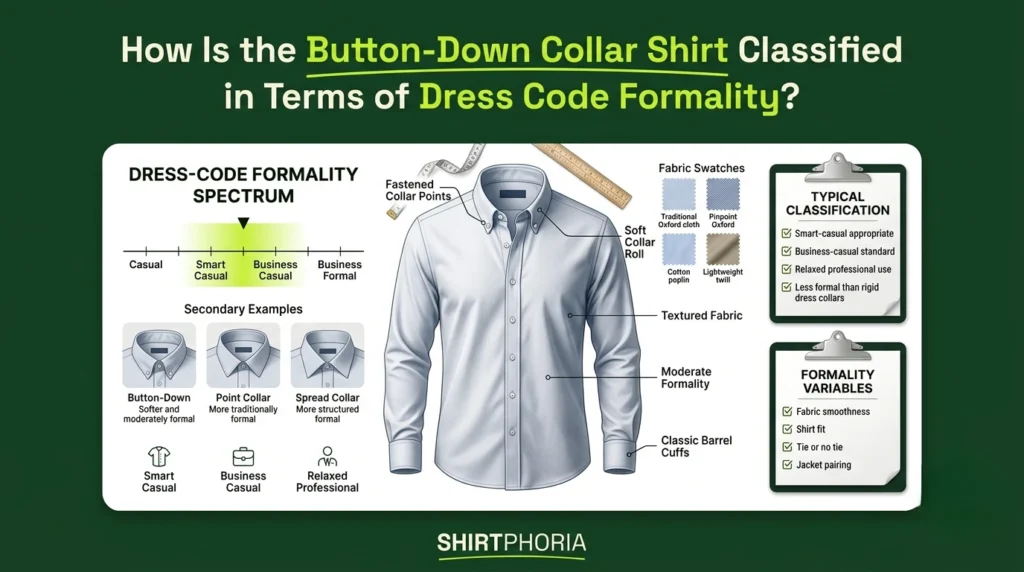
A button-down collar shirt is generally classified as a casual-to-business-casual shirt rather than a formal dress shirt because its buttoned collar points expose functional hardware and create a softer collar roll than point, spread, cutaway, or eveningwear collars.
Many people wear button-down collar shirts across casual, professional, and formal settings without considering the collar’s formality ceiling. The shirt may look neat and polished, but its visible collar buttons, sporting background, and relaxed structure communicate a softer dress-code signal than collars designed specifically for formal tailoring.
A button-down collar is defined by small buttons that fasten each collar point to the shirt body. These buttons stabilize the collar tips and help produce the curved shape known as collar roll.
The mechanism is practical and visually distinctive. It also places the collar below cleaner point, spread, cutaway, and formal eveningwear collars when the outfit requires strict structure.
Because this page focuses specifically on formality classification, readers who need the broader construction, function, and styling overview should first review the button-down collar shirt guide.
This article classifies the shirt across common dress codes, explains why its construction affects formality, compares it with formal collars, and provides a practical decision system for suits, ties, fabrics, professional settings, tuxedos, and formal eveningwear.
The button-down collar can look polished in business-casual settings. It should not, however, be treated as a tuxedo shirt or a strict formalwear shirt.
Quick Answer: Is a Button-Down Collar Shirt Formal?
A button-down collar shirt is not a true formal shirt; it is best understood as a casual-to-business-casual shirt that can look polished but remains less formal than point, spread, cutaway, or eveningwear collars. It suits smart casual and relaxed offices but should be avoided with tuxedos, strict black tie, and highly formal professional events.
Southern Living’s button-down collar guide similarly positions button-down collars as more casual than button-up shirts equipped with point or spread collars.
Why Button-Down Collar Shirt Formality Matters in Professional Settings
Button-down collar shirt formality matters in professional settings because the shirt can look polished in relaxed offices but underdressed when the event requires a sharper formal collar.
Professional dress is not one fixed category. A casual Friday, internal team meeting, client presentation, job interview, legal proceeding, and executive boardroom meeting can all require different levels of visual authority.
A button-down collar works naturally when the dress code rewards approachability, texture, comfort, and relaxed polish. The same collar becomes riskier when the setting expects smooth formal fabrics, sharp tailoring, conservative ties, and a cleaner collar line.
The wearer must therefore assess the complete situation rather than classify every office outfit in the same way.
What Visual Clash Happens When a Button-Down Collar Is Over-Formalized?
A button-down collar creates a visual clash when it is forced into highly formal tailoring because its soft roll and visible collar buttons conflict with the cleaner lines expected from point, spread, or cutaway collars.
Buttoned collar points soften the formal tailoring signal. The buttons reveal the collar’s fastening method, while the fabric between the neckband and buttoned point curves into a relaxed roll.
That construction can work well with a blazer, sport coat, softly tailored jacket, or casual suit. The contrast increases when the shirt is placed beneath a sharply structured worsted suit with a glossy silk tie and polished formal accessories.
The risk becomes greater as the outfit gains formality:
- A sharply padded jacket can overpower the soft collar.
- Broad formal lapels can make the button-down collar appear visually weak.
- A high-shine tie can conflict with the collar’s sporting character.
- A large symmetrical knot can flatten or crowd the collar roll.
- Formal French cuffs may feel disconnected from visible collar-point buttons.
- Ceremonial accessories can make the shirt look incorrectly substituted for a formal dress shirt.
This does not mean that all suits reject button-down collars. The shirt can work with relaxed suits, particularly when the fabric, tie, and jacket construction share the same moderate level of formality.
The mismatch appears when the suit and event communicate significantly more authority than the collar can support.
What Historical Reason Explains the Button-Down Collar’s Casual Association?
The button-down collar’s casual association comes from its sporting origin, where buttoned collar points were used by English polo players to keep the collar controlled during movement.
According to the Brooks Brothers button-down collar history, John E. Brooks observed English polo players securing their collar points during a match in 1896 so the fabric would not flap while they rode. Brooks Brothers later adapted and popularized the construction in American menswear.
The collar was therefore developed from a practical sporting solution rather than a ceremonial dress-shirt tradition.
Its development followed a functional sequence:
- English polo players needed to control loose collar points during play.
- The points were secured to prevent unwanted movement.
- Brooks Brothers adapted the functional idea into an American shirt.
- The design became associated with Oxford cloth, collegiate dress, Ivy style, office sportswear, and relaxed professional clothing.
The sporting origin does not make the shirt sloppy. A well-made Oxford Cloth Button-Down can look disciplined, intentional, and polished.
The history does explain why the collar usually reads as less formal than collars developed around structured suits, formal neckwear, and evening dress.
How Do Collar Buttons Lower Button-Down Collar Shirt Formality?
Collar buttons lower button-down collar shirt formality because they expose a functional fastening detail where formal dress shirts usually rely on cleaner collar geometry, interlining, pressing, or hidden support.
Strict formal dress generally favors smooth symmetry and restrained construction details. Point, spread, and cutaway collars can maintain their shape through pattern geometry, interlining, pressing, and removable collar stays without visibly attaching their tips to the chest.
The button-down collar makes its support system visible. Each collar-point button interrupts the smooth shirt front and identifies the collar as a practical design.
The buttons do not directly violate every formality standard. They simply create a more relaxed signal that usually conflicts with the cleanest levels of professional and evening dress.
Why Does the Collar Roll Make the Shirt Look More Relaxed?
The collar roll makes the button-down collar shirt look more relaxed because the fastened collar points create a soft curved shape instead of the sharper, cleaner collar line usually expected in formal dress.
Collar roll is the curved arc that forms between the neckband and the fastened collar point. The shape is affected by:
- Collar-point length.
- Anchor-button placement.
- Fabric flexibility.
- Fabric weight.
- Interlining.
- Neckband construction.
- Button tension.
- Pressing quality.
The buttons establish a fixed point, but they do not create the final roll by themselves. The collar needs enough length and flexibility to curve naturally.
A controlled roll is desirable in a traditional Oxford Cloth Button-Down, commonly abbreviated as OCBD. It gives the shirt character and prevents the collar from looking flat or lifeless.
The same soft arc is less suitable for strict formalwear because formal collars generally aim to frame the tie and jacket with a cleaner, more structured line.
Collar roll does not determine formality alone. Fabric, color, cuffs, tie, jacket, fit, and event context still influence the overall result.
How Does the Button-Down Collar Compare With Cutaway, Spread, and Point Collars?
Compared with cutaway, spread, and point collars, the button-down collar usually reads less formal because it uses visible collar buttons while those collars rely more on collar shape, spread angle, and structure.
A point collar uses relatively narrow, unsecured collar points. It creates a vertical frame around the tie and commonly suits traditional office shirts, conservative suits, and compact-to-standard tie knots.
A spread collar increases the distance between the collar points. It creates more room for medium or larger knots and visually supports structured business tailoring.
A cutaway collar extends the spread farther. Its highly open geometry can produce a strong formal-business or fashion-forward appearance when paired with an appropriate knot and jacket.
The button-down collar solves a different task. Its points are anchored for stability, and its construction encourages a softer roll.
The practical comparison is:
- The button-down collar supports casual, smart-casual, and business-casual clothing.
- The point collar supports conventional business and conservative professional dress.
- The spread collar supports polished business attire and fuller tie knots.
- The cutaway collar supports sharper formal-business styling when the outfit can carry its width.
- Formal eveningwear collars support ceremonial neckwear and tuxedo traditions.
This hierarchy is useful dress-code guidance rather than a universal law. A poorly constructed spread collar does not automatically look better than a well-made button-down collar. Context and execution still matter.
Comparison Matrix: Button-Down Collar Shirt vs Formal Collar Types
The button-down collar shirt becomes easier to classify when compared with formal collar types, because each collar creates a different relationship between structure, tie space, and dress-code expectation.
| Collar Type | Typical Formality Level | Visible Collar Buttons | Tie Compatibility | Best Use Context |
|---|---|---|---|---|
| Button-Down Collar | Casual to business casual | Yes | Best with small or casual knots | OCBDs, sport coats, relaxed offices, and smart-casual outfits |
| Point Collar | Business to business formal | No | Works with standard tie knots | Office shirts, suits, and conservative business dress |
| Spread Collar | Business formal | No | Works well with medium-to-larger knots | Tailored suits and polished business outfits |
| Cutaway Collar | High business formality | No | Best with larger knots and confident tailoring | Dressier suits and sharp formal-business styling |
| Wing Collar | Ceremonial formal | No collar-point buttons | Used with formal neckwear traditions | White tie, black tie, tuxedo, and eveningwear contexts |
The table shows why the button-down collar should not be judged only by whether a shirt has long sleeves or front buttons. Its collar mechanism sets a lower baseline than collars built to frame formal neckwear.
Button-Down Collar Shirt Suitability Across Common Dress Codes
Button-down collar shirt suitability depends on whether the dress code rewards relaxed polish or demands strict formal structure.
Industry, workplace culture, event type, fabric, suit construction, and tie choice can all shift the risk level. A shirt that is fully appropriate in a creative office may look too casual in a conservative legal or financial environment.
Where Does a Button-Down Collar Shirt Work Best?
A button-down collar shirt works best in casual, smart-casual, and business-casual settings because those dress codes allow softer collars, textured fabrics, and relaxed tailoring.
It is one of the strongest business-casual choices because it can appear polished without looking ceremonial.
Common combinations include:
- An OCBD with chinos and loafers.
- A white button-down shirt beneath a navy blazer.
- A pale-blue Oxford shirt with gray wool trousers.
- A button-down shirt beneath a crewneck sweater.
- A checked button-down shirt with a sport coat.
- An open-collar Oxford shirt in a casual office.
- A solid poplin button-down with unstructured tailoring.
- A button-down shirt with a compact tie and textured jacket.
The collar works particularly well with garments that share its relaxed construction language. Chinos, knitwear, sport coats, suede shoes, loafers, textured ties, cotton trousers, and brushed wool jackets support the same level of formality.
Can You Wear a Button-Down Collar Shirt With a Suit?
A button-down collar shirt can be worn with a suit when the suit is relaxed, the setting is business casual, and the outfit does not need strict formal authority.
The best suit pairings tend to use soft or lightly structured tailoring. Appropriate examples include:
- Cotton suits.
- Linen suits.
- Casual wool suits.
- Unstructured jackets.
- Softly constructed office suits.
- Textured seasonal tailoring.
- Suits worn without a tie in relaxed workplaces.
- Casual suits paired with matte or textured neckwear.
The shirt becomes less reliable as the event’s consequences increase.
For a high-stakes job interview, formal wedding, legal setting, executive presentation, conservative client meeting, or strict business-professional environment, a point, semi-spread, spread, or suitable cutaway collar usually creates a cleaner formal signal.
The suit fabric also matters. A soft cotton suit can accept the button-down collar’s visible hardware and relaxed roll. A smooth dark worsted suit with sharp shoulders and highly polished accessories may expose the formality gap.
When Should a Button-Down Collar Shirt Be Avoided?
A button-down collar shirt should be avoided when the dress code requires formal eveningwear, strict black tie, tuxedos, or a sharply structured business-formal shirt.
Black Tie uses a specialized eveningwear system. The tuxedo, formal bow tie, appropriate shirt front, formal cuffs, and polished accessories create a level of dress that is incompatible with sport-derived collar-point buttons.
Black Lapel’s guide to tuxedos and suits specifically advises avoiding the button-down collar commonly found on Oxford shirts because it is too casual to pair effectively with a tuxedo.
Traditional and modern tuxedo shirts generally use an appropriate turndown collar, such as a spread or semi-spread, or a formal wing collar depending on the dress tradition.
The button-down collar should normally be avoided for:
- Strict Black Tie events.
- Tuxedo dress codes.
- Formal evening galas.
- Ceremonial dinners.
- White Tie.
- Highly formal weddings requiring eveningwear.
- Events that specify a formal tuxedo shirt.
- Conservative business occasions where relaxed collar details create reputational risk.
This restriction applies to formal eveningwear. A bow tie can still be worn with a button-down collar in a casual, preppy, academic, or creative outfit. That combination does not make the shirt suitable for Black Tie.
How Fabric and Tie Choice Adjust Button-Down Collar Shirt Formality
Fabric and tie choice can adjust button-down collar shirt formality, but they cannot fully turn the collar into a strict formalwear collar.
The collar type establishes the baseline. Fabric, color, texture, pressing, tie material, and knot size can then move the shirt slightly upward or downward within that range.
A clean white poplin button-down may look more professional than a heavily textured plaid Oxford shirt. Both still retain visible collar buttons and the relaxed construction associated with the collar type.
Oxford Cloth vs Poplin and Broadcloth
Oxford cloth pushes a button-down collar shirt toward casual and business-casual use, while smoother poplin or broadcloth can make the same collar look slightly more professional.
Oxford cloth commonly has a visible basket-like texture, moderate weight, and relatively soft body. These characteristics support the traditional OCBD collar roll and work naturally with casual trousers, knitwear, blazers, and sport coats.
Poplin is smoother and usually lighter. Its cleaner surface can make a button-down collar appear more suitable for an office, especially in white, pale blue, or another conservative solid color.
Broadcloth also presents a smooth, closely woven surface. It can narrow the visual gap between a button-down collar and a conventional professional shirt without changing the collar’s underlying formality classification.
Four fabric characteristics influence the signal:
- Texture: Coarse or clearly visible texture usually lowers formality.
- Sheen: A controlled smooth finish can increase professional polish.
- Opacity: Thin or transparent fabric can weaken the shirt’s authority.
- Pressing quality: Clean pressing raises polish, while wrinkles lower it.
Smoother fabric elevates the baseline professional signal. It does not remove the visible collar buttons or convert the shirt into formal eveningwear.
What Tie Works Best With a Button-Down Collar Shirt?
A button-down collar shirt works best with ties that respect its relaxed formality, especially compact knots and matte or textured tie fabrics.
The Four-in-Hand is a strong default because its relatively compact shape fits naturally within the softer collar space. It also preserves the casual refinement associated with an OCBD.
Suitable tie materials include:
- Matte silk.
- Grenadine.
- Knitted silk.
- Wool.
- Cotton.
- Linen blends.
- Subtle textured weaves.
A large Windsor-style knot can crowd the button-down collar, flatten its roll, and make the neck area look overly heavy.
High-shine formal ties often create a mismatch. The polished tie communicates sharper formality while the collar buttons and soft roll communicate relaxed construction.
Tie choice can elevate the outfit slightly, but it cannot erase the collar’s baseline signal.
Diagnostic Dress-Code Matrix for Button-Down Collar Shirt Formality
Button-down collar shirt formality can be diagnosed by checking the event level, suit structure, fabric texture, tie formality, and collar comparison standard.
| Dress Code Context | Suitability | Risk Level | Required Pairing | Avoid If |
|---|---|---|---|---|
| Casual/Weekend | Approved | Low | Oxford cloth, flannel, chambray, denim, chinos, or an open collar | The shirt is excessively stiff or resembles formal officewear |
| Smart Casual | Approved | Low | Blazer, chinos, loafers, knitwear, and an optional tie | The event requires ceremonial formality |
| Business Casual | Approved | Low to medium | OCBD or smooth cotton, sport coat, and an optional compact tie | The office requires strict business-professional dress |
| Relaxed Suit Setting | Limited | Medium | Soft tailoring, relaxed fabric, small knot, and matte tie | The suit is sharply structured or highly formal |
| Business Professional | Limited | Medium to high | Smooth fabric, conservative color, and clean pressing | The meeting is high-stakes, client-facing, legal, executive, or formal |
| Black Tie/Tuxedo | Avoid | High | Use a formal tuxedo shirt instead | The event specifies Black Tie, formal eveningwear, or a tuxedo |
Both ends of the formality scale can damage the outfit.
Too little formality makes the wearer look underdressed in a formal setting. An OCBD, chinos, and an open collar may be polished in a casual office but insufficient for a ceremonial event or high-stakes executive presentation.
Too much formal styling makes the button-down collar look forced. A heavily structured suit, glossy tie, formal waistcoat, and polished evening accessories can expose the collar as the wrong component.
Too casual a fabric weakens professional polish. A heavily textured, wrinkled, or bold plaid Oxford may look too informal for an important business meeting.
A smooth poplin or broadcloth can improve polish, but it cannot override the relaxed signal created by visible collar buttons.
Too relaxed a tie can underdress a business setting. A very loose knit or casual novelty tie may make the outfit appear less professional than intended.
A glossy formal tie creates the opposite failure. It may clash with the collar roll and sport-derived fastening mechanism.
Definitive Checklist for Button-Down Collar Shirt Formality
The safest way to classify a button-down collar shirt is to judge the collar buttons, fabric texture, tie choice, suit structure, and dress-code risk together.
Collar Signal: Visible collar buttons usually place the shirt below point, spread, cutaway, and formal eveningwear collars.
Best Context: The shirt is strongest in casual, smart-casual, and business-casual settings.
Suit Rule: The shirt can work with relaxed suits, but point, spread, or cutaway collars are safer for high-stakes formal business.
Tie Rule: Choose compact knots and matte or textured ties; avoid high-shine formal tie styling when the outfit needs strict formality.
Fabric Rule: Oxford cloth reads more casual, while poplin or broadcloth can look more professional without making the shirt formalwear.
Formal Exclusion: Avoid button-down collars with tuxedos, strict Black Tie, and ceremonial eveningwear.
Risk Test: If the event would punish a casual signal, choose a cleaner formal collar instead.
FAQ: Button-Down Collar Shirt Formality
The most common questions about button-down collar shirt formality can be answered by separating relaxed professional dress from strict formalwear.
Is a button-down collar shirt formal?
No. A button-down collar shirt is generally casual to business casual, not true formalwear. Its collar buttons, soft roll, and sport-shirt history place it below point, spread, cutaway, and formal eveningwear collars.
Can I wear a button-down collar shirt to a business meeting?
Yes, if the meeting fits business-casual or relaxed office standards. For high-stakes client meetings, executive settings, legal settings, interviews, or formal business events, a point, spread, or cutaway collar is safer.
Can I wear a button-down collar shirt with a suit?
Yes, but the suit should be relaxed rather than highly formal. Button-down collars work better with sport coats, soft tailoring, cotton suits, and casual office suits than with sharp worsted business suits.
Can I wear a tie with a button-down collar shirt?
Yes. A button-down collar shirt works best with compact knots and matte or textured ties. A high-shine formal silk tie can create a mismatch because the collar has a relaxed construction signal.
Should I wear a button-down collar shirt with a tuxedo?
No. A button-down collar shirt should be avoided with tuxedos, strict Black Tie, and formal eveningwear because those settings require cleaner formal-shirt traditions.
Button-Down Collar Formality Checklist
Use this checklist before choosing a button-down collar for a professional or formal setting.
Frequently Asked Questions
No. A button-down collar shirt is generally casual to business casual, not true formalwear. Its collar buttons, soft roll, and sport-shirt history place it below point, spread, cutaway, and formal eveningwear collars.
Yes, if the meeting fits business-casual or relaxed office standards. For high-stakes client meetings, executive settings, legal settings, interviews, or formal business events, a point, spread, or cutaway collar is safer.
Yes, but the suit should be relaxed rather than highly formal. Button-down collars work better with sport coats, soft tailoring, cotton suits, and casual office suits than with sharp worsted business suits.
Yes. A button-down collar shirt works best with compact knots and matte or textured ties. A high-shine formal silk tie can create a mismatch because the collar has a relaxed construction signal.
No. A button-down collar shirt should be avoided with tuxedos, strict Black Tie, and formal eveningwear because those settings require cleaner formal-shirt traditions.
Terms Explained
| Term | Definition |
|---|---|
| Business casual | A professional dress level that permits softer tailoring, textured shirts, optional ties, and relaxed collar construction. |
| Business professional | A more conservative office dress standard centered on structured tailoring, polished shirts, and controlled accessories. |
| Collar roll | The curved arc formed between the neckband and the fastened point of a button-down collar. |
| OCBD | Oxford Cloth Button-Down, a traditional shirt combining Oxford fabric with buttoned collar points. |
| Point collar | A collar with relatively narrow unsecured points that creates a vertical tie frame. |
| Spread collar | A collar with wider point spacing that accommodates medium or fuller tie knots. |
| Cutaway collar | A very open collar geometry used in sharper business or fashion-forward tailoring. |
| Black Tie | A formal evening dress code based on a tuxedo, formal shirt, bow tie, and polished accessories. |
| Worsted suit | A smooth, structured wool suit often associated with formal business dress. |
Conclusion
The button-down collar shirt occupies a useful middle position in menswear because it offers relaxed polish without reaching the formality of point, spread, cutaway, or eveningwear collars.
Its strongest applications are business casual, smart casual, relaxed offices, sport-coat outfits, and softly tailored suits. It becomes more limited in business-professional settings where visual authority and conservative formality matter.
The collar is inappropriate for strict Black Tie and tuxedo dress codes because its visible buttons, sporting background, and soft roll conflict with specialized formal-shirt traditions.
Fabric and accessories can modify the signal. Oxford cloth reinforces casual character, while poplin or broadcloth can make the shirt look more professional. Compact knots and textured ties usually complement the collar better than oversized knots or glossy formal neckwear.
These adjustments cannot erase the collar’s construction. The visible buttons remain an important clue about where the shirt belongs on the dress-code scale.
By reading the collar buttons as a formality signal, you can wear the button-down collar shirt confidently where it belongs and avoid forcing it into dress codes that demand a cleaner formal collar.