How Should a Button-Down Collar Shirt Express Function Through Design and Formality?
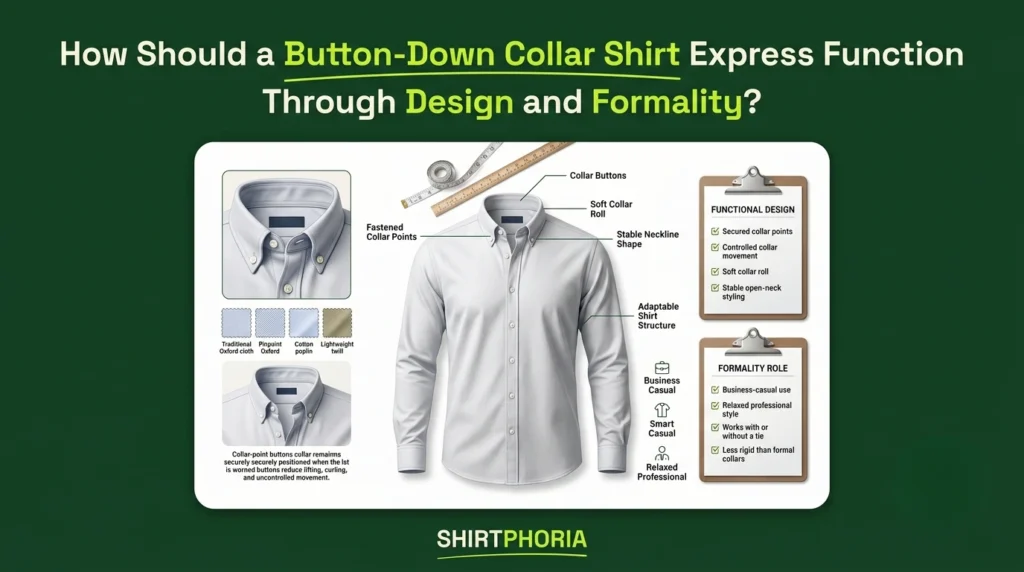
A button-down collar shirt expresses function through design because its collar points fasten directly to the shirt body, creating collar stability, a soft collar roll, and a visibly lower-formality signal than point, spread, or wing collar shirts.
Many people assume that every collared shirt with front buttons is a formal dress shirt. A button-down collar, however, is defined by a specific construction feature: two small buttons secure the collar points directly to the shirt body.
These buttons are functional rather than decorative. They control collar movement, preserve the intended shape, and help create the relaxed curve associated with traditional button-down shirts.
Because the button-down collar is one shirt-collar configuration within the larger dress-shirt system, readers can compare it with broader dress shirt collar configuration before judging its formality.
This article explains the button-down collar’s physical construction, historical origin, collar roll, formality level, tie compatibility, and appropriate use. The design can move comfortably from casual clothing to smart-casual and business-casual outfits, but it does not belong in strict formal eveningwear.
Quick Answer: What Is a Button-Down Collar Shirt?
A button-down collar shirt is a shirt with small buttons that fasten the collar points to the shirt body, preventing unwanted movement while producing a softer and more casual shape than most formal dress-shirt collars. “Button-down” describes the collar, while “button-up” refers more broadly to a shirt that closes with buttons down the front.
As Southern Living explains, a button-down shirt can also be a button-up shirt, but not every button-up shirt has a button-down collar.
Why the Button-Down Collar Shirt Design Is Functionally Unique
The button-down collar shirt is functionally unique because its collar points are physically anchored to the shirt body, preventing loose movement and giving the collar a controlled but relaxed shape.
Most point, spread, and club collars leave their tips unsecured. Their shape depends on fabric stiffness, pressing, interlining, collar stays, and the support provided by a tie or jacket.
A button-down collar adds a direct fastening mechanism. Each collar point contains a buttonhole that connects to a small button on the shirt front. This mechanism controls the collar tips while allowing the fabric above them to curve naturally.
How Do Fastened Collar Points Stabilize a Button-Down Collar Shirt?
Fastened collar points stabilize a button-down collar shirt by holding the collar tips against the shirt body so they do not lift, curl, or flap during movement.
The buttons convert each collar point from an unsecured fabric edge into a controlled construction feature. Once fastened, the points remain close to the chest while the upper part of the collar can move and curve naturally.
This construction helps prevent:
- Collar points from lifting in wind.
- Collar tips from moving across the shirt during activity.
- The collar from spreading outward when the wearer turns the neck.
- Collar points from curling unpredictably.
- The collar from slipping over the edge of a sweater or jacket.
The mechanism makes the shirt practical for movement, outdoor wear, travel, layering, and relaxed tailoring.
The visible buttons also influence formality. Formal dress usually favors smooth surfaces, concealed support, and cleaner collar lines. Because the button-down collar exposes its fastening hardware, it generally looks more casual than an unsecured point or spread collar.
That lower formality is not a flaw. It is an intentional part of the design.
What Historical Origin Explains the Button-Down Collar Shirt?
The historical origin of the button-down collar shirt is tied to English polo players who secured their collar points during play, a practical idea later adapted into American menswear through Brooks Brothers.
According to the Brooks Brothers shirt history, John E. Brooks observed English polo players fastening their collar points to prevent them from flapping while riding. Brooks Brothers later adapted the practical feature into an American shirt design.
The fastening method therefore did not begin as a decorative American fashion detail. It originated as a solution to unwanted collar movement during polo.
The design developed through three stages:
- English polo players secured their collar points during play.
- Brooks Brothers adapted the practical idea for American shirtmaking.
- The button-down collar became associated with collegiate style, office sportswear, Ivy clothing, and the Oxford Cloth Button-Down.
Brooks Brothers represents the American adoption and popularization point, not the original invention of fastening collar points during polo.
The sporting origin still shapes how the shirt is perceived. Even when it is made from fine cotton and worn beneath a jacket, the visible buttons preserve part of its functional identity.
How Does Collar Roll Define the Button-Down Collar Shirt’s Visual Identity?
Collar roll defines the button-down collar shirt’s visual identity because the fastened collar points allow the fabric between the neckband and collar tip to curve softly rather than sit flat or sharply pressed.
Collar roll is the soft curved arc formed by a button-down collar when the collar fabric has enough length, structure, and flexibility to curve naturally between the neckband and the fastened points.
A well-designed collar needs sufficient fabric between the neckband and the collar-point buttons. This extra length allows the collar to form a controlled curve.
Collar roll is especially associated with the traditional Oxford Cloth Button-Down, commonly shortened to OCBD. Oxford cloth has enough body to maintain shape while remaining flexible enough to form a soft arc.
A good collar roll gives the shirt a relaxed but intentional character. It should not look sharply pressed like a stiff formal collar, but it should also not appear loose or neglected.
Collar roll must be distinguished from collar collapse:
- Collar roll is a controlled curve produced by correct patterning, fabric, and button placement.
- Collar collapse is uncontrolled flattening, sagging, or outward movement caused by weak construction or unsuitable fabric.
A well-formed button-down collar should meet several observable standards:
- The collar curves softly from the neckband to the buttoned point.
- The collar does not lie completely flat against the chest.
- The collar tips remain fastened without curling upward.
- The collar does not collapse outward beneath a jacket.
- Both sides form reasonably balanced curves.
- The buttons secure the points without pulling the fabric.
Excessive fusing or stiff interlining can destroy the natural roll. The goal is controlled softness rather than rigid formality.
Assessing the Formality of the Button-Down Collar Shirt
The button-down collar shirt sits below point, spread, and wing collars in formality because its visible collar buttons expose a functional construction detail associated with practical and casual menswear.
Formal clothing tends to emphasize clean lines, polished symmetry, and concealed structural support. A button-down collar reveals exactly how its points are secured, making the functional hardware part of the visible design.
The softer collar movement also contributes to the casual signal. A point or spread collar normally creates a cleaner frame around the tie knot, while a button-down collar produces a curved and more relaxed shape.
The button-down collar is strongest in:
- Weekend casual outfits.
- Smart-casual combinations.
- Business-casual offices.
- Sport-coat outfits.
- Relaxed suits.
- Collegiate and Ivy-inspired clothing.
- Travel wardrobes.
- Open-collar warm-weather outfits.
It can still be appropriate in many workplaces. A solid Oxford shirt beneath a navy blazer can appear polished and professional in offices where ties are optional and soft tailoring is accepted.
The limitation appears when a dress code requires ceremonial formality, strict eveningwear, or a particularly sharp business presentation.
Why Is the Button-Down Collar Shirt Less Formal Than Point or Spread Collars?
The button-down collar shirt is less formal than point or spread collars because its fastened collar points create visible hardware, softer collar movement, and a sport-derived design signal.
The exposed collar buttons interrupt the otherwise clean surface around the tie space. They also make the collar’s practical construction immediately visible.
A point collar leaves its tips unsecured and creates a narrow, vertical frame around the tie. This structure commonly suits standard business shirts, slimmer tie knots, and traditional suits.
A spread collar also leaves its points unsecured but creates a wider opening. It can accommodate fuller knots and visually balance structured jackets and broader lapels.
The comparison depends on context rather than absolute superiority:
- A well-fitted button-down shirt can look more polished than a poorly fitted point-collar shirt.
- A fine button-down collar can work in a relaxed professional office.
- A spread collar does not automatically make a casual shirt formal.
- Fabric, color, fit, cuffs, tie choice, and jacket structure still influence the complete outfit.
The main distinction is functional identity. Point and spread collars are generally designed to create cleaner tie-and-jacket compositions. The button-down collar is designed to stabilize the collar while preserving softness and movement.
Why Should Button-Down Collar Shirts Be Avoided With Tuxedos and Black Tie?
Button-down collar shirts should be avoided with tuxedos and strict Black Tie dress codes because their visible collar buttons and casual construction conflict with the cleaner formal-shirt standards used in eveningwear.
Traditional tuxedo shirts normally use formal turndown collars or wing collars, depending on the event, neckwear, and dress tradition. A Black Lapel tuxedo-shirt guide presents formal spread, semi-spread, and wing-collar options as suitable tuxedo-shirt traditions rather than sport-derived button-down collars.
A button-down collar introduces several details that conflict with formal eveningwear:
- Visible collar-point buttons.
- A polo-derived fastening mechanism.
- A soft collar roll.
- A casual Oxford-shirt association.
- A construction designed for relaxed tailoring.
These elements do not align cleanly with the polished shirt front, formal bow tie, shirt studs, French cuffs, and satin-faced tuxedo used in strict Black Tie.
Because the button-down collar sits far below ceremonial collars in formality, readers comparing formal dress-code extremes should review wing collar shirt formality before choosing a tuxedo shirt.
A bow tie can still be worn with a button-down collar in a casual, preppy, or creative outfit. The combination is inappropriate specifically for tuxedo and strict Black Tie settings.
Can You Wear a Tie With a Button-Down Collar Shirt?
A tie can be worn with a button-down collar shirt, but the combination works best when the tie knot is small, the collar roll remains controlled, and the overall outfit stays within relaxed business or smart-casual territory.
The Four-in-Hand knot is the strongest default choice. Its compact and slightly asymmetrical form usually fits the softer, narrower space created by a button-down collar.
A large Windsor-style knot can crowd the collar, flatten the roll, push the collar points outward, or make the neck area look excessively heavy.
The thickness of the tie also matters. A compact knot made from thick wool may occupy as much space as a larger knot made from thin silk. The wearer should therefore judge the finished volume rather than relying only on the knot name.
A tie raises the outfit’s formality slightly, but it does not convert the button-down collar into a formalwear collar. The visible buttons, soft construction, and sporting origin remain present.
Tie Compatibility Rules
Small knot: Use a Four-in-Hand or another compact knot when wearing a tie with a button-down collar.
Controlled collar roll: Keep the collar buttons fastened so the collar shape remains intentional.
Soft tailoring: Pair the shirt with a sport coat, blazer, or relaxed suit rather than a tuxedo.
Context limit: Use the combination for business casual or smart casual, not strict Black Tie.
Textured silk, wool, cotton, and knit ties often complement the relaxed character of an OCBD. A highly polished formal tie may appear visually disconnected from coarse Oxford cloth.
Task-Oriented Guide to Wearing the Button-Down Collar Shirt
Correctly wearing a button-down collar shirt requires matching its relaxed collar construction with fabric, tie choice, jacket structure, and dress-code context.
The following matrix maps suitable use cases from casual settings to formal situations where the collar should be avoided.
| Style Situation | Best Fabric | Tie and Accessory Rule | Suitability Verdict |
|---|---|---|---|
| Weekend Casual | Oxford cloth, linen, or soft cotton | Open collar; tie not needed; the shirt may be tucked or untucked depending on its length. | Strong fit |
| Smart Casual Layering | Oxford cloth, poplin, or mid-weight twill | Tie optional; a blazer or sport coat works well. | Strong fit |
| Business Casual Office | Fine Oxford, poplin, or twill in solid colors | Tie acceptable; Four-in-Hand knot preferred; collar buttons fastened. | Good fit |
| Conservative Business Formal | Smooth poplin or twill if used carefully | Tie required, but a point or spread collar usually looks cleaner. | Limited fit |
| Black Tie or Tuxedo | Not recommended | Avoid button-down collars with tuxedos, formal bow ties, or strict Black Tie dress codes. | Avoid |
Oxford cloth reinforces the traditional OCBD identity. Its visible basket-like texture and moderate weight suit casual and business-casual clothing.
Poplin creates a smoother, lighter shirt. A fine poplin button-down can look cleaner beneath a blazer, although the collar remains less formal than a comparable point or spread collar.
Twill provides more body and a visible diagonal weave. It can support a controlled collar roll while fitting comfortably into an office wardrobe.
Linen emphasizes the casual side of the design. It works well in warm weather but should not be expected to preserve the same crisp shape as structured cotton.
Diagnostic Thresholds and Failure Modes for Button-Down Collar Shirts
Button-down collar shirt quality and appropriateness can be diagnosed by checking collar roll, button tension, collar stiffness, tie-knot size, fabric weight, and dress-code context.
These are practical diagnostic ranges rather than universal tailoring laws. Different makers, fabrics, body proportions, and style traditions can produce valid variations.
| Variable | Too Low Failure | Ideal Zone | Too High Failure | Diagnostic Fix |
|---|---|---|---|---|
| Collar Roll | Collar lies flat and lifeless, weakening the OCBD identity. | Soft visible curve from the neckband to the buttoned point. | Collar balloons outward or looks sloppy. | Choose better collar construction or firmer Oxford cloth. |
| Collar Button Tension | Collar points drift, curl, or lift. | Points stay anchored without pulling. | Buttons strain and distort the collar. | Adjust the shirt size, collar shape, or button placement. |
| Collar Stiffness | Collar collapses under a jacket. | Soft but controlled structure. | Collar looks rigid and artificial for a button-down. | Choose fabric and interlining suited to relaxed tailoring. |
| Tie-Knot Size | Knot looks weak or disconnected. | A Four-in-Hand or compact knot fills the space cleanly. | A large knot crowds the collar and neck. | Use a smaller knot or choose a spread collar. |
| Fabric Weight | Shirt looks flimsy or transparent. | Oxford cloth, poplin, or twill matches the situation. | Heavy fabric feels bulky under tailoring. | Match the fabric to the season, jacket weight, and dress code. |
| Formality Context | Shirt looks too casual for the event. | Casual, smart casual, or business casual. | Formal pairing looks confused or underdressed. | Switch to a point, spread, or wing collar according to the dress code. |
Both extremes can weaken the outfit.
Too little collar structure creates collapse, weak roll, and casual sloppiness. The collar may lie flat against the chest or lose its shape beneath a jacket.
Too much stiffness destroys the relaxed button-down identity. A rigid collar can resemble a formal point collar fitted with unnecessary buttons.
Too little button tension allows the points to drift or lift. Excessive tension pulls the fabric around the buttonholes and distorts the collar roll.
A very small tie knot may look disconnected from the collar. Too much knot volume crowds the neck and flattens the natural curve.
Too little formality leaves the wearer underdressed for ceremonies or conservative events. Too much formal styling creates a different mismatch by forcing a sport-derived collar into a tuxedo or strict Black Tie system.
Collar Style, Design, Formality, and Task Fulfilment Matrix
The button-down collar shirt becomes easier to classify when it is compared with nearby collar styles, because each collar uses a different structure to solve a different dress-code task.
This table is a practical menswear formality guide rather than a universal hierarchy. Fabric, construction, color, fit, neckwear, and regional conventions can adjust the formality of a specific shirt.
| Collar Style | Functional Design | Formality Level | Best Use Task |
|---|---|---|---|
| Button-Down Collar | Collar points fasten to the shirt body with visible buttons. | Casual to business casual. | Oxford shirts, sport coats, relaxed office wear, and tie-optional outfits. |
| Point Collar | Unsecured collar points create a narrow vertical frame. | Business to business formal. | Standard office shirts, slimmer ties, and traditional suits. |
| Spread Collar | A wider unsecured opening frames larger tie knots. | Business formal. | Structured suits, polished tie outfits, and formal business settings. |
| Club Collar | Rounded unsecured points create a heritage appearance. | Smart casual to soft business. | Vintage styling, knitwear, and patterned jackets. |
| Wing Collar | Short raised collar wings frame formal neckwear. | Ceremonial formal. | White Tie, Black Tie traditions, tuxedo, and eveningwear contexts. |
The point collar creates a cleaner and more vertical frame around the tie. It is often easier to combine with conventional business suits than an OCBD.
The spread collar creates a wider opening for fuller knots and visually balances more structured tailoring. Its lack of visible collar-point buttons generally produces a stronger business-formal signal.
The club collar uses rounded points to produce a heritage character. It may appear dressier than an OCBD in some outfits, but its formality depends heavily on fabric, tie, jacket, and styling context.
The wing collar serves a different function. It is intended for formal neckwear and ceremonial evening traditions rather than relaxed office clothing.
Common Mistakes That Weaken a Button-Down Collar Shirt
A button-down collar shirt weakens when its relaxed construction is either neglected, over-formalized, or paired with clothing that contradicts its functional design.
Leaving collar buttons undone: Unfastened collar points defeat the main function of the design and can make the collar look accidental. Fasten the collar buttons unless you are deliberately creating a very casual outfit.
Using a large tie knot: A bulky knot overwhelms the softer collar space and makes the neck look crowded. Use a Four-in-Hand or another compact knot.
Wearing it with a tuxedo: A button-down collar introduces visible casual hardware into a formal eveningwear system. Choose a tuxedo shirt with an appropriate formal turndown or wing collar.
Choosing a lifeless collar: A flat collar removes the defining roll that gives the shirt its visual identity. Choose better collar construction or Oxford cloth with enough body.
Pairing it with severe tailoring: A heavily structured suit can make the button-down collar look too soft or disconnected. Use a point or spread collar for sharper business formality.
Treating all button-up shirts as button-downs: Button-up describes the front closure, while button-down describes the collar points. Use the terms according to the shirt’s actual construction.
Ignoring button tension: Collar buttons that pull visibly distort the fabric and destroy the roll. Check the collar size and button placement.
Pressing the collar completely flat: A sharp, flat press removes the natural curve that distinguishes a traditional OCBD. Preserve a controlled collar roll.
Key Takeaways: Button-Down Collar Shirt Action Checklist
The key takeaways for the button-down collar shirt are that its fastened collar points create function first, formality second, and style rules that depend on context.
Function: The collar buttons should stay fastened because they anchor the collar points and preserve the shirt’s functional design.
Formality: A button-down collar shirt is less formal than point, spread, and wing collar shirts because its visible buttons expose practical hardware.
Collar Roll: A good button-down collar should create a controlled soft roll, not a flat, lifeless collar or collapsed shape.
Tie Pairing: A button-down collar can work with a tie when the knot is compact, especially a Four-in-Hand.
Best Context: The shirt works best in casual, smart-casual, and business-casual settings.
Formal Exclusion: A button-down collar shirt should be avoided with tuxedos, strict Black Tie, and ceremonial eveningwear.
Button-Down Collar Action Checklist
Use this checklist before wearing a button-down collar shirt.
Frequently Asked Questions
Button-down describes a collar whose points fasten to the shirt body with small buttons. Button-up describes any shirt that closes with buttons down the front. A button-down shirt can also be a button-up, but not every button-up has a button-down collar.
Yes. Fastening the collar-point buttons preserves the design’s intended function, controls movement, and supports the collar roll. Leaving them undone usually makes the collar look accidental.
Yes. A compact knot such as the Four-in-Hand works best because it fits the softer collar space without flattening the roll or crowding the neck.
It can work in some relaxed professional offices, but point and spread collars usually create a cleaner signal for conservative business-formal settings.
No. Its visible collar buttons, sporting origin, and soft roll conflict with strict Black Tie and tuxedo-shirt conventions.
Oxford cloth is the classic choice because it has enough body to support the collar while remaining soft enough to form a natural roll. Poplin, twill, and linen can also work depending on the setting.
Terms Explained
| Term | Definition |
|---|---|
| Button-down collar | A collar whose points fasten directly to the shirt body with small visible buttons. |
| Button-up shirt | A shirt that closes with buttons down the center front, regardless of collar style. |
| Collar roll | The soft curved arc formed between the neckband and the fastened collar points. |
| OCBD | An abbreviation for Oxford Cloth Button-Down, the traditional combination of Oxford fabric and a button-down collar. |
| Collar point | The lower tip of a folded shirt collar. |
| Interlining | A supporting material placed between collar fabric layers to control body and shape. |
| Four-in-Hand knot | A compact, slightly asymmetrical tie knot that works naturally with softer button-down collars. |
| Black Tie | A formal evening dress code normally centered on a tuxedo, formal shirt, and bow tie. |
Conclusion
The button-down collar shirt demonstrates how one functional design choice, fastening the collar points to the shirt body, can determine both practical behavior and formality level.
The design began as a practical way to stabilize the collars worn by English polo players. Brooks Brothers later adapted the idea into American menswear, where it became closely associated with Oxford cloth, collegiate wardrobes, relaxed tailoring, and everyday professional clothing.
Its success depends on several related details. The collar buttons must secure the points without creating excessive tension. The fabric must have enough body to produce a controlled collar roll. The tie knot must fit the available space, and the jacket should respect the shirt’s relaxed character.
The button-down collar remains strongest in casual, smart-casual, and business-casual settings. It can look polished beneath a blazer, sport coat, or relaxed suit, but it should not be forced into ceremonial eveningwear.
By respecting its functional design history, you allow the button-down collar shirt to do what it does best: provide relaxed, polished versatility without pretending to be formal eveningwear.