How Does a Tuxedo Shirt Convey Formal Purpose Through Construction and Styling?
A tuxedo shirt conveys formal purpose through a controlled white shirt front, formal cuffs, a black-tie-appropriate collar, clean fit, and coordinated accessories that frame the dinner jacket and bow tie without competing with them.
Quick Answer: What Gives a Tuxedo Shirt Its Formal Purpose?
A tuxedo shirt gains its formal purpose from the combined effect of white evening fabric, a controlled shirt front, French or Double Cuffs, an appropriate collar, clean fit, and compatible formal accessories. Whiteness alone does not make an ordinary business shirt equivalent to a purpose-built black-tie evening shirt.
The most common mistake is treating every white dress shirt as interchangeable with a tuxedo shirt. A business shirt may share its color and some basic construction, but black-tie dress requires closer attention to front design, cuffs, collar architecture, fasteners, fit, and accessory coordination.
This guide explains how the fabric, shirt front, cuffs, collar, fit, and accessories of a tuxedo shirt support black-tie dress while separating traditional standards from contemporary variations and white-tie requirements.
Black Tie and White Tie are not interchangeable. Black tie is the less formal of the two evening dress codes, while white tie uses a stricter full-dress system involving a stiff white shirt front, Wing Collar, white bow tie, white waistcoat, and tailcoat context. Traditional guidance from Debrett’s and Emily Post distinguishes these dress codes clearly.
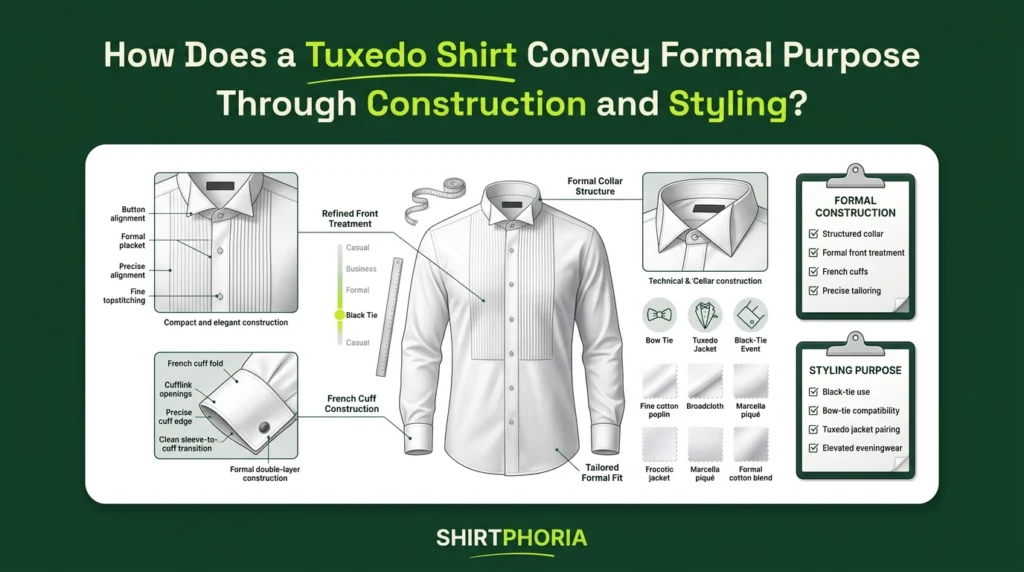
Tuxedo-shirt construction controls both concealment and restrained ornamentation. A Fly-Front Placket hides fasteners. A Stud-Ready Placket turns the fastening line into a controlled place for formal shirt studs. Piqué and pleated fronts add deliberate texture, while a restrained Plain Front creates a quieter contemporary appearance.
What Construction Decisions Define the Formal Purpose of a Tuxedo Shirt?
The formal purpose of a tuxedo shirt is defined by the combined treatment of its white fabric, shirt front, fasteners, texture, and opacity rather than by one compulsory cloth or placket style.
This construction goal differs from the activity-led engineering of performance shirts, where moisture transport, ventilation, stretch, and movement management are central priorities. A tuxedo shirt instead creates a controlled visual frame for evening dress.
Why Fabric and Shirt-Front Construction Must Signal Tuxedo Formality
A black-tie tuxedo shirt signals formality through crisp white fabric and a deliberately controlled front, which may use a Piqué Bib, Pleated Bib, concealed front, or restrained plain construction.
The base fabric forms the main body of the shirt. The shirt front can then use the same cloth or a different structured treatment to create the visible area beneath the dinner jacket.
Several constructions are appropriate within black-tie dressing.
Cotton Piqué, also called Marcella, uses a raised textured structure that produces a crisp, traditional evening front. A Piqué Bib is strongly associated with a more traditional black-tie appearance.
A Pleated Bib introduces controlled vertical folds. The pleating creates visible ornamentation without relying on bright color or casual pattern.
A Plain Front provides a more restrained contemporary surface. It may be combined with a Fly-Front, removable-button system, or discreet conventional fastening.
Broadcloth provides a smooth, clean white surface and works well for a quieter contemporary shirt. Because smooth lightweight fabrics can vary in opacity, the finished shirt should be evaluated under realistic lighting.
Twill has a diagonal weave structure that can provide greater visual depth, opacity, and drape while remaining appropriate for formal shirting.
The Emily Post attire guide supports the distinction between black-tie shirt-front options and the stiffer piqué Wing-Collar shirt associated with white tie. Proper Cloth likewise treats piqué, pleated, and plain fronts as distinct formalwear options.
A tuxedo shirt should appear clean, white, sufficiently opaque, and properly pressed. Heavy starch is not required for every black-tie shirt.
Dress-Code Boundary: Heavy starch and a rigid stiff front are most strongly associated with traditional full-dress or white-tie construction rather than every contemporary black-tie shirt.
The functional relationship is:
Controlled white shirt front → limits distracting show-through or casual detailing → supports visual continuity beneath the dinner jacket.
Opacity should be judged from the finished garment. Fabric structure, weave, weight, finishing, lighting, skin contrast, and a visible undershirt can all affect what the viewer sees.
How Placket and Fastener Design Support the Tuxedo Shirt’s Formal Purpose
Placket and fastener design support the tuxedo shirt’s formal purpose by either concealing the closure, converting it into restrained formal ornamentation, or minimizing its visual impact.
A Fly-Front Placket places the functional buttons beneath an outer layer of fabric. The result is a cleaner uninterrupted center line.
A Stud-Ready Placket uses eyelets or a removable-button arrangement that allows formal studs to become the visible fasteners.
A Restrained Plain Front may use discreet sewn or removable buttons to create a simpler contemporary appearance.
Fly-front and stud-ready constructions remain the clearest traditional black-tie choices. Contemporary black tie can also accept a restrained Plain Front when its buttons and overall construction remain formal rather than office-like.
Visible sewn buttons are not automatically an etiquette violation. The problem is stronger when ordinary business-style buttons are combined with a conventional office placket, Barrel Cuffs, or a button-down collar, because several casual or business signals then appear together.
Where a tuxedo shirt controls or minimizes its center-front details, Guayabera shirts deliberately use visible pockets, pleats, and embroidery as part of their cultural design language. The two garments use construction detail for very different purposes.
The Proper Cloth formalwear guide compares piqué, pleated, plain, studded, and concealed formal shirt-front approaches and helps show why multiple black-tie constructions can remain valid.
How Do Tuxedo Shirt Cuffs and Collars Reinforce Formal Styling Purpose?
Tuxedo shirt cuffs and collars reinforce formal styling purpose by framing cufflinks and the bow tie while clearly signalling whether the shirt belongs to black-tie or white-tie evening dress.
These components are small relative to the whole garment, but they strongly influence how the shirt interacts with the jacket and formal accessories.
Why French Cuffs Are the Traditional Standard for Tuxedo Shirt Formal Purpose
French Cuffs, also called Double Cuffs, are the traditional black-tie standard because they replace an ordinary buttoned cuff with a folded formal cuff secured by cufflinks.
The cuff extends beyond its finished wrist length, folds back over itself, and is secured through aligned buttonholes.
This construction creates a defined place for cufflinks within the evening ensemble.
French or Double Cuffs are therefore the safest traditional choice for a black-tie tuxedo shirt. Their purpose is sartorial rather than mechanical.
They do not make the shirt perform better as a garment. Instead, they remove the ordinary buttoned-cuff appearance and create a controlled location for formal jewelry.
When the arms rest naturally, a modest amount of shirt cuff should normally remain visible beyond the dinner-jacket sleeve. The exact amount should not be treated as an inflexible universal measurement because body proportions, tailoring, and sleeve construction vary.
Too little visible cuff can hide the formal detail. Excessive cuff exposure can indicate that either the jacket sleeve or shirt sleeve length needs adjustment.
Barrel Cuffs are less traditional for black tie and reduce the shirt’s specificity as formal evening wear, although they should not be described as impossible in every contemporary formal interpretation.
How Collar Design Separates Black-Tie and White-Tie Tuxedo Shirt Purpose
Collar design separates black-tie from white-tie shirt purpose: a crisp Turndown or Spread Collar is the safest modern black-tie choice, while a stiff Wing Collar belongs primarily to white tie.
A Turndown Collar folds around the neck in the familiar modern shirt structure. A Spread Collar is a turndown variation with a wider distance between the collar points.
Both can frame a black bow tie while concealing most of its neckband. This creates a clean modern black-tie presentation.
Button-down collars and strongly casual collar constructions should normally be avoided because they introduce a daytime or informal signal.
A Wing Collar is different. Its small standing wings expose more of the bow-tie band and form part of a stricter full-dress system.
Traditional White Tie combines the Wing Collar with a stiff white front, white bow tie, white Evening Waistcoat, and tailcoat. That complete arrangement should not be presented as an ordinary black-tie tuxedo-shirt configuration.
Some historical or highly traditional black-tie interpretations do use Wing Collars. However, for a general modern black-tie reader, a Turndown or Spread Collar remains the safer choice.
The relationship is:
Collar architecture → frames the bow tie and exposes or conceals its band → signals black-tie or white-tie convention.
A Wing Collar combined casually with a standard dinner jacket, black Cummerbund, and ordinary soft shirt front can create unresolved signals because white-tie and black-tie conventions are being mixed without a clear governing system.
How Should a Tuxedo Shirt Be Styled to Achieve Its Formal Purpose?
A tuxedo shirt achieves its formal purpose when it fits cleanly beneath the dinner jacket and coordinates its front, cufflinks, bow tie, and waist treatment without unnecessary visual conflict.
The goal is controlled structure rather than extreme tightness or decorative excess.
How a Clean Fit Reinforces the Tuxedo Shirt’s Formal Purpose
A clean tuxedo-shirt fit reinforces formal purpose by keeping the collar, chest, waist, cuffs, and shirt front stable without visible pulling, excessive bunching, or restricted movement.
The collar should close comfortably around the neck. It should not leave an obvious gap, but it should also not create throat pressure.
The chest should remain smooth when standing and sitting. Strain lines around the buttons or shirt front indicate that the garment may be too tight.
The waist should contain enough shaping to avoid large amounts of excess fabric beneath the jacket, Cummerbund, or Evening Waistcoat.
The armholes and sleeves should permit normal dining, standing, and dancing movement.
The Piqué Bib or Pleated Bib should remain centered rather than twisting or pulling to one side.
The shirt should also remain tucked as the wearer sits and rises.
Too much fabric creates the low-end failure mode:
Excess fabric can bunch beneath a Cummerbund or Evening Waistcoat and disturb the controlled shirt front.
Excessive tightness creates the opposite failure:
Excessively tight construction can cause pulling, restricted movement, collar strain, and visible tension around the placket.
Fit should therefore be checked as part of the complete ensemble.
Jacket-On Validation: Check the shirt while wearing the complete dinner jacket and waist treatment, not only while standing in the shirt by itself.
How Should the Tuxedo Shirt Front and Formal Accessories Be Coordinated?
The tuxedo shirt front and formal accessories should coordinate in color, material tone, scale, and level of formality without requiring every component to be an identical matching set.
The first rule is to match the accessory system to the shirt front.
A Stud-Ready Placket requires formal shirt studs to complete its intended fastening system.
A Fly-Front Placket conceals the functional buttons and normally does not require visible studs.
A restrained Plain Front should use discreet closures that do not dominate the shirt or make it resemble ordinary casualwear.
Black Onyx and Mother-of-Pearl are established examples of formal stud materials. They provide restrained ornamentation rather than bright decorative contrast.
Studs and cufflinks should coordinate in several ways:
- metal tone;
- color family;
- scale;
- surface finish;
- and overall formal character.
They do not need to come from an identical manufactured set. Restrained variation can work when the pieces still appear visually coherent.
Waist coverings require a separate decision.
A Cummerbund or low-cut Evening Waistcoat may be used to cover the trouser waistband and complete the lower visual frame of traditional black tie.
They should not be worn together.
A Cummerbund is traditional, but it is not compulsory in every contemporary black-tie interpretation.
Accessory coordination should remain restrained. Competing studs, oversized cufflinks, novelty buttons, heavily patterned bow ties, and additional visible waist accessories can create visual overload rather than reinforce the shirt’s formal purpose.
What Structural Elements Explain the Formal Purpose of a Tuxedo Shirt?
The structural elements of a tuxedo shirt reveal how each visible component supports a specific black-tie function, acceptable contemporary variation, or white-tie distinction.
| Tuxedo Shirt ElementConstruction Requirement or OptionFormal Purpose ConveyedSignal Status | |||
|---|---|---|---|
| Shirt Color | Clean white evening shirting | Creates contrast with the dark dinner jacket and black bow tie | Traditional black-tie standard |
| Shirt Front | Piqué/Marcella Bib | Creates a flat, structured, highly traditional shirt front | Traditional high-formality option |
| Shirt Front | Pleated Bib | Introduces controlled decorative texture | Traditional black-tie option |
| Shirt Front | Plain or Covered Front | Creates a quieter, more contemporary surface | Acceptable contemporary variation |
| Placket | Stud-Ready | Converts the closure into restrained formal ornamentation | Traditional black-tie option |
| Placket | Fly-Front | Conceals functional buttons and creates an uninterrupted center line | Traditional or contemporary black-tie option |
| Cuffs | French/Double Cuffs | Provides the correct structure for formal cufflinks | Safest traditional black-tie standard |
| Collar | Turndown or Spread Collar | Frames the black bow tie and supports modern black-tie proportion | Safest modern black-tie choice |
| Collar | Stiff Wing Collar | Exposes the bow-tie band and signals full-dress construction | Primarily a white-tie signal |
| Base Fabric | White Broadcloth or Twill | Provides a crisp, controlled surface beneath the jacket | Accepted black-tie fabric family |
| Waist Treatment | Cummerbund or Evening Waistcoat | Covers the waistband and completes the lower visual frame | Traditional option; never worn together |
| Stud Material | Black Onyx or Mother-of-Pearl | Adds restrained formal ornamentation | Classic example, not an exclusive rule |
Interpretation Boundary: “Traditional standard” identifies the safest conventional black-tie choice. “Acceptable contemporary variation” identifies an option that may work in modern black tie but should not be misrepresented as the strictest traditional form.
Tuxedo Shirt Verification Outcomes
| OutcomeRequired EvidenceFinal Interpretation | ||
|---|---|---|
| Traditional Black-Tie Pass | White formal shirt, Turndown/Spread Collar, French Cuffs, traditional or concealed formal front, clean fit, coordinated accessories | The shirt follows the safest established black-tie structure |
| Contemporary Black-Tie Pass | White formal shirt, Turndown/Spread Collar, French Cuffs, restrained Plain or Fly Front, clean fit, controlled accessories | The shirt follows a modern but recognizably black-tie configuration |
| White-Tie Classification | Stiff Wing Collar, stiff white or piqué front, White Bow Tie, White Waistcoat, and Tailcoat context | The shirt belongs to white tie and should not be presented as an ordinary tuxedo-shirt configuration |
| Mixed or Unclear | Features from black tie, white tie, business shirts, or creative dress are combined without a clear governing convention | Review the invitation and correct conflicting features |
| Correction Required | Button-down collar, visibly casual front, Barrel Cuffs in a traditional black-tie context, severe fit distortion, or conflicting waist coverings | One or more elements prevent a coherent formal-purpose result |
Error-Proof Verification Protocol
Use the same verification order each time:
- Read the invitation and identify the actual dress code.
- Separate black-tie guidance from white-tie guidance.
- Identify the collar before evaluating other details.
- Identify the shirt front and fastening system.
- Verify the cuff construction.
- Evaluate fabric, opacity, and pressing.
- Check fit while wearing the dinner jacket.
- Coordinate studs, cufflinks, bow tie, and waist treatment.
- Select one final outcome from the verification table.
- Correct conflicting features before the event.
Repeatability Rule: The verification result remains consistent only when the same dress-code scope, definitions, and evidence standards are applied each time.
Correction Hypothesis: When the shirt appears incorrect, isolate one variable at a time—collar, front, cuff, fit, or accessory coordination—before replacing the entire ensemble.
The Tuxedo Shirt Formal-Purpose Verification Checklist
Before finalizing a formal ensemble, verify the event code, shirt front, cuffs, collar, fit, accessories, and waist treatment as one connected black-tie system.
Frequently Asked Questions
No. A white business shirt may share the color, but a tuxedo shirt is better defined by the combined front construction, cuffs, collar, fit, fasteners, and accessory coordination required for formal evening dress.
A crisp Turndown or Spread Collar is the safest modern black-tie choice because it frames the black bow tie cleanly and avoids mixing in stronger white-tie signals.
French or Double Cuffs are the safest traditional black-tie standard because they create the appropriate structure for cufflinks, although some contemporary interpretations may vary.
A stiff Wing Collar is primarily associated with white tie, especially when combined with a stiff white front, white bow tie, white waistcoat, and tailcoat.
Either can work. A Stud-Ready Placket turns the closure into restrained ornamentation, while a Fly-Front hides the functional buttons for a cleaner uninterrupted center line.
Terms Explained
| TERM | DEFINITION |
|---|---|
| Black Tie | A formal evening dress code typically centered on a dinner jacket, black bow tie, white formal shirt, and coordinated formal accessories. |
| White Tie | A stricter full-dress evening code involving a stiff white shirt front, Wing Collar, white bow tie, white waistcoat, and tailcoat context. |
| Piqué / Marcella | A raised textured cotton structure associated with traditional formal shirt fronts. |
| Pleated Bib | A shirt-front treatment using controlled vertical folds for restrained formal ornamentation. |
| Fly-Front Placket | A closure in which functional buttons are concealed beneath an outer fabric layer. |
| Stud-Ready Placket | A front construction designed to accept removable formal shirt studs. |
| French / Double Cuffs | Fold-back cuffs secured with cufflinks rather than ordinary cuff buttons. |
| Turndown Collar | A collar that folds around the neck in the familiar modern shirt structure. |
| Wing Collar | A stiff standing collar with small projecting wings, primarily associated with white tie. |
| Cummerbund | A traditional black-tie waist covering worn around the waistband. |
| Evening Waistcoat | A low-cut formal waistcoat used as an alternative to a cummerbund in traditional evening dress. |
Conclusion
A tuxedo shirt conveys formal purpose when its white fabric, front construction, cuffs, collar, fit, and accessories form one coherent black-tie system rather than a collection of isolated formal-looking details.
The shirt front controls whether fasteners are concealed or turned into restrained ornamentation. French or Double Cuffs create the appropriate structure for cufflinks. A Turndown or Spread Collar provides the safest modern black-tie frame, while the Wing Collar marks an important white-tie boundary.
The shirt should fit cleanly without becoming restrictive, and its studs, cufflinks, bow tie, and waist treatment should coordinate without excessive matching or decoration.
A tuxedo shirt is therefore not defined by one compulsory fabric, one placket, or extreme stiffness. An under-formal business shirt can weaken the evening structure, while an over-rigid or incorrectly combined white-tie shirt can create a dress-code mismatch.
By understanding how every tuxedo-shirt feature supports a defined black-tie purpose, you can wear the garment with accuracy, restraint, and confidence.