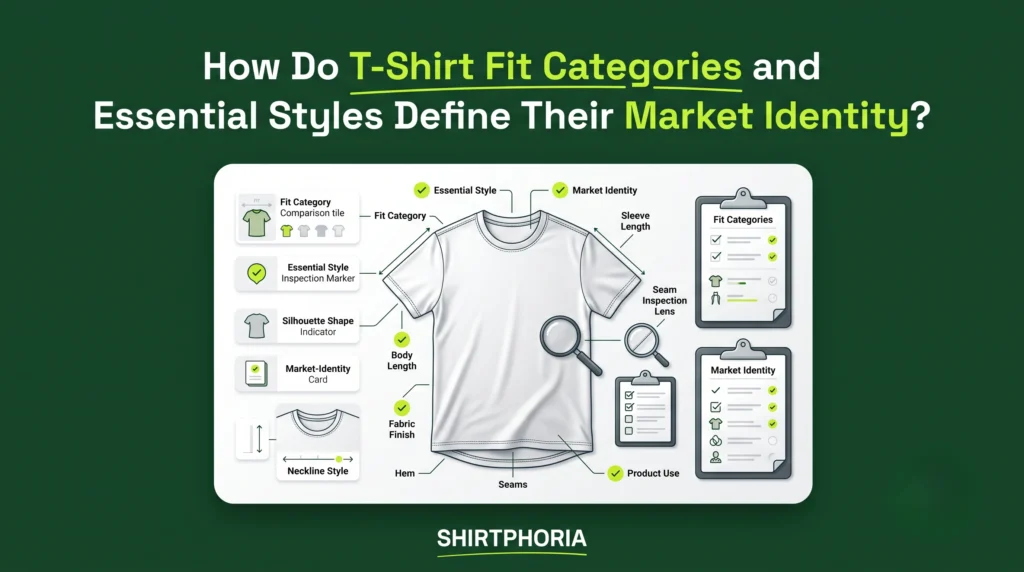
How Do T-Shirt Fit Categories and Essential Styles Define Their Market Identity?
A T-shirt’s market identity is defined by the specific engineering of its fit, meaning silhouette geometry, and style, meaning construction details, not its graphic print. These attributes act as immediate visual signals determining its target demographic, price point, and commercial category.
A T-shirt is never just a T-shirt. It is a calculated combination of geometry, fabric, construction, and consumer signaling. The fit is the foundation; the fabric is the building material. When those two elements align correctly, the product communicates a clear commercial identity before the consumer reads a label, sees a logo, or checks the price tag.
This guide analyzes how specific silhouettes, such as Slim Fit, Regular Fit, Boxy Fit, and Oversized Fit, classify a T-shirt into market segments ranging from promotional mass-market basics to premium streetwear and athleisure products. The focus is not on graphic decoration. The focus is on the industrial design language of the garment: silhouette, drape, cut, construction details, GSM, and use-case adaptation.
Understanding the T-shirt’s market identity is essential to its role in T-shirt fit and styling.
Why Does T-Shirt Market Identity Rely on Fit and Style Categories?
T-shirt market identity relies on fit and style categories because these physical attributes function as non-verbal communication signals. They instantly filter the target audience and establish price point perception before the consumer even touches the fabric.
Fit and style categories operate as visual classification systems. A narrow sleeve, a straight tubular body, a drop-shoulder seam, a thick rib collar, or a longline hem can communicate age group, price tier, use case, and market positioning within seconds.
The consumer does not need to understand apparel manufacturing to read these signals. In retail environments, silhouette recognition works as a low-cognitive-cost classification shortcut. The body sees shape before the mind analyzes construction.
Signaling the Target Audience
Fit acts as an immediate demographic filter. For instance, a muscle fit uses negative ease to target fitness-conscious consumers, while a boxy fit uses dropped shoulders to signal alignment with Gen Z and streetwear demographics.
Fit geometry filters target demographic. A slim fit T-shirt with tapered side seams, higher armholes, and visible body contour often signals athletic, athleisure, or modern tailoring influence. It targets consumers who want the garment to emphasize the body line.
A regular fit T-shirt signals corporate and mass market utility because its straight cut works across more body types and buying contexts. This makes it common in promotional merchandise, staff uniforms, event shirts, and basic retail programs.
A boxy fit or oversized fit signals youth-oriented fashion, streetwear, and premium casualwear because the garment uses volume as a deliberate design language. Dropped shoulders, wider sleeves, and a wider chest block communicate relaxed modern identity rather than conventional body-following fit.
Consumers use silhouette recognition as a low-cognitive-cost classification shortcut. Before they assess fiber quality or stitching, they often identify the product category by how the shirt sits on the body.
Establishing Price Point Perception
Complex style details elevate a T-shirt from a commodity to a premium product. Features like split hems, extended lengths, or specific neck-rib widths signal a higher manufacturing cost and, consequently, a higher retail value.
A standard tubular tee often reads as a commodity product because it is designed for efficiency, broad sizing tolerance, and lower production complexity. Tubular Construction removes side seams, which can reduce manufacturing steps and make the garment suitable for mass programs.
A Cut and Sew T-shirt usually reads as more intentional because separate fabric panels are cut, aligned, and sewn together. Side-seamed construction can improve shape control, print alignment, and fit consistency across sizes.
Construction details influence price point perception because they create visible manufacturing signals. A heavy rib collar, reinforced stitching, split hem, precise sleeve angle, or engineered drop-shoulder seam makes the product look less generic and more commercially specific.
How Do T-Shirt Fit Categories Shape Market Identity?
The three primary T-shirt fit categories, slim, regular, and oversized, each use distinct geometric proportions to shape the garment’s market identity and dictate its commercial use case.
Fit categories are not only size options. They are commercial archetypes. Each category uses different ease, shoulder placement, sleeve shape, torso width, and hem behavior to signal a different product segment.
The Slim Fit: The European/Fashion Identity
The slim fit is a contoured architectural cut designed with higher armholes and tapered side seams to follow the body’s natural lines. This creates a silhouette that prioritizes a tailored or night-out aesthetic.
The slim fit market identity is built around body definition. The shirt sits closer to the chest, shoulders, arms, and torso, which creates a more controlled and fitted silhouette. This geometry often connects to Euro-style casualwear, modern tailoring, fitness-oriented dressing, and athleisure.
Elastane and spandex blends often support this identity because close-fitting garments need stretch recovery. Without controlled stretch, a slim fit T-shirt may restrict movement, distort at the seams, or pull across the chest and sleeves.
The commercial risk is over-compression. If the garment clings too aggressively, the product can shift from tailored to undersized. Slim fit works best when the cut follows the body without creating excessive tension.
The Regular/Standard Fit: The Mass Market Identity
The regular fit, or standard fit, is the blank canvas of the industry. It is characterized by a straight cut running parallel from chest to hem and standard sleeve lengths, prioritizing maximum versatility.
The regular fit market identity is built around scale. It is designed to work for broad retail programs, corporate and mass market distribution, staff uniforms, promotional merchandise, event apparel, and everyday basics.
Tubular construction is common in this category because it supports cost efficiency. A standard tubular tee has no side seams, which can reduce production complexity and make it practical for high-volume manufacturing.
The commercial strength of regular fit is neutrality. It does not strongly target one niche demographic. The limitation is weak differentiation. If the fabric, collar, stitching, and finishing are basic, the product can read as low-value or generic.
The Oversized/Boxy Fit: The Streetwear Identity
The oversized fit is a deliberate structural choice distinct from simply sizing up. It features dropped shoulders, wider sleeves, and a significantly wider chest measurement relative to its length.
The oversized and boxy fit market identity is built around engineered volume. Dropped shoulders create a relaxed silhouette by moving the sleeve seam below the natural shoulder line. Wider sleeves and a broader chest block create visual mass, while a controlled body length keeps the shape intentional.
Dropped shoulders create relaxed silhouette. This geometry connects directly to luxury streetwear, Gen Z consumer behavior, and youth culture because the product communicates proportion control rather than traditional body conformity.
Oversized is not the same as ill-fitting. An engineered oversized fit has planned shoulder drop, controlled sleeve width, balanced length, and stable fabric weight. An ill-fitting T-shirt is simply too large without proportion control.
The commercial risk is collapse. If the shirt is too long, too light, or too wide without structure, the intended streetwear identity becomes accidental volume.
How Do Essential T-Shirt Styles Influence Market Identity?
While fit dictates the silhouette, essential style details, specifically collar construction, sleeve type, and hemline, finalize the market identity. These details determine whether the shirt is perceived as underwear, sportswear, or high fashion.
Fit creates the main outline, but style details refine the category. The same regular fit body can become promotional, athletic, premium, vintage, or designer-coded depending on collar ribbing, sleeve construction, hem shape, seam placement, and fabric finish.
These foundational concepts apply directly when selecting the most common style: crewneck shirt fit.
The Crewneck: The Utilitarian Anchor
The crewneck is the industry standard whose identity shifts entirely based on construction details. A thin, bound collar signals vintage utility, while a thick, 1-inch rib collar signals premium heavyweight luxury.
The crewneck is the dominant T-shirt style because it offers a simple circular neckline that works across mass-market, activewear, streetwear, heritage, vintage, and premium basics. Its market identity depends less on the neckline shape itself and more on how the neckline is built.
Ribbing width is a high-value construction signal. Thin ribbing often signals basic layering, undershirt utility, or vintage simplicity. Wide ribbing usually signals premium heavyweight construction, streetwear identity, or higher perceived durability.
Collar recovery also affects identity. A weak collar that waves, stretches, or collapses reduces perceived value. A stable rib collar that holds its shape supports a more premium product identity.
The V-Neck: The Smart-Casual Hybrid
The V-neck serves as a transitional style designed to elongate the neckline. It bridges the gap between casual loungewear and semi-formal layering, though it has largely receded from the high-fashion conversation.
The V-neck market identity is based on neckline exposure. By opening the chest area, it visually lengthens the neck and can sit more discreetly under sweaters, lightweight jackets, and casual tailoring.
Its commercial role is narrower than the crewneck because its shape carries stronger styling associations. A shallow V-neck can support refined layering. A deep V-neck can reduce versatility and appear dated in many contemporary markets.
The V-neck works best when the fabric, depth, and fit are controlled. If the neckline stretches or drops too low, the product can lose its smart-casual function.
The Longline and Asymmetric Cuts: The Avant-Garde
Longline and asymmetric cuts define the urban or designer commercial category. These styles prioritize aesthetic form and unique drape over traditional utilitarian function.
A longline T-shirt extends the body length beyond standard proportions. This changes the garment’s visual center and often creates a layered, vertical silhouette. The style is usually associated with urban fashion, designer casualwear, and fashion-forward retail categories.
Asymmetric cuts modify the hemline or panel structure to create visual imbalance by design. These garments are not optimized for mass-market neutrality. They are built to signal design intent.
The commercial risk is reduced usability. Longline and asymmetric T-shirts may work strongly in niche markets, but they can be less suitable for corporate basics, uniforms, or broad consumer programs.
How to Compare T-Shirt Fit and Style Categories Across Markets
| Market Identity | Primary Fit Category | Essential Style Feature | Typical Fabric Weight |
|---|---|---|---|
| Promotional / Merch | Standard / Tubular | Standard crewneck | Light-mid, around 150 GSM |
| Luxury Streetwear | Oversized / Boxy | Thick rib collar / drop shoulder | Heavy, around 220+ GSM |
| Athleisure / Gym | Slim / Tapered | Raglan sleeve | Performance blend / elastane |
| Heritage / Vintage | Relaxed / Short body | Bound neck / single stitch | Mid-weight, around 180 GSM |
How Does Fabric Weight Interact with Fit to Lock in Identity?
Fabric weight, measured in GSM, must be paired with the fit category to successfully lock in the intended market identity. A mismatch can cause the garment’s architecture to fail.
GSM stands for grams per square meter. It measures fabric weight, not total garment quality. A high-GSM fabric can still fail if the knit density, cut, stitching, finishing, or shrinkage control is poor. A lower-GSM fabric can still perform well if it matches the intended silhouette and use case.
Fabric weight interacts directly with drape. Lightweight fabric bends and falls more easily. Heavyweight fabric stands away from the body and supports stronger shape. The correct pairing depends on the market identity the product is trying to communicate.
Heavyweight Fabrics and Structured Fits
Heavyweight fabrics, usually around 200 to 300 GSM, are structurally useful for supporting the architecture of a boxy fit. Without this density, the intended structured silhouette can collapse into a sloppy drape that weakens the premium streetwear identity.
A boxy fit depends on fabric body. The wider chest block, dropped shoulder, and square torso need enough textile density to hold shape. If the fabric is too light, the shirt may hang unevenly, cling in the wrong places, or lose its architectural profile.
Heavyweight cotton is often used for premium streetwear because it supports opacity, structure, and visual weight. The garment looks more intentional because the fabric can hold the planned silhouette.
The limitation is heat and comfort. Heavyweight fabric can feel warmer and less fluid, especially in hot climates. The product developer must balance structure against breathability and wearability.
Lightweight Fabrics and Drape Fits
Lightweight fabrics, usually around 120 to 160 GSM, are useful for slim or fashion styles. These fabrics provide the fluidity, or drape, to contour the body rather than standing away from it.
Slim fit and fashion-oriented T-shirts often need softer fabric behavior. Lightweight jersey can follow the torso, sit smoothly under jackets, and layer without adding bulk. This supports athleisure, Euro-style casualwear, and smart-casual layering.
The limitation is opacity and durability perception. If the fabric is too thin, the shirt can become transparent, twist after washing, cling across the body, or appear low-value.
A lightweight slim fit usually performs best when the fabric includes controlled stretch, stable stitching, and enough recovery to prevent distortion. Elastane and spandex can support this function when used carefully.
What Are the Key Takeaways for T-Shirt Market Identity?
The key takeaways for understanding T-shirt market identity are that fit communicates demographic intent, style details signal price point, and fabric weight is the structural engineer that makes the identity possible.
Disclaimer: This guide is for educational and informational purposes only. Shirt comfort, fit, market perception, fabric behavior, and garment performance can vary by body shape, brand pattern, textile construction, climate, care method, and personal preference. Always check the specific shirt’s fabric label, fit, measurements, and return policy before buying.
Frequently Asked Questions
A T-shirt’s market identity is defined by fit geometry, fabric weight, construction details, style features, and the consumer segment those signals target.
Oversized fit often signals streetwear because planned shoulder drop, wider sleeves, broader chest width, and controlled length create engineered volume associated with modern relaxed fashion.
Regular fit is often useful for mass-market T-shirts because its straight, neutral geometry works across more body types, uniforms, promotional merchandise, and everyday retail basics.
No. Higher GSM usually means heavier fabric, but quality also depends on knit density, fiber quality, stitching, finishing, shrinkage control, fit, and the intended use case.
Crewneck details affect price perception through ribbing width, collar recovery, stitching quality, fabric weight, and finish. A stable thick rib collar often reads more premium than weak or stretched neck binding.
Terms Explained
| TERM | DEFINITION |
|---|---|
| Market Identity | The commercial signal a T-shirt communicates through its fit, fabric, construction, styling details, and target use case. |
| Slim Fit | A closer T-shirt cut that follows the body with higher armholes, narrower sleeves, and reduced chest or torso ease. |
| Regular Fit | A balanced, straight T-shirt cut designed for broad usability, everyday wear, and mass-market sizing tolerance. |
| Boxy Fit | A wider and often shorter T-shirt cut that creates a square, structured silhouette when fabric weight supports the shape. |
| Oversized Fit | An intentionally loose T-shirt cut with planned shoulder drop, wider sleeves, and controlled volume. |
| GSM | Grams per square meter, a measurement of fabric weight that influences structure, drape, opacity, and heat comfort. |
| Tubular Construction | A T-shirt construction method with no side seams, often used for efficiency in high-volume or basic garment programs. |
| Cut and Sew | A construction method where separate fabric panels are cut and sewn together for greater shape control and fit precision. |
| Drop Shoulder | A sleeve seam position that sits below the natural shoulder line to create relaxed or streetwear-oriented volume. |
| Rib Collar | The stretch-knit collar band around a T-shirt neckline; its width, recovery, and stability affect perceived quality. |
Conclusion
In conclusion, T-shirt market identity is not accidental. It is a calculated decision based on the precise interplay of fit categories, style construction, and fabric weight.
Knowing these categories allows for precision in manufacturing and purchasing. A slim fit T-shirt can signal athleisure or modern tailoring when supported by stretch recovery and clean contouring. A regular fit T-shirt can serve mass-market, promotional, and corporate programs when neutrality and scalability matter most. An oversized or boxy fit T-shirt can communicate premium streetwear when drop-shoulder construction, heavyweight cotton, and controlled proportions align.
The construction details complete the signal. Ribbing width, sleeve type, hemline, side-seamed construction, tubular construction, raglan sleeve design, and cut and sew panel control all help define whether a product reads as commodity, vintage, athletic, premium, or designer-led.
Whether you are a brand owner or a consumer, recognizing these categories allows you to navigate the T-shirt market with engineering precision rather than guessing.
At Shirtphoria, we engineer our profiles based on these precise architectural standards to ensure the fit matches the intent.