Which Structural Collar Design Characterizes a Camp Collar Shirt?
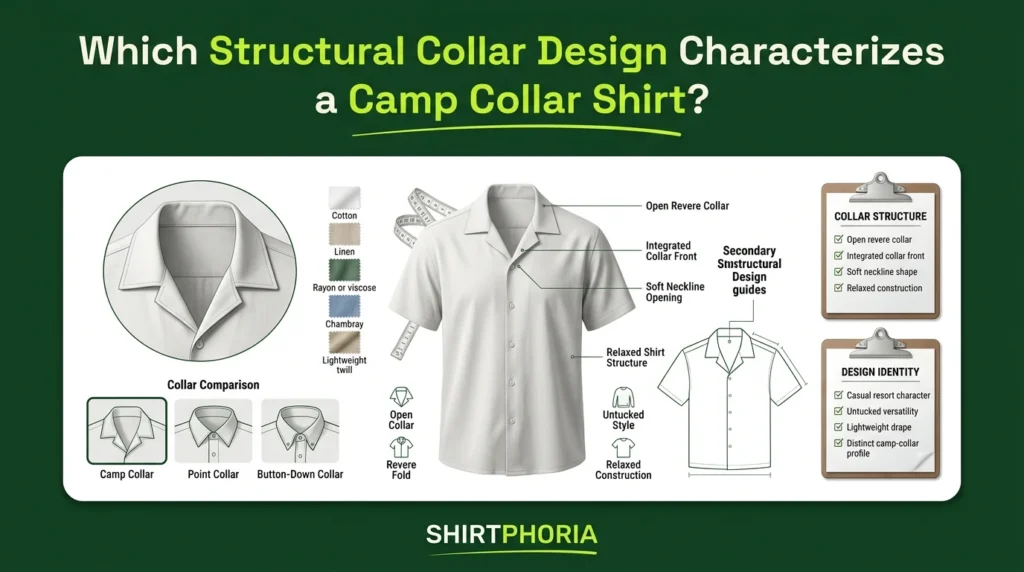
The structural collar design that characterizes a Camp Collar Shirt is a convertible, open-neck collar that typically lacks a separate collar stand, allowing the collar to lie flat against the upper chest and form a relaxed, lapel-like V shape.
The true identity of a Camp Collar Shirt comes from construction rather than from a summer, resort, or retro appearance alone.
A standard shirt collar usually gains height from a separate collar stand that supports the collar around the neck. A camp collar takes a different structural approach. It generally sits more directly against the shirt body or front facing, allowing the collar points to spread outward instead of standing vertically.
Threads Magazine describes the basic camp shirt as a convertible-collar shirt with fold-back front facings rather than an applied placket and without a collar stand.
This guide explains how the Camp Collar Shirt uses zero-stand collar architecture, an open throat, soft interfacing, and a loop closure to create its flat drape, warm-weather comfort, and convertible function.
This guide explains camp-collar construction for educational purposes. Collar behavior and warm-weather comfort can vary with fabric, pattern geometry, interfacing, garment fit, construction quality, movement, laundering, pressing, and environmental conditions.
How Does the Missing Collar Stand Define the Camp Collar Shirt?
The missing collar stand defines the Camp Collar Shirt because it removes the raised fabric band that normally supports a shirt collar around the neck, forcing the collar to rest lower and flatter on the body.
A collar stand is the separate or raised band between the shirt neckline and the main collar leaf. On many traditional shirt collars, it supports the collar and creates height around the neck.
The Camp Collar Shirt typically lacks this separate structure.
That absence changes several observable properties:
- The collar sits lower around the neck.
- The collar points spread outward.
- The neckline stays naturally open.
- The upper chest becomes more visible.
- The collar develops a softer roll.
- The shirt is less suited to tie-based collar positioning.
Threads Magazine specifically notes that camp-shirt construction has no collar band or collar stand.
For broader terminology, compare this construction with conventional shirt collar structure.
How Does Removing the Stand Force the Camp Collar to Lie Flat?
Removing the collar stand forces the Camp Collar Shirt to lie flat because the collar loses the vertical support that normally lifts fabric away from the clavicle and neck.
The clavicle is the collarbone running across the upper chest between the shoulder and center of the body.
On a standard point collar:
Collar Stand → Creates Vertical Support → Raises Collar Around Neck
On a camp collar:
No Separate Collar Stand → Removes Vertical Support → Produces Flat Collar Drape
The collar therefore spreads outward rather than wrapping tightly around the throat.
A useful visual test is simple.
Look beneath the collar.
If a firm separate band clearly encircles the neck and lifts the collar vertically, the construction is moving toward a conventional dress-shirt collar.
If the collar sits low, opens naturally, and spreads across the upper chest without that raised band, it is behaving more like a classic camp collar.
The correct camp collar should not simply collapse.
It should settle or roll softly while retaining enough shape to keep its collar points controlled.
Too little structure can cause curling or distortion.
Too much structure can make the collar stand upright and weaken the defining camp-collar architecture.
Why Does Convertible Construction Create a Softer Collar Roll?
Convertible construction creates a softer collar roll because the collar and front opening are designed to work together, allowing the shirt to be worn open by default and closed only when the loop button is used.
A convertible collar is a collar designed to function primarily in an open position while retaining some ability to close near the neck.
This is different from a conventional collar that is patterned primarily around a closed neckline.
Many camp shirts also use a front facing.
A front facing is fabric folded or sewn inside the front edge of a garment to finish and stabilize the opening.
This differs slightly from an applied placket, which is a reinforced fabric section associated with a garment opening and its closures.
The facing and collar can work together to produce a more natural outward fold.
Front Facing + Convertible Collar + No Separate Stand → Softer Outward Collar Roll
The result should remain controlled.
If the fabric and construction provide too little support, the collar points may curl, ripple, or turn unpredictably.
If the collar receives too much stiff reinforcement, it may begin to behave like a structured dress-shirt collar.
Why Does the Camp Collar Shirt Create a Lapel-Like V Shape?
The Camp Collar Shirt creates a lapel-like V shape because its open-throat construction lets the collar fold outward instead of fastening high around the neck.
The shape comes from several construction variables working together:
- Missing or minimal separate collar stand
- Lower natural closure point
- Outward collar fold
- Open throat
- Collar spread
- Front-facing construction
- Pattern geometry
The term lapel-like describes the visual effect only.
A camp collar is not a suit lapel.
A suit lapel forms part of a jacket front and has different patternmaking and tailoring functions.
The two simply share a visual characteristic: fabric folds outward around an open V-shaped front.
The depth of that V can vary between shirts.
A camp collar does not require one universal neckline measurement.
How Does the Open Throat Mimic a Casual Lapel?
The open throat mimics a casual lapel because the Camp Collar Shirt leaves the upper chest area open, allowing the collar points and front edges to angle outward from the neckline.
Open Throat → Angles Collar Points Outward → Creates V-Shaped Front
An open throat means that the shirt is not designed to close tightly around the neck in its normal wearing position.
Instead, the upper front edges separate.
This gives the collar room to fold outward.
The result is the familiar open V shape associated with camp and Cuban-collar shirts.
If the neckline closes tightly around the throat like a conventional business shirt, it is not functioning as a classic camp collar in that position.
If the opening is excessively deep, another problem appears.
Too much opening can reduce collar stability, expose more chest than intended, or create a sleepwear-like appearance.
The ideal opening is therefore neither closed nor uncontrolled.
How Does the Gorge Position Shape the Collar Profile?
The gorge position shapes the Camp Collar Shirt by controlling where the collar begins to fold outward and how wide the open neckline appears.
Gorge is primarily a tailoring term. In simple terms, the gorge is the visual hinge point where an open collar or lapel begins to break outward.
Applied cautiously to a camp collar, it helps explain why two shirts with similar collar shapes can produce different V openings.
A higher visual break tends to create:
- A narrower V
- Greater neck coverage
- A more closed appearance
A lower break tends to create:
- A wider opening
- More exposed upper chest
- A stronger lapel-like effect
Neither position is universally correct.
Pattern design, collar width, button placement, fabric weight, and collar softness all influence the final result.
If the collar spreads too widely, possible causes include:
- Very soft fabric
- Insufficient interfacing
- Low button placement
- Excessive collar spread
- Pattern shape
- Poor balance between collar and front facing
The gorge should therefore be treated as a diagnostic concept rather than a fixed measurement.
How Does the Camp Collar Shirt Support Warm-Weather Ventilation?
The Camp Collar Shirt can support warm-weather ventilation because its open neckline gives trapped warm air a path to escape instead of holding fabric tightly around the neck.
The important wording is can support.
An open camp collar does not guarantee that the wearer will be cooler.
Research on clothing ventilation shows that garment openings at areas such as the neck can affect ventilation and heat exchange. One study comparing open and closed collar and cuff conditions found greater clothing ventilation when those openings were left open. Clothing Ventilation Research.
The fabric remains critical.
A heavy, dense camp-collar shirt may feel warmer than a lightweight standard-collar shirt made from a highly breathable material.
Neck Opening + Fabric Permeability + Fabric Weight + Garment Fit + Air Movement + Wearer Activity
How Does the Open Throat Create Passive Air Release?
The open throat creates passive air release by leaving a ventilation gap near the neck, where warm air from the chest area can escape through the collar opening.
Open Neckline → Releases Trapped Warm Air → Supports Perceived Cooling
Loose clothing can contain a small layer of warmer air between the skin and garment.
When openings exist at the neckline, cuffs, or hem, some of this air can exchange with the surrounding environment.
A related concept is the chimney effect.
In clothing, the term describes warm air rising inside a relatively loose garment and leaving through an upper opening while other air enters through lower or surrounding openings.
The camp collar’s open neck can contribute to that process.
Research also shows that the effect of garment openings depends on factors such as fabric permeability, movement, and environmental airflow.
Too closed: Reduced opportunity for warm air to leave around the neck.
Balanced opening: The collar remains stable while providing an open path near the upper chest and neck.
Too open: Collar control decreases and chest exposure may become excessive for the setting.
The collar is therefore a ventilation feature, but not a complete cooling system.
How Does Reduced Interfacing Affect Breathability and Drape?
Reduced interfacing affects the Camp Collar Shirt by making the collar softer, lighter, and less rigid than a heavily structured dress-shirt collar.
Interfacing is supportive material added to selected parts of a garment to increase body, stability, or structure.
Seamwork explains that interfacing adds body, shape, and structural support to garment areas such as collars, cuffs, facings, and plackets.
Too little interfacing
- The collar may curl
- The collar may ripple
- The collar may fold unpredictably
- Collar points may lose shape
- The collar may distort after washing
Balanced interfacing
- The collar can hold a clean edge
- The collar can maintain a soft roll
- The collar can sit flat
- The collar can preserve the open neckline
Too much interfacing
- The collar may become stiff
- The collar may flare away from the body
- The collar may resist its natural fold
- The collar may begin to resemble formal collar construction
Lighter interfacing does not automatically make the entire shirt more breathable.
Breathability still depends strongly on fiber, weave, fabric weight, fit, openings, and environmental conditions.
What Is the Function of the Loop Closure on a Camp Collar Shirt?
The loop closure on a Camp Collar Shirt functions as a small convertible fastening system that lets the open collar temporarily close at the neck when more coverage or neatness is needed.
The loop closure is usually a small fabric loop positioned near the upper front opening.
It works with a corresponding button.
When unused, the shirt retains its normal open-throat shape.
When fastened, the loop brings the upper front sections closer together.
The feature is optional.
A shirt can still be a camp collar shirt without a loop closure.
The loop simply provides additional control.
How Does the Button Loop Enable Structural Conversion?
The button loop enables structural conversion by pulling the two collar sides together, reducing the V opening and stabilizing the collar points near the neck.
Loop Closure → Reduces Open-Throat Spread → Creates Temporary Closed Collar
This is one reason the term convertible collar is useful.
The shirt can operate in two positions.
Open position: The default camp-collar configuration, with the collar spreading outward.
Closed position: A temporary configuration in which the loop narrows the neckline.
Closing the loop does not create a conventional point collar.
There is still no normal raised collar stand supporting the collar around the neck.
The underlying architecture remains camp-collar construction.
When Should the Loop Closure Be Used?
The loop closure should be used when the wearer needs a neater neckline, better collar control under a jacket, or temporary reduction of wind exposure.
Useful situations may include:
- Wearing the shirt beneath light outerwear
- Controlling collar spread
- Creating slightly greater upper-chest coverage
- Reducing movement of very soft collar points
The loop does not need to be used every time the shirt is worn.
Constantly forcing a pattern designed to remain open into a fully closed position can make the collar sit awkwardly.
Its purpose is flexibility rather than formal transformation.
This convertible function also helps distinguish camp collars from other casual shirts.
Comparison: Camp Collar Structure vs. Standard Point Collar
The structural differences between a Camp Collar Shirt and a Standard Point Collar become clearest when the two systems are compared directly.
| Feature | Standard Point Collar | Camp Collar Shirt | Structural Result |
|---|---|---|---|
| Collar Stand | Usually includes a separate or raised collar stand that supports the collar around the neck | Typically lacks a separate collar stand and sits lower against the upper chest | The standard collar stands more upright, while the camp collar lies flatter |
| Neckline | Closes higher around the throat | Opens lower across the clavicle and upper chest | The standard collar creates greater neck coverage, while the camp collar supports a more open neckline |
| Top Closure | Uses a main top button aligned with the collar structure | May use an optional loop-close button or remain open | The standard collar is naturally compatible with closed-neck dressing, while the camp collar is open by default |
| Interfacing | Often uses enough structure to maintain a crisp collar shape | Usually benefits from lighter structure that preserves a soft roll | The standard collar looks sharper, while the camp collar drapes more softly |
| Visual Shape | Creates greater vertical collar height around the neck | Creates horizontal spread and a lapel-like V shape | The standard collar reads more structured, while the camp collar reads more relaxed |
| Failure Mode | Too little structure can cause unwanted collar collapse | Too much structure can remove the relaxed collar behavior | Each collar type fails when construction moves too far from its intended architecture |
For a closer comparison with more structured collar architecture, review the standard point collar.
Camp Collar Shirt Diagnostic Checklist
A Camp Collar Shirt can be identified by testing whether its collar construction behaves like a true open convertible collar rather than a conventional collar styled casually.
What Failure Modes Can Distort a Camp Collar Shirt?
A Camp Collar Shirt fails structurally when its core attributes move too far in either direction, because both under-structure and over-structure can damage the collar’s intended function.
| Attribute | Too-Low Failure | Too-High Failure | Corrective Hypothesis |
|---|---|---|---|
| Collar Structure | Collar curls, ripples, or collapses after wear or washing | Collar becomes stiff and begins to resemble a business-shirt collar | Adjust interfacing weight, fabric choice, or collar-pattern shape |
| Neckline Opening | Collar closes too high and weakens the relaxed open-throat identity | Shirt exposes excessive chest and loses collar stability | Adjust button position, break point, or collar spread |
| Interfacing | Collar points lose shape and fold unpredictably | Collar becomes rigid and resists the intended roll | Select lighter or more flexible interfacing according to fabric behavior |
| Collar Spread | Collar looks narrow and increasingly point-collar-like | Collar spreads too widely and appears unstable | Adjust break position, collar width, fabric support, or top closure placement |
| Loop Closure | Shirt lacks the optional ability to control the neckline when needed | Loop and button dominate the collar and make the closed position look forced | Keep the closure functional, small, and visually discreet |
These failures show why softness alone does not define a good camp collar.
A completely unsupported collar is not automatically more authentic.
Likewise, additional stiffness does not automatically improve quality.
The successful collar sits between those extremes.
What Are the Key Structural Takeaways of the Camp Collar Shirt?
The key structural takeaways of the Camp Collar Shirt are that its zero-stand architecture, open neckline, soft collar roll, and optional loop closure work together to create its flat, relaxed profile.
The Structural DNA of a Camp Collar Shirt
- Zero-Stand Architecture: The Camp Collar Shirt typically lacks a separate collar stand, allowing the collar to sit low and flat against the upper body.
- Convertible Collar Construction: The collar is patterned to function naturally in an open position rather than relying on a tightly closed throat.
- Open-Throat Shape: The neckline develops a relaxed V because the collar and front edges angle outward.
- Lapel-Like Profile: The outward fold visually resembles a casual lapel, although the collar is structurally different from a tailored jacket lapel.
- Soft Collar Roll: Pattern shape and controlled interfacing let the collar fold outward without becoming rigid.
- Front-Facing Relationship: Camp-shirt construction can use fold-back front facings that integrate naturally with the open collar.
- Optional Loop Closure: A small loop and button can temporarily narrow the neckline without changing its basic camp-collar architecture.
- Ventilation Support: The open neck can support clothing ventilation and warm-air release, while fabric, weave, fit, movement, and climate determine actual comfort.
- Structural Balance: A successful camp collar is neither excessively floppy nor excessively stiff. It holds a soft, controlled shape.
FAQ: Camp Collar Shirt Structure
The most common questions about camp collar structure can be answered by examining the collar stand, open throat, convertible construction, interfacing, and loop closure.
A camp collar shirt is primarily defined by a convertible open-neck collar that typically lacks a separate collar stand. This allows the collar to sit lower and flatter against the upper chest and spread outward into its characteristic relaxed V shape.
A classic camp collar shirt typically does not use a separate raised collar stand. Removing that vertical support lets the collar rest lower on the body, open naturally around the throat, and develop a softer outward roll.
The V shape forms because the camp collar is designed around an open throat. The upper front edges separate and the collar points fold outward, creating a lapel-like visual profile rather than closing tightly around the neck.
A convertible collar is designed to function naturally in an open position while retaining some ability to close near the neck. On a camp shirt, this construction works with the front opening and absence of a separate collar stand to create a softer outward collar roll.
A camp collar should have enough support to hold a clean edge and keep its points controlled without becoming rigid. Too little support can cause curling or rippling, while excessive interfacing can make the collar flare or begin to behave like a structured dress-shirt collar.
No. A loop closure is optional. When present, it allows the upper neckline to close more narrowly and can help control collar spread, but a camp collar shirt can still have the correct structural identity without a loop closure.
An open camp collar can support ventilation by creating an opening around the upper chest and neck through which warm air can exchange with the surrounding environment. It does not guarantee cooling because actual comfort also depends on fabric permeability, fabric weight, fit, movement, airflow, and climate.
Terms Explained
| TERM | DEFINITION |
|---|---|
| Camp Collar | A flat, open shirt collar that typically lacks a separate upright collar stand. |
| Convertible Collar | A collar designed to function naturally in an open position while retaining some ability to close near the neck. |
| Collar Stand | The separate or raised band between the shirt neckline and main collar leaf that supports collar height around the neck. |
| Open Throat | A neckline architecture designed to remain open rather than close tightly around the neck during normal wear. |
| Front Facing | Fabric folded or sewn inside a garment opening to finish and stabilize its front edge. |
| Placket | A reinforced fabric section associated with a garment opening and its closure system. |
| Interfacing | Support material added to selected garment areas to provide body, shape, and structural stability. |
| Gorge | A tailoring term describing the visual hinge or break area where a collar or lapel begins to fold outward. |
| Clavicle | The collarbone extending across the upper chest between the shoulder and center of the body. |
| Loop Closure | A small loop-and-button fastening near the upper opening that can temporarily narrow the camp collar neckline. |
| Chimney Effect | The movement of warmer air upward inside loose clothing and out through an upper opening while surrounding air enters elsewhere. |
| Soft Collar Roll | A controlled outward fold in which the collar remains flexible while retaining a recognizable edge and shape. |
Conclusion
In conclusion, the Camp Collar Shirt is defined by a specific collar architecture, not merely by a retro or summer aesthetic.
Its most important structural difference is the missing or minimal separate collar stand.
Removing that raised support allows the collar to sit lower, spread outward, and form the relaxed open shape associated with camp and Cuban-collar shirts.
The open throat creates the lapel-like V.
The convertible collar construction allows the shirt to remain naturally open.
Controlled interfacing helps the collar hold its edge without creating dress-shirt stiffness.
An optional loop closure can narrow the opening when additional collar control is useful.
The open neckline can also support ventilation by creating a path for air exchange around the upper chest and neck, but fabric weight, weave, garment fit, movement, and climate still determine real warm-weather comfort.
A good camp collar therefore depends on balance.
Too little structure produces curling and instability.
Too much structure removes the soft outward roll that makes the collar distinctive.
The collar should lie flat without looking collapsed, remain open without looking uncontrolled, and retain enough shape to clearly communicate its intended construction.
The Camp Collar Shirt is the architectural opposite of the tie-ready dress shirt: softer, flatter, more open, and built from the seams up for relaxed structure.