Why Does a Point Collar Shirt Create a Traditional Professional Look?
A point collar shirt creates a traditional professional look by using collar points that sit closer together than a spread collar, producing a narrower opening that often works well with smaller tie knots.
Many people choose shirt collars by habit, even though collar shape affects tie-knot fit, face framing, jacket balance, and how traditional or relaxed the shirt appears. A point collar shirt creates a different visual effect from a spread collar or button-down collar because its points direct the eye downward toward the shirt front and tie.
This guide explains the point collar shirt through collar structure, tie-knot compatibility, spread-collar comparison, face-shape guidance, and professional outfit use. The point collar remains a useful option, but its suitability depends on collar spread, face shape, neck length, tie knot, jacket style, fabric, occasion, and personal preference.
Quick Definition Summary
Point Collar Shirt: A dress shirt with collar points that sit closer together than a spread collar.
Main Visual Effect: The closer collar points can create a more vertical visual line.
Common Tie Pairing: Smaller tie knots, especially the Four-in-Hand, often fit point collars more naturally than bulky knots.
Main Comparison: A point collar narrows the collar opening, while a spread collar opens the collar wider.
Face-Shape Note: Point collars can help balance wider or rounder faces, but this is a guideline rather than a fixed rule.
Why Is the Point Collar Shirt Associated With Professional Styling?
The point collar shirt is associated with professional styling because its narrower collar opening and clean collar points usually create a traditional dress-shirt presentation.
Its shape commonly works with suits, ties, business shirts, and restrained professional outfits. The collar creates a focused frame around the tie knot without exposing as much space as a spread collar.
The professional effect does not come from the collar alone. Fabric smoothness, shirt color, collar stiffness, tie design, jacket construction, fit, and dress-code context all influence the final result.
How the Point Collar Creates a Vertical Visual Line
The point collar creates a vertical visual line because its collar points sit closer together and angle downward more directly than a spread collar.
Closer collar points narrow the visible space around the tie knot. This can draw attention toward the center of the shirt, tie, and jacket opening.
The visual effect is often more vertical than the effect created by a wider spread collar. A spread collar directs the eye farther outward, while a point collar keeps more of the visual emphasis near the middle of the chest.
How the Point Collar Fits Conservative Business Styling
The point collar fits conservative business styling because its cleaner, narrower collar shape usually works well with suits, ties, and restrained professional outfits.
A white or light blue point collar shirt can pair naturally with navy, charcoal, or medium-grey business suits. A restrained stripe can also work when the pattern scale does not compete with the tie or jacket.
The tie knot should remain proportionate to the collar opening. A compact knot may create a controlled frame, while a bulky knot can fill too much of the available space.
What Defines the Anatomy and Form of a Point Collar Shirt?
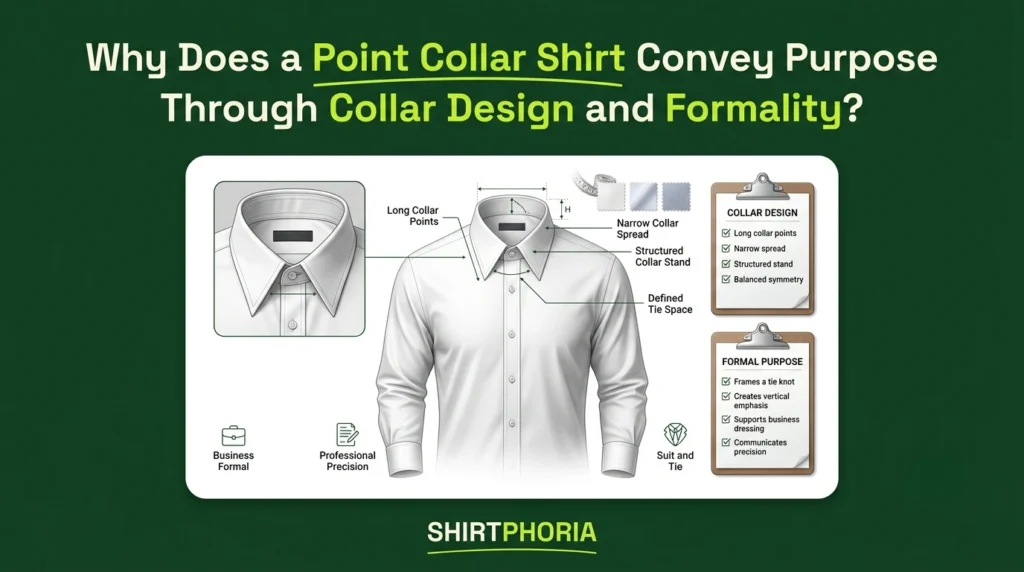
The anatomy and form of a point collar shirt are defined by closer collar points, a narrower collar opening, and a shape that usually leaves less room for bulky tie knots than a spread collar.
The collar leaf creates the visible points, while tie space determines how much room remains around the knot. Interlining, fabric, pressing, collar stays, and shirt construction influence whether the points remain neat or begin to curl and collapse.
How Narrow Spread and Tie Space Define a Point Collar Shirt
Narrow spread and tie space define a point collar shirt because the collar points sit closer together than they do on a spread collar.
A point collar commonly pairs with smaller tie knots such as the Four-in-Hand because its opening provides less visual room than a spread collar. The shirt collar styles guide explains the point collar’s smaller spread, tie-knot compatibility, collar stays, and comparison with wider collar styles.
A narrower opening leaves less visible space around the knot. A smaller knot often looks cleaner because it fits the collar frame without forcing the points outward.
Tie space should be evaluated while the top button is closed and the intended tie is knotted. The collar should frame the knot without gaping, bowing outward, or hiding most of the knot beneath the points.
How Collar Stays and Interlining Can Support a Point Collar
Collar stays and interlining can support a point collar by helping the collar points remain neat, but their effect depends on the shirt’s construction and fabric.
Interlining is an internal layer placed between the outer collar fabrics. It can influence whether the collar feels soft, flexible, crisp, or firm.
Collar stays are narrow inserts positioned inside some collar points. They can help the points remain straighter and reduce unwanted curling, although not every point collar includes removable or built-in stays.
| Component | Controlled Characteristic | Practical Result |
|---|---|---|
| Collar Points | Sit closer together than a spread collar | Creates a narrower collar opening |
| Tie Space | Usually smaller than a spread collar | Works more naturally with smaller tie knots |
| Collar Leaf | Can be soft or firm depending on construction | Affects how cleanly the collar lies under a jacket |
| Collar Stays | Optional or built-in depending on design | Can help keep collar points neat |
| Interlining | Varies by thickness and construction | Can affect stiffness and shape retention |
The Point Collar is a standard configuration within dress shirt collar configurations.
How Does a Point Collar Shirt Work With Ties and Formality Standards?
A point collar shirt works with ties and formality standards by creating a narrower frame that often suits smaller knots and traditional business outfits.
The collar commonly appears with business suits, professional shirts, and restrained ties. Its narrower spread can provide a clean central line, but the correct combination depends on knot size, tie thickness, jacket lapels, shirt fabric, and wearer proportions.
Matching the Point Collar Shirt With Business Suits
A point collar shirt often works well with business suits because its narrower collar opening creates a restrained frame for a tie.
The tie knot should not overpower the opening. A compact knot usually preserves visible space between the knot and collar points, while an oversized knot may force the collar outward.
Fabric affects the result. Smooth poplin, broadcloth, or fine twill can create a dressier appearance, while a textured fabric may make the point collar feel more relaxed.
Pairing the Point Collar Shirt With the Four-in-Hand Knot
The Four-in-Hand knot often pairs well with a point collar shirt because it creates a smaller, slightly asymmetrical knot that fits a narrower collar opening.
Other compact knots can also work, but the Four-in-Hand is a common and reliable starting point for a point collar.
A Pratt or Shelby knot may work when its size remains controlled. A Half Windsor can also fit some point collars when the opening is not especially narrow and the tie fabric is not too thick.
| Tie Knot | Common Use Context | Fit Logic |
|---|---|---|
| Four-in-Hand | Daily office, business suit, traditional dress-shirt styling | Smaller knot usually fits the narrower opening cleanly |
| Pratt / Shelby | Client meetings, professional outfits, moderate openings | Can work when the knot size stays controlled |
| Half Windsor | Dressier business settings with enough collar room | May work if the point collar is not too narrow |
| Full Windsor | Better suited to wider collar openings | May feel crowded in many point collars |
| No Tie | Smart casual, travel, relaxed business settings | Works best when the collar sits neatly open |
How Does the Point Collar Shirt Compare to the Spread Collar Shirt?
The point collar shirt compares to the spread collar shirt by narrowing the collar opening, while the spread collar opens the collar points outward for a broader frame.
Both collars can work in professional and dressier settings. The key difference is how they frame the face and tie knot.
How Vertical and Horizontal Emphasis Differ
Vertical and horizontal emphasis differ because the point collar usually creates a narrower visual line, while the spread collar usually creates a wider visual frame.
The point collar can lengthen the visual line around the face because the points direct the eye downward. The spread collar can widen the visual frame around the tie knot because the points extend farther apart.
How Tie Knot Compatibility Changes Between Point and Spread Collars
The narrow appearance of the Point Collar contrasts with the next common style, detailed in spread collar shirts.
Point collars often work better with compact knots because the collar points leave a narrower opening. Spread collars usually provide more visual room for wider knots.
A very small knot can create the opposite problem in a wide spread collar. Too much empty space may make the knot look undersized.
How Should You Choose a Point Collar Shirt Based on Face Shape?
You should choose a point collar shirt based on face shape by treating collar spread as a visual balancing tool rather than a fixed rule.
A narrower or more pointed collar may help create balance for a wider face, while a narrow or long face may benefit from more spread. These are styling guidelines rather than universal requirements, as explained in the shirt collars and face shape guide.
Step 1: Identify Your General Face Width
Look in a mirror and decide whether your face appears generally wider, narrower, or balanced. The goal is to identify the broad visual impression rather than classify every feature precisely.
Step 2: Use Opposite Visual Balance
If your face appears wider or rounder, a point collar may help by adding a narrower vertical line. If your face appears long or narrow, a wider collar spread may balance the face more effectively.
Step 3: Check Neck Length and Collar Height
A point collar can look different depending on neck length and collar height. A taller collar may suit a longer neck, while a lower collar may feel easier on a shorter neck.
Step 4: Test the Shirt With a Tie and Jacket
Face-shape guidance is incomplete without the full outfit. Test the point collar with the intended tie knot, jacket lapel, and shirt fabric before deciding.
| Face Type | Point Collar Suitability | Controlled Design Reason |
|---|---|---|
| Round / Wide | Often useful | Closer points can add a narrower visual line |
| Oval / Balanced | Usually flexible | Many collar shapes can work depending on outfit |
| Narrow / Long | Use carefully | A very narrow collar may make the face look longer |
| Short Neck | Check collar height carefully | Tall collars may feel crowded |
| Long Neck | Check collar height and spread | Higher collars and balanced spread may help proportion |
How Does the Point Collar Shirt Compare to Other Shirt Collar Styles?
The point collar shirt compares to other shirt collar styles through collar opening, tie-knot space, formality signal, and visual effect.
| Feature | Point Collar Shirt | Spread Collar Shirt | Button-Down Collar |
|---|---|---|---|
| Collar Opening | Narrower | Wider | Variable, usually softer |
| Common Tie Knot Fit | Four-in-Hand or other compact knots | Half Windsor, Full Windsor, or wider knots | No tie or smaller casual tie knots |
| Common Formality Signal | Traditional professional | Dressy or modern professional | Casual, Ivy-informed, or smart casual |
| Visual Effect | More vertical | More horizontal | Softer and more relaxed |
| Key Fit Risk | Bulky knots may crowd the opening | Small knots may look undersized | May feel too casual for stricter formal settings |
Key Takeaways: Mastering the Functionality of the Point Collar Shirt
Mastering the functionality of the point collar shirt requires understanding collar opening, tie-knot scale, face-shape balance, and construction support.
The Point Collar Protocol
Before buying, button the collar and test the intended tie knot. The knot should sit cleanly without forcing the collar points outward.
Place a jacket over the shirt to check whether the points remain controlled beneath the lapels. Test the shirt without a tie when open-neck wear matters.
Final Decision Tree: Should You Wear a Point Collar Shirt Today?
Are You Wearing a Conservative Business Suit and Tie?
A point collar shirt is a strong option. Its narrower opening often works well with traditional business styling and compact tie knots.
Do You Want a More Vertical Face-Framing Effect?
A point collar shirt may help. Its closer collar points can create a narrower visual line, which may suit wider or rounder faces.
Are You Planning to Wear a Large Full Windsor Knot?
A point collar may not be the easiest choice. Large knots often need more space, so a spread collar may feel more balanced.
Are You Wearing the Shirt Without a Tie?
A point collar can work without a tie if the collar sits neatly. Check whether the points collapse, curl, or spread awkwardly.
Are You Unsure Between Point and Spread Collars?
Choose the point collar for a narrower, more traditional look. Choose the spread collar when you want a broader frame or more room for a larger knot.