What Should You Consider When Choosing a V-Neck Shirt for Fit and Neckline Design?
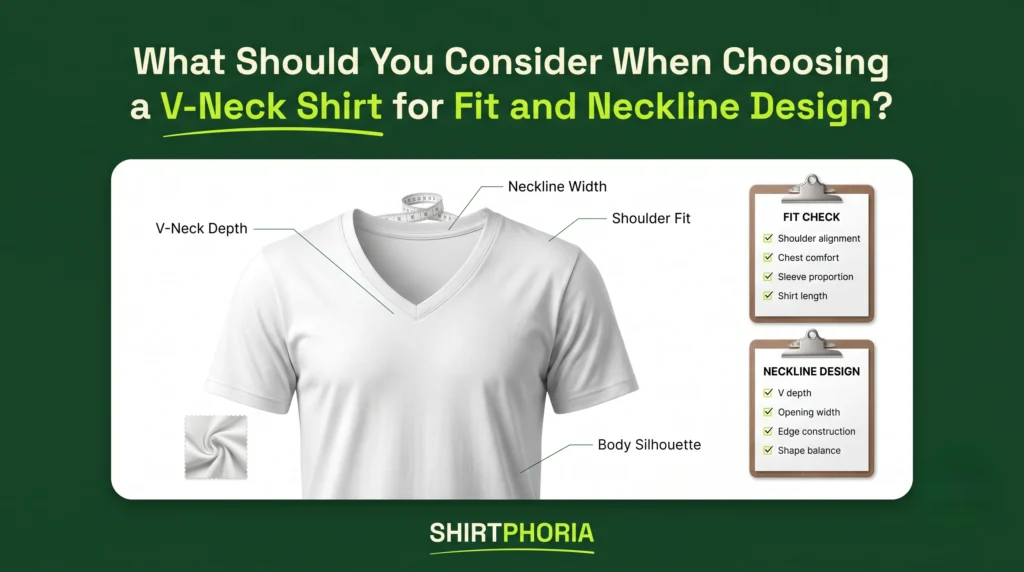
Choosing the right V-neck shirt requires evaluating both the neckline design, especially the depth, width, and apex placement of the V, and the foundational fit of the shirt, including shoulder seam alignment, torso drape, and fabric behavior.
A V-neck can look balanced, sharp, and easy to wear when its neckline depth works with the wearer’s proportions and outfit. The same shirt can feel too revealing, too narrow, or poorly structured when the Neckline Apex sits too low, the shoulders pull, or the fabric cannot support the neckline edge.
The V-neck differs from a round neckline because it introduces two diagonal lines that meet below the Collarbone Line. This downward shape can visually open the neckline, frame the face, and create a longer visual path through the upper torso. These are styling effects rather than guaranteed changes to physical proportions.
Lines can guide visual attention through a composition. Adobe’s guide to leading lines explains how line direction can direct attention toward specific areas of an image. Applied carefully to clothing, this principle helps explain why the diagonal lines of a V-neck may direct attention downward without proving that the neckline physically lengthens the neck or body.
This guide moves beyond basic size labels by evaluating V-neck selection in three stages: neckline design, physical fit, and functional suitability.
It explains:
- ✅ How neckline depth changes exposure and styling context.
- ✅ How to judge the V-neck apex.
- ✅ How to check whether shoulder seams support the neckline.
- ✅ How to separate Fabric Drape from Torso Cling.
- ✅ How ribbing quality affects the V-neck edge.
- ✅ When undergarments make a V-neck impractical.
- ✅ When to consider Scoop Neck shirts instead.
Now that the core design variables are clear, the next step is checking whether the physical fit supports the neckline’s visual effect.
Why Strategic V-Neck Shirt Selection Matters for Versatility
Strategic V-neck shirt selection matters because small differences in neckline depth, apex position, width, and construction can change how the shirt performs across casual, layered, and more polished outfits.
A V-neck should not be judged by depth alone. Its neckline must also relate to shoulder width, chest coverage, fabric behavior, outer layers, undergarments, and the wearer’s comfort level.
How Neckline Depth Affects Formality, Exposure, and Frame
Neckline depth influences a V-neck shirt’s perceived formality, exposure level, and visual frame because the apex position controls how much open space appears below the collarbone.
A shallow V usually creates a restrained opening that can work as a casual basic, a discreet base layer, or part of a smart-casual outfit. It introduces the V shape without exposing a large area of the upper chest.
A standard V creates a clearer downward line and more visible space around the collarbone. It often works well as a standalone casual shirt when the apex remains controlled and the fabric lies flat.
A deep or plunge V exposes more of the chest and creates a stronger fashion statement. It can suit warm-weather outfits or expressive styling, but it may feel less appropriate in conservative settings.
| Depth Level | Apex Position | Ideal Use Case | Visual Effect |
|---|---|---|---|
| Shallow V | Just below the collarbone | Layering, smart-casual outfits, conservative casual settings | Subtle neckline opening and discreet frame |
| Standard V | Upper to mid-chest, depending on the brand and body proportions | Everyday wear, standalone styling, and casual outfits | Clearer vertical line and classic V-neck effect |
| Deep V or Plunge V | Lower chest or below the pectoral line, depending on the design | Statement styling, fashion-forward outfits, and warm-weather casual looks | Strong exposure, bold visual frame, and higher styling risk |
The deeper the V-neck, the more important undergarment visibility, chest coverage, and styling context become.
A deep neckline is not automatically more flattering than a shallow one. The most suitable depth is the one that gives the desired openness without producing unwanted exposure, movement problems, or conflict with the setting.
Understanding the V-Neck as a Design Variation
Understanding the V-neck as a design variation shows how changing one structural element, the neckline shape, can alter the shirt’s visual direction, exposure level, and styling purpose.
A V-neck is not automatically better than a crewneck or Scoop Neck. Each neckline creates a different relationship between the face, neck, collarbone, chest, and clothing.
The V-neck may be useful when the wearer wants:
- More visible space around the collarbone.
- A less enclosed neckline.
- A downward visual line.
- A shirt that can sit beneath an open jacket or cardigan.
- A neckline that frames a necklace or pendant.
- A visual opening effect around the upper torso.
The diagonal lines of the V can produce Perceived Visual Elongation, meaning the neckline may appear more vertically oriented. This remains a styling heuristic because the final result depends on depth, width, shoulder fit, chest proportions, color contrast, and garment construction.
A shallow, wide V creates a different effect from a deep, narrow V. The former may emphasize collarbone width and openness, while the latter may create a longer and more dramatic central line.
Before comparing neckline depth and apex placement, readers should understand how broader T-shirts function as fit, styling, and wardrobe basics.
Key Design Factors When Choosing the V-Neck Shirt Neckline
The most important V-neck design factors are the position of the Neckline Apex, the width of the opening, the relationship to the Collarbone Line, and the stability of the neckline edge.
These attributes should be assessed together. An appropriate apex can still fail when the opening is too wide, the edge curls, or the ribbing pulls the neckline out of shape.
Assessing the V-Neckline Apex for Body Flattery
Assessing the V-neckline apex requires evaluating how the V point sits in relation to the collarbone line, upper chest, neck length, chest coverage, and personal comfort.
The Neckline Apex is the lowest point where the two sides of the V meet. Its position influences how open, modest, casual, or bold the shirt appears.
The apex should remain centred when the wearer stands, sits, turns, and raises the arms. If it shifts sideways, pulls open, or collapses, the issue may involve shoulder fit, fabric weakness, neckline construction, or torso tightness.
Apex Rules for Scannability
- Height: Shorter individuals may prefer a moderate or slightly higher apex if a very deep V makes the torso feel visually interrupted or creates more exposure than intended.
- Chest size: Larger chests may feel more balanced in a wider and shallower V that provides coverage without completely closing the neckline.
- Neck length: Shorter necks may benefit from a moderate V that opens space below the chin, but a very deep V may feel too revealing or visually unbalanced.
- Modesty need: If the apex exposes more chest than the wearer wants, the neckline is functionally unsuitable even when the shirt fits elsewhere.
- Layering need: When the V-neck is worn beneath a jacket, cardigan, or overshirt, the apex should remain visible enough to maintain the intended shape without revealing undergarments.
These are selection heuristics rather than universal rules. The mirror result, movement test, comfort level, and outfit context should determine whether a particular apex works.
The width of the V also matters. A narrow V may create a sharp, concentrated line down the centre of the chest, while a wider V may expose more of the collarbone and produce a softer frame.
A neckline that is both extremely wide and deep can become unstable. It may slide, reveal undergarments, or lose contact with the upper chest during movement.
The Importance of V-Neckline Edge and Ribbing
V-neckline edge quality matters because the ribbing or binding around the V shape can help the neckline lie flat, recover after wear, and reduce curling or collapse at the apex.
Knitted fabrics derive flexibility from interlocking yarn loops. CottonWorks’ guide to knit basics explains how knit construction influences stretch, recovery, stability, and fabric behavior. These properties help determine whether a V-neck edge remains controlled or becomes distorted during wear.
The neckline edge may be finished with Rib Knit, binding, self-fabric, or another knitted trim. Its quality should be judged by performance rather than visible thickness alone.
Ribbing Gauge refers to the density or fineness of the knitted structure, but it should not be confused automatically with collar thickness. Neckline bulk can also come from yarn thickness, rib height, fabric layers, seam allowance, and edge construction.
Thick, raised, or bulky ribbing can distract from the clean V shape. Ribbing quality should be judged by how flat it lies, how smoothly it follows the neckline, and whether the edge recovers after wear.
The main failure conditions are:
Too flimsy: The neckline may ripple, curl, stretch, or lose definition around the apex.
Too bulky: The edge may look heavy, sit above the chest, or compete visually with the shape of the V.
Balanced: The neckline lies flat, follows both diagonal sides smoothly, maintains a clean apex, and recovers after gentle stretching.
Edge Stability describes the neckline’s ability to retain its shape without curling, widening, twisting, or collapsing. It depends on the ribbing, binding, seam construction, knit structure, fabric weight, and laundering.
Inspect the apex carefully before purchase. Poor stitching or excess material at the V point may create a small bump, pucker, or fold that becomes more noticeable during wear.
Gently stretch one side of the neckline and release it. The edge should return close to its original position without remaining wavy or distorted.
How to Choose the V-Neck Shirt Fit Based on Body Type
A V-neck’s physical fit should support its neckline design. Shoulder placement, chest ease, torso allowance, sleeve shape, and fabric drape all influence whether the V remains centred and controlled.
Body type should be treated as a compatibility factor rather than a defect. The goal is to identify which neckline and fit characteristics work comfortably with the wearer’s proportions.
Checking Shoulder Seam Alignment for the V-Neck
Checking shoulder seam alignment helps determine whether the V-neck shirt has enough structure to frame the upper body cleanly.
For most standard V-neck fits, the Shoulder Seam usually works best when it sits near the outer shoulder point, close to the Acromion Process. SANVT’s T-shirt fit guidance uses the shoulder-bone area as a practical reference for assessing conventional T-shirt shoulder placement.
The Acromion Process is the bony outer point of the shoulder. It provides a useful reference, but the seam does not need to land on one mathematically exact point for every wearer or design.
Posture, shoulder slope, muscle development, body proportions, pattern shape, and intended fit can all change where a balanced seam appears.
Shoulder Fit Quick Check
- Too loose: The seam droops past the shoulder joint and may make the upper body look slouched. The neckline can also shift or sit wider than intended.
- Too tight: The seam pulls inward toward the neck and may distort the upper chest, sleeves, and V-neck shape.
- Balanced: The seam sits near the outer shoulder point and allows the V-neck to lie flat without pulling or twisting.
Shoulder tension can distort the apex even when the neckline itself is well constructed. If the shoulders are too narrow, the fabric may pull the V outward and create rippling across the upper chest.
Excess shoulder width can also reduce control. The garment may slide, allowing the apex to move away from the centre of the chest.
Relaxed, oversized, or dropped-shoulder V-necks may intentionally place the seam lower, so judge those designs by overall balance rather than standard shoulder placement alone.
An intentional dropped-shoulder shirt should maintain a centred neckline, proportional sleeve volume, controlled body width, and suitable fabric structure. Simply buying a standard V-neck several sizes larger may not produce the same balance.
Analyzing Fabric Drape and Torso Cling in a V-Neck
Analyzing fabric drape in a V-neck requires checking whether the material hangs smoothly across the torso without pulling, clinging, or collapsing around the neckline.
Fabric Drape describes how the material falls from the shoulders and chest under its own weight. It is affected by fiber content, knit structure, yarn, fabric weight, finish, cut, and body movement.
Torso Cling occurs when the fabric stretches closely across the chest, abdomen, or sides. Some cling may be intentional in a fitted shirt, but excessive tension can interrupt the clean visual line created by the V-neck.
Drape vs. Cling
- Drape: The fabric falls smoothly from the shoulders and chest without obvious tension lines.
- Cling: The fabric stretches tightly across the chest or stomach and may interrupt the clean vertical line created by the V.
- Collapse: The fabric is too weak or thin to support the neckline edge, causing curling, rippling, or distortion.
- Balanced: The fabric has enough softness for comfort and enough structure to maintain a clean V-neck shape.
A fabric can be soft without having controlled drape. A very light knit may feel comfortable but collapse around the apex or reveal the outline of the torso more than intended.
A heavier fabric may provide Edge Stability but feel stiff or bulky. The best balance depends on whether the shirt is intended for standalone wear, warm-weather use, or layering.
Check for horizontal pull lines across the chest and abdomen. These lines usually indicate insufficient torso ease, excessive stretch, or a fabric that is clinging to the body.
Vertical folds near the sides may indicate excess width. Some loose drape can be intentional, but uncontrolled volume may weaken the neckline’s clean shape.
Raise both arms, sit down, and turn sideways. If the V-neck pulls open, twists, or clings sharply, the fabric or fit may not suit the intended use.
The neckline should also return to its original position after movement. If the V widens permanently or one side remains lower, the shirt may lack sufficient recovery or structural balance.
Disclaimer
This article provides general fit and styling guidance. Always prioritize personal comfort, garment measurements, movement, and the requirements of the setting.
When to Consider Alternatives During V-Neck Shirt Selection
A V-neck may fit correctly and still be impractical for a particular outfit, dress code, layering need, or personal comfort preference.
Functional requirements should take priority over the idea that one neckline is universally flattering.
Assessing V-Neck Suitability Based on Undergarment Needs
A V-neck becomes less suitable when its depth exposes undergarments, conflicts with dress-code expectations, or creates more neckline exposure than the wearer wants.
Undergarment Compatibility means the neckline works with the undershirt, bra, camisole, or base layer worn beneath it. Compatibility should be checked while standing and moving because an undergarment that remains hidden initially may become visible when the wearer bends or reaches.
Use these practical checks:
- If an undershirt shows unintentionally, choose a shallower V or a lower-cut undershirt.
- If a bra or camisole becomes visible at the neckline, choose a wider-coverage undergarment or a more controlled V.
- If the neckline feels too exposed for the setting, choose a shallower V or a different neckline.
- If the V-neck collapses or pulls open during movement, choose a more stable edge construction or different fabric.
- If the V shape feels too sharp for the wearer’s style, consider a softer neckline alternative.
The colour of the undergarment also matters. A highly contrasting undershirt can become noticeable even when only a small section is exposed.
A visible undergarment can be intentional, but it should look planned. The neckline, colour, and fabric layers should support one another rather than appearing accidentally mismatched.
A V-neck used beneath a buttoned shirt should generally remain hidden unless the styling deliberately exposes it. A shallow undershirt neckline may appear above the open buttons and interfere with the outer shirt’s lines.
Identifying the Next Flattering Casual Neckline Option
A softer casual neckline may work better when a V-neck feels too deep, too sharp, too revealing, or too difficult to layer with undergarments.
A Scoop Neck creates a rounded opening that usually sits lower and wider than a classic crewneck. It can provide more neckline openness than a high round collar while avoiding the sharp diagonal point of a V-neck.
This may suit someone who wants visible collarbone space without a pronounced central apex. The effect depends on the depth and width of the scoop, fabric behavior, shoulder fit, and personal preference.
A shallow scoop can appear subtle and casual. A wider or deeper scoop can create more exposure and may face the same undergarment challenges as a deep V-neck.
Neither option is universally superior. The choice depends on whether the wearer prefers an angular frame, a rounded opening, stronger chest coverage, or easier layering.
If a V-neck feels too sharp, too low, or too revealing, the next casual neckline to evaluate is scoop neck shirts.
Final V-Neck Shirt Selection Checklist
A V-neck shirt selection checklist helps verify whether the neckline design, physical fit, fabric behavior, and functional requirements work together.
This checklist is a practical selection heuristic rather than a guarantee of flattery. The final decision should account for comfort, movement, garment construction, body proportions, and outfit context.
| Selection Criteria | Checkpoint Status | Purpose |
|---|---|---|
| Shoulder Fit | Seam sits near the outer shoulder point for standard fits | Maintains upper-body structure |
| Neckline Apex | Apex provides enough openness without unwanted exposure | Balances visual line, modesty, and comfort |
| Neckline Width | V shape frames the collarbone without gaping sideways | Keeps the neckline controlled |
| Fabric Drape | Fabric hangs smoothly and does not cling sharply | Supports a clean silhouette |
| Ribbing Quality | Ribbing or binding lies flat and recovers after gentle stretching | Helps reduce curling, buckling, or edge distortion |
| Undergarment Compatibility | Undershirt or bra remains hidden unless intentionally styled | Keeps the outfit functional |
| Styling Context | Depth matches the occasion and personal comfort level | Prevents the shirt from feeling too revealing or too casual |
If most checkpoints pass, the V-neck is likely working for the wearer’s proportions and outfit context. If the apex feels too low, the shoulder seam pulls, the fabric clings, or undergarments show unintentionally, adjust the neckline depth, fit, fabric, or shirt type before choosing the final garment.
A useful final fitting sequence is:
- Check the shoulder seams while standing naturally.
- Confirm that the V apex remains centred.
- Examine whether the neckline lies flat on both sides.
- Check the amount of chest exposure.
- Look for torso tension or uncontrolled folds.
- Raise the arms and sit down.
- Confirm that undergarments remain hidden.
- View the shirt with the outer layers intended for the outfit.
The right V-neck should continue to function after movement. A shirt that only looks controlled while the wearer remains completely still may not be suitable for everyday use.
Final Interactive V-Neck Selection Checklist
Use this checklist to confirm that the neckline design, fit, fabric, and styling context work together.