How Can Scoop Neck Shirts Be Matched to Different Body Types and Personal Styling Goals?
In this guide, you will learn:
- How scoop neck depth affects visible neckline space.
- How scoop neck width can influence upper-body visual width.
- How fabric drape changes the garment’s structure or softness.
- How to choose scoop necks for layering, casual outfits, and polished looks.
- How to pair scoop necks with necklaces and outer layers.
- How to use the final checklist before building the outfit.
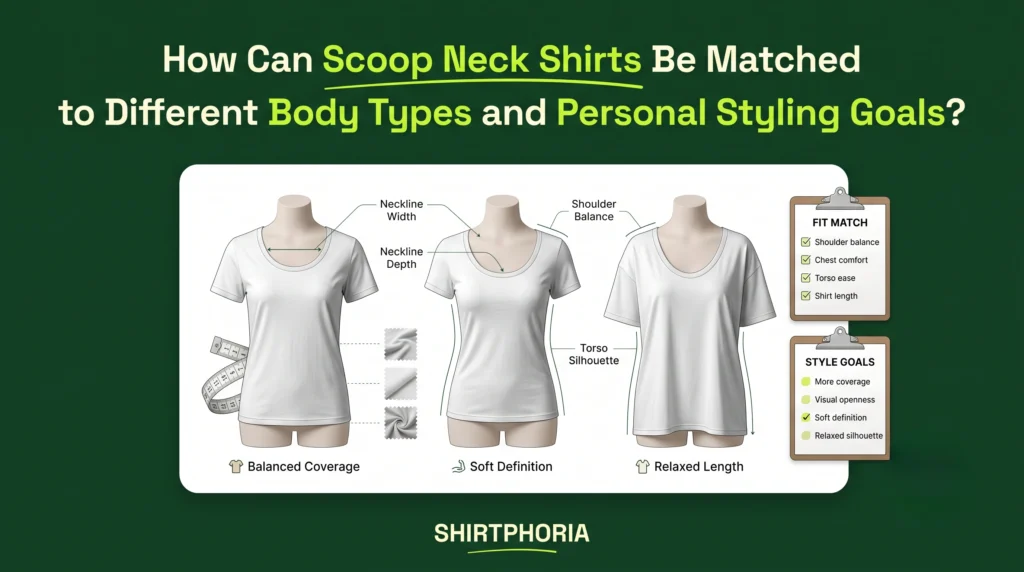
A scoop neck shirt can be matched to different styling goals by adjusting neckline depth, neckline width, fabric drape, fit, and layering context.
Scoop neck shirts are often treated as simple wardrobe basics, but small changes in their rounded neckline shape can noticeably influence how an outfit reads. A wide, shallow scoop creates a different collarbone line from a narrow, deeper scoop. A structured knit also behaves differently from a relaxed jersey, even when both shirts use a similar neckline.
A scoop neck is a rounded, usually lower neckline that creates visible space around or below the collarbone. This open shape distinguishes it from a standard crew neck, which normally sits closer to the base of the neck. The exact level of openness depends on the neckline depth and width rather than the garment name alone. Collins Dictionary defines a scoop neck as a rounded, usually low neckline.
The scoop neckline does not physically change body proportions. It can, however, influence how the neckline, upper body, and overall outfit proportions are perceived. The effect depends on comfort, coverage, fabric behavior, shirt fit, sleeve design, accessories, and the surrounding outfit.
This guide first explains how scoop neck depth, width, and visible neckline space affect styling. It then shows how to match those variables to personal styling goals, fabric behavior, layering needs, body-proportion preferences, and accessory choices.
Why the Scoop Neck Shirt Works as a Visual Styling Tool
The scoop neck works as a visual styling tool because its rounded opening creates adjustable space around the neck, collarbone, and upper chest.
Unlike a crew neck, which generally forms a compact circular boundary near the neck, a scoop neckline can vary substantially in width and depth. These variations affect whether the neckline appears open, contained, horizontal, vertical, structured, or relaxed.
The scoop neckline should not be evaluated in isolation. Shoulder seam placement, sleeve shape, fabric stretch, torso fit, shirt length, and outer layers all contribute to the final outfit effect.
How Scoop Neck Shirt Depth Influences Perceived Vertical Line
Scoop neck shirt depth can influence perceived vertical line because a lower rounded neckline creates more visible space below the collarbone.
A deeper scoop may create a more open upper neckline and a stronger perceived downward visual path. This effect becomes more noticeable when the neckline is longer than it is wide, especially when the shirt uses a clean edge finish and minimal decoration.
Lower Rounded Neckline → Creates More Visible Neckline Space → May Strengthen Perceived Vertical Line
Visible neckline space refers to the open area created between the garment edge and the neck or upper chest. In styling terms, this area functions as negative space because it surrounds the shirt, skin, jewelry, and outerwear rather than acting as a separate garment detail.
Negative space is a general visual-composition concept rather than proof that a neckline changes body measurements. Adobe’s composition guidance explains that negative space can contribute to balance and influence how visual elements relate to one another. Applied to clothing, the open area around a scoop neckline may affect where attention settles and how the upper portion of the outfit is perceived.
A moderately deep scoop can therefore make the neckline appear more open without requiring an extreme cut. The result depends on the curve of the neckline, the amount of visible space, the fabric’s stability, and whether jewelry or an outer layer interrupts the vertical path.
A very shallow scoop may feel visually closer to a crew neck. A very deep scoop may create more exposure than the wearer wants or may reveal an undershirt, bra, camisole, or base layer. The appropriate depth depends on coverage, comfort, setting, and personal preference.
How Scoop Neck Width Influences Upper-Body Visual Width
Scoop neck width can influence upper-body visual width by changing how much horizontal space appears across the collarbone and shoulder area.
A wider scoop extends farther toward the shoulders and may create more horizontal emphasis across the collarbone. This can make the upper part of an outfit feel more open when that is the intended styling goal.
Wider Rounded Neckline → Adds Collarbone-Level Visual Space → May Support Horizontal Balance
A narrower scoop keeps the opening closer to the center of the body. It may feel more contained and can preserve a stronger downward visual direction when combined with moderate neckline depth.
Width and depth must be considered together. A neckline can be wide and shallow, deep and narrow, or balanced between both dimensions. Each combination creates a different visual frame:
- A wide, shallow scoop emphasizes collarbone-level space.
- A narrow, deeper scoop creates a stronger downward path.
- A medium scoop balances horizontal and vertical openness.
- A very wide, deep scoop creates substantial openness and may require more careful coverage planning.
Neckline width also works with sleeve shape and shoulder construction. A wide scoop paired with cap sleeves may emphasize the shoulder area differently from the same neckline paired with long, relaxed sleeves. Dropped shoulders, raglan sleeves, fitted sleeves, and structured outerwear can all change the final impression.
How Fabric Weight and Drape Affect the Scoop Neck Shirt’s Silhouette
Fabric weight and drape affect a scoop neck shirt’s silhouette by changing how closely the garment follows the body or falls away from it.
Fabric drape describes how a material falls and behaves when worn. Some fabrics appear firm and structured, while others form softer folds and move more fluidly. Two shirts made from the same pattern can therefore look different when produced from fabrics with different levels of drape.
Cartem’s fabric-drape guide explains that drape can range from stiff and structured to soft and flowing. It also notes that weight can offer clues about fabric behavior, but weight alone does not determine drape because some lightweight fabrics remain crisp while certain heavier fabrics fall fluidly.
Fitted or Structured Knit: A structured knit can create a cleaner layering base and a more defined garment shape when the shirt fits comfortably. Fabric recovery can help the neckline return to shape after dressing and movement.
Loose or Draping Jersey: A softer jersey may create a more relaxed and fluid appearance. It may fall closer to the body in some areas while creating gentle folds in others.
Fabric choice determines whether the scoop neck reads as a clean base layer or a softer relaxed piece, but the final effect depends on fit, fabric recovery, body movement, and outfit context.
Fabric weight should not be treated as a guaranteed predictor. A lightweight knit can be stable, while a heavier knit can still drape softly. The neckline finish, stretch direction, fiber content, recovery, and garment cut also influence whether the scoop maintains its shape or stretches during wear.
Matching the Scoop Neck Shirt to Styling Goals and Body-Proportion Preferences
The following recommendations are styling heuristics, not fixed body-type rules. The best scoop neck cut depends on comfort, coverage, fabric, fit, layering, and personal preference.
| Styling Goal | Recommended Scoop Neck Direction | Why It May Work |
|---|---|---|
| Add Upper-Body Openness | Wider or shallower scoop | May create more visible space across the collarbone |
| Support a Longer Perceived Upper Line | Moderately deeper scoop | May create a stronger visual path below the neckline |
| Create a Softer Shoulder Line | Relaxed fit with softer drape | May reduce sharpness around the shoulder area |
| Create a Cleaner Base Layer | Structured or fitted knit | May sit more smoothly under jackets, cardigans, or overshirts |
| Highlight Accessories | Medium scoop with clear collarbone space | May frame pendants, chokers, or statement necklaces |
Body-shape terms can help readers describe their styling goals, but they should not operate as rigid rules. Two people who use the same body-shape label may prefer completely different neckline widths, depths, fabrics, and fits.
How to Style Scoop Neck Shirts When You Want More Upper-Body Balance
A wider or shallower scoop neck can support upper-body balance by creating more visible space across the collarbone line.
Readers who want more visual openness across the upper body may prefer a scoop that is wider than it is deep. The rounded edge guides attention across the collarbone rather than concentrating the entire visual path near the center of the torso.
This does not mean the neckline physically broadens the shoulders. It simply adds horizontal visual space near the collarbone. The effect may become stronger when the shirt also includes lighter colors, short sleeves, shoulder details, or accessories positioned near the neckline.
Readers who describe their proportions as pear-shaped or narrower through the shoulders may use this as one possible styling option, but it is not a rule.
A wide scoop should still sit securely. Check whether the neckline slides toward the shoulder, reveals undergarment straps, or stretches during movement. A shirt that appears balanced while standing may shift when sitting, bending, or raising the arms.
How to Use Scoop Neck Shirts When You Want a Longer Perceived Upper Line
A moderately deeper scoop neck can support a longer perceived upper line by creating more visible space below the collarbone.
The rounded opening can guide attention downward when the neckline has more depth than width. This is a visual styling effect, not a change to torso length.
The most practical depth should be selected according to:
- Personal comfort
- Desired coverage
- Workplace or event expectations
- Undershirt or bra visibility
- Outer-layer compatibility
- Jewelry placement
- Fabric stability
Very shallow necklines may feel more closed around the upper chest, while very deep scoop necks may feel too exposed or difficult to layer in some settings.
Readers searching for short-torso or petite styling may consider a moderately deeper scoop when they want a more open vertical line, but the best depth is not universal.
A medium-depth scoop often provides greater versatility than an extreme neckline. It can create visible neckline space while remaining suitable for casual outfits, layered looks, and settings where more coverage is preferred.
How to Use Scoop Neck Shirts When You Want a Softer Shoulder Line
A relaxed scoop neck with softer drape can create a less structured shoulder line when the wearer wants a softer outfit effect.
A tight, wide scoop may place more emphasis on the shoulder area because the neckline follows a strong horizontal path. A softer knit, narrower edge finish, or relaxed torso fit may reduce that visual sharpness and allow the garment to fall more fluidly.
Readers who describe their proportions as broad-shouldered or inverted triangle may use relaxed drape as one styling option, not a requirement.
The sleeve design matters as much as the neckline. A fitted cap sleeve may create a different shoulder effect from a relaxed long sleeve, dropped shoulder, or raglan sleeve. Testing the complete shirt is therefore more reliable than choosing based on neckline shape alone.
Before choosing a scoop neck cut, readers should understand how broader T-shirts fit, styling versatility, and use-case adaptation affect shirt selection.
How to Align Scoop Neck Shirts with Specific Personal Styling Goals
A scoop neck becomes easier to style when the neckline supports a clearly defined outfit purpose.
The same shirt may work as a casual standalone piece, a layering base, or part of a polished outfit. Its success depends on whether the neckline depth, fabric quality, torso fit, and surrounding garments communicate the same styling direction.
How to Style Scoop Neck Shirts for Minimalist Layered Outfits
Scoop neck shirts can work well in minimalist layered outfits when the neckline creates a clean frame beneath structured outer layers.
The scoop should support the outer layer rather than compete with it. A medium-depth neckline often works more easily than an extremely deep scoop under blazers, cardigans, overshirts, or lightweight jackets.
A structured or fitted knit may create a smooth layering base because it reduces excess fabric around the torso. The neckline should remain flat rather than rolling, stretching, or bunching beneath the outer garment.
For example, pair a gray fitted scoop neck with a black tailored blazer and slim dark jeans for a clean minimalist outfit.
This combination can read cleaner or more polished when the shirt fabric is opaque, the neckline sits evenly, and the color palette remains controlled. A stretched neckline, transparent fabric, or excessive bunching may make the same outfit appear less intentional.
When testing a layered look, put on the complete outfit and move naturally. Check whether the scoop neckline stays centered, whether the outer layer pulls it downward, and whether the shoulder seams remain aligned.
How to Style Scoop Neck Shirts for Business Casual Outfits
A structured scoop neck shirt can work in business casual outfits when the neckline depth remains modest and the fabric looks polished.
The shirt can act as a polished base layer when the scoop is not too low and the material is not overly sheer, distressed, or clingy. A stable neckline finish and controlled torso fit usually support a cleaner appearance under structured pieces.
For business casual styling, the scoop neck should look intentional, modest enough for the setting, and clean enough to sit under structured pieces.
For business casual, pair structured trousers with a navy scoop neck shirt and a simple pendant necklace.
A blazer, cardigan, or tailored overshirt can provide additional neckline structure. The scoop neck then creates an open but controlled base beneath the outer layer.
Workplace expectations vary. A neckline that feels appropriate in a creative office may not suit a more conservative environment. Evaluate the shirt while sitting and moving because neckline exposure can change with posture.
How the Scoop Neck Shirt Creates a Base for Statement Accessories
The open, rounded space of a scoop neckline can create a useful frame for statement accessories.
The neckline often pairs naturally with pendants, chokers, short chains, and rounded statement necklaces because it leaves visible space near the collarbone. Jewelry can either repeat the neckline’s curve or introduce a contrasting vertical direction.
Choose shorter or rounded accessories when you want to echo the curve of the scoop, and choose longer pendants when you want to add a stronger vertical line.
A short necklace positioned above the neckline creates separation between the accessory and shirt. A necklace that falls inside the scoop can visually connect the jewelry to the garment opening. A long pendant may extend the downward visual path created by a deeper scoop.
Accessory scale should match the available neckline space. A small scoop may feel crowded by a large necklace, while a very wide opening may provide enough negative space for a bolder piece.
Outerwear also affects accessory visibility. A necklace that works with the scoop neck alone may become hidden or visually crowded when a jacket, scarf, or lapel is added.
Visual Comparison: Scoop Neck Fit vs. Styling Effect
Comparing scoop neck depth, width, and fabric fit shows which variation may support different styling goals.
The table below describes common styling effects, not guaranteed body-shape outcomes. Use it as a starting point, then adjust based on comfort, fabric, coverage, and outfit context.
| Scoop Neck Variant | Depth/Width | Useful Styling Goal | Possible Styling Effect |
|---|---|---|---|
| Deep and Narrow | More depth than width | Creating a stronger vertical neckline path | May make the neckline feel more open |
| Wide and Shallow | More width than depth | Adding collarbone-level openness | May create more horizontal emphasis across the upper body |
| Fitted Stretch Knit | Medium depth and controlled fit | Creating a clean base layer | May define the garment shape without adding much bulk |
| Relaxed Drape | Medium depth with softer fabric | Creating a softer casual look | May reduce structure and add fluidity |
| Medium Scoop | Balanced depth and width | Everyday styling and accessory pairing | May work across casual, layered, and polished outfits |
Specific results vary by body proportions, neckline depth, fabric recovery, sleeve shape, shirt length, and outfit styling.
A medium scoop is often the most adaptable starting point because it can provide collarbone space without becoming difficult to layer. However, versatility should not override personal preference. A wearer who prefers greater coverage may find a shallow scoop more practical, while another may prefer a deeper neckline for casual or accessory-focused outfits.
Actionable Summary: Your Final Scoop Neck Styling Checklist
Use this checklist while testing the full outfit. Your selections are saved automatically on this device.
Complete the outfit test through natural movement: raise your arms, sit down, add the intended outer layer, and inspect the neckline from several angles.
Frequently Asked Questions
A medium scoop with balanced depth and width is often the most adaptable starting point. It can provide visible collarbone space while remaining easier to layer than an extreme wide or deep neckline.
No. A scoop neck does not change body measurements. Its depth, width, fabric, and surrounding outfit can only influence how the neckline and upper-body proportions are visually perceived.
A modest medium-depth scoop made from a stable or fitted knit often layers cleanly under blazers, cardigans, overshirts, and jackets. The final choice should be tested with the actual outer layer.
Choose a structured knit when you want a cleaner base layer and a more defined garment shape. Choose a softer draping jersey when you want a more relaxed, fluid effect.
Short or rounded necklaces can echo the neckline curve, while longer pendants can add a stronger vertical direction. The accessory scale should fit the amount of visible neckline space.
Terms Explained
| TERM | DEFINITION |
|---|---|
| Scoop neck | A rounded neckline that usually sits lower and more open than a standard crew neck. |
| Neckline depth | The vertical distance that the neckline extends below the base of the neck. |
| Neckline width | The horizontal spread of the neckline toward the shoulder and collarbone area. |
| Visible neckline space | The open area between the garment edge and the neck, collarbone, or upper chest. |
| Negative space | Open visual space surrounding garment details, accessories, skin, and outerwear. |
| Fabric drape | The way a fabric falls, folds, and moves when worn. |
| Fabric recovery | A material’s ability to return toward its original shape after stretching. |
| Layering compatibility | How cleanly and comfortably a shirt works beneath another garment. |
Conclusion
The scoop neck shirt works best when its depth, width, fabric drape, and styling context support the same outfit goal.
The scoop neck is more than a basic layering piece. Its rounded neckline, visible collarbone space, fabric behavior, and fit can influence whether an outfit appears open, structured, soft, relaxed, or polished.
Use a moderately deeper scoop when you want more visible neckline space and a stronger perceived downward path. Choose a wider scoop when you want more collarbone-level openness or horizontal visual weight. Select structured knits for cleaner layering and more defined garment shape, while softer draping fabrics can support relaxed styling.
The final decision should account for comfort, coverage, movement, accessories, layering, and personal preference rather than relying on rigid body-type rules.
Mastering the scoop neck means choosing the neckline, fabric, and styling details that support your outfit goal without turning personal style into a body-correction rule.