How Do Shirt Types’ Fabric, Fit, Design, and Function Define Their Role Across Styles?
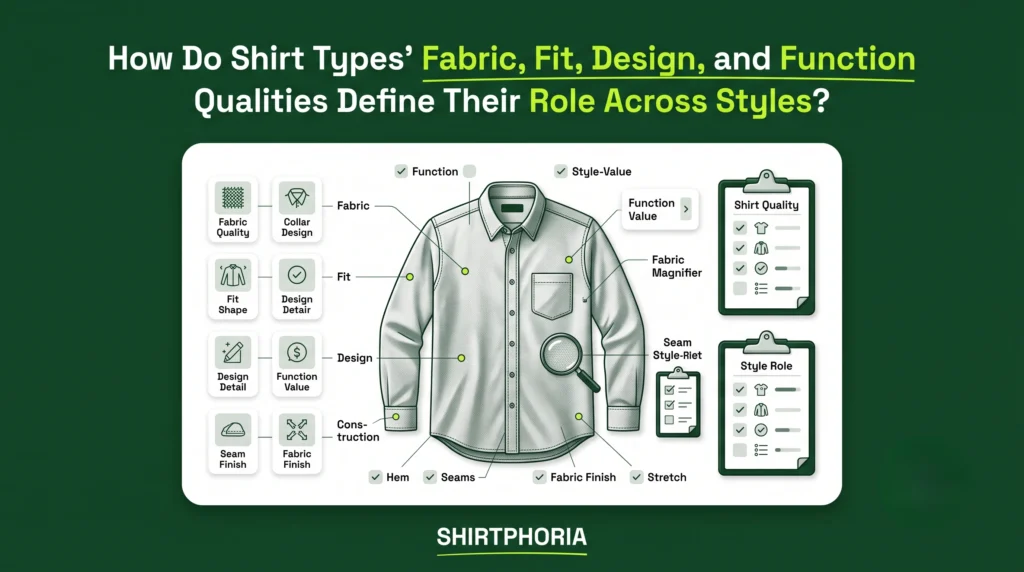
A shirt’s role in your wardrobe is shaped by the interaction of its fabric, fit, design, and function, not only by the label printed on a tag.
Most shirt-styling mistakes happen when a garment is forced into a role its construction does not support. A crisp dress shirt can look awkward in a rugged outdoor task, while a technical performance shirt can feel visually wrong in a strict formal room.
This guide explains how shirt types work as structural garment categories by showing how fabric, fit, design, and function determine whether a shirt belongs in formal, casual, smart-casual, performance, or utility settings.
A shirt type is a structural garment category shaped by construction features such as fabric, collar, placket, cuff, neckline, sleeve structure, hem, fit, and intended function. A shirt style is the outfit expression created after the garment is worn, layered, or paired with other clothing.
By reading construction signals like a tailor, you can classify any shirt before styling it. The practical test is simple: examine the fabric, read the fit, identify the design features, and match those signals to the garment’s intended function.
Disclaimer: This article is for educational shirt-style and garment-construction guidance only. Shirt suitability can vary by fabric quality, fit preference, dress code, workplace expectations, climate, and personal style context.
Why Should You Analyze Shirt Type Qualities for Better Styling?
Analyzing shirt type qualities improves styling because garment construction influences how formal, casual, comfortable, breathable, structured, or movement-friendly a shirt appears in a real outfit.
Why Contextual Harmony Prevents Shirt Type Styling Mismatches
Contextual harmony prevents shirt type styling mismatches by aligning the shirt’s fabric, fit, and design features with the visual expectations of the setting.
Visual dissonance is the jarring aesthetic clash that happens when a garment’s structure contradicts its environment. A crisp broadcloth dress shirt worn with athletic shorts creates this problem because the shirt communicates polish while the shorts communicate physical activity.
The issue is not moral or personal taste. It is a construction mismatch. When a shirt’s texture, collar, placket, or fit sends one message and the rest of the outfit sends another, the combination can feel less intentional.
How Fabric and Fit Directly Shape Shirt Function
Fabric shapes a shirt’s breathability, texture, drape, stretch, opacity, and perceived formality, while fit determines movement range, silhouette, layering ability, and comfort.
Woven fabrics typically offer more structure because their threads interlace in a stable grid. Knit fabrics such as cotton jersey usually offer more stretch and casual drape because looped yarn construction moves more easily with the body.
Fit determines whether the shirt supports tailoring, movement, or layering. Fitted shirts can support polish, but too little ease can restrict shoulder movement, chest expansion, and comfortable arm reach.
Fabric and fit together help determine whether a shirt functions best for formalwear, casual styling, active use, or layering.
How Design Features Signal a Shirt Type’s Styling Role
Design features such as collars, cuffs, plackets, pockets, hems, seams, and necklines act as visual signals that help define a shirt type’s styling role.
Stiff collars, collar stands, clean plackets, and formal cuffs usually visually increase perceived formality. Collarless necklines, soft collars, visible pockets, open necklines, and technical seams usually reduce formality or increase function.
A spread collar commonly supports polished tailoring because it frames the neck and works with a tie knot or jacket lapel. A camp collar usually reads more relaxed because its open structure sits away from strict business formality.
How Do Fabric, Fit, Design, and Function Classify Shirt Types Before Styling Decisions?
Before styling decisions begin, shirt types can be classified by analyzing how fabric, fit, design, and function combine to produce a formal, casual, smart-casual, performance, or utility garment.
No single signal defines a shirt alone. Fabric surface acts as a formality signal, but final formality also depends on collar structure, fit, design details, color, styling, and dress-code context.
How Fabric Properties Separate Formal, Casual, and Performance Shirt Types
Fabric properties help separate shirt types because weave, knit structure, texture, weight, stretch, and surface finish affect how polished, relaxed, breathable, or technical a shirt appears.
Smooth, tightly woven fabrics such as poplin, broadcloth, and fine twill usually signal higher formality. Oxford cloth, flannel, chambray, linen, denim, cotton jersey, and piqué knit often signal casual, seasonal, textured, or hybrid styling roles.
Synthetic blends, stretch fabrics, mesh panels, and moisture-wicking finishes often signal performance or active use. The fabric should be read as one signal inside the larger four-quality test.
How Fit Mechanics Determine Movement, Structure, and Layering
Fit mechanics determine whether a shirt supports tailoring, independent casual wear, relaxed layering, or high-movement activity.
Precise neck and sleeve sizing supports formalwear because dress shirts must align with jackets, ties, and cuffs. Relaxed fits support casual wear because the shirt can move and drape independently.
Stretch-based fits support activity because the garment must follow body movement. A shirt can technically fit the body but still fail the use case if it restricts the movement required by the setting.
How Functional Intent Turns Shirt Types Into Use-Case Tools
Functional intent turns shirt types into use-case tools by connecting each garment’s construction to the environment where it performs best.
A dress shirt is commonly engineered for polish, a T-shirt for casual baseline comfort, a polo for hybrid refinement, a casual shirt for versatile independent wear, and a performance shirt for movement and moisture control.
Function is the final test. If the shirt cannot perform in the intended environment, the type may be wrong for that use case.
| Shirt Quality | What It Controls | What It Reveals | Styling Effect |
|---|---|---|---|
| Fabric | Texture, breathability, weight, stretch, drape, opacity | Formality level, comfort level, seasonal use | Smooth compact fabrics usually read formal; textured, open, brushed, knit, or technical fabrics usually read casual, seasonal, or functional. |
| Fit | Ease, silhouette, movement, layering, tuck behavior | Body relationship and activity level | Tailored fits support polish; relaxed fits support casual wear; stretch fits support active movement. |
| Design | Collar, cuffs, placket, pockets, hems, seams, neckline | Visual identity and dress-code compatibility | Structured features raise perceived formality; soft, open, or technical features reduce formality or increase function. |
| Function | Purpose, environment, movement requirement, dress-code demand | Best use case | The shirt’s intended role becomes easier to identify when construction and environment match. |
| Diagnostic Dimension | Low / Casual Signal | Middle / Smart-Casual Signal | High / Formal Signal | Performance Signal |
|---|---|---|---|---|
| Fabric Surface | Brushed, slubbed, open, jersey, heavy texture | Oxford, chambray, linen, soft woven texture | Poplin, broadcloth, fine twill, smooth compact weave | Polyester, nylon, elastane blends, mesh, quick-dry finishes |
| Collar Structure | No collar or soft camp collar | Soft button-down collar | Stiff point/spread collar with collar stand | Soft or minimal collar, often absent |
| Fit Mechanics | Relaxed, boxy, untucked | Semi-fitted, wearable alone or layered | Precise neck/sleeve/chest sizing | Stretch-based, mobility-first |
| Design Features | Open neckline, pockets, curved hem, casual placket | Button-down collar, textured weave, practical hem | Full placket, barrel/French cuffs, reinforced collar | Raglan sleeves, flatlock seams, mesh panels |
| Best Use Case | Casual wear, layering, weekend outfits | Smart-casual, relaxed office, transitional dressing | Business formal, tailored outfits, ceremonies | Workouts, running, hiking, physical labor |
| Failure Risk | Too informal for polished settings | May lack formality for strict dress codes | Less suitable for high-movement use | Too technical for strict formal settings |
After this diagnostic reading, most shirts can be classified as a formal shirt type, smart-casual shirt type, casual shirt type, performance shirt type, utility/workwear shirt type, or hybrid shirt type.
How Does the T-Shirt Reflect Fit, Styling Versatility, and Use-Case Adaptation?
The T-shirt reflects casual versatility through knit fabric, a collarless neckline, simple construction, and an unstructured fit that makes it a foundational garment for relaxed wardrobes.
Premium materials, cleaner fits, or layering can raise polish, but the collarless knit structure keeps the T-shirt casual by default.
How Cotton Jersey and Relaxed Fit Make T-Shirts a Casual Baseline
Cotton jersey and relaxed fit make T-shirts a casual baseline because knit construction usually provides natural stretch, soft drape, and easy movement without tailored structure.
Knit fabric differs from woven fabric because it is built from interlooped yarns rather than interlaced threads. This construction helps the T-shirt move more casually against the body.
The lack of collar structure reduces formality. Very thin fabric may cling or become transparent, while fabric that is too heavy may feel hot, boxy, or stiff.
Why Collarless Design Gives T-Shirts Broad Styling Versatility
The collarless design gives T-shirts broad styling versatility because the shirt can sit quietly under overshirts, casual jackets, knitwear, or open button-front shirts.
As a base layer, a T-shirt supports casual systems without competing against collars, cuffs, or plackets. Crew necks and V-necks can shift the neckline effect, but the structural category remains casual.
When a T-Shirt Works Best and When It Becomes Too Informal
A T-shirt works best in casual outfits, warm-weather wardrobes, layering systems, and relaxed social settings, but it is usually too informal for strict business formal dress codes or ceremonial tailoring.
Context determines whether a T-shirt is acceptable. Understanding styling versatility begins with one of the most universal foundational garments, detailed in T-shirt styling versatility.
How Do Dress Shirts Express Collar Configuration, Formality Standards, and Fabric-Fit Attributes?
Dress shirts express high formality through structured collars, clean plackets, formal cuffs, precise sizing, and smooth woven fabrics designed to work with tailoring.
They are commonly expected in business formal settings, many ceremonies, interviews, and tailored outfits, though dress-code expectations can vary by culture, workplace, and event.
Why Structured Collars and Cuffs Create Formal Shirt Function
Structured collars and cuffs create formal shirt function by giving the neckline and wrists enough shape to support jackets, ties, and polished dress codes.
Spread collars, point collars, collar stands, barrel cuffs, and French cuffs create a cleaner frame around tailoring. A collar stand helps the collar sit upright under a jacket, while formal cuffs create a controlled wrist line.
How Precision Fit and Woven Fabrics Build a Tailored Silhouette
Precision fit and woven fabrics build a tailored silhouette by aligning the neck, sleeve length, shoulder line, chest, and cuff position with the body and jacket.
Neck and sleeve sizing matters more in dress shirts than in casual alpha-sized shirts because the garment must cooperate with collars, cuffs, jackets, and ties. Poplin and broadcloth usually create a smoother, cleaner surface, while twill often adds more texture and drape while remaining suitable for many dress-shirt contexts.
Too little ease can restrict movement; too much ease can cause bunching under jackets.
When Dress Shirts Should Be Used and When They Become Functionally Wrong
Dress shirts are usually the correct choice for business formal settings, tailored outfits, interviews, and many ceremonies, but many traditional dress shirts are less suitable for athletic, rugged, or high-output environments.
Fine woven fabric and stiff collar construction support polish but may reduce physical adaptability. Many traditional dress shirts are less suitable for high-movement use because structured collars, tighter woven fabrics, and precise sizing can restrict mobility.
When function qualities dictate professional attire, the core rules of formality and fit are established in dress shirt formality and fit.
How Does the Casual Shirt Incorporate Fabric Properties, Fit Functionality, and Design Features?
The casual shirt bridges formalwear and basic tops by using softer fabrics, relaxed fit features, and practical design details that support independent, jacket-free wear.
Casual shirt can include button-down shirts, camp collar shirts, flannel shirts, chambray shirts, denim shirts, and linen shirts. The category is defined by structural logic, not by brand styling.
How Soft Collars, Pockets, and Untucked Hems Reduce Formality
Soft collars, visible pockets, and shorter or curved hems reduce formality because they make the shirt easier to wear independently without a suit jacket or tie.
A lack of heavy collar interlining lowers perceived polish. Pockets add utility and visual casualness, but too many utility details can make the shirt look too rugged for refined smart-casual settings.
Why Textured Fabrics and Relaxed Drapes Support Independent Wear
Textured fabrics and relaxed drapes support independent wear because they give a casual shirt enough visual interest and body to stand alone without formal tailoring.
Oxford cloth, flannel, linen, chambray, denim, and brushed cotton reduce the visual emptiness that can happen when a plain formal dress shirt is worn without a jacket. Linen supports warm weather, while flannel supports cooler weather.
When Casual Shirts Bridge Weekend Outfits and Smart-Casual Roles
Casual shirts often bridge weekend outfits and smart-casual roles because they combine enough structure for polish with enough softness for comfort.
They are often suitable for relaxed offices, dinners, daytime events, travel, and transitional weather. They may still fail strict formal dress codes that require smooth fabric, sharper collars, or tailored structure.
Bridging the gap between formal wear and basics requires navigating the specific design features explored in casual shirt design features.
How Does the Polo Shirt Demonstrate Fabric Engineering, Structural Design, and Fit Characteristics?
The polo shirt demonstrates hybrid shirt construction by combining a knit fabric body with a soft collar and partial placket, placing it between T-shirts and woven button-front shirts.
The polo’s hybrid identity comes from combining sport function with modest collar structure. Modern polos vary by fabric, collar structure, and fit, so they should be read carefully.
How the Polo Shirt Combines a Soft Collar, Partial Placket, and Knit Body
The polo combines a soft collar, partial placket, and knit body to raise its polish above a T-shirt while keeping it more relaxed than most woven button-front shirts.
The collar visually adds structure, while the knit body preserves comfort and mobility. A collar that collapses, curls, or spreads poorly can make the polo look sloppy.
Why Piqué Knits and Athletic Origins Shape Polo Shirt Function
Piqué knit can shape polo shirt function by giving the garment a textured surface, breathable feel, and sport-influenced structure that may work across active and smart-casual settings.
Piqué usually creates a more textured and structured polo surface than jersey. It can work across active and smart-casual settings when the polo has suitable collar quality, fabric weight, and fit.
When Polo Shirts Work Best Across Sport, Business Casual, and Warm-Weather Styling
Polo shirts often work well in business-casual settings, golf, resort styling, summer offices, and relaxed smart-casual outfits, but they usually lack the structure required for black-tie or strict suiting contexts.
Polo suitability depends on collar quality, fabric weight, fit, color, styling, and dress-code expectations. A polo that is too thin may read like underwear, while a polo that is too stiff or oversized can lose its refined casual purpose.
For roles that demand both structure and mobility, specific fabric engineering comes into play, as outlined in polo shirt fabric and fit.
How Does the Performance Shirt Integrate Fabric Technology, Functional Design, and Use-Case Alignment?
The performance shirt often relies heavily on technical fabric, ergonomic construction, and movement-focused fit to prioritize sweat control, mobility, and comfort during physical activity.
Some modern performance shirts are designed to look cleaner, but visible technical features still shift them away from formal tailoring.
How Ergonomic Design Features Improve Movement and Reduce Friction
Ergonomic design features such as raglan sleeves, flatlock seams, mesh panels, and stretch zones can improve movement and reduce friction during high-output activity.
Raglan sleeves extend in one piece toward the collar, creating a diagonal seam that can improve shoulder mobility. Flatlock seams sit flatter against the body, helping reduce rubbing. Mesh panels usually increase airflow, though not every performance shirt contains all of these features.
Why Synthetic and Technical Fabrics Prioritize Performance Over Traditional Drape
Synthetic and technical fabrics usually prioritize moisture movement, stretch recovery, quick drying, and temperature management over the crisp drape associated with traditional woven shirts.
Polyester, nylon, elastane blends, and mesh can improve activity comfort. Some technical fabrics use antimicrobial treatments. The tradeoff is that technical fabrics may show sheen, cling, or seam lines.
When Performance Shirts Belong in Athletic and High-Output Environments
Performance shirts often belong in workouts, running, hiking, outdoor activity, travel, and physical labor, but most visible performance shirts are usually unsuitable for strict formal offices or traditional tailored outfits.
Clean performance polos or technical button-ups may work in casual travel or relaxed business-casual settings, but not strict formalwear. High sheen, visible mesh, athletic logos, or compression fit can create visual dissonance in formal spaces.
When the primary role is athletic function, garment design relies heavily on the fabric technology mapped out in performance shirt fabric technology.
How Do Secondary Shirt Types Expand Fabric, Fit, Design, and Function Classification?
Secondary shirt types expand the classification framework by modifying one or more of the four core qualities: fabric, fit, design, or function.
Secondary shirt types are not random. They are structural variations that adjust neckline, fabric texture, warmth, durability, layering capacity, or movement range.
How Henley, Flannel, Camp Collar, Denim, Work, and Overshirts Extend Shirt Type Classification
Henley, flannel, camp collar, denim, work, and overshirts extend shirt type classification by changing neckline, fabric texture, warmth, structure, durability, or layering function.
A Henley changes the T-shirt category with a partial placket and collarless neckline. Flannel adds brushed warmth and texture. A camp collar opens the neckline for summer casual use. Denim and chambray bring workwear associations through fabric surface. Work shirts add durability, pockets, and movement-friendly construction. Overshirts bridge shirts and light jackets through heavier fabric and layering fit.
How to Classify Any Shirt Type Using the Four-Quality Test
You can classify any shirt type by identifying its fabric, reading its fit, noting its design features, and matching those signals to its intended function.
- Fabric: Is the shirt woven, knit, brushed, smooth, textured, heavy, lightweight, stretchy, or technical?
- Fit: Is the shirt tailored, semi-fitted, relaxed, oversized, cropped, long, or stretch-based?
- Design: Does the shirt have a collar, placket, cuffs, pockets, special seams, or a distinctive hem?
- Function: Is the shirt intended for polish, comfort, layering, warmth, movement, durability, or seasonal wear?
| Secondary Shirt Type | Strongest Defining Quality | Closest Core Category | Main Styling Role |
|---|---|---|---|
| Henley Shirt | Partial placket with collarless neckline | T-Shirt | Rugged casual layering |
| Flannel Shirt | Brushed fabric with warmth and texture | Casual Shirt | Cold-weather casual wear |
| Camp Collar Shirt | Open, relaxed collar structure | Casual Shirt | Summer casual and resort styling |
| Denim Shirt | Durable cotton structure and visible rugged texture | Casual / Work Shirt | Rugged casual and layering |
| Chambray Shirt | Lightweight plain-weave look with workwear heritage | Casual Shirt | Smart-casual and workwear-inspired styling |
| Work Shirt | Durable fabric, utility pockets, reinforced details | Utility Shirt | Practical labor, rugged casual wear |
| Overshirt | Heavier fabric and layering-focused fit | Casual / Utility Shirt | Transitional outer layer |
| Linen Shirt | Breathable fabric with relaxed wrinkle behavior | Casual / Seasonal Shirt | Warm-weather styling |
| Cuban Collar Shirt | Open neckline and relaxed collar | Casual Shirt | Summer, vacation, and relaxed evening wear |
| Rugby Shirt | Heavy jersey, contrast collar, sport heritage | Polo / Casual Shirt | Rugged casual and preppy styling |
Compare the Defining Qualities of Core Shirt Types
| Shirt Type | Primary Fabric | Fit Characteristic | Key Design Feature | Optimal Styling Role | Avoid When |
|---|---|---|---|---|---|
| T-Shirt | Cotton jersey or knit blends | Relaxed, semi-fitted, or fitted casual drape | Collarless neckline | Casual baseline, layering, warm-weather wear | Strict business formal, ceremonial tailoring, dress-code environments requiring visible structure |
| Dress Shirt | Poplin, broadcloth, fine twill, formal Oxford variants | Precise neck, sleeve, chest, and cuff sizing | Structured collar, full placket, formal cuffs | Business formal, tailoring, interviews, weddings, polished outfits | Athletic activity, rugged work, high-heat casual settings, movement-heavy tasks |
| Casual Shirt | Oxford cloth, flannel, linen, chambray, denim, textured cotton | Relaxed or semi-fitted independent wear | Soft collar, pockets, curved hem, casual placket | Smart-casual, weekend outfits, relaxed offices, layering | Strict formal dress codes, black-tie, contexts requiring sharp tailoring |
| Polo Shirt | Piqué knit, jersey knit, cotton blends, performance knit | Semi-fitted or relaxed hybrid fit | Soft collar and partial placket | Business casual, golf, resort wear, summer offices, smart-casual outfits | Black-tie, strict suiting, highly formal ceremonies |
| Performance Shirt | Polyester, nylon, elastane blends, mesh, technical knits | Stretch-based and mobility-focused | Raglan sleeves, flatlock seams, mesh panels, ergonomic panels | Workouts, running, hiking, travel, physical labor | Traditional formal offices, tailored outfits, ceremonies, dress codes requiring matte woven structure |
| Work Shirt | Canvas, twill, denim, heavy cotton blends | Relaxed or movement-friendly utility fit | Utility pockets, reinforced seams, durable placket | Labor, rugged casual wear, outdoor tasks, utility styling | Formal offices, refined tailoring, dressy evening events |
| Overshirt | Heavy cotton, wool blends, flannel, twill, canvas | Relaxed layering fit | Shirt-jacket structure, heavier fabric, large pockets | Transitional layering, casual outerwear, workwear-inspired outfits | Warm indoor formal settings, strict business dress codes |
Which Shirt Type Mistakes Cause Styling and Function Mismatches?
Shirt type mistakes occur when the fabric, fit, design, or function of a shirt conflicts with the setting where it is worn.
Some mistakes are visual, such as a technical shirt looking too athletic in a formal meeting. Others are functional, such as a stiff dress shirt restricting movement during physical work.
Why Performance Fabrics Often Fail in Formal Style Contexts
Performance fabrics often fail in formal style contexts because sheen, visible technical seams, mesh panels, and athletic cuts can conflict with the matte surface and clean structure expected in tailored dress.
This does not apply to every technical garment because some are designed to look cleaner. The mismatch usually appears when visible performance cues such as logos, compression fit, mesh, or seam panels dominate the outfit.
Why Dress Shirts Are Less Suitable for High-Movement Use Cases
Many traditional dress shirts are less suitable for high-movement use cases when tightly woven non-stretch fabric, stiff collar construction, and exact sizing restrict mobility or trap heat.
Visual polish and physical performance are different requirements. Sweat, pulling at the armhole, tightness across the chest, and collar discomfort can show that the shirt type is wrong for the task.
How Ignoring Fabric Texture Causes Formality Misreads
Ignoring fabric texture can cause formality misreads because smooth compact fabrics usually read more polished, while brushed, slubbed, open-weave, or heavily textured fabrics usually read more casual.
Texture is a signal, not an absolute law. Flannel lowers formality through brushed warmth, while poplin raises polish through a smoother surface.
How Poor Fit Choice Breaks a Shirt Type’s Intended Role
Poor fit choice breaks a shirt type’s intended role when the garment fits the body but fails the environment, movement requirement, or layering purpose.
A slim formal shirt can work well under a jacket but restrict independent movement. An oversized casual shirt can offer comfort but may fail professional standards.
| Intake | Why It Fails | Better Choice |
|---|---|---|
| Wearing a performance shirt to a formal meeting | Technical fabric, sheen, and athletic seams may read too active | Dress shirt or refined smart-casual shirt |
| Wearing a dress shirt for physical activity | Non-stretch woven fabric and stiff collar structure can restrict movement | Performance shirt or breathable active shirt |
| Wearing a thin T-shirt to a dressy dinner | Collarless knit structure may look too casual | Polo shirt, casual button-front shirt, or dress shirt |
| Wearing a heavy flannel in hot weather | Brushed warmth and heavier fabric can trap heat | Linen shirt, lightweight casual shirt, or polo |
| Wearing an oversized casual shirt under a blazer | Excess fabric can bunch and distort the jacket silhouette | Tailored dress shirt or slim casual shirt |
| Wearing a formal poplin shirt untucked casually | Long hem and polished fabric can look mismatched without tailoring | Oxford shirt, chambray shirt, linen shirt, or camp collar shirt |
| Wearing a stiff dress shirt for rugged outdoor tasks | Formal construction often lacks utility and movement tolerance | Work shirt or durable overshirt |
| Wearing a polo to black-tie or strict formalwear | Soft collar and knit body usually lack ceremonial structure | Formal dress shirt with appropriate collar and cuffs |
What Are the Key Takeaways for Choosing the Right Shirt Type?
The key takeaways for choosing the right shirt type are that fabric influences formality, fit determines movement, design features set visual expectations, and function decides whether the shirt belongs in the setting.
FAQ
A shirt type is the garment category defined by construction features such as fabric, collar, placket, cuff, fit, hem, and intended function. A shirt style is the outfit expression created after the garment is worn, layered, or paired with other clothing.
The four qualities are fabric, fit, design, and function. Fabric reveals texture and formality signals, fit reveals movement and silhouette, design reveals visual identity, and function reveals the best use case.
They often create visual dissonance. This happens when the shirt’s construction signals one context while the rest of the outfit or setting signals another, such as a polished broadcloth dress shirt paired with athletic shorts.
Yes. Premium fabric, a clean fit, restrained color, and smart layering can raise a T-shirt’s polish. However, its collarless knit construction usually keeps it more casual than a dress shirt or structured button-front shirt.
A visible performance shirt is usually the wrong choice for strict formal offices, traditional tailoring, and ceremonial outfits because sheen, mesh, technical seams, logos, or compression fits can conflict with formal expectations.
Terms Explained
| TERM | DEFINITION |
|---|---|
| Shirt Type | A structural garment category defined by fabric, fit, design features, and intended function. |
| Shirt Style | The outfit expression created after a shirt is worn, layered, or paired with other clothing. |
| Fabric Surface | The visible and tactile character of the material, including smoothness, texture, brushing, sheen, openness, or compactness. |
| Fit Mechanics | The way a shirt’s ease, silhouette, shoulder line, torso relationship, and stretch affect movement and structure. |
| Collar Stand | The band that helps a shirt collar sit upright, especially in formal shirts designed to work with jackets and ties. |
| Placket | The reinforced opening where buttons or fasteners sit, often influencing formality and visual structure. |
| Hem | The finished lower edge of a shirt, which affects tuck behavior, casual wear, and layering compatibility. |
| Visual Dissonance | A styling clash that happens when a garment’s structure contradicts the environment, outfit role, or dress-code expectation. |
| Piqué Knit | A textured knit often used in polo shirts, usually giving more surface structure than plain jersey. |
| Flatlock Seams | Seams designed to sit flatter against the body, commonly used in performance garments to reduce rubbing. |
Conclusion
In conclusion, shirt types are best understood as structural garment categories shaped by fabric, fit, design, and function.
Shirt choice becomes easier when you read construction signals instead of guessing from style labels. Fabric influences formality, fit controls movement, design features communicate visual role, and function determines use-case suitability.
The four-quality test helps you classify any shirt type before you wear, layer, or buy it.
Mastering shirt style begins with respecting garment structure; when a shirt’s construction matches its purpose, the outfit feels intentional before a single accessory is added.
© 2026 Shirtphoria. All rights reserved.