How Does the Polo Shirt Demonstrate Fabric Engineering, Structural Design, and Fit Characteristics Across Style Variations?
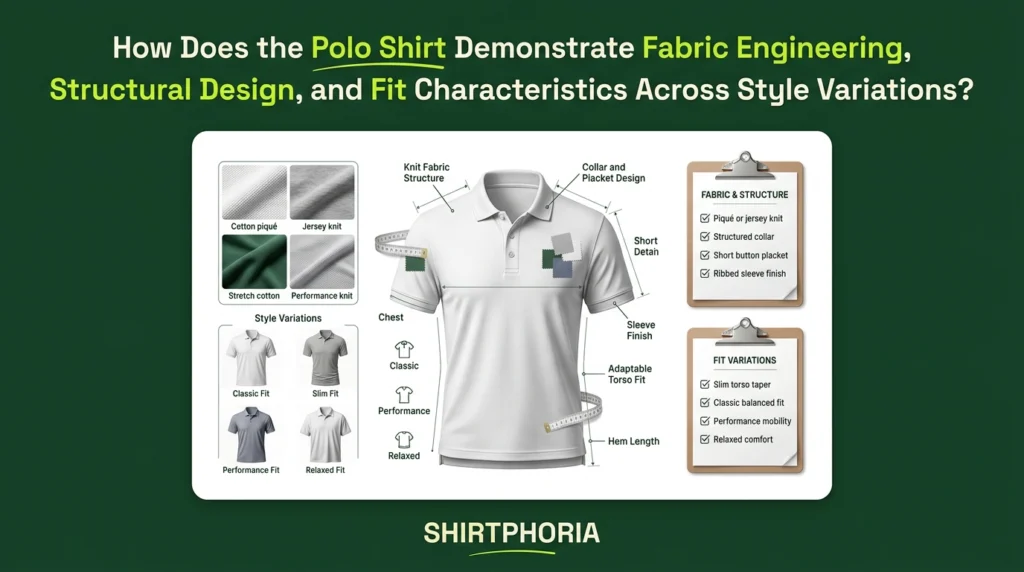
The polo shirt demonstrates fabric engineering, structural design, and fit characteristics by combining a knit fabric body, a soft collar, a partial placket, and fit variations that shift the garment between sport, leisure, smart-casual, and performance use.
A polo shirt is more than a casual top. It sits between the softness of a T-shirt and the more structured appearance of a woven button-front shirt. Its identity depends on three connected elements: fabric engineering, structural design, and fit characteristics.
The polo shirt becomes easier to classify when it is compared with the wider system of shirt types.
Fabric engineering determines texture, drape, breathability, weight, stretch, and stability. Structural design controls the collar, placket, sleeves, and hem. Fit determines how these components sit and move on the body.
The modern polo is strongly associated with René Lacoste’s tennis-wear innovation. Lacoste states that René Lacoste introduced the L.12.12 polo in 1933. The company connects the model with petit piqué fabric, short sleeves, and the development of a softer sporting shirt. Lacoste
Understanding the polo therefore requires looking at the whole garment rather than assuming that one fabric, collar, placket, or fit automatically makes a polo better.
Why Does the Polo Shirt Combine Sport Function and Smart-Casual Structure?
The polo shirt combines sport function and smart-casual structure because its knit body supports comfort while its collar and placket create a more dressed appearance than a basic T-shirt.
Its basic design can be understood as:
Knit Body + Soft Collar + Partial Placket → Hybrid Shirt Identity
The knit body allows the garment to remain flexible and relatively soft. The collar frames the neckline, while the partial placket gives the front more visual structure.
This combination allows polo shirts to move between sporting, casual, leisure, travel, and some business-casual settings.
A polo does not automatically belong to one formality level. Fabric texture, collar construction, placket design, fit, color, and styling all influence how formal or casual the garment appears.
How Did Athletic Function Shape the Polo Shirt?
Athletic function shaped the polo shirt by favoring a soft knit body, shorter sleeves, and a partial opening that could support movement and comfort better than stricter woven sportswear.
The modern polo should not be understood only through the sport of polo. Its current form is also strongly connected with tennis and René Lacoste’s development of lighter sporting clothing.
A partial placket gives the wearer some control over the neckline.
Partial Placket → Adjustable Neck Opening → Greater Wearer Control
Opening one or more buttons can make the neckline feel less closed. However, the placket alone does not guarantee ventilation.
Actual airflow depends on fabric openness, knit density, garment fit, placket depth, temperature, and surrounding conditions.
How Does the Polo Shirt Signal Smart-Casual Structure?
The polo shirt signals smart-casual structure because its collar and placket create a more framed neckline than a T-shirt while its knit body remains softer than a woven dress shirt.
The relationship can be summarized as:
Collar + Placket → Framed Neckline → Higher Perceived Structure
A firm, clean collar and stable placket can make a polo appear more polished. A softer collar, lightweight fabric, and relaxed silhouette can make the same shirt category appear more casual.
This does not mean every polo is suitable for business-casual wear.
The final formality signal depends on the fabric, collar quality, fit, surface finish, color, trousers, footwear, and dress code.
What Core Structural Components Define the Polo Shirt?
The core structural components that define the polo shirt are the soft collar, partial placket, knit body, sleeve construction, and hem design.
Each component performs a different role:
- Collar: frames the neckline and influences shape retention.
- Placket: creates the partial front opening and supports buttons or other closures.
- Knit body: affects texture, stretch, drape, weight, and comfort.
- Sleeves: influence shoulder movement and arm presentation.
- Hem: affects garment length, tuck behavior, and proportion.
Polo shirt quality depends on how well these components work together rather than on one feature alone.
How Does Collar Engineering Shape the Polo Shirt?
Collar engineering shapes the polo shirt by determining whether the neckline looks crisp, relaxed, sporty, or collapsed after wear and laundering.
Many polos use a rib-knit collar. Rib knit is a knitted structure made with alternating raised and recessed columns. It can provide flexibility and help the collar recover after movement.
Collar performance depends on several factors:
Collar Density → Supports Shape Retention → Reduces Curl Risk
A collar with suitable density can resist excessive curling or collapse.
However, density is not the only factor. Yarn type, rib construction, attachment method, laundering, body-fabric weight, and repeated wear also influence collar behavior.
An underbuilt collar may curl or lose shape.
An overly dense collar may resist curl but feel stiff, bulky, or visually too heavy compared with the rest of the shirt.
The goal is balanced structure.
How Does the Placket Affect Polo Shirt Formality?
The placket affects polo shirt formality by controlling how visible, structured, and polished the neckline opening appears.
A placket is the reinforced opening at the front neckline that normally supports buttons and buttonholes.
Classic polo shirts often use visible two-button or three-button plackets. This construction reinforces the familiar sporting identity of the polo.
A hidden placket conceals more of the closure system and can create a cleaner front.
The relationship is:
Placket Structure → Controls Neckline Finish → Adjusts Formality Signal
A hidden placket can make a polo appear cleaner or dressier, but it does not automatically make the shirt formal.
Fabric texture, collar quality, fit, color, and overall styling still matter.
The placket should also sit flat. Gaping, twisting, pulling, or puckering can make the front look poorly fitted or poorly constructed.
How Do Polo Shirt Sleeves and Hems Shape Functionality?
Polo shirt sleeves and hems shape functionality by controlling shoulder movement, arm presentation, tuck behavior, and the garment’s casual or athletic signal.
A set-in sleeve attaches around a defined armhole and creates a conventional shoulder seam.
This construction usually supports a cleaner and more familiar shoulder line.
A raglan sleeve extends toward the neckline instead of ending at a standard shoulder seam.
Raglan construction can support greater freedom around the shoulder and often creates a sportier visual effect.
Neither sleeve type is automatically better.
A poorly shaped set-in sleeve can restrict movement, while a raglan sleeve does not automatically make every polo suitable for sport.
Hem design also affects use.
Some polos use a straight hem, while others use a tennis tail, where the back hem is longer than the front.
The extra rear length can help the shirt remain tucked during movement.
The appropriate hem depends on whether the polo is intended for tucked wear, untucked wear, sport, leisure, or mixed use.
How Does Fabric Engineering Define Polo Shirt Performance?
Fabric engineering defines polo shirt performance because piqué, jersey, and interlock knits each create different balances of texture, breathability, drape, structure, and surface polish.
Knit type is an important signal, but it does not determine performance on its own.
Fiber content, yarn construction, knit density, gauge, fabric weight, finishing, stretch, recovery, and garment fit also influence how the shirt behaves.
How Does Piqué Knit Affect Polo Shirt Breathability and Structure?
Piqué knit affects polo shirt breathability and structure by creating a textured surface that can feel more open and dimensional than smoother knit fabrics.
Piqué is a textured knit strongly associated with traditional polo shirts.
Its raised surface gives the fabric visible depth and can help create the structured character associated with a classic polo.
SANVT describes its cotton piqué polo fabric as breathable, durable, thermoregulating, and structurally textured. These characteristics help illustrate why piqué is commonly used for classic polo construction. SANVT
The relationship can be summarized as:
Textured Piqué Surface → Can Support Air Movement and Structure → Classic Polo Character
Piqué does not provide a fixed level of breathability simply because it is piqué.
Actual comfort depends on:
- knit density
- yarn construction
- fiber type
- fabric weight
- finishing
- fit
- moisture
- climate
A lightweight, relatively open piqué may feel comfortable in warm weather, while a thick or densely knitted piqué can feel noticeably warmer.
How Do Jersey and Interlock Change Polo Shirt Drape?
Jersey and interlock change polo shirt drape by replacing piqué texture with smoother knit surfaces that usually feel softer, flatter, or more polished against the body.
Jersey is a smooth knit commonly associated with T-shirts and other soft casual garments.
A jersey polo can therefore feel lighter, softer, and more relaxed than a strongly textured piqué polo.
Its smoother surface can also produce a more fluid drape.
Interlock is a double-knit construction.
Manifutura describes interlock as a weft-knitted double-knit fabric made with two rows of needles. It is generally denser and heavier than jersey and is valued for dimensional stability and shape preservation. Manifutura
Its construction can be summarized as:
Interlock Double-Knit Structure → Greater Stability → Smoother Polo Drape
Interlock can create a clean and polished appearance that works well for smarter polo variations.
However, greater density may also make some interlock fabrics feel warmer or heavier than lightweight jersey or piqué.
How Do Performance Fibers Change Polo Shirt Use Cases?
Performance fibers change polo shirt use cases by adding properties such as stretch, quicker drying, moisture management, or easier care when the fabric is engineered for activity.
A performance polo may use:
- polyester
- polyester blends
- elastane
- lightweight synthetic knits
- mesh zones
- moisture-management finishes
- quick-dry construction
- odor-control treatments
These features are possibilities rather than standard requirements for every polo.
Moisture-management, odor-control, stretch, or water-repellent claims should only be made when the individual garment specification supports them.
For construction designed specifically around active use, compare polo shirts with broader performance shirts.
How Do Fit Characteristics Shape Polo Shirt Style Variations?
Fit characteristics shape polo shirt style variations because the chest block, shoulder line, sleeve width, torso taper, and hem length determine whether the polo reads classic, athletic, tailored, or relaxed.
Fit should be evaluated according to purpose.
A polo intended for golf or active travel may need more movement allowance than one designed for a polished smart-casual outfit.
A useful fit spectrum is:
Too Tight → Balanced → Too Loose
The correct position depends on movement needs, body shape, fabric behavior, and intended styling.
How Does a Classic Fit Polo Work?
A classic fit polo works by giving the body and sleeves enough room for comfort, airflow, and casual movement without forcing the garment close to the torso.
Classic-fit polos may use straighter side seams, moderate sleeve room, and enough body length for tucked or untucked wear depending on the design.
Moderate Ease → Better Comfort → Supports Leisure and Traditional Sport
Classic fit should still look intentional.
Too much ease can make the shirt appear boxy, oversized, or disconnected from the shoulders and collar.
How Does a Slim Fit Polo Work?
A slim fit polo works by reducing excess fabric through the torso and sleeves to create a cleaner and sharper outline.
Reduced Ease → Cleaner Silhouette → Greater Smart-Casual Polish
A slim polo can suit polished outfits when the garment remains comfortable.
Look for pulling around the chest, armholes, sleeves, and placket.
Horizontal stress lines, button strain, or a placket that spreads open indicate that the fit may be too tight.
Too little ease can also restrict movement.
How Does a Relaxed Fit Polo Work?
A relaxed fit polo works by adding intentional volume through the chest, shoulder, and torso so the garment drapes more casually.
Added Volume → Softer Drape → Casual Styling Signal
A relaxed polo can look intentional when its shoulder shape, fabric weight, collar proportion, sleeve width, and length support the larger silhouette.
Relaxed fit does not simply mean wearing a polo that is several sizes too large.
Excessive volume can overwhelm the body, weaken the relationship between collar and torso, and make the garment appear incorrectly sized.
Comparison Matrix: How Do Fabric and Fit Align in the Polo Shirt?
A fabric-and-fit alignment matrix helps match each polo shirt variation to the use case where its knit, structure, and silhouette make the most sense.
| Polo Shirt Variation | Fabric Engineering Focus | Structural Design | Fit Characteristic | Best Use Case | Failure Risk |
|---|---|---|---|---|---|
| Classic Piqué | Textured cotton or cotton-blend piqué that can support breathability and classic surface structure | Rib-knit collar, visible placket, short sleeves, balanced hem | Classic or semi-relaxed | Leisure, warm-weather smart casual, traditional sport-inspired outfits | Dense piqué can feel warm; weak collars may curl |
| Jersey Polo | Smooth knit surface emphasizing softness and T-shirt-like drape | Soft collar, lighter placket, minimal texture | Slim, regular, or relaxed | Casual layering, travel, weekend wear | Thin jersey may cling, stretch, or appear too casual in polished settings |
| Interlock Polo | Double-knit structure supporting smoothness and dimensional stability | Smoother body and more polished surface | Tailored or regular | Business casual, dinner, smart-casual wear | Dense interlock may feel warmer or heavier |
| Performance Polo | Synthetic or blended fibers developed for movement, quicker drying, or moisture management | Lightweight body, stretch zones, reduced seams, or sport-oriented details | Athletic, slim, or mobility-focused | Golf, travel, active work, warm-weather activity | Technical shine or synthetic hand-feel may look too sporty in dressier settings |
No row represents a universal quality ranking.
The most suitable option is the one whose fabric, construction, fit, and appearance match the intended use.
What Failure Modes Can Distort Polo Shirt Structure?
Polo shirt structure can fail when one or more attributes move too far in either direction.
Both underbuilt and overbuilt construction can affect collar shape, placket stability, fabric comfort, fit, and formality.
| Attribute | Too-Low Failure | Too-High Failure | Corrective Approach |
|---|---|---|---|
| Collar Density | Collar curls, collapses, or loses shape | Collar feels stiff, bulky, or visually heavy | Match collar density to body-fabric weight and intended formality |
| Placket Structure | Placket gaps, twists, or pulls open | Placket feels rigid or visually overbuilt | Balance reinforcement with knit flexibility |
| Piqué Texture | Fabric lacks desired surface structure | Fabric feels rough, thick, or too warm | Select piqué density according to climate and comfort |
| Jersey Drape | Fabric clings, stretches, or appears overly T-shirt-like | Fabric becomes heavy or limp | Match weight and recovery to the intended silhouette |
| Interlock Stability | Fabric lacks the desired smoothness or stability | Fabric becomes too dense, warm, or heavy | Use interlock where stability matters more than maximum lightness |
| Fit Taper | Shirt appears boxy or visually loose | Shirt pulls across chest, arms, or placket | Match ease to body shape and use case |
| Sleeve Geometry | Shoulder movement feels restricted | Sleeve creates excessive volume or sportiness | Match sleeve construction to intended movement and appearance |
| Performance Features | Shirt lacks the mobility or drying behavior needed for activity | Shirt appears too technical for the setting | Match technical features to actual activity needs |
These failure modes show why polo shirt quality cannot be judged from one feature.
A stiffer collar is not automatically better than a softer collar. A heavier fabric is not automatically more durable or more premium. A tighter fit is not automatically more polished.
The garment should be evaluated as a connected system.
What Are the Key Takeaways of Polo Shirt Structure?
The key takeaways of polo shirt structure show that a polo’s role is created by the interaction of knit fabric, collar density, placket design, sleeve geometry, and fit.
- The Polo Shirt Is a Hybrid Garment: It combines a knit body with a collar and partial placket.
- Fabric Changes the Role: Piqué, jersey, interlock, and performance knits create different combinations of texture, drape, stability, breathability, and formality.
- Collar Quality Matters: An underbuilt collar can curl or collapse, while an overbuilt collar can feel stiff or visually heavy.
- Placket Design Influences Polish: Visible plackets often reinforce classic polo styling, while hidden plackets can create a cleaner appearance.
- Sleeve Construction Changes Movement: Set-in and raglan sleeves create different balances of shoulder structure and mobility.
- Fit Must Match Use: Classic, slim, and relaxed fits support different styling and movement needs.
- Performance Claims Need Support: Moisture-management, odor-control, quick-dry, stretch, and water-repellent claims should match actual garment specifications.
- No Single Feature Determines Quality: The polo should be evaluated through the interaction of fabric, collar, placket, sleeves, fit, and use case.
Checklist: How Can You Select the Right Polo Shirt?
You can select the right polo shirt by matching knit type, collar behavior, placket structure, sleeve geometry, fabric weight, and fit to the occasion or task.
Frequently Asked Questions About Polo Shirt Structure
The best polo shirt fabric depends on the use case. Piqué often suits classic, textured polos. Jersey works well for soft casual drape. Interlock provides a smoother and more stable surface. Performance blends can suit travel, movement, quicker drying, or sweat-heavy activity.
Piqué is not automatically better than jersey. Piqué usually provides more texture and classic polo structure, while jersey often feels smoother and softer. The better choice depends on climate, styling goals, fabric weight, collar quality, garment construction, and fit.
A good polo shirt collar holds its intended shape without excessive curling, collapsing, or stiffness. Collar quality depends on rib density, yarn, attachment, laundering behavior, body-fabric weight, and how the collar works with the placket and body fabric.
A polo shirt should fit according to its intended use. Slim fits can create a cleaner smart-casual outline, while classic and relaxed fits provide more ease and softer drape. The shirt should not pull across the chest or overwhelm the torso.
Performance polos commonly use synthetic or blended fabrics designed for movement, stretch, quicker drying, or moisture management. Traditional polos may emphasize cotton texture, classic collar construction, and casual polish. The meaningful difference depends on fabric specification, construction, fit, and intended activity.
Terms Explained
| TERM | DEFINITION |
|---|---|
| Polo shirt | A knit shirt with a soft collar and a partial front placket. |
| Piqué | A textured knit commonly associated with classic polo shirts. |
| Jersey | A smooth knit that generally creates a softer, more casual drape. |
| Interlock | A double-knit fabric that is generally denser and more dimensionally stable than jersey. |
| Rib-knit collar | A flexible knitted collar structure made with raised and recessed columns. |
| Placket | The reinforced opening at the front neckline that supports buttons and buttonholes. |
| Set-in sleeve | A sleeve attached around a defined armhole, creating a conventional shoulder seam. |
| Raglan sleeve | A sleeve that extends toward the neckline instead of ending at a standard shoulder seam. |
| Tennis tail | A hem design where the back is longer than the front to support tucked wear during movement. |
| Ease | The amount of room between the body and the garment that affects comfort, movement, and silhouette. |
| Drape | The way a fabric hangs and falls on the body. |
Conclusion
In conclusion, the polo shirt is a hybrid knit-collar garment whose identity comes from the balance between fabric engineering, structural design, and fit characteristics.
Piqué provides the textured surface strongly associated with classic polo construction. Jersey creates softer and more casual drape. Interlock provides a smoother double-knit structure with greater stability.
Collar density influences neckline shape, while placket construction changes both functionality and visual polish. Sleeve construction affects shoulder presentation and movement.
Classic fit provides moderate ease, slim fit creates a closer silhouette, and relaxed fit adds intentional volume.
No knit, collar, placket, sleeve type, or fit is universally best. The appropriate polo depends on climate, occasion, movement requirements, desired formality, fabric behavior, and how all of its structural parts work together.
Choosing a polo shirt well means reading its fabric, collar, placket, sleeves, and fit as one connected garment system.