What Construction Traits Separate a Work Shirt From a Standard Casual Shirt?
The construction traits that commonly separate a work shirt from a standard casual shirt are heavier task-appropriate fabric, reinforced seams, stress-point bartacks, durable hardware, and fit details that support movement.
Work shirt construction is best judged as a system rather than by one feature alone. Heavy fabric does not automatically make a shirt suitable for work, and triple-needle stitching, metal snaps, or reinforced pockets cannot independently prove durability.
A work shirt can provide greater task-oriented durability than a casual shirt when its fabric, seams, hardware, reinforcement, and mobility features match the work being performed.
The correct construction also depends on environment. A shirt used around rough surfaces may need greater abrasion resistance, while a shirt used for repeated overhead movement may benefit more from mobility features. Hot indoor work may require less fabric mass than outdoor or abrasion-heavy tasks.
A strong work shirt can support durability, comfort, movement, and coverage, but it does not automatically provide certified occupational protection.
This guide explains how to evaluate work shirt construction through fabric weight, weave, seam engineering, bartacks, hardware, mobility details, and failure-mode checks.
These construction traits support the broader work shirt utility system of fabric performance and functional fit.
Why Do Work Shirt Construction Traits Matter?
Work shirt construction traits matter because they determine how well the garment resists wear, holds seams together, keeps hardware attached, and supports movement during repeated tasks.
Important construction areas include:
- Fabric
- Seams
- Stitching
- Pockets
- Bartacks
- Plackets
- Buttons or snaps
- Gussets
- Pleats
- Sleeves
- Tail length
The practical relationship is:
Construction Traits → Reduce Garment Failure Risk → Improve Task Suitability
The phrase garment failure risk refers to problems such as torn seams, detached pockets, failed closures, excessive abrasion, or movement restriction.
It does not mean the shirt prevents workplace injury.
Certified PPE, safe work procedures, machine guarding, and other occupational controls remain separate from ordinary work shirt construction.
What Is the Durability vs. Comfort Trade-Off?
The durability vs. comfort trade-off appears when heavier fabrics and reinforced construction improve wear resistance but also add stiffness, heat, or break-in time.
The relationship is:
Heavier Construction → Higher Wear Resistance Potential → More Stiffness or Heat
Work shirts may feel firmer than lightweight casual shirts because they can use:
- Greater fabric mass
- Dense weaves
- Multiple stitch rows
- Reinforced seams
- Double-layer stress zones
- Heavier plackets
- Stronger hardware
Those features can be useful when repeated abrasion or pulling is expected.
They can also become excessive.
A dense canvas work shirt may suit brush, wood, or rough equipment contact but feel unnecessarily hot during low-abrasion indoor work.
Heavy construction is therefore task-dependent rather than universally better.
How Do Construction Traits Affect Task Fit?
Construction traits affect task fit by determining whether the shirt can handle repeated bending, reaching, tool contact, washing, and abrasion without quickly losing function.
Different construction features address different stress points.
Seams hold garment panels together.
Bartacks reinforce concentrated stress areas.
Hardware secures openings.
Gussets and pleats provide movement allowance.
Tail length affects coverage during bending and reaching.
A durable shirt must still move properly.
A highly reinforced shirt that binds at the shoulders may be poorly suited to a job requiring frequent overhead reach.
A very mobile lightweight shirt may be unsuitable where heavy abrasion dominates.
The construction should match the task rather than simply maximize every feature.
Work Shirt vs. Standard Casual Shirt Construction Comparison
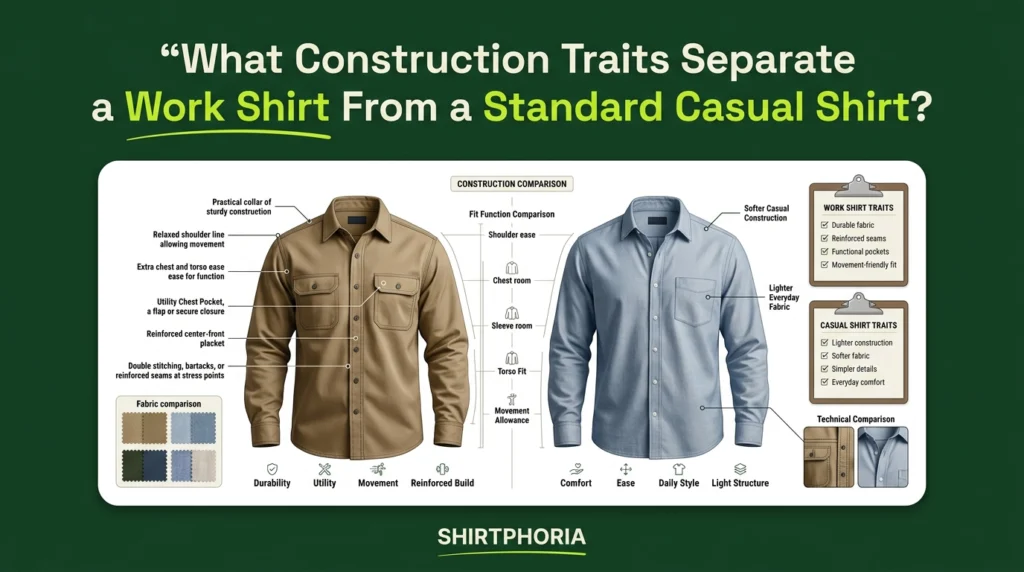
A work shirt differs from a standard casual shirt when its construction prioritizes durability, reinforcement, and movement support more heavily than visual drape or lightweight softness.
| Construction Trait | Work Shirt Construction | Casual Shirt Construction | Practical Meaning |
|---|---|---|---|
| Fabric Weight | Often uses medium-to-heavy task-appropriate fabric measured by GSM or ounces per square yard | Often uses lighter fabric selected for softness, breathability, comfort, or drape | Weight helps describe material mass, but fiber, weave, finish, and use also determine performance |
| Stitching | May use double-needle, triple-needle, chainstitch, or felled seam construction in high-stress areas | May use precise single-needle or lighter seam finishes suitable for ordinary wear | Stitching affects seam durability, bulk, flexibility, and appearance |
| Reinforcement | Often uses bartacks, reinforced pockets, stronger thread, or additional fabric at stress points | Usually uses lighter reinforcement unless the design borrows workwear construction | Reinforcement can reduce stress-point failure but may add stiffness |
| Hardware | May use melamine buttons, metal snaps, reinforced buttons, or other durable closures | May use plastic, shell, horn, or decorative buttons according to design | Hardware should match laundering, repeated use, pulling, and repair needs |
| Fit Intent | Often allows additional movement through the shoulders, upper back, sleeves, or torso | Often prioritizes everyday comfort or a cleaner silhouette | Work shirt fit should support tasks without becoming unnecessarily oversized |
| Tail Length | May use additional length for tucked stability and movement coverage | Length may be driven more strongly by styling and ordinary wear | Tail length can improve coverage but may interfere with equipment when excessive |
| Stress Zones | May reinforce areas expected to receive repeated loads | Usually uses construction appropriate to normal daily wear | Reinforcement is most valuable where loads actually concentrate |
A casual shirt is not automatically weak.
A high-quality casual shirt may use excellent fabric, strong seams, and precise workmanship.
The distinction is mainly one of design priorities.
How Can You Identify Work Shirt Fabric Strength and Weave?
You can identify work shirt fabric strength and weave by checking fabric weight, yarn density, weave structure, fiber content, and how the material behaves under touch and movement.
Fabric should not be judged by thickness alone.
A heavy textile may still perform poorly if its yarn, weave, seams, or finish are unsuitable for the work environment.
A lighter reinforced fabric may outperform a heavier plain weave under certain forms of stress.
CORDURA® describes its Classic Fabric as offering strong tear performance and abrasion resistance, which illustrates why textile construction matters alongside weight. CORDURA® Classic Fabric
The right work shirt fabric depends on the job.
Hot indoor work may require a very different material from:
- Carpentry
- Brush work
- Outdoor labor
- Equipment handling
- Repeated tool contact
How Should GSM and Ounces Be Used in Work Shirt Evaluation?
GSM and ounces should be used in work shirt evaluation as fabric-weight indicators, not as automatic proof that a shirt is durable or task-ready.
GSM means grams per square meter.
It describes the mass of one square meter of fabric.
Ounces per square yard expresses fabric mass using ounces over one square yard.
Both measurements help compare textile weight.
The relationship is:
Fabric Weight Measurement → Estimates Mass → Supports Durability and Comfort Evaluation
However, fabric weight alone does not establish:
- Abrasion resistance
- Tear resistance
- Fiber quality
- Seam quality
- Breathability
- Mobility
- Climate suitability
A lighter ripstop or reinforced blend may outperform a heavier fabric with unsuitable yarns, weave, or construction.
Work shirt fabric weight should therefore be interpreted alongside:
- Climate
- Abrasion exposure
- Movement demands
- Work duration
- Layering needs
- Washing frequency
There is no single weight range that every work shirt must use.
How Do Canvas, Twill, Ripstop, and Poplin Differ?
Canvas, twill, ripstop, and poplin differ because each weave structure balances durability, breathability, stiffness, and surface texture differently.
Canvas
Canvas is generally a strong plain-weave fabric used where structure and abrasion resistance matter.
Its firm surface can work well in environments involving repeated rough contact.
The limitation is that heavier canvas can become:
- Stiff
- Warm
- Bulky
Twill
Twill uses a diagonal weave structure that produces visible or subtle diagonal ribs.
Many workwear fabrics use twill because the construction can balance durability, flexibility, and drape.
Performance still varies according to fiber, yarn, weight, and finishing.
Ripstop
Ripstop incorporates reinforcement yarns into the fabric, commonly creating a grid structure.
The reinforcement can help limit tear propagation.
Ripstop is not tear-proof.
Its actual performance depends on:
- Fiber
- Yarn
- Grid construction
- Fabric weight
- Finish
- Garment construction
Poplin
Poplin is a smooth plain-weave fabric often associated with lighter shirts.
Poplin is not automatically fragile.
A lighter poplin may be less appropriate for heavy abrasion, but it can be useful where low weight and airflow are more important.
The central relationship is:
Weave Structure → Influences Tear and Abrasion Behavior → Affects Work Shirt Suitability
How Can You Inspect Stitching Traits in Work Shirt Construction?
You can inspect stitching traits in work shirt construction by checking seam type, stitch rows, thread condition, stitch density, and reinforcement at high-stress zones.
Seam durability depends on more than the number of visible stitch lines.
ASTM D6193 provides standardized terminology for stitches and seams and includes reinforcement terminology relevant to garment construction. ASTM D6193
Factors that can influence seam behavior include:
- Fabric
- Thread
- Stitch type
- Seam type
- Stitch density
- Tension
- Elasticity
- Workmanship
A visually heavy seam can still perform poorly if the tension is incorrect or the thread and fabric are mismatched.
What Do Double-Needle and Triple-Needle Stitching Indicate?
Double-needle and triple-needle stitching indicate that multiple visible stitch rows are being used to secure a seam or reinforce a high-stress construction area.
Double-Needle Stitching typically produces two parallel rows.
Triple-Needle Stitching typically produces three.
The relationship is:
Multiple Stitch Rows → Distribute Seam Stress → Improve Seam Security Potential
The word potential matters.
Multiple stitch rows are a strong durability clue, but they cannot compensate for:
- Weak thread
- Poor tension
- Skipped stitches
- Damaged fabric
- Incorrect seam placement
Single-needle stitching should not automatically be described as inferior.
Many high-quality casual and dress shirts use precise single-needle construction because their load requirements and finishing goals differ from heavy workwear.
How Do Felled Seams Support Work Shirt Durability?
Felled seams support work shirt durability by enclosing raw fabric edges and creating a cleaner, stronger seam structure that can better tolerate repeated wear.
A felled seam folds the fabric edges into the seam and stitches them down.
The relationship is:
Enclosed Raw Edges → Reduced Fraying → Better Seam Durability Potential
Potential benefits include:
- Reduced exposed raw edges
- Multiple fabric layers at the seam
- Strong seam structure
- Clean interior finishing
Felled seams also create additional bulk.
They are most useful where the durability gain justifies that structure.
A French seam also encloses raw edges.
French seams are often used where clean finishing is important and should not automatically be treated as weak construction.
The appropriate seam depends on location and use.
How Do Bartacks Reinforce Stress Points?
Bartacks reinforce stress points by adding dense reinforcement stitches at areas where pulling or repeated stress is likely to start a tear.
A Bartack is a concentrated group of stitches used to reinforce a small area.
ASTM D6193 describes bartacking in the context of reinforcing critical stress stitchlines. ASTM D6193
Typical locations may include:
- Pocket corners
- Cuff openings
- Placket ends
- Side vents
- Loops
- Other load-bearing junctions
The relationship is:
Bartack → Reinforces Stress Point → Reduces Tear Initiation Risk
Bartacks should be placed intentionally.
Excessive or incorrectly positioned bartacks may create:
- Stiffness
- Needle damage
- Visual clutter
- Concentrated stress
Bartacking is therefore a strong indicator of reinforced construction when it appears at a genuine failure point.
It is not universal proof of workwear quality.
How Can You Test Hardware and Fasteners in Work Shirt Construction?
You can test hardware and fasteners in work shirt construction by checking button material, attachment strength, snap action, zipper quality, and how the closure responds to repeated handling.
Hardware and fabric must work together.
A strong button attached poorly can fail.
A durable snap installed into weak fabric can pull through the placket.
Check:
- Button attachment
- Buttonholes
- Snap alignment
- Snap setting
- Placket stability
- Zipper operation
- Sharp edges
- Loose components
Hardware durability depends on:
- Material
- Attachment
- Washing
- Impact exposure
- Heat exposure
- Work environment
- Repairability
What Do Melamine Buttons Indicate on Work Shirts?
Melamine buttons on work shirts can indicate a durability-focused closure choice because melamine has been used historically where laundering performance and strength mattered.
Heddels describes melamine buttons in military and workwear-related historical contexts and discusses the material’s strength and laundering advantages. Heddels
The relationship is:
Melamine Button → Durable Closure Material → Supports Workwear Hardware Longevity
Melamine is still not indestructible.
Buttons can:
- Crack
- Chip
- Loosen
- Detach
- Fail around their attachment
Performance depends on:
- Button thickness
- Manufacturing quality
- Attachment thread
- Laundering
- Impact exposure
- Garment use
Other button materials can also perform well in appropriate shirts.
Melamine is a useful construction clue, not a universal authenticity requirement.
How Should Snaps, Zippers, and Reinforced Closures Be Evaluated?
Snaps, zippers, and reinforced closures should be evaluated by their attachment strength, smooth operation, material quality, and resistance to grit, impact, and repeated laundering.
No closure material is automatically superior for every job.
Possible constructions include:
- Metal snaps
- Heavy plastic snaps
- Metal zippers
- Coil zippers
- Reinforced sewn buttons
The correct choice depends on:
- Task
- Garment weight
- Washing frequency
- Dirt exposure
- Snag risk
- Repair requirements
Potential warning signs include:
- Loose snaps
- Distorted buttonholes
- Wavy plackets
- Rough zipper movement
- Sharp hardware edges
- Weak surrounding fabric
Closures should be judged as part of the garment construction system.
How Can You Assess Mobility Mechanics in Work Shirt Construction?
You can assess mobility mechanics in work shirt construction by testing whether gussets, pleats, sleeve shape, and tail length allow repeated movement without binding or excessive exposure.
A work shirt should provide movement allowance where the body actually needs it.
Simply making the entire shirt loose can create other problems.
Practical tests include:
- Forward reach
- Overhead reach
- Cross-body reach
- Bending
- Twisting
- Squatting
During each movement, observe:
- Shoulder tension
- Upper-back pulling
- Sleeve restriction
- Underarm binding
- Hem ride-up
- Excess fabric bunching
How Do Gussets and Pleats Support Work Shirt Movement?
Gussets and pleats support work shirt movement by adding controlled fabric allowance where the arms, shoulders, and upper back need range of motion.
An Underarm Gusset is an extra fabric panel inserted beneath the arm.
It can provide additional movement without requiring the entire shirt torso to become wider.
A Back Pleat is folded material positioned around the upper back.
It can open during movement and provide extra room.
The relationship is:
Gusset or Pleat → Adds Movement Allowance → Reduces Binding During Reach
The amount of added fabric still matters.
Too little can produce:
- Binding
- Pulling
- Hem lift
Too much can create:
- Bunching
- Loose folds
- Snagging
- Excess volume
Gussets and pleats are useful when movement demands justify them.
They are not required on every work shirt.
How Does Tail Length Affect Work Shirt Coverage?
Tail length affects work shirt coverage by determining whether the hem stays positioned during bending, reaching, lifting, or tucked wear.
The relationship is:
Adequate Tail Length → Maintains Coverage → Reduces Hem Ride-Up
A longer tail can help a tucked work shirt remain inside the waistband during movement.
The appropriate length depends on the task.
Too Short
A short tail may:
- Untuck
- Ride upward
- Expose the lower torso during bending
Balanced
The hem provides enough coverage without unnecessary interference.
Too Long
An excessively long or loose tail may interfere with:
- Toolbelts
- Harnesses
- Pockets
- Seated work
- Machinery-adjacent tasks
Longer therefore does not automatically mean better or safer.
Length must match the job and wearing method.
Work Shirt Quality Matrix: Weak vs. Functional vs. Strong Construction
A work shirt quality matrix helps users compare construction details by looking at seams, pockets, fabric, hardware, mobility, and reinforcement balance.
| Feature | Weak Construction | Functional Construction | Strong Construction |
|---|---|---|---|
| Seams | Loose stitches, uneven tension, skipped stitches, or poorly controlled edges appear in stress areas | Clean stable seams support ordinary work use | Reinforced seams, felled seams, multiple stitch rows, or other reinforcement are matched to fabric and stress |
| Pockets | Pocket corners lack support despite repeated expected loading | Backstitched or reinforced edges support ordinary use | Bartacked corners, reinforced edges, or double-layer construction are used where load justifies them |
| Fabric | Fabric abrades, tears, or loses shape too easily for the intended job | Cotton, drill, twill, canvas, or blends suit moderate tasks | Ripstop, canvas, reinforced panels, CORDURA® zones, or task-specific fabrics are used where higher stress exists |
| Hardware | Buttons loosen, snaps distort, or buttonholes weaken quickly | Closures remain secure through normal laundering and work use | Durable and repairable hardware is supported by stable attachment and placket construction |
| Mobility | Shoulder binding, sleeve pulling, or excessive hem lift occurs during reach | Fit provides useful allowance for normal bending and reaching | Gussets, pleats, articulated sleeves, or task-specific features reduce pulling without excess bulk |
| Reinforcement | Expected stress zones receive insufficient support | Important junctions receive suitable reinforcement | Reinforcement is concentrated where repeated loads justify it without making the shirt unnecessarily stiff |
Strong construction does not mean maximum construction.
It means appropriate construction.
Work Shirt Construction Diagnostic Checklist
Work shirt construction should be evaluated by checking whether fabric, seams, reinforcement, hardware, and mobility details support real work use rather than rugged styling alone.
Fabric Weight Check
The fabric mass should match:
- Climate
- Abrasion level
- Work duration
- Movement requirements
The heaviest option is not automatically the most useful.
Weave Structure Check
Determine whether the shirt uses:
- Canvas
- Twill
- Ripstop
- Poplin
- Another fabric
Judge that weave against the work environment.
Seam Check
High-stress seams should show:
- Clean stitching
- Stable tension
- Appropriate thread
- No significant skipped stitches
- Suitable seam construction
Reinforcement Check
Inspect stress points such as:
- Pocket corners
- Cuffs
- Placket ends
- Side seams
- Loops
Reinforcement should correspond to expected load.
Bartack Check
Bartacks should appear where concentrated reinforcement makes sense.
They should not be treated as decoration or as a universal requirement.
Hardware Check
Buttons, snaps, and zippers should:
- Remain secure
- Operate smoothly
- Align properly
- Sit in stable fabric
Mobility Check
Perform:
- Forward reach
- Overhead reach
- Cross-body reach
- Bending
- Twisting
Check for shoulder binding, underarm restriction, and excessive hem movement.
Tail-Length Check
The hem should maintain useful coverage without interfering with belts, tools, harnesses, pockets, or other equipment.
Comfort Boundary Check
Added durability should not make the shirt excessively:
- Hot
- Heavy
- Stiff
- Abrasive
- Restrictive
PPE Boundary Check
Do not treat ordinary work shirt construction as certified protective equipment unless the garment meets a specific protective standard.
What Failure Modes Can Reduce Work Shirt Construction Quality?
Work shirt construction quality fails when key attributes move too far in either direction, because both underbuilt and overbuilt construction can reduce durability, comfort, movement, or task compatibility.
| Attribute | Too-Low Failure | Too-High Failure | Corrective Hypothesis |
|---|---|---|---|
| Fabric Weight | Fabric abrades, tears, wrinkles, or collapses too quickly | Fabric becomes too stiff, heavy, or hot | Match weight to climate, abrasion, and movement requirements |
| Weave Strength | Tears or snags spread too easily for the task | Fabric becomes overly rigid, rough, or uncomfortable | Select weave according to task stress and climate |
| Stitching Strength | Loose or weak stitches allow seam separation | Excess stitching creates bulk, puckering, or stiffness | Balance stitch type, density, thread, and tension with fabric |
| Bartack Reinforcement | Stress points tear prematurely | Excess bartacking creates stiff areas or needle damage | Place bartacks only at actual stress points |
| Hardware Durability | Buttons, snaps, or zippers fail prematurely | Heavy hardware adds weight or difficult repair | Match hardware and attachment to laundering, stress, and serviceability |
| Mobility Construction | Shirt binds during reaching and bending | Excess allowance bunches or becomes snag-prone | Add movement allowance only where required |
| Tail Length | Hem rides upward and reduces coverage | Excess length interferes with equipment | Match tail length to wearing method and work task |
| Reinforcement Balance | Stress zones fail before expected fabric life | Shirt becomes overly hot, stiff, or uncomfortable | Reinforce expected failure areas instead of overbuilding the whole garment |
The principle is balance.
More fabric does not always mean more useful durability.
More stitch rows do not always mean a stronger garment.
More reinforcement does not always mean better workwear.
Every added feature has a possible cost in:
- Heat
- Weight
- Stiffness
- Bulk
- Mobility
- Repair difficulty
Checklist: How Can You Identify Superior Work Shirt Construction?
You can identify superior work shirt construction by inspecting stitching, fabric, hardware, reinforcement, mobility, and task compatibility before purchase.
Check the Stitching
Inspect:
- Side seams
- Shoulders
- Sleeves
- Plackets
- Cuffs
Look for:
- Clean stitch lines
- Stable tension
- No obvious skipped stitches
- Appropriate reinforcement
Check the Fabric
Pinch and bend the fabric.
Evaluate:
- Weight
- Stiffness
- Surface
- Drape
- Recovery
Ask whether those characteristics suit the work environment.
Check the Weave
Determine whether the fabric uses canvas, twill, ripstop, poplin, or another construction.
Do not choose a heavy workwear weave when the actual task does not require it.
Check the Bartacks
Inspect:
- Pocket corners
- Cuffs
- Vents
- Placket ends
- Loops
Dense reinforcement should correspond to real stress points.
Check the Hardware
Gently test buttons, snaps, or zippers.
Look for:
- Secure attachment
- Smooth operation
- Correct alignment
- Stable surrounding fabric
Check the Mobility
Raise both arms.
Reach forward.
Cross the arms.
Bend.
Twist.
The shirt should support required movement without severe binding.
Check the Tail Length
Make sure the hem provides useful coverage without interfering with:
- Belts
- Tools
- Harnesses
- Pockets
- Seated work
Check the Claim
Treat terms such as workwear, rugged, industrial, and heavy-duty as claims that need to be supported by actual construction details.
What Are the Key Takeaways of Work Shirt Construction Traits?
What Are the Key Takeaways of Work Shirt Construction Traits?
The key takeaways of work shirt construction traits show that durability comes from balanced fabric, seams, reinforcement, hardware, and movement design.
Work Shirt Construction Summary
- Construction Works as a System: Fabric, stitching, reinforcement, hardware, and fit need to support one another.
- Heavy Is Not Always Better: Fabric mass should match abrasion, climate, and movement requirements.
- GSM Describes Mass: It does not independently prove durability, quality, or task suitability.
- Weave Matters: Canvas, twill, ripstop, and poplin produce different balances of structure, flexibility, and wear behavior.
- Seams Affect Durability: Seam type, thread, tension, stitch density, fabric, and workmanship all matter.
- Multiple Stitch Rows Are Clues: Double and triple stitching can support seam security without guaranteeing quality.
- Felled Seams Have Tradeoffs: Enclosed raw edges can improve durability while adding bulk.
- Bartacks Need Purpose: Dense reinforcement is most useful at actual stress points.
- Hardware Must Match Use: Buttons, snaps, and zippers should suit laundering, pulling, exposure, and repair needs.
- Melamine Is a Durability-Oriented Material: Its workwear history does not make it unbreakable.
- Mobility Still Matters: Gussets, pleats, sleeves, and fit should support the movements required by the task.
- Tail Length Must Match the Job: More length can improve tucked stability but may interfere with tools or equipment.
- Reinforcement Has Limits: Overbuilding can create unnecessary heat, stiffness, weight, and discomfort.
- Workwear Is Not Automatically PPE: Ordinary work shirt construction does not replace certified protective equipment.
Educational note: This guide explains work-shirt construction, durability, mobility, hardware, and reinforcement for general educational purposes. Ordinary workwear does not replace certified PPE, workplace safety procedures, or other occupational controls required for the task.
Interactive Work Shirt Construction Checklist
Frequently Asked Questions About Work Shirt Construction Traits
A durable work shirt commonly combines task-appropriate fabric, stable seams, reinforced stress points, secure hardware, and movement-compatible fit. No individual feature proves durability. The correct construction depends on abrasion exposure, climate, washing, movement, and the specific job.
Triple-needle stitching can be a useful durability indicator in high-stress seams, but it is not automatically superior in every garment. Thread quality, stitch density, tension, fabric strength, seam type, and workmanship all influence the final seam performance.
No. Bartacks can strengthen concentrated stress areas such as pocket corners, cuff openings, vents, and placket ends, but not every shirt requires them in the same locations. Excess or poorly placed bartacking can create stiffness without adding useful durability.
Melamine buttons can be a durable closure choice with historical use in uniform and workwear contexts. They are not indestructible. Button thickness, manufacturing quality, attachment, laundering, heat, and impact exposure can all affect how long the closure performs.
Terms Explained
| TERM | DEFINITION |
|---|---|
| Double-Needle Stitching | A seam construction using two parallel stitch rows to improve seam security potential. |
| Triple-Needle Stitching | A seam construction using three parallel stitch rows, often used in high-stress workwear areas. |
| Felled Seam | A seam that encloses raw fabric edges and stitches them down for cleaner and potentially more durable construction. |
| Bartack | A dense group of reinforcement stitches placed at concentrated stress points. |
| Melamine Button | A durable button material historically used in military, uniform, and workwear contexts. |
| Underarm Gusset | An added fabric panel beneath the arm that can increase movement allowance. |
| Back Pleat | Folded fabric at the upper back that can open during movement and add controlled reach allowance. |
| GSM | Grams per square meter, a measurement of textile mass per unit area rather than a complete durability score. |
Conclusion
In conclusion, work shirt construction traits separate durable task-ready shirts from ordinary shirts when fabric, seams, reinforcement, hardware, and mobility details are matched to real work demands.
Fabric provides the foundation.
Its mass, weave, fiber, and reinforcement influence whether it suits abrasion, climate, and repeated wear.
Heavy fabric is not automatically better.
A lighter ripstop or reinforced material may be more suitable for some tasks than a dense heavy cloth.
Seams connect the fabric into a working garment.
Double and triple stitch rows can provide greater seam-security potential.
Felled seams can enclose raw edges.
Bartacks can reinforce concentrated stress points.
Each technique still depends on thread, tension, stitch density, placement, and fabric compatibility.
Hardware forms another part of the system.
Melamine buttons, snaps, zippers, and other closures need to remain attached and functional under expected laundering and work conditions.
Their material alone cannot guarantee durability.
Mobility construction determines whether that durability remains useful when the body moves.
Underarm gussets can provide extra allowance.
Back pleats can support upper-back movement.
Suitable tail length can help maintain coverage.
Those features should be proportional to the actual movement and equipment requirements.
Underbuilt construction creates one set of problems.
Fabric may abrade too quickly.
Seams may separate.
Pocket corners may tear.
Hardware may loosen.
Overbuilt construction creates another set.
Fabric may become too hot.
Stitching may create unnecessary stiffness.
Excess reinforcement may harden the garment.
Large mobility allowances may bunch.
Long tails may interfere with equipment.
The useful work shirt sits between these extremes.
Its construction can support durability, movement, coverage, and comfort, but it does not guarantee personal safety or replace certified PPE.
Choosing a work shirt well means judging construction by the failures it prevents and the work your body actually performs.