How Is Placket Design Differentiated in Formal Tuxedo Shirts?
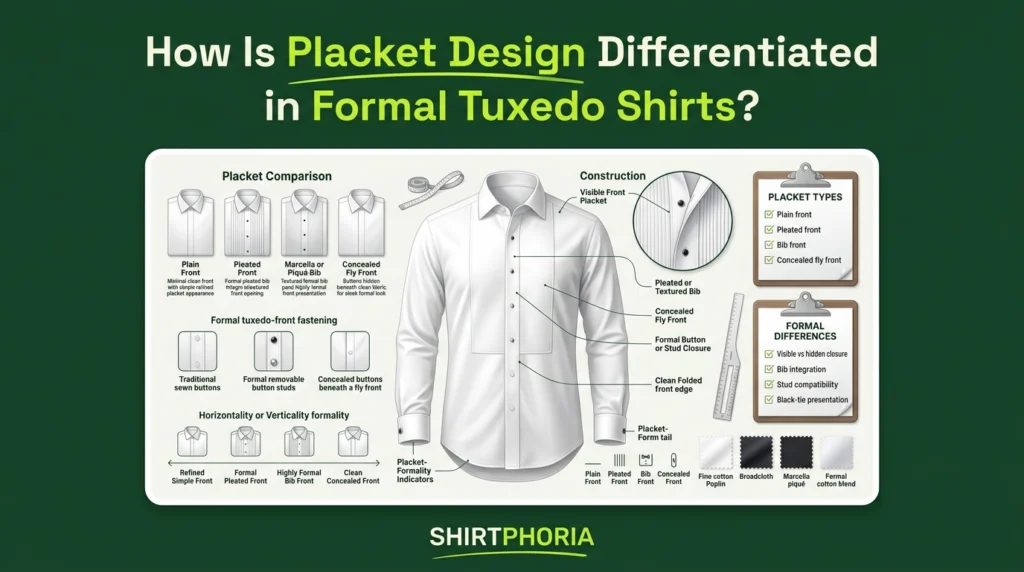
Placket design in formal tuxedo shirts is differentiated by how the center-front closure is presented: a Fly-Front conceals buttons, a Stud-Compatible front replaces visible closures with formal studs, and a Plain or French Front may use discreet or removable buttons while maintaining a restrained surface.
Quick Answer: What Are the Main Tuxedo-Shirt Placket Designs?
The main tuxedo-shirt closure systems are Fly-Front, Stud-Compatible, and discreet-button or removable-button configurations. These should not be confused with shirt-front treatments such as Plain, Pleated, or Piqué. A tuxedo shirt can combine one front treatment with several different closure systems.
A tuxedo shirt is often misclassified because terms such as front style, placket, bib, and button system are treated as though they describe the same feature.
They do not.
The visible shirt front and the fastening system are separate construction decisions.
This guide separates tuxedo-shirt front treatments from closure systems, explains how Fly-Front, Stud-Compatible, and Plain configurations work, and provides a framework for matching each design to Black Tie or White Tie.
The wider anatomy of tuxedo shirts also includes fabric, collar, cuffs, fit, shirt-front treatment, and closure construction rather than the placket alone.
A shirt may therefore combine:
- a Piqué Bib with studs;
- a Pleated Bib with studs;
- a Pleated Bib with concealed buttons;
- a Plain Front with removable buttons;
- a Plain Front with studs;
- or a Plain Front with a Fly-Front.
The Proper Cloth tuxedo-shirt guide documents Plain Front constructions that use removable buttons so the wearer can replace them with formal studs.
Why Do Formal Tuxedo Shirts Use Specialized Front and Placket Design?
Formal tuxedo shirts use specialized front and placket design to control button visibility, surface texture, ornamentation, and visual continuity beneath the dinner jacket or tailcoat.
The center front can serve several purposes.
It may:
- conceal functional buttons;
- replace visible closures with Shirt Studs;
- retain discreet sewn or removable buttons;
- introduce controlled texture through pleats;
- use a Piqué or Marcella panel;
- or maintain a smooth Plain Front.
The correct design depends on the complete formal system rather than a single feature.
How Formal Front Design Controls Visual Clutter
Formal front design controls visual clutter by limiting ordinary business-shirt details and organizing the shirt’s center line through concealment, studs, restrained buttons, or structured bib treatment.
The central relationship is:
Controlled center-front construction → reduces competing visual details → supports a coherent evening-shirt presentation.
The shirt front should visually support the other components of formal evening dress:
- the bow tie;
- the lapels of the Dinner Jacket or Tailcoat;
- Cufflinks;
- Shirt Studs where used;
- and the visible white shirt area above the waist treatment.
Ordinary office-shirt elements can weaken the formal character when several appear together.
Examples include:
- a Button-Down Collar;
- Barrel Cuffs;
- a chest pocket;
- a thick raised business placket;
- and large contrasting plastic buttons.
One visible white button does not automatically invalidate Black Tie.
The complete garment should be evaluated. Debrett’s black-tie guidance allows both plain evening shirts with buttons and Fly-Front shirts with concealed buttons, showing why button visibility alone is not enough to classify the shirt.
How Shirt-Front Treatment Differs from the Closure System
Shirt-front treatment and closure system perform different tasks: the front determines the visible chest surface, while the closure determines how the shirt is fastened.
The main visible front treatments are:
Plain Front: A clean surface without a separate Piqué panel or pleated bib.
Pleated Bib: A visible chest area formed with controlled vertical folds.
Piqué or Marcella Bib: A textured formal panel associated with traditional evening shirts.
The main closure systems are different.
Fly-Front: Functional buttons are concealed beneath an outer fabric flap.
Stud-Compatible Front: Paired openings or removable-button construction allow formal Shirt Studs to fasten the shirt.
Discreet-Button Closure: Restrained sewn or removable buttons remain visible as part of a Plain or other formal front.
These two construction axes can overlap.
For example:
- Piqué Bib + Stud-Compatible closure
- Pleated Bib + Stud-Compatible closure
- Pleated Bib + Fly-Front
- Plain Front + removable buttons
- Plain Front + Shirt Studs
- Plain Front + concealed Fly-Front
Taxonomy Rule: “Plain,” “Pleated,” and “Piqué” describe what the shirt front looks like. “Fly-Front,” “Stud-Compatible,” and “button closure” describe how the shirt fastens.
How Can You Differentiate the Three Primary Tuxedo-Shirt Closure Systems?
The three primary tuxedo-shirt closure systems are differentiated by whether buttons are concealed, replaced by studs, or retained in a restrained visible or removable configuration.
Each system should be evaluated by its construction, visual result, compatible front treatments, dress-code role, and possible failure modes.
How to Identify the Fly-Front Concealed Closure
A Fly-Front is identified by an outer fabric layer that covers the functional buttons and creates an uninterrupted center-front line.
Its construction normally includes:
- functional buttons beneath the front;
- a fabric extension that covers the button line;
- and an outer surface that hides most or all visible closures.
The visual result is one of the cleanest concealed options for contemporary Black Tie.
A Fly-Front should not be called the universally highest-formality closure because traditional White Tie generally uses visible Shirt Studs rather than concealed functional buttons.
Debrett’s recognizes concealed-button Fly-Front construction as an acceptable Black-Tie option.
A Fly-Front can appear with:
- a Plain Front;
- a Pleated Front;
- or another restrained formal front treatment.
Where a tuxedo shirt uses concealment to simplify its center line, rugby-shirt plackets are deliberately visible and reinforced for a sport-derived construction purpose.
The Fly-Front also has potential failure modes.
A poorly constructed or poorly fitted Fly-Front may develop:
- puckering along the flap;
- visible lumps from hidden buttons;
- pulling under tension;
- a front edge that rolls open;
- or excessive bulk.
The flap should remain flat and visually stable during normal movement.
How to Identify a Stud-Ready or Stud-Compatible Front
A Stud-Compatible front uses paired openings or removable-button construction so decorative shirt studs can fasten the visible portion of the shirt.
Construction varies among shirts.
Some Stud-Compatible shirts omit visible front buttons.
Some use buttons attached to a removable strip.
Others allow the wearer to switch between removable buttons and studs.
A Stud-Compatible front should therefore not be defined as a front that permanently lacks buttons.
Shirt Studs have two functions:
- They fasten the formal shirt front.
- They provide restrained formal ornamentation.
Their presence is compatible with more than one dress code.
Traditional White Tie uses studs as part of its formal shirt system.
Traditional Black Tie may also use studs.
The studs alone do not determine whether the shirt belongs to White Tie or Black Tie.
The Emily Post dress-code guide includes Shirt Studs and Cufflinks within traditional Black-Tie and White-Tie dress while distinguishing the two codes through the remaining ensemble.
Potential Stud-Compatible problems include:
- studs that are too small for the holes;
- oversized studs that overpower the shirt front;
- loose studs;
- stretched stud openings;
- missing hardware;
- uneven spacing;
- and center-front distortion.
A secure vertical line matters as much as the decorative material.
How a Plain or French Front Uses Discreet or Removable Buttons
A Plain or French Front creates a clean surface without a separate bib treatment and may use discreet sewn buttons, removable buttons, studs, or another restrained closure system.
A French Placket is a minimal front construction that does not use a separately sewn raised placket strip.
A Plain Front describes the visible treatment. It does not guarantee that permanently sewn buttons will remain visible.
Some Plain Front shirts use removable button systems that allow the front to switch between standard buttons and formal studs.
This construction can support:
- a quiet contemporary Black-Tie appearance;
- use with Shirt Studs;
- use with restrained buttons;
- and easier transition between tuxedo and formal-suit contexts.
Its formality still depends on the complete shirt.
Important variables include:
- collar;
- cuffs;
- fabric;
- fasteners;
- opacity;
- fit;
- and the surrounding ensemble.
Plain Fronts should not be dismissed as rental-only or beginner designs.
Their possible failure modes include:
- oversized business-style buttons;
- a thick office-style applied placket;
- button strain;
- gaping between closures;
- excessive transparency;
- or combination with Barrel Cuffs and a Button-Down Collar that makes the shirt resemble conventional businesswear.
How Should Tuxedo-Shirt Front and Placket Design Be Matched to Event Formality?
Tuxedo-shirt front and placket design should be matched to the complete dress code, including the collar, cuffs, coat, bow tie, waist treatment, and fastener system.
The placket alone does not establish White Tie or Black Tie.
How Collar Style and Placket Design Work Together
Collar style and placket design work together as coordinated parts of a formal ensemble, but neither component mechanically determines the other.
White Tie
Traditional White Tie typically combines:
- Wing Collar;
- stiff or Marcella formal shirt front;
- Stud-Compatible closure;
- White Bow Tie;
- White Waistcoat;
- and Tailcoat.
The Wing Collar does not mechanically require studs. The two features are simply part of the same traditional White-Tie system.
Traditional Black Tie
Traditional Black Tie commonly combines:
- Turndown or Spread Collar;
- Piqué, pleated, or another restrained formal front;
- Stud-Compatible or Fly-Front closure;
- Black Bow Tie;
- French or Double Cuffs;
- and Dinner Jacket.
Contemporary Black Tie
Contemporary Black Tie can allow a wider range of controlled combinations:
- Turndown or Spread Collar;
- Plain, pleated, or restrained Piqué front;
- Fly-Front;
- Shirt Studs;
- discreet removable buttons;
- French Cuffs;
- Black Bow Tie;
- and Dinner Jacket.
A Turndown or Spread Collar can therefore appear with studs, Fly-Front concealed buttons, or a restrained Plain Front.
Debrett’s Black-Tie guidance reflects this flexibility by accepting studs as well as plain or concealed-button fronts.
The relationship is:
Dress-code system → coordinates collar and closure choices → produces a coherent formal ensemble.
How Shirt Studs Should Coordinate with Cufflinks
Shirt studs should coordinate with cufflinks in scale, metal tone, color family, and formal character without requiring every piece to be an identical manufactured set.
Studs are functional fasteners first and decorative details second.
Black Onyx and Mother-of-Pearl are classic examples of stud materials, but they are not the only acceptable options.
Coordination can consider:
- similar metal tone;
- similar visual weight;
- compatible surface finish;
- controlled color contrast;
- and proportionate hardware size.
Exact matching is not compulsory.
Likewise, mixing metals does not automatically break formal etiquette. Restrained complementary hardware can remain visually coherent.
The simplest approach is a deliberately coordinated set, but it is not the only workable approach.
Oversized, brightly colored, novelty, or poorly secured studs can overpower the front or weaken its formal balance.
Comparison: How Do Formal Tuxedo-Shirt Front and Placket Systems Differ?
A direct comparison reveals that tuxedo-shirt closure systems differ primarily in button visibility, fastening method, visual emphasis, and dress-code compatibility rather than in one universal ranking of formality.
| Closure or Front ConfigurationButton VisibilityFastening MethodFormal RoleTypical Event Use | ||||
|---|---|---|---|---|
| Fly-Front | Functional buttons concealed | Sewn buttons beneath a covering flap | Creates a clean, uninterrupted center line | Traditional or contemporary Black Tie |
| Stud-Compatible Front | Shirt Studs visible | Paired openings or removable-button system | Combines fastening with restrained ornamentation | White Tie and traditional Black Tie |
| Plain/French Front with Studs | Studs visible on a minimal front | Removable buttons replaced by studs | Creates a modern clean surface with formal jewelry | Contemporary or traditional-leaning Black Tie |
| Plain/French Front with Discreet Buttons | Small buttons visible | Sewn or removable buttons | Creates a restrained contemporary appearance | Contemporary Black Tie or Black Tie Optional, depending on the complete shirt |
| Pleated Bib + Stud Closure | Studs visible against pleats | Stud-Compatible fastening | Combines controlled texture and formal ornamentation | Traditional Black Tie |
| Piqué/Marcella Bib + Stud Closure | Studs visible against a structured bib | Stud-Compatible fastening | Creates a highly traditional formal front | White Tie or high-tradition Black Tie, depending on the complete ensemble |
Formality Rule: The complete ensemble determines the dress code. A Fly-Front is not automatically more formal than studs, and visible studs do not automatically make a shirt White Tie.
Taxonomy Reminder: Plain, Pleated, and Piqué describe the shirt-front surface. Fly-Front, studs, and buttons describe the closure system.
Tuxedo-Shirt Front and Placket Outcomes
| OutcomeRequired EvidenceInterpretation | ||
|---|---|---|
| White-Tie Pass | White-Tie event, Wing Collar, stiff or Marcella formal front, secure studs, White Bow Tie, White Waistcoat, and Tailcoat | The shirt front and closure form part of a coherent White-Tie ensemble |
| Traditional Black-Tie Pass | Turndown/Spread Collar, formal white front, studs or Fly-Front, French Cuffs, Black Bow Tie, and Dinner Jacket | The shirt follows established Black-Tie construction |
| Contemporary Black-Tie Pass | Turndown/Spread Collar, restrained Plain/Pleated/Piqué front, Fly-Front, studs, or discreet buttons, French Cuffs, and Dinner Jacket | The shirt follows a modern but recognizably Black-Tie configuration |
| Black-Tie Optional Pass | Formal white shirt with a controlled front and closure appropriate to either a tuxedo or dark formal suit | The shirt offers greater flexibility without being mistaken for strict White Tie |
| Mixed Configuration | White-Tie, Black-Tie, business-shirt, or casual elements conflict without a deliberate convention | Review the collar, front, cuffs, closure, and coat |
| Correction Required | Missing studs, loose hardware, puckering, gaping, distorted holes, severe button strain, or misaligned closure | Repair, refit, or replace the affected front component |
| Insufficient Evidence | Event code, front treatment, or closure system cannot be identified | Do not assign a final dress-code classification |
Observable Condition Zones
Ideal Zone
The center front remains aligned.
The Fly-Front flap lies flat.
Shirt Studs remain secure.
The button line does not strain.
The front does not gap.
Pleats or bib panels remain symmetrical.
Hardware size suits the front.
The shirt remains stable through ordinary movement.
Transition Zone
Minor puckering appears near one closure.
A stud rotates but remains secure.
The Fly-Front edge lifts slightly.
The center line shifts during movement.
One button area shows mild tension.
The shirt requires a small pressing correction.
Correction-Required Zone
Studs detach or pass through stretched holes.
The shirt front opens between closures.
The Fly-Front rolls, bulges, or exposes its buttons.
Buttons strongly pull or distort the cloth.
The Pleated Bib or Piqué panel sits visibly off-center.
Missing hardware leaves the shirt unsecured.
The front configuration conflicts with the stated dress code.
Error-Proof Verification Protocol
Follow this sequence:
- Confirm the event dress code.
- Identify the visible shirt-front treatment.
- Identify the closure system separately.
- Confirm collar and cuff construction.
- Install removable buttons or Shirt Studs correctly.
- Close the shirt completely.
- Inspect the center line from the front.
- Sit, stand, turn, and raise the arms.
- Check for puckering, gaping, strain, or loose hardware.
- Add the bow tie, jacket, and waist treatment.
- Select one outcome from the verification table.
- Correct one variable at a time.
- Repeat the complete-ensemble inspection.
Correction Hypothesis: When the shirt front looks incorrect, isolate the front treatment, closure type, stud fit, button tension, pressing, and collar compatibility before replacing the entire shirt.
Repeatability Rule: The verification result remains consistent only when the same front taxonomy, closure definitions, dress-code boundaries, and inspection sequence are applied each time.
The Tuxedo-Shirt Front and Placket Verification Checklist
Before finalizing a formal ensemble, verify the event code, shirt-front treatment, closure system, collar, cuffs, alignment, fastening stability, and accessory coordination as one connected system.
Frequently Asked Questions
The front treatment describes the visible chest surface, such as Plain, Pleated, or Piqué. The placket or closure system describes how the shirt fastens, such as Fly-Front, Stud-Compatible, or discreet buttons.
No. A Fly-Front is a clean Black-Tie option, while studs are traditional in both White Tie and Black Tie. The complete ensemble determines the dress-code result.
Yes. A Plain or French Front can use removable buttons, studs, discreet sewn buttons, or a concealed Fly-Front depending on the shirt construction.
No. Studs appear in both traditional White-Tie and Black-Tie systems. Collar, cuffs, shirt front, bow tie, coat, and waist treatment determine the final classification.
The flap should lie flat, conceal the buttons, and remain stable without puckering, bulging, rolling open, or exposing the hidden button line during normal movement.
Terms Explained
| TERM | DEFINITION |
|---|---|
| Fly-Front | A closure in which functional buttons are concealed beneath an outer fabric flap. |
| Stud-Compatible Front | A closure system using paired openings or removable-button construction so formal shirt studs can fasten the shirt. |
| Plain Front | A clean visible shirt front without a separate pleated or Piqué bib treatment. |
| French Placket | A minimal front construction without a separately sewn raised placket strip. |
| Pleated Bib | A formal chest treatment made with controlled vertical folds. |
| Piqué / Marcella Bib | A textured formal front panel associated with traditional evening shirts. |
| Shirt Studs | Removable formal fasteners that secure the shirt front while adding restrained ornamentation. |
| Discreet-Button Closure | A restrained visible or removable button system used on some formal Plain Front shirts. |
| Black Tie | A formal evening dress system commonly using a dinner jacket, black bow tie, French cuffs, and a controlled white shirt front. |
| White Tie | The highest traditional evening dress code, normally using a Wing Collar, stiff formal front, studs, white bow tie, white waistcoat, and tailcoat. |
Conclusion
The final selection rule for formal tuxedo-shirt placket design is to choose the visible front treatment and fastening system separately, then verify that both support the intended dress code and complete ensemble.
Plain, Pleated, and Piqué describe the visible shirt-front treatment.
Fly-Front, Stud-Compatible, and button closures describe how the shirt fastens.
These systems can overlap.
Fly-Front construction prioritizes concealment.
Stud-Compatible construction combines fastening with restrained ornamentation.
Plain or French Fronts may use studs, removable buttons, or discreet visible buttons.
Traditional White Tie normally uses a stiff formal front with Shirt Studs.
Traditional Black Tie accepts studs or Fly-Front construction.
Contemporary Black Tie permits a broader range of controlled front configurations.
The complete ensemble determines the final result.
Excessively casual visible construction can weaken the formal effect, while excessive rigidity, oversized hardware, or incorrectly combined White-Tie features can create a different kind of mismatch.
By separating shirt-front design from closure construction, you can select a tuxedo-shirt placket that is structurally coherent, formally appropriate, and visually controlled.