What Makes Ringer Shirts Express Fit and Styling Versatility in Modern Fashion?
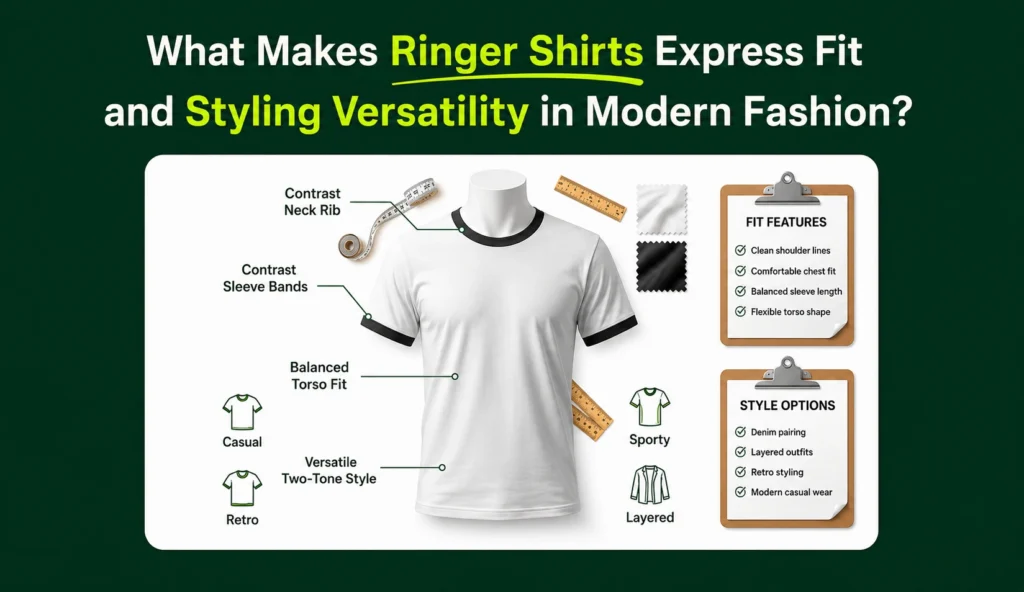
Ringer shirts are T-shirts defined by contrasting ribbed bands on the collar and sleeve hems, creating a visual frame that can make the neckline and arms look more defined than a plain standard T-shirt. Merriam-Webster similarly defines a ringer T-shirt as a tee with contrasting ribbed fabric around its collar and sleeves.
Many people see Ringer Shirts as retro throwback tees, but much of their styling value comes from the way the Contrast Collar and Sleeve Bands frame the neckline, sleeves, and upper body. Unlike a plain tee, a ringer design introduces colour and structure at the garment’s edges without requiring a large graphic or complicated layering.
This guide explains what ringer shirts are, how their contrast ribbed construction affects visual fit, and how to style them across retro, casual, Smart-Casual, and Athleisure outfits.
The phrase Express Fit Silhouette describes the sharper visual framing produced by the contrasting collar and sleeve bands. It is not an official apparel fit category, and it does not mean that all Ringer T-Shirts are cut slim or tight.
Readers comparing ringer shirts with broader T-shirt fit guide principles should consider how neckline shape, sleeve length, fabric weight, and cut all affect styling versatility.
Why Do Ringer Shirts Remain Popular in Modern Styling?
Ringer shirts remain popular in modern styling because their contrast collar and sleeve bands create an immediate retro visual frame without requiring heavy layering or accessories.
Their popularity is best understood as continued style relevance rather than proof that they are better than other T-shirt designs. The contrasting trim provides a recognisable detail that can make a simple jeans-and-tee outfit appear more deliberate.
The basic visual relationship is straightforward:
Contrast collar and sleeve bands → create a visual frame → support retro-casual styling.
This effect can be bold or subtle. A white shirt with black rings creates an obvious graphic outline, while a charcoal shirt with black rings offers a quieter interpretation.
How Does Retro Contrast Give Ringer Shirts Visual Appeal?
Retro contrast gives ringer shirts visual appeal because the collar and sleeve bands create graphic edges that make the shirt look more intentional than a plain tee.
A high-contrast combination, such as white with navy, red, or black bands, can attract attention to the neckline and sleeves. The colour difference forms what can be described as a Retro Contrast Frame: a visual border that defines the upper edges of the garment.
Lower-contrast combinations create a softer effect. Cream with beige, grey with charcoal, or navy with dark blue can preserve the ringer construction while making the shirt easier to combine with understated trousers, jackets, and footwear.
The effectiveness of the contrast depends on the complete outfit. Bright rings combined with a large graphic, distressed jeans, colourful footwear, and several accessories may make the outfit feel crowded. The same shirt may look more balanced with simple denim and neutral trainers.
How Did Ringer Shirts Move from Retro Sportswear to Casual Style?
Ringer shirts are commonly associated with retro sportswear and late-1960s/1970s casual style, but their exact history should be described only with source-supported context.
Ringer shirts are strongly associated with retro athletic styling, vintage casualwear, and 1970s-inspired graphic T-shirt culture. Fashion coverage frequently connects the design with the countercultural clothing of the 1960s and 1970s, while contemporary designers continue to reinterpret its contrasting trim.
The design’s athletic character comes partly from its resemblance to team-colour clothing and vintage sports uniforms. However, modern ringer styling is not limited to sportswear. The shirt can appear in vintage, rock-inspired, skate, indie, collegiate, minimalist, or everyday casual outfits.
These associations are styling references rather than a single universal origin story. A plain cream-and-navy ringer can suggest retro athletics, while a fitted graphic version may feel closer to music or 1970s casualwear.
What Defines the “Express Fit Silhouette” of Ringer Shirts?
The Express Fit Silhouette of ringer shirts refers to the more visually defined neckline and sleeve edges created by contrast ribbed bands, not to an official apparel fit category.
A ringer shirt may be slim, regular, boxy, cropped, oversized, or vintage-inspired. What distinguishes it visually is not necessarily the cut of the body but the way the Ribbed Bindings outline the collar and sleeves.
A 1×1 Rib Knit is constructed with alternating knit and purl columns. Research on rib-knit stretch and recovery also shows that recovery performance varies with construction variables such as stitch length, yarn count, and fabric weight. This structure gives the fabric horizontal stretch and recovery, which is why rib knits are frequently used for collars, cuffs, waistbands, and garment trims.
A 2×2 Rib Knit uses wider groups of knit and purl columns, producing a more pronounced rib pattern. It may be selected for cuffs, trims, sweaters, waistbands, or garments where a bolder rib texture is desired.
The use of rib knit does not automatically make a shirt durable or permanently resistant to stretching. Performance depends on yarn composition, elastane content, knit density, stitching, collar construction, use, and laundering.
How Do Ribbed Bindings Support Shape Retention?
Ribbed bindings can support Shape Retention by adding stretch and recovery to the collar and sleeve edges, but their performance depends on fibre content, knit structure, sewing quality, and care.
When a shirt is pulled over the head, its collar needs enough stretch to expand and enough recovery to return towards its original form. Rib knit is useful for this purpose because its looped structure can expand across the width more easily than many stable fabrics.
Good ribbing can help the collar and sleeve bands recover after wear, but washing heat, dryer heat, fabric quality, and construction still affect long-term shape.
A collar with weak recovery may become loose, wavy, twisted, or uneven. A rib that is too tight may pull the neckline inward or make the sleeve bands pinch. A strong-looking rib can also perform poorly when it has been attached with uneven tension.
Ribbed bindings therefore support edge structure, but they do not guarantee permanent Shape Retention or prevent stretching.
How Do Ringer Shirt Fabric and Rib Tension Affect Fit?
Ringer shirt fabric and rib tension affect fit because the main body controls drape while the collar and sleeve bands control how strongly the edges frame the neckline and arms.
Ringer shirts may be made from cotton, cotton blends, jersey, synthetic blends, or other T-shirt fabrics depending on the brand and design. A lightweight fabric may drape softly, while a denser jersey may create a more structured outline.
The rib tension must work with the body fabric. When the collar rib is too short or tight for the neckline opening, it may gather the surrounding fabric. When it is too loose, the collar may sit away from the neck or develop waves.
Sleeve-band tension matters as well. A snug band can create a sharp edge, but excessive tightness may pinch the arm and cause the sleeve fabric to bunch above it. Softer ribbing or a regular-fit sleeve can create a less restrictive appearance.
Many T-shirt collars use rib-knit structures because rib knits stretch and recover well; a ringer shirt’s contrast bands may use 1×1 rib, 2×2 rib, or another trim depending on the garment design.
How Can Ringer Shirts Create Styling Versatility?
Ringer shirts can create styling versatility because their contrast bands work as built-in visual detail that can support retro, minimalist, Smart-Casual, indie, grunge, or Athleisure outfits.
That versatility is conditional. It depends on the colour contrast, body fit, fabric quality, graphics, trousers, layers, footwear, and setting.
A plain tonal ringer shirt may work as a quiet wardrobe basic. A fitted white tee with red rings and a large vintage graphic may operate as a statement piece. Both belong to the same garment category, but they serve different styling goals.
How Can Ringer Shirts Work in Minimalist Outfits?
Ringer shirts can work in minimalist outfits when the contrast bands are simple, the colour palette is restrained, and the rest of the outfit stays clean.
Neutral combinations include:
- White with black rings
- Cream with navy rings
- Grey with charcoal rings
- Navy with dark-blue rings
- Beige with brown rings
For a simple casual outfit, a neutral ringer can be paired with straight-leg jeans and clean trainers. The contrast trim supplies enough definition to distinguish the shirt from a completely plain tee.
A low-contrast ringer shirt can work with chinos or tailored trousers in relaxed Smart-Casual settings, but it may still be too casual for formal workplaces.
The shirt should generally be clean, opaque, well fitted, and free from heavily distressed graphics when used in a smarter outfit. Structured pieces such as an overshirt, unstructured blazer, clean leather trainers, or simple loafers may help raise the formality slightly.
How Can Ringer Shirts Support Indie, Vintage, or Grunge Styling?
Ringer shirts can support indie, vintage, or grunge styling when paired with worn denim, canvas trainers, boots, overshirts, or vintage-wash fabrics.
For a vintage-inspired outfit, consider a cream shirt with burgundy, forest-green, or navy rings. Straight or slightly flared jeans can reinforce the retro reference without turning the outfit into a costume.
An indie outfit may combine a graphic ringer with dark denim, a lightweight overshirt, canvas trainers, and restrained accessories. A looser ringer with washed black jeans and boots may produce a grunge-influenced effect.
The graphic and colour choice should determine how many additional details the outfit needs. A bold printed Ringer T-Shirt often works best with simpler trousers and footwear. A plain ringer can accommodate more texture through denim, suede, corduroy, or layered shirts.
Not every ringer shirt carries rock, skate, or music-subculture meaning. Those effects come from the complete outfit, graphic treatment, colours, and cultural references used in the design.
How Can Ringer Shirts Fit Modern Athleisure Outfits?
Ringer shirts can fit modern Athleisure outfits when their retro athletic details are paired with joggers, track pants, technical trousers, or clean trainers.
The contrast rings supply a vintage-sport element, while streamlined modern bottoms keep the outfit current. A cream-and-green ringer, tapered navy track pants, and simple white trainers can create an athletic reference without resembling a full sports uniform.
Fit is especially important in this context. A very tight tee with very tight joggers may appear restrictive, while an oversized shirt with extremely wide track trousers may lose the graphic definition created by the trim.
A regular or slightly relaxed ringer often provides enough drape for comfort while keeping the collar and bands visible. Technical jackets, lightweight windbreakers, caps, and minimal trainers can support the athletic direction.
How Should Ringer Shirts Be Selected and Styled for Different Body Goals?
Selecting and styling ringer shirts for different body goals requires matching fit, sleeve length, fabric weight, and contrast level to the visual effect the wearer wants.
The garment does not physically change body shape. Instead, its trim can direct visual attention, strengthen or soften contrast, and create different levels of emphasis.
| Body Goal | Recommended Ringer Fit | Contrast Strategy |
|---|---|---|
| Draw attention to shoulders and arms | Slim or regular fit with sleeves ending around mid-bicep | Higher contrast, such as a white body with navy or black rings |
| Create a subtler profile | Regular fit or slightly heavier jersey | Tonal contrast, such as a charcoal body with black rings |
| Emphasise athletic styling | Fitted but not tight, with clean sleeve bands | Sport-inspired contrast, such as a cream body with green, navy, or burgundy rings |
| Keep the look relaxed | Regular fit with softer fabric | Low-to-medium contrast |
| Avoid overemphasis | Avoid very tight cuffs or very bright sleeve bands | Tonal or low-contrast rings |
How Can Ringer Shirts Draw Attention to the Shoulders and Arms?
Ringer shirts can draw attention to the shoulders and arms because the sleeve bands create a visual stopping point around the upper arm.
A high-contrast sleeve band can make the upper-arm area more noticeable, especially when the sleeve length and fit are well balanced. The effect is visual rather than anatomical and will vary according to the wearer, shirt cut, sleeve opening, colour combination, and posture.
Sleeves ending around the middle of the upper arm may create a clearer contrast point than very short or elbow-length sleeves. However, the best length depends on personal comfort and the intended silhouette.
The sleeve band should lie cleanly without digging into the arm. If the rib creates deep pressure marks, causes fabric to bunch, or restricts movement, a larger size, regular fit, wider sleeve opening, or softer rib may be more suitable.
How Should the Right Ringer Shirt Contrast Level Be Chosen?
The right ringer shirt contrast level should be chosen based on how bold or subtle the wearer wants the outfit to appear.
Higher contrast → stronger retro signal → more visual attention.
White with red, white with black, or cream with dark green can produce an obvious graphic effect. These combinations often work well when the rest of the outfit uses uncomplicated colours and shapes.
Tonal contrast is quieter. Grey with charcoal, navy with dark blue, or cream with beige retains the ringer identity but may be easier to include in minimalist and relaxed Smart-Casual outfits.
Medium contrast offers a balance between the two. A faded blue shirt with navy rings, for example, can reference vintage sportswear without dominating the outfit.
Personal colouring may influence preference, but rigid skin-tone rules are unnecessary. The most useful approach is to compare the shirt near the face in natural light and decide whether the collar colour creates the desired amount of contrast.
Ringer Shirts vs. Standard Crew Neck Tees: A Comparison
Comparing ringer shirts with Standard Crew Neck Tees shows that ringer shirts create stronger visual edge definition, while standard crew neck tees usually offer a quieter and more neutral base.
| Feature | Ringer Shirts | Standard Crew Neck Tees |
|---|---|---|
| Collar/Cuff Design | Contrasting ribbed collar and sleeve bands | Matching collar, self-fabric collar, or subtle ribbed collar |
| Visual Focus | Draws more attention to neckline and sleeve edges | Usually blends more quietly into the outfit |
| Fit Perception | Can look more defined because of contrast bands | Depends mostly on cut, fabric, sleeve length, and neckline |
| Durability | Depends on fabric, rib quality, stitching, and care | Depends on fabric, collar construction, stitching, and care |
| Style Vibe | Retro, sporty, graphic, casual | Basic, versatile, understated, or minimalist |
| Main Risk | Contrast may feel too loud, tight, or casual | May feel plain or less visually distinctive |
Neither style is automatically better.
A ringer shirt may be preferable when the outfit needs a graphic neckline, retro detail, or visual emphasis around the sleeves. A Standard Crew Neck Tee may work better when the goal is to create a neutral base for a jacket, patterned overshirt, statement trousers, or prominent accessories.
The right choice depends on the outfit goal, setting, colour contrast, fabric, and fit.
When Can Ringer Shirts Fail as a Styling Choice?
Ringer shirts can fail as a styling choice when the contrast, fit, fabric, or setting does not match the outfit goal.
| Intended Benefit | Possible Failure Mode | Correction |
|---|---|---|
| Retro contrast | Contrast looks too loud or costume-like | Choose tonal or low-contrast rings |
| Defined sleeve edge | Sleeve bands pinch or overemphasise the arm | Choose a regular fit or softer ribbing |
| Cleaner neckline | Ribbed collar waves, stretches, or “bacons” | Check collar recovery and wash gently |
| Smart-casual styling | Shirt looks too casual for the setting | Use subtle contrast and structured layers |
| Vintage appeal | Graphic or colour choice looks dated | Choose cleaner colours or minimal graphics |
| Shape retention | Heat damages fabric or rib recovery | Follow the care label, wash cold, and avoid high dryer heat |
| Contrast colour | Dark rings bleed into lighter body fabric | Wash inside out, use cold water, and separate colours |
A ringer shirt may also become difficult to style when several competing elements appear at once. A brightly coloured collar, tight sleeve bands, oversized graphic, distressed fabric, patterned trousers, and bold trainers can create more visual information than the outfit needs.
Dye-transfer risk deserves particular attention when dark Ribbed Bindings are attached to a pale shirt body. Following the care label, washing the garment inside out, using cold water, and separating dark or strongly coloured clothing may reduce risk, although no care method can guarantee that a garment will never bleed.
The value of a ringer shirt depends on balance: contrast, rib quality, fabric weight, fit, and setting must work together.
Final Checklist: Maximising Ringer Shirt Fit and Styling Performance
Maximising the styling potential of a ringer shirt requires attention to contrast, rib quality, fabric care, and outfit context. Checked items are saved automatically on this device.