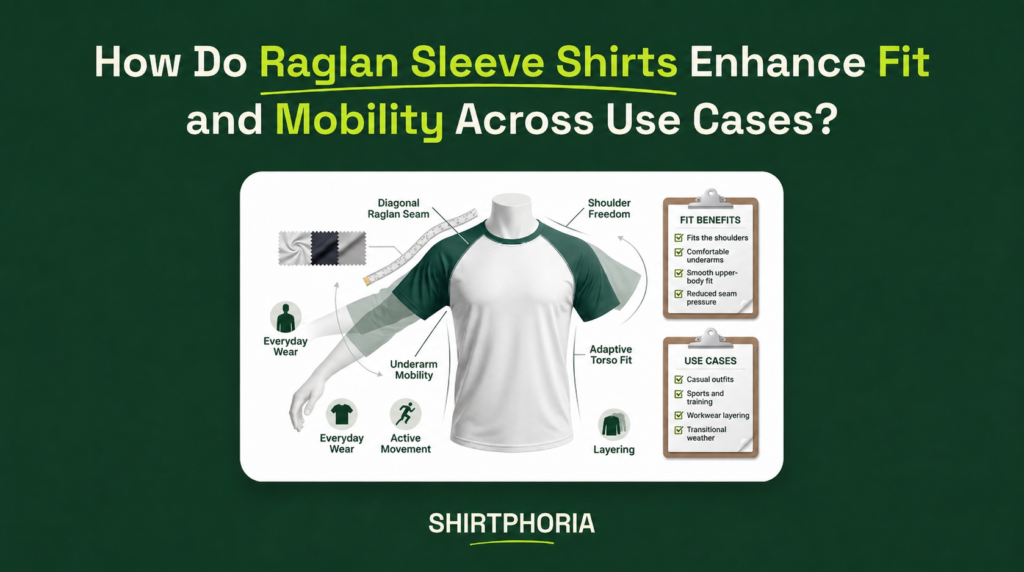
How Do Raglan Sleeve Shirts Enhance Fit and Mobility Across Use Cases?
Raglan sleeve shirts enhance fit and mobility across use cases by replacing the fixed shoulder seam of a standard set-in sleeve with a diagonal sleeve seam that runs from the neckline toward the underarm.
Many people recognize raglan sleeve shirts by their diagonal seams or contrasting sleeve colors, but this construction is more than a sporty visual detail. The placement of the sleeve seam can change how the shirt fits around the shoulder, responds during arm movement, layers under outerwear, and accommodates different shoulder shapes.
This guide explains what raglan sleeve shirts are, how they compare with set-in sleeve shirts, where they perform well, and where their design has practical limitations.
The performance of raglan construction still depends on fabric stretch, garment size, seam construction, and the intended use case. A well-designed raglan shirt may support comfortable movement, while a poorly sized or stiff version may still pull, bunch, or restrict the wearer.
What Are Raglan Sleeve Shirts?
Raglan sleeve shirts are shirts built with sleeves that extend toward the neckline instead of ending at a separate shoulder seam, creating a diagonal seam line from the underarm area to the collar or neckline.
In conventional set-in sleeve construction, the sleeve is attached around an armhole and meets the body near a defined shoulder endpoint. A raglan sleeve extends across part of the upper shoulder, so its diagonal seam replaces the standard horizontal shoulder seam and part of the circular armhole connection.
This construction changes the visual and functional relationship between the sleeve, shoulder, and shirt body. According to raglan pattern guide, raglan construction uses a diagonal seam path extending toward the neckline and can provide additional room around the underarm and shoulder area.
Raglan sleeves commonly appear in:
- Baseball shirts
- Running and athletic shirts
- Casual T-shirts
- Sweatshirts
- Thermal tops
- Training shirts
- Children’s shirts
- Outdoor base layers
The presence of raglan sleeves does not automatically make a shirt a technical performance garment. A casual cotton baseball shirt and a moisture-managing running shirt may use similar sleeve architecture while serving very different purposes.
In one design, the diagonal sleeve construction may primarily create a relaxed visual style. In another, it may be combined with stretch fabric, low-profile seams, moisture control, and an athletic cut to support repeated movement.
Before evaluating a specific raglan design, readers should understand how T-shirt fit affects shoulder appearance, casual comfort, and everyday wear.
Why Does Raglan Sleeve Construction Change Shoulder Movement?
Raglan sleeve construction changes shoulder movement by moving the main sleeve seam away from the shoulder apex, reducing the chance that a fixed shoulder seam will pull against the arm during reaching, lifting, or rotation.
The shoulder apex is the highest or most prominent point of the shoulder. In a well-fitted set-in sleeve shirt, the shoulder seam normally ends close to this point.
A set-in sleeve is attached around the armscye, which is the armhole edge where the sleeve joins the body of the garment. The rounded upper portion of the sleeve that fits into the armscye is called the sleeve cap.
Set-in sleeves can create a clean, precise shoulder shape. They are especially useful when a shirt requires tailoring, visual structure, or a defined shoulder line. However, movement may feel restricted when the shoulder endpoint, armscye, or sleeve cap is too tight for the wearer.
Raglan construction distributes the sleeve connection diagonally instead of concentrating it around one fixed shoulder endpoint. This can give the fabric more tolerance as the arm moves forward, upward, or across the body.
Diagonal sleeve seam → shifts seam tension away from the shoulder apex → supports freer shoulder movement.
The result depends on the entire garment. A raglan sleeve made from stiff fabric with a narrow underarm cut may still restrict movement. A well-sized set-in sleeve made from flexible fabric may move comfortably.
How Do Diagonal Raglan Seams Reduce Shoulder-Seam Interference?
Diagonal raglan seams can reduce shoulder-seam interference by shifting the main seam line away from the top of the shoulder, where set-in sleeves often meet backpack straps, jacket seams, or repeated arm rotation.
This placement can be helpful during movements such as:
- Reaching overhead
- Throwing a ball
- Climbing
- Stretching
- Serving in tennis
- Performing gym presses
- Swinging the arms while running
The benefit is strongest when the shirt provides enough stretch or mechanical ease to follow the movement of the arm.
A diagonal seam does not eliminate all friction. It may simply move the seam away from a common pressure point. Poor seam finishing, rough thread, tight sizing, or repeated movement against sweaty skin can still create discomfort.
Raglan seams can therefore reduce shoulder-seam interference when the garment is properly fitted and made from suitable fabric.
Why Can Raglan Sleeve Shirts Fit More Shoulder Shapes?
Raglan sleeve shirts can fit more shoulder shapes because they remove the fixed shoulder endpoint that set-in sleeves use to define where the sleeve should sit on the body.
In set-in sleeve construction, the shoulder seam often needs to align closely with the wearer’s shoulder point. When it sits too far inward, the shirt may feel narrow. When it drops too far outward, the shirt may appear oversized or poorly fitted.
Raglan construction can be more forgiving for:
- Broad shoulders
- Narrow shoulders
- Sloped shoulders
- Rounded shoulders
- Bodies that fall between standard shirt sizes
Because the seam travels diagonally from the neckline, there is no single shoulder endpoint that must align perfectly with the body.
No fixed shoulder endpoint → increases shoulder-shape tolerance → improves casual fit flexibility.
This increased fit tolerance does not create a perfect fit for every body type. Excess underarm fabric can bunch when the shirt is oversized, the pattern is too loose, or the sleeve angle is poorly designed. A badly shaped neckline may also shift when the arms move.
Raglan Sleeve Shirts vs. Set-In Sleeve Shirts: A Functional Baseline
Raglan sleeve shirts and set-in sleeve shirts serve different fit goals: raglan sleeves prioritize movement tolerance and relaxed adaptability, while set-in sleeves prioritize shoulder structure, tailoring precision, and a cleaner formal silhouette.
| Feature | Raglan Sleeve Shirts | Standard Set-In Sleeve Shirts |
|---|---|---|
| Seam Path | Diagonal seam from the neckline or collar area toward the underarm. | Circular sleeve seam attached around the armscye. |
| Shoulder Structure | Softer, more sloped, and less tailored. | Sharper, cleaner, and more structured. |
| Movement Comfort | Often better for reaching, lifting, and casual athletic movement. | Can restrict movement if the shoulder point or sleeve cap is too tight. |
| Fit Flexibility | More forgiving across different shoulder widths. | Requires more precise shoulder alignment. |
| Layering Comfort | May reduce shoulder seam overlap under jackets or overshirts. | May create seam stacking when multiple circular shoulder seams overlap. |
| Formal Appearance | Casual, sporty, and relaxed. | More formal, tailored, and structured. |
| Main Failure Risk | Underarm bunching, sloped shoulder appearance, or neckline distortion. | Shoulder pulling, sleeve cap tightness, or seam pressure. |
Neither construction is universally superior.
A set-in sleeve may be the better choice for a dress shirt, business shirt, tailored polo, or garment that needs a defined shoulder line. A raglan sleeve may be more suitable for training, running, casual layering, outdoor movement, or relaxed everyday wear.
The correct choice depends on how closely the sleeve architecture matches the activity, fabric, fit, and styling goal.
How Can Readers Test the Mobility of Raglan Sleeve Shirts?
Readers can test the mobility of raglan sleeve shirts by observing how the garment behaves during controlled movements such as overhead reach, cross-body reach, forward extension, and layered shoulder rotation.
This is a practical fit test rather than a laboratory measurement. Its purpose is to identify visible and physical signs of restriction before the shirt is used for exercise, travel, work, or extended daily wear.
Important variables include:
- Hem lift
- Shoulder pull
- Underarm bunching
- Neckline shift
- Seam pressure
- Sleeve drag
- Layering pressure
- Skin friction
| Diagnostic Input | How to Test It | Pass Signal | Warning Signal | Fail Signal |
|---|---|---|---|---|
| Hem Lift | Raise both arms overhead three times. | Hem stays close to its original position. | Hem lifts slightly but settles back. | Hem lifts sharply or exposes the torso. |
| Shoulder Pull | Reach forward and across the body. | No hard pulling at the shoulder or upper sleeve. | Mild pulling appears near the upper sleeve. | Shoulder or underarm seam restricts movement. |
| Underarm Bunching | Lower the arms after an overhead reach. | Fabric returns smoothly. | Some folds remain under the arm. | Fabric bunches, twists, or feels bulky. |
| Neckline Stability | Rotate the arms while wearing the shirt. | Neckline stays centered. | Neckline shifts slightly. | Neckline pulls, twists, or distorts. |
| Layering Comfort | Wear the shirt under a jacket or overshirt. | No painful seam overlap. | Mild seam awareness. | Bulky seam stacking or pressure occurs. |
| Skin Friction | Simulate repeated arm swings. | No rough seam contact. | Mild seam awareness. | Rubbing, scratching, or irritation risk appears. |
A movement test should be repeated in the size the wearer would normally buy. Testing a much larger raglan shirt against a tightly fitted set-in shirt does not provide a fair comparison.
Readers should also compare similar fabric weights. A lightweight stretch-knit raglan shirt will naturally behave differently from a thick, rigid set-in shirt. Sleeve architecture should not be blamed for problems caused primarily by fabric stiffness, incorrect sizing, or excessive garment weight.
How Do Raglan Sleeve Shirts Support Running and High-Movement Activities?
Raglan sleeve shirts can support running and high-movement activities by reducing shoulder-seam interference, allowing freer arm swing, and moving seam pressure away from common friction points.
During running, the arms repeatedly swing forward and backward. In tennis and baseball, the shoulder rotates through a wider range. Climbing, gym pressing, and overhead lifting require the shirt to follow upward and forward movement without excessive pulling.
Raglan construction may support these activities because the sleeve connection is distributed diagonally instead of being concentrated around a fixed shoulder point.
Common high-movement applications include:
- Running arm swing
- Tennis serves
- Baseball throws
- Climbing reaches
- Gym pressing
- Functional training
- Backpack use
- Outdoor hiking
Raglan construction alone does not make a shirt high-performance. Athletic comfort also depends on:
- Fabric stretch
- Moisture management
- Garment weight
- Seam finish
- Sleeve width
- Underarm shaping
- Neckline stability
- Overall garment size
Readers comparing sleeve mobility with athletic shirt performance should also review how running shirts combine fit, fabric, seams, and moisture control.
How Do Raglan Sleeve Shirts Reduce Hem Lift During Reaching?
Raglan sleeve shirts can reduce hem lift during reaching because the sleeve and shoulder area move with fewer fixed seam interruptions than a tightly fitted set-in sleeve.
Hem lift occurs when upward arm movement pulls the body of the shirt toward the shoulders. A small amount of movement may be normal, but sharp or repeated lifting can indicate that the sleeve, chest, shoulder, or underarm area is too restrictive.
Use this movement test:
Raise both arms overhead while standing naturally. If the hem rises sharply or the shirt pulls across the chest, the garment is restricting upper-body reach.
A properly shaped raglan sleeve may allow the sleeve and upper body panels to move together more smoothly. However, this advantage depends on correct sizing, adequate fabric ease, and balanced underarm construction.
A loose set-in sleeve can outperform a poorly fitted raglan sleeve. Construction is one factor, not the only factor.
How Does Seam Placement Affect Chafing Risk in Raglan Sleeve Shirts?
Seam placement affects chafing risk in raglan sleeve shirts because seams that avoid the top shoulder point may reduce rubbing under straps, packs, or repeated arm motion.
Backpack straps often rest near the shoulder apex. A raised shoulder seam positioned directly beneath the strap may become noticeable during long walks, runs, or hikes.
A raglan seam may move this seam away from the highest-pressure area. The amount of benefit depends on the exact seam angle, strap placement, fabric, thread, and garment fit.
Flatlock construction can provide additional support. According to flatlock stitching, flatlock seams create a flatter, lower-profile connection that reduces seam bulk and may improve comfort during repeated movement.
Flatlock stitching is not a guaranteed anti-chafing solution. Irritation may still occur because of:
- Rough thread
- Poor thread tension
- Bad seam placement
- Tight sizing
- Sweat accumulation
- Repeated skin contact
- Backpack or equipment pressure
Low-profile seam construction → reduces raised seam contact → can lower friction risk during repeated movement.
Why Can Raglan Sleeve Shirts Feel Comfortable in Layering Systems?
Raglan sleeve shirts can feel comfortable in layering systems because their diagonal seam placement may reduce direct shoulder-seam overlap under some jackets, overshirts, or thermal layers.
A layering system combines garments that serve different functions, such as moisture control, insulation, weather protection, or styling. A raglan shirt may be used as a base layer, casual inner layer, thermal top, or lightweight athletic shirt.
One possible comfort issue in layered clothing is seam stacking. Seam stacking happens when seams from two or more garments sit directly on top of one another, creating noticeable bulk or pressure.
A raglan sleeve seam may avoid sitting directly beneath the circular shoulder seam of an outer garment. This can reduce seam overlap in some clothing combinations.
Raglan construction does not automatically improve warmth. Thermal performance depends more strongly on:
- Fabric type
- Fabric thickness
- Insulating material
- Moisture control
- Air retention
- Garment fit
- Weather protection
Because sleeve construction is only one part of warmth, readers should connect this section to winter layering when choosing shirts for cold weather.
How May Raglan Sleeve Shirts Reduce Seam Stacking Under Outer Layers?
Raglan sleeve shirts may reduce seam stacking under outer layers when their diagonal sleeve seam does not sit directly beneath the circular shoulder seam of a jacket, overshirt, or outer layer.
Examples include:
- A base layer under a fleece
- A thermal shirt under a winter jacket
- A running shirt under a wind shell
- A casual raglan T-shirt under an overshirt
When the inner and outer seams follow different paths, pressure may be distributed across separate areas rather than concentrated at one shoulder point.
Seam stacking can still occur when:
- The outer layer also uses diagonal seams
- The base layer uses bulky fabric
- The shirt is too tight
- The jacket compresses the shoulder area
- Several thick garments are layered together
Raglan sleeves should therefore be viewed as one possible way to improve layering comfort, not a guarantee that seam stacking will disappear.
Do Raglan Sleeve Shirts Improve Insulation Continuity?
Raglan sleeve shirts may improve perceived layering comfort, but insulation continuity depends more on fabric type, fabric thickness, moisture control, and close-but-not-restrictive fit than on sleeve construction alone.
A raglan base layer may sit smoothly around the shoulder when it does not pull against a fixed shoulder seam. This smoother drape can reduce fabric displacement during movement.
Smooth shoulder drape → reduces fabric displacement → supports more consistent layering comfort.
Raglan sleeves do not prevent cold spots by themselves. Cold spots are more likely to result from:
- Gaps between garments
- Wet fabric
- Compressed insulation
- Poor sizing
- Loose openings
- Low-insulation materials
The sleeve design may affect comfort and fabric positioning, but it cannot replace suitable thermal materials and correct layering practices.
How Can Raglan Sleeve Shirts Support Children’s Active Play Comfort?
Raglan sleeve shirts can support children’s active play comfort by giving the shoulder and underarm area more movement tolerance during reaching, climbing, crawling, throwing, and dressing.
Children frequently change direction and position during play. Their shirts may need to accommodate overhead reaching, playground climbing, crawling, running, carrying a backpack, pulling on a jacket, and repeated dressing.
Raglan construction may feel comfortable because it does not depend on one fixed shoulder seam lining up precisely with the child’s shoulder point.
The suitability of a children’s raglan shirt still depends on:
- Neckline width
- Fabric softness
- Garment size
- Fabric stretch
- Underarm volume
- Seam finish
- Collar recovery
- Stitching quality
A raglan shirt should not be assumed to prevent tearing or other garment damage. Tearing can still occur when the shirt is too small, the fabric is weak, the stitching is poor, or the garment is placed under excessive stress.
Parents evaluating sleeve comfort for active children should also compare this design with kids’ shirt comfort because fabric softness, seam placement, and sizing all affect movement.
How Do Raglan Sleeve Shirts Improve Play Comfort for Children?
Raglan sleeve shirts can improve play comfort for children because the sleeve construction gives the upper arm and shoulder area more tolerance during unpredictable movement.
This tolerance may be helpful during activities such as:
- Monkey bars
- Playground climbing
- Reaching overhead
- Crawling
- Throwing
- Carrying a backpack
- Putting on a jacket
- Active classroom play
Because the shoulder connection is diagonal, the shirt may follow the child’s arm movement without concentrating pressure around one shoulder endpoint.
However, excess underarm fabric can become bulky when the shirt is oversized. A tight neckline may also make the shirt uncomfortable even when the sleeves provide adequate room.
Comfort should therefore be evaluated across the entire garment rather than judged from the sleeve design alone.
Why May Some Raglan Sleeve Shirts Be Easier for Children to Put On?
Some raglan sleeve shirts may be easier for children to put on because the shoulder area is less dependent on a precise shoulder seam, but dressing ease still depends on neckline width, fabric stretch, and overall shirt size.
Raglan construction alone does not create a wider neck opening. However, many casual raglan shirts are made from flexible knit fabrics that can stretch while being pulled over the head and shoulders.
Forgiving shoulder construction + stretch fabric → easier upper-body movement → improved dressing comfort.
A raglan shirt may still be difficult to put on when it has:
- A tight neck rib
- Low-stretch fabric
- Rough internal seams
- Incorrect sizing
- A narrow body opening
- Poor collar recovery
Parents should test both the neckline and shoulder movement rather than assuming that every raglan shirt will be easy to dress in.
When Are Raglan Sleeve Shirts Not the Best Choice?
Raglan sleeve shirts are not always the best choice because their relaxed shoulder construction can reduce formal structure, create excess underarm fabric, or distort the neckline if the pattern, fabric, or size is poorly matched.
Every construction benefit involves a trade-off. The softer shoulder line that supports casual fit flexibility may be unsuitable for formal clothing. Additional underarm room may support reaching but become bulky when the shirt is oversized.
| Raglan Benefit | Possible Failure Mode | Correction |
|---|---|---|
| Softer shoulder fit | Shoulder line may look sloped or less formal. | Choose set-in sleeves for sharper tailoring. |
| More underarm room | Excess fabric can bunch under the arm. | Choose a better size, slimmer cut, or stretch fabric. |
| Reduced shoulder seam pressure | Neckline may shift if the pattern is unstable. | Check neckline recovery and collar shape. |
| Better movement tolerance | Movement benefit decreases if the fabric is stiff. | Choose fabric with stretch or mechanical give. |
| Better layering comfort | Bulky fabrics can still create pressure. | Use thinner base layers or low-profile seams. |
| Casual sporty aesthetic | May not suit formal outfits. | Use set-in sleeve shirts for structured styling. |
“The correct choice is not raglan versus set-in in isolation; the correct choice is sleeve construction matched to activity, fabric, fit, and styling goal.”
Raglan sleeves may be less suitable when the wearer needs:
- A sharp shoulder line
- Formal tailoring
- Precise suit or jacket coordination
- Minimal underarm volume
- A traditional dress-shirt appearance
- Strong visual shoulder definition
Set-in sleeves may perform better in those situations because they provide a clearer sleeve cap and shoulder structure.
Practical Raglan Sleeve Mobility Checklist
Use this interactive checklist while trying on or comparing a raglan sleeve shirt. Your completed items remain saved after the page is refreshed.
Frequently Asked Questions
A raglan sleeve extends toward the neckline and uses a diagonal seam. A set-in sleeve joins the body around a rounded armscye and normally ends at a defined shoulder point.
No. Raglan construction can increase movement tolerance, but comfort still depends on garment size, underarm shape, fabric stretch, sleeve width, neckline stability, and seam finish.
Perform an overhead reach, cross-body reach, forward extension, and shoulder rotation. Check for sharp hem lift, shoulder pulling, persistent underarm bunching, neckline distortion, seam pressure, and friction.
Not automatically. A diagonal seam may move stitching away from a common shoulder pressure point, but rough thread, poor fit, sweat, raised seams, and equipment pressure can still cause irritation.
Raglan seams may improve layering comfort in some combinations, but warmth depends mainly on fabric type, thickness, moisture control, insulation, air retention, fit, and weather protection.
Choose a set-in sleeve when a sharp shoulder line, formal tailoring, precise jacket coordination, minimal underarm volume, or a traditional dress-shirt appearance is more important than relaxed movement tolerance.
Terms Explained
| TERM | DEFINITION |
|---|---|
| Raglan sleeve | A sleeve construction that extends toward the neckline and creates a diagonal seam from the underarm area. |
| Set-in sleeve | A sleeve attached around a rounded armhole, usually with a defined shoulder endpoint and sleeve cap. |
| Shoulder apex | The highest or most prominent point of the shoulder where a set-in shoulder seam commonly ends. |
| Armscye | The armhole edge where a set-in sleeve joins the body of a garment. |
| Sleeve cap | The rounded upper portion of a set-in sleeve that fits into the armscye. |
| Hem lift | Upward movement of the shirt body when the arms are raised or extended. |
| Seam stacking | Pressure or bulk created when seams from two or more clothing layers sit directly on top of one another. |
| Flatlock seam | A low-profile seam construction designed to reduce raised bulk and repeated skin contact. |
| Mechanical ease | Movement room created by pattern shape, fabric behavior, and garment dimensions rather than elastic stretch alone. |
Conclusion
In conclusion, raglan sleeve shirts are best understood as a functional shirt construction that changes how the sleeve, shoulder, and underarm area behave during movement, layering, and casual wear.
Their diagonal seams shift the sleeve connection away from the shoulder apex and remove the fixed shoulder endpoint commonly found in set-in sleeve shirts. This construction may provide more movement tolerance, increased shoulder-shape flexibility, and reduced seam overlap in certain use cases.
Raglan sleeve shirts are often useful for athletic movement, casual fit flexibility, layering comfort, and children’s active play. Their effectiveness still depends on fabric stretch, sizing, underarm shaping, seam quality, and neckline stability.
Raglan sleeves are not automatically better than set-in sleeves. They are most appropriate when the wearer needs movement tolerance, softer shoulder structure, and reduced seam overlap. Set-in sleeves remain valuable when tailoring precision, shoulder definition, and formal structure are more important.
The best raglan sleeve shirt is not the one with the most dramatic diagonal seam; it is the one whose fabric, fit, seam finish, and use case work together to make movement feel natural.
Disclaimer: This article is provided for general educational and informational purposes only. Shirt fit, mobility, comfort, and performance can vary according to body shape, garment size, fabric, pattern construction, seam finish, and intended use. Always assess the actual garment and follow the manufacturer’s care and use instructions.
© 2026 Shirtphoria. All rights reserved.