How Is the Placket Structured in a Traditional Polo Shirt?
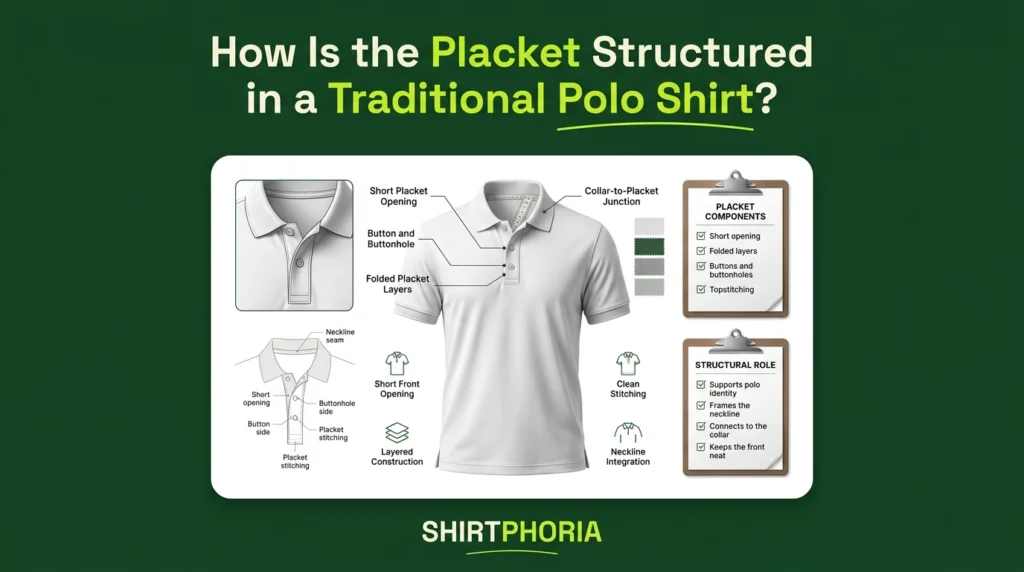
The traditional polo placket is a reinforced partial opening built from overlapping fabric layers, usually consisting of a visible outer button stand, a supporting inner under-placket, and an internal stabilizing layer such as fusible interlining.
The polo placket is not merely a decorative opening. It supports the buttons and buttonholes, stabilizes the front neckline, and helps create a controlled transition between the collar and shirt body.
Its construction can also influence how neatly the neckline sits after wear and laundering.
This guide deconstructs the traditional polo placket, explains the function of each layer, shows how assembly quality affects durability, and gives readers a practical checklist for evaluating placket construction.
Placket quality is one visible indicator of polo shirt construction quality, but it should be evaluated alongside fabric, collar construction, seam quality, shrinkage behavior, and overall fit.
For a wider understanding of how this component fits into the garment category, see polo shirts.
Why Does the Placket Structure Matter in a Traditional Polo Shirt?
The placket structure matters in a traditional polo shirt because it stabilizes the neck opening, supports the button closure, and helps the collar sit cleanly against the shirt body.
Threads defines a placket as overlapping fabric that covers a garment opening and supports or conceals its closures. That definition explains why the polo placket is a construction feature rather than simply a vertical decorative detail.
On a traditional polo, the placket must perform several jobs at the same time:
- create a controlled front opening;
- provide reinforced areas for buttons and buttonholes;
- support the base of the collar;
- distribute stress around the neckline;
- cover or encase raw construction edges;
- remain relatively flat when buttoned or open.
These jobs depend on the interaction of fabric layers, reinforcement, stitching, and alignment.
A placket can therefore look simple from the outside while containing several construction decisions underneath.
How Does the Polo Placket Support Collar Roll and Collar Stand?
The polo placket supports collar roll and collar stand by adding structure at the front neckline, where the collar, button opening, and shirt body meet under repeated movement.
The relationship can be understood as:
Polo Placket Structure → Supports → Collar Front Stability
The placket does not force every polo collar to stand upright.
A soft knitted collar may be designed to roll gently around the neck. A firmer collar may sit with greater height.
The placket contributes by stabilizing the front opening underneath that collar.
When the placket lies flat and its layers are properly aligned, the collar base has a more controlled platform.
When the placket twists or collapses, the collar may also appear uneven at the front.
Collar behavior still depends on several other factors:
- collar knit density;
- collar attachment;
- body-fabric weight;
- collar support;
- laundering behavior;
- overall fit.
For a closer examination of the neckline component itself, see polo collar construction.
How Does Placket Construction Signal Durability and Craftsmanship?
Placket construction can signal durability and craftsmanship because the buttonholes, topstitching, interlining, and base reinforcement all sit in a high-stress area of the garment.
The placket receives repeated mechanical stress.
This happens when the wearer:
- pulls the polo over the head;
- opens or closes the buttons;
- stretches the neckline during dressing;
- moves through the shoulders and upper torso;
- washes and dries the garment.
A well-controlled placket distributes these forces across several layers rather than concentrating them at one weak point.
Reinforced Placket Construction → Reduces → Neckline Distortion
Visible signs of controlled construction can include straight stitching, stable buttonholes, an even overlap, and a secure base.
Possible warning signs include:
- stretched buttonholes;
- loose threads;
- diagonal pulling;
- puckered topstitching;
- twisted overlap;
- bubbling;
- tearing near the bottom of the opening.
These signs should not be used as the only test of overall polo quality. Fabric quality, collar behavior, shoulder construction, seams, fit, and wash stability also matter.
Before evaluating placket quality, the reader needs to understand the anatomy of the placket itself.
Deconstructing the Traditional Polo Placket Structure: What Are the Core Components?
Deconstructing a traditional polo placket reveals three functional parts: the visible outer placket, the supporting inner placket, and the hidden stabilizing layer that gives the opening body and shape retention.
The outer and inner layers overlap when the polo closes.
Reinforcement may sit inside one or both layers depending on the garment design and manufacturing method.
Together, these components create the complete Placket Structure.
What Is the Role of the Outer Placket or Button Stand?
The Outer Placket, often called the Button Stand, is the visible overlapping fabric strip that forms the front line of the polo opening and usually houses the buttonholes.
This component has both visual and mechanical roles.
Visually, it creates the clean vertical line running downward from the neckline.
Mechanically, it provides additional material around the buttonholes so the closure does not rely on a single unsupported layer of body fabric.
A stable outer placket normally sits relatively straight when the shirt is unbuttoned and when it is closed.
Its buttonholes should also remain controlled rather than stretching into large openings.
Useful inspection points include:
Visual Line
A good placket should appear straight or follow the intended shape of the garment.
A slight movement caused by soft knit fabric may be normal.
Strong waviness, twisting, or diagonal distortion can indicate poor alignment or unstable construction.
Buttonhole Stability
Buttonholes should appear clean and appropriately sized for their buttons.
Warning signs include:
- frayed edges;
- stretched openings;
- loose thread;
- severe puckering;
- distorted fabric around the opening.
Surface Finish
The surface should remain compatible with the soft body fabric.
A small amount of knit texture is normal.
Bubbling, detached-looking areas, severe puckering, or visible warping deserve closer inspection.
What Is the Role of the Inner Placket or Under-Placket?
The Inner Placket, or Under-Placket, is the lower overlapping layer that sits beneath the outer placket and provides the base where the buttons are attached.
When the polo is closed, this layer works with the outer Button Stand to form the complete closure.
Its main tasks are to support the buttons, stabilize the back of the opening, and maintain overlap alignment.
The layers should meet without strong sideways tension.
Three practical checks are useful.
Button Base Stability
Buttons should sit securely without visibly pulling the fabric into deep folds.
A small amount of movement in a soft knit is normal.
Repeated strain or fabric distortion around every button may suggest poor alignment or insufficient reinforcement.
Overlap Alignment
The outer and inner plackets should overlap naturally.
A noticeably offset Under-Placket can move the buttons away from the buttonholes and cause diagonal strain.
Closure Behavior
Buttoning the polo should not force the placket to twist.
The closure should remain reasonably flat without obvious gaping or sideways pulling.
A strong inner placket is not necessarily stiff.
Its role is to provide enough support for the closure while retaining the flexibility expected from a knit garment.
How Does Fusible Interlining Influence Polo Placket Durability?
Fusible interlining influences polo placket durability by adding internal body, stiffness, and dimensional stability to fabric layers that would otherwise stretch, curl, or collapse more easily.
Fusible Interlining is an internal textile or non-textile structure bonded to shell fabric by heat, pressure, and, where appropriate, moisture.
Textil Trainer explains that fusible interlining typically combines a base material with thermoplastic adhesive and is used to add dimensional stability, body, or stiffness to garment components.
Textil Trainer fusible-interlining guide
In a polo placket, the reinforcement needs to match the shell fabric.
A soft lightweight knit does not necessarily need the same interlining behavior as a heavier or more stable fabric.
Too little support can contribute to:
- curling;
- weak buttonhole areas;
- rippling;
- collapsing;
- poor closure stability.
Too much or excessively stiff support can cause a different set of problems:
- board-like handfeel;
- excessive bulk;
- reduced drape;
- uncomfortable stiffness;
- a front opening that behaves differently from the soft shirt body.
The objective is balanced stabilization.
The placket should receive enough support to perform its structural job without becoming a rigid strip attached to a flexible knit garment.
Fabric choice also influences this balance. Different knit weights, fiber compositions, and stretch characteristics can require different reinforcement strategies. Readers comparing these variables can also consult the broader guide to shirt fabrics.
Once the placket layers are defined, the next step is understanding how they are fused, folded, stitched, and secured.
How Is a Durable Polo Placket Structure Assembled Step by Step?
A durable polo placket structure is assembled through a controlled sequence of cutting, fusing, folding, stitching, overlapping, and reinforcing the base of the opening.
The exact manufacturing sequence can vary with placket style and factory method, but the structural logic remains similar.
The components must first be prepared accurately.
Any required reinforcement is then applied.
The fabric layers are folded and positioned around the opening before stitching forms and secures the final structure.
Exact placket width, fusing temperature, pressure, processing time, and stitch density are not universal values.
They depend on variables such as:
- shell fabric;
- knit stretch;
- interlining type;
- adhesive system;
- machine settings;
- garment design;
- manufacturer specification.
Phase 1: Preparing and Fusing Polo Placket Components
The first phase prepares the polo placket components by cutting the fabric strips accurately and bonding suitable fusible interlining to the wrong side of the fabric where structure is required.
Fusing must create a stable bond without damaging the appearance or feel of the shell fabric.
OSHIMA explains that fabric fusing bonds fusible interlining to shell fabric using controlled heat and pressure and identifies front plackets among garment areas where fusing may provide structure. It also notes that successful bonding depends on factors including temperature, pressure, processing time, cooling, and compatibility between materials.
Poor fusing control can produce several visible or structural problems.
Insufficient Bonding
Too little heat, pressure, or processing time may leave areas weakly attached.
The result can include:
- lifted edges;
- incomplete adhesion;
- local separation;
- weak structural support.
Excessive Processing
Too much heat, pressure, or exposure time may create:
- excessive stiffness;
- surface marks;
- adhesive strike-through;
- unwanted shine;
- dimensional distortion.
Poor Material Compatibility
The shell fabric and interlining must behave together.
If their shrinkage, stretch, adhesive response, or care behavior are mismatched, the result may include:
- bubbling;
- delamination;
- surface distortion;
- shrinkage mismatch;
- unstable bonding.
Delamination occurs when fused layers begin separating.
Bubbling appears as raised or uneven areas where the layers no longer sit smoothly together.
Strike-through occurs when adhesive affects or becomes visible through the shell-fabric surface.
These defects are especially noticeable on the relatively small, prominent front area of a polo.
Phase 2: Folding, Aligning, and Attaching the Overlapping Layers
The second phase forms the placket by folding and aligning the outer and inner layers so the raw shirt opening is enclosed and the button closure sits on a reinforced structure.
The folds create clean finished edges around the slit.
The Outer Placket and Under-Placket are then positioned so they overlap correctly.
A controlled overlap performs several jobs:
- covers raw edges;
- supports closure alignment;
- stabilizes buttons and buttonholes;
- controls the shape of the opening;
- creates a clean visual front.
When the polo is buttoned, the layers should meet without strong diagonal pulling, lateral strain, or visible gaping.
Overlap can fail in both directions.
Too Narrow
An undersized or poorly positioned overlap can leave the closure unstable.
Possible symptoms include:
- gaping;
- exposed inner fabric;
- button strain;
- weak neckline control.
Too Wide or Bulky
Excessive material can make the front opening feel thick and rigid.
It may also interfere with the natural drape of a lightweight knit.
Poor Alignment
If the two layers are not positioned correctly, the result can include:
- crooked buttons;
- offset buttonholes;
- diagonal pulling;
- twisted placket edges;
- uneven collar positioning.
Accurate alignment matters because later stitching can secure the existing geometry but cannot fully correct badly positioned layers.
Phase 3: Securing the Polo Placket With the Base Stitch
The final assembly phase secures the base of the polo placket with a reinforced stitch pattern, often shaped as a box, square, or V, to absorb stress where the opening ends.
The bottom of the partial opening is a concentrated stress point.
Every time the wearer spreads the neckline to pull the shirt over the head, force can travel toward this location.
The structural relationship is:
Base Stitch → Absorbs → Opening Stress
A useful base reinforcement should be centered and securely stitched.
It should hold the end of the placket together without heavily distorting the surrounding fabric.
Too little reinforcement can contribute to:
- stress marks;
- tearing;
- opening distortion;
- loose stitching.
Excessively dense or tight stitching can produce the opposite problem:
- puckering;
- stiffness;
- visible bunching;
- a hard stress point.
Again, balance matters.
The reinforcement must stabilize the end of the opening while remaining compatible with the stretch and softness of the polo body.
What Is the Difference Between the Outer and Inner Polo Placket Components?
The difference between the outer and inner polo placket components is that the outer placket controls the visible buttonhole side, while the inner placket provides the hidden base for the buttons and closure stability.
| Placket Component | Common Name | Primary Function | Fastener Location | Quality Failure to Check |
|---|---|---|---|---|
| Outer Placket | Button Stand | Creates the visible front line and reinforces the opening | Buttonholes | Frayed buttonholes, waviness, puckering, bubbling |
| Inner Placket | Under-Placket | Provides the lower support layer and stabilizes the closure | Buttons | Pulling, twisting, poor overlap alignment, button strain |
| Internal Reinforcement | Fusible Interlining / Interfacing | Adds body and dimensional stability between fabric layers | Hidden between layers | Delamination, bubbling, strike-through, excessive stiffness |
These components should be evaluated together.
A strong Outer Placket cannot completely compensate for a twisting Under-Placket.
Likewise, good button alignment can still be undermined by unstable interlining or poor base reinforcement.
What Makes a Polo Placket Structurally Sound or Structurally Weak?
A structurally sound polo placket can be diagnosed by checking whether its alignment, interlining, button support, stitch tension, and base reinforcement stay within functional ranges rather than collapsing at either extreme.
| Variable | Ideal State | Transition Zone | Hazard State | Too-Low Harm | Too-High Harm |
|---|---|---|---|---|---|
| Interlining Support | Placket lies flat while retaining natural flexibility | Slight softness or mild stiffness | Bubbling, collapse, or board-like rigidity | Too little support can cause curling and weak button areas | Too much support creates stiffness and bulky drape |
| Button Alignment | Buttons and buttonholes meet without visible strain | Minor tension when closed | Diagonal pulling or obvious gaping | Weak alignment allows the closure to twist | Overbuilt structure can make the opening rigid |
| Base Stitch | Centered, secure, and visually controlled | Slight asymmetry without stress marks | Loose, crooked, puckered, or tearing | Weak reinforcement can allow tearing | Excessive stitch tension can pucker the fabric |
| Surface Flatness | Smooth surface without abnormal puckering | Normal minor knit texture | Bubbling, lifted edges, delamination, severe rippling | Weak bonding allows deformation | Excessive fusing conditions may distort appearance |
| Stitch Tension | Even stitches without skipped areas or distortion | Small variation without structural effect | Tight puckering, loose loops, or broken thread | Loose stitching reduces edge stability | Excessive tension distorts the placket |
These categories are practical inspection tools rather than universal factory specifications.
A soft jersey polo and a heavier piqué polo may require different reinforcement levels.
Exact technical values depend on:
- fabric weight;
- knit stretch;
- fiber composition;
- interlining system;
- placket dimensions;
- stitch construction;
- factory tolerances.
The reader should therefore look for balanced behavior rather than one universal amount of stiffness or reinforcement.
What Problems Can Develop in a Poorly Constructed Polo Placket?
Polo placket problems usually appear when reinforcement, alignment, fusing, stitching, or material compatibility fail to control the opening correctly.
Bubbling
Bubbling creates raised areas between fused layers.
It can make the front surface look uneven and may indicate that the interlining and shell fabric are no longer bonding uniformly.
Delamination
Delamination occurs when bonded layers separate.
It may begin locally and become more visible after wear or laundering.
Puckering
Puckering appears as small gathered or wrinkled areas around seams or stitching.
Possible contributors include excessive stitch tension, mismatched material behavior, or inaccurate assembly.
Warping
Warping causes the placket to stop following a clean, controlled line.
The opening may curve, twist, or pull toward one side.
Fabric Distortion
Fabric Distortion is a broader category that includes stretching, shrinkage mismatch, uneven pulling, and changes in shape around the reinforced zone.
Buttonhole Failure
Weak or poorly finished buttonholes may fray, stretch, or distort.
Because the buttonhole receives repeated friction, its surrounding fabric needs suitable stability.
Base-Stitch Failure
If the bottom reinforcement is weak, the end of the opening may begin to tear or spread.
If reinforcement is too tight, the same location may develop puckering or concentrated stress.
These defects do not all have one cause.
A visible problem should be interpreted by examining the surrounding fabric, stitching, reinforcement, and alignment together.
Final Checklist: How Can You Identify a Structurally Sound Polo Placket?
You can identify a structurally sound polo placket by checking whether the opening lies flat, the buttons align cleanly, the base reinforcement is secure, and the fused layers show no visible bonding failure.
Terms Explained
| TERM | DEFINITION |
|---|---|
| Placket | An overlapping fabric structure that covers a garment opening and supports or conceals closures. |
| Outer placket | The visible overlapping layer, often called the button stand, that usually contains the buttonholes. |
| Inner placket | The lower overlapping layer, or under-placket, that usually supports the buttons. |
| Button stand | Another name for the visible outer side of the placket. |
| Under-placket | Another name for the inner supporting layer beneath the outer placket. |
| Fusible interlining | A support material bonded to shell fabric with heat and pressure to add body and dimensional stability. |
| Delamination | Separation of bonded fabric and interlining layers. |
| Bubbling | Raised or uneven areas where fused layers no longer sit smoothly together. |
| Strike-through | A defect where adhesive affects or becomes visible through the shell fabric surface. |
| Puckering | Small gathered or wrinkled areas caused around seams or stitching. |
| Base stitch | Reinforcement at the bottom of the placket opening that helps absorb neckline stress. |
| Edgestitching | Stitching placed close to a folded or finished edge to help control the layer. |
Conclusion
In conclusion, the traditional polo placket is a layered construction system that combines overlapping fabric, fastener support, internal stabilization, and base reinforcement to keep the shirt opening functional and visually stable.
The Outer Placket, or Button Stand, creates the visible buttonhole side of the opening.
The Inner Placket, or Under-Placket, supports the buttons and provides the lower closure layer.
Fusible Interlining or another reinforcement method can add dimensional stability when the shell fabric needs additional support.
Topstitching and Edgestitching help control the finished layers, while the base reinforcement manages stress where the partial opening ends.
These elements need to work together.
A strong polo placket should not be judged by stiffness alone. It should be judged by balance: enough structure to support the collar and closure, but enough flexibility to preserve the natural character of a knit polo shirt.
Bubbling, Delamination, Puckering, Fabric Distortion, weak buttonholes, crooked alignment, or unstable base stitching can reveal problems in this construction system.
Placket inspection therefore gives the reader useful evidence about garment construction without treating one component as proof of the quality of the entire shirt.
A reader who understands the polo placket can evaluate shirt quality through construction, not guesswork.