What Makes a Performance Shirt Function Through Fabric Technology and Use-Case Fit?
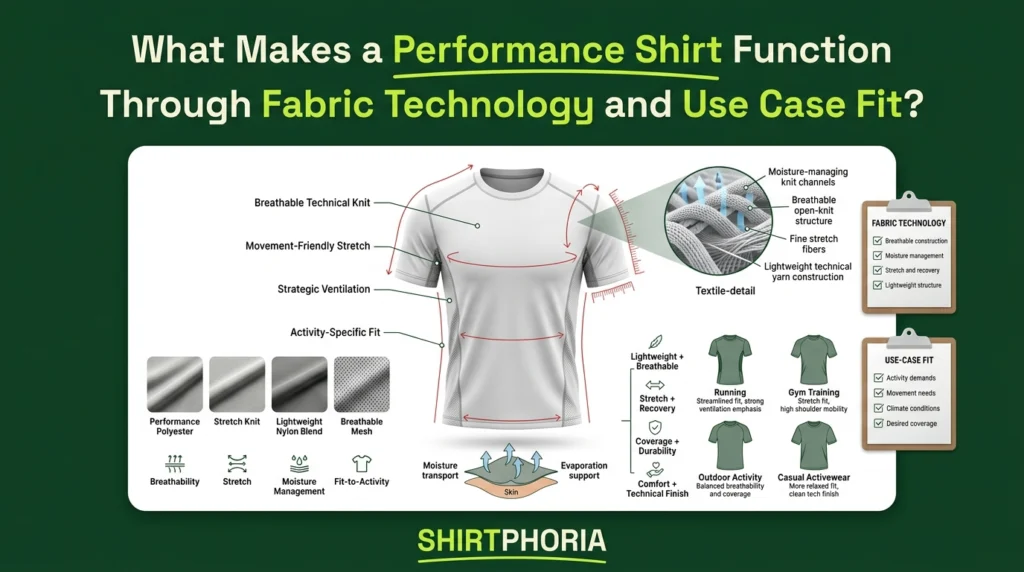
A performance shirt functions through the interaction of moisture-managing fabric, activity-specific fit, and construction details that help regulate comfort during movement. It is not defined by a sporty appearance, synthetic fabric, or a single technical label. Its function depends on how the complete garment manages sweat, heat, repeated movement, skin friction, stretch, environmental exposure, and durability.
Performance functionality therefore comes from a system. Fabric determines how moisture, heat, stretch, and odor behave. Garment construction controls seam position, sleeve movement, and fit pressure. The use case determines which of those properties matter most.
This guide explains how performance shirts work through fabric technology, functional design, and use-case fit so readers can choose shirts based on measurable needs rather than brand language. The wider category of performance shirts includes garments designed for different activities, so no single fibre, fit, or construction method is automatically best.
Why Do Engineered Performance Shirts Matter During Activity?
Engineered performance shirts matter during activity because they are designed to manage sweat, heat, friction, and movement more effectively than untreated everyday fabrics.
Exercise changes the conditions inside a shirt. Sweat increases moisture at the skin, repetitive movements increase fabric contact, and greater metabolic heat changes thermal demands. A shirt that feels comfortable during normal daily wear may therefore behave differently during running, lifting, hiking, or sustained outdoor activity.
Performance garments are designed to manage these demands, but they do not guarantee improved athletic output. Their more defensible role is supporting comfort, moisture handling, movement, friction control, and environmental suitability.
How Do Activity Demands Challenge a Shirt Fabric?
Activity challenges a shirt fabric by increasing sweat production, body heat, repetitive motion, and skin-fabric friction at the same time.
A material that absorbs and holds considerable moisture can become heavier when wet and remain against the skin for longer. Untreated cotton, for example, can hold liquid moisture and may develop wet cling or take longer to dry during strenuous activity.
Movement adds another problem. Arms swing repeatedly during running, shoulders rotate during training, and backpacks place pressure on fabric during hiking. These motions can repeatedly move fabric and seams across the skin.
Friction-induced dermatitis is irritation that can develop when repeated rubbing, moisture, and pressure disrupt the skin barrier. Normal exercise chafing should not automatically be treated as a medical condition, but reducing persistent rubbing is still an important garment-design objective.
The performance shirt must therefore manage several variables at once rather than solving only sweat absorption.
How Can Fabric Technology Support Comfort During Exercise?
Fabric technology can support comfort during exercise by moving sweat away from the skin, improving evaporation, reducing wet cling, and helping the body manage heat more efficiently.
Moisture transport can reduce the amount of liquid concentrated in one area of the garment. Once that moisture reaches a larger or more exposed textile surface, environmental conditions may support evaporation.
The useful relationship is:
Moisture Transport → Reduces → Wet Cling and Discomfort
This does not mean moisture-managing fabric automatically increases endurance. Moisture management may reduce discomfort and thermoregulatory strain, but direct endurance improvement depends on the sport, exercise intensity, climate, complete garment, and appropriate performance testing.
What Fabric Technologies Define Performance Shirt Functionality?
Performance shirt functionality is defined by fabric technologies that manage moisture transport, temperature balance, stretch recovery, odor development, and durability under repeated movement.
Not every performance shirt contains every technology. A lightweight running shirt and an insulated base layer solve different problems, so their material systems should differ.
How Does Moisture Wicking Work Through Capillary Action?
Moisture wicking works through capillary action, where liquid moves through small spaces in yarn and fabric structures from the skin-facing side toward the outer surface where evaporation can occur.
Capillary action describes liquid movement through narrow spaces. ACS’s inChemistry explanation of sweat-wicking textiles describes how adhesion, cohesion, yarn geometry, and small spaces within textile structures help liquid move through fabric. ACS / inChemistry moisture-wicking explanation
A useful performance fabric therefore needs more than a hydrophobic fibre name.
Hydrophobic fibres have relatively low attraction to water. Polyester is an important example, but polyester does not automatically wick effectively simply because it absorbs little moisture.
Wicking can depend on:
- yarn shape;
- knit structure;
- micropores;
- surface finishing;
- fibre cross-section;
- and pathways formed between yarns.
Some engineered yarns use non-circular cross-sections or channels that create spaces through which liquid can travel.
Hydrophilic finishing can also alter the surface behaviour of relatively hydrophobic fibres by increasing their interaction with moisture.
Hydrophobic synthetic fibres should not be described as absorbing sweat in the same way as highly absorbent fibres. Their useful role in a wicking textile is often helping moisture travel along engineered surfaces and spaces within the fabric structure.
Capillary movement gets moisture from one location to another. Evaporation remains a separate process.
How Do Phase-Change Materials and Hollow-Core Fibers Regulate Temperature?
Phase-change materials and hollow-core fibers regulate temperature in different ways: PCMs absorb and release thermal energy during phase transitions, while hollow-core fibers trap air to improve lightweight insulation.
Phase-Change Materials (PCMs) are materials that can absorb or release thermal energy as they change physical state. Textile research describes their integration into fabrics, coatings, and encapsulated systems for thermal-management applications. ScienceDirect review of phase-change materials in textiles
PCMs should be treated as specialized textile technology rather than as a standard feature in every athletic shirt.
Hollow-core fibres operate differently. Their internal spaces can trap air, which can contribute to insulation without requiring the same mechanism as a PCM.
That makes hollow-core systems particularly relevant to cold-weather base layers and other garments where lightweight insulation matters.
Thermal functionality also has two failure directions:
- Too little insulation or thermal management may leave the wearer uncomfortably cold during low-output periods.
- Too much insulation may hold excessive heat and moisture during strenuous activity.
The correct level therefore depends on climate, activity intensity, layering, garment coverage, and textile construction.
How Do Elastane and Antimicrobial Finishes Affect Stretch and Odor Control?
Elastane and antimicrobial finishes affect performance shirt functionality by improving stretch recovery and reducing microbial odor development, but both depend on fabric construction, treatment chemistry, and wash durability.
Elastane, also called spandex, is a highly elastic synthetic fibre added to textiles to increase stretch and help the material return toward its original shape.
Athletic shirts frequently blend elastane with polyester, nylon, or another primary fibre. However, the presence of a certain percentage of elastane does not guarantee excellent recovery.
Recovery also depends on:
- blend ratio;
- yarn quality;
- knit construction;
- fabric density;
- garment pattern;
- and laundering.
A relatively small elastane content can provide useful comfort stretch when the complete textile system is designed appropriately.
Antimicrobial finishes address a different function. Silver-based antimicrobial treatments and zinc-based antimicrobial treatments are examples of treatment approaches used in functional textiles. Their practical result depends on chemistry, concentration, application, product construction, washing, and product-level evidence.
An antimicrobial finish should not be interpreted as permanent odor prevention. A treatment may reduce the growth of odor-associated microorganisms while it remains effective, but odor can also depend on sweat composition, fibre chemistry, laundering, and other factors.
Wash durability therefore matters whenever antimicrobial or odor-control performance is part of the purchasing decision.
How Does Use-Case Fit Dictate Performance Shirt Functional Design?
Use-case fit dictates performance shirt design because the best fabric can perform poorly if the garment cut does not match the movement pattern, climate, and intensity of the activity.
A shirt’s pattern determines how close the textile sits to the body, where pressure develops, how much fabric moves, and where seams contact the skin.
When Should You Choose Compression Fit or Loose Athletic Fit?
Compression fit and loose athletic fit solve different performance problems: compression fit increases body contact and sensory feedback, while loose athletic fit increases airflow and freedom of movement.
Proprioception is the body’s awareness of its position and movement in space.
Compression garments create close contact that may increase sensory input. A 2024 systematic review and meta-analysis found improvement in one joint-position-sense measure, but several other proprioception measures did not show significant effects. The authors also identified limitations in the evidence base. 2024 systematic review of compression garments and proprioception
Compression should therefore not be treated as an automatic athletic-performance enhancer.
A useful compression fit may:
- keep fabric close to the body;
- provide a snug sensory feel;
- reduce uncontrolled garment movement;
- and suit activities where the wearer prefers close contact.
Too little compression may fail to provide the intended body contact.
Too much compression can create:
- movement restriction;
- uncomfortable pressure;
- excess heat;
- rolling;
- or breathing discomfort.
A loose athletic fit solves a different problem. Additional ease may support unrestricted movement and reduce constant skin contact, but excessive looseness can increase fabric movement, snagging, or rubbing.
Fit should therefore match the activity rather than follow a simple tighter-is-better hierarchy.
How Do Seam Placement and Sleeve Construction Reduce Friction?
Seam placement and sleeve construction reduce friction by moving bulky seams away from high-motion contact zones and using lower-profile stitch types where fabric repeatedly touches skin.
Flatlock stitching creates a relatively flat seam profile compared with constructions that leave larger seam allowances projecting inside the garment. Lower bulk can reduce one potential source of rubbing, particularly in next-to-skin garments.
Flatlock stitching does not entirely prevent friction. Thread, pressure, moisture, fit, seam location, and repetitive movement still affect the result.
Raglan sleeves move the sleeve seam away from the conventional top-of-shoulder position. This can reduce direct shoulder-top seam contact in some designs and change how the sleeve moves with the torso.
Raglan construction also does not guarantee unrestricted movement. Pattern geometry, fabric stretch, sleeve rotation, and shirt fit remain important.
The mobility-first logic of performance shirt construction contrasts with the formal structure of tuxedo shirts, where the design goal is polished presentation rather than athletic movement.
Case Studies: How Does Performance Shirt Functionality Change by Activity?
Now that the shirt’s fabric and construction systems are clear, the next step is matching those systems to real activity conditions.
A useful performance system for endurance running may not be the strongest choice for cold-weather layering or multi-sport training.
What Should High-Endurance Running Shirts Prioritize?
High-endurance running shirts should prioritize moisture transport, low wet cling, breathability, low seam irritation, and sun visibility features when used outdoors.
Rapid drying and low garment mass can matter during long, high-sweat sessions, but they are not the only relevant properties.
A running shirt should also be checked for:
- fit during repeated arm swing;
- seam location;
- wet cling;
- chafing risk;
- visibility in road environments;
- durability;
- and appropriate sun protection.
For outdoor use, UPF, or Ultraviolet Protection Factor, indicates how effectively a textile limits ultraviolet radiation passing through it.
The Skin Cancer Foundation describes UPF 30–49 as providing very good protection and UPF 50+ as excellent protection. Skin Cancer Foundation explanation of UPF clothing protection
UPF is only one part of outdoor protection. A highly rated textile cannot protect skin that the garment leaves uncovered.
What Should Cold-Weather Base Layers Prioritize?
Cold-weather base layers should prioritize insulation, moisture buffering, odor resistance, and comfort against the skin during changing activity levels.
Merino wool can be a strong base-layer choice because wool interacts with moisture differently from common synthetic fibres and can retain comparatively little body odor under some tested conditions.
Woolmark reports a New Zealand study in which wool fabrics retained 66% less body-odor intensity than polyester and 28% less than cotton across the study conditions. Woolmark research on wool and body odor
That result should not be converted into a claim that merino wool is universally superior.
Cold-weather performance depends on:
- fabric weight;
- wool fineness;
- blend composition;
- knit construction;
- drying environment;
- activity intensity;
- and layering.
Lightweight synthetics may dry faster in some conditions, while nylon-rich fabrics may provide higher abrasion resistance where durability matters.
Material choice remains a use-case decision.
What Should Multi-Sport Training Shirts Prioritize?
Multi-sport training shirts should prioritize stretch recovery, abrasion resistance, seam durability, and enough fabric stability to tolerate repeated lifting, floor work, and equipment contact.
A nylon-spandex blend can be useful where both durability and stretch are needed.
The basic relationship is:
Nylon-Spandex Blend → Supports → Abrasion Resistance and Stretch Recovery
Nylon is frequently selected where resistance to repeated abrasion matters, while elastane or spandex contributes stretch.
The fabric still needs enough recovery to maintain its intended shape. Excessive stretch without suitable recovery can produce bagging or unstable fit.
Fabric mass should also remain activity-specific. A somewhat stronger textile may suit contact with benches, bars, packs, or gym flooring, while excessive mass can increase heat retention during high-sweat training.
Comparison Matrix: Which Performance Shirt Fabric Works Best by Use Case?
Selecting the correct performance shirt fabric requires matching each fiber’s functional strengths and tradeoffs to the activity environment.
| Fabric TypePrimary Functional BenefitKey Feature / TechnologyBest Use CaseMain Tradeoff | ||||
|---|---|---|---|---|
| Polyester | Fast drying and moisture transport | Hydrophobic fiber with engineered wicking structures | High-aerobic running and gym training | Odor retention can be higher without treatment |
| Nylon | Durability and abrasion resistance | High-strength synthetic fiber | Hiking, training, tactical-style movement | May feel warmer depending on weave and weight |
| Merino Wool | Moisture buffering and odor resistance | Fine wool fiber with natural crimp and vapor absorption | Cold-weather hiking and base layers | Can dry slower than lightweight synthetics |
| Polypropylene | Very low moisture absorption | Highly hydrophobic structure | Base layers and water-adjacent activity | Can retain odor and may feel less natural |
| Elastane / Spandex Blend | Stretch and recovery | Elastic synthetic fiber blended into base fabric | Compression tops and multi-sport movement | Too much compression can restrict comfort |
No row represents a universal winner. The most appropriate fabric is the one whose properties match the activity, climate, duration, fit, and expected garment stresses.
Diagnostic Matrix: How Can You Tell if a Performance Shirt Matches the Task?
A performance shirt matches the task when its moisture handling, thermal behavior, fit pressure, seam construction, sun protection, and odor-control system stay within the functional range for the activity.
| VariableIdeal StateTransition ZoneHazard StateToo-Low HarmToo-High Harm | |||||
|---|---|---|---|---|---|
| Moisture Wicking | Sweat moves outward and fabric dries reasonably fast | Slight dampness during high output | Wet cling, slow drying, skin irritation | Too little wicking increases moisture retention | Overly thin wicking fabric may reduce durability or coverage |
| Thermal Regulation | Fabric matches climate and intensity | Slight warmth or slight chill during transitions | Overheating, chilling, or sweat accumulation | Too little insulation causes cold stress | Too much insulation traps heat and moisture |
| Compression Fit | Snug feedback without restricted breathing or movement | Noticeable pressure but tolerable | Numbness, overheating, restricted motion | Too little compression gives no support feedback | Too much compression reduces comfort and mobility |
| Seam Construction | Low-profile seams avoid high-friction zones | Mild seam awareness after long use | Chafing, rubbing, raised seam irritation | Too little seam control increases friction | Excessive seam stiffness can create pressure points |
| UPF Protection | UPF rating matches outdoor exposure | Moderate protection for short exposure | No rating during prolonged sun exposure | Too little UPF increases UV exposure | Dense high-UPF fabric may reduce airflow |
| Odor Control | Fabric manages odor for intended wear duration | Odor develops after heavy use | Persistent odor after washing | Too little odor control increases odor buildup | Heavy chemical finish may raise skin-sensitivity or wash-durability concerns |
| Stretch Recovery | Shirt moves and returns to shape | Slight bagging after long wear | Permanent bagging, sagging, or restriction | Too little stretch limits movement | Too much stretch/compression can feel clingy or hot |
These categories are practical diagnostics rather than universal laboratory thresholds. Exact drying time, air permeability, compression pressure, stretch recovery, antimicrobial durability, and other numerical values require relevant product testing, specifications, and activity-specific conditions.
A shirt should therefore be judged by whether it stays within a functional range for its intended activity, not by whether its marketing contains the highest number of technical terms.
The Final Performance Shirt Checklist for Optimal Function
You can evaluate a performance shirt by checking whether its fabric, fit, seams, sun protection, and odor-control features match the activity rather than relying on performance marketing language.
Frequently Asked Questions
No. Polyester absorbs relatively little moisture, but effective wicking also depends on yarn geometry, knit structure, surface finishing, fibre cross-section, and capillary pathways within the textile.
No. Compression can create close body contact and a snug sensory feel, but the article does not support treating compression as an automatic speed, endurance, or overall performance enhancer.
A running shirt should prioritize moisture transport, low wet cling, breathability, low seam irritation, movement compatibility, and appropriate outdoor visibility or sun protection when relevant.
They influence where pressure and rubbing occur during repeated movement. Low-profile seams and activity-compatible sleeve patterns can reduce friction risk, but no seam or sleeve type guarantees comfort by itself.
Start with the activity, climate, duration, and movement demands. Then match fabric behavior, fit, seam construction, stretch, sun protection, and odor-control features to those needs instead of choosing by marketing terminology alone.
Terms Explained
| TERM | DEFINITION |
|---|---|
| Capillary Action | Movement of liquid through small spaces in yarn and fabric structures. |
| Hydrophobic Fibre | A fibre with relatively low attraction to water, such as polyester or polypropylene. |
| Hydrophilic Finish | A surface treatment that increases a textile's interaction with moisture. |
| Phase-Change Material (PCM) | A material that absorbs or releases thermal energy during a physical phase transition. |
| Hollow-Core Fibre | A fibre with internal spaces that can trap air and contribute to lightweight insulation. |
| Elastane / Spandex | A highly elastic synthetic fibre used to increase stretch and recovery. |
| Flatlock Stitching | A relatively low-profile seam construction often used in next-to-skin performance garments. |
| Raglan Sleeve | A sleeve construction whose seam extends toward the neckline instead of using a conventional shoulder seam. |
| UPF | Ultraviolet Protection Factor, a rating describing how effectively a textile limits ultraviolet radiation transmission. |
| Stretch Recovery | The ability of a textile to return toward its original shape after being stretched. |
| Proprioception | The body's awareness of its position and movement in space. |
Conclusion
In conclusion, performance shirt functionality comes from the combined behavior of fabric technology, garment construction, and use-case fit.
A performance shirt works when moisture transport, thermal behavior, seam placement, stretch recovery, UPF protection, and fit profile match the activity. Capillary structures can support moisture transport, stretch fibres can support movement, low-profile seams can reduce friction risk, and specialized thermal or antimicrobial systems can address narrower requirements. None of those features establishes complete garment performance by itself.
The best performance shirt is not the one with the most technical claims; it is the one whose fabric and construction solve the specific problem created by the activity environment.
When you understand the science of the fabric, you can choose performance shirts by function instead of marketing.