How Does a Long-Sleeve Polo Shirt Differ From a Short-Sleeve Polo Shirt in Styling Flexibility?
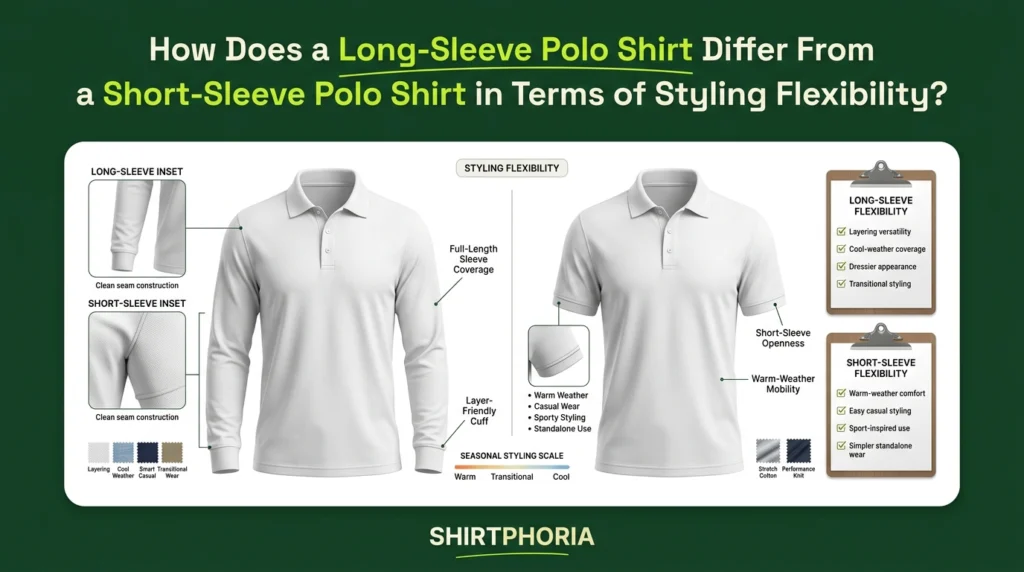
A long-sleeve polo shirt adds arm coverage and cuff-position options, while a short-sleeve polo reduces sleeve bulk and exposes more of the arm; the more flexible choice depends on fabric, fit, climate, outfit, and dress code.
Styling flexibility means the range of situations in which a completed garment works without creating a clear conflict in comfort, layering, proportion, visual cohesion, or dress-code suitability.
Long-sleeve and short-sleeve polos are not simply identical shirts with different amounts of fabric. Sleeve length changes arm coverage, the way the garment interacts with outer layers, and the visual continuity of the outfit. It does not independently determine warmth, breathability, formality, or athletic performance.
The comparison therefore needs five dimensions: perceived formality, climate suitability, sleeve construction, layering compatibility, and intended use.
Neither variant is universally more flexible. The better option is the one that produces fewer problems in the situations where the wearer actually plans to use it.
Quick Answer
Long-sleeve polos provide more arm coverage, cuff-position options, and a continuous layer beneath outerwear. Short-sleeve polos reduce sleeve bulk and can suit warm conditions or layered outfits where only the collar and placket need to remain visible. Neither is universally better; fabric, fit, climate, outer layers, and dress code determine the stronger choice.
How Does Sleeve Length Shape Long-Sleeve vs. Short-Sleeve Polo Shirt Styling Flexibility?
Sleeve length shapes long-sleeve and short-sleeve polo-shirt styling flexibility by changing arm coverage, visual continuity, and interaction with outer layers, but it works alongside the rest of the garment.
A long-sleeve polo covers the arm from shoulder to wrist or to another selected cuff position.
A short-sleeve polo usually covers part of the upper arm while leaving the forearm exposed.
That difference changes proportion and how much garment surface remains visible.
Long sleeves can create a more continuous line from shoulder to wrist. Short sleeves can create a lighter visual break around the upper arm.
Neither effect determines the finished outfit by itself.
Fabric surface, fit, collar stability, placket construction, trousers, footwear, branding, colour, and outerwear can all change the final result.
How Can Long-Sleeve vs. Short-Sleeve Polo Shirts Affect Perceived Formality?
A comparable long-sleeve polo can appear more covered and visually continuous than its short-sleeve counterpart, but perceived formality still depends on fit, fabric, collar, colour, branding, and the surrounding outfit.
Perceived formality is a context-sensitive visual judgment rather than a mechanical property of sleeve length.
Additional sleeve coverage can make an outfit appear more continuous, particularly when the rest of the garment is restrained.
A long-sleeve polo may appear smarter when it has:
- a controlled body fit;
- a stable collar;
- a centred placket;
- restrained branding;
- a smooth or refined knit surface;
- compatible trousers;
- appropriate footwear.
However, a loose, highly branded, technical-looking long-sleeve polo may remain clearly casual.
A short-sleeve polo can also work in smart-casual settings when it has:
- a clean sleeve opening;
- controlled torso fit;
- a stable collar and placket;
- restrained colour;
- limited branding;
- appropriate trousers and footwear.
The relationship is therefore:
Additional Sleeve Coverage → Can Increase Visual Continuity → May Support a Smarter Impression in a Compatible Outfit
That is a styling tendency, not a universal dress-code rule.
Neither version should automatically be treated as formalwear.
Business-casual acceptance depends on the workplace or event policy.
How Can Long-Sleeve vs. Short-Sleeve Polo Shirts Suit Different Weather Conditions?
Long-sleeve and short-sleeve polo shirts alter arm coverage, but their comfort across weather conditions depends on knit structure, fabric mass, fibre, fit, humidity, activity, and layering.
Long sleeves add coverage.
That can be useful in cooler, breezy, or changeable conditions.
A lightweight long-sleeve polo may also remain usable in some warm settings if the fabric, knit, and fit allow comfortable wear.
Short sleeves reduce arm coverage.
That may feel more comfortable in warm conditions, but exposed arms do not guarantee that the entire garment will feel cool.
A heavy, compact, or poorly breathable short-sleeve knit can still feel warm.
CottonWorks explains that knit construction, yarn, and fibre selection can change knitted fabric weight, drape, texture, and behaviour. CottonWorks knit construction guide
The useful tendencies are:
Long-Sleeve Polo
- more arm coverage;
- possible cuff-position changes;
- continuous fabric beneath outerwear.
Short-Sleeve Polo
- less arm coverage;
- lower forearm fabric bulk;
- exposed arms where the setting allows.
Either version can also be layered in cooler weather.
Climate suitability must therefore be judged from the completed garment rather than sleeve length alone.
How Does Sleeve Construction Change Long-Sleeve vs. Short-Sleeve Polo Shirt Styling Flexibility?
Sleeve construction changes long-sleeve and short-sleeve polo-shirt styling flexibility through differences in sleeve length, opening shape, cuff or hem finish, fit, and fabric recovery.
The sleeve opening is the finished edge through which the arm or wrist exits the sleeve.
On a long-sleeve polo, the opening may use:
- a Ribbed Knit Cuff;
- a simple folded finish;
- an open cuff;
- another knitted or sewn treatment.
On a short-sleeve polo, the opening may use:
- a plain hem;
- a ribbed band;
- a shaped opening;
- another finished edge.
Products vary considerably.
Movement also depends on the complete pattern rather than the opening alone.
Research on apparel fit emphasizes that garments should be evaluated while both standing and moving because tightness, looseness, balance, and wrinkles can appear differently across positions. Fashion and Textiles fit study
How Does Long-Sleeve Polo Cuff Construction Affect Styling Options?
A long-sleeve polo cuff can support wrist-level wear or a selected forearm position when its opening and recovery suit the wearer and fabric.
A Ribbed Knit Cuff uses a rib structure around the sleeve opening.
Cuff recovery describes how well the cuff returns toward its original size after stretching.
A cuff that works correctly for the wearer may hold the sleeve near the wrist during normal wear.
It may also allow the wearer to position the sleeve higher on the forearm when the cuff opening, recovery, and sleeve design permit it.
Moving the cuff upward can create a less covered visual line and may make the outfit appear more relaxed.
That does not automatically change the polo from smart casual to casual.
Cuff performance depends on:
- opening size;
- elasticity;
- recovery;
- sleeve width;
- sleeve mass;
- wrist circumference;
- forearm circumference.
Too little recovery may allow the sleeve to slide down repeatedly.
Too much compression may create discomfort or prevent the wearer from using the desired sleeve position.
The useful relationship is:
Compatible Cuff Opening and Recovery → Supports Selected Sleeve Position → Expands Practical Styling Options
The strongest cuff is not necessarily the tightest one.
How Does Short-Sleeve Polo Opening Construction Affect Styling Options?
A short-sleeve polo opening affects styling through its width, angle, length, and relationship with the upper arm rather than through the hem finish alone.
A close-fitting sleeve opening may frame the upper arm clearly.
If it is too tight, however, it may grip the arm, create horizontal tension, or restrict comfort.
A wider opening may create a more relaxed silhouette.
If it is excessively wide for the intended fit, it may make the sleeve appear detached from the shape of the upper arm.
Mobility can also depend on:
- shoulder fit;
- armhole shape;
- sleeve width;
- body ease;
- fabric stretch;
- wearer proportions.
A simple sleeve hem therefore does not automatically create greater mobility.
Sleeve Opening and Fit → Influence Arm Framing and Movement → Affect the Completed Short-Sleeve Silhouette
Readers interested in how sleeve openings shape upper-arm presentation can also compare the principles used in muscle shirt sleeve tailoring.
That comparison provides construction context rather than proof of how a specific polo will perform.
What the Evidence Establishes
- Lacoste’s official history documents the modern lightweight piqué polo’s sporting connection with René Lacoste and tennis.
- Apparel fit assessment should include both static and moving positions because fit problems can appear differently during movement.
- Knit construction, yarn, and fibre influence fabric behaviour, so sleeve length alone cannot determine comfort, drape, or warmth.
These sources establish historical and construction context; they do not rank long-sleeve and short-sleeve polos by universal formality.
How Can Long-Sleeve vs. Short-Sleeve Polo Shirts Work With Outer Layers?
Long-sleeve and short-sleeve polo shirts can both work with outer layers, but they distribute fabric differently around the arms, collar, and torso.
Successful layering depends on compatibility between both garments.
A good combination should be checked for:
- shoulder room;
- sleeve room;
- collar interaction;
- placket alignment;
- torso bulk;
- movement.
Long sleeves add another complete fabric layer around the arm.
Short sleeves remove most of that forearm layer but do not eliminate torso bulk.
How Can a Long-Sleeve Polo Work Beneath a Jacket?
A long-sleeve polo can work beneath a blazer, sport coat, bomber jacket, or other compatible outer layer when the combined sleeves and body preserve movement without persistent bunching.
Long sleeves create continuous fabric coverage beneath the jacket.
This can be useful when full arm coverage is desired.
It may also add sleeve bulk.
The actual combination should be checked for:
- cuff interaction;
- sleeve bunching;
- shoulder mobility;
- collar position;
- placket alignment;
- waist pooling.
A jacket designed closely around a thin woven shirt may not have enough room for a substantial knit polo.
The polo and jacket therefore need to be tested together.
For a more detailed look at how body fit, cuff recovery, and layering interact, see long-sleeve polo styling.
Example: Transitional-Weather Combination
One possible combination is:
- navy long-sleeve polo;
- tan bomber jacket;
- grey chinos;
- leather loafers.
The combination can work when the polo remains controlled beneath the jacket, the colours remain visually separated, and the setting accepts smart-casual footwear.
This is an example rather than a universal formula.
How Can a Short-Sleeve Polo Work Beneath an Outer Layer?
A short-sleeve polo can reduce fabric around the forearms beneath a sweater, blazer, overshirt, or jacket while preserving the visible polo collar and placket.
That can reduce sleeve-on-sleeve bulk.
It does not automatically solve all layering problems.
The torso may still bunch beneath an outer garment when the polo body is too loose or the outer layer is too narrow.
A short-sleeve polo can work beneath:
- a Crewneck Sweater;
- a lightweight jacket;
- an unstructured blazer where permitted;
- an overshirt;
- a cardigan;
- a casual coat.
A Crewneck Sweater can conceal the polo body while allowing some or all of the collar to remain visible.
A jacket or overshirt worn open may reveal the bare forearms, which changes the visual effect.
Weather also matters because reduced sleeve coverage may be less comfortable when the outer layer is removed.
The relationship is:
Reduced Sleeve Coverage → Can Lower Forearm-Layer Bulk → May Support Specific Outer-Layer Combinations
Neither sleeve length owns the concept of layering.
How Can Long-Sleeve vs. Short-Sleeve Polo Shirts Support Casual Styling?
Long-sleeve and short-sleeve polo shirts support casual styling through different combinations of coverage, proportion, fabric behaviour, and outfit pairing.
Both can work as casual garments.
Their strengths simply appear in different ways.
How Can a Long-Sleeve Polo Create a Relaxed Outfit?
A long-sleeve polo can create a relaxed outfit when it is worn independently or with the cuffs placed comfortably at the wrist or forearm.
Keeping the cuff at the wrist creates full coverage.
Moving it higher may expose part of the forearm and create a less covered visual line.
This can appear more relaxed when the cuff remains comfortable and stable.
Possible casual pairings include:
- Chinos;
- clean denim;
- casual Trousers;
- lightweight jackets;
- simple leather shoes;
- casual footwear.
The final result still depends on body fit, colour, fabric surface, collar structure, and the context of the outfit.
A heavily structured or glossy long-sleeve polo does not necessarily become relaxed simply because the cuffs are moved.
How Can a Short-Sleeve Polo Create a Relaxed Outfit?
A short-sleeve polo can create a relaxed outfit by combining reduced arm coverage with compatible warm-condition fabrics, casual trousers or shorts, and context-appropriate footwear.
Reduced arm coverage may be useful in warm conditions.
Actual breathability still depends on fabric construction.
Possible pairings include:
- linen-blend trousers;
- Chino Shorts;
- lightweight Chinos;
- clean denim;
- minimalist sneakers;
- loafers;
- context-appropriate sandals.
Short sleeves are not restricted to lightweight bottoms.
A short-sleeve polo may also work with heavier trousers when climate, texture, colour, and setting make the combination coherent.
Likewise, wool trousers are not automatically incompatible with a short-sleeve polo.
The entire outfit determines the result.
What Does the Long-Sleeve vs. Short-Sleeve Polo Shirt Styling Flexibility Comparison Show?
The comparison shows that each sleeve length creates different options and limitations rather than a permanent hierarchy.
Styling Flexibility Comparison
| Styling Parameter | Long-Sleeve Polo Shirt | Short-Sleeve Polo Shirt |
|---|---|---|
| Arm Coverage | Full arm coverage, depending on cuff position | Upper-arm coverage with exposed forearm |
| Perceived Formality | Can appear more covered in a comparable restrained outfit | Can remain smart casual when fit, collar, and outfit are controlled |
| Warm-Condition Use | Depends on fabric, knit, fit, and activity | Reduced arm coverage may help, but fabric remains decisive |
| Cool-Condition Use | Adds coverage and can function beneath outerwear | Can remain usable beneath sweaters, jackets, or coats |
| Cuff or Hem Options | May offer wrist and forearm positions | Sleeve opening usually remains fixed unless designed otherwise |
| Layering Beneath Jackets | Continuous sleeve layer; may add sleeve bulk | Reduced forearm bulk; torso and collar fit still matter |
| Layering Beneath Sweaters | Can work if combined sleeves do not bunch | Can expose collar and placket while reducing sleeve bulk |
| Casual Use | Works with chinos, denim, and casual trousers | Works with shorts, chinos, denim, and casual trousers |
| Business-Casual Potential | Context-dependent and subject to workplace policy | Context-dependent and subject to workplace policy |
| Main Risk | Sleeve bulk, cuff pressure, or excessive warmth | Poor sleeve opening, exposed-arm mismatch, or insufficient coverage |
| Best Decision Basis | Fit, climate, outer layer, and dress code | Fit, climate, outer layer, and dress code |
The matrix summarizes common options.
It does not establish one version as permanently more flexible than the other.
Which Long-Sleeve vs. Short-Sleeve Polo Shirt Choice Fits Common Scenarios?
Different situations create different starting points.
A starting choice should still be checked against the actual garment.
Context-Based Polo Decision Matrix
| Scenario | Likely Starting Choice | Decision Boundary |
|---|---|---|
| Warm Outdoor Gathering | Short-sleeve polo | Fabric, sun exposure, humidity, and dress expectations still matter |
| Mild Transitional Weather | Long-sleeve polo | Confirm that the fabric does not create excess warmth |
| Business-Casual Office | Either where permitted | Workplace policy, fit, collar, trousers, and footwear determine suitability |
| Smart-Casual Dinner | Either variant | Long sleeves may add coverage, but a refined short-sleeve polo can also work |
| Beneath a Crewneck Sweater | Short sleeve may reduce sleeve bulk | Long sleeves may suit users who want more warmth or continuous coverage |
| Beneath a Blazer | Either variant | Test shoulder room, collar interaction, torso bulk, and sleeve comfort |
| Active Casual Event | Short sleeve may reduce coverage | Movement still depends on sleeve opening, armhole, fabric, and fit |
| Cool Evening Outdoors | Long sleeve may add coverage | Outerwear and fabric may matter more than sleeve length |
| Travel Wardrobe | Either or both | Base the choice on destination climate and planned outfits |
| Casual Friday With Jeans | Either variant | Temperature, workplace rules, and desired coverage determine the better choice |
“Likely starting choice” is an initial styling direction, not a universal answer.
What Checklist Clarifies Long-Sleeve vs. Short-Sleeve Polo Shirt Styling Flexibility?
Choosing between a long-sleeve and short-sleeve polo requires matching the completed garment to the intended climate, layer, dress code, and level of arm coverage.
What Common Mistakes Reduce Long-Sleeve vs. Short-Sleeve Polo Shirt Styling Flexibility?
Long-sleeve and short-sleeve polo-shirt styling flexibility decreases when the wearer chooses by sleeve label alone and ignores garment construction or context.
Mistake 1: Treating Long Sleeves as Automatic Formality
A long-sleeve polo does not automatically become dressier simply because it covers more of the arm.
A loose, heavily branded, shiny, or strongly technical long-sleeve polo may remain highly casual.
Formality depends on the complete outfit.
Mistake 2: Treating Short Sleeves as Athletic-Only
The modern polo has documented sporting heritage.
Lacoste’s official corporate history connects René Lacoste with tennis and states that in 1933 the brand introduced a lightweight petit-piqué polo for sporting use. Lacoste history
That history does not restrict every modern short-sleeve polo to sport.
A well-fitted short-sleeve polo with a stable collar and restrained styling can work in many contemporary casual and smart-casual settings.
Mistake 3: Assigning Fixed Seasons
Long sleeves are not automatically limited to cool seasons.
Short sleeves are not automatically limited to hot seasons.
Fabric mass, knit structure, humidity, wind, indoor heating or cooling, and outer layers can change suitability.
Mistake 4: Ignoring Sleeve Bulk
A long-sleeve polo may bunch beneath narrow outer-layer sleeves.
The problem can occur even when the body of the polo fits well.
Always test the complete combination.
Mistake 5: Ignoring Torso Bulk
Short sleeves reduce fabric around the forearm.
They do not prevent excess body fabric from gathering beneath a sweater or jacket.
Torso fit still matters.
Mistake 6: Confusing Coverage With Breathability
Reduced arm coverage and fabric air permeability are different characteristics.
A short-sleeve polo exposes more skin but may still use a dense fabric.
A long-sleeve polo covers more skin but may use a lighter, more open knit.
Mistake 7: Ignoring Movement
A garment should be assessed while standing and moving.
A sleeve that appears correct in a static position can still grip, pull, or shift during normal activity.
Movement testing helps distinguish visual fit from functional fit.
Mistake 8: Using Brand Prestige as Proof
Brand name does not prove:
- sleeve quality;
- collar stability;
- fit;
- fabric behaviour;
- layering compatibility.
Inspect the actual garment.
Mistake 9: Ignoring Workplace Policy
A polo that looks polished may still conflict with a formal workplace dress code.
General styling guidance cannot override employer or event requirements.
Key Takeaway
Long sleeves expand arm coverage and cuff-position options; short sleeves reduce arm coverage and can lower forearm bulk beneath layers. Neither advantage works alone. The better polo is the one whose fit, fabric, sleeve construction, collar, and outer-layer interaction suit the actual climate, outfit, and dress code.
Frequently Asked Questions About Long-Sleeve vs. Short-Sleeve Polo Shirts
Not automatically. Long sleeves can create more arm coverage and visual continuity, but perceived formality still depends on fabric, fit, collar, placket, colour, branding, trousers, footwear, and the dress code.
Short sleeves reduce arm coverage, but warm-weather comfort still depends on fabric mass, knit openness, fibre, fit, humidity, activity, and layering. A dense short-sleeve polo can still feel warm.
Yes, where the setting permits it. A short-sleeve polo can reduce forearm fabric bulk beneath a blazer, but the torso, shoulders, collar, placket, and jacket fit still need to work together.
Yes, when the cuff opening, recovery, sleeve width, and wearer dimensions allow the cuff to remain stable without excessive pressure or repeated sliding.
Neither is universally more versatile. The better choice is the one whose fit, fabric, sleeve construction, climate suitability, outer-layer compatibility, and dress-code fit create fewer conflicts in the situations where it will actually be worn.
Terms Explained
| TERM | DEFINITION |
|---|---|
| Styling flexibility | The range of situations in which a garment works without clear conflicts in comfort, layering, proportion, visual cohesion, or dress-code suitability. |
| Perceived formality | A context-sensitive visual judgment influenced by the complete outfit rather than sleeve length alone. |
| Sleeve opening | The finished edge through which the arm or wrist exits the sleeve. |
| Ribbed knit cuff | A knitted sleeve opening that uses rib structure for stretch and recovery. |
| Cuff recovery | The ability of a cuff to return toward its original size after stretching. |
| Layering compatibility | How well the polo works beneath an intended sweater, blazer, jacket, or coat without excessive bulk or restriction. |
| Forearm bulk | The amount of fabric around the forearm area when garments are layered. |
| Visual continuity | The degree to which garment coverage creates an uninterrupted visual line across the body. |
| Static fit | How the garment appears and feels when the wearer is standing still. |
| Dynamic fit | How the garment behaves during movement. |
What Is the Final Principle of Long-Sleeve vs. Short-Sleeve Polo Shirt Styling Flexibility?
The final principle of long-sleeve and short-sleeve polo-shirt styling flexibility is contextual compatibility rather than universal superiority.
Long sleeves change arm coverage, cuff-position possibilities, and how fabric interacts with outerwear. Short sleeves reduce forearm coverage and can reduce sleeve bulk.
Neither change independently determines warmth, comfort, formality, or occasion suitability.
Knit construction and body fit influence comfort and visual structure, while collar and placket behaviour influence how the polo integrates with the rest of the outfit.
Both variants can work in casual and smart-casual settings. Business-casual acceptance remains dependent on workplace rules.
The more flexible polo is the version whose sleeve design, fit and fabric create the fewest conflicts in the situations where the wearer plans to use it.