What is the Historical Origin of the Guayabera Shirt in Latin American Fashion?
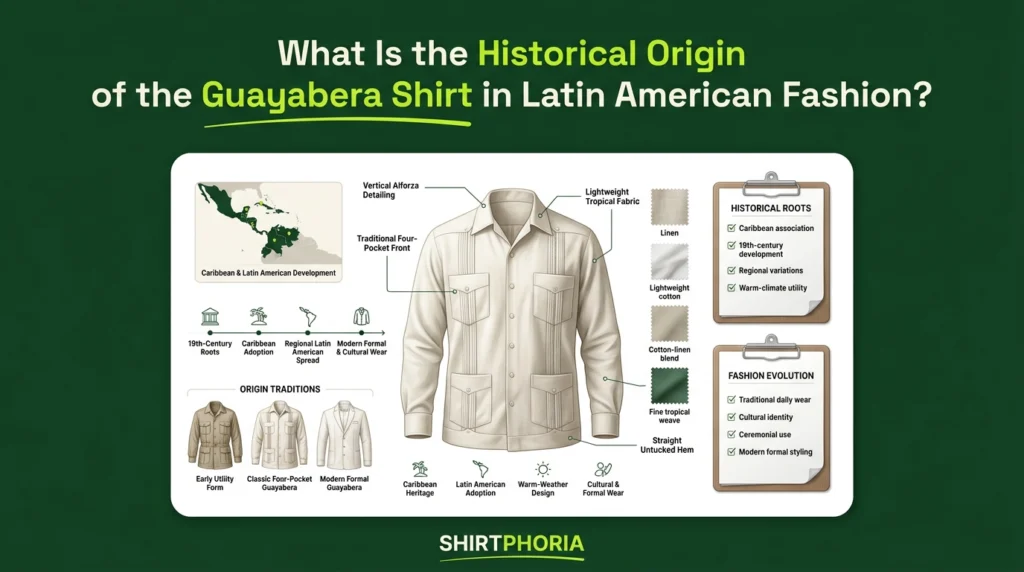
The precise inventor and birthplace of the Guayabera remain unresolved, but late-nineteenth-century archival and military evidence provides the strongest documented case for its emergence in Cuba before later refinement, production, and cultural expansion in Mexico, the Caribbean, Latin America, and diaspora communities.
Source: Museum of Miami — The Guayabera: A Shirt’s Story
The Guayabera occupies an important place in Latin American fashion, but its history is more complicated than a simple story about one inventor or one country. Popular accounts often combine oral legends, surviving garments, military records, regional pride, manufacturing history, and visual similarities as though they represent the same level of historical evidence.
They do not.
Among the approved historical sources, a Spanish soldier’s 1896 pay book and Spanish military garments dated 1895–1898 provide identifiable late-nineteenth-century evidence for the term and garment in Cuba.
This evidence supports Guayabera use in Cuba during that period, but it does not identify the person who invented the modern civilian shirt.
Source: Museum of Miami, The Guayabera: A Shirt’s Story.
This guide separates legend from archival evidence, evaluates Cuban, Mexican, Spanish, and Philippine connections, and traces how the Guayabera developed from late-nineteenth-century garments into an urban, political, commercial, and internationally recognized part of Latin American fashion.
Why Does the Documented History of the Guayabera Shirt Matter to Cultural Identity?
The documented history of the Guayabera matters to cultural identity because the garment acquired different meanings through rural use, military records, urban adoption, regional tailoring, political promotion, and international commerce.
Today, the shirt may appear at weddings, business meetings, government functions, cultural celebrations, restaurants, or casual tropical events. Those uses did not emerge from one fixed tradition.
Instead, the Guayabera developed different meanings in Cuba, Mexico, the Caribbean, Latin America, and diaspora communities.
Historical use therefore informs the garment’s modern identity and etiquette, but it does not permanently dictate how every Guayabera must be worn today.
How Historical Use Shaped the Guayabera’s Modern Formality
Historical use shaped the Guayabera’s modern formality through several overlapping transitions, including countryside wear, military terminology, urban retail, government use, regional tailoring, and later ceremonial adoption.
Late-nineteenth-century evidence connects the Guayabera name with Spanish military garments in Cuba, Cuban military or independence-era clothing, and countryside use involving both landowners and fieldworkers.
Some early shirts and jackets associated with the name did not necessarily look identical to the familiar modern four-pocket Guayabera.
That distinction matters.
A historical garment can belong to the development of the Guayabera without having every feature now associated with the modern shirt.
By the mid-twentieth century, however, the recognizable arrangement of two chest pockets and two lower pockets had become well established in Havana.
A 1951 example associated with the El Encanto department store also demonstrates that Guayaberas were being sold as established urban clothing rather than remaining limited to countryside or military environments.
Source: Museum of Miami, The Guayabera: A Shirt’s Story.
The historical changes in pockets, fabrics, detailing, and social use explain why modern Guayabera shirts appear in both casual and formal settings.
The garment’s movement into weddings, diplomatic events, government functions, business settings, and formal social occasions did not happen through one universal sequence.
Different countries and communities formalized the Guayabera through different combinations of tailoring, politics, climate, social convention, retail, and cultural identity.
How Social-Class Associations Changed Guayabera Use
Social-class associations changed Guayabera use as the shirt moved among rural workers, landowners, soldiers, urban employees, political officials, tailors, tourists, and consumers across several countries.
It is therefore misleading to describe the Guayabera as belonging originally to only one social class.
Historical countryside references include both landowners and fieldworkers.
Later urban adoption brought the garment into workplaces, department stores, government environments, and increasingly formal social life.
A revealing example appeared in 1948 with Uso y Abuso de la Guayabera.
The publication debated whether wearing the shirt was socially appropriate in different circumstances. The fact that this debate existed shows that the Guayabera’s formal status was contested rather than universally accepted from the beginning.
Source: Museum of Miami, The Guayabera: A Shirt’s Story.
Social mobility, urban retail, political use, and regional tailoring collectively expanded the Guayabera’s meaning.
Its position in Latin American fashion therefore resulted from several historical processes rather than a single transition from workwear to formalwear.
What Are the Main Historical Origin and Influence Theories of the Guayabera Shirt?
The main Guayabera origin and influence theories involve Cuban emergence evidence, Mexican and Yucatecan refinement, Spanish military connections, and a plausible but unproven Philippine or Asian comparative influence.
These theories should not be treated as equally supported claims about who invented the garment.
Some evidence concerns the earliest documented appearance of the Guayabera name.
Other evidence concerns oral traditions, manufacturing, regional refinement, political promotion, or possible cultural influence.
A careful historical interpretation therefore separates five questions:
- Where does the strongest early documentary evidence place the garment?
- Which oral traditions claim an earlier creation?
- Which regions later refined or transformed it?
- Which garment traditions may have influenced its development?
- Which places later became important manufacturing or political centers?
When those questions are separated, the Guayabera’s complicated history becomes easier to understand.
What Does the Cuban Origin Evidence Actually Establish?
Cuban evidence establishes that garments called Guayaberas or Guayaveras were documented in Cuba during the late nineteenth century, while the famous Sancti Spíritus invention story remains an earlier oral tradition rather than verified archival history.
Stronger Documented Evidence
The strongest approved evidence includes late-nineteenth-century archival references to a shirt or jacket called a Guayabera.
A Spanish soldier’s 1896 pay book records the term “guayavera.”
Military garments associated with the term also survive or are documented from approximately 1895–1898.
Some were made from Rayadillo, a striped linen-or-cotton fabric used for tropical Spanish military uniforms.
These military examples are important because they establish a dated context for the Guayabera name and related garment forms in late-nineteenth-century Cuba.
They do not prove that those military shirts were identical to the later civilian Guayabera.
Source: Museum of Miami, The Guayabera: A Shirt’s Story.
Countryside references also connect the shirt with both landowners and fieldworkers.
Taken together, these sources provide the strongest approved documentary evidence for the Guayabera’s late-nineteenth-century Cuban emergence.
Cultural Tradition
The best-known earlier story places the Guayabera in Sancti Spíritus, Cuba.
According to popular tradition, a wife made or modified a shirt for her husband and added large pockets so that he could carry belongings while working.
One version says the pockets were used to carry guavas, or guayabas.
According to this explanation, the fruit eventually contributed to the name “Guayabera.”
Another popular explanation connects the garment’s name with the Yayabo River near Sancti Spíritus and terms such as Yayabero or Yayabera.
These stories have cultural importance because they preserve how communities have explained the garment’s identity.
However, they remain oral traditions rather than strongly documented invention history.
The precise etymology of “Guayabera” is therefore uncertain.
Source: Museum of Miami, The Guayabera: A Shirt’s Story.
The Cuban evidence strongly supports late-nineteenth-century emergence and use, but it does not identify one inventor or reconstruct every step toward the modern shirt.
What Did Mexico and Yucatán Contribute to Guayabera History?
Mexico and Yucatán contributed major tailoring, embroidery, manufacturing, political promotion, and formalwear traditions to Guayabera history without providing conclusive evidence that the modern garment was first invented there.
A commonly repeated transmission narrative says that Yucatecan henequen planters may have encountered the shirt while traveling to Cuba during the late nineteenth or early twentieth century and later brought the style into Yucatán.
This should be treated as a commonly told historical narrative rather than settled archival proof of a specific transfer.
What is clearer is that Veracruz and Yucatán developed strong Guayabera traditions.
Mérida eventually became particularly important.
As Cuban apparel production declined after the Cuban Revolution of 1959, manufacturers in Mérida became increasingly prominent in the Guayabera market.
Mexican production then experienced a major boom during the 1970s.
President Luis Echeverría’s public use of the shirt for domestic and international government business contributed to its visibility and popularity.
Yucatecan makers also became especially associated with detailed tailoring and intricate vertical front embroidery.
Fine alforza work became part of the region’s reputation for Guayabera craftsmanship, although this does not establish that Yucatecan tailors invented alforzas.
Source: Museum of Miami, The Guayabera: A Shirt’s Story.
This difference between invention and refinement is essential.
A region can become one of the most important places for manufacturing, embroidery, tailoring, commercialization, or formalwear without necessarily being the original birthplace of the garment.
What Was the Mexican Filipina?
Another important comparative garment is the Mexican Filipina.
The garment was generally lightweight, often light-colored, and worn untucked. Its name and construction have sometimes been associated with Asian influence.
It developed as a distinct Mexican garment tradition and was increasingly displaced in common use by the Guayabera during the twentieth century.
The Mexican Filipina should not be treated as another name for the Philippine Barong Tagalog.
The two garments belong to different cultural and historical contexts.
Their comparison can support questions about cultural exchange, but similarity alone cannot establish direct descent.
Does the Barong Tagalog Prove a Philippine Origin for the Guayabera?
The Barong Tagalog does not prove a Philippine origin for the Guayabera, but its tropical, untucked silhouette and the trans-Pacific history connecting Manila and Mexico make comparative influence a legitimate subject for cautious investigation.
At a broad level, the garments share several characteristics.
Both can feature:
- Lightweight construction
- Untucked wear
- Tropical suitability
- Decorative front details
- Formal and cultural use
Those similarities make comparison reasonable.
They do not make the garments historically identical.
Traditional Philippine Barong garments developed with materials including piña, jusi, and abacá.
They are often associated with pechera or concentrated chest embroidery and traditionally feature long, loose sleeves.
Their modern political and national significance developed through the Philippines’ own history.
The classic Guayabera, by comparison, is commonly associated with opaque linen or cotton, multiple front pockets, and vertical alforzas or embroidery.
The Barong therefore has an independent development rather than functioning simply as an earlier Guayabera.
Source: Cultural Center of the Philippines — How the Baro Transformed into the Garment of Filipino Identity
Possible Trans-Pacific Comparative Influence
The Manila–Acapulco Galleon Trade connected Manila and Acapulco across the Pacific and formed part of a broader exchange system connecting Asia, the Americas, and Europe.
Source: UNESCO World Heritage Centre — Historic Manila and Manila–Acapulco Trade Context
Such a network enabled the movement of people, materials, objects, craft practices, and design ideas.
That makes cross-cultural influence possible.
But the existence of the trade route does not establish that one particular shirt traveled through it or that the Guayabera directly descended from the Barong.
Trade contact makes transmission possible; it does not establish that one specific shirt descended directly from another.
The Philippine connection is therefore best classified as a possible trans-Pacific comparative influence.
Trans-Pacific trade networks enabled the movement of materials and design ideas, which supports an influence hypothesis but not direct lineage proof.
How Strong Is the Evidence for Each Guayabera Origin Theory?
The evidence for Guayabera origin theories varies substantially because dated Cuban records, oral traditions, Mexican production history, and Philippine design comparisons do not provide the same level of historical certainty.
| Historical ClaimSupporting EvidenceEvidence LimitationsDefensible Conclusion | |||
|---|---|---|---|
| Late-Nineteenth-Century Cuban Emergence | Archival references; 1896 Spanish soldier’s pay book; 1895–1898 military garments; countryside references | Early garments may not match the modern four-pocket civilian shirt; no single inventor identified | Strongest approved documentary emergence evidence |
| Sancti Spíritus Invention Legend | Widely repeated story of an eighteenth-century couple and a pocketed work shirt | Oral tradition; no conclusive early record identifying the couple or first shirt | Important Cuban cultural narrative, not proven invention history |
| Guava-Name Explanation | Popular belief that pockets carried Guayabas | Explanation is difficult to verify; competing Yayabo-based explanation exists | Plausible name legend, not settled etymology |
| Spanish Military Connection | Spanish uniforms in Cuba called Guayaberas; Rayadillo garments with multiple pockets | Relationship between military garments and civilian shirt evolution is incomplete | Possible structural and terminological influence |
| Mexican or Yucatecan Invention | Long-standing Yucatecan use; regional pride; Mexican Filipina; major tailoring tradition | Transfer from Cuba is commonly told rather than proof of invention | Mexico and Yucatán are major refinement and production centers |
| Yucatecan Contribution | Mérida manufacturing; fine tailoring; intricate front embroidery; later alforza craftsmanship | Contribution does not establish birthplace; styles continued evolving | Strong evidence of refinement, embroidery, production, and formalwear development |
| Philippine or Barong Influence | Untucked tropical shirts; chest ornamentation; Manila–Acapulco exchange | No direct dated garment chain or archival record connecting Barong and Guayabera | Plausible comparative influence, currently unproven |
| Mexican Filipina Connection | Lightweight, untucked Mexican shirt with a name suggesting Asian origin | Exact relationship to Philippine garments and the Guayabera remains incomplete | Useful intermediate comparative garment, not automatic proof of descent |
This distinction is one of the most important rules for interpreting Guayabera history.
A dated record can establish that a garment or garment name existed by a particular year.
It cannot necessarily identify where the first example appeared decades earlier.
Likewise, a region’s later importance in tailoring, embroidery, manufacturing, or political promotion does not automatically establish that the garment originated there.
How Did Guayabera Design Features Evolve Historically?
Guayabera design features evolved through military, rural, urban, tailoring, climatic, commercial, and regional influences rather than through one fully documented functional invention process.
Several features now seem inseparable from the Guayabera, particularly its pockets, straight hem, side vents, alforzas, and embroidery.
However, historians should avoid assuming that the present-day function of a feature explains exactly why it was invented.
A visible feature can have several roles at once.
It may provide a practical effect, become decorative, acquire symbolic importance, develop regional meaning, or be modified later by manufacturers.
What Can Be Historically Said About Guayabera Pockets and Side Vents?
Guayabera pockets and side vents provide storage, movement, and support for untucked wear, but their exact original purposes and development cannot be reduced to one verified worker, crop, tool, or riding practice.
Late-nineteenth-century military examples documented by the museum included four pockets positioned near the lower part of the garment.
By the mid-twentieth century, the familiar Havana arrangement of two chest pockets and two lower pockets had become common.
The exact historical steps connecting these configurations remain incomplete.
Source: Museum of Miami, The Guayabera: A Shirt’s Story.
In modern construction, pockets clearly provide storage while also contributing strongly to the Guayabera’s distinctive visual identity.
Side vents permit greater movement around the hips and help the straight hem function comfortably when the shirt is worn outside the trousers.
Pockets provided practical storage, while side vents improved movement and helped the straight hem function when worn untucked.
The popular explanation that Guayabera pockets were originally created specifically for carrying guavas remains a cultural story rather than established functional history.
Similarly, there is insufficient evidence to claim that the four pockets were created exclusively for tools, cigars, agricultural produce, or another single object.
Side vents also should not be assigned an exclusive origin in horseback riding or access to trouser pockets without direct historical evidence.
How Did Alforzas and Embroidery Become Guayabera Hallmarks?
Alforzas and embroidery became Guayabera hallmarks through tailoring refinement and regional decoration, although the approved evidence does not establish one original inventor or a single initial reinforcing purpose.
Alforzas are narrow stitched folds or pintuck-like vertical details.
They create controlled vertical lines that help give the Guayabera its recognizable appearance.
Embroidery refers to decorative stitched patterning that can replace or complement alforzas.
Vertical detailing gradually became one of the garment’s strongest visual signatures.
Fine alforzas demonstrate precise construction, while embroidery allows makers to introduce greater regional and decorative variation.
Yucatecan workshops became particularly known for skilled execution.
Intricate vertical embroidery is widely recognized as an important Mexican and Yucatecan contribution.
Some Mexican decorative traditions may also reflect local Maya textile influences.
Source: Museum of Miami, The Guayabera: A Shirt’s Story.
There is not enough evidence to state that alforzas were originally invented specifically to reinforce lightweight fabric.
Alforzas may add controlled texture and localized structure, but their documented historical role is strongest as a visual and craftsmanship feature.
How Did Historical Events Expand the Guayabera Shirt’s Cultural Status?
Historical events expanded the Guayabera’s cultural status through urban adoption, political promotion, manufacturing shifts, tourism, migration, retail, and regional reinvention.
No single event transformed the garment into an important part of Latin American fashion.
Instead, several developments worked together over different periods.
Urban consumers normalized the shirt.
Tailors refined it.
Politicians made it more visible.
Manufacturers expanded production.
Tourists encountered it as regional clothing.
Migrants carried it into new communities.
Retailers and designers then continued adapting it.
How Did Political and Diplomatic Use Popularize the Guayabera?
Political and diplomatic use popularized the Guayabera when named leaders and officials wore it in government settings, helping transform a regional shirt into a visible symbol of tropical formality and public identity.
Political meaning, however, varied according to the leader, country, and historical setting.
One of the strongest documented examples comes from Mexican president Luis Echeverría, who served from 1970 to 1976.
Echeverría frequently wore Guayaberas during government business and used the garment in both domestic and international settings.
His public adoption helped popularize the shirt and supported the major expansion of Mexican Guayabera production during the 1970s.
The Museum of Miami also describes his use of the garment partly in relation to creating a more approachable or humanized image of the presidency.
Source: Museum of Miami, The Guayabera: A Shirt’s Story.
This does not mean every political wearer used the Guayabera for the same reason.
It would also be inaccurate to assume that every politician who wore one intended to reject European or American suits.
In some contexts, the Guayabera communicated regional pride, accessibility, climatic practicality, nationalism, populism, or diplomatic informality, but the intended message must be established case by case.
How Did Manufacturing, Tourism, Migration, and Retail Spread the Guayabera?
Manufacturing, tourism, migration, and retail spread the Guayabera through overlapping markets rather than through one mid-century tourism boom alone.
By the middle of the twentieth century, Havana retailers such as El Encanto were selling established urban Guayaberas.
After the Cuban Revolution of 1959, everyday use and apparel production in Cuba declined.
As Cuban output diminished, manufacturers in Mérida became more prominent.
Mexican production experienced a major boom during the 1970s, supported partly by political visibility and promotion.
Tourism added another layer by associating the garment with tropical destinations and generating demand from visitors.
Migration across the Caribbean and Latin America also carried the shirt into communities in the United States.
Miami businesses, tailors, and designers later became part of the Guayabera’s expanding commercial network.
Contemporary Guayaberas are now produced in multiple countries and use both traditional and newer materials, colors, and decorative approaches.
Source: Museum of Miami, The Guayabera: A Shirt’s Story.
Tourism increased visibility and souvenir demand, while political promotion, industrial capacity, post-1959 production shifts, migration, and retail networks also shaped expansion.
The Guayabera’s commercial growth therefore cannot be explained by tourism alone.
What Historical Timeline Best Explains the Guayabera Shirt’s Development?
The most defensible Guayabera timeline begins with late-nineteenth-century Cuban evidence, proceeds through early- and mid-twentieth-century regional adoption, and continues through post-1959 manufacturing shifts, 1970s Mexican expansion, and later global reinvention.
| PeriodDocumented or Bounded DevelopmentEvidence Status | ||
|---|---|---|
| Eighteenth Century | Popular Sancti Spíritus invention story involving a pocketed work shirt | Oral Tradition |
| Late Nineteenth Century | Archival references to a shirt or jacket called Guayabera in Cuba; Spanish and Cuban military associations | Strongly Documented |
| 1895–1898 | Surviving or documented military garments associated with the term and made in Rayadillo or cotton | Strongly Documented |
| 1896 | Spanish soldier’s pay book records a “Guayavera” in Cuba | Strongly Documented |
| Late 1800s–Early 1900s | Commonly told transmission narrative involving Yucatecan planters encountering the shirt in Cuba | Plausible but Unproven |
| Early to Mid-Twentieth Century | Regional use expands in Cuba, Yucatán, Veracruz, and other Caribbean and Latin American contexts | Moderately Supported |
| 1948 | Uso y Abuso de la Guayabera debates the shirt’s social appropriateness in Havana | Strongly Documented |
| 1951 | El Encanto example demonstrates established urban retail in Havana | Strongly Documented |
| 1950s | Two-chest-and-two-lower-pocket form becomes common in Havana | Strongly Documented |
| After 1959 | Cuban use and apparel production decline; Mexican manufacturers increase prominence | Strongly Documented |
| 1970s | Mexican production boom is strongly associated with Luis Echeverría’s government use and promotion | Strongly Documented |
| Later Twentieth Century | Migration, tourism, Miami retail, regional politics, weddings, and business use expand international visibility | Moderately Supported |
| Contemporary Period | Designers use new fabrics, colors, gendered forms, national symbols, and regional reinterpretations | Strongly Documented |
Source: Museum of Miami, The Guayabera: A Shirt’s Story.
This timeline should not be understood as a perfectly continuous progression.
Guayabera adoption occurred at different speeds and in different forms across countries and communities.
Some traditions overlapped for decades.
Rural use could continue while the shirt became urban fashion.
Formal political use could exist alongside casual everyday wear.
Manufacturing could shift between countries without erasing earlier cultural associations.
How Does the Guayabera’s Timeline Move from Early Evidence to Formalwear?
The Guayabera’s timeline moves from late-nineteenth-century documentary evidence through rural, military, urban, political, manufacturing, and ceremonial phases rather than through one uninterrupted progression from peasant workwear to elite formalwear.
The broad historical sequence can be understood through seven stages:
- Early terminology and garment evidence
- Military and countryside associations
- Regional tailoring and transmission
- Urban retail and social debate
- Political adoption
- Manufacturing relocation and expansion
- International commercial and cultural reinvention
These phases overlap.
Military associations did not necessarily disappear once urban use increased.
Rural use could continue while tailors produced finer versions.
Political adoption could grow while the garment remained ordinary clothing in other environments.
A Guayabera worn in Cuba, Mexico, Puerto Rico, the Dominican Republic, Miami, or another community therefore did not necessarily follow the same historical path.
How Does Guayabera History Compare with Other Iconic Garment Histories?
Guayabera history resembles other iconic garment histories because function, climate, labor, military use, tailoring, politics, and commerce interacted over time, but the precise sequence must be established separately for each garment.
Many culturally important garments develop through combinations of practical use, regional tailoring, class association, political interpretation, commercial production, and later cultural symbolism.
A practical garment can become fashionable.
A regional garment can become political.
A commercial garment can eventually become a cultural symbol.
Those broad patterns help explain how clothing acquires meanings beyond construction and function.
However, similarity in development should not be confused with direct historical connection.
Similar evolutionary patterns do not establish direct historical relationships between unrelated garments.
Historical Evidence Checklist
Frequently Asked Questions
Late-nineteenth-century archival and military evidence provides the strongest approved case for documented Guayabera use in Cuba.
No. It is an important Cuban oral tradition, but it is not established as archival invention history.
They became major centers of tailoring refinement, embroidery, manufacturing, political promotion, and formal Guayabera use.
No. Similarities and trans-Pacific exchange make comparative influence plausible, but they do not prove direct descent.
Terms Explained
| TERM | DEFINITION |
|---|---|
| Alforzas | Narrow stitched folds or pintuck-like vertical details associated with Guayabera tailoring. |
| Rayadillo | A striped linen-or-cotton fabric used in tropical Spanish military uniforms and relevant to late-nineteenth-century Guayabera evidence. |
| Guayavera | A historical spelling recorded in a Spanish soldier’s 1896 pay book in Cuba. |
| Sancti Spíritus | The Cuban location associated with the best-known oral origin tradition of the Guayabera. |
| Barong Tagalog | A Philippine formal garment with an independent historical development that is sometimes compared with the Guayabera. |
| Mexican Filipina | A lightweight, usually untucked Mexican shirt discussed as a comparative garment in Guayabera history. |
Conclusion
The strongest conclusion about the Guayabera’s historical origin is that its precise invention remains unresolved, while late-nineteenth-century Cuban records provide the strongest approved emergence evidence and later regional contributions shaped the garment recognized today.
No verified single inventor has been identified.
Sancti Spíritus remains the center of the best-known Cuban origin legend, but the story of an eighteenth-century couple creating the first pocketed Guayabera has not been established as archival fact.
The explanations connecting the name with either guayaba fruit or the Yayabo River also remain uncertain.
Late-nineteenth-century Cuban archival and military evidence is substantially stronger than these oral traditions.
That evidence includes the 1896 “guayavera” reference and military garments associated with the 1895–1898 period.
Rayadillo belongs specifically to this military history.
By the mid-twentieth century, the recognizable civilian four-pocket form was well established in Havana.
Mexico and especially Yucatán later became major centers of tailoring refinement, embroidery, manufacturing, political promotion, and formal Guayabera use.
Mérida’s strongest documented rise as a manufacturing center belongs primarily to the period following the decline of Cuban production and the major Mexican expansion of the 1970s.
The Barong Tagalog developed through its own Philippine clothing history.
Its similarities with the Guayabera and the existence of Manila–Acapulco exchange make cultural influence worth investigating, but those facts do not establish direct descent.
The same evidence discipline applies to individual design features.
Pockets, vents, and alforzas have practical and visual functions today, but their first historical purposes should not be invented from their present-day effects.
Political use, tourism, migration, manufacturing, tailoring, and retail all contributed to the garment’s wider visibility.
Their importance differed across countries and historical periods.
This explains why the Guayabera became an important part of Latin American fashion without belonging to one simple national, political, or social narrative.
Oral tradition preserves cultural meaning, archival evidence strengthens chronology, and comparative similarity generates hypotheses; none of these should be confused with the others.
The Guayabera’s history is best understood not as a single invention story, but as a documented Cuban emergence followed by regional refinement, political adoption, commercial expansion, and continuing cultural reinterpretation.