How Do Cuff Styles Contribute to the Formality Level of Button-Front Shirts?
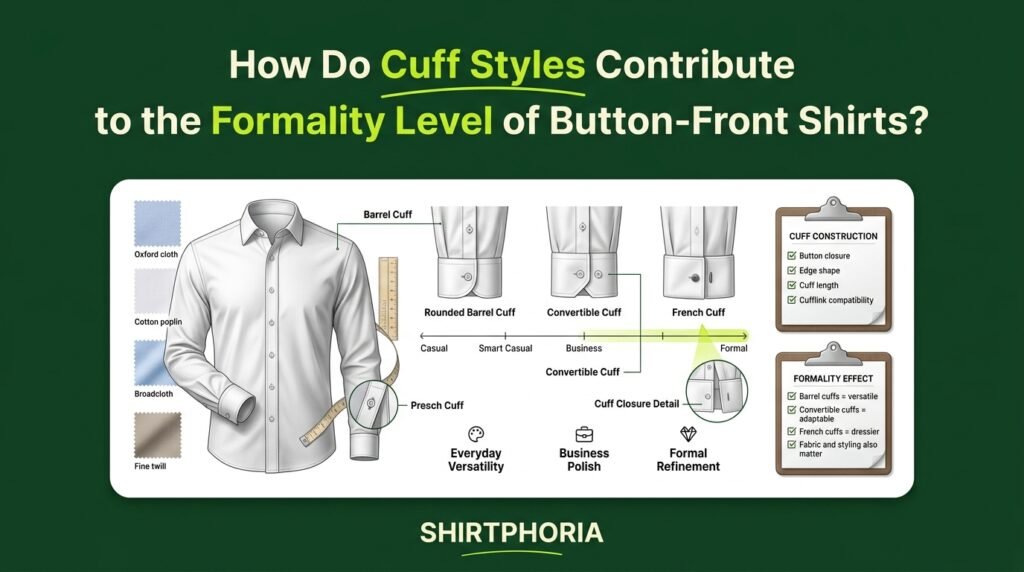
Cuff style is one of the clearest formality signals on a button-front shirt, because the cuff’s closure, fold, bulk, and accessory requirement influence whether the shirt reads casual, business-ready, formal, or eveningwear-appropriate.
Many shirts look similar when viewed from the front, but their cuffs can reveal very different purposes. A simple single-button cuff suggests practical everyday dressing. A multi-button barrel cuff can create more wrist structure. A French cuff introduces a folded construction and cufflinks, which moves the shirt toward formal dressing.
Cuff style does not determine shirt formality by itself. Collar design, fabric, shirt front, placket, fit, jacket context, color, and dress code also influence the final result.
Cuff style is one visible detail inside the broader construction system of button-front shirts.
This guide compares barrel cuffs, convertible cuffs, link cuffs, tab cuffs, safari cuffs, and French cuffs while explaining how each construction works across casual, business, formal, black-tie, and white-tie settings.
This guide explains shirt-cuff construction and dress-code formality for educational purposes. Formalwear expectations vary by event, invitation, culture, industry, workplace, tailoring tradition, and personal context, so cuff style should always be judged as part of the complete outfit.
Quick Answer: How Do Cuff Styles Affect Shirt Formality?
Cuff styles affect shirt formality by changing the closure mechanism, wrist profile, accessory requirement, fabric bulk, and compatibility with jackets, collars, and dress codes. Button cuffs usually read more practical and less formal, while cufflink closures create a more deliberate formal signal. French cuffs are among the most formal common shirt cuffs, but the complete outfit still determines appropriateness.
Why Cuff Style Is a Major Formality Signal, Not the Only Formality Rule
Cuff style is a major formality signal because it changes how the shirt closes at the wrist, how much structure it carries, and whether it requires a formal accessory such as a cufflink.
Shirt formality is created through several details working together:
- Cuff construction
- Collar shape
- Fabric smoothness and weight
- Shirt-front design
- Placket construction
- Fit
- Jacket context
- Accessories
- Event dress code
A French cuff on a crisp white dress shirt under structured tailoring creates a very different message from a French cuff attached to a bright printed casual shirt worn untucked.
The reverse is also true.
A barrel cuff can look business-ready when it appears on a smooth shirt with a clean collar, controlled fit, and tailored jacket.
The cuff provides a strong signal. The rest of the garment confirms that signal.
How Does Closure Type Change the Formality Signal?
Closure type changes the formality signal because a self-contained button reads practical, while a cufflink closure requires a separate accessory and therefore reads more intentional.
A button closure is self-contained. The wearer closes the cuff using a button sewn directly onto the shirt.
This makes button cuffs convenient for everyday dressing, office wear, travel, casual clothing, and many professional settings.
A cufflink closure uses separate hardware inserted through aligned cuff holes.
Cufflinks introduce another level of coordination because their material, size, finish, and design become part of the outfit.
The practical distinction can be summarized simply:
Button closure: convenience and everyday versatility.
Cufflink closure: accessory-based fastening and a generally stronger formal signal.
The difference becomes clearer when cuff fastening is considered alongside broader button-front shirt fastening types.
How Do Clean Lines and Cuff Bulk Affect Formality?
Clean lines and cuff bulk affect formality because dressier cuffs usually look flatter, sharper, and more controlled under a jacket sleeve, while casual cuffs tolerate more overlap, softness, and visible utility.
A barrel cuff wraps around the wrist and normally overlaps where the button closes.
A French cuff is longer and folds back on itself before being secured with cufflinks. The folded construction creates a deliberate double layer.
Bulk is not automatically a problem.
A cuff only becomes excessively bulky when its thickness or shape interferes with the sleeve surrounding it.
Under tailoring, the cuff should sit comfortably beneath the jacket sleeve without heavy bunching or distortion.
Casual shirts have more freedom because they may be worn without a jacket and can tolerate softer or more visible cuff construction.
How Should Cuff Style Align With Collar and Jacket Context?
Cuff style should align with collar and jacket context because the wrist and neckline act as two visible endpoints of shirt formality.
A dressier cuff generally works best when the rest of the shirt follows a similar direction.
That may include:
- A cleaner collar
- Smooth or refined fabric
- Controlled shirt fit
- Structured jacket
- Dress trousers
- Formal accessories
A rugged single-button cuff, tab cuff, or safari cuff usually works more naturally with heavier fabrics, utility pockets, relaxed collars, outdoor clothing, or casual layering.
A French cuff usually pairs best with a dressier collar and structured jacket context, but the exact collar can vary according to dress code and shirt design.
The objective is visual and functional consistency.
Analyzing Barrel Cuff Styles and Their Contribution to Shirt Formality
Barrel cuff styles contribute to shirt formality through button count, cuff height, corner shape, wrist fit, and the amount of visual structure they create.
The barrel cuff is one of the most common cuff families because it uses a straightforward wraparound construction and sewn-button closure.
Its formality can range from relaxed casual wear to polished professional dressing.
How Does a Single-Button Barrel Cuff Signal Casual or Everyday Style?
A single-button barrel cuff usually signals casual or everyday style because it uses the simplest self-contained closure and creates a softer, less ceremonial wrist finish.
The cuff wraps around the wrist and closes with one sewn button.
Its simplicity makes it common on:
- Weekend shirts
- Everyday casual shirts
- Utility shirts
- Relaxed office shirts
- Travel shirts
- Lightweight warm-weather shirts
A single-button barrel cuff is not restricted to casual clothing.
Its formality can rise when paired with smooth fabric, a structured collar, restrained colors, and a clean fit.
The cuff itself remains simple, but the complete shirt can still look polished.
How Do Two-Button and Three-Button Barrel Cuffs Increase Polish?
Two-button and three-button barrel cuffs can increase polish by creating a more adjustable, controlled, and structured fit around the wrist.
Additional buttons can create more closure positions or produce a taller cuff profile.
A two-button barrel cuff commonly balances practicality with a cleaner business or smart-casual appearance.
A three-button barrel cuff can create a taller and more visually pronounced wrist structure.
Corner shape also changes appearance.
Rounded corners generally feel softer.
Squared corners produce cleaner geometry.
Mitered or angled corners can add a sharper visual line.
Multiple buttons do not automatically make the shirt formal. Fabric, collar, fit, and jacket context still matter.
These cuffs remain button cuffs and normally create less ceremonial formality than cufflink-only formal cuffs.
What Is a Convertible Cuff and How Formal Is It?
A convertible cuff is a single cuff that can fasten with buttons or cufflinks, giving the shirt mid-range flexibility rather than true formalwear status.
Apposta describes convertible cuffs as single cuffs that do not fold back like French cuffs and can be worn with either buttons or cufflinks.
This dual fastening system makes the convertible cuff useful for people who want one shirt to move between different settings.
During ordinary office use, the wearer can use the built-in button.
For a dinner, celebration, or more polished occasion, cufflinks can replace the button closure.
The convertible cuff does not develop the folded double-layer construction of a true French cuff.
Its strongest advantage is flexibility, not maximum formality.
Specialized Cuff Styles That Shift Button-Front Shirt Formality
Specialized cuff styles shift button-front shirt formality by introducing either cufflink-based refinement or utility-based sleeve control.
Some cuff styles move the shirt toward tailored or formal dressing.
Others move it toward field wear, travel, workwear, or outdoor utility.
What Is a Link Cuff?
A link cuff is a cuff designed to close with links rather than sewn buttons, creating a more formal or specialized wrist closure than a standard barrel cuff.
Gentleman’s Gazette describes link-style cuffs as constructions with fastening holes on both sides rather than a conventional button closure.
The two sides are secured using a cufflink or another link-style fastener.
Link-based construction can appear on different cuff forms.
A single cuff may use links without folding back.
A French or double cuff also uses cufflinks but includes the additional folded construction.
This distinction matters because not every cufflink cuff is automatically a French cuff.
Link cuffs can appear in bespoke, formal, historical, or specialized shirt construction, and their level of formality still depends on the fabric, collar, jacket, and event.
What Is a Tab or Safari Cuff?
A tab or safari cuff is a utility-oriented cuff detail that uses an extra tab, strap, or buttoning method to help manage the sleeve in active or outdoor settings.
The purpose is functional sleeve control rather than dress-code elevation.
Tab and safari cuffs often appear on:
- Field shirts
- Safari shirts
- Outdoor shirts
- Travel shirts
- Utility clothing
- Warm-weather shirts
These cuffs may allow the sleeve to be rolled or secured in a practical position.
Their additional hardware and utility emphasis usually create a casual signal.
Tab and safari cuffs are strongly casual or utility-coded and should usually be avoided for business professional, black tie, and white tie settings.
Defining the French Cuff Style and Its High Formality Level
The French cuff, also called a double cuff, is one of the most formal common shirt cuff styles because it folds back on itself and requires cufflinks for closure.
Apposta identifies the French cuff as a double-cuff construction and places it among its most formal cuff options.
Unlike an ordinary barrel cuff, a French cuff does not rely on a sewn button for normal closure.
Its additional fabric, fold, aligned holes, and cufflink fastening create a deliberately formal wrist treatment.
How Is a French Cuff Constructed?
A French cuff is constructed as a longer cuff that folds back on itself and closes with cufflinks through aligned buttonholes.
The process creates two visible layers around the wrist.
The basic structure is:
- The cuff extends farther than an ordinary barrel cuff.
- The extended fabric folds backward.
- Fastening holes align.
- A cufflink passes through the aligned openings.
- The linked cuff sits at the wrist beneath or slightly beyond a jacket sleeve.
A true French cuff is designed for cufflinks rather than an ordinary sewn-button closure.
Its folded structure gives the wrist more presence than most everyday button cuffs.
That combination of fold structure and accessory requirement explains much of its stronger formal signal.
When Are French Cuffs Appropriate?
French cuffs are appropriate when the outfit calls for visible formality, cufflinks, a jacket-based silhouette, or a formal evening shirt.
Common contexts include:
- Weddings
- Formal dinners
- Evening events
- Tuxedo-shirt outfits
- Dressier business settings
- Ceremonial occasions
- Some executive environments
French cuffs can also appear in personal smart-casual dressing, especially when the wearer deliberately mixes formal and relaxed elements.
They still read more intentional than ordinary button cuffs.
In C-suite or executive settings, French cuffs can signal formality and attention to detail, but appropriateness depends on industry, company culture, geography, meeting type, and surrounding clothing.
They are an option, not a universal executive requirement.
Black Tie, White Tie, and Cuff Style Nuance
Black tie and white tie require more careful cuff guidance because each dress code has specific evening-shirt conventions that should not be reduced to a simple French-cuff rule.
Both are formal evening dress systems, but white tie operates at a stricter level than black tie.
The shirt, collar, front, studs, cufflinks, waistcoat, jacket, trousers, and accessories work together.
Are French Cuffs Correct for Black Tie?
French cuffs are widely appropriate for black tie because formal tuxedo shirts commonly use cufflinks and often feature French cuffs.
GQ describes proper tuxedo shirts as commonly using formal front treatments and French cuffs.
This makes the French cuff a natural partner for:
- Tuxedo jackets
- Formal evening shirts
- Dress studs
- Bow ties
- Formal trousers
- Restrained cufflinks
Cufflinks should support the outfit rather than overpower it.
Large novelty designs or highly distracting decorative links can disrupt the restrained character expected in traditional black tie.
French cuffs are therefore widely appropriate and commonly preferred, but black-tie guidance should still be interpreted according to the specific event and formalwear tradition.
Should White Tie Be Treated the Same as Black Tie?
White tie should not be treated the same as black tie because it has stricter and more traditional shirt conventions.
White tie is the highest traditional evening dress code and typically involves a tightly coordinated system of eveningwear.
That system may include:
- Formal evening shirt
- Specific collar treatment
- Formal shirt front
- Shirt studs
- Cufflinks
- White waistcoat
- White bow tie
- Tailcoat
- Formal trousers
Debrett’s formal dress guidance distinguishes white tie from black tie and describes specific formal eveningwear conventions rather than treating the two dress codes as interchangeable.
For white tie, the safest approach is to follow the host’s specified dress code or established formalwear guidance rather than choosing a cuff based only on general shirt-formality rules.
Cuff Styles and Formality: Comparison Matrix for Button-Front Shirts
A cuff-style comparison matrix helps readers classify shirt formality by linking each cuff type to closure method, construction, ideal setting, and main mismatch risk.
| Cuff Style | Closure Mechanism | Construction Signal | Formality Level | Ideal Setting | Main Mismatch Risk |
|---|---|---|---|---|---|
| Single-Button Barrel | One sewn button | Simple, practical, low ceremony | Low to everyday casual | Weekend wear, casual office, leisure, utility shirts | May look underdressed with highly formal tailoring |
| Two-Button Barrel | Two sewn buttons | More wrist control and cleaner shape | Smart casual to business casual | Office wear, smart casual, blazer outfits | Still less formal than cufflink-based cuffs |
| Three-Button Barrel | Three sewn buttons | Taller cuff with stronger wrist structure | Business casual to fashion-forward smart casual | Sharper casual shirts, selected office shirts | Can become bulky under close jacket sleeves |
| Convertible Cuff | Button or cufflink | Single cuff with flexible closure | Mid-range versatility | Office-to-evening, semi-dressy events | Does not provide the folded structure of a true French cuff |
| French Cuff or Double Cuff | Cufflink | Folded cuff with formal accessory | High formality | Black tie, weddings, formal dinners, formal business | Can overdress casual fabrics or untucked outfits |
| Link Cuff | Cufflink or link fastener | Link-based closure without standard button | Semi-formal to formal depending on construction | Bespoke tailoring, dress shirts, formal dinners | Formality depends heavily on fabric and context |
| Tab or Safari Cuff | Button and fabric tab | Utility sleeve control | Casual utility | Outdoor activity, travel, field wear, safari styling | Usually inappropriate for formal or business professional settings |
This table should be used as a guide rather than an isolated dress-code rule.
The same cuff can shift slightly in perceived formality when the fabric, collar, jacket, and event change.
Diagnostic Thresholds and Failure Modes for Cuff Formality
Cuff formality can be diagnosed by checking whether closure type, fold structure, cuff bulk, wrist fit, sleeve-jacket harmony, accessory requirement, and dress-code context sit inside the correct range.
These are practical diagnostic ranges rather than universal laws.
| Variable | Too Low Failure | Ideal Zone | Too High Failure | Observable Test | Diagnostic Fix |
|---|---|---|---|---|---|
| Closure Formality | Button-only cuff appears too casual for the intended eveningwear | Closure matches the event, from everyday button cuff to formal cufflink closure | Cufflink closure overdresses a highly casual shirt | Compare the cuff with jacket, collar, fabric, and dress code | Use barrel cuffs for casual and many business settings, French cuffs for formal contexts, and convertible cuffs for flexibility |
| Fold Structure | Single cuff lacks the additional structure wanted for a formal outfit | Fold construction matches the intended formality | Double cuff looks too ceremonial with rugged fabric or relaxed untucked styling | Check whether the cuff folds back and whether that construction matches the outfit | Use French cuffs with dressier shirts and barrel cuffs for most everyday button-front shirts |
| Cuff Bulk | Cuff collapses or lacks enough structure for the surrounding outfit | Cuff maintains shape without interfering with movement | Cuff bunches or distorts beneath the jacket sleeve | Wear the shirt under a jacket and bend the wrist | Choose a cleaner cuff profile for tailoring and softer construction for casual comfort |
| Wrist Fit | Cuff slides too far over the hand | Cuff sits securely while allowing ordinary wrist movement | Cuff restricts the wrist or feels uncomfortable | Close the cuff and rotate and bend the wrist | Adjust cuff size, button position, or cufflink choice |
| Sleeve-Jacket Harmony | Shirt cuff disappears completely under the jacket | Controlled shirt cuff exposure supports the jacket line | Excess cuff dominates the wrist area | Put on the jacket and let the arms hang naturally | Correct shirt or jacket sleeve length and use a cuff profile compatible with the sleeve |
| Accessory Requirement | Formal outfit lacks the accessory coordination expected by its cuff | Cufflink choice matches the shirt, jacket, and occasion | Highly ornate cufflinks distract from restrained business or eveningwear | Compare cufflinks with watch, studs, jacket, and event | Use restrained links for formal and conservative business settings |
| Dress-Code Fit | Cuff style underdresses the occasion | Cuff supports the dress code without becoming the focal point | Cuff makes the outfit unnecessarily ceremonial | Compare cuff construction with the host’s dress code and complete outfit | Follow specific black-tie or white-tie guidance and use business-appropriate cuffs for professional events |
Both extremes can harm cuff-formality alignment.
A cuff that is too casual can weaken formalwear coherence.
A cuff that is too formal can overdress a relaxed shirt.
A bulky cuff can bunch beneath a jacket sleeve.
A very dressy cuff can conflict with rugged cloth or heavily casual styling.
A tight cuff restricts movement.
A loose cuff can slide over the hand.
An ornate cufflink can distract in conservative professional settings.
A utility tab cuff can look misplaced with formal tailoring.
A French cuff can also create a visible mismatch when combined with highly casual fabric, an untucked shirt, rugged pockets, and relaxed footwear.
The objective is not maximum formality.
The objective is formality alignment.
Final Checklist: Matching Cuff Styles to Your Formality Goal
To match cuff style to formality goal, choose the cuff that fits the dress code, jacket context, collar structure, fabric formality, and expected accessory level.
FAQ: Cuff Styles and Shirt Formality
The most common questions about cuff styles and shirt formality can be answered by comparing closure type, fold structure, cufflink requirement, and dress-code context.
The French cuff, also called the double cuff, is one of the most formal common shirt cuff styles because it folds back on itself and closes with cufflinks. It is widely associated with formal eveningwear, weddings, dressier business clothing, and other situations where a deliberate formal wrist treatment is appropriate.
French cuffs are widely appropriate and commonly used for black tie because tuxedo shirts often use cufflinks and French-cuff construction. Exact requirements can vary according to formalwear tradition, shirt design, and event guidance, so French cuffs should be treated as a strong black-tie option rather than an unsupported universal rule.
A barrel cuff wraps around the wrist and normally closes with one or more sewn buttons. A French cuff is longer, folds back on itself, and closes with cufflinks. Barrel cuffs emphasize self-contained practicality, while French cuffs add folded structure and an accessory-based formal signal.
A convertible cuff is a single cuff that can close with either its built-in button or cufflinks. It does not fold back like a French cuff. This makes it useful for office-to-evening flexibility when the wearer wants cufflink capability without the full double-cuff construction.
Barrel cuffs can work in many professional environments when the shirt uses smooth fabric, a structured collar, controlled fit, and restrained styling. They are usually less formal than French cuffs, but professional dressing does not always require the most formal cuff available. Workplace culture and occasion remain important.
Tab and safari cuffs are generally casual or utility-oriented because their construction focuses on sleeve control during travel, field wear, outdoor activity, or relaxed dressing. They usually fit those contexts better than business professional, black-tie, or white-tie environments.
Cuff style should align with collar style because both the neckline and wrist contribute to the shirt’s formality. A dressier cuff generally works naturally with a cleaner collar and jacket-based outfit, while utility cuffs usually pair more coherently with casual collars, heavier fabrics, and relaxed clothing.
Terms Explained
| TERM | DEFINITION |
|---|---|
| Barrel Cuff | A wraparound shirt cuff that normally closes with one or more sewn buttons. |
| Single-Button Barrel | A simple barrel cuff secured with one button and commonly used for casual, everyday, and many office shirts. |
| Two-Button Barrel | A barrel cuff using two buttons to create additional wrist adjustment or a more structured profile. |
| Three-Button Barrel | A taller barrel-cuff construction using three buttons to create a more pronounced wrist profile. |
| Convertible Cuff | A single cuff that can close with either its sewn button or cufflinks without folding back like a French cuff. |
| Link Cuff | A cuff designed with aligned fastening holes and secured using a cufflink or another link-style fastener. |
| French Cuff | A longer double cuff that folds back on itself and closes with cufflinks. |
| Double Cuff | Another term commonly used for the folded French-cuff construction. |
| Tab Cuff | A utility-oriented cuff or sleeve system using an additional fabric tab or fastening point for sleeve control. |
| Safari Cuff | A practical cuff or sleeve-management construction associated with safari, field, travel, or outdoor shirts. |
| Cufflink | A removable accessory inserted through aligned cuff holes to secure link-style or French cuffs. |
| Formality Alignment | The degree to which cuff construction, collar, fabric, jacket, accessories, and dress code communicate a consistent level of formality. |
Conclusion
Ultimately, cuff style strongly influences button-front shirt formality by shaping the wrist closure, accessory requirement, fold structure, sleeve profile, and dress-code compatibility.
Barrel cuffs provide the broadest everyday range.
A single-button barrel cuff supports simple casual and practical dressing, while multi-button barrel cuffs can create more wrist structure for smart-casual and business settings.
Convertible cuffs add flexibility by allowing either buttons or cufflinks without creating a true folded double cuff.
Link cuffs move the shirt toward accessory-based fastening.
Tab and safari cuffs prioritize utility and sleeve management rather than formal presentation.
French cuffs create one of the strongest common formal signals because they combine fold-back construction with cufflink closure.
Their strongest role appears in formal, evening, wedding, and selected professional settings, especially when they are supported by an equally appropriate collar, fabric, jacket, and dress code.
Black tie and white tie require additional care because their shirt conventions belong to larger formalwear systems rather than cuff rules alone.
The best cuff is therefore not simply the most formal option. It is the cuff whose closure, structure, fit, and accessory requirements match the complete shirt and the occasion.
By reading the cuff as part of the full shirt system, the wearer can match a button-front shirt to the occasion without underdressing, overdressing, or creating a visible formality mismatch.