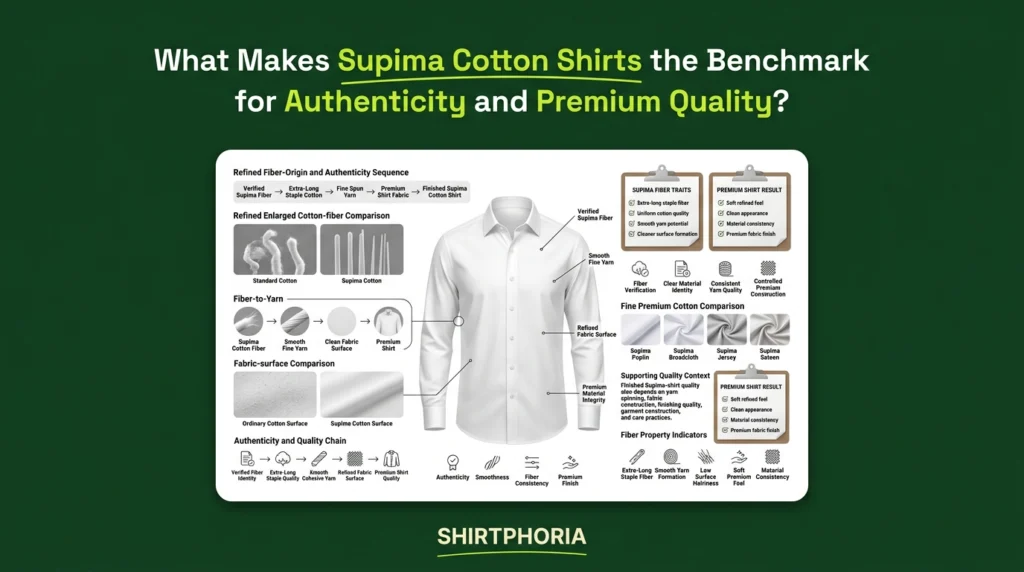
What Makes Supima Cotton Shirts the Benchmark for Authenticity and Premium Quality?
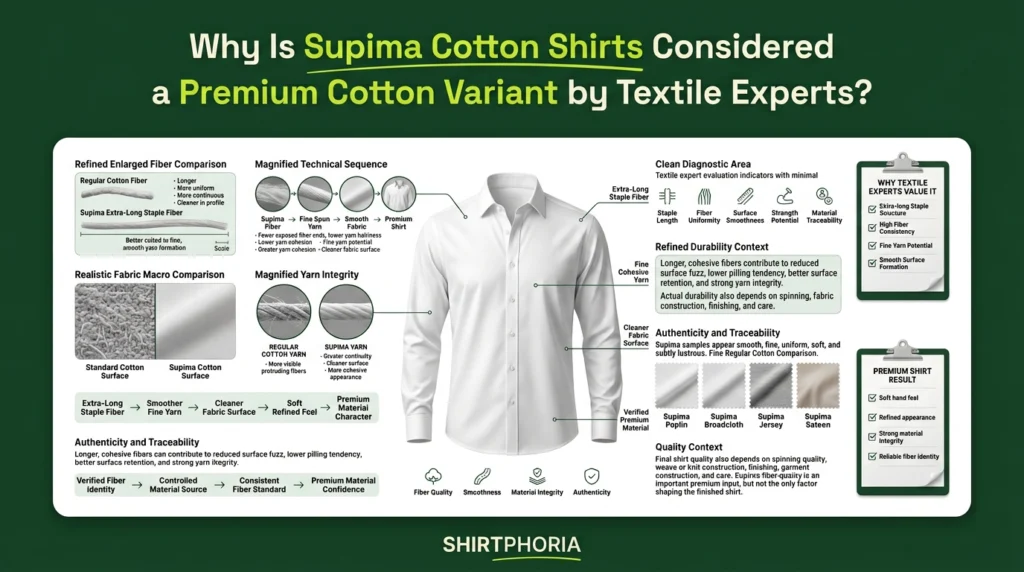
Supima cotton shirts are considered a benchmark for authenticity and premium quality because Supima combines a defined American-grown extra-long staple cotton fiber with controlled trademark use, supply-chain traceability, origin verification, and fiber properties that support strength, softness, smoothness, color retention, and reduced pilling.
The important distinction is that Supima is not simply another marketing name for high-quality cotton. SUPIMA® is a trademark associated with American-grown extra-long staple cotton, and products using the name must meet the brand’s sourcing and authentication requirements.
This creates two connected quality layers:
Verified fiber identity → predictable premium fiber properties
A genuine Supima shirt therefore depends on both the cotton actually being Supima and the textile manufacturer preserving the advantages of that fiber through spinning, fabric construction, dyeing, finishing, and garment production.
What Is Supima Cotton?
Supima cotton is American-grown extra-long staple cotton promoted under the SUPIMA® trademark.
The name is associated with American Pima cotton, which belongs to the extra-long staple cotton category. The USDA identifies American Pima as an extra-long staple cotton and notes that ELS cotton is characterized by long staple length, fineness, and high fiber strength that can support finer and stronger yarns.
Supima states that its cotton is grown in the United States and that its defining extra-long staple fibers contribute to three major textile properties:
- strength;
- softness; and
- color retention.
That fiber identity is the foundation of Supima’s premium positioning.
However, Supima should not be treated as a synonym for every Pima cotton product.
Pima is a cotton category. SUPIMA® is a controlled trademark associated with eligible American-grown extra-long staple cotton and an authorized supply chain.
This distinction is central to authenticity.
Why Does Authenticity Matter for Supima Cotton Shirts?
Authenticity matters because a premium fiber claim only has value when the fiber inside the shirt actually matches the identity being advertised.
A shirt may look smooth, soft, or expensive without proving that its cotton is genuinely Supima.
The authenticity question is therefore:
Can the claimed Supima fiber be connected to a legitimate and verifiable supply chain?
Supima’s current authentication system combines digital supply-chain traceability with physical origin verification. Its AQRe™ program uses TextileGenesis for transactional traceability and Oritain for forensic verification of cotton origin. Products outside the required system are not authorized to carry the SUPIMA® trademark under the current program.
That produces an authenticity chain:
American-grown ELS cotton → controlled supply chain → traceability → origin verification → authorized SUPIMA® identity
This is one reason Supima differs from loosely defined premium-cotton descriptions.
Authenticity Is Different From Appearance
Authenticity cannot be determined simply by touching a shirt.
A smooth fabric does not automatically prove that it is Supima.
A high thread count does not prove that it is Supima.
A premium price does not prove that it is Supima.
A long cotton fiber alone does not establish that the product is authorized to use the SUPIMA® trademark.
Authenticity depends on fiber identity and sourcing evidence rather than appearance alone.
How Does Extra-Long Staple Fiber Improve Supima Cotton Shirts?
Supima cotton’s premium textile behavior starts with its extra-long staple fibers.
Staple length describes the length of the individual natural fibers that can be spun into yarn.
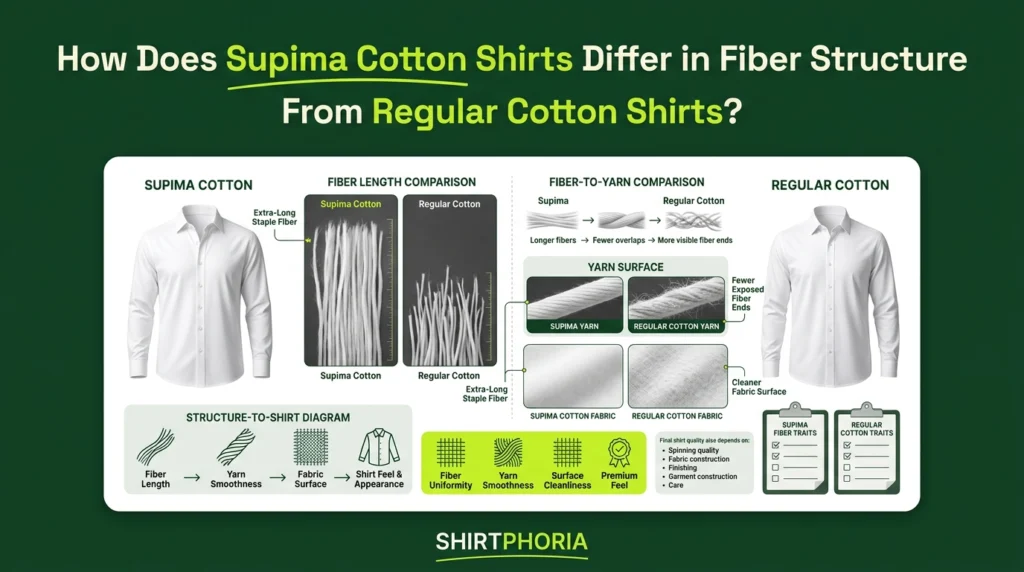
Longer cotton fibers provide the spinner with more fiber length over which neighboring fibers can overlap and interact inside the yarn.
This can support:
- finer yarn formation;
- smoother yarn surfaces;
- improved yarn integrity;
- fewer protruding short fiber ends; and
- stronger textile structures.
The relationship can be summarized as:
Extra-long staple fibers → improved yarn formation → smoother and stronger textile potential
The word potential matters.
Fiber length creates favorable raw-material conditions, but finished shirt quality still depends on spinning, yarn construction, weaving or knitting, finishing, and garment manufacture.
Why Do Longer Supima Fibers Produce Smoother Shirt Fabrics?
Longer fibers can be incorporated into yarn with fewer exposed fiber ends than yarns made from a greater proportion of shorter fibers.
When fewer loose ends project from the yarn surface, the resulting fabric can feel smoother against the skin.
A smoother yarn surface can also contribute to a cleaner-looking textile.
The mechanism is:
Longer fibers → fewer exposed fiber ends → smoother yarn surface → smoother fabric feel
This helps explain why Supima is associated with premium softness.
Supima itself identifies the extra-long staple fiber as the basis for its characteristic softness and states that the longer fiber produces a smoother fabric surface.
Softness, however, does not come from fiber length alone.
Finished hand feel can also be affected by:
- yarn twist;
- yarn count;
- knit or weave construction;
- mercerization;
- washing;
- mechanical finishing;
- chemical finishing; and
- garment treatment.
A genuine Supima shirt can therefore feel different from another genuine Supima shirt.
How Does Supima Fiber Length Support Shirt Strength?
Longer fibers can create stronger and more cohesive yarn structures because more fiber length is available for overlap within the yarn.
That can reduce the dependence on numerous short fiber ends and create a more continuous yarn structure.
The mechanism is:
Long fiber length → greater fiber overlap → stronger yarn potential → better fabric durability
The USDA describes extra-long staple cotton as having both fineness and high fiber strength, qualities that contribute to finer and stronger yarns.
Supima also identifies strength as one of the key properties associated with its extra-long staple cotton.
But this does not mean every Supima shirt will have identical durability.
A very lightweight Supima knit and a densely woven Supima fabric can behave differently even though they use the same cotton category.
Finished durability still depends on:
Fiber quality + yarn structure + fabric construction + finishing + use conditions
Why Can Supima Cotton Shirts Resist Pilling Better?
Pilling occurs when loose or broken fibers migrate toward the fabric surface, entangle, and form small balls.
Shorter or poorly secured fibers can provide more exposed fiber ends that participate in this process.
Because extra-long staple cotton allows more fiber length to remain integrated into the yarn, it can help reduce the number of loose fiber ends at the fabric surface.
The simplified mechanism is:
Longer fibers → fewer loose ends → lower surface fuzz potential → improved resistance to pilling
Supima specifically associates its longer fiber structure with reduced pilling compared with shorter-fiber cotton.
However, fiber length is not the only factor.
Pilling can also be influenced by:
- yarn twist;
- fabric density;
- abrasion;
- laundering;
- finishing;
- blending;
- surface brushing; and
- garment use.
Supima should therefore be described as providing a favorable fiber foundation for pilling resistance rather than making a shirt completely pill-proof.
Why Does Supima Cotton Hold Color Well?
Supima cotton is also associated with strong color retention.
Fine, high-quality cotton fibers can support smooth yarn and fabric surfaces, while cotton itself has a strong affinity for appropriate textile dyes.
Supima states that its finer fibers can support deep dye penetration and longer-lasting color performance.
The practical result can be:
- rich coloration;
- even-looking dye appearance;
- cleaner fabric surfaces; and
- better color retention through repeated use.
But final colorfastness still depends heavily on the dye class, dyeing procedure, pretreatment, finishing, laundering conditions, detergent, and exposure to light.
Supima fiber therefore contributes to premium color potential, while textile processing determines how effectively that potential is realized.
How Does Supima Cotton Differ From Regular Cotton?
The most useful distinction between Supima and ordinary cotton begins with fiber classification and identity.
| Property | Supima Cotton | Typical Regular Cotton |
|---|---|---|
| Fiber category | Extra-long staple American Pima cotton | Commonly shorter-staple upland cotton |
| Trademark identity | Controlled SUPIMA® name | Usually generic cotton designation |
| Origin requirement | U.S.-grown under Supima requirements | Can originate from many regions |
| Traceability system | Structured Supima authentication system | Depends on individual supplier or brand |
| Fiber length | Extra-long staple | Generally shorter |
| Yarn potential | Fine, smooth, strong yarns | Depends strongly on cotton grade and staple |
| Surface smoothness | High potential | Variable |
| Pilling resistance | Improved fiber-level potential | Variable |
| Color performance | Strong potential | Variable |
| Finished quality | Still depends on manufacture | Still depends on manufacture |
The central relationship is not simply:
Supima = good / regular cotton = bad
Regular cotton exists in many quality grades.
The more accurate distinction is that Supima begins with a tightly defined premium fiber identity and adds systems intended to protect that identity through the supply chain.
For more detail about the underlying structural difference, see Supima vs regular cotton.
Why Is the SUPIMA® Trademark Important?
The SUPIMA® trademark converts a general fiber-quality claim into a controlled product identity.
Without a controlled name, a producer could use broad phrases such as “premium cotton” without those words identifying one specific cotton origin or supply-chain system.
The SUPIMA® name works differently.
Supima states that use of its trademark is tied to its authorized sourcing and authentication framework.
This gives the trademark a specific role:
Trademark → identifies controlled fiber claim
It does not automatically prove that every Supima garment has exceptional construction.
A poorly designed or poorly sewn garment does not become excellent simply because the raw fiber is premium.
Instead, the trademark primarily helps answer:
Is this product legitimately connected to the cotton identity it claims?
That distinction protects the meaning of authenticity.
How Can Buyers Identify Authentic Supima Cotton?
A buyer should start with the product’s labeling and the information provided by the manufacturer or retailer.
Supima states that genuine products commonly identify Supima content on labels, product descriptions, or retail displays.
The FTC also requires cotton fiber-content descriptions used in U.S. textile labeling and advertising to be truthful and non-deceptive. When a specific cotton type or trademark is used, the fiber claim must accurately describe the product’s actual content.
Authenticity Checklist
Does “100% Cotton” Mean a Shirt Is Supima?
No.
“100% cotton” describes the generic fiber composition.
It does not identify the cotton as Supima.
A garment can be entirely cotton and still contain conventional upland cotton or another cotton type.
Likewise:
100% cotton ≠ 100% Supima
A Supima claim requires the product to legitimately contain the cotton identified by that trademark.
FTC guidance also makes clear that specific cotton descriptions cannot be used in a deceptive way and that fiber-content disclosures must accurately reflect the textile.
This is why specific fiber identity matters when evaluating authenticity.
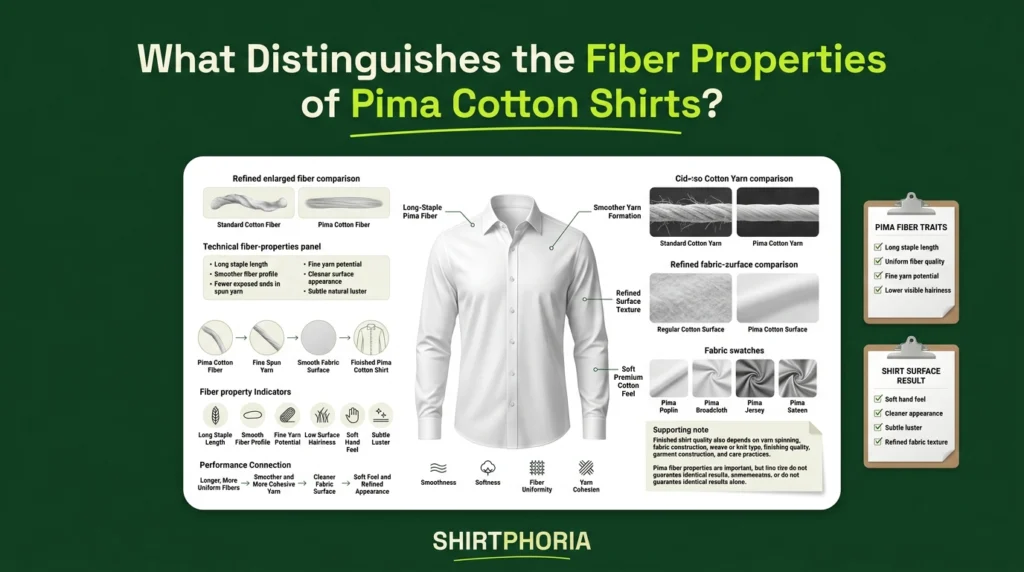
Is Supima the Same as Pima Cotton?
Supima and Pima are related but not interchangeable.
American Pima is a type of extra-long staple cotton.
SUPIMA® is the trademark used for qualifying American-grown extra-long staple cotton within Supima’s controlled system.
The distinction can be expressed as:
Pima → cotton category
Supima → controlled branded American Pima identity
Supima’s own guidance states that “Pima” is a generic term, while SUPIMA® is the trademark associated with American-grown extra-long staple cotton sourced through its authorized supply chain.
Therefore, seeing the word “Pima” by itself should not be treated as proof that a shirt is Supima.
How Is Supima Different From Egyptian Cotton?
Supima and Egyptian cotton are not equivalent designations.
Supima identifies a controlled American-grown cotton program built around extra-long staple cotton.
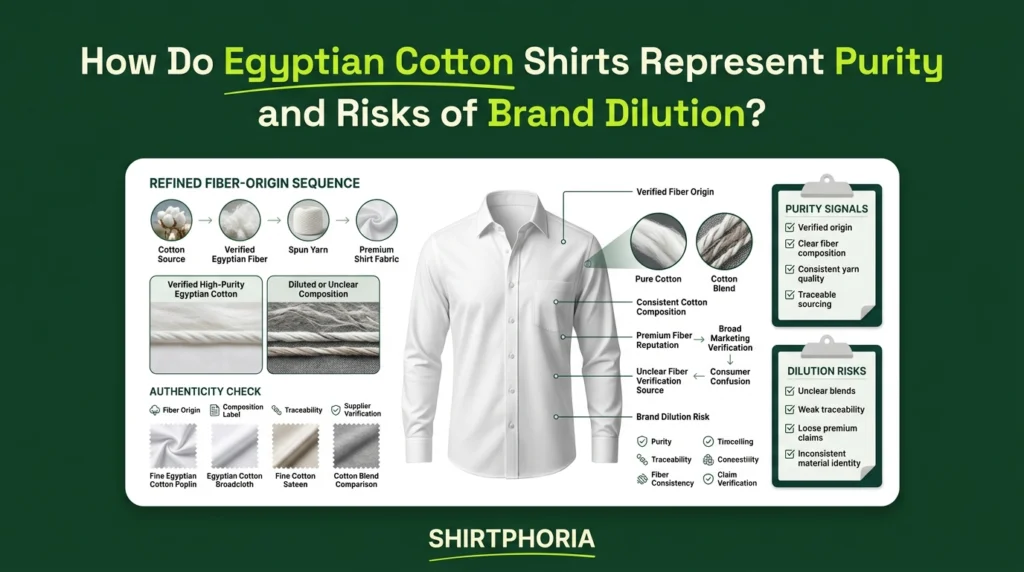
“Egyptian cotton” primarily identifies cotton associated with Egypt, but that geographical description by itself does not establish one uniform staple length or one uniform quality level.
Supima similarly explains that its designation specifically concerns premium extra-long staple cotton, whereas the Egyptian label alone does not establish a single fiber grade.
This means buyers should separate:
Origin terminology
from
verified fiber classification and authenticity
For a deeper explanation of this problem, see Egyptian cotton authenticity.
Does Supima Automatically Make a Shirt Premium?
Supima provides a premium raw-material foundation, but the fiber alone cannot determine every aspect of garment quality.
A finished Supima shirt still depends on:
- yarn quality;
- spinning consistency;
- yarn twist;
- fabric weight;
- weave or knit construction;
- dyeing;
- finishing;
- cutting;
- stitching;
- seam quality; and
- garment care.
A useful quality chain is:
Premium fiber → quality yarn → controlled fabric construction → appropriate finishing → well-made shirt
If one of the later stages is poor, the garment may not fully express the advantages of the original fiber.
This prevents an important misconception:
Authentic Supima does not automatically mean perfect garment construction.
Authenticity verifies the fiber claim.
Premium finished quality requires both authentic material and competent manufacturing.
What Role Does Traceability Play in Supima Authenticity?
Traceability creates a documented connection between the raw cotton and the product offered to the consumer.
This matters because textile supply chains can involve numerous stages:
Farm → gin → spinner → yarn supplier → fabric manufacturer → finisher → garment manufacturer → brand → retailer
Without traceability, maintaining identity across this sequence becomes difficult.
Supima’s AQRe™ platform is designed to record supply-chain transactions digitally and combine that information with physical origin authentication. Supima says its system uses TextileGenesis for digital traceability and Oritain’s forensic methods to verify the physical origin of selected cotton samples.
This produces a stronger authenticity model than relying solely on a printed claim:
Digital records + physical verification → stronger fiber identity assurance
Traceability does not directly make cotton softer or stronger.
Instead, it protects confidence that the material delivering those properties is genuinely the fiber being claimed.
Why Is Origin Verification Important?
Premium fibers can command higher prices, which creates an incentive for incorrect substitution or misleading labeling.
Origin verification addresses that problem by asking whether the physical cotton matches its claimed geographic source.
Supima describes its collaboration with Oritain as using naturally occurring chemical and isotopic characteristics in cotton to establish an origin profile.
The purpose is not to judge softness or fabric performance.
It addresses a different question:
Where did this cotton originate?
That distinction is important because authenticity has multiple layers.
| Authentication Layer | Question Answered |
|---|---|
| Fiber labeling | What fiber is being claimed? |
| Trademark authorization | Is use of the SUPIMA® name authorized? |
| Supply-chain traceability | Can movement of the cotton be followed? |
| Origin verification | Does physical evidence support the claimed origin? |
| Textile performance | Does the finished fabric express the expected quality? |
Authenticity and performance reinforce each other, but they are not the same thing.
Why Is Supima Considered Premium Cotton?
Supima’s premium position comes from the interaction of raw-material quality and identity control rather than from one characteristic.
1. Extra-Long Staple Fiber
Long fibers support smooth and strong yarn formation.
2. Fiber Fineness
Fine cotton can support refined, comfortable textile structures.
3. Strength
The fiber characteristics can support stronger yarns and durable fabrics.
4. Smoothness
Long fibers can reduce exposed ends and surface roughness.
5. Softness
Smoother yarn and fabric surfaces contribute to premium hand feel.
6. Reduced Pilling Potential
Long fibers can remain more securely integrated into yarn.
7. Color Performance
High-quality cotton fibers can support rich and lasting dye results when properly processed.
8. Controlled Identity
SUPIMA® is not simply a generic quality adjective.
9. Traceability
Supply-chain tracking strengthens transparency.
10. Physical Authentication
Origin-verification systems add another layer of confidence to the fiber claim.
Together these create the broader system:
Premium fiber structure + controlled identity + traceability + authentication = Supima’s premium-quality proposition
How Does Supima Fit Within the Natural-Fiber Shirt Category?
Supima remains a natural cotton fiber despite its premium branded identity.
Like other cotton shirts, it is cellulose-based and inherits the broader characteristics associated with natural cotton textiles.
Its distinction comes from the particular fiber class and the system used to identify and protect it.
Understanding that distinction helps prevent the assumption that every natural-fiber shirt behaves identically.
For the broader material context, see natural fiber shirts.
What Factors Determine the Final Quality of a Supima Cotton Shirt?
The best way to evaluate a Supima shirt is to separate fiber authenticity from garment execution.
Fiber-Level Factors
Check:
- whether the Supima identity is legitimate;
- fiber purity;
- fiber length;
- fiber fineness;
- fiber strength; and
- raw-material consistency.
Yarn-Level Factors
Consider:
- yarn count;
- spinning method;
- twist level;
- yarn evenness; and
- surface hairiness.
Fabric-Level Factors
Consider:
- knit or weave structure;
- fabric density;
- fabric weight;
- structural balance;
- surface smoothness; and
- stability.
Finishing Factors
Consider:
- dyeing;
- washing;
- mercerization where applicable;
- dimensional finishing;
- softening treatments; and
- other finishing processes.
Garment-Level Factors
Check:
- seam construction;
- stitching consistency;
- collar construction;
- button attachment;
- panel alignment;
- shrink control; and
- overall fit.
The correct hierarchy is:
Authentic Supima fiber → well-made yarn → appropriate fabric → controlled finishing → high-quality garment
No single stage should be used as a substitute for the others.
Supima Authenticity and Premium-Quality Matrix
| Quality Layer | Supima Feature | What It Contributes |
|---|---|---|
| Identity | SUPIMA® trademark | Defines a controlled cotton identity |
| Origin | American-grown cotton | Establishes geographic sourcing requirement |
| Fiber | Extra-long staple | Supports premium yarn formation |
| Fiber | High strength potential | Supports textile durability |
| Fiber | Long smooth structure | Supports softness and smoothness |
| Yarn | Reduced exposed short ends | Helps create cleaner surfaces |
| Fabric | Smooth yarn potential | Supports premium hand feel |
| Color | Favorable dye performance | Supports rich color |
| Surface | Long fiber structure | Helps limit pilling potential |
| Supply chain | Digital traceability | Tracks fiber movement |
| Authentication | Physical origin verification | Strengthens confidence in authenticity |
| Garment | Quality manufacturing | Converts fiber potential into finished performance |
The matrix should be viewed as a system rather than a ranking.
Supima’s extra-long staple fiber establishes the raw-material potential, while authentication protects fiber identity and textile manufacturing determines how much of that potential appears in the finished shirt.
Supima Cotton Shirt Authenticity Checklist
Disclaimer
| Area | What to Know |
|---|---|
| Purpose | This article explains how Supima combines fiber properties with controlled identity, traceability, and authentication to support authenticity and premium-quality potential. |
| Quality boundary | Authentic Supima fiber does not automatically guarantee exceptional garment construction. Yarn, fabric, finishing, sewing, and care still affect finished performance. |
| Verification boundary | Softness, price, thread count, or appearance alone cannot prove that a shirt is genuine Supima. |
Frequently Asked Questions
Supima has a defined extra-long staple fiber identity that provides favorable conditions for fine, strong, smooth, and low-pilling yarns. However, the final quality of any shirt still depends on fabric construction and manufacturing.
No. Pima is a broader cotton category, while SUPIMA® is a trademark associated with qualifying American-grown extra-long staple cotton within Supima’s controlled system.
Check the garment label and official product description for legitimate SUPIMA® identification and purchase from credible brands or retailers. Supima also operates a traceability and authentication framework for authorized products.
Any textile can pill under sufficient abrasion, but Supima’s extra-long staple fibers can reduce the number of loose short fiber ends that contribute to surface fuzz and pilling.
Supima is still cotton, so dimensional change can occur. Shrinkage depends on yarn structure, fabric construction, finishing, manufacturing stabilization, and laundering conditions—not simply on the Supima name.
Its premium positioning reflects factors including extra-long staple fiber quality, limited production, specialized sourcing, supply-chain controls, and authentication. Retail price, however, can also reflect brand, garment construction, design, and distribution.
Terms Explained
| Term | Definition |
|---|---|
| Supima | A controlled trademark associated with qualifying American-grown extra-long staple cotton. |
| American Pima | A U.S.-grown extra-long staple cotton category associated with long, fine, strong fibers. |
| Extra-long staple | A cotton fiber-length classification associated with longer staple fibers that can support refined yarn formation. |
| Traceability | The documented ability to follow cotton through relevant supply-chain transactions and stages. |
| Origin verification | Evidence used to assess whether cotton physically matches its claimed geographic source. |
| Trademark authorization | Permission to use a controlled brand identity such as SUPIMA® when applicable requirements are met. |
| Pilling | The formation of small fiber balls on a textile surface through fiber migration, entanglement, abrasion, and wear. |
| Fiber authenticity | Confidence that the cotton in the product matches the specific identity being claimed. |
Conclusion
Supima cotton shirts represent a benchmark for authenticity and premium quality because their value does not depend on softness or marketing language alone.
The system begins with American-grown extra-long staple cotton, whose long, fine, and strong fibers provide favorable conditions for smooth yarns, soft fabrics, improved resistance to surface pilling, strong color performance, and durable textile construction.
Authenticity adds another layer.
The SUPIMA® trademark identifies a controlled fiber claim, while supply-chain traceability and physical origin verification help protect that identity from substitution and misleading representation.
Yet Supima fiber alone cannot guarantee a perfect shirt. Yarn spinning, fabric construction, dyeing, finishing, sewing, dimensional control, and garment care still determine how effectively the premium fiber performs in the finished product.
The complete quality chain is therefore:
Authentic Supima fiber → premium fiber properties → controlled yarn and fabric construction → appropriate finishing → well-made Supima cotton shirt
That combination of verifiable identity and high-quality fiber potential is what distinguishes Supima cotton shirts within the premium cotton category.