How Do Egyptian Cotton Shirts Represent Purity and Risks of Brand Dilution?
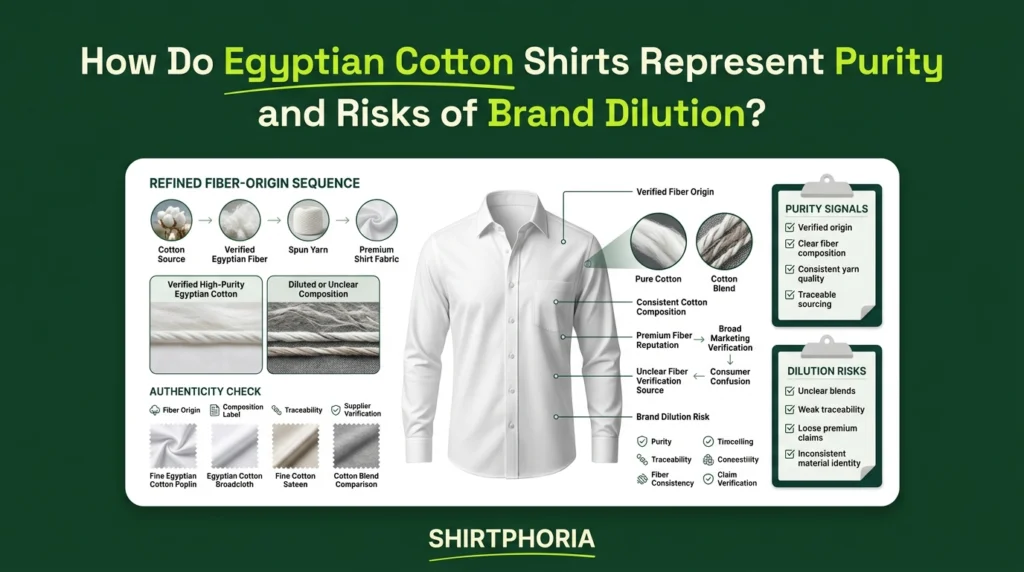
Egyptian cotton shirts represent purity when their claimed Egyptian fiber origin, composition, and supply-chain identity can be substantiated, while brand dilution occurs when the Egyptian cotton name communicates more purity, provenance, or exclusivity than the available evidence can justify.
The word purity can refer to three different things:
- Provenance purity: whether the claimed cotton actually originates from Egypt.
- Composition purity: how much of the relevant fiber content is Egyptian cotton.
- Claim integrity: whether labeling and marketing accurately describe the material’s origin and composition.
These questions should remain separate.
“Egyptian” primarily describes provenance. It should not automatically be treated as proof that a shirt contains the longest, strongest, softest, or highest-quality cotton, nor does Egyptian origin guarantee premium garment construction.
The correct distinction is:
Provenance → Fiber/material quality → Finished garment quality
Authentic Egyptian-origin cotton can be used in a poorly constructed shirt. Conversely, a well-made shirt can still carry an inaccurate or weakly substantiated Egyptian cotton claim.
Egyptian cotton also belongs to the wider category of natural fiber shirts, where fiber composition, wearability, and material characteristics should be considered separately from provenance claims.
What Does Purity Mean for Egyptian Cotton Shirts?
Purity in an Egyptian cotton shirt can refer to provenance purity, composition purity, and claim integrity, and these dimensions must be evaluated separately.
How Does Geographic Origin Contribute to Egyptian Cotton Purity?
Geographic origin contributes to provenance purity because a valid Egyptian cotton claim requires a defensible connection to cotton grown in Egypt.
The origin of the fiber should be separated from later manufacturing locations.
A shirt may involve several countries:
- cotton-growing country;
- spinning country;
- weaving or knitting country;
- dyeing or finishing country;
- garment-assembly country;
- and retail market.
Cotton grown in Egypt does not stop being Egyptian-origin cotton merely because it is spun or sewn elsewhere, provided the provenance remains credibly documented.
Likewise, Made in Egypt does not automatically mean the fiber itself is Egyptian cotton.
The strongest relationship is:
Documented Egyptian fiber origin → supports → Egyptian provenance claim
How Does Fiber Composition Determine Material Purity?
Fiber composition determines composition purity by identifying how much of the relevant fiber content is Egyptian cotton and whether other cotton types or textile fibers are present.
These are different claims:
100% Egyptian cotton
means the relevant cotton composition is being represented as entirely Egyptian-origin cotton.
Egyptian cotton blend
means Egyptian cotton is combined with another cotton type or another textile fiber.
100% cotton
describes fiber category but does not independently establish Egyptian provenance.
Contains Egyptian cotton
does not necessarily mean the entire cotton content is Egyptian.
The wording should match the actual material composition.
How Does Claim Integrity Differ From Material Purity?
Claim integrity differs from material purity because composition describes what the shirt contains, while claim integrity concerns whether labeling and marketing communicate that composition and origin accurately.
A blended Egyptian cotton shirt can have strong claim integrity.
For example, a shirt labeled accurately as:
70% Egyptian cotton + 30% another cotton
may have better claim integrity than a shirt marketed simply as “pure Egyptian cotton” without evidence supporting that stronger statement.
Blending itself is not deception.
Accurate disclosure → preserves → claim integrity
Why Does Traceability Matter to Egyptian Cotton Purity?
Traceability matters because it helps preserve the evidentiary connection between claimed Egyptian fiber origin and the material as it moves through processing and garment production.
A useful chain is:
Origin claim → sourcing evidence → lot or batch continuity → processing records → finished garment
Traceability is not merely a premium badge. Its purpose is to maintain continuity between the claimed raw material and the finished product.
How Does Egyptian Origin Establish the Identity of Genuine Egyptian Cotton Shirts?
Egyptian cotton identity begins with provenance because the defining origin claim concerns where the cotton fiber was grown, not merely whether the finished fabric feels soft, fine, or luxurious.
Why Is Egyptian Cotton Defined by Origin Rather Than Softness Alone?
Egyptian cotton is defined by geographic provenance rather than softness alone because tactile characteristics can result from many fibers, yarn systems, fabric structures, and finishing treatments.
A shirt can feel:
- soft;
- smooth;
- fine;
- luxurious;
- or silky;
without containing Egyptian-origin cotton.
Likewise:
Long-staple cotton ≠ automatically Egyptian cotton
and:
Soft cotton ≠ proof of Egyptian provenance
Touch can reveal tactile character. It cannot independently reveal geographic origin.
Why Should Egyptian Cotton Variety and Origin Be Separated From Marketing Language?
Egyptian cotton should not be treated as one uniform fiber profile because different cotton varieties cultivated in Egypt can possess different material characteristics.
Giza cotton varieties are examples associated with Egyptian cotton production, but the Egyptian origin label alone does not mean every sample has identical:
- staple length;
- strength;
- fineness;
- uniformity;
- spinning behavior;
- or finished-textile performance.
Prestige language should therefore remain separate from measurable fiber characteristics.
Why Does Genuine Egyptian Provenance Not Guarantee Finished-Shirt Quality?
Genuine Egyptian provenance does not guarantee finished-shirt quality because origin is only the first stage in a chain that also includes fiber properties, spinning, fabric construction, finishing, and garment manufacture.
The relationship is:
Provenance → Fiber properties → Yarn and fabric quality → Garment quality
Authentic origin does not independently guarantee:
- strong yarn;
- stable fabric;
- refined finishing;
- durable seams;
- or long garment lifespan.
How Can Blending Change the Purity of Egyptian Cotton Shirts?
Blending changes composition purity by changing which fibers are present and in what proportions, but blending remains legitimate when the resulting composition is accurately disclosed.
How Does Blending Egyptian Cotton With Another Cotton Change the Composition Claim?
Blending Egyptian cotton with another cotton changes the composition claim because the resulting material no longer consists entirely of Egyptian-origin cotton.
For example:
- 100% Egyptian cotton
- 70% Egyptian cotton + 30% another cotton
- Egyptian cotton blend
- unspecified cotton blend
are materially different descriptions.
The issue is not whether blending happened.
The issue is whether the blend is represented accurately.
How Can Non-Cotton Fibers Change an Egyptian Cotton Shirt’s Composition?
Non-cotton fibers create an additional composition distinction because polyester, elastane, viscose, or other textile fibers may be present alongside Egyptian cotton.
A blended fabric may be designed deliberately for stretch, easier care, durability, drape, or another performance goal.
Therefore:
Blending itself ≠ deception
but:
Undisclosed or misleading blending = claim-integrity problem
Why Must Percentage Claims Match Actual Fiber Content?
Percentage claims must match actual fiber content because stronger numerical claims create stronger factual commitments.
“Contains Egyptian cotton” and “100% Egyptian cotton” do not communicate the same thing.
The more precise the claim, the more precise the supporting evidence should be.
For textiles sold in the United States, the FTC Textile Fiber Rule provides formal requirements for fiber-content labeling on covered textile products.
This reinforces a broader principle:
Specific composition language should correspond to the actual fiber content being represented.
How Does Mislabeling Create Brand Dilution for Egyptian Cotton Shirts?
Mislabeling can contribute to Egyptian cotton brand dilution when inaccurate, exaggerated, or poorly substantiated use of the name weakens its ability to communicate a distinct and trusted material identity.
What Does Brand Dilution Mean for Egyptian Cotton Shirts?
Brand dilution is the weakening of the meaning and differentiation associated with Egyptian cotton when the identity is used inconsistently, inaccurately, or without adequate substantiation.
In this context, brand dilution is primarily an information-integrity problem.
If consumers repeatedly encounter products carrying strong Egyptian cotton language without matching evidence, the name may become less useful as a reliable signal of material identity.
How Can False or Exaggerated Egyptian Cotton Claims Create Dilution?
Claims can create dilution when they imply stronger Egyptian origin or purity than the available evidence supports.
Examples include:
- little Egyptian cotton presented as if the entire product were Egyptian cotton;
- blends represented as fully Egyptian cotton;
- unsupported geographic-origin claims;
- vague wording designed to imply Egyptian provenance;
- certification-style graphics without clear applicability;
- and marketing promises stronger than the substantiation available.
The correct principle is:
Claim strength should not exceed evidence strength.
Why Can Repeated Misuse Reduce the Value of the Egyptian Cotton Label?
Repeated misuse can reduce the informational value of the Egyptian cotton label by making substantiated material identity harder to distinguish from prestige-oriented marketing.
Conceptually:
Repeated misuse → greater uncertainty → weaker differentiation → potential trust erosion
The trust effect should be treated as a possible reputational consequence rather than a guaranteed measurable outcome.
Why Is Brand Dilution Different From Garment-Quality Failure?
Brand dilution differs from garment-quality failure because one concerns identity and claim accuracy, while the other concerns physical product performance.
For example:
Authentic Egyptian fiber + poor construction = authentic material claim but weak garment
while:
Strong garment + inaccurate Egyptian cotton claim = good garment with weak claim integrity
These are separate problems.
How Do Purity Failures Occur Across the Egyptian Cotton Shirt Supply Chain?
Egyptian cotton purity or claim integrity can become uncertain at multiple supply-chain stages when source identity, composition, batch continuity, or documentation is lost, changed, or insufficiently controlled.
These are potential risk points rather than proof that every Egyptian cotton supply chain experiences a failure.
How Can Egyptian Cotton Identity Become Uncertain During Sourcing?
Egyptian cotton identity can become uncertain during sourcing when cotton lots are mixed, supplier-origin information is incomplete, substitutions occur, or lot segregation is weak.
Potential risk points include:
- mixed cotton lots;
- unclear geographic origin;
- substitution;
- weak material segregation;
- incomplete provenance records.
How Can Spinning Introduce Composition Uncertainty?
Spinning can introduce composition uncertainty when different cottons or textile fibers enter the production stream without reliable batch control, segregation, or disclosure.
This can result from:
- deliberate cotton blending;
- undocumented material changes;
- poor batch control;
- mixed spinning inputs.
When blending is intentional and accurately disclosed, it is not inherently a purity problem. The issue arises when the final claim fails to reflect the material actually used.
How Can Later Processing Weaken Traceability?
Later processing can weaken traceability when material identity or documentation is lost as the product moves through weaving, knitting, dyeing, finishing, subcontracting, or garment production.
Potential documentation gaps include:
- missing invoices;
- weak batch identification;
- undocumented transfers;
- subcontracting gaps;
- lost production records;
- weak links between finished garments and originating material lots.
How Can Retail Claims Become Stronger Than the Evidence?
Retail claims become stronger than the evidence when wording such as:
- “pure Egyptian cotton”;
- “100% Egyptian cotton”;
- “certified Egyptian cotton”
communicates a level of certainty that the available composition, provenance, traceability, or authentication evidence does not support.
A useful rule is:
Stronger claim → stronger substantiation requirement
| Supply-Chain StageMain Purity or Traceability RiskResulting Claim RiskEvidence That Can Reduce Uncertainty | |||
|---|---|---|---|
| Cotton sourcing | Wrong, mixed, or unclear origin | Provenance becomes uncertain | Supplier and origin documentation |
| Spinning | Another cotton or fiber is introduced | Composition changes | Input records and batch controls |
| Weaving / knitting | Material lots become mixed | Product linkage weakens | Lot tracking and production records |
| Dyeing / finishing | Lot identity is lost | Material history becomes unclear | Batch continuity records |
| Garment production | Unverified fabric is substituted | Finished shirt may not match sourcing claim | Fabric-to-garment linkage |
| Retail labeling | Marketing exceeds evidence | Consumer confusion and dilution risk | Accurate composition and provenance disclosure |
How Do Traceability and Testing Protect the Purity of Egyptian Cotton Shirts?
Traceability, verification, authentication, and testing can strengthen Egyptian cotton claim confidence when each evidence type is used for the specific question it is designed to address.
These terms should not be treated as interchangeable.
How Does Supply-Chain Traceability Protect Egyptian Cotton Identity?
Supply-chain traceability protects Egyptian cotton identity by linking source inputs, transaction records, production stages, and finished outputs into a continuous evidence chain.
That can include:
- supplier documentation;
- lot identification;
- transaction records;
- production records;
- finished-product linkage.
The basic model is:
Input identity → transaction record → production stage → finished output
Continuous traceability helps preserve material-identity evidence.
Formal identity-protection systems can add another evidence layer. The Cotton Egypt Association supports Egyptian Cotton identity through trademark, accreditation, traceability, and authentication-related systems.
Such systems can strengthen confidence in a material claim, but each should still be interpreted according to what the specific process actually establishes.
How Can Accreditation Strengthen an Egyptian Cotton Claim?
Accreditation or certification can strengthen an Egyptian cotton claim when the relevant system imposes defined requirements for documentation, participant controls, audits, testing, or authorized use.
Its importance depends on its scope.
A system that supports identity or traceability should not automatically be interpreted as proof that the garment is softer, stronger, better constructed, or more durable.
Accreditation ≠ automatic garment quality
How Can Testing Support Egyptian Cotton Authentication?
Testing can support Egyptian cotton authentication when the selected method is appropriate to the specific identity or composition question being evaluated.
The central limitation is:
A test supports only what that test is designed to evaluate.
Testing should not be described as universal proof of:
- provenance;
- exact composition;
- fiber quality;
- garment quality;
- durability;
unless the specific method actually addresses that question.
Why Is Authentication Strongest When Multiple Evidence Types Agree?
Authentication confidence is strongest when independent evidence layers—such as documentation, traceability, applicable testing, and accurate labeling—support the same identity and composition claim.
Conceptually:
Documentation + traceability + applicable authentication/testing + accurate labeling → stronger claim confidence
This is an evidence model, not a guaranteed authenticity formula.
How Do Strong and Weak Egyptian Cotton Shirt Claims Compare?
Stronger Egyptian cotton claims are specific, compositionally transparent, provenance-supported, traceable, and appropriately authenticated, while weaker claims rely more heavily on implication or prestige language without equivalent evidence.
| Evaluation FactorStronger Egyptian Cotton ClaimWeaker or More Uncertain ClaimEvidence NeededWhy It Matters | ||||
|---|---|---|---|---|
| Cotton origin | Documented Egyptian provenance | Origin unclear or implied | Supplier or provenance records | Establishes geographic identity |
| Fiber composition | Clearly disclosed | Ambiguous or exaggerated | Fiber-content evidence | Establishes composition |
| Blend disclosure | Exact and transparent | Hidden or vague | Percentage or blend disclosure | Prevents misleading impressions |
| Supply-chain records | Traceable across relevant stages | Major documentation gaps | Lot and transaction records | Preserves identity continuity |
| Authentication | Applicable credible system | Marketing assertion alone | Authentication or testing where relevant | Strengthens confidence |
| Trademark use | Authorized where applicable | Name or logo unsupported | Trademark authorization | Supports identity governance |
| Finished quality | Evaluated independently | Assumed from fiber name | Fabric and garment inspection | Prevents quality misconceptions |
A weak or uncertified claim should not automatically be called counterfeit.
Absence of one certification means other evidence may be needed; it does not independently prove the Egyptian cotton claim false.
What Egyptian Cotton Purity and Brand-Dilution Mistakes Should Be Avoided?
The most common Egyptian cotton purity mistakes come from treating origin, composition, fiber quality, softness, authentication, and garment quality as if they proved one another.
Why Are “Egyptian Cotton” and “100% Egyptian Cotton” Different Claims?
“Egyptian cotton” and “100% Egyptian cotton” are different claims because the second makes a more specific assertion about total fiber composition.
A generic Egyptian cotton identity claim should not automatically be interpreted as proof that the entire garment’s relevant fiber content is Egyptian cotton.
Why Should Egyptian Origin Not Automatically Mean Extra-Long Staple?
Egyptian origin should not automatically be equated with extra-long staple classification because geographic provenance and fiber-length classification describe different attributes.
In short:
Provenance ≠ fiber classification
A product can make a valid Egyptian-origin claim without that claim independently proving every desired fiber characteristic.
Why Should Blended Egyptian Cotton Not Automatically Be Treated as Fraudulent?
Blended Egyptian cotton should not automatically be treated as fraudulent because a blend can be legitimate when its composition is accurately and transparently disclosed.
Accurately disclosed blend = legitimate composition
Undisclosed or misrepresented blend = claim-integrity problem
Why Should Softness Not Be Used as Proof of Egyptian Cotton Authenticity?
Softness cannot prove Egyptian cotton authenticity because tactile smoothness can result from:
- yarn structure;
- finishing;
- brushing;
- fabric construction;
- different cotton varieties;
- other textile fibers.
Touch reveals tactile character, not geographic provenance.
Why Should Certification Not Replace Garment-Quality Evaluation?
Certification, authentication, or trademark authorization should not replace garment-quality evaluation because identity substantiation and finished-shirt construction answer different questions.
Ask separately:
Is the material claim credible?
and:
Is the shirt itself well made?
A verified identity does not automatically guarantee premium construction.
What Evidence Helps Distinguish a Credible Egyptian Cotton Shirt Claim?
A credible Egyptian cotton shirt claim becomes stronger when specific wording is supported by composition disclosure, Egyptian provenance, traceability, and applicable authentication evidence.
How Specific Should an Egyptian Cotton Composition Claim Be?
Egyptian cotton claims are easier to evaluate when they state material identity and composition specifically rather than relying on vague prestige phrases.
Statements such as:
- Egyptian quality;
- Egyptian-style cotton;
- luxury cotton;
- premium cotton;
do not provide the same factual information as a specific Egyptian cotton composition claim.
Specific wording creates a claim that can be checked against evidence.
How Can Provenance Evidence Strengthen the Origin Claim?
Provenance evidence strengthens the origin claim by distinguishing where the cotton was grown from where it was spun, woven, finished, or assembled into a shirt.
These locations should be considered separately:
- cotton-growing location;
- spinning location;
- fabric-production location;
- finishing location;
- garment-assembly location.
A shirt assembled in another country may still contain legitimate Egyptian-origin cotton.
How Can Traceability Strengthen Confidence Beyond the Label?
Traceability strengthens confidence beyond the label by showing that the claimed Egyptian fiber identity remained connected to the material across relevant processing and manufacturing stages.
A stronger approach is:
Label claim + composition evidence + provenance + traceability
rather than:
Prestige wording = authenticity
How Can Recognized Authentication Strengthen an Egyptian Cotton Claim?
Recognized authentication can strengthen an Egyptian cotton claim when the relevant system, test, certification, or mark genuinely applies to the product and supports the specific claim being made.
A symbol or logo alone should not be treated as proof unless its authorization and scope are clear.
Identity authentication should also remain separate from garment-quality evaluation.
What Should Buyers Check Before Choosing an Egyptian Cotton Shirt?
Buyers should evaluate an Egyptian cotton shirt in sequence by checking the exact claim wording, disclosed fiber composition, provenance information, traceability or authentication evidence, and finished garment quality.
Buyers can assess claims and documentation.
They cannot prove Egyptian geographic origin through softness, luster, hand feel, or unaided visual inspection.
Step 1 — What Does the Label Actually Claim?
The first step is to identify exactly what the label or product description says.
Ask:
- Is Egyptian cotton explicitly named?
- Is a percentage provided?
- Are other cottons or textile fibers disclosed?
- Does the wording say “contains,” “blend,” or “100%”?
Small wording differences can represent major differences in composition claims.
Step 2 — How Should Provenance Be Separated From Manufacturing Location?
Fiber provenance should be separated from manufacturing location because Egyptian-grown cotton can be spun, woven, finished, or assembled elsewhere.
Ask separately:
- Where was the cotton grown?
- Where was it spun?
- Where was the fabric produced?
- Where was the shirt assembled?
Do not use a “Made in” statement alone as proof of fiber origin.
Step 3 — What Evidence Supports the Egyptian-Origin Claim?
The Egyptian-origin claim becomes stronger when provenance information, supplier traceability, product disclosure, or applicable authentication evidence supports it.
Useful evidence may include:
- provenance information;
- supplier traceability;
- relevant authentication;
- clear material disclosure.
One missing evidence layer does not automatically prove a claim false, but stronger claims benefit from more complete substantiation.
Step 4 — How Should Garment Quality Be Evaluated Independently?
Garment quality should be evaluated independently because a credible Egyptian cotton claim does not prove that the shirt has strong yarn, stable fabric, good seams, or suitable finishing.
Inspect:
- yarn consistency;
- fabric stability;
- stitching;
- seams;
- finishing;
- suitability for intended use.
Authenticity evaluation ≠ garment-quality evaluation
Step 5 — How Should the Strength of the Claim Match the Strength of the Evidence?
The strength of the evidence should increase with the specificity of the claim because “100% Egyptian cotton” makes a more precise factual commitment than “contains Egyptian cotton.”
A practical buyer sequence is:
Claim wording → Composition → Provenance → Traceability/authentication → Garment quality → Purchase decision
This is a conceptual decision process rather than a standardized authenticity formula.
How Can Egyptian Cotton Shirts Preserve Brand Trust and Avoid Dilution?
Egyptian cotton brand trust is better preserved when composition claims are accurate, provenance remains traceable, marketing language stays within the evidence, and authentication supports rather than replaces truthful disclosure.
How Does Accurate Composition Disclosure Protect Egyptian Cotton Trust?
Accurate composition disclosure supports trust by ensuring that the product communicates which fibers it contains and in what proportion.
The simplest rule is:
Say exactly what the shirt contains.
Prestige attached to the Egyptian cotton name should not imply a composition the product does not actually have.
How Does Continuous Provenance Protect Egyptian Cotton Identity?
Continuous provenance protects Egyptian cotton identity by maintaining an evidence chain between the claimed fiber source and the finished product.
In practical terms:
Do not break the evidence chain between source and finished product.
How Does Restrained Marketing Protect Claim Integrity?
Restrained marketing protects claim integrity by avoiding quality promises that Egyptian provenance alone cannot substantiate.
Unsupported equations should be avoided, including:
- Egyptian origin = strongest cotton;
- Egyptian origin = softest cotton;
- Egyptian origin = longest staple;
- Egyptian origin = superior finished shirt.
How Can Authentication Support Rather Than Replace Truthful Labeling?
Authentication supports truthful labeling by adding relevant evidence to an already accurate composition and provenance claim rather than replacing basic disclosure.
A stronger trust architecture is:
Accurate composition + provenance + traceability + applicable authentication → stronger claim confidence
Finished-shirt quality still requires its own evaluation.
Why Does Egyptian Cotton Brand Dilution Make Traceability Comparisons With Supima Useful?
Egyptian cotton’s brand-dilution risks make traceability comparisons useful because premium material identities retain more informational value when provenance, composition, and authorized product claims remain tightly connected.
Why Do Premium Cotton Identities Benefit From Protected Provenance?
Premium cotton identities benefit from protected provenance because market value can create incentives for:
- substitution;
- undisclosed blending;
- overclaiming;
- identity misuse.
This leads to a general principle:
Premium identity → stronger need for provenance controls
How Can a Supima Comparison Clarify Traceability Architecture?
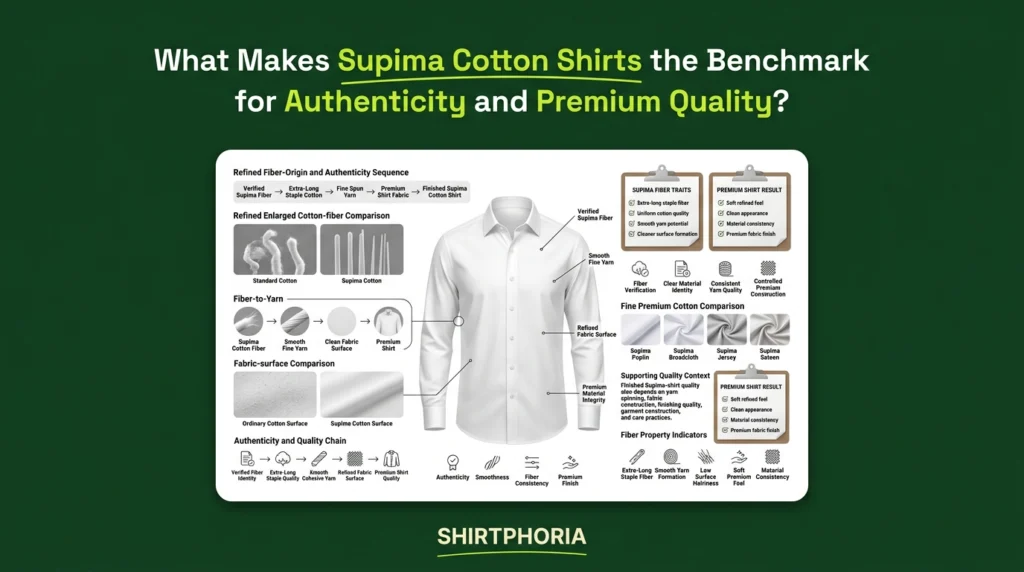
Supima provides a useful comparison because its identity architecture can illustrate how trademark control, provenance management, and product-level traceability concepts can help protect a premium cotton identity.
The comparison should remain narrow.
It does not mean Supima is universally more authentic, nor does it mean Egyptian cotton lacks authentication systems.
What Should the Supima Comparison Teach Readers About Egyptian Cotton?
The relevant lesson for Egyptian cotton is that premium identity retains value when product claims remain connected to verifiable provenance and accurate material representation.
A useful comparison is Supima authenticity, especially for understanding how premium cotton identity can be supported through provenance and claim controls.
The important comparison is the traceability architecture, not a universal quality ranking.
How Can Buyers Run a Final Egyptian Cotton Shirt Credibility Check?
A strong Egyptian cotton credibility check asks whether the product’s composition, origin, traceability, authentication, and marketing claims all support the same material identity.
Egyptian Cotton Shirt Purity and Credibility Checklist
- ✅ The garment clearly states its cotton composition.
- ✅ Egyptian cotton is explicitly identified rather than implied through vague prestige language.
- ✅ “100% Egyptian cotton” is used only when supporting composition evidence matches that claim.
- ✅ Other cotton types or textile fibers are disclosed when present.
- ✅ Egyptian fiber origin is separated from garment-manufacturing location.
- ✅ Provenance information is available or credibly substantiated.
- ✅ Traceability evidence supports strong origin or purity claims where appropriate.
- ✅ Testing or authentication evidence is interpreted only within the scope of the relevant method.
- ✅ Trademark or certification evidence is used only when genuinely applicable.
- ✅ Trademark authorization is not treated as proof of superior garment quality.
- ✅ The shirt does not depend only on words such as “premium,” “luxury,” “soft,” or “fine.”
- ✅ Softness is treated as a tactile characteristic rather than proof of Egyptian provenance.
- ✅ Blending is judged by disclosure accuracy rather than automatically treated as fraud.
- ✅ Authenticity and finished-shirt quality are evaluated independently.
- ✅ Stronger purity claims are supported by stronger evidence.
- ✅ The buyer can distinguish supported identity from marketing prestige.
Rapid Credibility Model
Specific claim + accurate composition + credible provenance + preserved traceability + applicable authentication = stronger Egyptian cotton claim confidence
This is a conceptual confidence model, not a standardized authenticity equation.
Egyptian Cotton Claim Confidence Categories
Strong evidence: Specific composition claims, credible Egyptian provenance, continuity of traceability, and applicable authentication evidence align.
Partial evidence: Some meaningful evidence supports the claim, but important composition, provenance, or traceability information remains incomplete.
Label-only evidence: Egyptian cotton is claimed mainly through labeling or marketing without enough supporting provenance or traceability evidence.
Conflicting evidence: Composition, provenance, records, testing, authentication, or claim wording do not align.
Indeterminate: Available information is insufficient to classify the Egyptian cotton claim confidently.
These categories should not be converted into numerical authenticity scores.
Disclaimer
| Area | What to Know |
|---|---|
| Purpose | This article explains how Egyptian cotton origin, composition, traceability, authentication, and marketing claims relate to material credibility and brand dilution. |
| Evidence limits | A label, trademark, certification, test, or traceability record supports only the specific question it is designed to address; none automatically proves overall garment quality. |
| Consumer verification | Unaided touch and visual inspection can help assess construction and tactile quality, but they cannot independently prove Egyptian geographic origin or exact composition. |
Egyptian Cotton Purity and Brand-Dilution Checklist
Use this interactive checklist to review the article’s most important distinctions.
Frequently Asked Questions
Purity can refer to three separate dimensions: whether the cotton genuinely originates from Egypt, how much of the relevant fiber content is Egyptian cotton, and whether the product’s labeling accurately represents its origin and composition.
No. Egyptian provenance establishes an origin claim, not finished-garment quality. Yarn engineering, fabric construction, finishing, stitching, seams, and care still determine how well the shirt performs.
No. Blending can be legitimate when the other cotton or textile fibers are accurately disclosed. The claim-integrity problem begins when the blend is hidden, understated, or marketed as a stronger purity claim than the evidence supports.
Confidence is stronger when specific composition wording, credible Egyptian provenance, preserved traceability, applicable authentication or testing, and accurate labeling all support the same material identity.
Terms Explained
| Term | Definition |
|---|---|
| Provenance purity | Whether the claimed cotton fiber genuinely originates from Egypt. |
| Composition purity | How much of the relevant fiber content is Egyptian cotton and what other fibers are present. |
| Claim integrity | Whether labeling and marketing accurately describe the material’s origin and composition. |
| Traceability | The evidence chain connecting source inputs, transactions, production stages, and the finished garment. |
| Authentication | Evidence or testing used to support a specific identity or composition question within the scope of the method. |
| Accreditation | A defined system of requirements, controls, audits, testing, or authorized participation that can strengthen a claim within its stated scope. |
| Brand dilution | The weakening of Egyptian cotton’s meaning or differentiation when the identity is used inaccurately, inconsistently, or without adequate substantiation. |
| Claim substantiation | Evidence sufficient to support the strength and specificity of the product claim being made. |
Conclusion
In conclusion, Egyptian cotton shirts represent purity when their claimed Egyptian provenance, fiber composition, and material identity remain credibly connected from sourcing through the finished garment, while brand dilution begins when marketing communicates more than the evidence can substantiate.
The stronger evidence model is:
Verified Egyptian origin + accurate composition + preserved traceability + applicable authentication → stronger claim confidence and stronger trust potential
By contrast:
Weak provenance + misrepresentation + broken traceability + unsupported claims → uncertain purity and greater brand-dilution risk
Three questions should always remain separate:
Is the Egyptian-origin claim credible?
Is the fiber composition accurately disclosed?
Is the finished shirt itself well made?
That distinction prevents several common errors:
Provenance purity ≠ composition purity
Traceability ≠ authentication
Authentication ≠ accreditation
Testing ≠ universal proof
Trademark authorization ≠ garment-quality proof
Authenticity ≠ fiber quality
Fiber quality ≠ finished-shirt quality
Blending is not inherently deceptive when it is accurately disclosed, and trust effects should be treated as potential consequences of claim misuse rather than automatic outcomes.
The premium value of Egyptian cotton is protected not by the name alone, but by the ability to connect what the label promises with what the material contains, where the fiber came from, and how transparently that identity was preserved through the supply chain.