Why Are Pima Cotton Shirts Known for Their Silky Feel and Material Integrity?
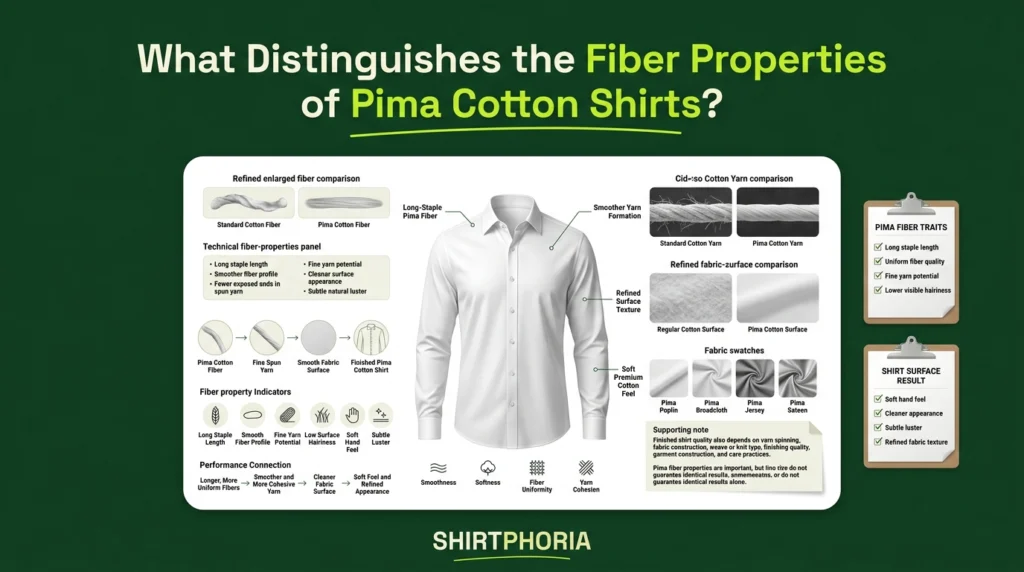
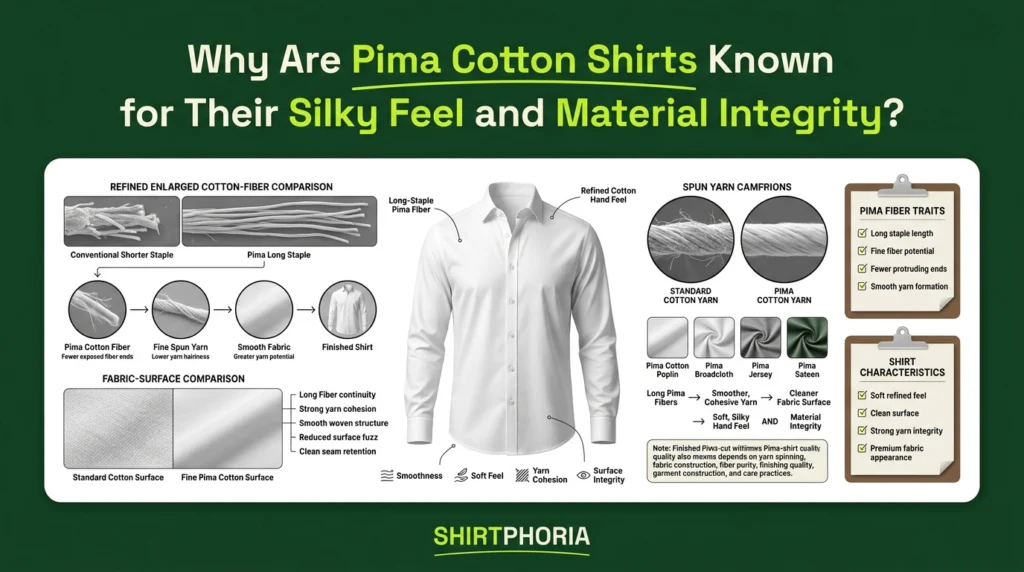
Pima cotton shirts are known for their silky feel and material-integrity potential mainly because Pima cotton uses long, fine fibers that can support smoother, more cohesive yarn formation with fewer disruptive protruding fiber ends than typical shorter-staple cotton under otherwise comparable conditions.
The central relationship is:
Long, fine Pima fibers → smoother and more cohesive yarn potential → cleaner fabric surface + stronger material foundation → silky tactile feel + greater material-integrity potential
These outcomes are related, but they are not identical.
A silky tactile surface concerns how the fabric feels against the skin. Material integrity involves yarn cohesion, surface retention, fabric structure, and the way the complete garment withstands use.
Pima cotton provides strong raw-material potential, but the name alone does not guarantee that every finished Pima shirt will feel or perform the same way. Spinning, weaving or knitting, finishing, garment construction, laundering, and care all influence the final result.
Pima cotton is one natural-fiber shirt material whose fiber characteristics can support a refined surface and strong material-quality potential within the broader category of natural fiber shirts.
Why Do Pima Cotton Shirts Develop Both a Silky Feel and Strong Material Integrity?
Pima cotton shirts can develop both a silky tactile feel and strong material-integrity potential because their long, fine fibers can support smoother and more cohesive yarn formation while reducing disruptive surface protrusions under suitable spinning and construction conditions.
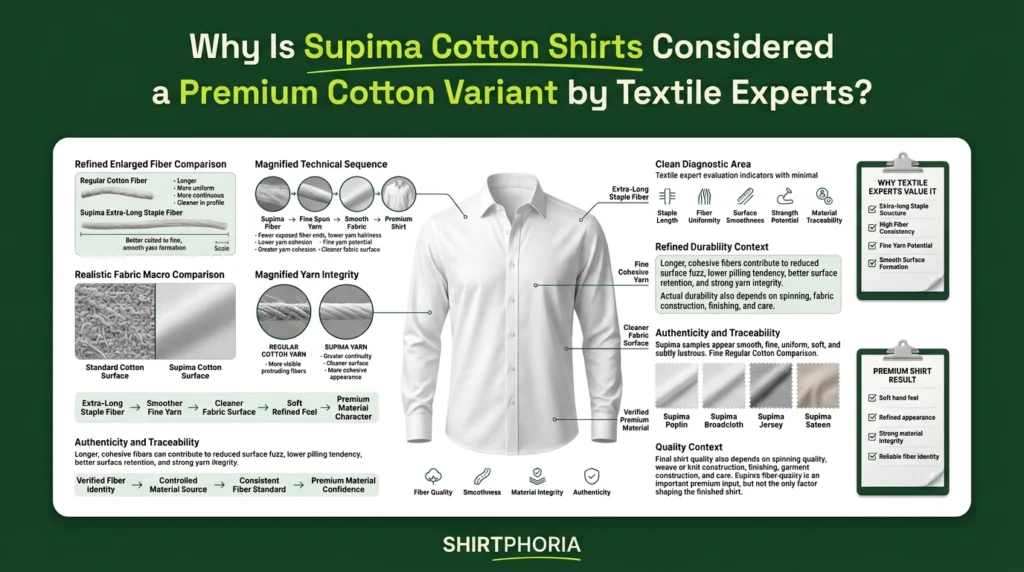
CottonWorks identifies Pima as extra-long staple cotton, meaning its fibers are notably long relative to common Upland cotton.
Staple length and fiber fineness contribute differently to the finished textile.
How Does Pima Cotton’s Long-to-Extra-Long Staple Structure Improve Shirt Quality?
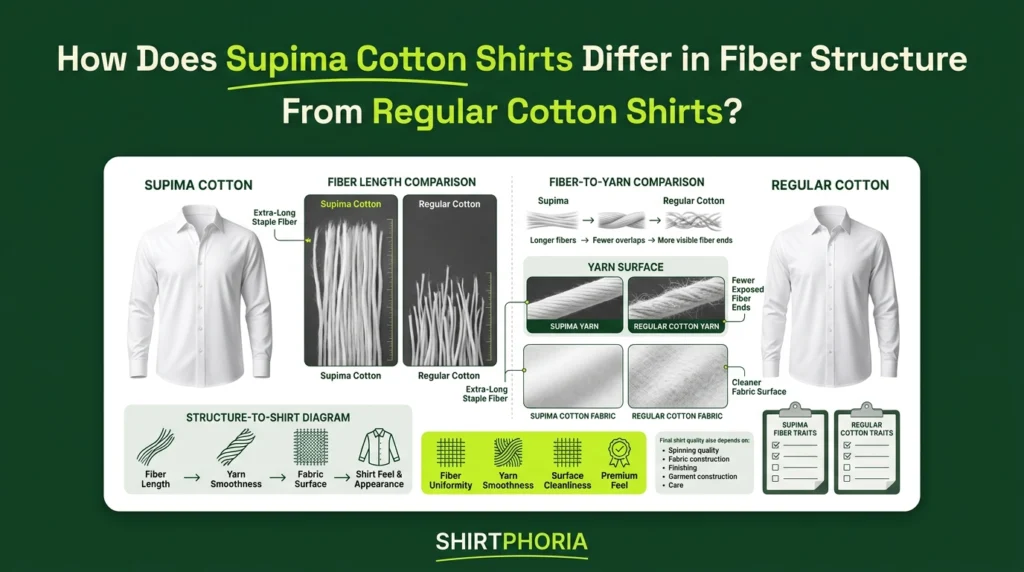
Pima cotton’s long-to-extra-long staple structure can improve shirt-quality potential because longer fibers provide greater opportunity for stable incorporation and cohesion during yarn formation.
Staple length means the length of an individual cotton fiber.
Longer fibers can provide more continuous material within the yarn structure. Under suitable spinning conditions, this can support:
- stronger fiber incorporation,
- greater yarn-cohesion potential,
- smoother yarn formation,
- fewer disruptive loose fiber ends,
- cleaner fabric-surface potential,
- and greater yarn-strength potential.
The basic relationship is:
Longer Pima fibers → support → greater yarn-cohesion potential
Cotton Incorporated classifies American Pima as extra-long staple cotton and reports fiber lengths greater than those typical of Upland cotton.
Staple length is still only one textile variable. It should not be treated as a complete measure of shirt quality.
How Does Pima Cotton Fiber Fineness Contribute to a Smoother Shirt Surface?
Pima cotton fiber fineness can contribute to a more refined tactile surface because finer fibers can support flexible, refined yarn construction without being equivalent to fiber length.
Fiber fineness describes the size or thickness characteristics of individual fibers.
A fine fiber can contribute to refined yarn construction and a smoother textile surface, particularly when spinning quality and fabric construction preserve that advantage.
The relationship is:
Fine fiber structure → supports → refined tactile potential
However, several terms should remain separate:
Long describes fiber length.
Fine describes fiber size.
Smooth describes surface character.
Soft describes tactile perception.
They influence one another but should not be used as synonyms.
Why Must Pima Fiber, Yarn, and Fabric Quality Be Evaluated Together?
Pima fiber, yarn, and fabric quality must be evaluated together because the raw-fiber advantage can reach the finished shirt only if spinning, fabric construction, finishing, garment manufacture, and care preserve it.
The full quality pathway is:
Fiber → yarn → fabric → garment → care
Pima’s fiber characteristics must successfully move through:
- spinning,
- weaving or knitting,
- finishing,
- cutting,
- sewing,
- laundering,
- and repeated wear.
Premium fiber combined with weak downstream manufacturing can still result in an average or poorly performing shirt.
For a deeper explanation of the underlying fiber profile, see Pima cotton fiber properties.
How Do Pima Cotton Fibers Create the Silky Feel of Pima Cotton Shirts?
Pima cotton fibers can contribute to a silkier tactile feel because their long, fine structure can support smoother yarn with fewer disruptive surface projections, creating cleaner contact between the fabric and the skin.
Here, silky describes tactile character. It does not mean the cotton contains silk.
The mechanism follows:
Fiber property → yarn effect → fabric surface → wearer perception
How Do Longer Pima Fibers Reduce Protruding Ends on the Shirt Surface?
Longer Pima fibers can reduce opportunities for disruptive protruding fiber ends because each fiber contributes a longer continuous segment to the yarn structure and can remain incorporated across more of the yarn body.
Short exposed fiber ends can contribute to yarn hairiness and surface fuzziness.
Longer fibers can create better opportunities for stable incorporation within the spun yarn.
This can support:
- cleaner yarn surfaces,
- lower fuzziness potential,
- fewer disruptive projections,
- and more regular fabric contact.
The relationship is:
More stable fiber incorporation → can reduce → disruptive surface ends
This remains conditional on yarn twist, spinning method, yarn count, and other engineering variables.
How Does Smoother Pima Yarn Create a Silkier Hand Feel?
Smoother Pima yarn can contribute to a silkier hand because fewer disruptive surface fibers can reduce fuzzy tactile character and support more regular contact with the skin.
Fabric hand means the tactile character perceived when a fabric is touched, handled, or worn.
A cleaner yarn surface can support a more refined sensation through this pathway:
Fewer disruptive surface fibers → cleaner surface character → smoother tactile contact → silkier perceived hand
This does not mean lower hairiness automatically produces maximum softness.
Softness also depends on:
- fiber fineness,
- yarn construction,
- fabric architecture,
- fabric weight,
- finishing,
- and laundering history.
How Do Fabric Construction and Finishing Amplify Pima Cotton Smoothness?
Fabric construction and finishing can amplify, reduce, or redirect Pima cotton’s smoothness potential because yarn count, structure, density, combing, mercerization, and other finishing choices determine how the yarn surface is presented in the finished shirt.
Two Pima cotton shirts can therefore feel very different.
Important variables include:
- yarn count,
- yarn uniformity,
- knitting versus weaving,
- fabric density,
- combing,
- mercerization,
- and surface finishing.
A fine woven Pima dress shirt may feel different from a Pima jersey T-shirt even though both use the same broad fiber category.
Finishing can also temporarily create an especially slick or soft surface, so first-touch softness should not be treated as proof of underlying fiber quality.
How Does Pima Cotton Preserve the Material Integrity of Pima Cotton Shirts?
Pima cotton can support material integrity because its long fibers can contribute to cohesive yarn formation and cleaner surface retention, while fabric integrity and finished-garment durability still depend on downstream construction and use.
Material integrity should be separated into several levels:
Yarn cohesion
Yarn-strength potential
Surface retention
Appearance serviceability
Fabric structural integrity
Finished-garment durability
An advantage at one level does not automatically prove an equal advantage at every later level.
How Do Longer Pima Fibers Help Create More Cohesive Yarn?
Longer Pima fibers can support more cohesive yarn because their longer continuous structure provides greater opportunity for stable mechanical integration during spinning.
Greater fiber incorporation can contribute to improved yarn cohesion.
The relationship is:
Longer fiber structure → supports → yarn-cohesion potential
This may also support yarn-strength potential.
However, actual yarn performance still depends on:
- twist,
- spinning system,
- yarn count,
- fiber preparation,
- and yarn uniformity.
A fiber-level advantage should therefore not automatically be converted into a claim that the final shirt will last a specific number of years.
How Can Pima Cotton Reduce Surface Fuzzing and Pilling Tendencies?
Pima cotton can reduce some surface-fuzzing and pilling tendencies when longer, well-incorporated fibers leave fewer disruptive loose ends available to move outward under friction.
Pilling occurs when loose or protruding fibers become entangled into small surface balls.
Pima’s long-fiber profile can reduce some of the conditions that encourage surface fuzzing under otherwise comparable circumstances.
However, pilling also depends on:
- yarn twist,
- yarn structure,
- knit or weave construction,
- friction,
- finishing,
- washing,
- and drying.
Pima cotton can still pill.
Pilling should also be treated mainly as an appearance or serviceability issue unless actual structural damage is independently established.
How Can Pima Cotton Help Retain a Refined Surface Through Repeated Wear?
High-quality Pima cotton can support refined surface retention because cohesive yarn and lower disruptive-fiber potential may slow the development of excessive fuzziness and visual surface degradation.
This can help preserve:
- surface smoothness,
- visual refinement,
- lower fuzziness,
- consistent yarn appearance,
- and overall appearance serviceability.
However, surface retention is not the same as garment lifespan.
A shirt can maintain a relatively clean surface while still experiencing seam failure, abrasion, dimensional change, or other construction-related problems.
The correct boundary is:
High-quality Pima fiber can support surface integrity, but cannot make a shirt immune to friction, abrasion, weak construction, or unsuitable care.
How Are the Silky Feel and Material Integrity of Pima Cotton Shirts Connected?
The silky feel and material-integrity potential of Pima cotton shirts can share upstream fiber and yarn mechanisms because longer fibers can support both cleaner yarn surfaces and stronger yarn cohesion, while the final sensory and structural outcomes remain distinct.
Silkiness does not necessarily indicate fragility.
Why Can the Same Long-Fiber Structure Support Both Smoothness and Strength?
The same long-fiber structure can support both smoothness and yarn-strength potential because stable fiber incorporation can contribute to yarn cohesion while reducing disruptive surface projections.
The mechanism is:
Longer fibers → more stable yarn incorporation → greater yarn-cohesion potential + fewer disruptive projections → smoother yarn surface + stronger yarn foundation
This creates a shared upstream advantage.
However:
Yarn strength ≠ fabric strength
and
Fabric strength ≠ finished-shirt durability
Each level requires its own evidence.
Why Does Pima Cotton Softness Not Necessarily Require Weak Fabric?
Pima cotton can feel soft or silky without being structurally weak because tactile refinement can arise from fiber fineness, yarn refinement, surface regularity, and finishing rather than from deliberately weakening the textile.
Possible contributors include:
- fine fibers,
- refined yarn,
- regular surfaces,
- fewer protruding fibers,
- and suitable finishing.
A fabric can therefore provide tactile refinement while maintaining a cohesive textile structure.
Softness and silky smoothness should still remain separate.
A fabric may feel soft because it bends easily, while a silky surface may come more from smooth, regular contact.
Which Parts of Pima Cotton Shirt Performance Still Depend on Construction?
Pima cotton shirt performance still depends heavily on construction because weave or knit type, fabric density, fabric weight, yarn twist, seams, finishing, and care determine how much of the fiber advantage survives into the finished garment.
Relevant factors include:
- weave or knit structure,
- fabric density,
- fabric weight,
- yarn twist,
- seam construction,
- finishing,
- and laundering.
The central rule is:
Premium fiber + poor construction ≠ automatically premium shirt
How Do Pima Cotton Shirts Compare With Typical Shorter-Staple Cotton Shirts in Feel and Material Quality?
Under otherwise comparable yarn, fabric, and finishing conditions, Pima cotton generally offers greater potential for refined yarn surfaces, silky tactile character, and cohesive yarn formation than typical shorter-staple cotton.
This is a comparison of material potential rather than universal superiority.
How Does Pima Cotton Differ From Typical Shorter-Staple Cotton at the Fiber Level?
Pima cotton typically differs from shorter-staple cotton through greater staple length and a fiber profile that can support different yarn-refinement and cohesion potential.
CottonWorks notes that the principal distinction between Pima and Upland cotton is fiber length, with Pima classified as extra-long staple.
The fiber-level comparison can involve:
- staple length,
- fiber fineness,
- fiber incorporation potential,
- exposed fiber-end opportunities,
- yarn-refinement potential,
- and yarn-strength potential.
Not all non-Pima cotton is identical, so the comparison should not imply that every other cotton has the same properties.
How Can Those Fiber Differences Become Visible in a Finished Shirt?
Fiber-level differences can become visible or tactile in a finished Pima shirt through smoother surface potential, lower fuzziness potential, refined hand, and cleaner appearance when downstream construction preserves the fiber advantage.
Possible observable results include:
- a cleaner surface,
- fewer obvious loose fibers,
- smoother tactile contact,
- lower fuzziness,
- and refined appearance.
These are downstream tendencies, not laboratory proof of Pima identity.
Why Can a Well-Made Conventional Cotton Shirt Outperform a Poor Pima Cotton Shirt?
A well-made conventional cotton shirt can outperform a poorly made Pima shirt because finished garment quality depends on spinning, fabric construction, finishing, seam quality, and care as well as fiber identity.
The key distinction is:
Fiber quality ≠ finished garment quality
Poor:
- spinning,
- fabric balance,
- density,
- finishing,
- seam construction,
- or care
can reduce the benefit of premium fibers.
| Attribute | Pima Cotton Shirt | Typical Shorter-Staple Cotton Shirt | Why It Matters |
|---|---|---|---|
| Fiber length | Long to extra-long staple profile | Typically shorter comparator | Influences yarn-formation potential |
| Fiber fineness | Separate refinement characteristic | Varies | Can influence tactile refinement |
| Yarn-surface potential | Greater smooth-yarn potential under suitable spinning | More variable | Influences feel and fuzziness |
| Silky-feel potential | High when well constructed | Varies widely | Influences tactile refinement |
| Yarn-strength potential | Greater potential under comparable yarn engineering | Depends on fiber and yarn system | Supports yarn-level integrity |
| Surface fuzzing potential | Potentially lower | Potentially higher under comparable conditions | Influences appearance serviceability |
| Finished-shirt quality | Still construction-dependent | Still construction-dependent | Fiber name alone is insufficient |
How Does Comparing Pima Cotton With Egyptian Cotton Clarify Premium-Cotton Quality Claims?
Pima and Egyptian cotton are often discussed within premium-cotton evaluation, but their labels should be treated as distinct fiber or market identities rather than interchangeable guarantees of finished-shirt quality.
They should not be treated as synonyms or ranked solely by name.
Why Are Pima and Egyptian Cotton Discussed in the Same Premium Context?
Pima and Egyptian cotton are often discussed in the same premium context because buyers commonly evaluate such claims through fiber properties, traceability, authenticity, and finished textile quality.
Common evaluation themes include:
- staple characteristics,
- fiber refinement,
- yarn quality,
- authenticity,
- and traceability.
The names themselves do not prove the final quality of a shirt.
Why Does a Premium Cotton Name Not Automatically Prove Shirt Quality?
A premium cotton name does not automatically prove shirt quality because fiber identity is only one stage in a system that also includes spinning, fabric construction, finishing, and garment workmanship.
Evaluation therefore needs to distinguish:
- fiber identity,
- fiber properties,
- origin or commercial claims,
- spinning,
- fabric construction,
- finishing,
- and garment workmanship.
A premium raw material can be poorly converted into fabric, while a less prestigious fiber can be engineered into a well-made garment.
Why Do Authenticity Claims Matter When Evaluating Premium Cotton?
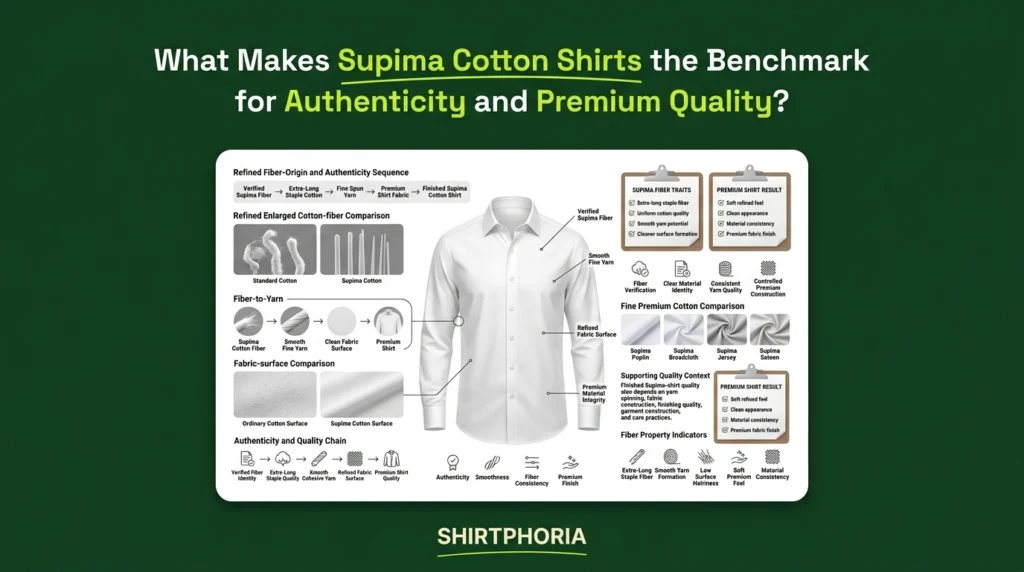
Authenticity claims matter because a premium-fiber reputation is meaningful only when the material being sold actually corresponds to the claimed fiber identity.
Traceability and product disclosure should be evaluated separately from softness or tactile quality.
A shirt that feels smooth does not prove its fiber identity.
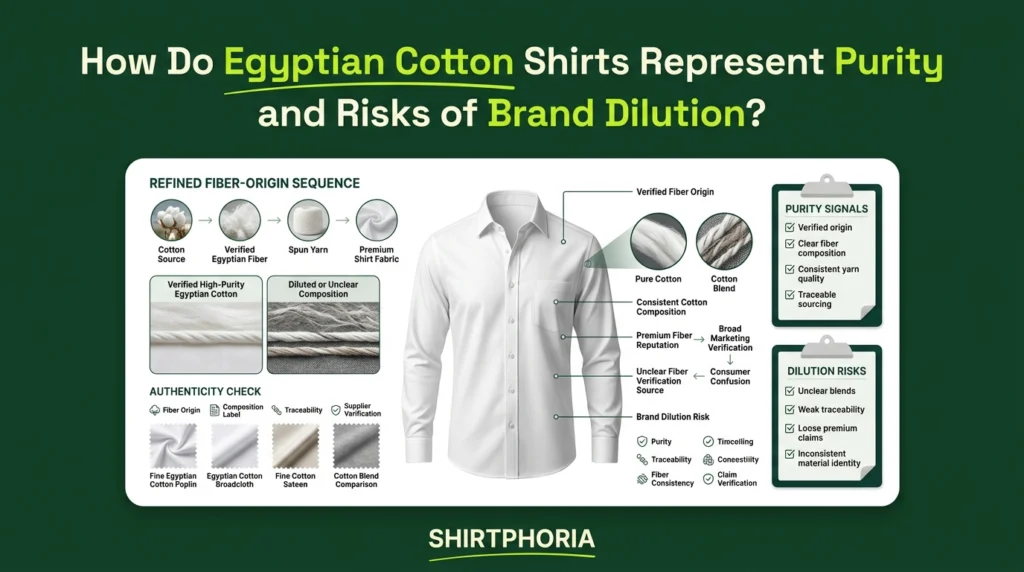
Pima’s premium-fiber reputation also leads naturally to the related question of Egyptian cotton authenticity.
How Can You Evaluate Whether a Pima Cotton Shirt Has Genuine Material Quality?
A Pima cotton shirt should be evaluated through its fiber claim, surface quality, yarn and fabric consistency, garment construction, finishing, and care requirements rather than through the Pima label alone.
Visual and tactile inspection can help evaluate the finished garment, but they cannot independently prove:
- microscopic staple length,
- fiber fineness,
- standardized yarn strength,
- or Pima authenticity.
How Can Labeling Help Evaluate a Pima Cotton Claim?
Fiber-content labeling can establish that a garment is being presented as Pima cotton, but labeling alone does not establish overall shirt quality or independently verify every fiber-property claim.
Check for:
- specific Pima identification,
- manufacturer disclosure,
- composition information,
- and traceability information where available.
Terms such as:
- premium cotton,
- luxury cotton,
- superior cotton
are less specific than an explicit Pima claim.
The label is one evidence layer, not a complete verdict.
How Can You Inspect the Surface Quality of a Pima Cotton Shirt?
A well-made Pima cotton shirt may present a relatively smooth and uniform finished surface with limited unintended fuzziness or irregular yarn appearance.
Look for:
- surface uniformity,
- limited excessive fuzziness,
- tactile consistency,
- even texture,
- and obvious yarn irregularities.
Smoothness alone does not prove Pima identity.
A well-finished non-Pima fabric can also feel smooth.
How Can Fabric Construction Show Whether Pima’s Fiber Advantage Was Preserved?
Fabric construction can show whether the claimed premium-fiber potential has been converted into a consistent finished textile because even high-quality fiber requires appropriate yarn and fabric engineering.
Inspect:
- consistency of weaving or knitting,
- appropriate fabric density,
- yarn uniformity,
- fabric stability,
- loose fibers,
- and visibly weak areas.
Consumer inspection remains a screening method rather than a laboratory quality test.
How Can Seams and Finishing Reveal Overall Garment Quality?
Seams and finishing reveal whether the rest of the garment construction is consistent with the claimed material quality because premium fiber cannot compensate for major workmanship weaknesses.
Look for:
- stable seams,
- even stitching,
- clean finishing,
- suitable reinforcement,
- and construction that matches the quality of the fabric.
A useful consumer evaluation sequence is:
Fiber claim → surface → yarn/fabric consistency → seams → finish → care requirements
What Factors Can Reduce the Silky Feel or Material Integrity of Pima Cotton Shirts?
Pima cotton’s fiber-level advantages can be reduced by poor spinning, weak fabric construction, poor garment workmanship, unsuitable finishing, or harsh care that prevents the original material potential from reaching or remaining in the finished shirt.
How Can Poor Spinning Reduce Pima Cotton’s Advantages?
Poor spinning can reduce Pima cotton’s material potential by creating uneven yarn, inconsistent twist, excessive loose fibers, or weak yarn cohesion.
Problems can include:
- irregular yarn,
- inconsistent twist,
- excess loose fibers,
- weak cohesion,
- and inconsistent yarn quality.
The relationship is:
Poor spinning → reduces → fiber-level quality potential
Even premium fibers need effective spinning to become high-quality yarn.
How Can Weak Fabric Construction Undermine Pima Cotton Performance?
Weak fabric construction can undermine Pima cotton performance when loose, unstable, poorly balanced, or inconsistent weaving or knitting fails to convert refined yarn into a stable fabric.
Potential problems include:
- overly loose construction,
- unsuitable density,
- inappropriate fabric weight,
- poor structural balance,
- and inconsistent fabric formation.
These are fabric-level problems rather than failures of the Pima fiber itself.
How Can Poor Garment Construction Reduce Material Integrity?
Poor garment construction can reduce finished-shirt integrity because weak seams, poor stitching, or inadequate reinforcement can fail independently of the underlying Pima fabric.
A strong fabric does not compensate for:
- weak stitching,
- unstable seams,
- poor seam allowances,
- or inadequate reinforcement.
Fiber quality and garment workmanship therefore need separate evaluation.
How Can Finishing Treatments Distort the Initial Feel of Pima Cotton?
Finishing can alter the initial perception of Pima quality because surface treatments can make fabric feel especially soft, slick, polished, or smooth without independently proving the underlying fiber identity or construction quality.
Finishing is not inherently negative.
It can enhance a well-made fabric.
The important point is that first-touch softness alone is incomplete evidence.
A temporary slick finish should not be confused with fiber-derived yarn refinement.
How Can Laundering Reduce Pima Cotton Surface Quality?
Harsh laundering can reduce Pima cotton surface quality because repeated heat, friction, aggressive washing, or unsuitable drying can accelerate visible surface wear.
Risk factors include:
- excessive heat,
- harsh washing,
- unnecessary abrasion,
- unsuitable drying,
- and ignoring care instructions.
The relationship is:
Greater heat/friction exposure → greater surface-wear potential → reduced refined appearance and tactile quality
Surface wear does not automatically mean complete structural failure.
How Should You Choose Pima Cotton Shirts for Softness, Durability, and Everyday Wear?
The best Pima cotton shirt depends on whether the wearer prioritizes tactile softness, silky surface refinement, everyday material integrity, warm-weather comfort, dress-shirt appearance, or long-term surface retention.
Different fabric constructions can emphasize different benefits.
What Should You Prioritize for Maximum Pima Cotton Softness?
Maximum perceived softness should be evaluated through tactile consistency, yarn refinement, fabric construction, finishing, and comfortable fabric weight rather than through Pima fiber identity alone.
Look for:
- refined yarn,
- limited unintended fuzziness,
- suitable fabric structure,
- consistent tactile feel,
- appropriate finishing,
- and comfortable weight.
Remember that softness and silky surface smoothness are related but different sensations.
What Should You Prioritize for Long-Term Wear?
Long-term wear is better supported by stable fabric construction, consistent yarn, appropriate density and weight, sound seams, and realistic care requirements.
Evaluate the complete garment rather than fiber identity alone.
Important factors include:
- stable fabric,
- consistent yarn,
- appropriate fabric weight,
- suitable density,
- strong seam construction,
- and manageable care instructions.
Pima identity alone cannot predict exact garment lifespan.
How Should Breathability and Fabric Weight Influence the Choice?
Breathability and fabric weight should be evaluated independently of the Pima label because airflow and thermal comfort depend strongly on fabric structure, weight, density, and finishing.
Pima cotton itself does not guarantee superior breathability.
A lightweight open construction may allow different airflow than a dense, heavier Pima fabric.
Likewise, lightweight does not automatically mean higher overall quality.
How Should Intended Use Determine the Best Pima Cotton Shirt?
Intended use should determine which Pima cotton construction is most suitable because casual comfort, dress-shirt refinement, repeated everyday use, and warm-weather wear place different demands on the finished textile.
| Priority | What to Look For | Why It Helps |
|---|---|---|
| Silky surface refinement | Smooth yarn, low unintended fuzziness, regular surface | Supports cleaner tactile contact |
| Maximum softness | Tactile consistency, suitable finishing, flexible construction | Supports perceived softness |
| Everyday material integrity | Stable fabric, consistent yarn, sound seams | Supports repeated wear |
| Warm-weather comfort | Suitable structure, weight, and airflow | Supports thermal comfort |
| Dress-shirt refinement | Smooth woven surface, fine yarn, clean finish | Supports polished appearance |
| Casual comfort | Flexible construction with comfortable weight | Supports relaxed wear |
| Long-term appearance | Low fuzzing potential, stable construction, appropriate care | Supports surface retention |
These are selection priorities rather than guarantees.
How Can You Check a Pima Cotton Shirt for Quality Before Choosing It?
A Pima cotton shirt should be screened through its fiber claim, surface consistency, fabric construction, stitching, finishing, and care requirements rather than through the Pima name or first-touch softness alone.
This is consumer screening, not laboratory verification.
Rapid Decision Rule
Specific Pima claim + credible disclosure + consistent surface + stable construction + sound seams + appropriate finishing = stronger consumer evidence of a well-made Pima cotton shirt
This is a consumer evaluation model rather than a standardized authenticity test.
Pima Cotton Evidence Categories
Strong Pima-quality evidence: Specific Pima identification is accompanied by credible disclosure and a finished garment whose construction is consistent with the claimed quality level.
Partial evidence: Pima is specifically claimed, but information about traceability, yarn, construction, or performance remains limited.
Surface-quality evidence only: The shirt looks and feels refined, but this does not independently verify Pima identity.
Label-only evidence: Pima is stated, but little supporting material or construction information is available.
Indeterminate: Available evidence is insufficient to assess either the fiber claim or finished garment quality confidently.
What Are the Key Takeaways About the Silky Feel and Material Integrity of Pima Cotton Shirts?
The key takeaway is that Pima cotton shirts gain their silky-feel and material-integrity potential from a fiber profile that can support refined, cohesive yarn, while finished-shirt quality still depends on spinning, construction, finishing, manufacture, use, and care.
The Most Important Facts About Pima Cotton Shirts
☐ Pima cotton’s silky reputation begins with a fiber profile that can support refined yarn formation.
☐ Pima is recognized as extra-long staple cotton.
☐ Staple length and fiber fineness are separate properties and should not be treated as synonyms.
☐ Longer fibers can support stable yarn incorporation and cohesion under suitable spinning conditions.
☐ Fewer disruptive protruding fibers can support a cleaner yarn and fabric surface.
☐ Silky tactile smoothness and general softness are related but different sensory outcomes.
☐ Yarn strength, fabric structural integrity, and garment durability are different measurement levels.
☐ Surface fuzzing and pilling are primarily appearance or serviceability outcomes unless structural damage is independently established.
☐ Pima cotton’s fiber advantages must survive spinning, fabric construction, finishing, garment manufacture, wear, and care.
☐ Pilling, smoothness, strength, and lifespan cannot be predicted from fiber identity alone.
☐ A well-made conventional cotton shirt can outperform a poorly constructed Pima cotton shirt.
☐ Premium-cotton terminology should be separated from actual fiber identity, authenticity, and finished-shirt quality.
☐ Consumer touch and visual inspection cannot independently verify microscopic Pima fiber properties or authenticity.
☐ Pima cotton represents quality potential rather than an automatic guarantee of superiority.
☐ The most reliable evaluation follows the complete chain: Fiber → Yarn → Fabric → Garment Construction → Finish → Care.
Pima Cotton Shirt Quality Checklist
Conclusion
In conclusion, Pima cotton shirts are associated with silky tactile feel and material integrity because their long, fine fiber profile can support refined, cohesive yarn and cleaner surface structure when downstream manufacturing preserves that potential.
The central relationship is:
Pima fiber profile → refined and cohesive yarn potential → cleaner fabric surface + stronger yarn foundation → silky tactile feel + material-integrity potential
Pima’s extra-long staple profile can provide greater opportunities for stable fiber incorporation, smoother yarn formation, reduced disruptive surface ends, and stronger yarn cohesion.
Those advantages do not collapse every textile property into one definition of quality.
Silky smoothness ≠ general softness
Yarn strength ≠ fabric strength
Fabric strength ≠ garment durability
Pilling ≠ structural failure
Fiber identity ≠ finished-shirt quality
The finished result depends on fiber characteristics, yarn formation, fabric construction, finishing, garment workmanship, wear, laundering, and care.
Consumers can examine labels, fabric surfaces, seams, tactile consistency, and overall workmanship, but those observations cannot independently prove microscopic Pima characteristics or authenticity.
Pima cotton therefore provides premium material potential rather than guaranteed finished-shirt superiority.
The strongest Pima cotton shirt is not defined by the fiber name alone, but by how successfully the complete yarn, fabric, construction, finishing, and care system preserves the tactile refinement and material-quality potential that the underlying fiber can provide.