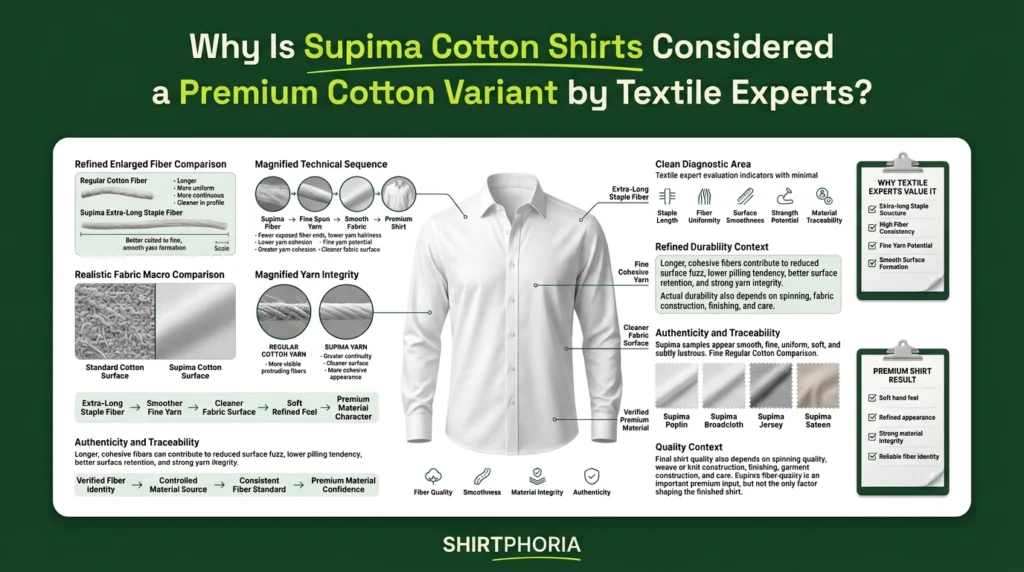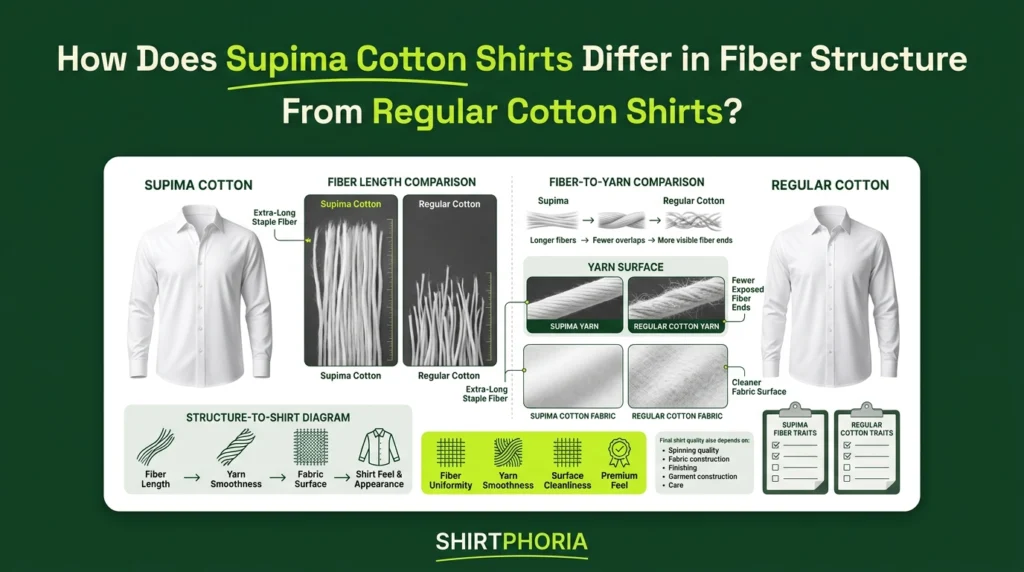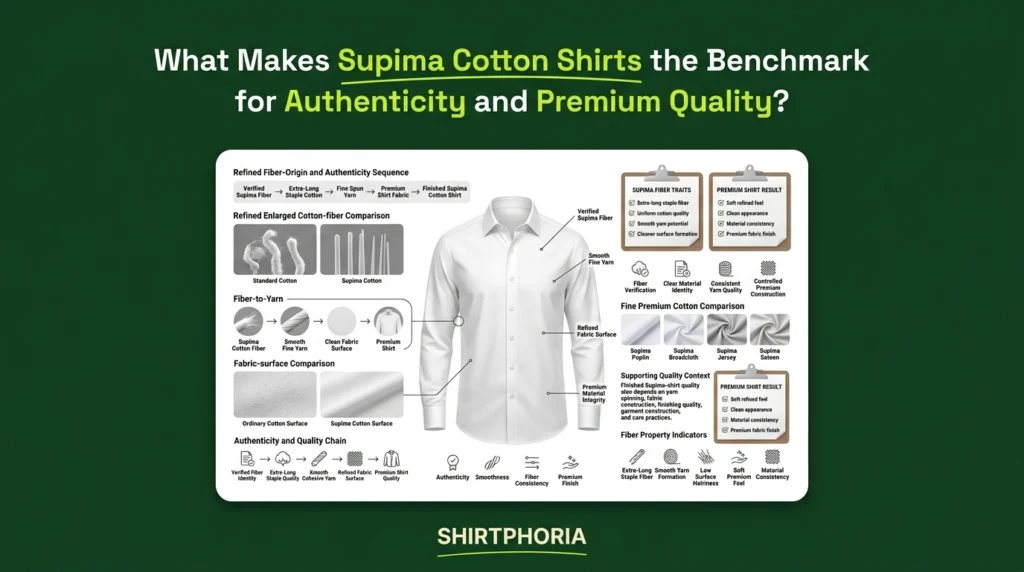
Why Does Longer Fiber Length Enhance the Lifespan of Cotton Shirts?
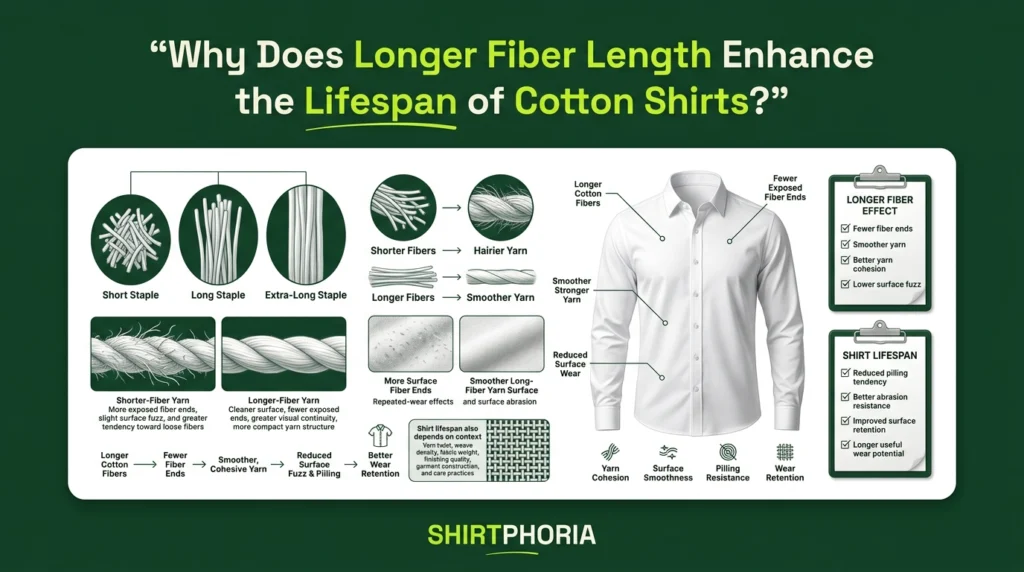
Longer cotton fibers can enhance the potential lifespan of cotton shirts because, under suitable spinning and construction conditions, they can support stronger, more even, and more cohesive yarn. Better yarn structure can reduce structural weak points, limit excessive surface hairiness, and slow some pathways of progressive material deterioration.
The important word is potential. Longer cotton fibers do not automatically create a longer-lasting shirt.
Fiber length primarily affects durability during the fiber-to-yarn stage. The yarn must then be converted into fabric, the fabric must be constructed into a garment, and the finished shirt must withstand repeated wearing, washing, drying, friction, and mechanical stress.
The basic durability pathway is:
Longer fiber → better yarn potential → greater yarn integrity → more stable fabric performance → slower accumulation of some types of wear → greater cotton-shirt lifespan potential.
Fiber strength, fiber-length uniformity, fiber fineness, yarn construction, fabric structure, finishing, garment construction, use, and care can all strengthen or weaken this advantage.
It is also important to distinguish two types of durability. Structural durability concerns material weakening, fabric thinning, yarn breakage, tearing, and eventual hole formation. Appearance or serviceability durability concerns visible deterioration such as surface fuzzing and pilling. A shirt that pills is not automatically close to structural failure.
Why Does Cotton Fiber Length Influence the Lifespan of Cotton Shirts?
Cotton fiber length influences the lifespan of cotton shirts primarily because fiber length affects the quality of yarn that can be produced, and yarn properties subsequently influence how effectively the finished fabric withstands progressive mechanical deterioration.
Cotton does not become shirt fabric directly after harvesting. Individual cotton fibers must first be cleaned, prepared, drafted, twisted, and assembled into continuous yarn. Those yarns are then woven or knitted into fabric.
That makes yarn formation the main bridge between fiber length and shirt durability.
According to CottonWorks, staple length is an important cotton property because it affects yarn strength, yarn evenness, spinning efficiency, and the range of yarns that can be produced. Length uniformity is a separate property that also influences processing and yarn performance.
How Does Cotton Fiber Length Affect Yarn Quality?
Cotton fiber length affects yarn quality because longer fibers provide more usable length for incorporation into a stable yarn structure. This can increase the potential for stronger, more even, and more cohesive yarn when the other fiber properties and spinning conditions are suitable.
Cotton is a staple fiber, meaning each individual fiber has a finite length. To create continuous yarn, large numbers of separate fibers must be held together through their arrangement, contact, friction, and twist.
A longer fiber can remain incorporated within a section of yarn for a greater distance. This can help it interact with neighboring fibers more effectively.
However, length alone does not determine the result. Fiber strength, fineness, length uniformity, yarn count, twist, spinning system, and processing quality all influence how much of the longer-fiber advantage becomes actual yarn performance.
How Does Yarn Quality Affect Cotton-Shirt Fabric Durability?
Higher-quality cotton yarn can improve shirt-fabric durability because stronger and more structurally consistent yarns provide a more stable foundation for the woven or knitted fabric network.
A cotton shirt is not made from isolated fibers. Its fabric consists of interconnected yarns. Weak or highly irregular areas within those yarns can become vulnerable points as the shirt experiences repeated bending, rubbing, stretching, washing, and drying.
Therefore:
Longer fibers → stronger and more even yarn potential → greater yarn integrity → more stable fabric-performance potential → slower accumulation of certain forms of wear.
Yarn tensile strength can be measured under standardized laboratory conditions, but yarn strength should not be treated as identical to finished-fabric strength or abrasion resistance.
Why Does Longer Fiber Length Improve Durability Potential Rather Than Guarantee Lifespan?
Longer fiber length improves the durability potential of cotton shirts rather than guaranteeing lifespan because the raw-fiber advantage must survive spinning, yarn engineering, fabric construction, garment construction, repeated wear, laundering, and care.
A shirt made from excellent long fibers can still perform poorly if it has weak seams, unsuitable yarn construction, fragile fabric architecture, damaging finishing, poor fit, or harsh care.
For this reason, there is no reliable rule such as:
“A certain staple length equals a certain number of years of shirt life.”
Fiber length is one part of a much larger durability system.
Core causal chain:
Longer fiber → better yarn potential → greater material-integrity potential → slower deterioration under suitable conditions → greater cotton-shirt lifespan potential.
Because fiber length affects shirt durability through yarn formation rather than by acting directly on the finished garment, the next step is to define exactly what cotton fiber length measures and how it differs from other cotton properties.
What Does Fiber Length Mean in Cotton Shirts?
Fiber length in cotton shirts refers to the finite length of the individual cotton staple fibers used to create yarn. This property must be distinguished from fiber strength and fiber-length uniformity.
The USDA Agricultural Marketing Service treats fiber length, length uniformity, and fiber strength as separate cotton-classification properties. This distinction is important because each property provides different information about how raw cotton may behave during textile production.
What Is Cotton Staple Length?
Cotton staple length describes the measured length of individual cotton fibers, while standardized raw-cotton classification commonly reports fiber length using Upper-Half Mean Length, or UHM.
A staple fiber is a fiber with a finite length rather than an effectively continuous filament.
Upper-Half Mean Length represents a length characteristic calculated from the longer portion of fibers in a measured cotton sample.
Commercial cotton classification relies on instrument measurements rather than simply looking at a fiber or accepting marketing terminology.
This matters for consumers because the precise UHM measurement of the original cotton normally cannot be determined by inspecting a finished shirt.
A label saying “premium cotton” therefore does not tell you the measured staple length.
How Is Cotton Fiber Length Different From Fiber Strength?
Cotton fiber length measures how long individual fibers are, while fiber strength measures their resistance to breaking under defined testing conditions.
These are different properties.
A long fiber is not automatically an exceptionally strong fiber. Similarly, a strong cotton fiber does not automatically have exceptional length.
Confusing these properties can create inaccurate durability claims.
Fiber length contributes to favorable yarn-forming conditions, while fiber strength contributes more directly to resistance against fiber breakage.
How Is Fiber Length Different From Fiber-Length Uniformity?
Fiber-length uniformity describes how consistently similar the fibers in a cotton sample are in length, whereas Upper-Half Mean Length describes a different characteristic of the sample’s fiber-length distribution.
A cotton sample can have relatively long UHM while still containing a meaningful proportion of shorter fibers.
Those shorter fibers can influence processing behavior and yarn consistency.
Good length uniformity can help fibers process more consistently, but uniformity alone does not determine how long a cotton shirt will last.
Why Must Fiber Length, Strength, and Uniformity Be Evaluated Together?
Fiber length, fiber strength, and fiber-length uniformity should be evaluated together because each provides different information about how cotton can perform during yarn formation and textile use.
- Fiber length contributes to yarn-forming potential and useful fiber overlap.
- Fiber strength contributes to resistance against fiber breakage.
- Fiber-length uniformity contributes to consistency within the fiber population and subsequent yarn.
- Yarn engineering determines how those raw-fiber properties are assembled into a usable structure.
Other factors such as fiber fineness, yarn count, twist, spinning system, and processing quality also affect final yarn performance.
| Cotton Property | What It Measures | Why It Matters to Cotton-Shirt Lifespan |
|---|---|---|
| Fiber length | Length characteristic of individual cotton staple fibers | Influences yarn-forming potential, yarn strength, evenness, and spinning behavior |
| Length uniformity | Consistency of fiber lengths within the cotton sample | Helps indicate how consistently the fiber population may process into yarn |
| Fiber strength | Resistance of cotton fibers to breaking | Helps fibers withstand processing and mechanical loading |
| Yarn construction | How fibers are assembled, twisted, plied, and spun into yarn | Determines how raw fiber properties translate into yarn durability |
| Fabric construction | How yarns are organized into cloth | Determines how yarn properties interact with fabric weight, density, and structure |
| Garment construction | How fabric is sewn, joined, and reinforced | Determines whether durable cloth becomes a durable finished shirt |
Once fiber length is separated from strength and uniformity, its specific mechanical contribution can be traced through the structure of spun cotton yarn.
How Do Longer Cotton Fibers Strengthen the Yarn Structure of Cotton Shirts?
Longer cotton fibers can strengthen the yarn structure of cotton shirts by increasing usable fiber-to-fiber overlap, reducing fiber-end frequency under otherwise comparable conditions, supporting greater yarn evenness, and improving the potential tensile integrity of spun yarn when the other fiber and spinning variables are suitable.
How Do Longer Cotton Fibers Increase Fiber-to-Fiber Contact?
Longer cotton fibers can increase useful fiber-to-fiber overlap because each fiber remains engaged with neighboring fibers across a greater portion of the yarn structure.
This increased contact can support friction and mechanical cohesion.
Yarn cohesion is the mechanical tendency of fibers to remain integrated within the yarn structure.
The fibers are not chemically fused together. Instead, their arrangement, friction, twist, and contact help them remain organized as a yarn.
Greater useful fiber overlap can therefore help stabilize the yarn when twist and spinning conditions are suitable.
Greater fiber-to-fiber overlap → supports → yarn cohesion.
Why Do Shorter Cotton Fibers Create More Fiber Ends?
Under otherwise comparable yarn-count, fiber-fineness, and spinning conditions, shorter cotton fibers can create more fiber-end occurrences along a similar length of yarn because each fiber contributes a shorter continuous segment to the yarn structure.
This does not mean shorter fibers always require a greater total number of fibers. Total fiber number also depends on fiber fineness and yarn linear density.
The important issue is the frequency of fiber ends along the yarn path.
Poorly integrated fiber ends can protrude from the yarn body, contributing to hairiness and structural irregularity. Longer fibers can provide more continuous engagement within the yarn before another fiber end is encountered.
How Can Longer Cotton Fibers Improve Yarn Evenness?
Longer cotton fibers can improve yarn evenness when length uniformity and processing quality are also favorable, reducing severe mass or structural irregularities along the yarn.
Yarn evenness describes how consistently the mass and structure of yarn are distributed along its length.
Severe thin regions can function as localized weak points because they contain less material to carry mechanical loads.
Greater consistency can help stresses spread more evenly through the yarn instead of concentrating heavily at one vulnerable point.
However, yarn evenness also depends on fiber-length uniformity, fineness, drafting quality, spinning system, yarn count, and other processing variables.
Greater yarn evenness → reduces → localized weak points.
How Does Fiber Length Influence Cotton-Yarn Tensile Integrity?
Longer fiber length can support cotton-yarn tensile integrity because well-incorporated longer fibers can remain engaged across more of the spun structure.
However, fiber strength, fineness, length uniformity, twist, yarn count, processing quality, and spinning system also influence the final tensile result.
Tensile integrity refers to the yarn’s ability to remain intact when pulled.
A staple yarn can fail through fiber slippage, fiber breakage, or a combination of both.
Long fibers can help provide greater structural engagement, but a long fiber that is weak, poorly processed, or incorrectly incorporated does not automatically produce strong yarn.
Why Does Stronger Yarn Matter to the Finished Cotton Shirt?
Stronger cotton yarn matters to shirt lifespan because woven and knitted fabrics depend partly on the integrity of their yarn network.
Progressive yarn weakening can contribute to local fabric thinning, broken yarns, and eventual hole formation.
A stronger and more consistent yarn foundation can therefore support a more stable fabric structure.
But fabric construction determines how yarn-level performance becomes cloth-level performance.
A strong yarn can still be used in a fabric that is too open, too light, or otherwise unsuitable for severe mechanical wear.
How Does Stronger Yarn Reduce the Wear That Shortens Cotton-Shirt Lifespan?
Stronger and more cohesive cotton yarn can slow some forms of wear that shorten shirt lifespan, but surface fuzzing, pilling, abrasion resistance, and structural failure remain multivariable textile outcomes rather than direct measurements of fiber length.
How Can Longer Fibers Reduce Yarn Hairiness and Early Surface Fuzzing?
Longer cotton fibers can reduce yarn hairiness under suitable spinning conditions because they can be incorporated more effectively into the yarn body, leaving fewer vulnerable fiber ends protruding from the surface.
Yarn hairiness refers to fibers or fiber ends extending away from the main yarn body.
When exposed fiber ends repeatedly rub against clothing, furniture, skin, washing equipment, or other surfaces, they can become disturbed and contribute to surface fuzz.
The basic pathway is:
Better fiber incorporation → fewer vulnerable protruding ends → potentially more stable fabric surface.
Spinning system, yarn twist, yarn count, fiber-length uniformity, and finishing also influence yarn hairiness.
This pathway primarily concerns appearance and serviceability durability, although severe long-term surface material loss can eventually contribute to structural wear.
How Can Fiber Length Influence Cotton-Shirt Pilling?
Fiber length can influence cotton-shirt pilling indirectly through yarn hairiness and surface-fiber behavior, but pilling is a multivariable fabric property rather than a direct consequence of staple length.
Pilling can develop through a process such as:
Fibers protrude → friction raises surface fuzz → loose fibers become entangled → visible pills can form.
Fiber length can influence how fibers are incorporated into the yarn, but it does not control the entire process.
Yarn twist, fabric structure, finishing, laundering, abrasion, yarn construction, and fiber strength can also influence pilling.
Long-staple cotton can therefore still pill.
Pilling mainly affects the visible appearance and serviceability of a shirt. It does not, by itself, prove that the fabric is close to structural failure.
How Can Stronger Cotton Yarn Improve Abrasion Resistance?
Greater cotton-yarn integrity can slow some abrasion-related fiber loss because a stable yarn structure may tolerate repeated rubbing before fibers loosen, fatigue, break, or detach.
Abrasion is repeated mechanical rubbing.
A shirt experiences abrasion during ordinary movement, washing, drying, and contact with other surfaces. Common high-friction areas include collars, cuffs, elbows, underarms, and other repeated contact zones.
Repeated rubbing can gradually disturb fibers and remove material from the fabric.
Stronger yarn can help slow some of this material loss, but yarn strength should not be confused with finished-fabric abrasion resistance.
Fabric weight, density, weave or knit structure, yarn construction, finishing, and the type of abrasion also affect the result.
ASTM International textile standards include separate test approaches for yarn tensile properties, fabric breaking performance, abrasion resistance, pilling, and fabric mass. This illustrates why these textile characteristics should not be treated as interchangeable measurements.
How Can Better Yarn Integrity Delay Fabric Thinning?
Better yarn integrity can delay some forms of fabric thinning because repeated wear can progressively loosen, fatigue, break, and remove material, while more stable yarn can slow the rate at which structural material is lost.
Gradual thinning is different from sudden tearing.
A fabric can slowly lose fibers over many wear and wash cycles until particular areas become visibly thinner. If the process continues, yarns may eventually fail and holes can develop.
Fiber length can influence this pathway indirectly through yarn quality, but fabric weight, density, structure, finishing, care, and wear intensity are also important.
A long-fiber shirt is not automatically a heavy shirt. Fabric weight is a separate property.
Which Shirt Failures Cannot Be Directly Prevented by Longer Fiber Length?
Longer cotton fiber length cannot directly prevent every shirt failure because weak seams, poor stitching, fit-related stress, chemical damage, and defective garment construction arise partly or entirely outside the raw fiber-length mechanism.
A seam can fail even when the surrounding cotton fabric is excellent.
Seam durability depends on factors such as sewing thread, stitch type, stitch density, seam design, seam allowance, workmanship, and stress caused by fit.
This is why fabric failure and seam failure should not be treated as the same problem.
| Cotton-Shirt Wear Sign | Relevant Fiber-Length Pathway | Other Major Variables |
|---|---|---|
| Surface fuzzing | Fiber-end exposure and yarn hairiness can influence surface instability | Finishing, friction, spinning system, twist, yarn count |
| Pilling | Surface fibers can form fuzz and entangle into pills | Fiber strength, twist, fabric structure, finishing, laundering, abrasion |
| Fabric thinning | Yarn integrity may influence progressive material loss | Fabric weight, density, structure, wear intensity, care |
| Yarn breakage | Fiber integration can influence yarn tensile integrity | Fiber strength, fineness, twist, yarn count, spinning system |
| Seam failure | Limited direct relationship to staple length | Stitching, sewing thread, seam design, fit, garment construction |
Pilling primarily describes surface or serviceability deterioration, whereas fabric thinning, yarn breakage, and hole formation more directly describe structural deterioration.
How Do Shorter and Longer Cotton Fibers Compare for Shirt Lifespan?
Under otherwise comparable fiber, yarn, fabric, and production conditions, longer cotton fibers generally provide greater potential for cohesive, even, and mechanically stable yarn than shorter fibers.
However, fiber length alone cannot determine the finished cotton shirt’s exact lifespan.
A meaningful comparison assumes that important variables such as fiber strength, fineness, length uniformity, yarn count, twist, spinning system, and fabric construction are reasonably comparable.
How Do Shorter and Longer Cotton Fibers Compare at the Yarn Level?
Shorter cotton fibers tend to create more fiber-end occurrences and greater challenges for highly cohesive and even yarn formation under comparable conditions.
Longer fibers can provide greater potential for cohesive, strong, and structurally consistent yarn.
At the yarn level, longer fibers may provide advantages in:
- usable fiber overlap,
- cohesion potential,
- yarn evenness,
- control of excessive hairiness,
- structural continuity,
- tensile integrity.
These are tendencies rather than universal outcomes.
Good spinning and yarn engineering can improve the performance of shorter fibers, while poor processing can waste much of the potential advantage of longer fibers.
How Can Shorter and Longer Cotton Fibers Differ at the Fabric Level?
Differences between shorter and longer cotton fibers can appear at the fabric level through the yarn properties they influence, including cohesion, evenness, hairiness, tensile behavior, and surface-fiber stability.
However, fabric construction controls how strongly those yarn-level differences appear in the finished cloth.
Fabric weight, density, weave or knit structure, finishing, and overall design can preserve or limit the durability advantage provided by better yarn.
There is therefore no one-to-one relationship between raw cotton fiber category and finished-shirt lifespan.
What Are the Short, Medium, Long, and Extra-Long Cotton Fiber Categories?
Cotton fibers can be classified into short, medium, long, and extra-long categories using measured Upper-Half Mean Length, but these categories describe fiber length rather than guaranteed finished-shirt durability.
Using the classification supplied in the brief:
| Fiber-Length Rating | Upper-Half Mean Length |
|---|---|
| Short | Below 0.99 in |
| Medium | 0.99 to 1.10 in |
| Long | 1.11 to 1.26 in |
| Extra Long | Above 1.26 in |
These are fiber-length ratings, not shirt-durability grades.
A shirt made from a higher fiber-length category is not automatically guaranteed to outlast every shirt made from a lower category.
Why Can Fiber Length Not Predict an Exact Cotton-Shirt Lifespan?
Fiber length cannot predict an exact cotton-shirt lifespan because service life emerges from interactions among raw fiber properties, yarn engineering, fabric construction, garment construction, wear intensity, laundering, drying, and care.
A rule such as:
“X-inch cotton fiber = Y years of shirt life”
would ignore too many independent variables.
It is better to distinguish three concepts:
Fiber classification describes a measurable raw-material characteristic.
Durability potential describes how that characteristic may contribute to material performance.
Realized service life describes what happens after manufacturing quality, garment construction, use, and care are included.
Under otherwise comparable conditions, longer cotton fibers generally provide greater potential for stronger, more even yarn, but finished-shirt durability still depends on how that fiber is processed and constructed.
When Does Longer Fiber Length Provide the Greatest Cotton-Shirt Lifespan Advantage?
Longer cotton fiber length provides its greatest lifespan advantage when it is combined with good length uniformity, adequate fiber strength, suitable yarn engineering, durable fabric construction, sound garment construction, and appropriate real-world care.
Why Does Fiber-Length Uniformity Matter Alongside Long Fiber Length?
Long fiber length provides a stronger yarn-quality advantage when the cotton also has favorable length uniformity because excessive short-fiber content can disrupt the consistency implied by a high average or Upper-Half Mean Length.
A good UHM value does not mean every fiber in the sample has the same length.
If the fiber population contains many substantially shorter fibers, yarn formation can become less consistent.
Fiber length and length uniformity should therefore be treated as related but separate cotton characteristics.
Why Must Longer Fibers Also Have Adequate Fiber Strength?
Longer cotton fibers still require adequate fiber strength because length contributes to yarn-forming structure while strength contributes to resistance against fiber breakage during processing and mechanical loading.
The distinction is simple:
Length contributes to overlap and yarn architecture.
Strength contributes to breakage resistance.
If fibers break excessively during processing, the effective fiber-length distribution entering later manufacturing stages can change.
A cotton shirt should therefore not be described as durable merely because its raw material has long fibers.
How Does Spinning Preserve the Longer-Fiber Advantage?
Spinning determines how successfully the structural potential of longer cotton fibers is converted into durable yarn because twist, yarn count, ply, spinning system, drafting, and process quality shape the final yarn architecture.
Long fibers provide potential. Spinning determines how effectively that potential is organized.
Different yarn counts, twist levels, and spinning systems can change strength, flexibility, hairiness, and other yarn characteristics.
No single spinning system is automatically best for every shirt application.
Spinning quality → converts → fiber potential into yarn performance.
How Does Fabric Construction Convert Strong Yarn Into Durable Cloth?
Fabric construction converts yarn-level strength and stability into cloth-level performance by determining how yarns are organized, supported, and exposed to stress within a woven or knitted structure.
Important variables include:
- weave or knit structure,
- yarn density,
- fabric weight,
- structural stability,
- finishing.
A strong yarn does not automatically create a highly abrasion-resistant or exceptionally strong finished fabric.
Yarn properties and fabric properties must therefore be evaluated separately.
How Do Use and Care Affect the Lifespan Advantage of Longer Cotton Fibers?
Use and care determine how much of the longer-fiber durability advantage survives in practice because harsh laundering, excessive drying stress, repeated abrasion, poor fit, and heavy wear can shorten cotton-shirt lifespan regardless of staple length.
Manufacturing creates durability potential. Actual use determines how quickly that potential is consumed.
Important real-world variables include wear frequency, repeated rubbing, washing intensity, drying conditions, fit-related strain, and other mechanical stresses.
Therefore:
Longer fiber + good uniformity + adequate strength + suitable spinning + durable fabric construction + sound garment construction + appropriate use and care → strongest probability of realizing the cotton-shirt lifespan advantage.
This is a causal durability model, not a numerical lifespan equation.
Why Does Long-Staple Cotton Not Automatically Guarantee a Longer-Lasting Cotton Shirt?
Long-staple cotton does not automatically guarantee a longer-lasting cotton shirt because staple length describes only one raw-material property.
Finished durability depends on how the fibers are spun, constructed into fabric, sewn into a garment, used, and maintained.
Why Is Long-Staple Cotton Not a Complete Quality Grade?
Long-staple cotton is not a complete quality grade because cotton performance depends on multiple independently measurable raw-material properties beyond fiber length.
Important cotton properties can include:
- fiber length,
- length uniformity,
- fiber strength,
- fineness and maturity-related characteristics,
- contamination or trash,
- color,
- processing characteristics.
Therefore, long-staple should not automatically be interpreted as best.
It provides meaningful information about fiber length, but not everything about cotton quality or finished-shirt durability.
How Can Yarn Engineering Change the Durability of Long-Staple Cotton?
Yarn engineering can strengthen or weaken the practical durability advantage of long-staple cotton because yarn count, twist, ply, spinning system, evenness, hairiness, and processing quality determine the finished yarn structure.
Excellent raw cotton can be poorly processed.
Conversely, careful yarn engineering can make effective use of available fiber properties.
The final yarn should therefore be evaluated as a manufactured structure rather than assuming its performance from a raw-cotton marketing label.
How Can Fabric Construction Change the Lifespan of Long-Staple Cotton?
Fabric construction can reduce or strengthen the practical advantage of long-staple cotton because fabric weight, density, weave or knit structure, finishing, and structural design influence how the cloth responds to repeated wear.
A fine lightweight fabric may use excellent long fibers but still be designed for lightness, drape, comfort, or refinement rather than severe abrasion.
That does not make the fabric low quality. It reflects a different design objective.
Similarly, a heavier fabric is not automatically better. Durability should be judged relative to intended use.
How Do Garment Construction and Real-World Use Affect Cotton-Shirt Lifespan?
Garment construction and real-world use affect cotton-shirt lifespan independently of staple length because seam quality, stitching, fit-related stress, wear frequency, washing, drying, and abrasion determine how the finished shirt is stressed.
Excellent fabric cannot fully compensate for poorly sewn seams or weak button attachment.
Material quality and garment assembly quality should therefore be evaluated separately.
How Should Fiber Length Be Used as a Durability Signal?
Fiber length should be used as one durability signal inside a complete performance system rather than as a standalone buying verdict.
A useful decision framework is:
- Fiber length increases yarn-quality and durability potential.
- Fiber and yarn engineering determine how much of that potential becomes yarn performance.
- Fabric construction determines how yarn performance becomes material performance.
- Garment construction, use, and care determine how much of that material performance becomes realized shirt lifespan.
In simple terms:
Fiber quality → yarn engineering → fabric construction → garment construction → use and care → realized cotton-shirt lifespan.
How Can You Evaluate Fiber Length When Choosing a Cotton Shirt for Longevity?
Fiber length is most useful when choosing a cotton shirt for longevity as one evidence-based durability signal evaluated alongside yarn quality, fabric construction, garment workmanship, intended use, and care requirements.
Consumers should also distinguish what can reasonably be screened from a finished shirt from what requires laboratory measurement.
You normally cannot visually determine exact microscopic staple length, yarn tensile strength, standardized pilling performance, or laboratory abrasion resistance simply by looking at a shirt.
What Fiber-Length Claims Are Meaningful When Buying Cotton Shirts?
Specific and credible fiber-length information is more useful than vague marketing language because terms such as “premium cotton” or “luxury cotton” do not by themselves identify a measured staple length.
Terms such as long-staple cotton or extra-long-staple cotton can provide useful information when the claim is specific and credible.
By comparison, descriptions such as:
- premium cotton,
- luxury cotton,
- high-quality cotton,
provide little technical information about fiber length on their own.
Even a credible long-fiber designation remains a raw-material signal. It does not prove that the yarn, fabric, seams, or finished garment were well engineered.
How Should Yarn and Fabric Quality Be Evaluated Alongside Fiber Length?
Yarn and fabric quality should be evaluated alongside fiber length because the finished cloth can provide useful visible evidence of construction consistency even though it cannot reveal microscopic staple length.
When screening a shirt, check whether:
- the fabric appears reasonably consistent,
- there are obvious loose or unusually thin areas,
- structural irregularity appears excessive where it is not an intentional design effect,
- the fabric weight and structure suit the intended use,
- the overall construction appears suitable for the expected wear intensity.
Visual inspection is a screening method, not laboratory verification.
A smooth-looking fabric does not prove that the cotton has long staple length, and visible inspection cannot establish precise microscopic fiber length.
Why Should Garment Construction Be Inspected at Stress Points?
Garment construction should be inspected at high-stress points because excellent cotton fiber cannot fully compensate for weak stitching, poor seam construction, or structural defects in the finished shirt.
Inspect areas such as:
- collar attachment,
- cuffs,
- armholes,
- side seams,
- sleeve seams,
- button attachment,
- buttonholes,
- other high-stress zones.
If these areas are poorly assembled, they may fail before the fabric has exhausted its material durability.
How Should Intended Use Affect Cotton-Shirt Durability Expectations?
Intended use should shape cotton-shirt durability expectations because frequent high-friction wear places different demands on fabric weight and construction than occasional dress wear.
A daily work shirt may face repeated washing, rubbing, bending, and contact with other surfaces.
A lightweight dress shirt may instead prioritize comfort, drape, breathability, and refinement.
Neither design is automatically better.
The useful question is whether the fabric and garment construction match the intended type and intensity of use.
Why Should You Avoid Choosing a Cotton Shirt From Fiber Name Alone?
A cotton shirt should not be selected for longevity from fiber name alone because cotton species, marketing terminology, staple length, yarn engineering, fabric quality, and garment construction are related but non-equivalent indicators.
A practical way to interpret the available evidence is:
Strong durability evidence: Specific or credible fiber information is supported by suitable fabric and garment construction for the intended use.
Partial durability evidence: Some useful durability signals are present, but important information about material or construction remains unknown.
Marketing-only evidence: The durability claim relies mainly on broad terms such as “premium cotton” without enough material or construction evidence.
Construction-limited durability: The raw-material claim may be credible, but visible fabric or garment construction presents an important limiting factor.
These are consumer evidence categories, not laboratory quality grades.
What Are the Key Takeaways About Fiber Length and Cotton-Shirt Lifespan?
The key takeaway is that longer cotton fibers can increase cotton-shirt lifespan potential by supporting stronger, more even, and more cohesive yarn, but the final durability advantage depends on how the fiber is spun, constructed into fabric, sewn into a garment, used, and cared for.
The Most Important Facts About Cotton Fiber Length and Lifespan
☐ Longer cotton fibers can increase durability potential: Longer fibers can support stronger, more even, and more cohesive yarn under suitable fiber and spinning conditions.
☐ The causal pathway operates through yarn and fabric: Fiber length influences yarn structure, which then interacts with fabric construction to influence durability and certain wear pathways.
☐ Greater yarn integrity can slow some wear pathways: More stable yarn can help limit excessive surface hairiness and may slow some forms of progressive material loss, but finished-fabric wear remains multivariable.
☐ Pilling and structural failure are not the same: Pilling primarily affects appearance and serviceability and does not by itself prove that the fabric is close to structural failure.
☐ Abrasion resistance is a finished-fabric property: Yarn integrity can influence abrasion-related material loss, but fabric construction, finishing, and use conditions also matter.
☐ Fiber length and fiber strength are separate properties: Longer fibers are not automatically stronger fibers.
☐ Fiber-length uniformity also matters: A favorable Upper-Half Mean Length does not mean every fiber in the sample has the same length.
☐ Longer staple length does not guarantee longer shirt life: Finished durability still depends on fiber quality, yarn engineering, fabric construction, garment construction, use, and care.
☐ Fiber length should be treated as one durability signal: It is an important input inside a larger cotton-shirt performance system, not a standalone lifespan score.
How Is Cotton-Shirt Lifespan Different From Other Fiber-Length Outcomes?
Cotton fiber length can influence outcomes beyond durability, including yarn hairiness, surface appearance, and tactile characteristics, but those effects represent a separate question from cotton-shirt lifespan.
Some of the same mechanisms discussed here, particularly fiber incorporation, yarn evenness, and surface hairiness, can also influence how a cotton shirt looks and feels.
Those effects should not be confused with structural lifespan.
How Does Fiber Length Affect the Smooth Texture of Cotton Shirts?
The same fiber-length characteristics that influence cotton-yarn structure can also affect the smooth texture and aesthetic feel of cotton shirts, but that relationship requires a separate analysis.
For the related surface mechanism, see fiber length and cotton texture.
Cotton-Shirt Longevity Checklist
Frequently Asked Questions
No. Longer fibers improve durability potential by supporting stronger, more even, and more cohesive yarn, but final lifespan also depends on fiber strength, uniformity, yarn engineering, fabric construction, garment construction, use, and care.
Fiber length mainly affects durability during the fiber-to-yarn stage. Longer fibers can provide more useful overlap and better incorporation within spun yarn, which can support yarn cohesion, evenness, and tensile integrity.
No. Fiber length measures how long individual staple fibers are. Fiber strength measures resistance to breaking. They are separate properties and both can influence textile performance.
No. Fiber length can influence pilling indirectly through yarn hairiness and surface-fiber behavior, but pilling also depends on twist, fabric structure, finishing, laundering, abrasion, yarn construction, and fiber strength.
No. There is no reliable rule that converts a staple-length measurement into a fixed number of years. Realized service life depends on manufacturing quality, construction, wear intensity, laundering, drying, and care.
Treat fiber length as one durability signal. Also inspect fabric consistency, suitable weight and structure, seams and stress points, intended use, credible material claims, and whether the recommended care routine is realistic for you.
Terms Explained
| TERM | DEFINITION |
|---|---|
| Staple fiber | A fiber with a finite length rather than an effectively continuous filament. |
| Upper-Half Mean Length (UHM) | A standardized cotton length characteristic calculated from the longer portion of fibers in a measured sample. |
| Fiber strength | The resistance of cotton fibers to breaking under defined testing conditions. |
| Length uniformity | The degree to which fiber lengths within a cotton sample are consistently similar. |
| Yarn cohesion | The mechanical tendency of fibers to remain integrated within a yarn through arrangement, friction, twist, and contact. |
| Yarn evenness | How consistently yarn mass and structure are distributed along its length. |
| Yarn hairiness | Fibers or fiber ends that extend away from the main yarn body. |
| Abrasion | Repeated mechanical rubbing that can disturb fibers and gradually remove material from fabric. |
| Structural durability | Resistance to material weakening, thinning, yarn breakage, tearing, and eventual hole formation. |
| Serviceability durability | Resistance to visible deterioration that affects appearance or usefulness, such as surface fuzzing and pilling. |
Conclusion
In conclusion, longer cotton fibers can enhance cotton-shirt lifespan primarily by providing better raw material for producing strong, even, and cohesive yarn, which can help the finished fabric preserve its structural integrity through repeated wear when downstream construction and use conditions are suitable.
The complete relationship is:
Longer fiber → improved yarn potential → stronger material-integrity potential → slower accumulation of some wear pathways → greater cotton-shirt lifespan potential.
Longer staple length therefore increases durability potential, not guaranteed service life.
Fiber length works together with fiber-length uniformity, fiber strength, fineness, yarn engineering, fabric construction, garment quality, intended use, and care.
Surface deterioration should also be separated from structural deterioration. Fuzzing and pilling can make a shirt look older without necessarily showing that its fabric is close to structural failure. Fabric thinning, yarn breakage, tearing, and hole formation provide more direct evidence of structural deterioration.
The most reliable durability assessment therefore looks at the complete shirt-performance system rather than a fiber-length label alone.
The useful question is not simply whether a cotton shirt contains long fibers, but whether the shirt’s fiber quality, yarn engineering, fabric construction, garment construction, intended use, and care conditions preserve the durability advantage those longer fibers can provide.