What Role Does Fiber Length Play in the Smooth Texture of Cotton Shirts?
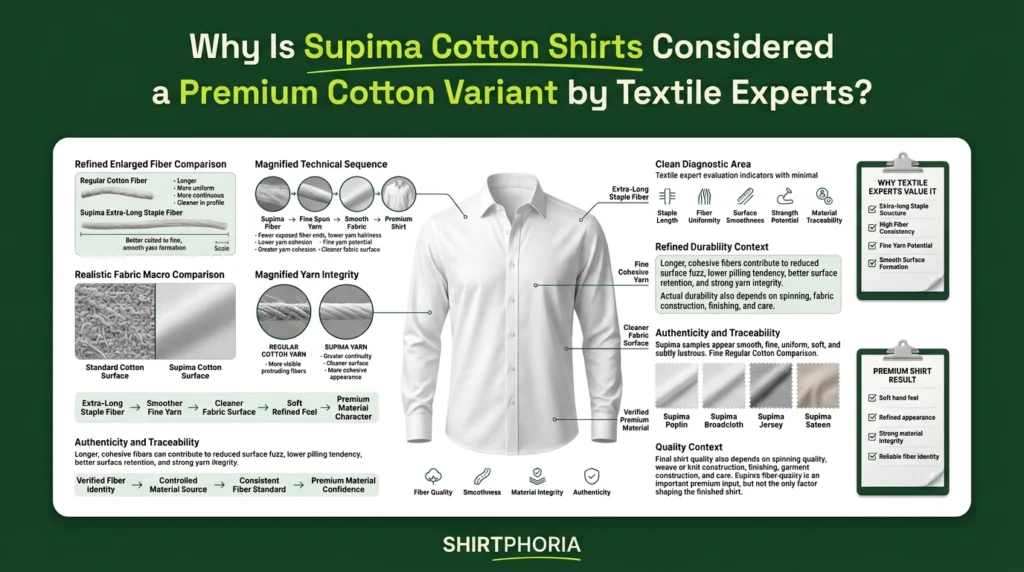
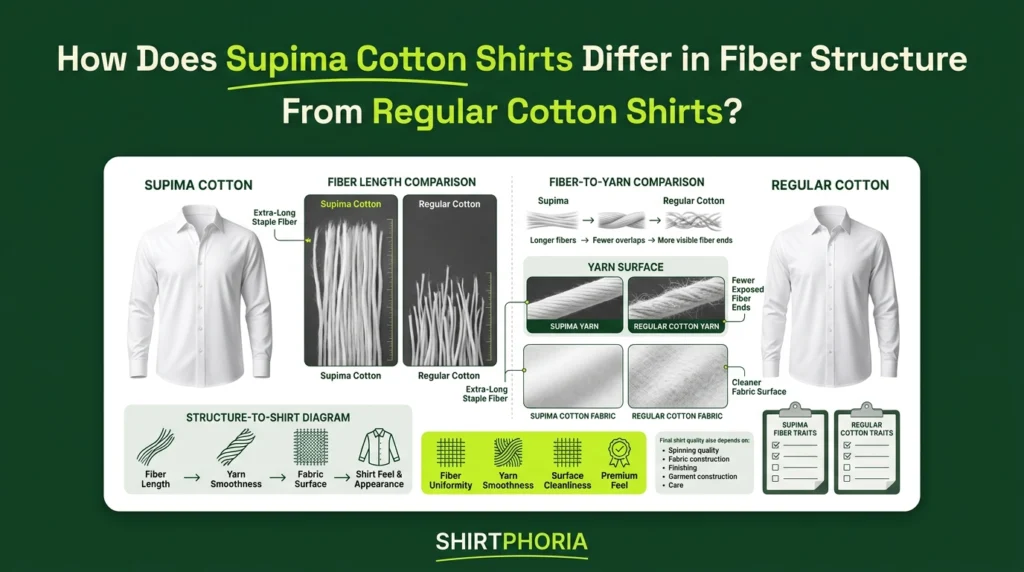
Longer cotton fibers can contribute to smoother cotton shirts because, under suitable fiber and spinning conditions, they can support more regular yarn formation and lower disruptive surface hairiness. This gives the finished fabric greater potential to develop a clean, regular surface when fabric construction and finishing preserve that advantage.
The relationship is indirect.
Cotton fiber length is an upstream raw-material property. The fibers must first be converted into yarn, the yarn must become fabric, and the fabric may then be finished, washed, worn, and altered by friction before the wearer experiences its final texture.
The main pathway is:
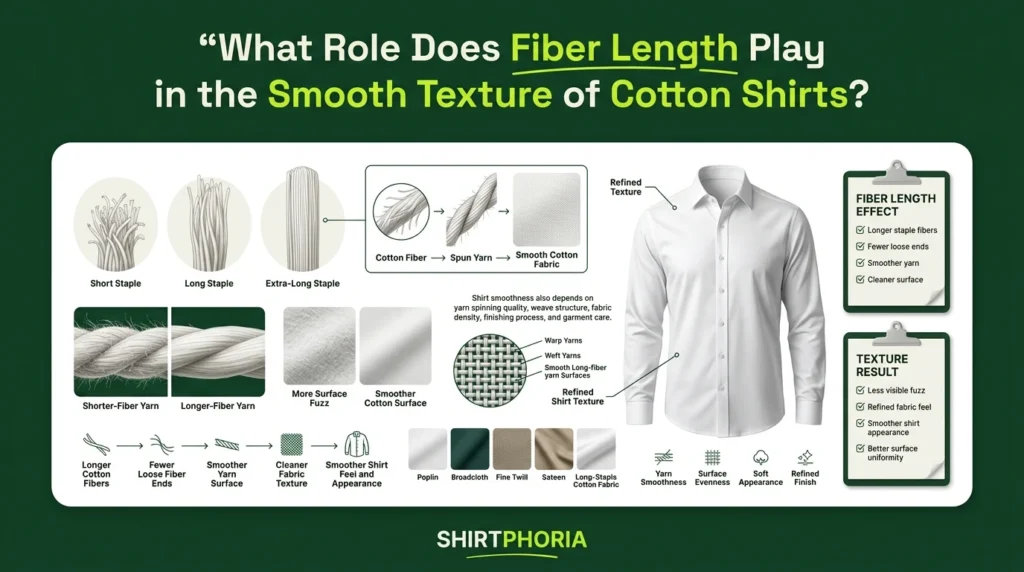
Fiber length → yarn formation and regularity → yarn hairiness → fabric-surface behavior → perceived smoothness.
Longer fibers therefore increase smoothness potential, not guaranteed smoothness.
Smoothness should also not be confused with softness. Smoothness mainly concerns surface regularity and the absence of disruptive surface features. Softness is a broader tactile response involving flexibility, compression, yielding behavior, finishing, and other characteristics.
Fiber fineness, fiber-length uniformity, spinning system, yarn twist, yarn count, fabric construction, finishing, laundering, and wear can all change how much of the fiber-length advantage is ultimately felt.
Why Does Fiber Length Influence the Smooth Texture of Cotton Shirts?
Cotton fiber length influences shirt smoothness indirectly because longer fibers can support more regular yarn formation and, under suitable spinning conditions, lower disruptive yarn hairiness, creating greater potential for a cleaner finished fabric surface.
Cotton fibers cannot become shirt fabric without first becoming yarn. That makes yarn formation the main bridge between raw fiber length and finished surface texture.
The high-level sequence is:
Longer fibers → greater yarn-quality potential → greater yarn regularity and potentially lower disruptive hairiness → cleaner fabric surface → greater perceived smoothness potential.
CottonWorks identifies staple length as an important cotton property affecting yarn strength, evenness, spinning efficiency, and the fineness of yarn that can be produced.
Fiber length also influences yarn hairiness, but it does not act alone. Barella and Manich found that fiber length and length uniformity were particularly influential fiber properties in the cotton yarns they studied, while spinning process and yarn linear density also affected hairiness.
This distinction matters because evidence that fiber length affects yarn behavior does not mean fiber length alone determines how a finished shirt feels.
How Does Cotton Fiber Length Affect Yarn Quality?
Cotton fiber length affects yarn-quality potential because longer staple length supports yarn strength, yarn evenness, spinning efficiency, and the production of finer yarns when the remaining fiber and spinning conditions are suitable.
Cotton is naturally a staple fiber. Each individual fiber has a finite length and must be assembled with many other fibers to create continuous yarn.
Longer staple length gives the spinning process greater fiber length to control and organize within the yarn structure.
This can support:
- yarn evenness,
- yarn strength,
- spinning efficiency,
- finer-yarn production.
However, none of these outcomes depends on length alone.
Fiber fineness, strength, length uniformity, spinning system, yarn count, yarn linear density, twist, and processing quality also influence final yarn quality.
Longer cotton fibers → support → greater yarn-quality potential.
How Does Yarn Quality Affect Cotton-Shirt Surface Smoothness?
More regular cotton yarn can contribute to a cleaner shirt surface because greater yarn evenness and controlled surface hairiness provide a more consistent foundation for woven or knitted fabric.
Yarn evenness describes how consistently yarn mass and structure are distributed along its length.
More regular yarn can help create a more consistent fabric structure. Severe yarn irregularities may instead contribute to uneven visual or physical surface character.
Yarn hairiness represents a different characteristic. It concerns fibers or loops projecting outward from the yarn body.
These two properties should not be treated as identical.
A yarn can have good evenness while still having a particular level of hairiness, and finished fabric smoothness depends on more than either variable.
Weave or knit structure, yarn exposure, finishing, surface friction, geometric roughness, compression, and other tactile characteristics also influence the final result.
Greater yarn regularity → supports → cleaner fabric-surface potential.
Why Does Fiber Length Increase Smoothness Potential Rather Than Guarantee Softness?
Fiber length increases smoothness potential rather than guaranteeing softness because smoothness and softness describe different tactile characteristics.
Smoothness describes perceived surface regularity and the relative absence of disruptive surface features.
Softness describes a broader tactile response that can involve flexibility, compression, yielding behavior, surface treatment, and other characteristics.
A fabric can be smooth but relatively firm.
Another fabric can feel soft while having a raised or deliberately textured surface.
Surface friction and geometric roughness can provide objective information about textile-surface behavior, but neither represents a universal cotton-shirt smoothness score.
The core texture chain is:
Longer fiber → improved yarn-quality potential → greater yarn regularity and potentially lower disruptive hairiness → cleaner fabric-surface potential → greater cotton-shirt smoothness potential.
What Does Cotton Fiber Length Mean When Evaluating Shirt Texture?
Cotton fiber length describes the finite length of individual cotton staple fibers, but this raw-fiber measurement should not be confused with fiber fineness, length uniformity, yarn hairiness, surface roughness, or finished cotton-shirt smoothness.
The USDA Agricultural Marketing Service classifies fiber length, length uniformity, fiber strength, and micronaire as separate instrumentally measured cotton properties.
Each characteristic provides different information about the raw cotton.
What Is Cotton Staple Length?
Cotton staple length describes fiber length, while modern instrument-based cotton classification commonly reports it as Upper-Half Mean Length, or UHM.
Cotton is a staple fiber because its individual fibers have finite lengths rather than continuing indefinitely like manufactured filaments.
Upper-Half Mean Length represents the average length characteristic of the longer half of the measured fiber distribution.
This is a raw-cotton property measured with specialized instruments.
It is not a direct measurement of finished-shirt smoothness.
A consumer normally cannot touch a finished shirt and determine its exact UHM value because yarn engineering, fabric construction, finishing, washing, and wear all influence what the hand ultimately feels.
How Is Fiber Length Different From Fiber Fineness?
Fiber length describes how long cotton fibers are, while fiber fineness describes their relative linear density or fineness.
These are different characteristics.
Long fibers are not automatically fine fibers, and fine fibers are not automatically long.
Both properties can influence yarn production, but through different mechanisms.
Fiber fineness can affect how many fibers are present within a yarn cross-section at a given yarn size. Fiber length influences yarn-forming capability and the range of yarn structures that can be produced successfully.
Micronaire also needs careful interpretation. It is influenced by both fiber fineness and maturity and should not be treated as a pure measurement of fineness alone.
Fiber length → describes → fiber length dimension.
Fiber fineness → describes → relative fiber linear density.
How Is Fiber Length Different From Length Uniformity?
Fiber-length uniformity describes the consistency of the fiber-length distribution, whereas Upper-Half Mean Length describes the length characteristic of the longer portion of the measured fiber population.
Cotton naturally contains fibers of different lengths.
A favorable UHM therefore does not mean every individual fiber is equally long.
It also does not mean short fibers are completely absent.
Length uniformity influences yarn evenness, yarn strength, spinning efficiency, and the behavior associated with short-fiber content.
Fiber length and length uniformity should therefore be evaluated as related but separate properties.
Why Do Raw Fiber Properties Not Directly Equal Finished Cotton-Shirt Texture?
Raw fiber properties do not directly equal finished cotton-shirt texture because cotton must pass through several production stages before the wearer touches the final fabric.
Those stages include:
- spinning,
- yarn formation,
- weaving or knitting,
- finishing,
- laundering,
- wear.
Each stage can preserve, amplify, reduce, or mask an upstream fiber-related advantage.
Yarn hairiness, for example, is a yarn-level property.
Surface friction and geometric roughness are finished-textile surface properties.
Perceived smoothness is the sensory result produced by several interacting characteristics.
Finished texture is therefore a textile-system outcome, not a direct raw-fiber measurement.
| Property | What It Describes | Connection to Cotton-Shirt Texture |
|---|---|---|
| Fiber length | Length characteristic of cotton staple fibers | Influences yarn strength, evenness, spinning efficiency, and fine-yarn potential |
| Length uniformity | Consistency of fiber lengths within the sample | Influences yarn evenness, processing efficiency, and short-fiber-related behavior |
| Fiber fineness | Relative linear density or fineness of fibers | Influences yarn cross-section and refinement potential |
| Yarn hairiness | Fibers or loops projecting from the yarn body | Influences surface fuzziness and cleanliness |
| Surface friction | Resistance or drag at the textile surface | Provides one objective surface-property input relevant to tactile perception |
| Geometric surface roughness | Geometric variation in the textile surface | Provides objective information about physical surface irregularity |
| Fabric construction | Arrangement and exposure of yarns within cloth | Determines how yarn properties are presented at the surface |
| Finishing | Treatments that modify textile appearance or hand | Can amplify, reduce, or mask underlying yarn-surface characteristics |
How Do Longer Cotton Fibers Improve Yarn Formation for Smooth Shirts?
Longer cotton fibers can improve the yarn-forming potential used in smooth shirting by supporting yarn evenness, strength, spinning efficiency, and finer-yarn production when complementary fiber properties and spinning conditions are suitable.
These advantages begin during yarn formation, not when the finished fabric touches the skin.
How Do Longer Cotton Fibers Increase Useful Fiber Overlap?
Longer cotton fibers can support stable yarn formation because greater staple length gives the spinning process more fiber length to control and incorporate within the yarn structure.
Fiber overlap is useful as a mechanical explanation, but it should not be treated as a standardized measurement of smoothness.
Longer fibers provide greater continuous length that can be controlled during spinning.
Twist, fiber fineness, length distribution, drafting, and spinning architecture then determine how effectively those fibers become integrated into the finished yarn.
The fibers are not chemically fused together.
Their mechanical arrangement, friction, twist, and interaction help form the yarn structure.
Longer staple length → supports → stable yarn-formation potential.
Why Do Shorter Fibers Create More Fiber Segments and Ends?
Under otherwise comparable fiber-fineness, yarn-linear-density, and spinning conditions, shorter-fiber populations can create more opportunities for fiber ends to occur or project along a given length of yarn because each fiber contributes a shorter continuous segment.
This does not mean that shorter fibers universally require a greater total number of fibers.
The number of fibers in yarn also depends on:
- fiber fineness,
- yarn linear density,
- yarn cross-sectional structure.
The safer comparison concerns opportunities for fiber-end occurrence and projection.
Not every fiber end becomes visible hairiness.
However, a greater frequency of poorly controlled or projecting fiber ends can contribute to a fuzzier yarn surface.
Fiber length therefore influences hairiness potential without acting as its only cause.
How Can Longer Cotton Fibers Support Greater Yarn Evenness?
Longer cotton fibers can support greater yarn evenness when length uniformity and processing conditions are also favorable.
Yarn evenness describes consistency in yarn mass and structure along its length.
Severe variations can create irregular areas in the yarn and later influence the visual or physical regularity of the fabric.
Longer staple length can contribute to favorable yarn-forming conditions, but yarn evenness also depends on fiber uniformity, fineness, drafting, spinning system, yarn count, and process quality.
Long staple length alone cannot guarantee even yarn.
Greater yarn evenness → supports → more regular fabric foundation.
How Can Longer Fibers Support Fine-Yarn Spinning?
Longer cotton fibers can support finer-yarn production because fiber length influences the fineness of yarn that can be successfully spun.
However, the practical limit also depends on:
- fiber fineness,
- fiber strength,
- length uniformity,
- spinning system,
- process control.
Fine yarn can create opportunities for refined shirting fabrics, but finer does not automatically mean smoother.
It also does not automatically mean softer or higher quality.
The correct relationship is:
Fiber length contributes to yarn-forming capability; yarn engineering determines how that capability becomes the final yarn.
How Do Yarn Evenness and Hairiness Translate Into a Smoother Cotton-Shirt Surface?
Yarn evenness and hairiness can influence cotton-shirt surface character because regular yarn with controlled disruptive projections provides a cleaner surface foundation.
However, perceived smoothness also depends on fabric construction, surface friction, geometric roughness, compression, finishing, and contact conditions.
The texture pathway remains:
Fiber properties → yarn regularity and hairiness → fabric surface → perceived smoothness.
Each step matters.
What Is Yarn Hairiness?
Yarn hairiness describes fiber ends or loops that project outward from the main body of spun yarn.
Spun cotton yarn is not microscopically perfectly smooth.
Some fibers or loops can extend away from the central yarn structure.
The degree of these projections affects the surface character of the yarn.
Hairiness is an intermediary yarn property. It is not itself a finished-shirt smoothness measurement.
A certain level of hairiness is also not automatically a defect. Yarn type, fabric design, spinning system, and intended surface effect all matter.
How Can Fiber Length Influence Protruding Fiber Ends?
Fiber length can influence yarn hairiness under controlled conditions because shorter-fiber populations provide more opportunities for fiber ends and incomplete incorporation, while longer fibers can support more stable yarn formation.
Barella and Manich’s 1988 work on cotton-yarn hairiness found that fiber length and length uniformity were particularly influential fiber properties among the ring-spun and rotor-spun yarns examined.
However, fiber properties explained only part of the total hairiness behavior.
Spinning process and yarn linear density also materially affected the result.
This means the correct interpretation is:
Fiber length and uniformity → influence → yarn-hairiness potential.
It does not mean:
Long fibers = no protruding fibers.
How Does Lower Yarn Hairiness Affect Tactile Smoothness?
Lower disruptive yarn hairiness can contribute to a cleaner, less fuzzy fabric surface, but perceived tactile smoothness also depends on several downstream properties.
Fewer disruptive projections can reduce fuzzy surface character.
However, a cleaner-looking yarn surface does not automatically create a particular tactile sensation.
The NC State Kawabata Evaluation System illustrates why fabric-surface behavior needs more than one measurement.
The KES-FB4 Surface Tester evaluates properties including:
- MIU: coefficient of surface friction,
- SMD: geometric surface roughness.
Surface friction describes resistance or drag at the fabric surface.
Geometric roughness describes physical variation in the surface profile.
These measurements provide objective information about fabric surfaces, but they do not combine into one universal cotton-shirt smoothness score.
Lower disruptive hairiness → can support → cleaner surface character.
How Does Yarn Evenness Affect Visual Surface Refinement?
Greater yarn evenness can improve visual surface regularity because consistent yarn mass and structure provide a more uniform foundation for the finished fabric.
Severe thick and thin variations in yarn can become visible in some fabrics.
More consistent yarn can therefore support a cleaner visual surface when the weave, knit, finishing, and other production variables are suitable.
Visual regularity and tactile smoothness should still be kept separate.
A surface that looks highly regular does not necessarily produce exactly the same sensation when touched.
How Can Surface Stability Influence Cotton-Shirt Pilling?
Greater surface stability can reduce some conditions that encourage pilling because loose or projecting fibers can be raised by friction and become entangled.
A simplified pathway is:
Surface fibers project or loosen → friction creates fuzz → loose fibers may entangle → pills can form.
Pilling remains a multivariable surface phenomenon.
It can also depend on:
- fiber properties,
- fiber strength,
- yarn twist,
- spinning system,
- fabric construction,
- finishing,
- abrasion,
- laundering.
Long-staple cotton can still pill.
Pilling is also not a direct measurement of staple length.
Why Can Two Long-Staple Cotton Shirts Still Feel Different?
Two long-staple cotton shirts can feel noticeably different because staple length is only one upstream variable.
Other important factors include:
- fiber fineness,
- length uniformity,
- spinning system,
- yarn linear density,
- yarn count,
- yarn twist,
- fabric construction,
- finishing,
- wear and laundering condition.
One long-staple shirt could use a dense smooth construction.
Another could use a textured weave, different twist, different finish, or different yarn size.
Both can legitimately contain long fibers while producing noticeably different tactile surfaces.
The complete mechanism is:
Longer fiber → greater yarn-quality potential → yarn regularity + potentially lower disruptive hairiness → cleaner fabric-surface potential → greater perceived smoothness potential.
How Do Shorter and Longer Cotton Fibers Compare for Shirt Texture?
Under otherwise comparable fiber, yarn, spinning, fabric, and finishing conditions, longer cotton fibers generally provide greater potential for regular yarn and lower disruptive hairiness.
Shorter-fiber populations can provide more opportunities for fiber-end-related surface irregularity.
For a fair comparison, important variables such as fiber fineness, length uniformity, yarn linear density, twist, spinning system, fabric construction, and finishing should remain reasonably comparable.
| Texture Attribute | Shorter-Fiber Tendency | Longer-Fiber Tendency |
|---|---|---|
| Fiber-end opportunities along comparable yarn length | Potentially greater under controlled conditions | Potentially lower under controlled conditions |
| Yarn regularity | More difficult to optimize in some conditions | Greater regularity potential |
| Yarn hairiness | Greater potential under otherwise comparable conditions | Lower potential under otherwise comparable conditions |
| Fine-yarn spinning | More constrained by fiber length | Greater potential where other properties support it |
| Surface fuzziness | Potentially greater | Potentially lower |
| Fabric-surface regularity | May require greater processing or finishing control | Greater regularity potential |
| Smooth tactile surface | Cannot be predicted from fiber length alone | Greater potential, not guaranteed |
Why Does This Comparison Describe Tendencies Rather Than Guarantees?
The shorter-versus-longer fiber comparison describes tendencies rather than guarantees because textile engineering can strengthen, reduce, or override the expected difference.
A shorter-fiber cotton fabric can still develop a smooth surface through effective spinning, yarn design, fabric construction, and finishing.
A longer-fiber cotton fabric can deliberately be designed with a textured surface.
Fiber length should therefore not be used as a universal quality ranking.
The comparison only becomes meaningful when the other major variables are reasonably comparable.
Why Can Fiber Classification Not Predict Exact Finished-Shirt Texture?
Fiber-length classification cannot predict exact finished-shirt texture because raw-fiber measurements describe an upstream material property rather than the final textile system experienced by the wearer.
Four different levels should be separated:
Raw-fiber measurement: Staple length and Upper-Half Mean Length.
Yarn properties: Evenness, hairiness, yarn count, and yarn-surface structure.
Finished surface properties: Friction, geometric roughness, construction, and finishing.
Perceived outcome: What the wearer actually sees and feels.
A UHM value therefore cannot directly predict a finished surface-friction value, roughness measurement, or exact tactile response.
Under otherwise comparable conditions, longer cotton fibers generally provide greater potential for regular yarn and controlled disruptive hairiness, but finished-shirt smoothness still depends on the complete textile-production system.
When Does Longer Fiber Length Make the Biggest Difference to Cotton-Shirt Smoothness?
Longer cotton fiber length makes the biggest difference to shirt smoothness when it is combined with favorable length uniformity, suitable fiber fineness, controlled spinning, appropriate fabric construction, compatible finishing, and reasonable wear and care.
The raw fiber creates potential.
The later production stages determine how much of that potential survives.
Why Does Fiber-Length Uniformity Matter Alongside Longer Fiber Length?
Longer cotton fibers provide a stronger yarn-quality advantage when the fiber population also has favorable length uniformity.
A high Upper-Half Mean Length does not mean all fibers in the sample have the same length.
Shorter fibers and length variation can still be present.
Length uniformity affects yarn evenness, yarn strength, spinning efficiency, and short-fiber-related behavior.
Therefore, two cotton samples with similar UHM values can still behave differently if their length distributions differ substantially.
Why Does Fiber Fineness Matter Alongside Staple Length?
Fiber fineness matters alongside staple length because it influences the structure of the yarn cross-section and the opportunities available to textile engineers.
At a given yarn size, finer fibers can allow more fibers to be present within the yarn cross-section.
However, that fact does not automatically make the resulting fabric smooth or soft.
Fiber fineness, staple length, and fiber maturity must remain separate concepts.
Micronaire also reflects the combined effects of fineness and maturity rather than acting as a pure fineness measurement.
How Does Spinning Preserve the Longer-Fiber Smoothness Advantage?
Spinning determines how much of the longer-fiber advantage becomes controlled yarn regularity and hairiness.
Important variables include:
- spinning system,
- yarn linear density,
- yarn count,
- twist,
- drafting,
- process control.
Barella and Manich’s yarn-hairiness work illustrates the importance of both fiber properties and manufacturing variables.
Fiber length and length uniformity mattered, but spinning process and yarn linear density also influenced hairiness.
Therefore:
Controlled spinning → converts → fiber potential into yarn-surface performance.
No single spinning system should automatically be considered best for every smooth cotton shirt.
How Does Fabric Construction Affect the Surface Created by Refined Yarn?
Fabric construction affects how refined yarn feels because weave or knit geometry, yarn density, yarn exposure, and structural arrangement determine how the surface interacts with the hand and skin.
Similar yarns can feel different when used in different fabric structures.
One construction may expose more yarn surface.
Another may create more pronounced intersections, ribs, loops, or other texture.
Surface friction and geometric roughness therefore emerge from the finished textile system rather than from staple length alone.
How Can Finishing Alter the Smoothness Created by Fiber Length?
Finishing can substantially alter perceived smoothness because treatments applied after yarn and fabric formation can modify the textile surface.
For example:
Calendaring can flatten and polish the fabric surface.
Mercerization changes cotton morphology and can influence surface appearance and luster.
Cellulase enzyme treatments can remove exposed cotton surface fibers and create a cleaner appearance.
Sanding or sueding can create a softer but more textured surface.
Brushing or napping raises or alters surface fibers rather than automatically producing a flatter surface.
This creates an important consumer boundary.
A strongly finished shorter-fiber fabric may initially feel smoother than a minimally finished longer-fiber fabric.
Touch alone therefore cannot identify staple length.
How Do Wear and Laundering Change Cotton-Shirt Smoothness Over Time?
Wear and laundering can change cotton-shirt smoothness because friction, washing, drying, pilling, surface-fiber movement, and changes in finishing effects gradually alter the surface.
It is useful to separate:
Initial surface smoothness from how the shirt feels when new.
Retained surface smoothness from how well that surface character remains after repeated use and care.
Fiber length may contribute to upstream yarn characteristics, but it cannot independently predict how the surface will change over time.
Washing intensity, drying, friction, fabric structure, finishing, yarn properties, and wear conditions also matter.
The complete realization model is:
Longer fiber + favorable uniformity + suitable fineness + controlled spinning + appropriate fabric construction + compatible finishing + reasonable care → strongest probability of realizing the longer-fiber smoothness advantage.
This is a conceptual textile-causality model, not a standardized numerical equation or smoothness score.
Why Does Longer Fiber Length Not Automatically Guarantee a Smooth Cotton Shirt?
Longer fiber length does not automatically guarantee a smooth cotton shirt because staple length represents only one raw-fiber property.
Finished texture depends on the complete:
fiber → yarn → fabric → finishing → wear
system.
Long staple, smooth, soft, premium, and best should not be treated as interchangeable terms.
Why Is Staple Length Not a Complete Cotton-Quality Score?
Staple length is not a complete cotton-quality score because cotton quality and textile performance depend on several independently measured fiber properties.
Cotton classification can include:
- fiber length,
- length uniformity,
- fiber strength,
- micronaire,
- color,
- trash and other classification characteristics.
No single measurement describes the entire raw cotton.
Even less can one raw-cotton measurement fully describe a finished shirt.
Long-staple cotton therefore tells you something useful about fiber length, but it does not automatically mean the final shirt is smooth, soft, or universally superior.
How Do Fiber Fineness and Uniformity Modify the Smoothness Outcome?
Fiber fineness and length uniformity modify downstream texture because cotton with similar staple length can still differ significantly in other fiber properties.
Two samples can have similar UHM values while differing in fiber fineness.
They can also have different distributions of shorter fibers.
Those differences can influence yarn formation, yarn regularity, hairiness, and the range of yarn structures that can be produced.
Staple length should therefore never be used to infer fiber fineness or perfect length uniformity.
How Can Yarn Engineering Reduce the Advantage of Longer Fibers?
Yarn engineering can reduce or redirect the practical smoothness advantage of longer fibers because the yarn delivered to the fabric is created through manufacturing decisions.
Important variables include:
- spinning system,
- yarn count,
- yarn linear density,
- twist,
- ply where relevant,
- yarn evenness,
- yarn hairiness.
Excellent raw-fiber potential can be weakened by poor process control.
It can also be deliberately redirected toward a textured yarn design.
There is no universal yarn count or twist level that guarantees maximum smoothness for every shirt.
How Can Fabric Structure Change the Feel of Long-Fiber Cotton?
Fabric structure can change the feel of long-fiber cotton because weave, knit, density, yarn exposure, and surface geometry determine how yarn is presented to the hand and skin.
The same basic cotton yarn can produce different tactile outcomes in different fabric structures.
Some fabrics are deliberately designed to be textured.
That does not make them low quality.
A smooth surface is one possible design objective rather than the only definition of good cotton fabric.
How Can Finishing Treatments Change Perceived Smoothness?
Finishing treatments can substantially change perceived smoothness after yarn and fabric formation.
Different treatments produce different surface effects.
Calendaring can create a flatter and smoother surface.
Mercerization can change the appearance and morphology of cotton and increase luster.
Cellulase enzyme treatments can reduce exposed cotton surface fibers.
Sanding and sueding can create a softer, more textured surface.
Napping and brushing raise or modify surface fibers.
Finishing can therefore amplify, mask, reduce, or redirect characteristics produced by the underlying fiber and yarn.
Finishing-created softness should not be interpreted as proof of a particular raw-fiber quality.
How Should Fiber Length Be Used as a Texture Signal?
Fiber length should be used as one upstream texture signal within a complete textile system rather than as a standalone prediction of finished shirt feel.
A useful framework is:
- Fiber length influences yarn-quality potential.
- Fiber properties and yarn engineering determine yarn regularity and hairiness.
- Fabric construction determines how yarn properties become textile-surface behavior.
- Finishing, use, and laundering influence the final perceived surface.
The complete smoothness system is:
Fiber properties → yarn engineering → fabric construction → finishing → wear condition → realized cotton-shirt texture.
How Can You Evaluate Fiber Length When Choosing Smooth Cotton Shirts?
Fiber length is most useful when choosing a smooth cotton shirt as one material signal that should be evaluated alongside visible surface regularity, fabric construction, finishing, tactile consistency, and verified material information.
Consumer inspection can provide useful clues, but it is not equivalent to laboratory measurement.
A shopper cannot accurately determine exact UHM, fiber fineness, standardized yarn-hairiness values, MIU, or SMD simply through touch or visual inspection.
What Fiber Information Is More Useful Than Vague Softness Claims?
Specific, credible fiber information is more useful than vague softness claims because terms such as:
- premium cotton,
- luxury cotton,
- ultra-soft cotton,
- fine cotton,
do not identify staple length by themselves.
A credible long-staple or extra-long-staple designation can provide useful upstream material information.
However, it still does not prove a particular level of finished smoothness.
The fiber-length claim should be interpreted together with evidence from the actual yarn, fabric construction, finishing, and intended surface.
What Should You Look for on the Cotton-Shirt Surface?
The finished cotton-shirt surface can be screened for consistency when a smooth construction is intended.
Look for:
- excessive fuzz,
- loose surface projections,
- unintended yarn irregularity,
- premature pilling,
- uneven surface character.
These observations tell you something about the finished textile.
They do not tell you its exact staple length.
Intentional texture also needs to be respected. Brushed, slubbed, sanded, peached, napped, or otherwise textured constructions should not be judged as defective simply because they are not flat and smooth.
Why Should You Feel for Consistency Rather Than Softness Alone?
Tactile consistency is often more useful than softness alone when evaluating a fabric intended to have a smooth surface.
Finishing can create considerable softness without revealing the underlying staple length or yarn-surface structure.
Compare several parts of the shirt rather than touching only one area.
Ask whether the intended surface character feels reasonably consistent across the garment.
Touch remains subjective.
It should be used as consumer screening rather than treated as standardized textile testing.
The softest shirt is not automatically the smoothest or highest-quality shirt.
How Should Yarn and Fabric Quality Be Evaluated Alongside Fiber Length?
Yarn and fabric quality should be evaluated alongside fiber-length claims because the finished textile reveals whether upstream material potential was successfully converted into an appropriate surface.
A useful decision sequence is:
Verified fiber information → visible yarn and fabric regularity → surface fuzz screening → fabric construction → finishing → tactile consistency.
Each stage provides a different type of evidence.
Verified fiber information tells you about the raw material.
Surface inspection tells you about the finished textile.
Construction shows how yarn has been organized.
Finishing can explain some of the final tactile character.
No single stage proves all the others.
Why Should Smoothness Expectations Match the Intended Fabric Type?
Smoothness expectations should match the intended fabric type because not every cotton shirt is designed to have a flat, highly regular surface.
Some shirts deliberately use:
- textured yarn,
- visible weave structure,
- raised surfaces,
- slub effects,
- brushed finishes,
- other intentional surface features.
Intentional texture is not automatically poor quality.
The better question is whether the final surface matches the intended design and performs appropriately for its use.
Why Can You Not Identify Exact Staple Length by Touch Alone?
Exact staple length cannot reliably be identified by touch because several downstream production stages alter the tactile surface.
Yarn construction, fabric structure, finishing, washing, and wear can all change what the wearer feels.
Upper-Half Mean Length is an instrument-based raw-cotton measurement.
Verified material information is therefore more reliable than tactile guessing when identifying a cotton fiber-length category.
A practical consumer framework is:
Strong smoothness evidence: Credible fiber information aligns with a consistently regular finished surface and construction designed for smoothness.
Partial smoothness evidence: Some fiber or surface indicators are favorable, but important yarn, construction, or finishing information remains unknown.
Finish-dominated evidence: The fabric feels smooth, but finishing appears to be a major observable contributor, so raw staple length cannot be inferred.
Intentional-texture construction: The textile is deliberately textured, so lack of maximum smoothness should not be interpreted as evidence of poor fiber quality.
These are consumer interpretation categories, not standardized laboratory grades.
What Are the Key Takeaways About Fiber Length and Smooth Cotton-Shirt Texture?
The key takeaway is that longer cotton fibers can increase smoothness potential by supporting better yarn-quality conditions and potentially lower disruptive hairiness, but finished cotton-shirt texture still depends on the complete textile-production and finishing system.
The Most Important Facts About Fiber Length and Cotton-Shirt Smoothness
☐ Longer cotton fibers can increase smoothness potential: Fiber length supports yarn strength, evenness, spinning efficiency, and finer-yarn capability, which can create favorable conditions for refined fabric surfaces.
☐ The texture pathway operates through intermediate textile stages: Fiber length influences yarn behavior, while yarn behavior interacts with fabric construction and finishing before the wearer experiences smoothness.
☐ Fiber length and length uniformity can influence yarn hairiness: Both properties can affect how the spun yarn surface develops.
☐ Fiber properties do not determine hairiness alone: Spinning system, yarn linear density, twist, and other processing variables also matter.
☐ Lower disruptive hairiness can support a cleaner surface: It should not automatically be equated with perceived smoothness or softness.
☐ Surface friction and geometric roughness are measurable textile properties: They provide objective information about fabric-surface behavior but do not create one universal cotton-shirt smoothness score.
☐ Fiber length and fiber fineness are separate properties: Longer does not automatically mean finer.
☐ Fiber length and length uniformity are separate properties: A favorable Upper-Half Mean Length does not mean every fiber has the same length.
☐ Smoothness and softness are not synonyms: They describe different aspects of tactile behavior.
☐ Long-staple cotton does not automatically guarantee a smooth shirt: Yarn engineering, fabric construction, finishing, laundering, and wear can modify or override the upstream fiber effect.
☐ Fiber length is an upstream texture signal: It should be interpreted inside the complete fiber-to-yarn-to-fabric system.
How Is General Fiber-Length Smoothness Different From Specialized Cotton Properties?
General fiber-length mechanics explain why staple length can support favorable yarn-surface conditions, but specialized cotton types can combine several fiber characteristics that require separate evaluation.
The current relationship remains focused on:
fiber length → yarn behavior → smooth cotton-shirt texture.
A specialized cotton type should not automatically be described as smoother simply because it is associated with long fibers.
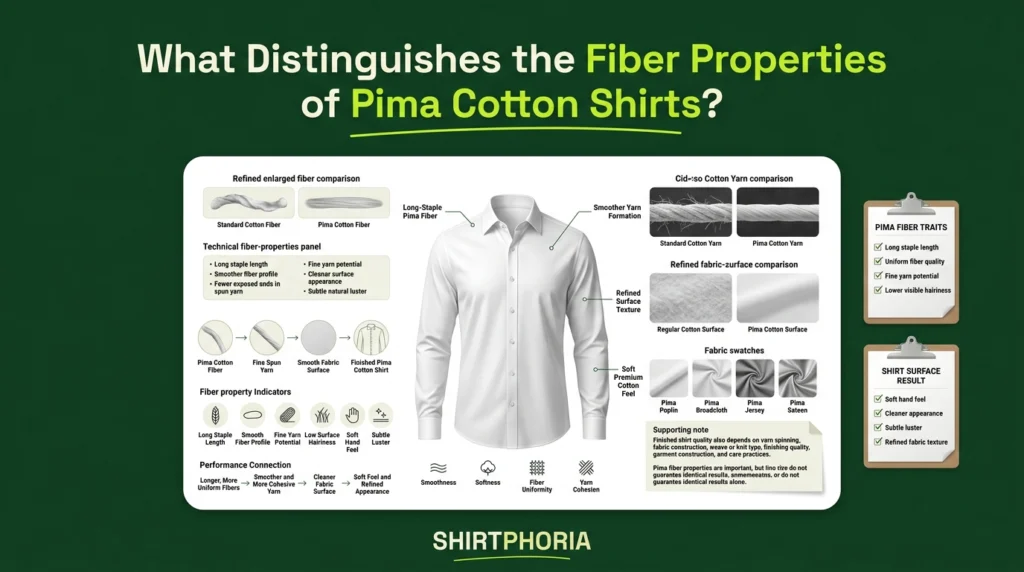
How Do Pima Cotton Fiber Properties Extend the Fiber-Length Discussion?
Pima cotton provides a useful specialized example because its material performance should be evaluated through a broader fiber-property profile rather than reducing the entire material to staple length alone.
For that broader material discussion, see Pima cotton fiber properties.
Smooth Cotton-Shirt Checklist
Frequently Asked Questions
No. Longer fibers increase smoothness potential by supporting more regular yarn formation and potentially lower disruptive hairiness, but fabric construction, finishing, laundering, wear, and other fiber and yarn properties still influence the final feel.
No. Smoothness mainly concerns surface regularity and the relative absence of disruptive surface features. Softness is a broader tactile response involving flexibility, compression, yielding behavior, finishing, and other characteristics.
Longer fibers can support more stable yarn formation and fewer opportunities for poorly controlled fiber-end projections, but spinning process, yarn linear density, twist, fiber uniformity, and other variables also affect hairiness.
Yes. Pilling is a multivariable surface phenomenon. Fiber length can influence hairiness and surface stability, but pilling also depends on fiber strength, yarn twist, spinning system, fabric construction, finishing, abrasion, and laundering.
No. Upper-Half Mean Length is an instrument-based raw-cotton measurement. Yarn construction, fabric structure, finishing, washing, and wear all change the surface that the wearer touches.
Because staple length is only one upstream variable. Fiber fineness, length uniformity, spinning system, yarn size and twist, fabric construction, finishing, wear, and laundering can all produce different tactile surfaces.
Terms Explained
| TERM | DEFINITION |
|---|---|
| Staple fiber | A fiber with a finite length rather than an effectively continuous filament. |
| Upper-Half Mean Length (UHM) | An instrument-based cotton fiber-length characteristic based on the longer half of the measured fiber distribution. |
| Fiber fineness | The relative linear density or fineness of individual cotton fibers. |
| Length uniformity | The consistency of fiber lengths within a cotton sample. |
| Yarn evenness | How consistently yarn mass and structure are distributed along its length. |
| Yarn hairiness | Fiber ends or loops projecting outward from the main body of spun yarn. |
| Surface friction | Resistance or drag at the textile surface. |
| Geometric roughness | Physical variation in the textile surface profile. |
| Smoothness | Perceived surface regularity and the relative absence of disruptive surface features. |
| Softness | A broader tactile response involving flexibility, compression, yielding behavior, finishing, and related characteristics. |
Shirtphoria provides educational information about shirts, fabrics, construction, care, styling, and textile performance. This content is for general informational purposes only and does not guarantee specific product performance, durability, comfort, texture, or suitability. Actual results can vary depending on materials, manufacturing quality, garment construction, use, care, and individual preferences.
Conclusion
In conclusion, longer cotton fibers can contribute to smoother cotton shirts by supporting favorable yarn-quality conditions and potentially lower disruptive hairiness, but the final surface depends on how those fibers are spun, constructed, finished, and used.
The complete causal relationship is:
Longer fiber → better yarn-quality potential → greater yarn regularity and potentially lower disruptive hairiness → cleaner fabric-surface potential → greater cotton-shirt smoothness potential.
Fiber length increases smoothness potential, not guaranteed finished-shirt feel.
Fiber fineness, length uniformity, spinning, yarn linear density, yarn count, twist, fabric structure, finishing, wear, and laundering determine how much of the upstream advantage survives into the finished shirt.
Yarn hairiness, surface friction, geometric roughness, softness, and perceived smoothness should also remain separate concepts. They can interact, but they do not describe exactly the same textile property.
Consumer touch can help evaluate the final surface, but it cannot replace instrument-based fiber or textile-surface measurements.
The smoothness of a cotton shirt is therefore best understood as a complete textile system rather than as the result of one staple-length label.
Fiber properties establish the potential, yarn engineering shapes the yarn surface, and fabric construction and finishing determine how much of that potential the wearer ultimately sees and feels.