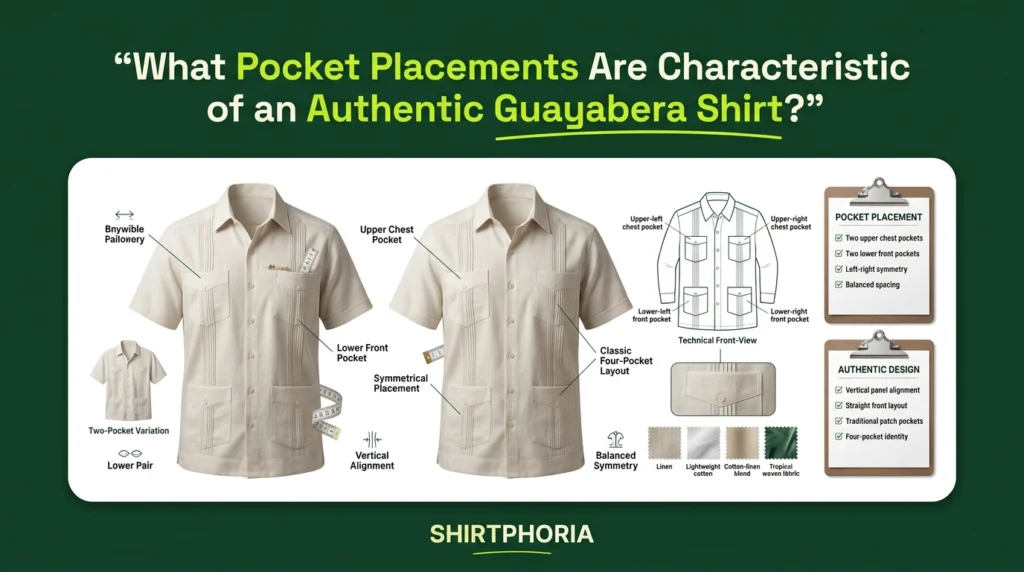
What Pocket Placements Are Characteristic of Classic and Regional Guayabera Shirts?
Classic Guayabera pocket placement most commonly uses two chest pockets and two lower pockets, but regional, formal, and contemporary variations may use fewer pockets without losing their Guayabera classification.
Quick Answer: How Many Pockets Does a Guayabera Have?
The best-known classic Guayabera has four front pockets: two Chest Pockets and two Lower Pockets. However, documented regional and formal variations may use one, two, or fewer prominent pockets. Pocket count helps classify construction, but it cannot independently prove authenticity, origin, age, maker, or cultural provenance.
Online sellers sometimes use terms such as “Guayabera,” “Cuban shirt,” “Mexican wedding shirt,” and “Camp Shirt” loosely. Counting pockets alone is therefore less reliable than examining the entire garment.
This guide explains classic Guayabera pocket geometry, documented regional variations, pocket-to-alforza relationships, construction-quality checks, and the limits of pocket-based authenticity claims.
Pocket anatomy should be evaluated within the broader construction of Guayabera shirts, including their vertical detailing, Straight Hem, Side Vents, collar, fabric, sleeves, and untucked proportions.
The traditional Guayabera is widely associated with four pockets, vertical pleating or Embroidery, a Straight Hem, Side Vents, and untucked wear, although its precise origin and stylistic evolution remain complex and regional. HistoryMiami Museum documents the four-pocket form while also showing Cuban, Mexican, and other variations.
Classification Boundary: Pocket placement can support classification as a classic or regional Guayabera, but it cannot independently prove provenance, age, cultural authenticity, handmade status, or manufacturing origin.
Why Does Guayabera Pocket Placement Matter for Construction Classification?
Guayabera pocket placement matters for construction classification because the number, position, proportion, and integration of the pockets help distinguish classic, regional, formal, and Guayabera-inspired shirt designs.
Pocket inspection should be combined with other construction evidence, including:
- Straight Hem;
- Side Vents;
- untucked proportions;
- Alforzas or Embroidery;
- collar construction;
- sleeve treatment;
- fabric;
- maker documentation;
- and regional context.
Pockets are therefore classification signals rather than authentication evidence.
How Pocket Placement Helps Distinguish a Guayabera from a Camp Shirt
Pocket placement helps distinguish a Guayabera from a Camp Shirt when it appears alongside vertical detailing, a straight untucked hem, side vents, and other recognized Guayabera construction features.
A Camp Shirt may share several visual characteristics with a Guayabera:
- lightweight fabric;
- short sleeves;
- an open collar;
- untucked styling;
- and one or two Chest Pockets.
Those shared attributes are not enough to make the garments identical.
A Guayabera is more strongly identified through a combination of:
- vertical Alforzas, Pintucks, or Embroidery;
- two or four classic pockets, or a documented regional alternative;
- Straight Hem construction;
- Side Vents;
- decorative or functional buttons;
- and identifiable regional tailoring context.
The structural relationship is:
Combined Guayabera anatomy → creates a recognizable construction pattern → supports classification beyond a generic Camp Shirt.
A shirt without four pockets may still qualify as a regional or formal Guayabera when the remaining construction and documentation support that classification.
Two Chest Pockets alone cannot either confirm or reject Guayabera classification.
Why the Traditional Four-Pocket Configuration Is a Classic Guayabera Signal
The traditional four-pocket configuration is a classic Guayabera signal because the established Cuban-style model places two pockets on the chest and two near the lower front or hem.
HistoryMiami documents this established Cuban configuration as having two Chest Pockets and two lower or hem-area pockets.
This arrangement should be called the:
Traditional four-pocket configuration
The four-pocket system can provide:
- left-right visual balance;
- repeated geometric structure;
- practical storage;
- integration with Alforzas or Embroidery;
- and a recognizable Classic Cuban Guayabera silhouette.
“Classic” should not be confused with “only legitimate.”
Classification Boundary: Four pockets strongly support a classic Cuban-style classification, but fewer pockets may support a valid Yucatecan, Presidential, regional, or contemporary classification.
Fabric also changes how pockets behave. Weight, weave stability, drape, and transparency affect whether a pocket hangs cleanly, puckers, sags, or pulls the front out of balance. These relationships become clearer when comparing broader shirt fabric types.
How Should the Classic Four-Pocket Placement of a Guayabera Be Analyzed?
The classic four-pocket placement of a Guayabera should be analyzed through left-right balance, vertical positioning, pocket proportion, stitching stability, and its relationship with the garment’s detailing and straight untucked silhouette.
Exact pocket positions vary with:
- shirt size;
- wearer proportions;
- pocket pattern;
- pleat or Embroidery layout;
- regional style;
- and maker specifications.
No universal inch or centimeter tolerance applies to every Guayabera.
A ruler and flat surface can still help document differences, but the measurements should be compared with the garment’s own pattern or maker specifications rather than an invented universal threshold.
How Should Upper Chest Pockets Be Positioned on a Classic Guayabera?
Upper chest pockets on a classic four-pocket Guayabera should appear balanced relative to the placket, shoulder line, vertical detailing, and each other.
Paired Chest Pockets can be evaluated for:
- similar top-edge height;
- similar distance from the center front;
- comparable width and height;
- consistent flap shape where flaps are present;
- stable corners;
- even button placement where buttons are used;
- minimal fabric distortion;
- and intentional alignment with Alforzas or Embroidery.
Not every Chest Pocket must sit at exactly the same mathematical point. Handmade construction, fabric relaxation, body shape, or intentional regional design can create small differences.
A useful measurement protocol is:
- Lay the closed shirt flat without stretching it.
- Smooth the shoulders and side seams.
- Measure from the center front to the inner edge of each paired pocket.
- Measure from a consistent shoulder or horizontal reference point to each pocket top.
- Record the difference.
- Compare the result with the maker’s construction or intended regional design.
- Try on the garment and recheck visual balance.
Large unexplained differences, severe twisting, distorted flaps, or inconsistent reinforcement raise construction-quality concerns, but they do not independently prove that a Guayabera is culturally inauthentic.
Chest Pockets can hold small lightweight items, although their exact historical uses have varied.
How Should Lower Pocket Placement Support the Guayabera’s Untucked Structure?
Lower pockets in the classic four-pocket Guayabera should sit within the lower front without interfering with the straight hem, side vents, or balanced untucked drape.
Classic lower pockets are often:
- larger than the Chest Pockets;
- positioned near the lower front or hem area;
- balanced on the left and right sides;
- integrated with vertical detailing;
- reinforced at stress points;
- and proportioned to the garment size.
The safest terms are Lower Pockets, lower front pockets, or lower hem-area pockets, because their exact height varies between patterns.
A well-integrated lower pocket should not interfere with the garment’s fundamental untucked geometry.
The pocket bottom should not collide awkwardly with the Straight Hem.
The opening should remain usable without forcing the shirt upward.
Heavy contents should not pull the hem badly out of balance.
Side Vents should still open naturally.
The lower pocket should also not make the shirt resemble a jacket unless that effect is deliberately part of the regional construction.
One popular but unverified origin story says Guayabera pockets were used for carrying guavas, possibly contributing to the garment’s name. HistoryMiami presents this as a repeated legend rather than established historical fact.
The pocket arrangement should therefore not be explained as definitively originating from agricultural storage.
How Should Alforzas and Embroidery Relate to Guayabera Pockets?
Alforzas and embroidery should relate coherently to Guayabera pockets through intentional spacing, alignment, interruption, continuation, or framed placement according to the maker’s design.
Alforzas are narrow stitched folds or pintuck-like decorative details.
Their relationship with pockets can vary considerably.
Alforzas may:
- run beside the pockets;
- continue onto a pocket;
- repeat across the pocket body or flap;
- stop intentionally above or below the pocket;
- frame the pocket edges;
- or be replaced by Embroidery.
There is no universal rule requiring the vertical details to run continuously through every pocket.
The important relationship is:
Controlled relationship between detailing and pockets → preserves the visual design system → supports a refined construction interpretation.
Different manufacturing methods can also produce valid Alforzas. Yucatán Today’s guide to Alforza construction describes both specialized and more automated production methods, showing that one sewing technique does not define legitimacy.
Inspect:
- intentional spacing;
- straight stitch paths;
- consistent fold width;
- stable pocket edges;
- absence of accidental twisting;
- controlled puckering;
- secure threads;
- symmetry where symmetry is intended;
- and coherent transition between the body and pocket.
Misalignment becomes a quality concern when it appears accidental, distorts the garment, or disrupts a repeated pattern. It is not automatic proof of imitation.
How Do Regional Guayabera Variants Use Different Pocket Placements?
Regional Guayabera variants use different pocket placements because formal purpose, local tailoring, embroidery, maker tradition, and contemporary design can simplify or reorganize the classic four-pocket front.
Reduced pocket count should always be interpreted alongside the rest of the garment.
How Can Two-Pocket and Reduced-Pocket Guayaberas Remain Valid Variants?
Two-pocket and reduced-pocket Guayaberas can remain valid variants when their pocket configuration aligns with a documented regional style, coherent garment construction, or identified maker tradition.
Possible valid arrangements include:
- two Lower Pockets;
- two Chest Pockets;
- one Chest Pocket;
- one or two discreet Welt Pockets;
- four classic Patch Pockets;
- pocket-minimized embroidered fronts;
- and contemporary reduced-pocket designs.
There is no rule requiring every two-pocket Guayabera to use only lower pockets.
A garment with two Chest Pockets should also not be rejected automatically.
The Presidential Guayabera provides an important regional example. Some refined Yucatecan Presidential designs use one discreet chest-level Welt Pocket or flap pocket while retaining Guayabera identity through long sleeves, fine fabric, Pintucks, formal finishing, and recognizable construction. Yucatán Today documents these formal Yucatecan variations.
A reduced-pocket shirt should be evaluated with supporting evidence such as:
- regional construction;
- maker description;
- Alforzas or Embroidery;
- Straight Hem;
- Side Vents;
- collar and sleeve treatment;
- workmanship;
- and historical or contemporary design context.
Regional-Variation Rule: Reduced pocket count is not evidence of lower authenticity when the rest of the garment matches a documented Guayabera tradition.
When Does a Pocket Configuration Suggest a Guayabera-Inspired Shirt Instead?
A pocket configuration suggests a Guayabera-inspired shirt when it borrows isolated visual features but lacks enough combined evidence to support a classic or documented regional Guayabera classification.
A Guayabera-inspired shirt might use:
- one or two Patch Pockets;
- decorative Pintucks;
- an open Camp Shirt collar;
- a curved hem;
- no Side Vents;
- proportions intended for tucking;
- military- or work-shirt construction;
- printed imitation pleats;
- or pocket placement unrelated to the rest of the design.
Such garments should not automatically be called fake.
A more accurate classification is:
Guayabera-inspired or insufficiently documented
A generic Camp Shirt with decorative pleating may resemble a Guayabera while lacking the wider construction pattern of a classic or regional Guayabera.
That is a classification distinction, not necessarily a judgment about garment quality.
What Pocket Characteristics Help Classify Guayabera Construction?
Guayabera pocket characteristics help classify classic, regional, formal, contemporary, and inspired constructions when pocket evidence is combined with the rest of the garment anatomy.
| Pocket FeatureStrong Classic or Regional MatchConstruction or Classification Concern | ||
|---|---|---|
| Pocket Count | Four pockets strongly match the classic Cuban-style configuration; one, two, or reduced pockets may match documented regional or Presidential forms | Pocket count is used alone to claim authenticity without regional or maker evidence |
| Classic Four-Pocket Layout | Two Chest Pockets and two Lower Pockets with balanced proportions | Severe unexplained asymmetry, distorted positioning, or unstable attachment |
| Presidential Variation | One discreet chest-level Welt Pocket or flap pocket combined with formal Yucatecan construction | Reduced pockets rejected solely because the shirt lacks four pockets |
| Two-Pocket Variation | Two Chest Pockets or two Lower Pockets supported by coherent regional or contemporary design | Two-pocket construction presented as universally authentic without supporting evidence |
| Chest-Pocket Balance | Paired pockets align intentionally with placket, shoulders, Alforzas, or Embroidery | Accidental-looking height differences, twisted flaps, or strong fabric distortion |
| Lower-Pocket Placement | Pockets support the untucked hem and remain proportionate to the shirt | Pockets collide with the hem, pull Side Vents, or create uncontrolled sagging |
| Alforza Relationship | Pleats continue, stop, frame, or repeat around pockets in an intentional and stable pattern | Random interruption, severe puckering, loose stitching, or accidental misalignment |
| Embroidery Relationship | Embroidery aligns with or deliberately frames the pocket arrangement | Embroidery is irregularly cut off or distorted by poor pocket attachment |
| Pocket Function | Functional, semi-functional, welted, Patch Pocket, or decorative construction is accurately described | Decorative pockets are misrepresented as full storage pockets |
| Flaps and Buttons | Present or absent according to the chosen regional or maker design | Flaps or buttons are treated as universal requirements |
| Stitching | Secure seams, reinforced stress points, controlled corners, and no major loose threads | Opening seams, weak reinforcement, torn corners, or attachment failure |
| Provenance Evidence | Maker, regional, museum, archival, or reliable product documentation supports the classification | Seller uses “authentic heritage” language without verifiable evidence |
Key Classification Rule: Pocket Placement Supports Guayabera Classification but Does Not Independently Authenticate Provenance
Four pockets strongly support the Classic Cuban Guayabera pattern.
Reduced pockets can support formal or regional classifications.
Pocket symmetry contributes to quality analysis.
Alforza alignment contributes to construction analysis.
Pocket count cannot prove age, maker, country of production, handmade status, or cultural legitimacy.
Reliable regional documentation can outweigh a generalized four-pocket rule.
Guayabera Pocket-Classification Outcomes
| OutcomeRequired EvidenceInterpretation | ||
|---|---|---|
| Classic Cuban-Style Match | Two Chest Pockets and two Lower Pockets, coherent vertical detailing, Straight Hem, Side Vents, and balanced untucked construction | The shirt strongly matches the established classic Cuban-style configuration |
| Documented Regional Variation | Pocket count or placement differs but aligns with documented Yucatecan, Presidential, Mexican, Caribbean, or maker-specific construction | The shirt represents a valid regional variation |
| Contemporary Guayabera Match | Modernized pocket arrangement combined with recognizable Guayabera anatomy and accurate maker description | The shirt is a contemporary adaptation rather than a classic replica |
| Guayabera-Inspired Shirt | Isolated pockets or pleats resemble Guayabera details, but the complete garment does not strongly match classic or documented regional anatomy | Use a bounded Guayabera-inspired classification |
| Construction-Quality Concern | Severe puckering, torn reinforcement, unstable pockets, accidental asymmetry, distorted Alforzas, or failing seams | The construction requires repair or quality review |
| Provenance Unverified | Garment anatomy appears plausible, but country, maker, age, or handmade status cannot be confirmed | Do not make a cultural-authenticity claim |
| Insufficient Evidence | Images, measurements, labels, or complete garment details are unavailable | Delay classification until stronger evidence is available |
Evidence-Confidence Levels
| Evidence AvailableConfidence Level | |
|---|---|
| Complete garment inspection, maker documentation, regional context, and clear construction images | High Confidence |
| Complete garment inspection with limited provenance documentation | Moderate Confidence |
| Partial images or seller description without maker or regional evidence | Low Confidence |
| Pocket count alone | Insufficient Evidence |
A Low-Confidence or Insufficient-Evidence result should not be described as definitive.
Guayabera Pocket Condition Zones
Ideal Construction Zone
- Pocket count and placement are accurately documented.
- Paired pockets appear intentionally balanced.
- Pocket dimensions suit the garment.
- Corners and openings remain stable.
- Alforzas or Embroidery interact coherently with the pockets.
- Lower Pockets do not distort the Straight Hem.
- Side Vents remain unobstructed.
- Buttons and flaps function correctly where present.
- Severe puckering or loose stitching is absent.
- Seller claims match observable evidence.
Transition Zone
- Minor left-right variation appears.
- Handmade differences remain visible but coherent.
- One flap sits slightly unevenly.
- A pocket edge shows light puckering.
- Alforzas stop near a pocket but appear intentionally terminated.
- Regional classification is plausible but not documented.
- Pocket function is limited but accurately described.
- Minor pressing or repair may improve presentation.
Correction or Verification-Required Zone
- Pocket seams are opening.
- Reinforcement is torn.
- Lower Pockets strongly pull the hem.
- Side Vents become distorted.
- Pocket placement produces severe asymmetry.
- Alforzas twist because of attachment tension.
- Decorative pockets are misrepresented as functional.
- Country or handmade claims lack documentation.
- A guava-origin story is presented as verified provenance.
- Pocket count alone is used to declare the garment authentic or fake.
Error-Proof Inspection Protocol
Use this order:
- Record the seller or maker’s claimed regional style.
- Inspect the entire garment before focusing on pockets.
- Count and classify every pocket.
- Identify Patch, Welt, flap, decorative, and functional constructions.
- Lay the closed garment flat.
- Smooth shoulders, placket, and side seams without stretching.
- Measure paired pocket placement from consistent reference points.
- Record dimensions and differences.
- Inspect pocket reinforcement and stitching.
- Inspect Alforza or Embroidery relationships.
- Check the Straight Hem and Side Vents.
- Try on the shirt and recheck visual balance.
- Review maker and provenance documentation.
- Assign an evidence-confidence level.
- Select one classification outcome.
- Correct construction problems separately from provenance questions.
- Reclassify the garment if stronger documentation becomes available.
Correction Hypothesis: When the pockets appear incorrect, isolate garment size, fabric distortion, pressing, pocket attachment, regional design, and body shape before concluding that the shirt is misclassified.
Repeatability Rule: The classification remains repeatable only when the same regional definitions, measurement reference points, construction checks, and evidence-confidence rules are used each time.
Cultural-Safety Rule: When provenance cannot be verified, describe the observable pocket construction without assigning unsupported cultural authenticity.
The Guayabera Pocket-Construction Inspection Checklist
Before classifying a Guayabera, inspect pocket count, regional context, placement, proportions, stitching, detailing, hem relationship, function, and provenance evidence as one connected system.
Frequently Asked Questions
No. Four pockets strongly match the classic Cuban-style configuration, but documented regional, Presidential, formal, and contemporary Guayaberas may use fewer pockets.
The best-known classic layout uses two Chest Pockets and two Lower Pockets arranged symmetrically on the front.
Yes. Two Chest Pockets, two Lower Pockets, or other reduced-pocket configurations can be valid when supported by coherent regional construction or maker documentation.
No. Pocket count can support classification, but it cannot independently prove provenance, age, country, handmade status, maker, or cultural authenticity.
Check pocket count, left-right balance, proportion, reinforcement, stitching, relationship to Alforzas or Embroidery, interaction with the Straight Hem and Side Vents, and supporting regional or maker evidence.
Terms Explained
| TERM | DEFINITION |
|---|---|
| Chest Pocket | A front pocket positioned on the upper torso area of the shirt. |
| Lower Pocket | A pocket positioned on the lower front or hem area of a Guayabera. |
| Patch Pocket | A pocket made from a separate piece of fabric sewn onto the garment exterior. |
| Welt Pocket | A pocket opening finished with narrow fabric welts rather than a large visible patch. |
| Alforzas | Narrow stitched folds or pintuck-like vertical details characteristic of many Guayabera designs. |
| Straight Hem | A level lower edge designed to support traditional untucked wear. |
| Side Vents | Openings at the lower side seams that help an untucked shirt move and drape cleanly. |
| Presidential Guayabera | A refined Yucatecan formal style that may use a reduced or discreet pocket configuration. |
| Provenance | Documented information about a garment’s maker, origin, history, or chain of ownership. |
| Guayabera-Inspired | A bounded classification for shirts that borrow Guayabera-like details without enough evidence to match a classic or documented regional form. |
Conclusion
The final pocket-classification rule for a Guayabera is to treat the four-pocket layout as a strong classic signal while allowing documented regional and formal variations to use different pocket counts and placements.
The Classic Cuban Guayabera commonly uses two Chest Pockets and two Lower Pockets, but four pockets are characteristic rather than universally mandatory.
Presidential Guayaberas can use one discreet Chest Pocket.
Two-pocket and other reduced-pocket forms require complete-garment and regional evaluation.
Two Chest Pockets alone do not invalidate the garment.
Lower Pockets are not universal across every regional form.
Alforzas can continue, stop, repeat, or frame pockets according to the maker’s design.
Construction quality depends on stable, intentional execution rather than one universal pleat rule.
The guava-carrying explanation remains a popular but unverified origin story, and pocket placement cannot independently prove provenance, age, country, or handmade status.
Rejecting every reduced-pocket Guayabera creates false negatives, while accepting any pocketed, pleated shirt as a Guayabera creates false positives.
By combining pocket analysis with regional context, complete garment anatomy, construction quality, and provenance evidence, you can classify a Guayabera accurately without reducing cultural authenticity to pocket count alone.