How Can a Rugby Shirt Deliver Performance Through Design and Fabric Durability?
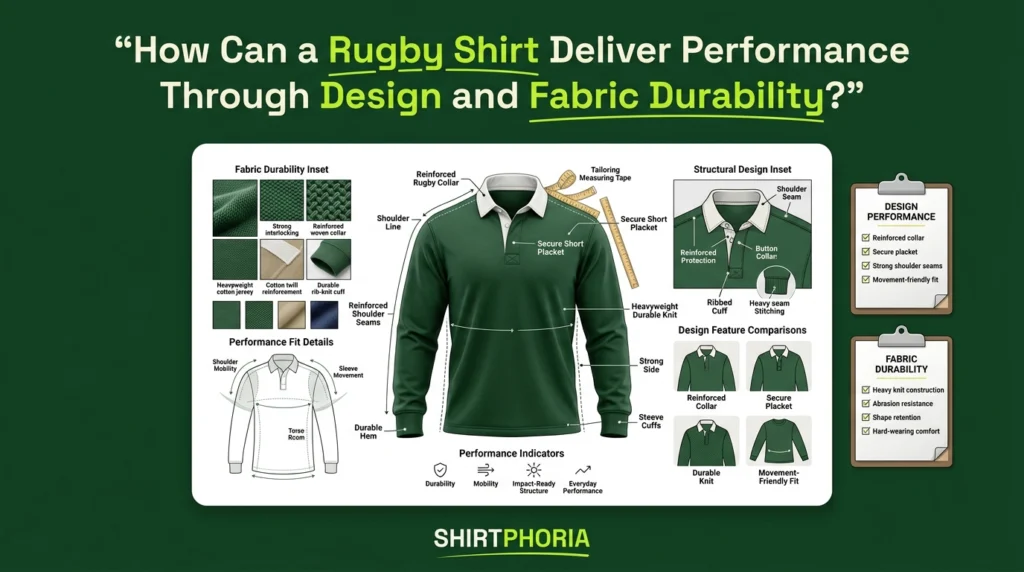
A heritage-style rugby shirt can deliver durable performance when its fabric, seams, fit, placket, collar, and reinforcement details work together for the intended use, but no single feature proves overall strength.
A heritage-style rugby shirt is a collared knitted garment commonly associated with substantial fabric, traditional collar and placket construction, and casual or rugby-inspired use. It should not be treated as identical to a modern rugby jersey, which may use synthetic performance fabrics, close fits, reduced collars, stretch systems, and other construction priorities.
Durability is also not one single property. A rugby shirt can perform differently in abrasion, tearing, bursting, seam loading, washing, shape retention, and surface wear.
This guide evaluates five connected systems: fabric, seams, fit, structural components, and intended use. Visual inspection can reveal warning signs, but it cannot certify laboratory performance.
Quick Answer
A durable heritage-style rugby shirt combines an appropriate knit, sound seams, secure component attachment, functional fit, and construction suited to its intended use. Heavy fabric may feel substantial, but GSM alone does not prove abrasion, tear, or seam strength. Buyers should inspect visible quality and seek published specifications where strong performance claims are made.
Which Rugby Shirt Does This Guide Evaluate?
This guide focuses mainly on the heritage-style heavyweight rugby shirt.
It also compares that category with the modern match jersey where useful.
The guide does not assume that every rugby shirt uses:
- cotton;
- long sleeves;
- a rigid collar;
- a reinforced yoke;
- rubber buttons;
- side vents;
- heavyweight fabric.
The first rule is simple:
Identify the category before judging performance.
A fashion rugby-style shirt may copy the visual cues of traditional rugby clothing without using the same fabric mass, reinforcement, seam construction, or intended performance.
How Does the Performance Mandate Differ Between Heritage Rugby Shirts and Modern Match Jerseys?
Heritage rugby shirts and modern match jerseys serve related visual traditions but may use different materials, fits, and construction priorities.
A heritage-style rugby shirt may prioritize:
- substantial hand;
- traditional appearance;
- durable casual use;
- repeat wear;
- stable collar and placket construction.
A modern match jersey may prioritize:
- close body fit;
- reduced loose fabric;
- stretch;
- low mass;
- moisture management;
- movement during competitive play.
Current World Rugby law identifies the jersey as part of permitted player clothing and specifies sleeve coverage requirements, but it does not define the modern jersey as a heavyweight cotton, long-sleeve, traditionally collared garment. World Rugby Law 4
The categories should therefore not be judged by one shared construction formula.
What Does Performance Mean for a Heritage Rugby Shirt?
Performance in a heritage-style rugby shirt means completing its intended wearing, movement, and laundering tasks without unacceptable distortion, seam failure, or premature surface damage.
The intended use must be defined first.
A shirt intended for casual wear has different requirements from a professional match jersey.
Relevant failure areas include:
- body fabric;
- seams;
- placket;
- buttons;
- collar;
- cuffs;
- vents;
- dimensional stability.
A heritage shirt can perform well for its intended use without meeting the design requirements of modern professional matchwear.
Why Can Modern Match Jerseys Use Different Construction?
Modern match jerseys can use different construction because current sport requirements do not prescribe the traditional heavyweight cotton shirt as the only acceptable form.
Modern designs may use:
- synthetic or blended fabrics;
- close fits;
- short sleeves;
- reduced collars;
- stretch fabrics;
- technical moisture-management systems.
These changes do not make heritage construction obsolete.
They reflect different priorities.
This article evaluates heritage-style construction rather than treating it as the universal specification for modern rugby matchwear.
How Do Fabric Mass and Knit Construction Affect Rugby Shirt Durability?
Fabric mass and knit construction influence rugby-shirt hand, structure, and wear behaviour, but they do not independently establish tear, abrasion, or seam performance.
Fabric mass per unit area describes how much material is present over a measured area.
Two common expressions are:
- grams per square metre, or GSM;
- ounces per square yard.
These values describe mass, not total durability.
ASTM lists separate textile methods for properties such as fabric mass, abrasion resistance, tear strength, breaking strength, stiffness, and other physical characteristics. ASTM fabric physical test methods
That distinction matters.
High GSM does not automatically prove:
- abrasion resistance;
- tear strength;
- breaking strength;
- bursting strength;
- seam strength.
Related collared knit garments can also use very different fabric and structural systems, as shown in broader polo shirt construction.
What Does Heavyweight Fabric Contribute to a Rugby Shirt?
A heavyweight fabric may provide a substantial hand and additional material within a particular construction, but its durability still depends on yarn, knit, finishing, seams, and use conditions.
Possible benefits include:
- substantial feel;
- greater visual structure;
- reduced transparency;
- resistance to minor deformation in some constructions.
Possible limitations include:
- greater warmth;
- slower drying;
- more layering bulk;
- reduced comfort in hot conditions.
The relationship is:
Fabric Mass → Changes Material Quantity and Hand → Does Not Independently Certify Durability
A heavy rugby shirt can still fail if its yarn, seams, placket, or finishing are weak.
A lighter shirt can also perform well when its construction is appropriate to the intended use.
How Can Knit Construction Change Rugby Shirt Behaviour?
Knit construction changes rugby-shirt behaviour by affecting stretch, recovery, surface texture, stability, and the way stress moves through the fabric.
Not every rugby shirt uses the same knit.
Relevant variables include:
- stitch structure;
- yarn size;
- fibre blend;
- loop geometry;
- finishing;
- recovery.
Two fabrics with similar GSM can behave differently because their knit systems differ.
A Single Knit and a Double Knit, for example, may differ in structure and stability even when their mass values are similar.
Construction should therefore be evaluated directly rather than ranked from category names alone.
Does Yarn Ply Prove Rugby Shirt Durability?
Yarn ply can alter yarn behaviour, but a two-ply label does not by itself prove that a rugby shirt is stronger than every single-ply alternative.
Ply describes the number of strands combined to form a yarn.
Performance may also depend on:
- fibre strength;
- yarn count;
- twist;
- evenness;
- knit structure;
- finishing;
- manufacturing defects.
A two-ply yarn may provide useful characteristics in one construction, but the final garment still depends on how the yarn is knitted, finished, sewn, and used.
Yarn-level strength and garment-level durability are different claims.
How Does Fit Influence Rugby Shirt Performance and Structural Stress?
Fit influences rugby-shirt performance by determining whether the garment provides movement without creating excessive loose material, concentrated tension, or repeated distortion.
The correct amount of ease depends on intended use.
Useful descriptive categories include:
- movement-oriented ease;
- regular heritage fit;
- close lifestyle fit.
A traditional rugby shirt does not need to be excessively boxy.
Likewise, a close-fitting rugby-inspired shirt is not automatically more functional.
How Can Movement-Oriented Ease Support a Rugby Shirt?
Movement-oriented ease can support reaching, rotation, and shoulder motion when the additional room is distributed through the correct areas rather than added indiscriminately.
Important areas include:
- shoulders;
- chest;
- back;
- armholes;
- sleeves;
- hem.
Too much loose fabric may:
- snag;
- twist;
- bunch;
- move unpredictably.
Too little ease may:
- concentrate seam stress;
- restrict reaching;
- spread the placket;
- pull across the shoulders.
Useful fit gives movement without uncontrolled excess.
How Can Cuff Construction Affect Long-Sleeve Rugby Shirts?
A long-sleeve cuff can stabilize the sleeve when its opening, recovery, and compression suit the wearer and intended activity.
This applies only to long-sleeve variants.
A Ribbed Cuff can help control the sleeve opening.
Possible benefits include:
- holding the sleeve position;
- reducing loose fabric at the wrist;
- creating cleaner wrist alignment.
Possible failures include:
- sleeve drop;
- stretched cuffs;
- excessive pressure;
- fabric gathering above the wrist.
A tighter cuff is not automatically a better cuff.
It must hold the intended position without causing discomfort or restriction.
How Can Side Vents Affect Rugby Shirt Movement?
Side vents may provide additional hem separation during movement, but their value depends on body ease, vent depth, garment length, and reinforcement.
A Side Vent is an opening at the lower side seam.
Possible benefits include:
- reduced hem restriction;
- easier hip movement;
- improved untucked positioning.
Possible problems include:
- tearing at the vent end;
- weak reinforcement;
- curling;
- excessive opening.
Not every rugby shirt uses side vents.
Where present, they should be evaluated as one part of the complete body construction.
How Do Seams and Reinforcements Affect Rugby Shirt Durability?
Seams and reinforcements affect rugby-shirt durability through their material compatibility, stitch type, thread, seam construction, placement, and manufacturing consistency.
A stitch is the thread formation used to join or finish material.
A seam is the structural join created where garment components meet.
The number of visible stitch rows does not prove seam strength.
Coats explains that seam performance depends on properties including seam construction, thread, stitch choice, seam strength, and seam slippage. Coats seam types technical bulletin
Does a Reinforced Yoke Guarantee Greater Strength?
A reinforced yoke may add material or alter seam placement around the shoulders, but its durability benefit depends on how the panel is designed and attached.
A Yoke is a shaped panel used in the upper part of a garment.
In a rugby shirt, it may be:
- structural;
- partly structural;
- mainly decorative.
A buyer should inspect:
- panel material;
- seam continuity;
- stitch consistency;
- edge finishing;
- puckering.
A visible yoke should not automatically be treated as proof of load distribution or superior durability.
Do Triple Stitching and Bar Tacks Prove Rugby Shirt Durability?
Triple stitching and bar tacks may reinforce selected locations, but their presence does not independently prove strong seams or long garment life.
A Bar Tack is a dense localized stitch formation used to reinforce a specific point.
Multiple stitch rows may add redundancy where properly designed.
Poor sewing can still weaken a garment through:
- needle damage;
- excessive stitch density;
- incorrect thread tension;
- skipped stitches;
- misalignment.
The relationship is:
Appropriate Seam Engineering → Supports Load Transfer → Reduces Avoidable Seam Failure Risk
More stitching is not automatically stronger stitching.
What Should a Buyer Inspect in a Rugby Shirt Seam?
A buyer can inspect visible seam quality, but only testing can establish the force required to break or open the seam.
Look for:
- skipped stitches;
- broken threads;
- loose loops;
- seam puckering;
- inconsistent seam width;
- raw edges;
- fabric damage around needle holes;
- visible seam opening.
Three parallel lines may include structural or decorative topstitching.
Appearance can identify warnings, but it cannot establish laboratory seam strength.
How Do the Collar, Placket, Buttons, and Vents Affect Rugby Shirt Construction?
The collar, placket, buttons, and vents affect rugby-shirt usability and local durability, but their performance depends on materials, attachment, and intended use.
These components often create the visual identity of the heritage rugby shirt.
They also introduce local stress points that deserve inspection.
How Can a Woven Collar and Placket Affect a Rugby Shirt?
A woven collar or placket may provide a different balance of stability and stretch from the knitted body fabric.
Traditional products may combine woven components with knitted bodies.
Possible functions include:
- shape control;
- button support;
- visual contrast;
- local reinforcement.
Possible failures include:
- puckering;
- tearing at corners;
- placket spreading;
- collar distortion;
- incompatible shrinkage.
A woven collar or placket does not need to be rigid.
The useful level of structure depends on the surrounding fabric and intended use.
What Can Rubber Buttons Contribute?
Flexible rubber buttons are a traditional feature in some rugby shirts, but their presence does not independently establish placket or garment durability.
Possible advantages may include:
- flexibility;
- lower brittleness than some rigid button materials;
- traditional appearance.
Inspect:
- button attachment;
- buttonhole finishing;
- placket distortion;
- ease of replacement.
A rubber button should not be treated as proof that the placket can safely withstand heavy loading.
How Should Vent Reinforcement Be Evaluated?
Vent reinforcement should be evaluated at the point where the side seam ends and the opening begins because that transition can concentrate local stress.
Check:
- reinforcement or Bar Tack where present;
- broken stitches;
- fabric splitting;
- uneven vent length;
- curling.
Different manufacturers may use different solutions.
One visible stitch pattern is not mandatory.
How Can a Buyer Evaluate Rugby Shirt Quality In-Store?
A buyer can screen a rugby shirt for visible construction quality and intended-use compatibility, but cannot verify laboratory durability through touch or sight alone.
Three evidence levels should be kept separate:
- Published product specifications
- Consumer visual and tactile screening
- Laboratory test results
Each supports a different level of conclusion.
What Can a Fabric Hand-Feel Check Reveal?
A hand-feel check can reveal perceived thickness, stiffness, surface texture, and stretch, but it cannot verify GSM, tear strength, or abrasion resistance.
A buyer can compare:
- thickness;
- surface consistency;
- stretch;
- recovery;
- light transmission.
However, touch cannot confirm a specific GSM or ounces-per-square-yard value.
Measuring fabric mass properly requires:
- a known sample area;
- accurate weighing;
- an appropriate test procedure.
Hand feel is useful screening, not laboratory measurement.
How Should Published Fabric Specifications Be Read?
Published fabric specifications can identify mass, fibre content, and care requirements, but they do not automatically prove durability.
Useful information may include:
- GSM or ounces per square yard;
- fibre composition;
- knit description;
- care instructions;
- pre-wash or post-wash dimensions;
- stated test methods.
Strong claims such as “abrasion resistant,” “tear resistant,” or “performance grade” should ideally be connected to identifiable testing or manufacturer evidence.
A published GSM figure alone does not prove those claims.
How Should Seams and Components Be Screened?
Seams and components should be screened for visible defects, consistent attachment, and compatibility with the fabric.
Where permitted, turn the garment inside out.
Inspect:
- shoulder seams;
- armholes;
- side seams;
- cuff joins;
- placket base;
- collar attachment;
- vent ends;
- buttons.
Do not pull the garment destructively.
Manual pulling is not a seam-strength test.
How Can a Buyer Screen a Rugby Shirt Consistently?
A rugby shirt can be screened consistently by evaluating category, specifications, fabric, seams, components, movement, and comfort in the same order.
This is a practical buyer-screening method.
It is not:
- an ASTM test;
- an ISO test;
- a World Rugby product approval;
- a laboratory certification;
- a lifespan guarantee.
Step 1: Identify the Product Category
Record one:
- Heritage-style heavyweight rugby shirt
- Modern match jersey
- Supporter or replica jersey
- Fashion rugby-style shirt
- Category unclear
Pass: Category and intended use are clear.
Conditional: Category appears likely, but specifications are incomplete.
Fail: Strong performance claims are made while category and intended use remain unclear.
Step 2: Record Published Specifications
Check for:
- fibre content;
- fabric mass;
- knit description;
- care instructions;
- manufacturing information;
- test evidence.
Pass: Relevant specifications are available and consistent.
Conditional: Some information is missing, but no unsupported guarantee is made.
Fail: Strong durability claims appear without supporting specification.
Step 3: Screen the Body Fabric
Inspect:
- holes;
- thin areas;
- snags;
- surface inconsistency;
- poor recovery;
- visible distortion.
Pass: No material defect prevents intended use.
Conditional: Minor cosmetic issue exists without affecting function.
Fail: Visible weakness or damage makes the garment unsuitable.
Step 4: Screen the Seams
Inspect:
- skipped stitches;
- broken thread;
- seam opening;
- puckering;
- inconsistent width;
- raw edges;
- fabric damage around needle holes.
Pass: No visible seam defect prevents intended use.
Conditional: Minor irregularity exists without visible instability.
Fail: A seam is open, broken, damaged, or clearly unstable.
Step 5: Screen Structural Components
Inspect:
- collar;
- placket;
- buttons;
- buttonholes;
- cuffs;
- yoke where present;
- vents where present.
Pass: Components remain secure, aligned, and functional.
Conditional: Minor issue exists without preventing use.
Fail: A component detaches, distorts, restricts use, or shows visible structural damage.
Step 6: Test Intended Movement
Perform ordinary non-destructive movements:
- raise the arms;
- reach forward;
- rotate the torso;
- sit;
- bend where appropriate.
Pass: Movement occurs without persistent distortion or restriction.
Conditional: Minor displacement occurs without preventing use.
Fail: The garment binds, opens, twists severely, or needs repeated readjustment.
Step 7: Evaluate Comfort and Fit
Record:
- shoulder restriction;
- chest tension;
- sleeve pressure;
- cuff pressure;
- collar discomfort;
- uncontrolled fabric movement.
Pain, numbness, or meaningful restriction should produce a fail for the intended use.
What Final Evaluation Can a Buyer Give a Rugby Shirt?
The final decision should reflect both what can be observed and what remains unverified.
Evidence-Supported Durable Candidate
Use this outcome when:
- visible construction screening passes;
- movement screening passes;
- specifications are available;
- strong durability claims have supporting test evidence or clearly bounded manufacturer data.
Structurally Promising but Unverified
Use this when:
- visible and functional screening passes;
- laboratory durability has not been demonstrated.
This is often the strongest conclusion a consumer can make from ordinary shopping inspection alone.
Conditional Match
Use this when:
- no critical failure exists;
- one or more limitations narrow the intended use.
Poor Match for the Intended Use
Use this when:
- a critical seam, fabric, component, fit, or movement test fails;
- or strong durability claims conflict with visible construction quality.
What Are the Main Rugby Shirt Failure Modes?
Rugby-shirt durability fails when fabric, seams, components, or fit move outside the functional range required by the intended use.
Fabric-Mass Failure
Too little structure for the intended use may produce:
- cling;
- transparency;
- distortion;
- rapid visible wear.
Excessive mass for the intended use may produce:
- heat;
- slow drying;
- layering bulk;
- reduced comfort.
Functional zone: The fabric suits the intended task without relying on a universal GSM threshold.
Fabric-Strength Failure
Insufficient resistance may produce:
- tearing;
- bursting;
- abrasion damage;
- holes.
Excessive stiffness may produce:
- reduced comfort;
- poor drape;
- movement restriction.
Functional zone: The fabric provides suitable structure without making the garment impractical.
Seam Failure
Insufficient seam performance may produce:
- thread breakage;
- seam opening;
- slippage;
- component detachment.
Excessive or poorly controlled stitch density may produce:
- fabric perforation;
- puckering;
- stiffness;
- needle damage.
Functional zone: Thread, stitch, seam construction, and fabric remain compatible.
Fit Failure
Too loose may produce:
- snagging;
- twisting;
- bunching;
- unstable movement.
Too tight may produce:
- concentrated tension;
- restricted reach;
- placket spreading;
- seam loading.
Functional zone: The garment permits intended movement without uncontrolled excess.
Reinforcement Failure
Too little reinforcement may produce:
- local tearing;
- vent failure;
- attachment failure.
Too much or poorly positioned reinforcement may produce:
- stiffness;
- bulk;
- stress concentration;
- discomfort.
Functional zone: Reinforcement is placed and attached according to the actual construction need.
How Failures Can Cascade
One failure may create another:
Poor Fit → Concentrated Tension → Seam Distortion → Thread or Fabric Damage → Visible Seam Opening → Reduced Intended-Use Performance
Another possible sequence is:
Incompatible Fabric and Reinforcement → Uneven Stretch or Shrinkage → Puckering → Local Stress Concentration → Component Distortion → Premature Failure
Durability should therefore be diagnosed as a system.
What Rugby Shirt Construction Features Should a Buyer Check?
A buyer should evaluate rugby-shirt construction as a complete system rather than treating thickness, stitching, or traditional details as automatic proof of durability.
What Does the Rugby Shirt Performance Feature Matrix Show?
Rugby Shirt Construction and Evidence Matrix
| Design Component | Potential Function | What a Buyer Can Observe | What Requires Testing |
|---|---|---|---|
| Body Fabric | Coverage, structure, wear surface | Thickness, texture, visible defects, recovery | Mass, abrasion, tear, breaking, bursting performance |
| Yarn System | Contributes to fabric behaviour | Usually not verifiable visually | Yarn count, ply, twist, tensile properties |
| Seam | Joins load-bearing components | Opening, puckering, skipped stitches, consistency | Seam strength, seam slippage |
| Yoke | May alter panel structure or seam placement | Presence, attachment, visible quality | Actual load distribution |
| Placket | Supports opening and button system | Alignment, attachment, distortion | Strength under defined loading |
| Collar | Controls neckline shape and comfort | Attachment, stability, comfort | Material and dimensional performance |
| Button | Provides closure | Flexibility, attachment, buttonhole quality | Failure behaviour under loading |
| Cuff | Controls sleeve opening | Fit, recovery, pressure | Long-term recovery and fatigue |
| Side Vent | Allows hem separation where present | Vent depth, alignment, reinforcement | Repeated-load resistance |
| Finished Garment | Performs intended task | Fit, comfort, movement | Laboratory and wear-trial durability |
Observable construction can support a purchase decision, but it does not replace standardized testing.
What Evidence Establishes Rugby Shirt Durability?
What the Evidence Establishes
- Current rugby law does not define every jersey as a heavyweight cotton heritage shirt.
- Fabric mass, abrasion resistance, tear strength, and breaking strength are separate textile properties.
- Seam quality depends on seam construction, thread, stitch choice, slippage, and breaking behaviour rather than visible stitch quantity alone.
These principles support accurate evaluation, but they do not certify the durability of a specific rugby shirt without product-level evidence.
Frequently Asked Questions About Rugby Shirt Performance and Durability
No. GSM measures fabric mass per unit area. It does not by itself prove abrasion resistance, tear strength, breaking strength, bursting strength, seam strength, or overall garment life.
No. Heritage-style rugby shirts may use substantial fabrics, traditional collars, and plackets, while modern match jerseys can use synthetic blends, close fits, stretch systems, short sleeves, and technical moisture-management features.
No. They can reinforce selected areas, but seam performance also depends on thread, stitch type, seam construction, fabric compatibility, tension, placement, and manufacturing quality.
First identify the product category and intended use. Then inspect fabric, seams, placket, collar, buttons, cuffs, vents where present, movement, comfort, care information, and any published performance specifications.
You can screen visible construction quality and intended-use compatibility, but you cannot confirm laboratory properties such as abrasion resistance, tear strength, seam strength, or long-term fatigue by touch and visual inspection alone.
Terms Explained
| TERM | DEFINITION |
|---|---|
| Heritage-style rugby shirt | A collared knitted garment commonly associated with substantial fabric, traditional collar and placket construction, and casual or rugby-inspired use. |
| Modern match jersey | A rugby jersey designed for competitive play that may use synthetic or blended fabrics, close fits, stretch systems, and reduced traditional details. |
| GSM | Grams per square metre, a measurement of fabric mass per unit area. |
| Ply | The number of strands combined to form a yarn. |
| Yoke | A shaped upper-garment panel that may be structural, partly structural, or decorative. |
| Bar tack | A dense localized stitch formation used to reinforce a specific point. |
| Side vent | An opening at the lower side seam that can allow additional hem separation during movement. |
| Seam slippage | Movement of yarns or fabric at a seam that can create visible opening without thread breakage. |
| Structurally promising but unverified | A buyer conclusion where visible and functional screening passes but laboratory durability has not been demonstrated. |
| Evidence-supported durable candidate | A garment that passes visible and movement screening and has supporting specifications or test evidence for strong durability claims. |
What Is the Final Principle Behind Rugby Shirt Performance and Durability?
The final principle behind rugby-shirt performance and durability is system compatibility: fabric, seams, fit, and components must complete the intended task together.
Heritage-style rugby shirts and modern match jerseys should not be treated as identical products. Fabric mass can contribute to substance, but it does not prove total durability. Visible stitching may provide useful inspection clues, but stitch count alone does not establish seam strength.
The intended use remains central to every decision.
A buyer may classify a garment as evidence-supported, structurally promising but unverified, conditionally suitable, or a poor match for the intended use.
No visual feature can promise a specific lifespan.
A rugby shirt earns a durability claim only when its construction, intended use and supporting evidence point to the same conclusion.