What Helps a Long-Sleeve Polo Shirt Combine Fit and Sleeve Design for Versatile Use?
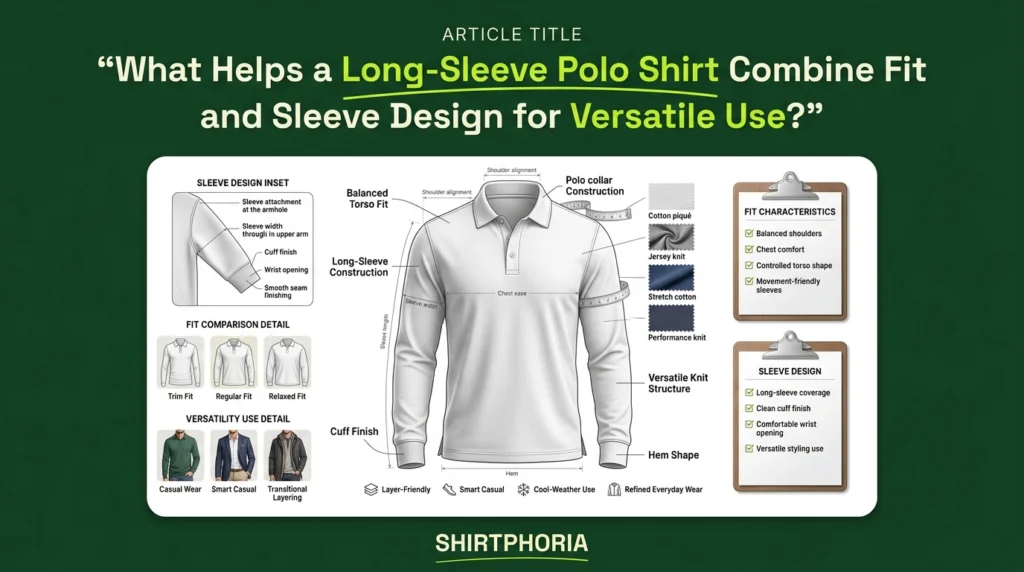
A long-sleeve polo shirt becomes versatile when its body fit, sleeve system, collar, placket, and knit fabric perform consistently in both the wearer’s intended standalone and layering contexts.
Versatility is not simply a matter of having long sleeves. The garment must maintain useful movement, stable sleeve position, controlled fabric volume, and an appropriate neckline while being worn alone or beneath an intended outer layer.
Five connected systems matter most: body silhouette, fabric and knit construction, sleeve and cuff design, collar and placket stability, and intended-use context.
No single GSM value, fibre label, or fit name guarantees that these systems will work together.
This guide explains how to evaluate the completed garment through static fit, movement, layering, and practical purchase checks. The Shirtphoria evaluation method used here is an editorial decision tool for comparing garments consistently. It is not an ASTM or ISO apparel-manufacturing standard.
Quick Answer
A versatile long-sleeve polo needs enough wearing ease for normal movement, enough shape control for clean layering, functional sleeves and cuffs, and a collar and placket that remain aligned. The garment should pass both static and movement checks in the actual standalone and layering situations where the wearer plans to use it.
How Do Fabric Engineering and Silhouette Create Versatile Long-Sleeve Polo Shirt Fit?
Fabric engineering and silhouette create versatile long-sleeve polo shirt fit by balancing measurable wearing ease with controlled fabric volume and a knit structure appropriate for the intended use.
Wearing ease is the difference between the wearer’s body dimensions and the corresponding dimensions of the finished garment that allows the body to breathe and move.
Design ease is additional volume deliberately added to create a particular silhouette or style beyond the minimum room needed for movement.
These ideas should not be confused.
A loose-looking polo may contain intentional design ease, poor fit, or both. A close-fitting polo may look visually controlled but still fail if the chest, shoulders, sleeves, or armholes restrict movement.
Research on apparel technical fitting identifies ease as one component of fit and shows that fit is assessed in both standing and moving positions rather than from a static view alone. Fashion and Textiles fit study
For the wider relationship between body construction, collar, placket, fabric, and fit, see polo shirt construction.
A long-sleeve polo should therefore be judged as a connected garment rather than by one label such as slim, classic, tailored, or relaxed.
Why Does Controlled Wearing Ease Support Long-Sleeve Polo Shirt Layering?
Controlled wearing ease can support long-sleeve polo shirt layering because it limits uncontrolled fabric gathering while preserving the space required for breathing, sitting, and reaching.
Controlled ease means the polo is neither restrictive nor excessively loose for its intended task.
The correct amount varies with:
- body proportions;
- chest and shoulder shape;
- fabric stretch;
- fabric thickness;
- knit recovery;
- garment pattern;
- intended outer layer.
Standing appearance alone is not enough.
A polo may look clean while the wearer stands still but shift badly when reaching forward or lifting the arms.
Likewise, a slightly relaxed polo may look fuller on the hanger but move effectively and settle back into position after activity.
Too-Loose Indicators
Possible signs of excessive or poorly controlled volume include:
- persistent folds remaining beneath a jacket;
- fabric pooling above the waistband;
- side seams rotating away from their intended position;
- the placket shifting away from the centre;
- repeated smoothing or manual readjustment.
These signs matter most when they interfere with the intended use rather than simply reflecting a relaxed styling preference.
Too-Tight Indicators
Possible restriction signs include:
- horizontal or diagonal tension lines;
- placket spreading during normal movement;
- binding around the shoulder or upper arm;
- a hem that rises and remains displaced;
- difficulty reaching normally.
A closer silhouette supports layering only when it preserves the movement and alignment required by the wearer.
The basic relationship is:
Controlled Wearing Ease → Reduces Uncontrolled Fabric Displacement → Improves Intended-Use Compatibility
How Do Fabric Mass and Knit Construction Affect Long-Sleeve Polo Shirt Drape?
Fabric mass and knit construction affect long-sleeve polo shirt drape together because weight, yarn, fibre, and stitch structure influence how the material hangs and responds to movement.
Drape describes how fabric hangs, folds, and moves under its own mass and during wear.
Fabric mass per unit area describes how much a fabric weighs relative to a specified surface area.
In clothing, it is commonly expressed in grams per square metre, or GSM.
ASTM D3776/D3776M provides standardized methods for measuring fabric mass per unit area. The standard establishes a measurement method; it does not prescribe an ideal GSM for polo shirts. ASTM D3776/D3776M
GSM should therefore not be treated as a complete measure of:
- density;
- durability;
- warmth;
- quality;
- fit;
- drape;
- formality.
Two fabrics can have similar GSM values and still behave differently.
Relevant variables include:
- yarn size;
- yarn structure;
- fibre composition;
- stitch construction;
- stitch length;
- finishing;
- thickness;
- stretch;
- recovery.
CottonWorks explains that knit structure, yarn, and fibre choices can change the weight, texture, and drape of knitted fabrics. CottonWorks single and double knits
A Piqué Knit may create a more textured surface.
A Jersey Knit often produces a smoother and softer surface.
Neither label predicts complete garment performance without knowing the rest of the construction.
The same boundary applies to fibre names.
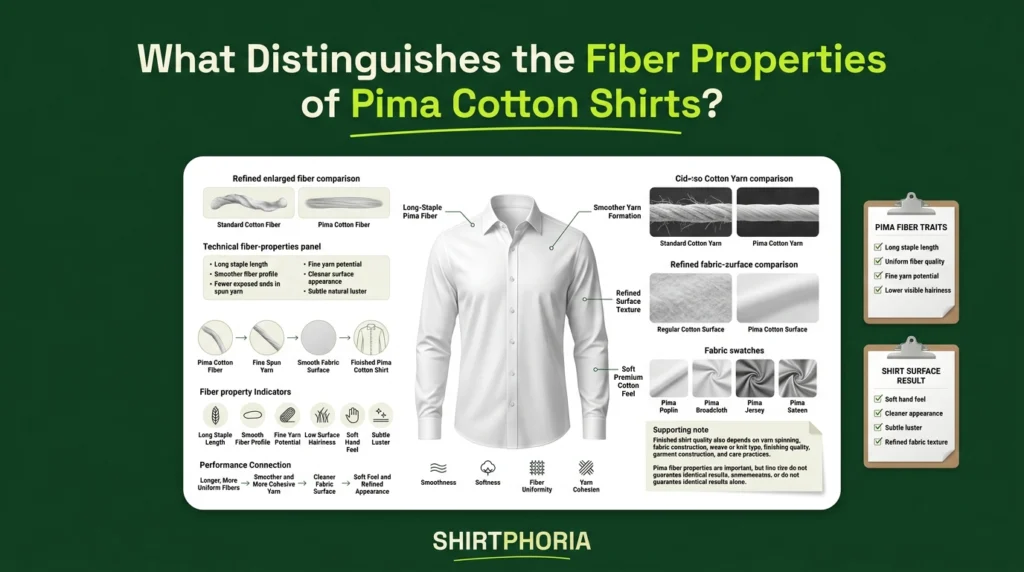
Pima Cotton identifies a fibre category, but it does not guarantee a particular fit, drape, recovery, or layering result.
Merino Wool also identifies a fibre type, not a complete garment-performance verdict.
The finished polo must still be evaluated through its yarn, knit structure, fabric mass, finishing, pattern, stretch, recovery, and intended use.
Fabric mass is measurable, but the suitability of that mass depends on the entire fabric-and-garment system.
Fabric establishes the base behaviour, while the sleeve, cuff and armhole determine how that behaviour responds to movement.
How Does Sleeve Design Influence Long-Sleeve Polo Shirt Versatility?
Sleeve design influences long-sleeve polo shirt versatility by affecting wrist placement, cuff stability, elbow movement, and the amount of garment displacement produced during normal arm motion.
The sleeve is not one isolated tube.
Its behaviour depends on:
- sleeve length;
- sleeve width;
- cuff opening;
- cuff recovery;
- sleeve cap;
- armhole;
- fabric stretch;
- body fit.
A sleeve that fits well while standing may still fail during movement.
For this reason, static and dynamic fit should be tested separately.
How Does Cuff Construction Support Long-Sleeve Polo Shirt Wearing Positions?
Cuff construction supports different long-sleeve polo wearing positions when the opening and recovery hold the sleeve at the selected wrist or forearm position without excessive compression.
Cuff recovery is the ability of the cuff to return toward its intended size and shape after stretching.
A Ribbed Knit Cuff may provide stretch and return through its knit construction.
Some long-sleeve polos instead use a simple folded hem or another sleeve-opening treatment.
Neither system is universally better.
The relevant question is whether the selected sleeve finish works for the wearer and intended position.
Retention should not be confused with tightness.
A cuff can hold securely without applying strong pressure.
Low-Recovery Failure
Possible signs include:
- the sleeve repeatedly drops below the selected position;
- the opening remains visibly stretched;
- repeated manual repositioning is needed;
- the left and right cuffs behave differently.
Excessive-Compression Failure
Possible signs include:
- persistent deep pressure marks;
- pain or numbness;
- fabric gathering sharply above the wrist;
- inability to maintain the intended forearm position.
The useful relationship is:
Balanced Cuff Opening and Recovery → Maintains Selected Sleeve Position → Supports Multiple Intended Uses
Cuff performance depends on opening size, knit recovery, sleeve mass, and wearer dimensions.
How Do the Armhole and Sleeve Cap Affect Long-Sleeve Polo Shirt Movement?
The armhole and sleeve cap affect long-sleeve polo shirt movement as part of the complete bodice-and-sleeve system, so their performance must be evaluated through physical movement rather than visual height alone.
The armhole, also called the armscye or scye, is the opening in the shirt body where the sleeve is attached.
The sleeve cap is the curved upper section of the sleeve that fits into that opening.
These parts interact with:
- shoulder shape;
- chest ease;
- back ease;
- upper-arm width;
- fabric stretch;
- sleeve-cap dimensions;
- seam placement.
A low or oversized armhole may contribute to excess torso movement in a particular polo because lifting the arm can pull a larger portion of the body fabric upward.
However, a higher armhole is not automatically better.
An armhole that is too narrow, badly shaped, or poorly balanced with the sleeve cap can restrict reaching and produce tension under the arm.
Excessive Looseness or Poor Balance
The torso may:
- lift;
- twist;
- pull away from the body;
- move the side seams;
- displace the hem.
Excessive Restriction or Poor Balance
The wearer may experience:
- underarm binding;
- limited reach;
- diagonal tension;
- shoulder pressure;
- sleeve restriction.
The completed garment’s movement response should decide the result.
Movement-Tested Armhole and Sleeve Balance → Reveals Displacement or Restriction → Supports a More Accurate Fit Decision
How Can Long-Sleeve Polo Shirt Movement Be Tested Consistently?
Long-sleeve polo shirt movement can be tested consistently by using the same wearer, base layer, outer layer, movement sequence, and garment position during each comparison.
This Shirtphoria protocol is intended to create repeatable observations.
It is not:
- an ASTM standard;
- an ISO standard;
- a medical test;
- a manufacturing specification;
- a universal sizing system.
Its purpose is to compare one garment or correction against another under consistent conditions.
Test Preparation
Before testing:
- Define the intended use.
- Use the same base layer in each comparison.
- Use the same blazer, sport coat, or jacket when testing layering.
- Fasten the same polo and jacket buttons.
- Allow the garments to settle naturally.
- Mark the resting hem and cuff positions.
- Use the same measuring tool each time.
- Record left and right sleeves separately.
- Do not manually reposition the garment before recording the result.
- Change only one primary variable at a time when testing a correction.
Hem Return Test
Procedure
- Stand naturally.
- Mark the resting side-hem position.
- Raise the arms to the position required by the intended activity.
- Return the arms to rest.
- Record remaining displacement.
- Repeat the sequence until results are reasonably consistent.
Pass
The hem returns to its baseline within the practical resolution of the measuring tool, no manual correction is needed, and the placket and side seams remain acceptably aligned.
Conditional
Some measurable displacement remains, but the garment still performs the intended task without repeated adjustment.
Fail
The garment requires manual repositioning, remains significantly bunched or twisted, displaces the placket, or restricts the intended movement.
Record the actual displacement for comparison.
Do not convert one measured result into a universal industry threshold.
Cuff Position Test
Procedure
- Select the intended wrist or forearm position.
- Mark that position.
- Perform the same repeated elbow-flexion sequence.
- Record cuff migration from the selected landmark.
- Repeat until results are consistent enough for comparison.
Pass
The cuff remains in the intended position without meaningful restriction or manual repositioning.
Conditional
The cuff moves but remains within the intended wearing area and continues to function.
Fail
The cuff drops outside the intended area, requires repeated correction, or creates enough compression to interfere with use.
Record the migration in centimetres or millimetres if useful for comparison, but do not present that number as a universal ideal.
Static Fit Test
Inspect:
- shoulder alignment;
- chest tension;
- waist pooling;
- side-seam position;
- sleeve length;
- placket alignment;
- collar position;
- unintended wrinkles.
Pass: No persistent fit defect prevents the intended use.
Conditional: Minor defects remain, but the garment remains usable.
Fail: Persistent distortion, restriction, or excess fabric prevents the intended use.
Outer-Layer Compatibility Test
Use the actual blazer, sport coat, or jacket that will be worn with the polo.
Check:
- jacket closure;
- shoulder comfort;
- sleeve mobility;
- waist bunching;
- collar conflict;
- placket alignment;
- recovery after movement.
Pass: The garments work together without repeated correction or functional restriction.
Conditional: Some bulk or displacement remains, but the outfit remains usable.
Fail: Compression, collar conflict, restriction, or persistent bunching makes the combination unsuitable.
Comfort Overrides Visual Fit
Mechanical fit and comfort should not be treated as identical.
Record separately:
- pressure;
- irritation;
- heat discomfort;
- restricted breathing;
- numbness;
- pain.
Pain, numbness, or meaningful restriction overrides a visually clean result.
A garment that looks controlled but prevents normal use fails for that intended task.
How Does the Long-Sleeve Polo Shirt Bridge Casual and Smart-Casual Use?
A long-sleeve polo shirt can bridge casual and smart-casual use when its fit, collar, placket, fabric surface, and sleeve position remain appropriate for the dress code and intended setting.
Casual, smart casual, and business casual are context-dependent dress categories.
Their boundaries can vary by:
- workplace;
- event;
- region;
- climate;
- organizational policy.
A long-sleeve polo is not formalwear.
It also does not replace a dress shirt in every workplace.
Observable details that can support a smarter presentation include:
- a stable collar;
- a centred placket;
- restrained branding;
- controlled surface texture;
- useful sleeve length;
- limited unwanted fabric displacement.
Color and pattern can change the visual effect, but construction remains the main focus here.
How Should a Long-Sleeve Polo Shirt Be Layered Beneath a Blazer?
A long-sleeve polo shirt can layer cleanly beneath a blazer when the combined garments preserve collar alignment, placket position, movement, and acceptable fabric distribution.
A blazer is a tailored jacket typically designed as a separate garment rather than part of a matching suit.
A sport coat is also a separate tailored jacket, often using more visibly textured or casual fabrics.
Either can potentially work over a long-sleeve polo when the garment combination has enough room.
A jacket fitted closely around a thin woven shirt may not provide enough space for a heavier knit polo.
Test the actual combination rather than assuming compatibility.
Look for:
- collar collapse;
- collar edges escaping awkwardly over the lapel;
- shoulder restriction;
- sleeve binding;
- placket distortion;
- waist pooling;
- hem displacement.
The outer layer should not force the polo into persistent folds.
The polo should also not push the jacket shoulders, chest, or sleeves beyond a comfortable range.
An open-neck polo generally communicates less formality than a dress shirt with a tie.
The combination is appropriate only where the setting accepts a knit collar and open neck.
Workplace policy overrides general styling guidance.
How Does a Long-Sleeve Polo Shirt Work as a Standalone Casual Garment?
A long-sleeve polo shirt works as a standalone casual garment when its visible fit and structure remain controlled without an outer layer concealing fit problems.
Evaluate:
- shoulder alignment;
- sleeve length;
- cuff behaviour;
- collar position;
- placket alignment;
- body volume;
- hem behaviour.
Long sleeves create a continuous line from shoulder to wrist, but that does not automatically make them better than short sleeves.
The effect depends on the complete garment.
A standalone polo can work with casual trousers such as chinos or denim, but these are context examples rather than mandatory pairings.
The important question is whether the shirt’s construction remains controlled when fully visible.
Long-Sleeve Polo Shirt Styling Signals
| Design Signal | Smart-Casual or Permitted Business-Casual Use | Casual or Weekend Use |
|---|---|---|
| Sleeve Position | Cuff stable at the wrist | Cuff at wrist or selected forearm position |
| Collar | Stable within the jacket line | Stable or naturally relaxed |
| Placket | Centred with controlled opening | Opening adjusted to intended casual context |
| Body Fit | Limited persistent bunching | Controlled or deliberately relaxed |
| Outer Layer | Compatible blazer, sport coat, or refined jacket | Standalone or casual jacket |
| Surface | Controlled texture and branding | Wider texture and branding range may be acceptable |
| Main Failure | Dress-code conflict, bulk, or restriction | Distortion, discomfort, or uncontrolled movement |
These are evaluation signals rather than universal dress-code rules.
How Does Long-Sleeve Polo Shirt Versatility Compare With Rugby Shirt Durability?
Long-sleeve polo shirt versatility and rugby shirt durability represent different potential design priorities, but the actual performance of either garment must be verified from its construction rather than its category name.
Traditional rugby shirts are often associated with substantial fabrics and robust construction.
Modern rugby-inspired garments vary widely, however.
Some are designed mainly as casual fashion products rather than for contact sport.
Likewise, not every polo is lightweight or delicate.
For a broader look at traditional construction and reinforcement, see rugby shirt durability.
What Trade-Off Can Separate Long-Sleeve Polo Shirt Versatility From Rugby Shirt Durability?
A traditional rugby shirt may use heavier fabric or reinforced components that increase visual and physical substance, while a long-sleeve polo may prioritize lower-bulk layering and a more controlled collar-led presentation.
Fabric mass alone does not prove durability.
Useful durability evidence may include:
- abrasion resistance;
- tear resistance;
- bursting strength;
- seam strength;
- reinforcement design;
- after-wash stability.
Additional reinforcement may improve resistance in a particular construction, but it may also add bulk.
The relationship can be:
Additional Reinforcement → May Increase Structural Bulk → May Reduce Low-Bulk Layering Compatibility
That trade-off is conditional.
A robust rugby shirt can still layer effectively in a sufficiently roomy outer layer.
A low-bulk polo can still use strong construction.
Durability and versatility are not mutually exclusive.
How Do Fibre and Surface Finish Affect Long-Sleeve Polo Shirt Styling Limits?
Fibre and surface finish affect long-sleeve polo shirt styling limits by influencing texture, lustre, recovery, and visual character, but no fibre category produces one universal appearance.
Synthetic fibres can appear:
- matte;
- brushed;
- textured;
- smooth;
- lustrous.
Natural fibres can also display surface lustre.
Therefore, synthetic should not be treated as a synonym for shiny or low quality.
Natural should not be treated as a synonym for refined.
A Pima cotton or Merino label also does not establish how the completed polo will look or behave.
Finished-fabric observation matters more than fibre stereotypes.
How Does a Long-Sleeve Polo Shirt Compare With a T-Shirt and Rugby Shirt?
The main structural difference between these garments lies in how their necklines, sleeves, fabric systems, and intended contexts are organized.
Typical Garment Design and Context Comparison
| Design Attribute | Long-Sleeve Polo Shirt | Traditional Rugby Shirt | Long-Sleeve Crewneck T-Shirt |
|---|---|---|---|
| Neck Structure | Collar and placket | Traditional collar and placket, depending on design | Crewneck without placket |
| Typical Context | Casual to smart casual | Robust casual or rugby-inspired use | Casual wear or base layer |
| Sleeve Finish | Often fitted or ribbed cuff | Construction varies | Ribbed cuff or open finish may be used |
| Layering Profile | Can support collar-led layering | May create more bulk | Low neckline bulk without collar structure |
| Fabric Mass | Varies widely | Often substantial in traditional examples | Varies widely |
| Main Strength | Cross-context collar-led styling | Robust visual character and possible reinforcement | Simple casual layering |
| Main Failure | Collar conflict, bunching, or restriction | Excess bulk or context mismatch | Limited collar-led smart-casual structure |
| Buying Requirement | Test fit, movement, collar, and cuff | Verify actual construction and durability evidence | Test neckline, sleeve, and body recovery |
These are typical tendencies rather than mandatory product specifications.
A garment’s category name should guide inspection, not replace it.
How Can a Buyer Diagnose Long-Sleeve Polo Shirt Versatility?
A buyer can diagnose long-sleeve polo shirt versatility by testing whether the garment completes each intended task without persistent distortion, restriction, or repeated manual readjustment.
The first step is to define the intended uses.
For example:
- standalone weekend wear;
- travel;
- smart-casual dinner;
- office wear where permitted;
- layering beneath a blazer.
Each intended context should be tested separately.
Evaluate six variables:
- static silhouette stability;
- movement and hem recovery;
- cuff position and sleeve usability;
- collar and placket stability;
- outer-layer compatibility;
- intended dress-code compatibility.
Versatile for the Tested Uses
Use this conclusion only when:
- every required standalone test passes;
- every required layering test passes;
- no pain or meaningful restriction occurs;
- no repeated manual readjustment is required.
Conditionally Versatile
Use this conclusion when:
- no core test fails;
- one or more tests produce a conditional result;
- the garment remains useful within a narrower set of situations.
A polo might, for example, work well alone but create excess bulk beneath one particular blazer.
That shirt can still be useful without being versatile across both tested contexts.
Poor Match for the Tested Use
Use this conclusion when:
- a required core test fails;
- intended movement is restricted;
- repeated manual correction is needed;
- the garment conflicts with the intended dress code.
The conclusion is based on task completion rather than an arbitrary numerical score.
What Can Be Changed When a Long-Sleeve Polo Fails a Fit Test?
A failed fit test becomes more useful when the likely variable is isolated and one correction is tested at a time.
Waist Pooling
Possible correction:
Test a different body cut or garment length.
Sizing down should not be the automatic response because it may create new restriction elsewhere.
Chest Restriction
Possible correction:
Test additional wearing ease or another body pattern.
Shoulder Restriction
Possible correction:
Test a different shoulder or sleeve pattern rather than simply increasing overall garment size.
Hem Displacement
Possible correction:
Test another balance between armhole, sleeve, and body pattern.
Cuff Drop
Possible correction:
Test a cuff with a different opening or recovery behaviour.
Cuff Pressure
Possible correction:
Test a larger or less compressive cuff.
Collar Collapse
Possible correction:
Test another collar construction or another fabric-and-collar combination.
Placket Spreading
Possible correction:
Test more chest ease or a placket structure better matched to the fabric.
Blazer Compression
Possible correction:
Test a lower-bulk polo or a roomier outer layer.
Heat Discomfort
Possible correction:
Test a fabric and garment construction better matched to the intended climate.
After changing one variable:
- keep the other conditions as consistent as practical;
- repeat the same movement sequence;
- record the same observations;
- compare them with the original result;
- confirm whether the predicted problem improved.
Changing several variables at once makes it harder to know which correction actually solved the problem.
What Design Elements Should a Long-Sleeve Polo Shirt Buyer Check?
A long-sleeve polo shirt buyer should evaluate how the completed garment performs rather than treating GSM, fibre labels, or marketing terminology as proof of versatility.
What Are the Main Failure Modes of Long-Sleeve Polo Shirt Versatility?
Long-sleeve polo shirt versatility fails when one component moves outside its functional range and begins to damage fit, movement, comfort, layering, or dress-code compatibility.
Body-Fit Failure
Too loose:
- uncontrolled folds;
- waist pooling;
- twisting;
- layering bulk.
Too tight:
- tension lines;
- placket distortion;
- restricted movement;
- shoulder or chest binding.
Functional zone:
Enough room for movement with controlled excess fabric.
Fabric-System Failure
Insufficient structure for the intended use:
- uncontrolled cling;
- collapse;
- unwanted transparency.
Excessive bulk for the intended use:
- heat discomfort;
- jacket compression;
- difficult layering.
Functional zone:
A construction appropriate to the wearer, climate, and intended layer.
No universal GSM number defines this zone.
Cuff Failure
Insufficient retention:
The sleeve drops and requires repeated repositioning.
Excessive compression:
The cuff produces pressure or interferes with use.
Functional zone:
The selected position remains stable without meaningful restriction.
Armhole-and-Sleeve Failure
Excessive looseness or imbalance:
The torso lifts, rotates, or loses alignment during movement.
Excessive restriction or imbalance:
The underarm binds or reaching becomes difficult.
Functional zone:
The wearer can complete the intended movement without persistent torso distortion.
Collar Failure
Insufficient stability:
The collar collapses or conflicts with the outer layer.
Excessive rigidity or poor shape:
The collar creates discomfort or sits awkwardly around the neck.
Functional zone:
The intended collar position remains controlled without discomfort.
How One Failure Can Trigger Another
Poor armhole or sleeve balance can create a chain reaction:
Poor Armhole or Sleeve Balance → Excessive Torso Displacement → Hem Movement → Waist Pooling → Placket Misalignment → Repeated Manual Correction → Reduced Layering Compatibility
This is why a garment should be diagnosed as a system.
Do not solve every fit problem by sizing down.
A smaller size may reduce visible fabric volume while worsening:
- chest tension;
- shoulder restriction;
- armhole pressure;
- sleeve tightness;
- placket spreading.
The correction should target the variable causing the failure.
Frequently Asked Questions About Long-Sleeve Polo Shirt Versatility
A long-sleeve polo is versatile when its body fit, fabric, sleeves, cuffs, collar, and placket work together across the wearer’s intended standalone and layering situations without persistent restriction, distortion, or repeated readjustment.
No. A closer fit can reduce excess fabric beneath an outer layer, but the polo still needs enough wearing ease for breathing, sitting, reaching, and normal arm movement. A tight shirt that restricts movement or spreads the placket is not a successful layering fit.
No. GSM measures fabric mass per unit area. It does not by itself determine durability, warmth, drape, fit, or quality. Yarn, fibre, knit structure, finishing, stretch, recovery, and the intended use also affect garment performance.
Yes, when the polo and blazer are compatible. The combined outfit should preserve collar alignment, placket position, shoulder comfort, sleeve mobility, and acceptable fabric distribution without persistent bunching or compression.
The cuffs should hold the intended wrist or forearm position without repeatedly sliding down and without causing pain, numbness, or excessive compression. Useful cuff performance depends on opening size, recovery, sleeve weight, and wearer dimensions.
Terms Explained
| TERM | DEFINITION |
|---|---|
| Wearing ease | The difference between body dimensions and corresponding finished-garment dimensions that allows breathing and movement. |
| Design ease | Additional garment volume added deliberately to create a silhouette beyond the minimum room needed for movement. |
| Drape | How fabric hangs, folds, and moves under its own mass and during wear. |
| GSM | Grams per square metre, a measurement of fabric mass per unit area. |
| Piqué knit | A textured knit structure commonly used in polo shirts. |
| Jersey knit | A smoother knit structure commonly used in soft casual garments. |
| Cuff recovery | The ability of a cuff to return toward its intended size and shape after stretching. |
| Armhole | The opening in the shirt body where the sleeve is attached; also called the armscye or scye. |
| Sleeve cap | The curved upper section of a sleeve that fits into the armhole. |
| Hem return | The degree to which the hem returns toward its resting position after movement. |
| Outer-layer compatibility | How well the polo works beneath an intended blazer, sport coat, or jacket without restriction or persistent bunching. |
| Conditional versatility | A result where the garment remains useful but performs well only across a narrower set of tested situations. |
What Is the Final Design Principle Behind Long-Sleeve Polo Shirt Versatility?
The final design principle behind long-sleeve polo shirt versatility is functional balance: each component must complete its intended task without causing another component to fail.
Body ease must provide movement without uncontrolled excess. Fabric mass and knit construction must suit the climate, silhouette, and intended layering context. Cuffs should retain their selected position without excessive compression. Armholes and sleeves must allow movement without repeatedly displacing the torso.
The collar and placket should remain useful in both standalone and intended layered wear.
GSM remains one textile measurement rather than a complete quality score, and fibre labels cannot replace evaluation of the finished garment.
The practical final outcomes are versatile, conditionally versatile, or a poor match for the tested use.
The correct garment is the one that completes the wearer’s defined tasks.
A long-sleeve polo earns its versatility when its fit, fabric, sleeve and collar remain functional in the situations where the wearer actually intends to use it.