What Defines the Collar Construction of a Classic Polo Shirt?
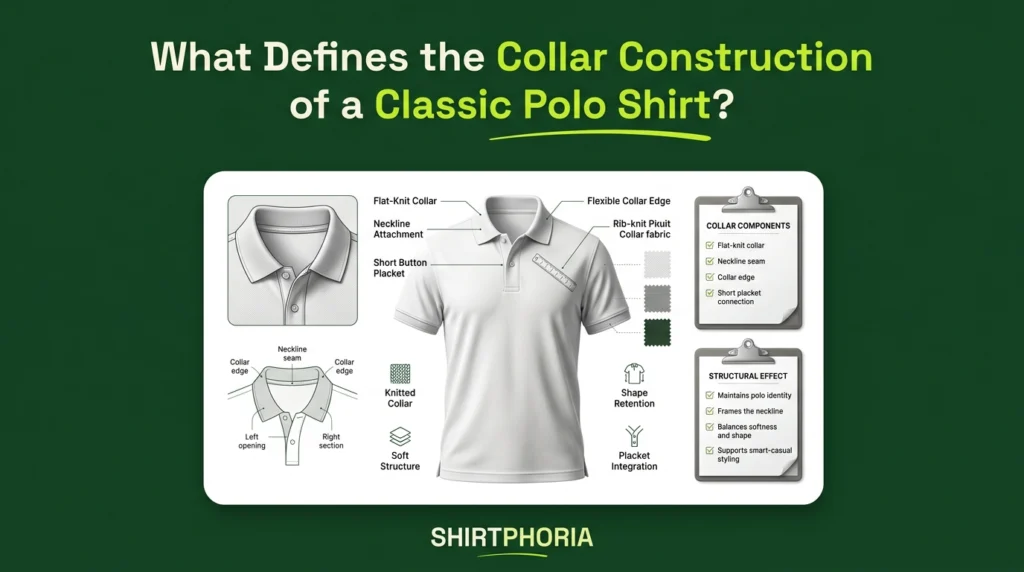
The collar construction of a classic polo shirt is defined by a knit collar system that uses collar shape, rib or flat-knit structure, neckline attachment, placket support, and recovery behavior to create a soft but recognizable collar.
The collar is one of the most visible identity features of a polo shirt, but it does not work alone. Its quality depends on how knit density, yarn behavior, edge finishing, attachment stitching, placket stability, and laundering response work together.
The collar’s role becomes clearer when placed inside the larger polo shirt structure.
This guide explains the anatomy, knit construction, recovery behavior, manufacturing methods, and quality checks that define a classic polo shirt collar.
Why Does Polo Shirt Collar Construction Matter?
Polo shirt collar construction matters because the collar controls the neckline shape, supports the shirt’s smart-casual signal, and reveals whether the knit structure can resist curling, sagging, or distortion.
A basic T-shirt normally uses a collarless neckband or binding. A polo adds a visible folding collar around the neckline.
This relationship can be summarized as:
Knit Collar → Frames Neckline → Creates Polo Identity
The visible collar gives the upper part of the polo more structure, but it does not make the garment formal by itself.
Fabric texture, fit, placket construction, color, sleeve design, and styling context also influence the final appearance.
A well-shaped collar can support a cleaner neckline. A collar that curls, collapses, or becomes heavily distorted can weaken that structure.
How Does the Polo Collar Differ From a Henley Neckline?
The polo collar differs from a Henley neckline because the polo uses a collar structure around the neck, while the Henley relies on a collarless placket opening.
Both garments may use partial button plackets, but the plackets perform different structural jobs.
A polo combines the opening with a separate collar that frames the neck.
A Henley normally uses the placket with a bound or otherwise finished collarless neckline.
Polo Collar + Placket → Framed Neckline
Henley Placket Without Collar → Softer Neckline
The difference is structural rather than a judgment about which garment is better.
A Henley may work well where a flatter neckline is useful for layering, while a polo provides more visible neckline definition.
This contrast is clearer in a direct Henley vs polo collar comparison.
How Does the Collar Affect Polo Shirt Formality?
The collar affects polo shirt formality by giving the neckline more structure than a collarless knit shirt, but the final formality depends on the whole garment.
A stable collar can support a clean appearance with chinos, tailored trousers, an overshirt, or some casual jackets.
The relationship is:
Stable Collar Shape → Cleaner Neckline → Stronger Smart-Casual Signal
Collar condition matters because curling, uncontrolled collapse, or severe waviness can make the neckline look less organized.
However, collar structure alone cannot turn every polo into a formal shirt.
A shiny technical fabric, strained fit, unstable placket, bright athletic detailing, or a strict dress code can override the visual polish provided by the collar.
How Do the Placket and Collar Work Together?
The placket and collar work together because the placket anchors the neckline opening while the collar frames the top edge of the shirt.
A placket is the reinforced front opening that normally holds the polo’s buttons and buttonholes.
It creates a controlled break in the neckline while providing support around the base of the collar.
Stable Placket → Anchors Collar Base → Improves Neckline Control
If the placket twists, stretches, or gaps excessively, the neckline may lose stability even when the collar itself is well constructed.
A very rigid placket can create the opposite problem. It may resist distortion but feel too stiff for a soft knit garment.
Good polo construction balances support with flexibility.
What Are the Key Components of a Classic Polo Shirt Collar?
The key components of a classic polo shirt collar are the collar leaf, the neckline attachment area, the support structure, and the placket system that helps control the collar base.
Not every polo uses exactly the same internal construction.
Some rely mainly on knit density and carefully shaped edges. Others may use double-ply construction, a support layer, or another stabilizing method.
The important question is how well the complete system controls collar shape.
What Is the Collar Leaf in a Polo Shirt?
The collar leaf is the visible fold-over portion of the polo collar that shapes the neckline and determines how the collar lies against the upper chest.
Depending on the design, the collar leaf may use:
- rib knit
- flat knit
- self-fabric
- double-layer construction
- another coordinated knit structure
Its main relationship is:
Collar Leaf → Creates Visible Collar Shape → Controls Drape and Roll
A soft collar leaf can create a relaxed roll.
If it is too soft for the design, it may collapse or curl.
A heavily supported collar leaf may hold its shape more strongly, but excessive stiffness can make a knit polo look or feel forced.
The correct behavior depends on the intended collar design.
What Is the Collar Band or Neckline Attachment Area?
The collar band or neckline attachment area is the zone where the polo collar is sewn to the shirt body and where the collar gains much of its base stability.
Some polo designs create a visible band-like area around the neck.
Others attach a separately knitted collar more directly to the neckline.
The structural relationship is:
Neckline Attachment → Stabilizes Collar Base → Controls Collar Height
This area affects how the collar rises, folds, and settles around the neck.
Too little stability can allow the collar to flatten, twist, or distort.
Too much reinforcement may make the neckline feel stiff or bulky.
The attachment should therefore suit the body fabric and intended collar roll.
How Does Interlining or Double-Ply Knit Support a Polo Collar?
Interlining or double-ply knit can support a polo collar by adding body, shape retention, or thickness when the collar fabric alone is not stable enough.
Interlining is an internal support material placed between fabric layers in some garment components.
Not every classic polo collar uses interlining, and polo construction should not be assumed to follow dress-shirt collar construction.
Other designs may use:
- double-ply knit
- denser knitted collar fabric
- reinforced edges
- shaped knit construction
- controlled seam finishing
The relationship is:
Support Layer or Double-Ply Knit → Adds Collar Body → Improves Shape Stability
Support must remain proportional to the garment.
Too little can allow unwanted collapse or curl.
Too much can make the collar feel hot, stiff, bulky, or visually disconnected from the soft knit body.
Figure: Exploded View of a Polo Collar System
An exploded construction view would show the collar leaf, neckline attachment, support layer or double-ply knit, placket, and attachment stitch line as connected parts of one collar system.
How Does Rib Knit Define Classic Polo Shirt Collar Construction?
Rib knit defines many classic polo shirt collars because its vertical rib structure can provide stretch, recovery, and shape control at the neckline.
Rib Knit is produced with alternating knitted structures that create raised vertical ribs and recessed channels.
Towin Textile describes rib fabric as a knitted structure known for vertical rib texture, widthwise stretch, and shape-recovery behavior, with common uses including collars, cuffs, neckbands, and hems. Towin Textile rib-knit guide
This makes rib construction useful in areas that need to expand during wear and then return toward their original shape.
Rib-Knit Structure → Supports Stretch Recovery → Helps Collar Shape Retention
Rib knit does not guarantee a durable collar.
Yarn quality, knit density, tension, fiber composition, finishing, attachment stitching, laundering, heat, and repeated wear can all change its performance.
How Do 1×1 and 2×2 Rib Structures Affect Collar Behavior?
1×1 and 2×2 rib structures affect collar behavior by changing the balance between stretch, texture, thickness, and recovery.
A 1×1 Rib alternates individual knit and purl columns.
This creates a relatively fine rib pattern that can provide substantial elasticity while keeping the surface visually compact.
A 2×2 Rib uses wider paired columns.
The ribs therefore appear more pronounced and may create a stronger textured effect.
The structural relationship is:
Rib Configuration → Changes Elastic Behavior → Affects Collar Recovery
Neither configuration has one fixed level of stretch or durability.
Performance changes with:
- yarn type
- knit gauge
- fiber composition
- elastane content
- fabric density
- finishing
- collar dimensions
A 1×1 collar in one fabric can behave very differently from another 1×1 collar produced with different yarn and knitting specifications.
How Does Collar Memory Affect Polo Shirt Quality?
Collar memory affects polo shirt quality by determining whether the collar returns close to its intended shape after wear, laundering, or gentle stretching.
Collar memory describes the ability of the collar material to recover after temporary deformation.
A useful relationship is:
Better Recovery → Less Permanent Distortion → Cleaner Collar Shape
A collar does not need to snap back instantly to demonstrate useful recovery.
Instead, it should return reasonably close to its original form after a small, gentle deformation.
Recovery can weaken over time.
Repeated pulling, heat, moisture, aggressive washing, drying methods, and material fatigue can reduce how well the collar returns to shape.
Collar memory should therefore be evaluated together with construction and care.
Why Do Polo Collars Curl or Develop Bacon-Neck?
Polo collars curl or develop bacon-neck when the collar loses shape through repeated stretching, heat, moisture, laundering stress, weak recovery, or poor attachment.
Bacon-neck describes a visible wavy, rippled, or stretched appearance around a neckline or collar edge.
The Guardian has discussed textile-expert explanations linking this type of distortion with repeated mechanical stress, washing, heat, and deterioration of elastic recovery. The Guardian on bacon-neck and collar care
The mechanism can be understood as:
Repeated Stress + Heat or Moisture → Reduced Recovery → Wavy Collar Distortion
A collar may also curl because the edge behaves differently from the center of the knit, the attachment seam is poorly balanced, or the collar fabric is too weak for the design.
Rib knit can reduce distortion risk when yarn, density, finishing, attachment, and care are suitable.
It cannot make a collar permanently curl-proof.
How Do Fully Fashioned and Cut-and-Sew Collar Methods Differ?
Fully fashioned and cut-and-sew collar methods differ because one shapes knitted pieces during production, while the other cuts pieces from pre-made knit fabric and then sews them into the garment.
A Fully Fashioned knitted component is shaped during knitting rather than cut from a larger finished fabric sheet.
A Cut-and-Sew component begins with pre-made knit fabric that is cut to a required pattern shape and then stitched into the garment.
Glenmuir explains this manufacturing distinction and notes that the construction methods should not be treated as a universal better-versus-worse hierarchy because suitability depends on the garment and wearer. Glenmuir fully fashioned knitwear guide
The method is one quality signal, not the final verdict.
When Can a Fully Fashioned Polo Collar Be a Quality Signal?
A fully fashioned polo collar can be a quality signal when the collar is shaped cleanly during knitting and the edges, tension, and attachment support stable wear.
Because shaping occurs during the knitting process, the component can be produced without cutting its main shape from a larger sheet of knit fabric.
The potential relationship is:
Shaped Knit Construction → Cleaner Edge Control → Better Collar Stability Potential
This can produce controlled edges and a neat transition between knitted sections.
However, fully fashioned construction is not automatically superior.
Poor yarn, inconsistent knitting tension, weak attachment, or incorrect collar proportions can still produce disappointing results.
When inspecting a fully fashioned collar, look at the actual outcome:
- Does it recover after gentle stretching?
- Are its edges smooth?
- Do the collar tips behave evenly?
- Is the attachment clean?
- Does it suit the body fabric?
The construction term should support inspection, not replace it.
When Can a Cut-and-Sew Polo Collar Still Perform Well?
A cut-and-sew polo collar can still perform well when the collar fabric, edge finishing, stitching, and neckline attachment are correctly matched.
The construction works through a different route:
Cut Knit Piece + Strong Finishing → Stable Attachment → Functional Collar Performance
A well-made cut-and-sew collar can maintain a clean roll and stable neckline.
Its performance depends heavily on how the cut edges are controlled.
Problems may appear when:
- edges fray
- seam tension distorts the knit
- collar fabric lacks recovery
- attachment stitching puckers
- the collar is mismatched with body-fabric weight
Cut-and-sew should not be treated as a low-quality method simply because cutting and sewing are involved.
The finished behavior matters more than the manufacturing label alone.
How Can You Identify Durable Polo Collar Construction Before Buying?
You can identify durable polo collar construction before buying by testing recovery, checking edge finishing, inspecting stitch quality, and evaluating how the collar works with the placket.
No single shop-floor test can predict years of wear.
Several small checks together can reveal whether the collar already shows structural weaknesses.
In-Store Polo Collar Quality Check
| Quick Test | What to Look For | Warning Sign | Why It Matters |
|---|---|---|---|
| Gentle Recovery Test | Collar returns close to its original shape after light stretching | Collar remains wavy, stretched, or distorted | Recovery supports long-term collar shape |
| Collar Tip Check | Tips lie evenly or roll softly according to the design | Tips curl sharply, twist, or ripple before washing | Tip behavior affects visible collar neatness |
| Attachment Check | Neckline stitch line appears even and secure | Loose thread, puckering, skipped stitches, or pulling | Attachment stabilizes the collar base |
| Placket Check | Placket sits flat and supports the collar base | Gaping, twisting, or collapse near the buttons | Placket structure helps anchor the neckline |
| Fabric Density Check | Collar feels appropriately structured for the body fabric | Collar feels flimsy, excessively stiff, or mismatched | Density influences roll, recovery, and comfort |
These tests are comparative cues rather than guarantees.
A collar that passes them may still react differently after repeated washing, drying, moisture exposure, and wear.
How Should Collar Recovery Be Tested?
Collar recovery should be tested gently by stretching a small collar section and observing whether it returns close to its original shape without rippling.
Use only light pressure.
The goal is not to find the maximum stretch of the fabric.
Gentle Stretch → Recovery Observation → Collar Quality Cue
Release the material and watch whether the ribs or knitted surface settle close to their previous position.
Avoid aggressively pulling the collar tips or neckline because that can damage the garment rather than test it.
A single recovery test also cannot predict every wash result.
Long-term shape depends on heat, moisture, care methods, repeated wear, fiber behavior, and construction.
How Should Collar Attachment Be Inspected?
Collar attachment should be inspected by checking the stitch line where the collar meets the shirt body for even tension, clean finishing, and no visible pulling.
A strong collar can behave poorly if the attachment seam is unstable.
Look for:
- even stitches
- no skipped sections
- minimal puckering
- no obvious loose thread
- a balanced neckline curve
- no local pulling at the back neck
The relationship is:
Clean Attachment → Stabilizes Collar Base → Reduces Distortion Risk
Some polos use back-neck tape or other finishing that partly covers the seam.
When possible, examine both the inside and outside of the neckline rather than relying only on decorative finishing.
How Should Collar Tip Integrity Be Evaluated?
Collar tip integrity should be evaluated by checking whether the tips lie evenly, avoid sharp curling, and match the intended collar roll.
A classic polo collar does not necessarily need to behave like a stiff dress-shirt collar.
Some designs are intended to roll softly.
The useful relationship is:
Even Collar Tips → Controlled Edge Behavior → Cleaner Polo Appearance
Look for symmetry and control rather than complete flatness.
A warning sign is one tip twisting strongly while the other sits normally, particularly before the garment has even been washed.
Heat, laundering, storage, and repeated folding can still alter tip behavior over time.
What Failure Modes Can Distort Classic Polo Collar Construction?
Classic polo collar construction fails when support, recovery, attachment, or edge control moves too far in either direction, because both underbuilt and overbuilt collars can distort the shirt’s identity.
A collar can fail from too little structure, but excessive structure can create different problems.
| Attribute | Too-Low Failure | Too-High Failure | Corrective Approach |
|---|---|---|---|
| Rib-Knit Recovery | Collar stretches, waves, or develops bacon-neck distortion | Collar feels rigid, tight, or excessively springy | Balance yarn, rib configuration, density, and finishing |
| Collar Support | Collar collapses, curls, or lies without intended shape | Collar behaves too much like a stiff woven collar | Match support to body-fabric weight and intended roll |
| Placket Stability | Neckline twists, gaps, or collapses below the collar | Placket feels rigid and uncomfortable | Balance reinforcement with knit flexibility |
| Collar Attachment | Collar puckers, pulls away, or distorts at the neckline | Heavy stitching creates bulk or stiffness | Match stitch density and thread to the fabrics |
| Edge Finishing | Collar edge frays, ripples, or curls | Edge becomes thick or visually heavy | Stabilize the edge without overbuilding it |
| Collar Tip Control | Tips twist, curl sharply, or become uneven | Tips become excessively flat or stiff | Match tip structure to the intended collar roll |
| Fully Fashioned Construction | Weak yarn or poor shaping still permits distortion | Construction terminology is treated as proof of quality | Judge recovery, yarn, edges, and attachment together |
| Cut-and-Sew Construction | Weak edges or stitching allow fray and distortion | Excessive seam construction creates bulk | Judge edge finishing and attachment rather than the label alone |
These failure modes demonstrate why collar quality is a balance.
More support is not always better.
More elasticity is not always better.
The collar needs enough recovery and structure to hold its intended form without losing the softness expected from a knit polo.
Comparison Summary: Key Distinctions in Polo Collar Construction
A polo collar construction summary helps users connect each collar component to its structural role and common failure point.
| Component | Defining Feature | Function | Common Failure Risk |
|---|---|---|---|
| Collar Leaf | Visible fold-over collar portion | Shapes neckline and controls collar roll | Curling, twisting, collapse, uneven tips |
| Rib Knit | Vertical rib texture with stretch and recovery potential | Supports elasticity and shape return | Waviness or bacon-neck when recovery weakens |
| Support Layer / Double-Ply Knit | Added body through interlining, double-ply, or denser knit | Helps collar maintain intended shape | Too soft may collapse; too stiff may feel heavy |
| Placket | Reinforced neckline opening containing closures | Anchors collar base and controls opening | Gaping, twisting, pulling, excess rigidity |
| Attachment Seam | Stitch line joining collar to shirt body | Stabilizes collar base | Puckering, loose thread, skipped stitches, excess bulk |
| Edge Finishing | Finished perimeter or shaped knitted edge | Controls fraying, curl, and tip behavior | Fraying, rippling, bulky edges, uneven roll |
The strongest collar is not necessarily the stiffest or thickest one.
Each component should be proportioned to the body fabric and intended collar shape.
Checklist: How Can You Choose a Better Classic Polo Shirt Collar?
You can choose a better classic polo shirt collar by inspecting recovery, edge control, placket support, attachment quality, and how the collar behaves before washing.
Frequently Asked Questions About Classic Polo Shirt Collar Construction
A good polo shirt collar usually has balanced recovery, stable attachment, clean edge finishing, and enough structure to maintain its intended roll. It should not already show severe waviness, uncontrolled curl, weak stitching, or a placket that collapses beneath the collar.
Polo collars can curl because of weak recovery, edge imbalance, repeated stretching, heat, moisture, washing stress, or mismatched support. Rib knit can reduce distortion risk when properly constructed, but no knitted polo collar is completely curl-proof under every condition.
Rib knit is common because its structure can provide useful stretch and recovery around collars and necklines. It is not automatically the best construction for every polo. Yarn quality, density, finishing, attachment, body-fabric weight, and intended collar shape also matter.
Fully fashioned collars can be a quality signal because the component is shaped during knitting rather than cut from a larger fabric sheet. They are not automatically superior. A well-finished cut-and-sew collar can also perform effectively when its fabric, edges, stitching, and attachment are controlled.
Choose a collar with useful recovery, stable edges, clean attachment, and suitable density. Follow the garment’s care instructions and limit unnecessary pulling or excessive heat. Bacon-neck risk depends on material recovery, mechanical stress, washing, moisture, heat, and construction quality.
What Are the Key Takeaways of Classic Polo Shirt Collar Construction?
The key takeaways of classic polo shirt collar construction show that collar quality comes from recovery, support, attachment, edge finishing, and care behavior working together.
- Collar Quality Is System-Based: No single material or manufacturing method proves quality by itself.
- The Collar Leaf Creates Visible Shape: Its weight, stiffness, and edge behavior control how the collar folds and rolls.
- Rib Knit Can Support Recovery: Rib structures provide useful elasticity, but they cannot guarantee permanent shape retention.
- Collar Memory Matters: Useful recovery allows the knit to return close to its intended shape after temporary deformation.
- Bacon-Neck Has Multiple Causes: Stretching, heat, moisture, washing, weakened recovery, and construction can all contribute.
- Support Must Be Balanced: Too little support can allow collapse; too much can make the collar excessively stiff.
- Placket Stability Matters: The collar depends partly on a controlled neckline opening beneath it.
- Attachment Quality Matters: Poor stitch tension can distort even a well-made knitted collar.
- Fully Fashioned Is a Signal, Not Proof: The manufacturing method still needs good yarn, shaping, finishing, and attachment.
- Cut-and-Sew Can Perform Well: Its quality depends on fabric recovery, edge finishing, stitching, and assembly.
- Care Influences Collar Life: Washing, drying, pulling, storage, heat, and moisture can change collar behavior over time.
Terms Explained
| TERM | DEFINITION |
|---|---|
| Collar leaf | The visible fold-over portion of a polo collar that controls its roll and visible shape. |
| Rib knit | A knitted structure with raised vertical ribs and recessed channels that can provide stretch and recovery. |
| Collar memory | The ability of collar material to recover toward its intended shape after temporary deformation. |
| Bacon-neck | A wavy, rippled, or stretched distortion around a neckline or collar edge. |
| Interlining | An internal support material used between fabric layers in some garment components. |
| Double-ply knit | A collar construction using multiple knit layers to add body and shape stability. |
| Fully fashioned | A knitted component shaped during knitting instead of cut from a larger finished fabric sheet. |
| Cut-and-sew | A method where knit fabric is cut into pattern pieces and then sewn into the garment. |
| Placket | The reinforced front opening that holds buttons and helps stabilize the base of the polo collar. |
| Attachment seam | The stitch line joining the collar to the shirt body. |
| Edge finishing | The treatment used to control fraying, curling, rippling, and tip behavior around collar edges. |
Conclusion
In conclusion, classic polo shirt collar construction is best understood as a knit collar system shaped by recovery, support, attachment, edge finishing, and placket stability.
The collar leaf creates the visible fold-over shape. The neckline attachment controls the stability of its base. Rib knit can provide useful stretch and recovery, while double-ply construction or other support methods can add body when required.
The placket helps stabilize the center-front neckline, while attachment stitching connects the collar to the shirt body. Edge finishing influences curling, fraying, and collar-tip behavior.
Fully fashioned and cut-and-sew methods use different production approaches, but neither method guarantees a better collar on its own.
Long-term collar shape also depends on wear and care. Repeated stretching, laundering, moisture, heat, and storage can change how a knit collar recovers.
No classic polo collar is completely bacon-neck proof, curl proof, or guaranteed to retain its original shape forever.
Choosing a classic polo shirt collar well means judging recovery, structure, attachment, and care behavior as one connected collar system.