How Does a Henley Shirt Differ From a Polo Shirt in Collar Design?
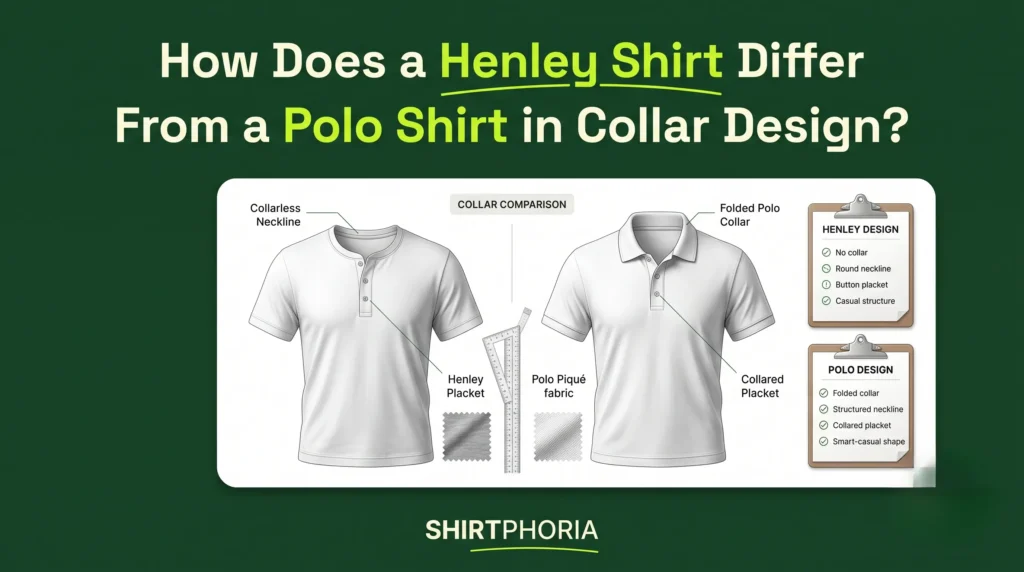
A Henley shirt differs from a Polo shirt in collar design because the Polo uses a visible collar structure, while the Henley uses a collarless neckline with a partial button placket.
Although both shirts normally include buttons at the upper chest, they do not perform the same styling or construction task. A Polo creates visible collar structure around the neck, while a Henley usually creates a flatter neckline profile with less collar height. Confusing the two can lead to styling mismatches, especially when an outfit requires a defined collar, smooth base layering, or a particular level of casual formality.
A Polo often works better when an outfit needs collar definition or when a setting expects a collared casual shirt. A Henley often works better when the shirt needs to sit under another layer without adding a separate collar. These are practical guidelines rather than fixed rules because the result also depends on fabric weight, collar construction, placket depth, neckline finishing, fit, and styling context.
This guide first explains the anatomical difference between the Polo collar and the Henley neckline. It then compares their formality, layering behavior, placket construction, fabric requirements, and most suitable styling tasks.
- How Polo collar construction creates visible neckline structure.
- How Henley neckline construction creates a flatter collarless profile.
- How neckline finishing differs between Henleys and Polos.
- How placket construction differs between the two shirt types.
- How collar presence affects perceived formality and layering compatibility.
- How to choose between a Henley and a Polo based on the styling task.
Written by Shirtphoria, created under the editorial direction of Abdimalik Mohamed, Founder of Shirtphoria.
The Fundamental Structural Divergence in Shirt Necklines
The fundamental difference is that a Polo combines a partial button placket with a visible collar, while a Henley combines its placket with a collarless neckline finish.
This changes how each shirt frames the neck, supports the front opening, interacts with outer layers, and communicates visual formality. The buttons are only one component. The construction surrounding those buttons determines whether the garment functions as a collared knit shirt or a collarless placket shirt.
Defining the Polo Shirt’s Collar Anatomy and Stance
A Polo shirt is usually defined by a visible collar attached around the neckline, often supported by a short button placket at the front opening.
The collar strongly influences the Polo’s neckline structure, upper-chest framing, and perceived formality. When the collar lies flat, it creates a clear boundary around the neck and upper chest. Depending on the design, it may fold softly, form a more visible roll, or maintain a relatively firm stance.
Polo collars are not limited to one construction method. They may be produced from rib knit, flat knit, self-fabric, or another coordinated knit structure. A traditional ready-to-wear Polo may use a separately knitted collar, while another design may use rib knit or the same fabric as the shirt body.
Thread Theory’s Polo construction guide explains that rib knit can be used for a Polo collar and that self-fabric may be suitable when the selected knit is light enough. The guide also notes that knit interfacing can reinforce the front placket and that twill tape may reinforce the collar seam. These methods are construction options rather than requirements for every Polo shirt.
Source: Thread Theory Polo guide
Rib knit can provide stretch, recovery, texture, and support, but it does not guarantee a stiff collar. Collar behavior depends on the rib structure, yarn, fabric weight, stretch recovery, seam construction, and support provided around the placket and neckline.
CottonWorks identifies rib knit as a common material for stretchy trims such as necklines, cuffs, and waistbands. It also distinguishes flat knit trims as heavier structures and identifies piqué as a breathable knit commonly used for Polo shirts. These textile choices can influence how strongly the collar holds its shape and how much contrast it creates against the shirt body.
Source: CottonWorks knit basics
The collar stand or roll on a soft Polo is not identical to the structured stand found on many woven dress shirts. Instead, it refers to how the knit collar rises, folds, and settles around the neckline. A heavier flat-knit collar may create a more defined stance, while a lightweight self-fabric collar may sit closer to the body.
Defining the Henley Shirt’s Collarless, Bound Neckline
A Henley shirt is usually defined by a collarless neckline and a partial button placket that opens at the upper chest.
Unlike the Polo, the Henley does not have a separate collar folding around the neck. Its neckline may instead be completed with self-fabric binding, rib binding, a knit neckband, or another collarless finish selected according to the pattern, fabric stretch, and construction method.
The absence of a separate Polo-style collar usually gives the Henley less neckline height and less visible structure. However, this does not mean the neckline has no structure. The knit neckband, bound neckline, placket reinforcement, stitching, and fabric weight can still influence how firmly the opening sits against the body.
A knit neckband usually forms a visible band around the opening, while knit binding may wrap or finish the raw neckline edge with a flatter profile. Self-fabric binding can create close visual continuity with the body of the shirt. Rib binding may provide greater stretch or recovery, depending on the selected material.
Melly Sews’ knit neckline guide demonstrates that knit necklines can be completed through different neckband and binding methods. The selected technique affects how the neckline stretches, lies against the body, and manages the raw edge. It should not be assumed that every Henley uses the same finish.
Source: Melly Sews neckline guide
The Henley placket is generally positioned at the center front and attached directly to the shirt body and neckline area. Its construction may involve separate placket pieces, fusible interfacing, clipping, overlapping, pressing, and topstitching.
Thread Theory’s Henley placket guide shows one method in which fusible interfacing is applied to the placket pieces before they are aligned with center-front markings and stitched to the shirt. The pieces are then manipulated to form the finished overlapping opening. This demonstrates one valid Henley construction method without suggesting that every Henley uses the same placket depth, button count, or reinforcement technique.
Source: Thread Theory Henley guide
How Collar Design Impacts Shirt Formality and Styling Task Fulfilment
Collar design strongly influences how each shirt is perceived and how comfortably it works within a layered outfit.
A visible collar normally adds a clearer neckline boundary and a more structured visual signal. A collarless neckline normally creates a softer transition between the neck, shirt body, and outer layer. Neither result is universally better. Each supports a different styling task.
The Polo Collar’s Role in Formality and Neck Coverage
The Polo collar often supports a more structured casual appearance because it frames the neck and upper chest more visibly than a collarless Henley neckline.
The visible collar can make the Polo appear more polished than a basic collarless knit shirt. However, the Polo is not automatically formal. Its perceived formality still depends on fit, collar condition, placket construction, fabric texture, sleeve design, color, and the rest of the outfit.
A Polo is often the cleaner choice when the setting expects a collared casual shirt, but it is not automatically formal.
For example, a well-shaped Polo made from a stable piqué knit may work in a smart-casual outfit with tailored trousers or clean chinos. A lightweight athletic Polo with contrast branding may communicate a more sporting purpose. Both garments have collars, but they do not necessarily occupy the same level of formality.
CottonWorks describes piqué as a breathable knit suitable for Polo shirts and rib knit as a stretchy trim material for necklines. These characteristics help explain why piqué bodies and ribbed or flat-knit collars frequently appear together, but they do not establish a universal Polo construction formula.
Wearing the collar flat usually creates a neater casual appearance. Turning it upward is a styling choice that may appear sporty, protective, retro, or intentionally bold depending on the setting. The result comes from styling context rather than a fixed rule about correct collar use.
The Henley Neckline’s Role in Base Layering and Perceived Vertical Line
The Henley neckline often works well for base layering because its collarless profile can reduce neckline bulk under outerwear.
Without a separate collar interrupting the neckline, an open Henley placket may create a cleaner vertical path under jackets, overshirts, or sweaters. This makes it useful when another garment already supplies the outfit’s main collar, lapel, or neckline structure.
When one or two buttons are open, the placket may create a more open neckline and a stronger perceived vertical line. The opening can direct visual attention downward from the neck, but this is a styling effect rather than a physical change to neck or body proportions.
Closing all the buttons generally creates a more contained neckline. Opening some of the buttons creates a softer and more relaxed effect. The exact result depends on placket length, button spacing, neckline width, fabric drape, and how closely the shirt fits.
The Henley is particularly useful beneath garments such as:
- An open overshirt
- A denim or workwear jacket
- A casual blazer
- A cardigan
- A zip-front jacket
- A crewneck sweater with enough neckline clearance
The Henley may still create bunching when its neckline binding is thick, the placket is heavily reinforced, or the outer layer is very close-fitting. Collarless construction can reduce bulk, but it does not guarantee completely flat layering.
Structural Placket Differences Between Henley and Polo Shirts
Henley and Polo plackets differ because they support different neckline jobs: the Henley placket opens a collarless neckline, while the Polo placket works with a collar structure.
A Polo placket forms part of a larger neckline system. It helps shape the center-front opening while the collar surrounds the remaining neckline. Many Polo plackets use knit interfacing, stable knit, reinforced stitching, or another supporting construction to keep the opening controlled and help the collar area remain balanced.
The precise reinforcement depends on the garment. A lightweight knit may benefit from knit interfacing, while a more stable fabric may require less additional support. Collar seam reinforcement can also help control stretching and conceal seam allowances in certain designs.
A Henley placket connects more directly to the collarless neckline. It may be longer or softer than a typical Polo placket, but length, fabric, button count, and stiffness vary widely. Some Henleys have a narrow, flexible opening, while others use substantial placket pieces and visible topstitching.
Henley placket construction may involve applying interfacing, matching the placket pieces to center-front markings, stitching around a marked opening, clipping into the opening, turning the pieces, overlapping them, and securing the base. These steps help control an area of the knit fabric that would otherwise be vulnerable to stretching or distortion.
A longer or softer Polo placket may reduce collar support if the opening is not stabilized with suitable fabric, interfacing, stitching, or construction. Similarly, an overly rigid Henley placket may create unnecessary bulk or prevent the collarless neckline from draping naturally.
Technical Comparison of Henley and Polo Collar Design
A direct technical comparison shows how collar presence, neckline finish, placket support, and fabric behavior shift the garment’s primary styling function.
The following comparison describes common construction and styling patterns, not universal manufacturing rules. Actual Henley and Polo designs vary by brand, fabric, placket depth, collar construction, neckline finish, and intended use.
| Design Feature | Henley Shirt Neckline | Polo Shirt Collar | Styling Outcome Influenced |
|---|---|---|---|
| Primary Structure | Collarless neckline with partial button placket | Visible collar with partial button placket | Perceived formality and neckline definition |
| Neckline Finish | Often self-fabric binding, rib binding, knit neckband, or another collarless finish | Often rib knit, flat knit, self-fabric, or another collar construction | Layering bulk and neckline cleanliness |
| Placket Connection | Often connects directly to the body and neckline finish | Usually works with the collar opening and front neckline structure | Stance, support, and opening shape |
| Textile Material | Often matches or coordinates with the body knit | Often uses rib, piqué, flat knit, or coordinated knit construction | Texture, recovery, and visual contrast |
| Formal Range | Casual to elevated casual depending on fabric and fit | Casual to smart casual depending on collar structure and styling | Occasion suitability |
| Layering Role | Often strong as a base layer under jackets or overshirts | Often stronger as a visible top layer or collared casual layer | Outfit role and neckline bulk |
The neckline-finish and textile distinctions in this comparison reflect common options documented in knit neckline, Polo construction, and textile references. They should not be interpreted as requirements for every shirt.
Use this table as a styling and construction guide, not as a fixed rulebook. Specific shirts may differ based on collar shape, placket depth, knit weight, neckline finish, and brand design.
Final Checklist for Selecting Based on Collar Design
Choosing between a Henley and a Polo requires evaluating layering needs, neckline structure, and the required level of visual formality.
A real outfit test is more reliable than selecting the shirt type by name alone. Two Polos can have different collar behavior, just as two Henleys can have different placket depth, neckline binding, and fabric drape.
Frequently Asked Questions
A Polo has a visible collar that folds around the neckline. A Henley has no separate collar and instead uses a bound neckline or neckband with a partial button placket.
Not always. A Polo generally looks more structured because of its collar, but its formality still depends on fabric, fit, collar condition, branding, color, and the rest of the outfit.
A Henley often layers more smoothly because it has no separate collar. However, a thick neckband, rigid placket, or very close-fitting jacket can still create bulk.
No. A Henley placket opens and stabilizes a collarless neckline. A Polo placket works together with the collar and helps support the front neckline structure.
Yes. Its neckband, binding, stitching, placket reinforcement, fabric weight, and fit can all create structure even though the shirt does not have a Polo-style collar.
Terms Explained
| Term | Definition |
|---|---|
| Collarless Neckline | A neckline finished without a separate folding collar, commonly using binding, ribbing, or a knit neckband. |
| Partial Placket | A buttoned opening that extends only partway down the front of a shirt rather than opening from neck to hem. |
| Rib Knit | A knit structure with raised vertical ribs that can provide stretch, recovery, texture, and support around trims and collars. |
| Flat Knit Collar | A separately knitted collar construction that can be heavier and more defined than a lightweight self-fabric collar. |
| Self-Fabric | The same or closely matching fabric used for both the shirt body and a neckline, collar, or binding component. |
| Knit Neckband | A strip of knit fabric joined around the neckline to finish the opening and help it sit against the body. |
| Knit Binding | A narrow knit strip wrapped around or sewn to a raw neckline edge to create a flatter finished profile. |
| Collar Stance | The amount a collar rises, rolls, folds, and holds its position around the neckline. |
| Piqué Knit | A textured and breathable knit commonly associated with Polo shirt bodies. |
| Placket Reinforcement | Interfacing, stable fabric, stitching, tape, or another construction method used to reduce stretching and distortion around an opening. |
Conclusion
The main difference between a Henley and a Polo is not the presence of buttons; it is the way each shirt handles the neckline.
The Polo uses a visible collar structure to create stronger neckline definition and a more polished casual profile. The Henley uses a collarless placket neckline to create a flatter, softer, and often more layer-friendly profile.
Choose the Polo when the outfit benefits from visible collar structure or when the setting expects a collared casual shirt. Choose the Henley when the outfit needs cleaner base layering, less collar overlap, or a softer open neckline.
Once you understand the collar structure and neckline finish, the choice between a Henley and a Polo becomes a styling decision instead of a guessing game.