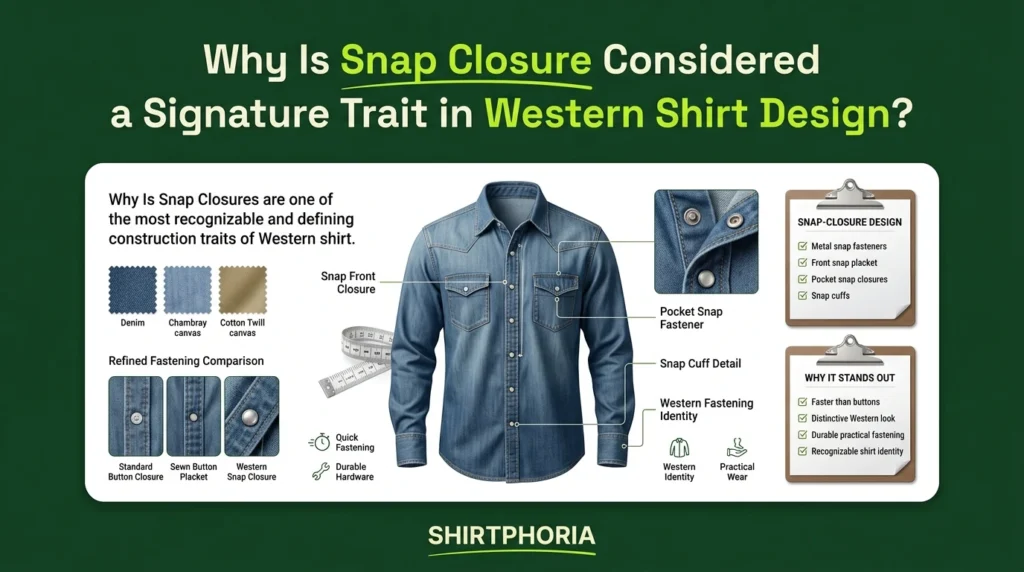
Why Are Snap Closures a Signature Trait in Western Shirt Design?
Snap closures are a signature trait in Western shirt design because they can release under pulling force, operate more easily than small sewn buttons, and create the visible pearl-snap identity associated with classic Western wear.
Snap closures on Western shirts should be understood as a hardware system rather than decoration alone.
A traditional shirt button is sewn to fabric with thread and passes through a buttonhole. A snap works differently. Its mating hardware presses together to close and pulls apart to release. That mechanical behavior can make the shirt faster to operate, easier to handle with gloves, and capable of releasing under some sudden pulling conditions.
The history of this closure is strongly connected with Jack A. Weil and Rockmount Ranch Wear. Rockmount states that Weil founded the company in Denver in 1946 and developed its signature Western shirt with snaps. Rockmount also explains the practical snag logic: if a rider’s shirt became caught, the snaps could release rather than forcing the fabric to absorb the entire pulling load. (Rockmount)
That does not mean snap closures guarantee personal safety. Release depends on hardware strength, pull direction, fabric reinforcement, and how the snaps were installed.
This guide explains how snap closures on Western shirts developed from practical ranch and rodeo hardware into one of the clearest visual markers of Western shirt design.
Snap closures are one part of the broader Western shirt system.
How Did Snap Closures Become Standard on Western Shirts?
Snap closures became strongly associated with Western shirts through Jack A. Weil and Rockmount Ranch Wear, whose 1940s designs helped make pearl snaps a defining Western-shirt detail.
Snap fasteners already existed before the modern Western shirt.
The important Western-wear development was their application and popularization as shirt-front hardware.
Rockmount identifies Jack A. Weil as its founder and dates the company to 1946. Its historical material connects his shirt design with snap closures, sawtooth pockets, and diamond pearl snaps.
This history should be described carefully.
It is reasonable to say that Weil and Rockmount helped popularize the snap-front Western shirt.
It is less precise to claim that one individual invented every type of snap fastener or every snap shirt.
The hardware existed separately.
The Western Shirt turned it into part of a recognizable garment system.
What Was Jack A. Weil’s Role in Pearl Snap Western Shirts?
Jack A. Weil’s role in pearl snap Western shirts was to popularize the snap-front Western shirt through Rockmount Ranch Wear after founding the company in Denver in 1946.
Rockmount’s historical account connects Weil’s signature shirt design with sawtooth pockets and diamond pearl snaps.
The combination mattered.
The snaps did more than replace ordinary buttons.
They became coordinated with:
- Western yokes
- Sawtooth pockets
- Wider cuffs
- Decorative hardware
- Western-oriented proportions
That created a recognizable shirt architecture.
Diamond Pearl Snap should therefore be understood as a strong Rockmount-associated design marker rather than a requirement for every Western Shirt.
Other manufacturers use different snap shapes, colors, metals, and decorative caps.
What Problem Did Snaps Solve Compared With Sewn Buttons?
Snaps solved a practical closure problem because a mechanically set snap can separate under pulling force, while a sewn button usually holds until the thread, buttonhole, or surrounding fabric fails.
The core relationship is:
Pulling Force → Separates Snap Closure → Can Reduce Fabric-Tear Risk
A sewn button depends on:
- Button thread
- Fabric strength
- Buttonhole construction
- Button attachment quality
A snap depends on a different system:
- Mating hardware
- Mechanical setting
- Placket reinforcement
- Metal or cap quality
- Fabric around the attachment point
This means snaps and buttons have different durability profiles.
Neither system is permanently superior.
A sewn button can loosen when its thread abrades.
A snap can loosen when its setting fails.
Decorative caps can chip.
Metal hardware can corrode.
Weak surrounding fabric can tear even when the snap itself remains intact.
The correct question is not simply “Are snaps stronger?”
The useful question is:
Does the closure system match the fabric, garment purpose, and expected stress?
How Do Snap Closures Work as Hardware?
Snap closures work as hardware by joining a socket and stud together through pressure, with a cap or post anchoring each side of the fastener to the shirt placket.
A Snap Fastener is made from mating hardware components rather than a single button.
Scovill describes a common snap assembly as four main parts: a cap and socket on the female side, plus a stud and post on the male side. (Scovill)
Cap
The cap is the visible outer component on one side of the snap.
On Western Shirts, this is often the decorative part.
It may appear as:
- Faux pearl
- Pearl-like resin
- Metal
- Colored material
- Diamond-shaped styling
- Engraved or decorative hardware
The cap contributes heavily to visual identity.
Socket
The socket is one of the mating internal components.
It receives or grips the corresponding stud when the two sides are pressed together.
The interaction between socket and stud creates the actual holding action.
Stud
The stud is the mating component that engages with the socket.
When pressed together correctly, the stud and socket remain connected until sufficient separating force is applied.
Post
The post, sometimes described through related backing or eyelet terminology depending on hardware design, helps anchor the snap assembly through the fabric.
Scovill’s component description identifies the cap and socket as one half and the stud and post as the other.
Placket
The placket is the reinforced shirt-front area that carries the closure system.
On a snap-front Western Shirt, the placket is critical because each snap transfers opening and closing forces into the surrounding fabric.
The hardware cannot perform properly if the fabric beneath it is unstable.
The complete system is therefore:
Cap + Socket + Stud + Post + Reinforced Placket
A high-quality snap attached badly can fail.
A strong placket with poor-quality hardware can also fail.
Performance comes from the combination.
Why Does the Placket Matter for Snap Performance?
The placket matters for snap performance because the snap hardware can only hold and release properly if the surrounding fabric is reinforced enough to resist tearing.
The construction relationship is:
Reinforced Placket → Supports Snap Hardware → Reduces Fabric Failure
Every time the wearer opens a snap, some pulling force reaches the fabric around the hardware.
If the placket is too weak, repeated use can cause:
- Puckering
- Distortion
- Enlarged attachment holes
- Fraying
- Local fabric tearing
- Snap pull-out
A practical inspection is simple.
Hold the shirt close to the snap rather than pulling from the edge of the fabric.
Open the closure.
Watch the surrounding placket.
If the entire area stretches dramatically or forms a cone around the snap, the fabric may be absorbing excessive stress.
More reinforcement is not automatically better.
An excessively heavy placket can become:
- Stiff
- Bulky
- Uncomfortable
- Difficult to drape
- Visually heavy
The ideal placket supports the hardware without making the front of the shirt rigid.
What Is the Breakaway Function of Snap Closures on Western Shirts?
The breakaway function of snap closures on Western shirts is that the hardware can separate under sudden pulling force, which may reduce snag-related fabric tearing or entrapment risk.
Rockmount explains this design logic through the example of a rider’s shirt becoming caught on a bull’s horn. In that situation, snap closures can release rather than requiring the fabric to remain attached until something tears.
This is a breakaway concept, not certified personal protection.
Snap release depends on:
- Snap retention strength
- Pulling direction
- Pulling speed
- Number of snaps engaged
- Fabric reinforcement
- Installation
- Hardware condition
The shirt should therefore never be treated as protective equipment simply because it uses snaps.
How Can Snaps Reduce Snag-Related Risk?
Snaps can reduce snag-related risk because the socket and stud may separate when the shirt front is pulled sharply by a fence, saddle horn, livestock horn, or another obstruction.
The relationship is:
Sudden Pull → Snap Separates → Shirt Can Release From Obstruction
With a conventional sewn button, a strong pull may instead be transferred through:
Button → Thread → Fabric
If those components continue holding, greater force reaches the garment.
Eventually the thread may fail, the button may tear free, or the fabric around the attachment point may rip.
A snap introduces another possible failure path:
The hardware separates first.
That can be useful.
It should still not be described as guaranteed injury prevention.
A very strong snap may not release under the particular force.
A poorly reinforced snap may pull through the cloth instead.
A snag can also occur elsewhere on the garment.
Snaps reduce one potential risk mechanism. They do not make riding, ranching, or rodeo activity inherently safe.
Why Should Release Strength Be Balanced?
Release strength must be balanced because a snap that is too weak opens during normal movement, while a snap that is too strong may fail to release when snagged or may stress the fabric.
There are three practical zones.
Too Weak
The snap may:
- Open when bending
- Release when the shirt stretches across the chest
- Pop loose during ordinary movement
- Fail to keep pocket flaps closed
Balanced
The snap:
- Remains closed during normal wear
- Opens intentionally without extreme force
- Maintains useful garment control
- Preserves the possibility of release under a stronger pull
Too Strong
The closure may:
- Require excessive opening force
- Distort the placket
- Transfer stress to the fabric
- Reduce the practical breakaway behavior
The desired relationship is:
Balanced Snap Tension → Prevents Accidental Opening → Preserves Useful Release Behavior
There is no universal release-force number for all Western Shirts.
Different hardware, fabrics, and manufacturers use different systems.
Why Are Snap Closures Useful for One-Handed or Gloved Operation?
Snap closures are useful for one-handed or gloved operation because pressing and pulling a snap requires less fine finger alignment than threading a small button through a buttonhole.
Ledbury’s history of the pearl-snap Western Shirt states that Rockmount added pearl snaps during the 1940s and notes that the snaps were easier for ranch workers to operate while wearing gloves. (Ledbury)
This usability advantage is easy to understand mechanically.
A standard button requires the wearer to:
- Grip the button.
- Locate the buttonhole.
- Align the button with the opening.
- Angle it through the hole.
- Pull the fabric into position.
A snap requires a different sequence:
- Align two mating components.
- Press them together.
To open:
- Pull the mating components apart.
That can require less finger precision.
Potential situations where this matters include:
- Gloves
- Cold weather
- Work-worn hands
- One-handed operation
- Riding
- Holding reins
- Carrying equipment
The benefit remains conditional.
A corroded, bent, damaged, overly stiff, or poorly aligned snap can be harder to use than a normal button.
How Do Snaps Improve Fastening Speed?
Snaps improve fastening speed by replacing the thread-through-buttonhole motion with a press-to-close and pull-to-open action.
The mechanical relationship is:
Press Closure → Reduces Dexterity Demand → Can Speed Operation
The advantage is most noticeable when the wearer has reduced fine finger control.
Gloves are an obvious example.
A small button can become difficult to manipulate through fabric while the hand is covered.
A correctly aligned snap gives the wearer a larger press-fastening target.
Speed should still not be treated as universal.
A damaged snap may jam.
A loose snap may fail to hold.
An incorrectly aligned snap can require repeated attempts.
Fast operation depends on functional hardware.
How Do Snap Closures Create the Visual Identity of Western Shirts?
Snap closures create the visual identity of Western shirts by turning the shirt front into a line of visible hardware, especially when pearl, metal, or diamond-style caps contrast against the fabric.
Conventional dress-shirt buttons are often visually restrained.
They may be:
- White
- Clear
- Fabric-matched
- Small
- Low-profile
Western snaps frequently take the opposite approach.
Their caps may deliberately remain visible.
That produces repeated points of contrast along:
- Front placket
- Chest pockets
- Cuffs
Rockmount’s historical design combines sawtooth pockets with diamond pearl snaps, showing how closure hardware can become part of a coordinated Western design system rather than remaining purely functional.
Wrangler also continues to produce snap-front Western shirts, showing that visible snap hardware remains part of current Western shirt construction and category recognition.
How Do Pearl and Metal Snaps Change the Shirt Front?
Pearl and metal snaps change the shirt front by adding contrast, reflection, and repeated visual rhythm down the placket.
The relationship is:
Visible Snap Caps → Add Contrast → Strengthen Western Identity
A Pearl Snap usually refers to a snap with a pearl-like decorative face.
That face may be:
- Genuine shell-based material in some designs
- Faux pearl
- Resin
- Synthetic decorative material
Real Mother-of-Pearl is not required for a shirt to qualify as Western.
Metal snaps create a different effect.
They can appear:
- Brushed
- Polished
- Darkened
- Antique-finished
- Bright silver-toned
- Decorative
Each finish changes how strongly the hardware stands out against the shirt fabric.
There is also an upper boundary.
Too little visual presence may make the closure read like generic hardware.
Too much ornamentation can overpower the yokes, fabric, pockets, and overall garment.
The snaps should support Western identity rather than carry the entire identity alone.
How Do Snaps Relate to Yokes and Flap Pockets?
Snaps relate to yokes and flap pockets because all three features create the visible front architecture that distinguishes many Western shirts from plain button-front shirts.
Think of the shirt front as one system.
Yokes create large geometric lines across the shoulders and chest.
Flap chest pockets create additional shapes and storage zones.
Snaps create repeated points of hardware.
Together, these features produce a highly recognizable composition.
A shirt does not need every possible Western feature to qualify.
Some Western Shirts use snaps and simple pockets.
Others emphasize pointed yokes.
Some modern versions reduce the hardware.
The stronger principle is:
The features should support one another.
Snaps also distinguish Western construction from many conventional button-front shirts, where sewn buttons remain the more common closure system.
Western Shirt Snap Closure Diagnostic Checklist
Snap closures on Western shirts can be evaluated by checking whether the hardware system is functional, repairable, visually coherent, and structurally appropriate for the garment.
Hardware Component Check
Inspect whether the closure is a real snap assembly rather than decorative faux hardware.
A functional system normally includes mating elements such as:
- Cap
- Socket
- Stud
- Post or backing
The visible cap alone does not make a complete functioning snap.
Placket Reinforcement Check
Inspect the fabric around each snap.
The placket should not show:
- Tearing
- Extreme puckering
- Enlarged holes
- Heavy distortion
- Loose snap attachment
Some visible reinforcement is useful because the hardware repeatedly transfers force into the front of the shirt.
Release Behavior Check
Close every snap and move normally.
The closures should remain engaged during:
- Standing
- Sitting
- Reaching
- Walking
- Ordinary torso movement
Then open them intentionally.
They should release without requiring extreme pulling force.
One-Handed Use Check
Try opening and closing several snaps with one hand.
A functional Western snap system should make operation reasonably simple.
Very stiff or poorly aligned snaps reduce this advantage.
Material Quality Check
Inspect hardware surfaces.
Watch for:
- Rust
- Corrosion
- Bent components
- Loose caps
- Cracks
- Chipped decorative surfaces
- Rough edges
Hardware condition affects both appearance and operation.
Visual Identity Check
The caps should make sense with the rest of the shirt.
Pearl, faux-pearl, metal, and diamond-style snaps can all support Western identity.
They should coordinate with:
- Yokes
- Pocket flaps
- Fabric
- Cuffs
- Stitching
- Overall design
Repairability Check
Determine whether damaged hardware can be replaced.
Unlike an ordinary button, which can often be resewn with thread, a snap generally needs compatible replacement parts and appropriate setting equipment.
A useful shirt should not depend on hardware that is impossible to match or repair.
Whole-Shirt Check
Do not identify a Western Shirt from the snaps alone.
Strong classification comes from the relationship between:
- Snaps
- Yokes
- Flap pockets
- Fabric
- Fit
- Cuffs
- Overall construction
A generic shirt with decorative snaps may be Western-inspired rather than a fully developed Western design.
How Do Snap Closures on Western Shirts Compare to Traditional Buttons?
Snap closures on Western shirts differ from traditional buttons because they use mechanical mating hardware rather than thread-sewn button attachment.
| Feature | Snap Closures on Western Shirts | Traditional Shirt Buttons | Practical Result |
|---|---|---|---|
| Attachment | Snaps are mechanically set into the placket with mating hardware components | Buttons are attached with thread | The two systems fail differently because snaps depend on setting and hardware while buttons depend strongly on thread and fabric |
| Release Behavior | Snaps can separate under pulling force | Buttons normally remain attached until thread, buttonhole, or fabric gives way | Snaps can support breakaway logic, but actual release depends on hardware and pull direction |
| Operation | Snaps can be pressed closed and pulled open | Buttons need to pass through buttonholes | Snaps can require less fine finger control, especially with gloves |
| Repair | Broken snaps usually require compatible parts and a setting tool | Lost buttons can commonly be resewn by hand | Buttons generally offer simpler field repair |
| Placket Stress | Snap opening force transfers directly around mechanically set hardware | Button stress is distributed through thread, button, buttonhole, and fabric | Both systems need appropriate reinforcement |
| Visual Identity | Pearl, metal, or diamond-style caps can remain highly visible | Buttons frequently blend into the shirt | Snaps create a stronger Western hardware signal |
| Failure Risk | Hardware may corrode, loosen, chip, bend, or pull through fabric | Thread may abrade, buttons may crack, or buttonholes may stretch | Neither closure is failure-proof |
| Dexterity | Functional snaps can be easier to operate with limited fine finger movement | Small buttons need more precise alignment | Snap advantage increases when glove use or dexterity matters |
The comparison does not produce one universal winner.
Buttons offer easy repair and low visual bulk.
Snaps offer a different release mechanism, less buttonhole manipulation, and stronger Western identity.
The appropriate closure depends on the shirt’s purpose.
What Failure Modes Can Distort Snap Closures on Western Shirts?
Snap closures on Western shirts fail when their main attributes move too far in either direction, because both weak and overbuilt hardware can damage function, comfort, or garment identity.
| Attribute | Too-Low Failure | Too-High Failure | Corrective Hypothesis |
|---|---|---|---|
| Snap Retention | Snaps open during normal movement | Snaps resist release and transfer excessive pulling stress into the placket | Match closure strength to fabric weight and use |
| Placket Reinforcement | Hardware puckers, stretches, or tears the shirt fabric | Shirt front becomes stiff, bulky, or uncomfortable | Reinforce sufficiently without overbuilding the placket |
| Metal Quality | Hardware corrodes, bends, loosens, or becomes rough | Excessively heavy hardware adds unnecessary weight and stiffness | Select hardware appropriate to laundering, wear level, and garment weight |
| Cap Material | Decorative surfaces chip, crack, or detach | Caps dominate the shirt visually | Choose durable caps proportionate to the shirt design |
| Snap Spacing | Large gaps permit the shirt front to gape | Excessive hardware makes the placket stiff and slower to use | Space snaps closely enough for control without overcrowding |
| Repairability | Incompatible hardware makes clean replacement difficult | Removal of oversized or heavily set hardware damages fabric | Use serviceable hardware and proper setting tools |
| Visual Western Identity | Hardware looks generic or disconnected from the shirt | Ornamentation becomes costume-like | Balance snaps with yokes, pockets, fabric, and stitching |
Snap Retention Failure
A weak closure is not useful simply because it releases easily.
If normal breathing, sitting, or bending opens the placket, the snap is under-retaining.
The other extreme is also undesirable.
If the user must pull hard enough to distort the shirt every time the snap is opened, the hardware may be too strong for the surrounding construction.
Placket Failure
Watch the fabric rather than only the snap.
Repeated distortion around the hardware is an early warning sign.
The placket and snap should behave as one system.
Corrosion Failure
Metal hardware can deteriorate depending on material, coating, moisture exposure, washing, storage, and age.
Corrosion may:
- Change appearance
- Roughen the surface
- Weaken parts
- Reduce smooth operation
- Stain surrounding fabric
Care and hardware quality both matter.
Decorative Cap Failure
Pearl-like and coated caps can also suffer visual damage.
Chipping does not necessarily make the snap mechanically unusable, but it can weaken the shirt’s visual finish.
The decorative surface should therefore be evaluated separately from the mating mechanism.
Checklist: How to Identify Strong Western Shirt Snap Closures
To identify strong Western shirt snap closures, inspect the hardware, placket support, release behavior, repairability, and visual relationship to the rest of the shirt.
- Check the Hardware: Confirm that the closure contains real mating hardware rather than a nonfunctional decorative cap.
- Check the Placket: Look for enough reinforcement to support repeated opening without tearing, stretching, or heavy puckering.
- Check the Closure: Press each snap together and make sure it engages positively rather than feeling loose or uncertain.
- Check the Release: Open the snap and watch whether the surrounding fabric distorts excessively.
- Check the Cap: Pearl, faux-pearl, metal, and diamond-style caps can all work when their scale matches the shirt.
- Check for Corrosion: Inspect metal parts for rust, discoloration, bending, or roughness.
- Check the Alignment: Misaligned snaps can become difficult to fasten and may twist the placket.
- Check the Spacing: Closures should control front gaping without making the placket unnecessarily crowded.
- Check the Repair Path: Determine whether compatible replacement hardware and a setting method are available.
- Check the Whole Shirt: The snaps should coordinate with yokes, pockets, cuffs, fabric, and fit rather than functioning as an isolated Western decoration.
What Are the Key Takeaways of Snap Closures on Western Shirts?
The key takeaways of snap closures on Western shirts show that this hardware combines practical release behavior, easier use, repairable construction, and strong Western visual identity.
Snap Closure Summary
- Rockmount Heritage: Jack A. Weil founded Rockmount in 1946, and the company strongly connects him with the development and popularization of the snap-front Western Shirt.
- Breakaway Logic: Snap hardware can separate under pulling force, which may reduce fabric tearing or entrapment in some snag situations.
- Safety Boundary: The release behavior does not guarantee protection from injury and does not make the shirt certified safety equipment.
- Hardware System: A complete snap depends on mating components such as the cap, socket, stud, and post plus suitable garment reinforcement.
- Placket Support: Strong hardware still needs enough surrounding fabric structure to prevent pull-out or distortion.
- Glove-Friendly Use: Pearl snaps historically offered easier operation than small buttons for gloved ranch workers.
- Different Repair Profile: Broken snap hardware usually requires replacement components and setting tools, while a lost conventional button can often be resewn.
- Pearl Snap Identity: Decorative snap caps turn the closure into a visible part of Western design.
- Diamond Snap Association: Diamond pearl snaps are a particularly strong Rockmount heritage marker rather than a universal requirement.
- Balanced Strength: A useful snap remains secure during normal movement without transferring unnecessary opening stress into the shirt.
- Whole-Garment Rule: Snap hardware should be interpreted alongside yokes, pockets, fabric, cuffs, and fit when classifying a Western Shirt.
Educational note: This guide explains shirt construction and design for general educational purposes. Actual garment performance varies by fabric, hardware, installation, manufacturing quality, wear conditions, and intended use.
Interactive Western Shirt Snap Closure Checklist
Frequently Asked Questions About Snap Closures on Western Shirts
This section answers common maintenance, safety, and identification questions about snap closures on Western shirts.
Yes. Many snap closures can be repaired or replaced, but the process normally requires compatible hardware and a snap-setting tool rather than ordinary sewing thread. The required repair depends on whether the damaged component is the cap, socket, stud, post, or the surrounding fabric.
Metal snaps can resist corrosion when suitable metals and finishes are used, but hardware quality varies. Lower-quality or damaged finishes may corrode, discolor, or weaken after repeated moisture exposure. Following the garment care label and allowing the shirt to dry properly helps reduce prolonged damp exposure.
Pearl-snap shirts can often be machine washed when the garment’s own care label permits it. Decorative snap materials and finishes vary, so the care label should control the decision. Turning the garment inside out before washing may also reduce direct abrasion against decorative snap faces.
Snaps can reduce one type of snag-related risk because their mating hardware may separate under pulling force, while a sewn button may remain attached until thread or fabric fails. This breakaway behavior does not guarantee injury prevention and should not be treated as certified protective equipment.
Terms Explained
| TERM | DEFINITION |
|---|---|
| Snap Fastener | A mechanical closure made from mating hardware components that press together to close and pull apart to release. |
| Cap | The visible outer component of a snap, often decorative on Western shirts. |
| Socket | The female mating component that receives or grips the snap stud. |
| Stud | The mating component that engages with the socket to create the holding action. |
| Post | The backing component that helps anchor the snap assembly through the fabric. |
| Placket | The reinforced shirt-front area that supports and carries the closure system. |
| Pearl Snap | A snap with a pearl-like decorative face commonly associated with Western shirts. |
| Diamond Pearl Snap | A Rockmount-associated decorative snap style used as a strong Western heritage marker. |
Conclusion
In conclusion, snap closures on Western shirts are best understood as functional hardware that became a visual symbol of Western shirt identity.
Their function begins with mechanical fastening.
A socket and stud connect under pressure.
A cap and post help anchor the assembly to the garment.
The reinforced placket supports the hardware during repeated opening and closing.
This construction creates a different release system from a sewn button.
Under sufficient pulling force, the snap may separate.
That release behavior helps explain the historical snag logic associated with ranch and rodeo clothing, but it should never be treated as guaranteed personal protection.
Snaps also reduce the need to guide a small button through a buttonhole.
That can make them easier to operate when gloves are worn or fine finger movement is limited.
Over time, the hardware became visually important as well.
Pearl-like caps, metal snaps, and Rockmount-associated diamond pearl snaps create repeated points of contrast along the front placket, cuffs, and pockets.
Jack A. Weil and Rockmount Ranch Wear remain major historical references because Rockmount’s 1946 shirt system combined snaps with other recognizable Western construction details.
Still, one snap shape does not define every Western Shirt.
The hardware must be evaluated through function, installation, repairability, placket support, and its relationship with the rest of the garment.
A weak snap opens too easily.
An excessively strong snap can stress the shirt.
Poor hardware can corrode.
Weak fabric can tear.
Overly decorative caps can dominate the shirt.
The strongest snap system stays closed during ordinary wear, opens predictably when intended, remains serviceable, and visually supports the Western construction around it.
Snap closures endure on Western shirts because they do more than fasten fabric: they release, signal, decorate, and connect the shirt to a practical Western heritage.