How Does a Western Shirt Define Purpose Through Design Features and Fabric?
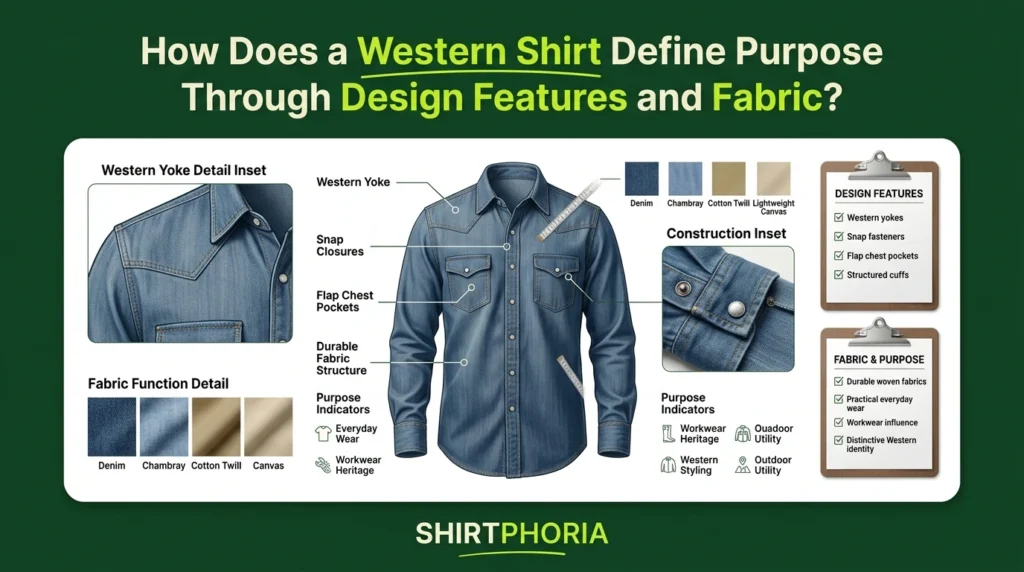
A Western Shirt defines purpose through a recognizable set of construction features: durable fabric, pointed yokes, snap closures, secure chest pockets, and an extended tail that developed from a mix of ranch utility, rodeo practicality, and Western style identity.
A Western Shirt should be analyzed as a garment system rather than as a costume piece or a shirt defined by one decorative detail.
Its strongest identifiers commonly include pointed front and back yokes, pearl or metal snaps, distinctive chest pockets, durable fabrics, and construction suited to active wear. Lasso identifies pointed yokes, snap closures, shaped chest pockets, and durable cotton or wool among the recurring characteristics of Western shirts. (Lasso)
Modern versions vary considerably. Some preserve workwear-oriented construction. Others borrow Western details primarily for casual styling. A pearl snap alone does not automatically make a shirt a complete Western Shirt.
Rockmount Ranch Wear also has an important place in the development of the modern snap-front Western shirt. Rockmount states that Jack A. Weil founded the company in Denver in 1946 and developed its signature Western snap-shirt format. (Rockmount)
This guide explains how the Western Shirt uses fabric, yokes, snaps, pockets, and fit details to balance durability, mobility, practical function, and Western identity.
What Construction Features Define a Western Shirt?
A Western Shirt is defined by a cluster of construction features, most commonly pointed front and back yokes, pearl or ring snap closures, durable fabrics, shaped chest pockets, and a longer shirt tail designed for active wear.
No single detail proves that a garment is a complete Western Shirt.
Classification becomes stronger when several major attributes appear together.
Common structural markers include:
- Pointed front yoke
- Pointed back yoke
- Pearl, ring, or metal snap closures
- Dual chest pockets
- Sawtooth or pointed pocket flaps
- Denim, cotton twill, flannel, or other durable fabric
- Extended tucked-wear length
- Movement-friendly fit
- Western-specific decorative shaping
These features appear repeatedly in historical and modern Western-shirt construction. Lasso, for example, identifies pointed yokes, pearl snaps or snap closures, distinctive chest pockets, and durable fabrics as characteristic elements.
Western shirts belong inside the broader family of shirt types.
Why Is the Western Shirt a Feature System Rather Than a Single Detail?
The Western Shirt is a feature system because its identity comes from the interaction of hardware, fabric, pocket design, yoke shape, and fit, not from one decorative cue alone.
The relationship can be summarized as:
Multiple Functional Features → Combine Into One Garment System → Define Western Shirt Identity
Consider pearl snaps.
A conventional casual shirt can use pearl snaps without having pointed Western yokes or Western chest pockets. That shirt may be better described as a pearl-snap shirt or Western-inspired shirt.
The reverse also occurs.
A casual shirt may borrow a pointed shoulder yoke while using ordinary sewn buttons and conventional pockets.
That yoke alone does not necessarily create the complete Western system.
A stronger Western Shirt classification generally appears when several major signals align, particularly:
- Western yoke construction
- Snap-front closure
- Western-style pockets
- Appropriate fabric or fit
The entire garment should be read together.
Why Does the Western Shirt Use Durable Fabrics?
The Western Shirt uses durable fabrics because ranch and outdoor work historically required shirts that could resist abrasion, tolerate repeated wear, and provide more protection than lightweight dress shirting.
This does not mean every modern Western Shirt must be heavy.
Western shirts now range from lightweight lifestyle pieces to substantial workwear.
Historically relevant fabric families include:
- Denim
- Cotton twill
- Heavy cotton
- Flannel
- Wool
- Wool gabardine
The useful distinction is between fabric identity and fabric performance.
Two cotton Western shirts may behave very differently if one uses lightweight cloth and the other uses dense workwear twill.
Fabric durability depends on weight, yarn quality, weave, finishing, seams, and garment construction.
How Do Denim and Heavy Cotton Improve Abrasion Resistance?
Denim and heavy cotton improve abrasion resistance by using denser woven structures that can tolerate repeated friction better than many lightweight dress-shirting fabrics.
That can be useful around:
- Brush
- Equipment
- Saddle contact
- Repeated outdoor wear
- Work surfaces
- Layering friction
Denim should still not be treated as universally stronger than every other shirting fabric.
A lightweight fashion denim may provide less resistance than a dense workwear twill.
Likewise, poorly constructed seams can shorten garment life even when the fabric itself is substantial.
The correct relationship is:
Dense Woven Fabric → Supports Abrasion Resistance → Can Extend Wear Life
Fabric performance remains dependent on the complete textile and garment construction.
How Do Flannel, Wool, and Gabardine Support Weather Adaptation?
Flannel, wool, and gabardine can support weather adaptation by adding warmth, surface protection, or more structured fabric behavior depending on their weight and weave.
Flannel is useful when warmth and softness matter.
A heavier flannel Western Shirt can work in cooler conditions or as a layered work shirt.
Its limitation is heat retention. The same fabric can become uncomfortable in warm weather.
Wool can appear in Western and ranch-influenced clothing where warmth and structure are useful.
Wool gabardine uses a tightly organized twill construction that can create a smooth, structured surface.
These materials are options rather than requirements.
Western Shirt Fabric Utility Matrix
| Fabric | Main Trait | Ranch / Outdoor Use Case | Claim Boundary |
|---|---|---|---|
| Denim | Abrasion-resistant potential through dense woven construction | Brush contact, saddle friction, repeated wear | Performance depends on denim weight, yarn, weave, and finishing |
| Cotton Twill | Durable diagonal weave | Daily ranch work and general outdoor wear | Lightweight twill may prioritize comfort rather than heavy protection |
| Flannel | Warmth and softness | Cold mornings, layering, outdoor shifts | Flannel can retain too much heat in warm climates |
| Wool Gabardine | Smooth structure and weather-oriented fabric behavior | Cooler conditions and structured Western wear | Less common in many modern casual Western Shirts |
The correct fabric should match climate and activity.
Too light a material may provide insufficient durability for abrasion-heavy work.
Too heavy a material can become hot, stiff, and unnecessarily restrictive.
How Do Western Shirt Yokes Support Structure and Identity?
Western Shirt yokes support structure and identity by reinforcing the shoulder area, shaping the upper shirt visually, and creating one of the most recognizable construction signatures of Western wear.
A yoke is a shaped fabric panel positioned across part of a garment, commonly around the shoulders and upper back.
Western shirts frequently make this feature more visible than standard dress shirts.
A Pointed Yoke extends into angular or pointed shapes.
It may appear across the front shoulders, back shoulders, or both.
These shapes contribute strongly to Western recognition, but they should not be reduced to decoration alone.
Depending on construction, a yoke can also:
- Add fabric layers
- Organize shoulder seams
- Reinforce the upper garment
- Change grain orientation
- Shape the chest and back
- Support decorative stitching
The exact function depends on how the particular shirt has been patterned and assembled.
How Does a Double-Layer Yoke Reinforce the Shoulder Area?
A Double-Layer Yoke can reinforce the shoulder area by adding fabric and seam structure where a shirt experiences friction, pulling, and repeated movement.
The construction relationship is:
Double-Layer Yoke → Adds Shoulder Structure → Can Improve Wear Resistance
The additional material may act as a reinforcement layer across the upper back or shoulders.
Its actual durability depends on:
- Fabric strength
- Stitch quality
- Seam placement
- Number of layers
- Yoke shape
- Garment fit
A yoke should not be described as a built-in shock absorber.
That wording overstates what the construction does.
Reinforcement layer or friction guard is more accurate.
There is also a balance point.
Too little structure can reduce the durability benefit.
Too much structure can add bulk and reduce shoulder comfort.
How Should Bias Cut Be Explained Without Overclaiming Tensile Strength?
Bias cut should be explained as a fabric-grain direction that can add mechanical ease, stretch, and visual shaping, not as a guaranteed increase in tensile strength.
Fabric grain describes the directional relationship created by warp and weft yarns in woven fabric.
Bias generally refers to a diagonal direction across that grain.
Woven fabric can behave differently on the bias than it does along straight grain.
A bias-oriented section may provide:
- Greater mechanical give
- Different drape
- Easier shaping
- More movement accommodation
The safe construction relationship is:
Bias Grain Direction → Adds Mechanical Ease → Can Support Shoulder Movement
Mechanical ease should not be confused with tensile strength.
Whether a fabric is stronger in one direction requires actual textile testing and depends on fiber, yarn, weave, finishing, seam orientation, and load direction.
Bias cutting can also create a failure mode.
Too much uncontrolled bias movement can cause:
- Stretching
- Warping
- Distortion
- Uneven seams
- Loss of original shape
The patternmaker must therefore use grain orientation intentionally.
What Safety Purpose Do Snap Buttons Serve on a Western Shirt?
Snap buttons serve a practical purpose on a Western Shirt because they can release more easily than sewn buttons when pulled, making them useful for fast opening, glove-friendly handling, and some snag-related safety situations.
Rockmount’s historical account specifically describes the practical idea that a snap-front shirt can release if caught rather than forcing the garment fabric to absorb the entire pulling load. Rockmount connects this design logic to Western riding and its development of snap-front shirts after Jack A. Weil founded the company in 1946. (Rockmount)
This should not be interpreted as guaranteed personal protection.
Snap strength varies.
Fabric reinforcement varies.
Pull direction varies.
A Western Shirt is not automatically certified protective equipment because it uses snaps.
How Do Snap Buttons Function as a Breakaway Feature?
Snap buttons can function as a breakaway feature because they are designed to separate under pulling force, while sewn buttons may stay attached until thread or fabric fails.
The basic mechanical relationship is:
Pulling Force → Opens Snap Closure → Can Reduce Fabric-Tearing Risk
Rockmount describes this using the example of a shirt becoming caught on a bull’s horn, where snaps may release rather than forcing the fabric to tear.
The word may matters.
Different snap hardware has different holding strength.
A heavily reinforced snap can behave differently from a lightweight snap.
The direction and speed of the load also affect the outcome.
Snap release is therefore a practical design characteristic, not a guarantee of injury prevention.
Why Are Snaps Useful for One-Handed or Gloved Operation?
Snaps are useful for one-handed or gloved operation because they require less precise buttonhole alignment than traditional sewn buttons.
Ledbury’s account of Western pearl-snap history notes that pearl snaps were easier for ranch workers to operate with gloves than conventional buttons. (Ledbury)
That matters when hand dexterity is limited.
Possible use situations include:
- Wearing work gloves
- Handling reins
- Riding
- Carrying equipment
- Working outdoors
- Opening a shirt quickly
The advantage should not be universalized to every modern wearer.
Many people now choose pearl snaps primarily because of their Western identity.
Snap Closure Quick Check
- Breakaway Behavior: Snaps can release under pulling force in some snag situations.
- Glove-Friendly Use: Snaps can require less precise finger movement than small sewn buttons.
- Fabric Protection: Snap release may prevent some loads from being transferred entirely into button thread or surrounding fabric.
- Claim Boundary: Actual behavior depends on snap strength, reinforcement, fabric, and pull direction.
How Do Pocket Designs on a Western Shirt Improve Utility?
Pocket designs on a Western Shirt improve utility by using chest placement, snap flaps, and distinctive pocket shapes to keep small items more secure during movement.
Western Shirts commonly use two chest pockets rather than the single open pocket or pocket-free construction found on many dress shirts.
The pocket shapes vary.
Common configurations include:
- Pointed flaps
- Sawtooth flaps
- Snap flaps
- Western-shaped pocket bodies
- Curved or smile-style details
The combination also reinforces category identity.
How Do Snap Flaps Help Prevent Item Loss During Movement?
Snap flaps help prevent item loss by covering the pocket opening and fastening the flap to the shirt body during riding, bending, or active work.
The functional relationship is:
Snap Flap → Covers Pocket Opening → Improves Item Retention
A secured flap can help keep small objects inside the pocket when the wearer’s torso changes angle.
Possible pocket contents might include:
- Notes
- Tickets
- Small personal items
- Compact tools
- Other appropriately sized objects
Pocket security is not absolute.
It depends on:
- Pocket depth
- Flap size
- Snap strength
- Item dimensions
- Shirt orientation
- Activity intensity
A shallow pocket with a small flap cannot safely retain every object simply because it uses a snap.
What Does Sawtooth Pocket Geometry Contribute?
Sawtooth pocket geometry contributes a distinct Western visual signature while also giving the pocket flap a shaped closure area that can help the flap sit flat when properly snapped.
A Sawtooth Pocket generally uses a sharply pointed or double-pointed flap associated with Western shirt design.
The useful relationship is:
Sawtooth Flap → Creates Shaped Snap Area → Helps Secure Pocket Face
The geometry is also visually important.
Pointed pockets echo the angular shapes commonly used in Western yokes.
This creates a consistent design language across the front of the garment.
The shape should not be given unsupported safety properties.
There is not enough basis to say that sawtooth geometry universally eliminates snag hazards.
Its strongest defensible roles are:
- Western identification
- Shaped pocket coverage
- Snap positioning
- Visual continuity with the yokes
Pocket construction also needs balance.
Too little closure can allow items to escape.
Too much flap material and hardware can make the chest area stiff, bulky, or uncomfortable.
How Does Western Shirt Fit Support Active Riding and Work?
Western Shirt fit supports active riding and work by combining upper-body mobility with enough shirt length to stay controlled during bending, reaching, and sitting in a saddle.
Traditional functional priorities often include:
- Shoulder movement
- Arm reach
- Chest room
- Sleeve mobility
- Tuck stability
- Comfortable seated wear
These are fit goals rather than universal pattern specifications.
Modern Western Shirts can be slim, regular, relaxed, cropped, fashion-oriented, or designed primarily for casual wear.
A working Western Shirt should therefore be judged by movement rather than by category label alone.
How Can Armhole Shape Affect Roping and Reaching?
Armhole shape affects roping and reaching because the sleeve-to-body relationship controls how much the shirt pulls upward when the wearer lifts or extends the arms.
A well-shaped armhole can allow the sleeve to move with less disruption to the torso.
The construction relationship is:
Controlled Armhole Shape → Reduces Body Lift → Supports Overhead Movement
This does not prove that every traditional Western Shirt has a higher armhole than every dress shirt.
Patterns vary by manufacturer, era, use case, and fit category.
The more useful diagnostic is movement.
Raise both arms.
Reach forward.
Reach overhead.
Rotate the shoulders.
If normal movement repeatedly pulls the entire shirt sharply upward or out of the waistband, the garment’s mobility system is not working well for that activity.
Why Does an Extended Tail Help a Western Shirt Stay Tucked?
An extended tail helps a Western Shirt stay tucked by adding extra fabric below the waistline, which reduces the chance that the hem pulls free while the rider sits, bends, or reaches.
The relationship is straightforward:
Extended Tail → Increases Tuck Depth → Improves Tuck Stability
This longer construction is sometimes associated with riding-oriented Western shirts and may also be described through terms such as an extended shirt tail or saddle-oriented tail.
It should not be treated as mandatory.
Modern lifestyle Western Shirts may be shorter because they are designed for untucked casual use.
Length also has an upper limit.
Too short: The hem can escape the waistband during movement.
Balanced: The shirt stays secure without excessive internal bulk.
Too long: Excess fabric can bunch inside the trousers.
The correct length depends on intended wear.
Comparison: Western Shirt Features vs. Standard Dress Shirts
Western Shirts and standard dress shirts are both woven button-front garments, but their construction emphasizes different priorities.
| Feature | Standard Dress Shirt | Western Shirt | Functional / Structural Effect |
|---|---|---|---|
| Closure | Usually uses sewn buttons through buttonholes | Commonly uses pearl, ring, or metal snaps | Snaps can be quicker to operate and may release under pulling force |
| Yoke | Usually uses a simpler back yoke or split yoke | Commonly uses pointed front and back yokes | Western yokes strengthen category identity and can add shoulder structure depending on construction |
| Pockets | Often uses one open chest pocket or no chest pocket | Commonly uses dual chest pockets with flaps or distinctive shapes | Covered pockets can improve small-item retention during movement |
| Fabric | Often uses poplin, broadcloth, fine twill, or other lighter shirting | Often uses cotton, denim, twill, flannel, or other durable fabrics | Heavier or denser cloth can improve wear resistance but may increase warmth |
| Tail Length | Commonly uses a curved tail suitable for tucked dress wear | Functional Western versions may use additional length for riding or active work | Extra tuck depth can improve stability while seated or reaching |
| Style Identity | Prioritizes clean formal structure and tie compatibility | Combines workwear construction with recognizable Western markers | The Western Shirt generally communicates greater workwear and casual utility |
Because Western Shirts still belong to the button-front family, compare them with other button-front shirts.
What Failure Modes Can Distort a Western Shirt?
A Western Shirt fails structurally when its main design attributes move too far in either direction, because both under-built and over-built features can reduce comfort, durability, functional utility, or visual coherence.
| Attribute | Too-Low Failure | Too-High Failure | Corrective Hypothesis |
|---|---|---|---|
| Fabric Weight | Fabric wears too quickly for the intended abrasion level | Shirt becomes hot, stiff, or unnecessarily heavy | Match weight to climate, activity, and expected wear |
| Snap Strength | Snaps open during ordinary movement | Snaps become difficult to release or transfer excessive stress into the fabric | Match hardware strength to fabric and reinforce attachment points |
| Yoke Structure | Upper shirt loses intended structure or reinforcement | Yoke becomes bulky and restricts movement | Balance fabric layers, seam placement, and yoke pattern |
| Bias / Grain Handling | Shaped areas provide insufficient mechanical ease | Excess bias movement causes stretching or distortion | Control grain direction and stabilize seams where necessary |
| Pocket Closure | Items escape during bending or active movement | Pocket becomes stiff, bulky, or difficult to access | Balance pocket depth, flap size, and snap placement |
| Tail Length | Shirt untucks during riding, bending, or reaching | Excess fabric bunches inside trousers | Match shirt length to tucked or untucked use |
| Western Styling | Garment lacks enough structural markers to read clearly as Western | Decoration overwhelms construction and becomes costume-like | Use recognizable Western features without replacing functional coherence |
The same principle applies across the entire garment.
More hardware is not automatically better.
More fabric is not automatically more durable.
A larger yoke is not automatically more functional.
A longer tail is not automatically more secure.
Each feature needs to remain proportional to the shirt’s intended purpose.
What Are the Key Takeaways of Western Shirt Purpose and Design?
The key takeaways of Western Shirt purpose and design show that the shirt is best understood as a combination of durable fabric, Western construction details, practical closures, secure pockets, and riding-friendly fit.
Western Shirt Purpose and Design Summary
- Durable Fabric System: Western Shirts often use cotton, denim, twill, flannel, or wool-based fabrics when repeated wear and outdoor use matter.
- Western Yoke Identity: Pointed front and back yokes are important visual and structural markers of many Western Shirts.
- Double-Layer Potential: A layered yoke can reinforce the shoulder region, but its effect depends on material and construction.
- Bias-Cut Boundary: Bias-oriented fabric can add mechanical ease and shaping, but it should not be described as universally increasing tensile strength.
- Snap Closure Utility: Pearl, ring, or metal snaps can support fast fastening, easier gloved operation, and release under some pulling conditions.
- Snap Safety Boundary: Snap release is a useful mechanical characteristic, not guaranteed personal protection or certified machinery safety.
- Secure Pocket Design: Dual chest pockets with snap or shaped flaps can improve retention of suitably sized small items.
- Sawtooth Identity: Sawtooth pocket shapes are strong Western markers, but they should not be given unsupported anti-snag claims.
- Movement-Oriented Fit: Active-use versions should permit reaching and shoulder movement without excessive torso pull.
- Extended Tail Utility: Additional shirt length can improve tuck stability during seated or bending movement.
- Classification Rule: A complete Western Shirt is better identified through a cluster of features than through one snap, yoke, or decorative element.
Western Shirt Diagnostic Checklist
A Western Shirt can be identified more accurately by examining several structural features together instead of relying on pearl snaps or decorative embroidery alone.
Use this checklist while examining the garment. Your selections are saved on this device.
A shirt using only one decorative Western cue may be better understood as Western-inspired. Strong classification comes from the way multiple features work together.
Frequently Asked Questions
A strong Western Shirt classification usually comes from several features appearing together: pointed yokes, snap closures, distinctive chest pockets, purpose-appropriate fabric, active-use fit, and sometimes an extended tail. One pearl snap or decorative detail alone is not enough.
Western shirts developed around active ranch and outdoor use, so denser cottons, denim, twill, flannel, and wool-based fabrics can support abrasion resistance, warmth, structure, or repeated wear. Actual performance still depends on fabric weight, weave, yarns, finishing, seams, and construction.
Snaps can release under pulling force and may reduce some loads transferred into fabric or button thread. They can also be easier to operate with gloves. However, snap behavior varies and a snap-front Western Shirt is not automatically certified protective equipment.
Pointed front and back yokes are major Western identity markers. Depending on construction, a yoke can also organize seams, add layers, reinforce the upper garment, alter grain direction, shape the chest and back, and support decorative stitching.
Snap flaps cover the pocket opening and can improve retention of suitably sized small items during bending, riding, and other movement. Security still depends on pocket depth, flap size, snap strength, item size, and activity.
Extra body length increases tuck depth, which can help a shirt remain controlled while sitting, riding, bending, or reaching. Modern lifestyle Western shirts may intentionally be shorter for untucked wear.
Western Shirt Terms
| TERM | DEFINITION |
|---|---|
| Western Shirt | A woven shirt category identified by a system of Western construction features such as pointed yokes, snap closures, distinctive chest pockets, durable fabrics, and active-use fit. |
| Yoke | A shaped fabric panel positioned across part of a garment, commonly around the shoulders and upper back. |
| Pointed Yoke | A yoke whose shape extends into angular or pointed forms across the front shoulders, back shoulders, or both. |
| Bias | A diagonal direction across the warp-and-weft grain of woven fabric that can create different drape and mechanical give. |
| Sawtooth Pocket | A Western-style chest pocket or flap using sharply pointed geometry, often paired with snap closures. |
| Snap Closure | A two-part fastening system that presses together and can separate under sufficient pulling force. |
| Extended Tail | Additional shirt-body length below the waist that can increase tuck depth and stability during seated or active movement. |
| Armhole | The shaped opening and seam area where the sleeve joins the shirt body; its geometry influences sleeve mobility and torso pull. |
Conclusion
In conclusion, the Western Shirt is best defined as a purpose-shaped garment that blends ranch-work practicality, rodeo history, and recognizable Western construction details.
Its identity comes from a system.
Durable fabrics can support repeated wear.
Pointed yokes organize and visually distinguish the shoulder and chest areas.
Snap closures provide a fast, recognizable fastening mechanism and can release under some pulling conditions.
Chest pockets with secured flaps improve storage control during movement.
Extended tails can help functional versions remain tucked during sitting, riding, bending, and reaching.
Not every feature has one universal origin or one mechanical purpose.
Some details developed around practical Western clothing needs.
Some became associated with rodeo wear.
Others were strengthened as category signatures by manufacturers such as Rockmount Ranch Wear and by later Western fashion.
Modern Western-inspired shirts may deliberately preserve only part of that system.
A pearl snap shirt may omit the yokes.
A fashion Western shirt may use lightweight fabric and a shorter hem.
An overshirt-inspired Western piece may emphasize fabric weight and layering rather than saddle-oriented tuck length.
The distinction matters because a Western Shirt should be understood through what its construction actually does, not simply through cowboy imagery.
The rugged utility of the Western Shirt also connects naturally to overshirts, another shirt category built around layering, coverage, and practical function.
The Western Shirt works because its strongest details do more than decorate the garment: they shape how the shirt fastens, moves, protects, stores, and signals its place in Western wear.