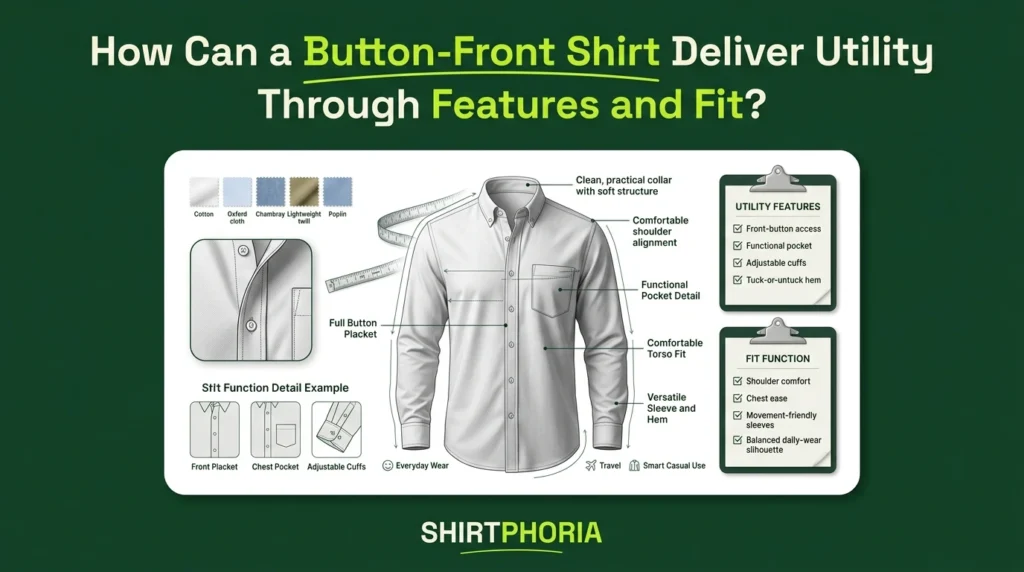
How Can a Button-Front Shirt Deliver Utility Through Features and Fit?
A button-front shirt delivers utility through its full placket, collar structure, cuff design, armhole shape, chest fit, and hem construction, all of which affect ventilation, layering, movement, presentation, and daily adaptability.
Many button-front shirts look similar at first glance. Their practical performance can be very different, however, because small changes in construction influence how the garment opens, closes, moves, layers, and stays positioned on the body.
A full placket can provide controlled front opening. Collar construction affects neckline structure. Cuffs determine wrist and sleeve control. Shoulder width, chest room, armhole shape, and sleeve construction determine whether the wearer can reach and move comfortably. Hem length influences whether the shirt works better tucked or untucked.
Terminology also matters. A button-front shirt or button-up shirt describes a shirt whose front closure uses buttons. A button-down collar describes a collar whose points are secured to the shirt with small buttons. A button-front shirt may have a button-down collar, but the two terms do not describe the same construction feature.
Button-front construction is one of the clearest ways to understand how casual shirts turn fabric, fit, and physical features into daily utility.
This guide explains button-front shirt utility through construction features, functional fit, comparisons with other shirt structures, diagnostic tests, and a practical scoring system.
This guide explains button-front shirt construction and functional fit for educational purposes. Actual comfort, mobility, coverage, ventilation, and layering performance vary with fabric, garment dimensions, body proportions, climate, activity, and personal preference.
Quick Answer: What Makes a Button-Front Shirt Useful?
A button-front shirt is useful because its full front opening gives the wearer direct control over ventilation, layering, closure, and presentation while the fit determines whether the shirt can move comfortably with the body. Its utility comes from three connected systems: placket control, garment structure, and functional fit. No single construction feature makes the shirt practical by itself.
Button-Front vs Button-Down: What Is the Correct Term?
A button-front shirt refers to a shirt with buttons running down the front opening, while a button-down shirt usually refers to a shirt with collar points fastened by small buttons.
People often use “button down” casually when they mean any shirt that buttons at the front. In garment terminology, however, the distinction is useful.
Button-front shirt: Describes the front closure system.
Button-up shirt: Another common term for a shirt that closes with buttons at the front.
Button-down collar: Describes a collar construction in which small buttons secure the collar points to the shirt.
A button-front shirt can therefore have a point collar, spread collar, camp collar, button-down collar, or another collar configuration.
This article focuses primarily on the front closure and construction system, not only shirts with button-down collars.
Why Is the Button-Front Shirt a Benchmark for Utility in Casual Wear?
The button-front shirt is a benchmark for utility in casual wear because its standard construction gives the wearer more adjustment options than many closed-front or partial-placket shirt types.
This does not mean it is universally superior. Its advantage is adaptability.
A wearer can open or close the front according to temperature and coverage requirements. The collar can be worn more open or more controlled. Sleeves can be secured at the wrist or rolled when construction permits. A suitable hem can be tucked for a cleaner presentation or worn outside the trousers in more relaxed settings.
The button-front format therefore creates several physical adjustment points within one garment.
What Is the Core Difference Between Style and Utility?
Style describes how a button-front shirt looks, while utility describes what the shirt physically allows the wearer to do.
A floral print, stripe pattern, or unusual color primarily changes visual style.
A full placket that opens to increase access or ventilation changes physical utility.
A decorative pocket changes appearance when it cannot hold anything useful. A properly positioned and reinforced pocket can provide storage utility.
A narrow silhouette may look streamlined, but if the chest or armholes restrict movement, that visual effect does not automatically produce functional fit.
Style and utility can exist together. The important distinction is that utility must be connected to a physical outcome such as:
- Opening control
- Airflow
- Neckline structure
- Wrist adjustment
- Sleeve security
- Arm mobility
- Layering access
- Hem stability
- Torso movement
How Does the Button-Front Shirt Adapt Across Environments?
A button-front shirt adapts across environments because the wearer can adjust the front opening, collar position, sleeves, and hem treatment according to temperature, activity, and expected polish.
In warmer conditions, opening one or two upper buttons can create a less enclosed neckline. Actual cooling still depends on fabric, fit, humidity, and airflow.
In a more polished setting, the shirt can be buttoned higher and paired with a more structured collar.
During manual work, sleeves can be rolled when their construction permits it. Roll-tab sleeves can provide additional security for the rolled position.
For business casual use, a sufficiently long shirt can be tucked into trousers to maintain cleaner coverage during sitting and reaching.
For relaxed wear, a shorter shirt with an appropriate hem can remain untucked without creating excessive fabric below the waist.
Not every button-front shirt performs each task equally well. The usefulness depends on how the individual garment is built.
How Do Construction Features Deliver Functional Utility in a Button-Front Shirt?
Construction features deliver button-front shirt utility by turning fabric panels into adjustable systems for closure, airflow, coverage, sleeve control, and small differences in formality.
How Does the Full Button Placket Control Ventilation and Layering?
The full button placket controls ventilation and layering by allowing the shirt to open or close along the front body instead of relying on a fixed neckline or partial opening.
A shirt placket is the reinforced section along the shirt front that carries the buttons and corresponding buttonholes. Hockerty describes the placket as the layered front section that supports the button closure.
Because a full placket extends through the front body, it provides several practical advantages.
The wearer can open the shirt completely when putting it on or removing it.
The opening also makes it easier to wear the shirt over an undershirt, T-shirt, or other base layer because the garment does not need to be pulled over the head.
Individual buttons provide incremental closure control. The wearer can change the neckline opening without opening the entire shirt.
The full placket itself does not guarantee cooling. Actual ventilation depends on fabric permeability, shirt fit, environmental airflow, temperature, and how far the front is opened.
Its core utility is opening control.
How Does the Collar Stand Support Protection and Presentation?
The collar stand supports protection and presentation by lifting the collar around the neck, helping the neckline hold shape, and creating limited coverage from sun, wind, or layering friction.
A collar stand is the upright band between the shirt neckline and the main collar leaf.
It gives the collar a structural base around the neck.
A firmer collar stand can help maintain a cleaner neckline when the shirt is worn under a jacket, sweater, or overshirt.
A taller stand may provide slightly more physical neck coverage, but that should not be confused with complete sun or weather protection.
More structure also creates a tradeoff.
If the stand is too soft for the intended design, the collar may collapse or lose its intended shape.
If it is excessively stiff or high, it can rub the neck, retain more heat, or feel restrictive when the wearer turns the head.
The useful collar stand is therefore the one whose structure matches the intended level of coverage, comfort, and presentation.
How Do Cuffs Add Adjustability Without Confusing Cuff Types?
Cuffs add utility by controlling the sleeve opening, but different cuff types solve different problems.
Adjustable cuffs normally use multiple buttons or fastening positions to change the wrist opening.
Convertible cuffs have a different purpose. They can fasten with regular buttons or cufflinks. Apposta specifically defines convertible cuffs around this button-or-cufflink flexibility.
Roll-tab sleeves use a separate tab or fastening system to help hold a rolled sleeve in position.
- Adjustable cuffs help control wrist opening and sleeve security.
- Convertible cuffs allow button or cufflink fastening.
- Roll-tab sleeves help secure rolled sleeves during manual tasks.
- Loose cuffs can slide over the hand, while tight cuffs can restrict wrist movement.
A convertible cuff should not be described as a sleeve-length adjustment device or as the primary construction for securing rolled sleeves.
How Does Fit Maximize Button-Front Shirt Utility?
Fit determines whether a button-front shirt’s features can actually function, because poor shoulder, chest, sleeve, armhole, or hem proportions can restrict movement and weaken comfort.
A shirt does not need to be extremely slim or extremely loose to be functional.
It needs functional fit.
How Do Shoulder and Chest Fit Affect Mobility?
Shoulder and chest fit affect mobility because the shirt must give the arm enough pivot space and the torso enough room for reaching, sitting, and breathing.
The shoulder seam often works well when it sits near the wearer’s natural shoulder area and the fabric can move without obvious pulling.
A seam that sits too far inward may contribute to tension across the upper body.
A heavily dropped shoulder can create additional fabric around the upper arm and torso. That may be intentional in relaxed styling, but it produces different movement and drape characteristics from a controlled shoulder fit.
A shirt that is too tight across the chest often produces:
- Visible pulling between buttons
- Horizontal tension lines
- Restricted forward reach
- Reduced seated comfort
- Limited layering capacity
Excessive chest room creates a different problem.
Too much fabric may pool around the torso, gather beneath outer layers, or weaken clean drape.
The useful zone lies between strain and uncontrolled volume.
How Do Armhole Depth and Sleeve Shape Affect Reach?
Armhole depth and sleeve shape affect reach because they control how much the shirt body moves when the arms lift, extend, twist, or carry weight.
A properly shaped higher armhole can allow the sleeve to move with less disruption to the shirt torso.
Permanent Style explains how a smaller and better-positioned armhole can separate arm movement from the body of the garment more effectively, provided the armhole is not cut excessively tight.
A low armhole usually connects a larger portion of the sleeve movement to the body of the shirt. When the wearer raises an arm, more of the torso fabric may be pulled upward.
This does not mean that every high armhole is better.
A high but overly tight armhole can press into the underarm and restrict the shoulder.
The practical target is a higher but properly shaped armhole with sufficient clearance.
Articulated sleeves add shaping intended to follow the natural bend or movement path of the arm.
How Do Length and Hem Shape Affect Tucked and Untucked Utility?
Length and hem shape affect button-front shirt utility by determining whether the shirt stays secure when tucked or hangs cleanly when worn untucked.
A shirt intended primarily for tucking generally needs enough length below the waist to remain anchored during sitting, bending, and reaching.
If the shirt is too short, movement can pull the hem from the trousers.
Longer curved hems often provide additional front and back length for tucked wear.
Straight or shorter hems are commonly useful for relaxed untucked wear because they can create a cleaner horizontal finish without excessive fabric extending below the waist.
Hem shape alone does not dictate use. The correct test is whether the hem remains stable and proportionate during actual movement.
Beyond the Standard: Button-Front Shirt vs Popover and Camp Collar Shirts
Comparing the standard button-front shirt with popover and camp collar shirts shows how changing the placket or collar structure changes ventilation, layering, formality, and warm-weather comfort.
Button-Front vs Popover Pullover: Full Opening vs Half Placket
A standard button-front shirt offers more opening control than a popover pullover because the full placket can open completely, while a popover usually uses a shorter half placket.
A popover pullover combines shirt-like construction with a partial front opening. The garment must generally be pulled over the head because the placket does not continue through the full front body.
The shorter opening can create a visually cleaner and more relaxed front.
It also changes utility.
A popover provides less full-body opening control than a conventional button-front shirt.
That does not make the popover less useful overall. It gives the shirt different utility, prioritizing simplicity and partial opening over complete front access.
Button-Front vs Camp Collar Shirt: Structure vs Open-Neck Airflow
A camp collar shirt changes button-front utility by removing the traditional collar stand and creating a relaxed open neckline that favors warm-weather comfort over structured presentation.
The open neckline of camp collar shirts shows how removing the conventional collar stand changes airflow, structure, and warm-weather styling.
The result is less enclosure around the neck.
A standard button-front shirt with a collar stand usually provides greater neckline structure, especially when worn under another layer or in a setting that rewards a more controlled presentation.
Comparison Matrix: Utility Across Button-Front Variants
| Shirt Type | Primary Utility Focus | Adjustment Speed | Layering Capability | Main Tradeoff |
|---|---|---|---|---|
| Full Button-Front | Broad daily adaptability and full opening control | High because the placket opens fully | Strong for overshirts, undershirts, and transitional outfits | Can look overly structured or visually ordinary when fabric and fit are poorly matched |
| Popover Pullover | Casual simplicity and cleaner front structure | Moderate because the half placket provides limited opening | Moderate because the shirt must be pulled over the head | Less ventilation and layering access than a full button-front |
| Camp Collar Shirt | Warm-weather comfort and open-neck airflow | High at the neckline and moderate across the complete shirt | Most natural in relaxed and warm-weather layering | Less neckline structure and usually less business-casual polish |
Diagnostic Thresholds and Failure Modes for Button-Front Shirt Utility
Button-front shirt utility can be diagnosed by checking whether placket control, collar structure, cuff function, shoulder fit, chest room, armhole shape, sleeve mobility, and hem length sit inside the correct daily-use range.
| Variable | Too Low Failure | Ideal Zone | Too High Failure | Observable Test | Diagnostic Fix |
|---|---|---|---|---|---|
| Placket Control | Partial or difficult opening limits ventilation, layering, or easy on-off use | Full button placket opens cleanly and allows controlled closure | Excessive open-front styling can reduce coverage, polish, or task suitability | Open and close the shirt while seated and standing | Choose a full placket when complete access matters, or a popover when simpler partial opening is sufficient |
| Collar Stand | Collar collapses and loses neckline structure | Collar stand supports shape without irritating the neck | Collar feels stiff, hot, or restrictive | Turn the head and bend the neck while checking rubbing or collapse | Choose softer construction for relaxed comfort or firmer structure for polished layering |
| Cuff Function | Cuffs slide over the hand or fail to secure the sleeve | Cuffs adjust to wrist size and task needs without restriction | Cuffs feel tight, overbuilt, or unnecessarily formal | Bend the wrist, reach forward, and test sleeve position | Use adjustable cuffs for practical control, convertible cuffs for button or cufflink use, or roll tabs for rolled sleeves |
| Shoulder Fit | Shoulder area pulls inward and restricts movement | Shoulder seam sits near the natural shoulder area and moves cleanly | Excessive dropped shoulder creates uncontrolled fabric | Reach forward and sideways while observing seam tension | Adjust size, shoulder width, or fit category |
| Chest Room | Buttons pull and fabric strains across the chest | Chest allows breathing, sitting, and reaching without excessive volume | Extra fabric bunches and weakens controlled drape | Sit, twist, and reach while watching for button strain or pooling | Select a more suitable chest measurement or tailoring adjustment |
| Armhole and Sleeve Mobility | Low armholes pull the shirt body upward during reach | Armhole sits high enough for useful movement without cutting into the underarm | Tight armhole restricts the shoulder and underarm | Raise both arms overhead and observe hem movement | Choose a better-shaped armhole or useful sleeve articulation |
| Hem Shape and Length | Short hem untucks easily during bending or reaching | Hem length matches the intended tucked or untucked use | Excessively long hem looks messy when worn untucked | Sit, bend, and raise the arms while checking hem position | Use sufficient length for tucking and controlled shorter length for untucked wear |
Both extremes can harm button-front shirt utility.
Too little placket control limits opening and ventilation options. Too much open-front styling can reduce coverage or polish.
Too little collar structure creates collapse. Too much structure can produce neck discomfort or excess heat.
Too little cuff control allows the sleeve to slide or interfere with tasks. Excessive cuff tightness restricts wrist movement.
A very low armhole can pull the shirt body upward. A high but excessively tight armhole can restrict the shoulder and underarm.
A hem that is too short can untuck easily. A hem that is unnecessarily long can look unbalanced when worn outside the trousers.
Insufficient chest room restricts movement. Excessive chest room creates fabric pooling.
The useful target lies between these extremes.
Button-Front Shirt Utility Scoring Key
A button-front shirt becomes easier to evaluate when each feature and fit variable is scored by whether it supports, weakens, or fails the intended daily-use function.
- Placket control
- Collar stand
- Cuff function
- Shoulder fit
- Chest room
- Armhole and sleeve mobility
- Hem shape and length
Score Interpretation
The shirt’s features and fit support the intended daily-use setting.
The shirt can work, but one or two variables require correction or compromise.
The shirt is likely mismatched to the task, environment, or wearer’s fit requirements.
This score is a practical buying aid rather than a universal measurement of garment quality.
Button-Front Shirt Utility Matrix: Features vs Fit
| Element | Category | Utility Delivered | Task Fulfilled | Failure to Avoid |
|---|---|---|---|---|
| Full Button Placket | Feature | Ventilation, closure, and layering access | Temperature adjustment and easy on-off use | Partial opening when complete access is required |
| Collar Stand | Feature | Neckline structure and limited neck coverage | Presentation, layering polish, and mild environmental coverage | Collar collapse or neck irritation |
| Adjustable Cuffs | Feature | Wrist-opening control | Sleeve security during movement | Cuffs sliding over the hand or restricting the wrist |
| Convertible Cuffs | Feature | Button or cufflink fastening flexibility | Casual-to-smart adaptability | Confusing cufflink flexibility with sleeve-roll utility |
| Roll-Tab Sleeves | Feature | Secure sleeve roll-up | Manual tasks and warm-weather adjustment | Loose rolled sleeves falling during work |
| High but Properly Shaped Armhole | Fit | Improved arm mobility | Reaching, lifting, carrying, and overhead movement | Tight underarm restriction |
| Chest Room | Fit | Breathing and torso movement | Sitting, twisting, reaching, and layering | Button pulling or excessive fabric pooling |
| Curved Hem | Fit | Tucked stability when sufficient length is present | Secure wear during bending and reaching | Excessively long tails worn untucked |
| Straight or Shorter Hem | Fit | Untucked casual balance | Relaxed wear without excess lower-body fabric | Hem so short that the waist becomes exposed during movement |
The matrix shows why shirt utility comes from interaction rather than individual components.
A full placket provides little benefit if the torso is too tight to move comfortably.
A high armhole loses its advantage if it cuts into the underarm.
A useful cuff becomes inconvenient when the sleeve length is incorrect.
A curved hem helps with tucked stability only when its total length is sufficient.
Construction and fit must work together.
Button-Front Shirt Buying Checklist
FAQ: Button-Front Shirt Utility
The most common questions about button-front shirt utility can be answered by examining the placket, collar, cuffs, fit, armholes, and hem shape together.
A button-front shirt is useful because its full front opening controls ventilation, closure, and layering while its fit determines comfort and mobility. The most important utility variables include the placket, collar structure, cuffs, shoulder fit, chest room, armhole shape, sleeve mobility, and hem length.
A button-front shirt is not necessarily the same as a button-down shirt. Button-front describes a shirt with a front button closure. Button-down usually describes a collar whose points are fastened to the shirt with small buttons. A button-front shirt can use a button-down collar or another collar style.
The placket holds and supports the buttons and buttonholes along the shirt front. With a full button-front construction, it also lets the wearer open or close the garment incrementally for easier dressing, layering, coverage adjustment, and ventilation control.
Convertible cuffs can be useful when a shirt needs to move between casual and smarter settings because they can fasten with regular buttons or cufflinks. They should not be confused with roll-tab sleeves, which are designed more directly to help secure sleeves after they are rolled.
A higher armhole can improve shirt mobility when it is shaped correctly and provides enough underarm clearance. It can allow the sleeve to move more independently from the torso. A high armhole that is cut too tightly can instead restrict the shoulder and create underarm discomfort.
A button-front shirt should have a hem shape and length that match how it will be worn. Longer curved hems commonly support tucked stability, while shorter or straighter hems often suit untucked casual wear. Either shape can work differently when the overall shirt length is adjusted appropriately.
Terms Explained
| TERM | DEFINITION |
|---|---|
| Button-Front Shirt | A shirt whose complete front opening is closed using a vertical series of buttons and buttonholes. |
| Button-Up Shirt | A common alternate term for a shirt that fastens with buttons along the front. |
| Button-Down Collar | A collar whose points are secured to the shirt body with small buttons. |
| Placket | The reinforced front section that supports the buttons and buttonholes of a shirt closure. |
| Collar Stand | The upright band between the shirt neckline and collar leaf that supports neckline structure. |
| Adjustable Cuff | A cuff with multiple fastening positions used to change the wrist opening. |
| Convertible Cuff | A cuff that can be fastened with either regular buttons or cufflinks. |
| Roll-Tab Sleeve | A sleeve construction containing a tab that helps secure the sleeve after it is rolled upward. |
| Armhole | The opening where the sleeve joins the shirt body; its shape and depth affect mobility. |
| Articulated Sleeve | A sleeve shaped to follow natural arm bend or movement more closely. |
| Curved Hem | A shirt hem with extended rounded front and back sections commonly associated with tucked wear. |
| Functional Fit | A fit balance that provides movement room and comfort without excessive garment volume. |
Conclusion
Ultimately, button-front shirt utility comes from the interaction between construction features and fit rather than from visual style alone.
The full placket controls access, closure, and adjustment.
The collar structure controls neckline shape and coverage.
Cuffs regulate the sleeve opening and can provide different forms of fastening or sleeve management.
Shoulder width, chest room, armhole position, and sleeve shape determine whether the wearer can reach, sit, lift, and move without pulling the entire garment out of position.
Hem shape and length determine whether the shirt remains stable when tucked or proportionate when worn untucked.
No single feature should be maximized without considering its tradeoffs. Greater collar structure can improve presentation but create discomfort when excessive. A higher armhole can improve independence of movement when properly shaped but restrict the wearer when too tight. Extra chest room can support mobility until it becomes excess fabric.
The useful button-front shirt is therefore not simply the most structured, relaxed, fitted, or feature-heavy option.
It is the shirt whose construction and fit match the wearer’s environment, movement requirements, layering needs, temperature conditions, and expected level of presentation.
By evaluating features and fit as functional systems, the buyer can choose a button-front shirt that works as practical daily wear rather than simple clothing.