What Enables a Camp Collar Shirt to Balance Construction and Styling Versatility?
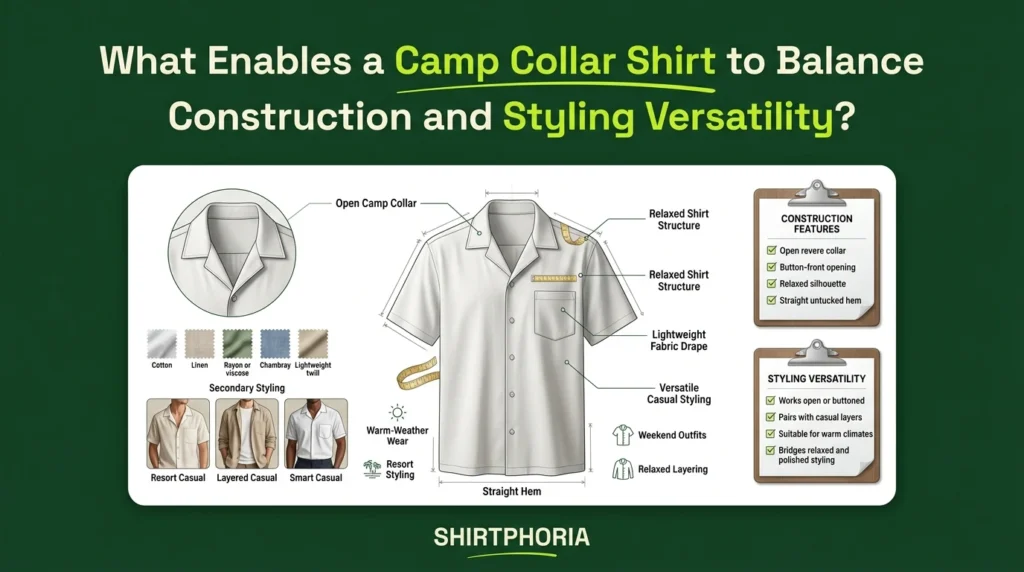
A camp collar shirt balances construction and styling versatility through its open collar, lack of collar stand, relaxed neckline, straight hem, fabric behavior, and ability to move between casual and soft-tailored outfits.
Many camp collar shirts look naturally relaxed, but their success depends on more than an open neckline. Collar shape determines how the shirt frames the neck. Fabric determines whether it falls fluidly or holds a crisper shape. Hem length affects whether untucked styling looks controlled. Fit decides whether the shirt appears relaxed or simply oversized.
The terms camp collar and Cuban collar are often used for overlapping open-collar shirt styles. In garment-construction language, convertible collar is also useful for describing a collar designed to lie open and flat without a separate collar stand.
The camp collar shirt shows how casual shirts use collar shape, fabric, fit, and hem construction to create practical warm-weather styling.
This guide explains the collar construction, fabric choices, straight hem, optional loop closure, tuck and untuck decisions, soft-tailoring compatibility, and common styling failure points.
This guide explains camp-collar shirt construction and styling for educational purposes. Actual fit, drape, thermal comfort, formality, and jacket compatibility vary according to fabric, garment pattern, body proportions, climate, tailoring, care, and personal preference.
Quick Answer: What Makes a Camp Collar Shirt Versatile?
A camp collar shirt is versatile because its open collar, missing collar stand, straight hem, and relaxed fabric behavior create a shirt that can feel casual in warm weather but still refined when the fabric, fit, trousers, and jacket are chosen carefully. The collar creates the main visual difference, while fabric and outfit context determine how polished the shirt can become.
Camp Collar, Cuban Collar, and Convertible Collar: What Is the Difference?
Camp collar and Cuban collar are often used for similar open-collar shirts, while convertible collar is the safer construction term for a collar that can sit open and flat without a separate stand.
Reader-facing fashion language does not always separate camp and Cuban collars consistently. Brands, regions, and menswear writers may use the terms differently.
The shared construction idea is more important than the label.
A typical camp or Cuban collar:
- Opens into a relaxed V-shaped neckline
- Sits flatter against the upper chest
- Usually lacks a separate collar stand
- Creates less neck enclosure than a standard point collar
- Often appears on warm-weather casual shirts
- Frequently works with a straight or relatively short hem
Permanent Style describes the camp or Cuban collar as having little structure and specifically notes the lack of a collar stand.
Convertible collar is useful when discussing the actual construction. Instead of depending on a separate neckband to hold the collar upright, the collar is designed to sit open.
The word “cabriolet collar” should not be substituted automatically. Camp collar, Cuban collar, and convertible collar are clearer terms for this article.
Why Camp Collar Shirt Construction Shapes Styling Potential
Camp collar shirt construction shapes styling potential by removing the rigid collar stand, lowering the neckline, softening the collar roll, and supporting untucked warm-weather wear.
Construction does not determine the entire outfit.
The same camp collar pattern can behave differently when made from:
- Fluid rayon
- Silk
- TENCEL Lyocell blends
- Crisp cotton
- Linen
- Cotton-linen
- Seersucker
A soft fabric can make the collar roll and body fall gently.
A crisper fabric can create clearer collar edges and a cleaner city silhouette.
A very stiff fabric can make the open collar flare instead of resting naturally.
The shirt therefore works as a system:
Collar shape + fabric behavior + fit + hem + styling context
Why Does the Absence of a Collar Stand Create a Relaxed Drape?
The absence of a collar stand creates a relaxed neckline because the collar attaches lower and flatter to the shirt body instead of being lifted upright around the neck.
A standard point-collar shirt commonly uses a separate collar stand. That stand creates height around the neckline and gives the collar a more structured base.
A camp collar removes that upright architecture.
The result is a flatter collar that opens outward and downward.
Threads Magazine’s camp-shirt construction guidance also describes the camp shirt neckline as having no collar band, which helps distinguish it from conventional shirt-collar construction.
This does not mean every camp collar hangs identically.
Fabric weight, interfacing, collar pattern, seam construction, laundering, and pressing can all affect how the collar sits.
A soft camp collar may roll gently.
A more structured version may create a clearer and sharper edge.
The essential point is that the shape comes from flat open-collar construction rather than an upright collar stand.
How Does Open-Neck Architecture Change Styling Breathability?
Open-neck architecture changes styling breathability by exposing more of the neckline, reducing the enclosed appearance of a standard collar, and creating a wider visual frame around the face.
The neckline naturally draws the eye downward.
This can visually lengthen the neck and soften the upper torso compared with a conventional collar that closes higher around the throat.
The construction is particularly compatible with warm-weather styling because the neckline is designed to remain open.
That should not be interpreted as a guarantee that every camp collar shirt will keep a wearer cool.
Actual thermal comfort also depends on:
- Fabric weight
- Fiber content
- Weave
- Shirt fit
- Humidity
- Air movement
- Layers underneath the shirt
An open collar can reduce neck enclosure, but the complete fabric and outfit determine real comfort.
What Structural Elements Define the Camp Collar Shirt Design?
The camp collar shirt design is defined by a flat open collar, a relaxed front opening, a straight hem, and fabric behavior that controls whether the shirt reads fluid, crisp, casual, or refined.
Several details work together to create this identity.
The collar produces the strongest visual signal.
The front opening controls how much chest is exposed.
The fabric determines whether the shirt falls gently or holds shape.
The hem determines whether untucked styling feels deliberate.
Some models also use side vents or an optional loop closure to change movement and neckline control.
How Does the One-Piece or Convertible Collar Shape the Shirt?
The one-piece or convertible collar shapes the shirt by allowing the collar to sit open and flat instead of standing upright like a dress-shirt collar.
The collar rolls outward from the neckline and creates the characteristic open shape.
Some versions are very soft.
Others use enough body in the fabric or internal construction to create cleaner collar points.
Fabric matters substantially.
A fluid shirt may create a softer collar roll.
A crisp cotton version may create sharper edges.
A linen version may combine visible texture with moderate structure.
The shirt still remains recognizably camp-collar because the collar stays visually open rather than using conventional upright neck structure.
How Does the Loop Closure Change the Neckline?
A loop closure can change the neckline by letting the wearer fasten the top area more closely, which makes the shirt read neater without turning it into a formal dress shirt.
Some vintage-inspired camp shirts include a small fabric loop near the collar.
This feature is optional.
It is not a defining requirement of every camp collar shirt.
When left open, the neckline maintains its characteristic V-shaped presentation.
When fastened, the loop can narrow the upper opening and create a slightly more controlled appearance.
That adjustment does not create a collar stand.
It also does not convert the shirt into a formal dress shirt.
The collar remains structurally relaxed.
Why Does the Straight Hem Usually Support Untucked Styling?
The straight hem usually supports untucked styling because it creates a cleaner horizontal finish around the hips than a long curved dress-shirt tail.
Many camp shirts are intentionally designed to finish around hip level.
This allows the shirt to create a compact visual block when worn outside the trousers.
A long dress-shirt tail behaves differently.
Its additional front and back length exists partly to help the garment remain tucked during sitting, bending, and reaching.
Camp shirts often prioritize independent untucked wear instead.
Side vents can also improve how a straight hem sits over the hips by allowing the front and back panels to move more independently.
The straight hem does not prohibit tucking.
Tucking can work when:
- The shirt is long enough to remain secure
- The fabric is relatively refined
- The shirt does not create excessive bulk at the waist
- The trousers have enough rise to hold the shirt cleanly
- The outfit is intentionally moving toward smart casual styling
A short camp shirt designed specifically for untucked wear may look unstable when forced into low-rise trousers.
Hem length matters more than the simple label “straight” or “curved.”
How Fabric Choice Affects Camp Collar Shirt Construction and Styling
Fabric choice affects camp collar shirt construction and styling because the same open-collar pattern can look fluid, relaxed, crisp, structured, or overly collapsed depending on fiber, weave, weight, and finish.
Fabric is therefore one of the most important styling controls.
A very fluid fabric emphasizes movement and leisure.
A moderately structured fabric can make the shirt easier to combine with trousers and light tailoring.
A very stiff fabric can interfere with the natural collar roll.
How Do High-Drape Fabrics Enhance Camp Collar Styling?
High-drape fabrics enhance camp collar styling by letting the open collar, front body, and hem fall softly rather than standing away from the body.
Rayon is frequently used for this effect because suitable rayon fabrics can feel soft and fall fluidly.
Silk and silk blends can create another version of the same idea, although the exact result depends on weave, weight, finishing, and blend percentage.
TENCEL is a branded family that includes Lyocell and Modal fibers. The official TENCEL information describes its Lyocell fibers as soft and smooth and notes moisture-control characteristics. TENCEL.
That does not mean every garment containing TENCEL Lyocell will produce identical drape.
The finished fabric still depends on:
- Yarn
- Weave
- Weight
- Blend
- Finishing
- Garment pattern
Fluid camp shirts tend to work naturally with:
- Resort trousers
- Relaxed linen trousers
- Drawstring trousers
- Lightweight shorts
- Minimal loafers
- Sandals
- Open-neck evening styling
The aim is controlled softness.
If the fabric is excessively thin or clingy, the shirt can lose its intended shape.
How Do Structured Fabrics Create a Crisper Camp Collar Silhouette?
Structured fabrics create a crisper camp collar silhouette by giving the collar edge, placket, and hem more shape than a highly fluid fabric would.
Cotton can provide this effect when the weave has enough body.
Linen can create a similarly clean silhouette while retaining visible natural texture.
Cotton-linen blends often sit between those two behaviors.
Seersucker creates another useful warm-weather option.
GQ describes seersucker as a lightweight cotton fabric distinguished by alternating smooth and puckered stripes, with the puckered construction helping keep more fabric away from the skin.
That puckered surface also creates visible texture.
A seersucker camp shirt can therefore look structured enough for city styling without becoming visually heavy.
Structured fabrics work particularly well when the shirt is intended for:
- City day wear
- Smart casual dinners
- Pleated trousers
- Chinos
- Loafers
- Soft tailoring
- Minimal prints
Structure should still remain proportional.
A fabric that is too stiff can make the camp collar flare away from the chest or fight against a jacket lapel.
The goal is a crisper collar shape, not a collar stand.
Comparison: Camp Collar Shirt Structure vs Standard Point Collar Shirt
A camp collar shirt differs from a standard point collar shirt because the camp collar is built around a flatter open neckline, while the point collar usually uses a stand to hold the collar higher around the neck.
| Feature | Camp Collar Shirt | Standard Point Collar Shirt | Styling Effect |
|---|---|---|---|
| Collar Stand | Usually absent | Usually present | Camp collar reads more relaxed; point collar reads more structured |
| Neckline | Open V-shape by default | Higher closure and more covered neckline | Camp collar feels more warm-weather and casual |
| Collar Behavior | Lays flatter against the shirt body | Stands more upright around the neck | Camp collar softens the upper body; point collar creates sharper structure |
| Hemline | Often straight and untucked-friendly | Often longer or curved for tuck-friendly wear | Camp collar supports relaxed hip-level styling |
| Top Closure | Optional loop closure on some designs | Standard top button and buttonhole | Camp collar can narrow slightly while remaining visually relaxed |
| Primary Use Signal | Relaxed, retro, warm-weather, smart casual | Business, dress, classic shirting | Camp collar requires controlled fabric and styling to move into smarter contexts |
The difference is therefore structural rather than simply decorative.
A standard point collar is designed to create neckline height and structure.
A camp collar is designed to lie more openly.
That construction difference explains much of the styling difference between the two shirt types.
How to Style a Camp Collar Shirt for Casual, City, and Smart Settings
Styling a camp collar shirt requires matching its collar openness, fabric drape, hem length, and fit to the formality of the setting.
| Occasion | Fabric Recommendation | Styling Mode | Construction Reason | Mistake to Avoid |
|---|---|---|---|---|
| Poolside or Beach | Rayon, TENCEL blend, silk blend, or lightweight cotton | Worn open or partly buttoned over swim shorts, a vest, or linen trousers | Open collar and straight hem support relaxed layering | Very stiff fabric that makes the shirt look boxy |
| City Day Wear | Linen, light cotton, cotton-linen, or seersucker | Buttoned partly or worn over a restrained vest with chinos or relaxed trousers | Crisper fabric balances the relaxed collar with cleaner structure | Loud resort print when the goal is city polish |
| Dinner or Date Night | Structured cotton, silk blend, rayon blend, or refined seersucker | Buttoned higher and paired with pleated trousers or loafers | Controlled fabric and cleaner trousers make the open collar appear intentional | Tucking a shirt that is too short or excessively boxy |
| Soft Tailoring | Linen, cotton-linen, silk blend, or matte fluid fabric | Worn under an unstructured or lightly structured jacket | Relaxed collar works naturally with softer tailoring | Pairing it with a rigid high-sheen business suit |
How Do You Style a Camp Collar Shirt in Vacation Mode?
Vacation styling works best when the camp collar shirt uses its open neckline, soft fabric, and straight hem as relaxed warm-weather features.
A fluid camp shirt can be worn open over swimwear or a simple vest.
It can also be partly buttoned and paired with linen trousers, shorts, sandals, or casual loafers.
A softer fit generally suits this environment because the shirt does not need to cooperate with rigid tailoring.
The visual goal is ease without shapelessness.
The shoulders should still sit intentionally.
The body should have room to move without appearing several sizes too large.
The hem should finish at a length that looks deliberate when worn outside the trousers.
Strong prints can work particularly well here because the setting tolerates more visual energy.
How Do You Style a Camp Collar Shirt for City Wear?
City styling works best when the camp collar shirt’s relaxed neckline is balanced by cleaner trousers, restrained fabric, and controlled fit.
This is where cotton, linen, cotton-linen, and seersucker become particularly useful.
They can give the shirt more visible structure than very fluid resort fabrics.
Try combinations such as:
- Solid camp collar shirt with pleated trousers
- Linen camp shirt with chinos
- Seersucker camp shirt with relaxed tailored trousers
- Open camp shirt over a ribbed vest
- Tonal shirt and trouser combinations
- Camp shirt with loafers or minimal leather shoes
Print control matters.
A bold tropical print can still work in a city outfit, but it pushes the outfit toward vacation styling.
Solid colors, subtle stripes, small patterns, and textured neutrals usually make the shirt easier to integrate into a refined urban wardrobe.
How Do You Style a Camp Collar Shirt for Dinner or Date Night?
Dinner styling requires more visual control than beach styling.
The open collar can remain relaxed, but the other pieces should add definition.
Choose a fabric with either:
- Clean structure
- Controlled fluidity
- Refined texture
- Matte finish
Pleated trousers can help because their cleaner waist construction balances the informal neckline.
Loafers or understated leather shoes can produce a similar effect.
If the shirt includes a loop closure, fastening it can create a slightly narrower neckline, although leaving the collar open is still the more characteristic camp-collar presentation.
A tuck can work when the shirt has sufficient length and the trousers have enough rise.
Do not force a short, boxy camp shirt into trousers simply to make the outfit look more formal.
How Do You Pair a Camp Collar Shirt with a Suit or Blazer?
A camp collar shirt pairs best with a suit or blazer when the tailoring is soft, the fabric is seasonal, and the collar sits naturally inside or around the jacket opening without fighting the lapel.
This combination usually works better with:
- Unstructured linen jackets
- Cotton tailoring
- Cotton-linen tailoring
- Lightweight summer blazers
- Relaxed suits
- Soft-shouldered jackets
The jacket and shirt should speak the same visual language.
A relaxed collar under a heavily padded, high-sheen business suit often creates a mismatch.
The suit says formal business structure.
The camp collar says open-neck leisure.
Soft tailoring reduces that conflict.
The shirt should also be clean enough to support the jacket.
A loud novelty print can overpower a refined blazer.
Solid linen, matte rayon blends, silk blends, cotton, or restrained seersucker often provide an easier transition into smart casual tailoring.
A camp collar shirt is not a universal replacement for a formal dress shirt.
Strict business dress, ceremonial tailoring, black tie, and other formal environments usually call for more conventional formal-shirt construction.
Diagnostic Thresholds and Failure Modes for Camp Collar Shirt Styling
Camp collar shirt styling can be diagnosed by checking whether collar openness, collar structure, fabric drape, hem length, fit, print intensity, and jacket compatibility sit inside the intended use range.
These are practical styling ranges rather than universal tailoring laws.
| Variable | Too Low Failure | Ideal Zone | Too High Failure | Observable Test | Diagnostic Fix |
|---|---|---|---|---|---|
| Collar Openness | Shirt begins to resemble a regular short-sleeve button-front rather than a camp collar | Neckline is open enough to show the flat collar shape without appearing exposed | Neckline looks sloppy, overly beach-focused, or inappropriate for the setting | Button the shirt partly and check whether the neckline frames the chest cleanly | Adjust buttoning, use the loop closure if available, or choose a higher-cut camp collar |
| Collar Structure | Collar collapses or curls unevenly | Collar lies flat while maintaining a clean edge | Collar flares stiffly or fights against jacket lapels | Check the collar while standing, sitting, and wearing the intended jacket | Use softer construction for relaxed wear or moderate structure for city styling |
| Fabric Drape | Fabric is too stiff and produces an uncontrolled boxy shape | Fabric falls cleanly while preserving the shirt silhouette | Fabric becomes too clingy, collapsed, or sleepwear-like | Let the shirt hang naturally from the shoulders and inspect the front body | Use fluid fabric for resort styling or cotton and linen structures for cleaner city wear |
| Hem Length | Hem is so short that movement exposes the waist | Hem finishes cleanly around the hips for intended untucked wear | Straight hem extends too far and looks oversized | Sit, bend, reach, and raise the arms | Select a length suited to untucked wear or tuck only when sufficient length is present |
| Fit | Shirt is too tight to maintain relaxed camp-collar character | Fit is relaxed but controlled through the shoulder, chest, and body | Shirt appears oversized, shapeless, or sleepwear-like | Check shoulder seam, chest ease, sleeve width, and body drape | Adjust size or use a more structured fabric to increase visual control |
| Print Intensity | Styling can feel too plain when a stronger vacation identity is desired | Print or color supports the intended environment | Print dominates the outfit and limits city or tailoring use | Pair the shirt with the intended trousers and jacket | Use stronger prints for resort settings and restrained colors for city or tailoring |
| Jacket Compatibility | Shirt appears too casual or visually weak under tailoring | Collar and fabric cooperate naturally with soft tailoring | Jacket is too formal or rigid for the relaxed collar | Wear the shirt under the actual jacket and inspect collar-lapel interaction | Use unstructured or lightly structured tailoring |
Both extremes can weaken camp collar styling.
Too little collar openness reduces the distinctive camp-collar identity.
Too much openness can make the neckline look uncontrolled.
Too little collar structure can cause collapse.
Too much stiffness can make the collar flare.
A hem that is too short can expose the waist during movement.
A straight hem that is too long can make untucked styling look oversized.
Fabric that is too fluid can cling or lose its silhouette.
Fabric that is too stiff can block the relaxed collar roll.
A print that is extremely casual can limit the shirt’s usefulness with tailoring.
A jacket that is excessively formal can clash with the shirt’s open-neck construction.
The objective is not to maximize relaxation.
It is to keep the shirt inside a controlled range for the intended setting.
Key Takeaways for Selecting and Styling a Camp Collar Shirt
To select and style a camp collar shirt well, match the collar shape, fabric drape, hem length, print, and jacket context to the setting.
FAQ: Camp Collar Shirt Construction and Styling
The most common questions about camp collar shirt construction and styling can be answered by examining the collar stand, open neckline, fabric drape, hem shape, and outfit context.
A camp collar shirt is an open-collar shirt that usually lacks a separate collar stand, allowing the collar to sit flatter and lower against the shirt body. It is commonly associated with warm-weather casual clothing, Cuban-collar styling, resort shirts, and relaxed smart-casual outfits.
Camp collar and Cuban collar are often used for overlapping open-collar shirt styles. Terminology varies between brands, regions, and garment histories, but both commonly describe a relaxed collar that sits open and flatter against the upper body rather than standing upright like a conventional dress-shirt collar.
The absence of a separate collar stand allows the camp collar to attach and sit more directly against the shirt neckline. This helps create its low, open, flat appearance. A standard point collar typically uses a stand to create more height and structure around the neck.
A camp collar shirt is commonly worn untucked because many versions use relatively short bodies and straight hems. Tucking can still work when the shirt has sufficient length, the fabric is refined, the body is not excessively boxy, and the trousers have enough rise to keep the shirt secure.
The best fabric depends on the desired setting. Fluid fabrics can create softer resort styling, while cotton, linen, cotton-linen, and seersucker can produce a crisper city silhouette. Fabric weight, weave, finish, fit, and shirt pattern matter more than choosing one universally superior fiber.
A camp collar shirt can work with a suit or blazer when the tailoring is soft, relaxed, and seasonally appropriate. Linen, cotton, or lightly structured jackets usually coordinate more naturally with the open collar than rigid business suits or highly formal tailoring.
A loop closure allows some camp collar shirts to fasten the upper neckline more closely. It can make the collar area look slightly neater, but it does not create a traditional collar stand or turn the garment into a formal dress shirt. Many camp collar shirts do not include this feature.
Camp collar shirts are generally casual or smart casual rather than formal. Controlled fabric, restrained color, precise fit, tailored trousers, and soft jackets can make them look considerably more refined, but their open collar construction normally remains less formal than a conventional dress shirt.
A camp collar shirt can work in some relaxed or creative offices when workplace expectations allow open-neck smart-casual clothing. Solid colors, restrained patterns, clean trousers, controlled fit, and crisper fabrics usually make the shirt easier to wear professionally. Strict business-formal environments generally require more structured shirting.
A camp collar shirt usually benefits from some ease, but it does not need to be oversized. The shoulders should look intentional, the chest should allow movement, and the body should fall cleanly. Excess width can make fluid fabrics collapse or make structured fabrics appear unnecessarily boxy.
Terms Explained
| TERM | DEFINITION |
|---|---|
| Camp Collar | An open shirt collar that usually lies flat against the upper chest without a separate upright collar stand. |
| Cuban Collar | A reader-facing term commonly used for open, relaxed shirt collars that overlap substantially with camp-collar styling. |
| Convertible Collar | A collar construction designed to lie open and flat rather than depend on a separate collar stand. |
| Collar Stand | The upright neckband used on many conventional shirts to support and raise the collar around the neck. |
| Loop Closure | An optional small fabric loop near the upper opening that allows some camp collars to close more narrowly. |
| Straight Hem | A relatively horizontal shirt hem commonly used on garments intended to look balanced when worn untucked. |
| Side Vent | A small opening at the side hem that allows the front and back panels to move with greater independence. |
| Drape | The way fabric hangs and falls from the body under its own weight. |
| Rayon | A manufactured cellulosic fiber often used in fabrics intended to create softness and fluid drape. |
| TENCEL Lyocell | A branded Lyocell fiber associated with soft, smooth textile constructions and moisture-control characteristics. |
| Seersucker | A puckered fabric construction commonly used for lightweight warm-weather clothing. |
| Soft Tailoring | Tailoring that uses reduced padding, lighter structure, and more relaxed construction than rigid business suiting. |
Conclusion
Ultimately, camp collar shirt construction works because the open collar, absent collar stand, straight hem, fabric behavior, and relaxed fit create a shirt that can shift between casual ease and controlled smart-casual styling.
The camp collar is more than a retro visual detail.
Its construction deliberately reduces the upright neck structure associated with conventional point collars.
That flatter neckline supports relaxed wear.
The straight hem commonly supports untucked styling.
Fabric then determines how the basic pattern behaves.
Rayon, silk, and suitable fluid blends can create a softer resort character.
Cotton, linen, cotton-linen, and seersucker can produce cleaner edges and make the shirt easier to integrate into city styling.
Fit controls whether the result looks relaxed or uncontrolled.
Print controls how strongly the shirt signals vacation wear.
The jacket determines whether the open collar works as part of a smart-casual system or clashes with excessively formal tailoring.
No single construction feature creates the shirt’s entire versatility.
The strongest results come from matching collar shape, fabric behavior, hem length, fit, trousers, footwear, and jacket structure to the environment.
By reading the collar, fabric, hem, and jacket context together, the wearer can style a camp collar shirt with ease instead of relying on trend alone.