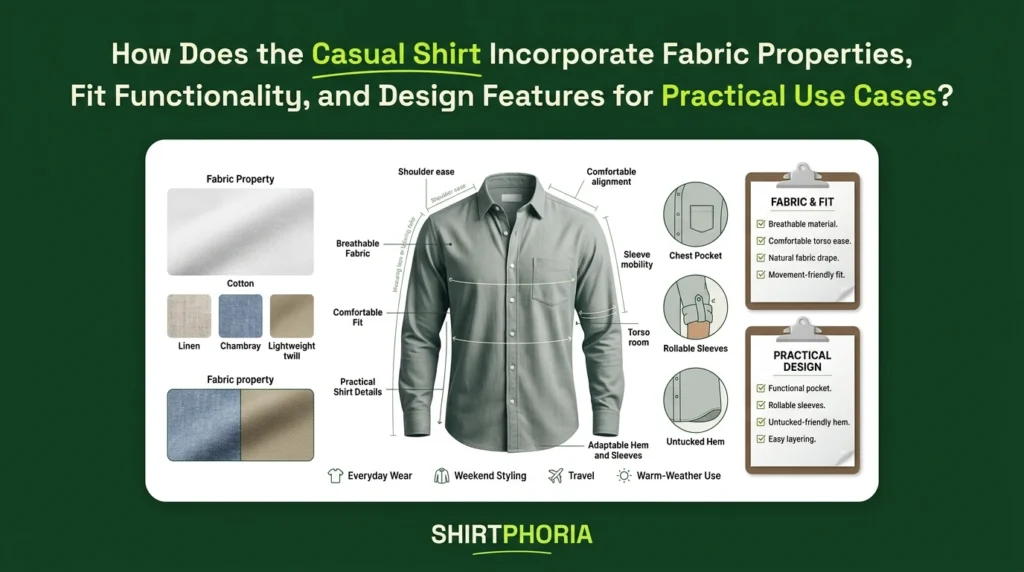
How Does the Casual Shirt Incorporate Fabric Properties, Fit Functionality, and Design Features for Practical Use Cases?
A casual shirt achieves practical utility when its fabric properties, fit functionality, and design features work together to support comfort, movement, breathability, durability, and the intended use environment.
Many casual shirts look similar on a hanger but behave very differently during actual wear. Fiber composition changes how moisture is absorbed or moved. Fabric structure changes stretch, drape, and durability. Collar, placket, cuff, and pocket construction affects ventilation, adjustability, coverage, and storage. Fit determines whether those features continue working when the wearer sits, reaches, layers clothing, or moves through daily tasks.
Casual shirt utility is therefore easier to understand as three connected systems: fabric properties, fit functionality, and design features. These systems also fit within the broader framework of shirt types fabric fit design function.
This guide explains those systems individually and then combines them through diagnostic thresholds, a scoring method, practical use cases, and a buying checklist.
This guide explains casual-shirt materials, fit, and construction for educational purposes. Fabric performance and garment comfort vary according to fiber blend, weave or knit density, finishing, climate, activity level, body proportions, laundering, and individual preference.
Quick Answer: What Makes a Casual Shirt Useful?
A casual shirt becomes useful when its fabric controls comfort, its fit allows movement, and its design features adapt the shirt to the wearer’s environment and task. No individual material, collar, weave, or fit is universally superior. Practical utility comes from matching fabric behavior, garment proportions, ventilation, structure, and adjustability to the conditions in which the shirt will actually be worn.
Defining Fabric Properties for Practical Casual Shirt Utility
The practical utility of a casual shirt begins with fabric properties, because fiber composition and fabric construction influence breathability, moisture handling, durability, drape, and comfort.
Fabric should not be judged by fiber name alone. Cotton, linen, polyester, nylon, and blended fabrics can behave differently depending on yarn construction, fabric weight, weave or knit structure, finishing, and garment design.
CottonWorks describes apparel comfort testing in terms that include airflow, moisture handling, drying speed, and wicking. It also identifies breathability, absorbency, and softness as important characteristics of cotton.
How Does Fiber Composition Influence Thermal and Moisture Control?
Fiber composition influences thermal and moisture control by shaping how a casual shirt absorbs, releases, moves, or resists moisture during wear.
Cotton is useful where softness, absorbency, and breathable everyday comfort matter. Its ability to absorb moisture can feel comfortable in moderate daily conditions, although the complete performance of a cotton shirt still depends on fabric thickness, weave, finishing, and environmental conditions.
Linen is a natural fiber derived from flax and is commonly valued for breathable warm-weather clothing. Its usefulness in heat does not mean every linen shirt will perform identically. Fabric density, weight, garment fit, and humidity still affect the result.
Polyester is frequently used in fabrics engineered to move moisture. Nylon can contribute stretch and breathability. This should not be interpreted to mean that every polyester or nylon casual shirt automatically wicks moisture effectively. Performance depends on how the yarn, fabric structure, finishing, and blend are engineered.
Synthetic blends can therefore make sense for active travel, walking, or environments where drying and moisture movement are important. Natural fibers may make more sense where softness, absorbency, tactile comfort, or a relaxed appearance carries more weight.
The useful question is not simply, “Is this natural or synthetic?” It is, “Does this particular fabric behave appropriately for my activity and environment?”
How Do Weave and Knit Structures Change Fabric Utility?
Weave and knit structures change casual shirt utility by controlling how the fabric stretches, drapes, resists abrasion, holds shape, and allows air movement.
Fiber content tells only part of the story. The same fiber can be constructed into fabrics with very different mechanical properties.
Twill Weave: A woven construction recognized by diagonal ribs. Twill structures can provide substantial stability and are commonly used where durability and structure matter.
Jersey Knit: A knitted structure commonly associated with lightweight, comfortable garments. Standard single jersey is generally lightweight and naturally offers stretch through its knitted construction.
Plain Weave: A basic interlacing structure in which warp and filling yarns alternate over and under each other. It generally provides a firm, stable fabric foundation.
Poplin: A smooth shirting fabric with a fine crosswise rib and closely controlled structure. It is frequently used where a cleaner, crisper casual-shirt appearance is preferred.
A twill shirt may make sense where abrasion resistance and structure have priority. Jersey may suit a wearer who values softness and stretch. Poplin can provide a cleaner presentation where the shirt needs to move between casual and more polished environments.
Jersey should not automatically be classified as highly breathable simply because it is knitted. Fiber composition, density, thickness, and finishing still influence airflow and thermal comfort.
The material side of utility also connects directly to casual shirt fabric formality, because fabric composition and construction influence both physical performance and the visual signal of the shirt.
Analyzing Design Features for Task-Specific Casual Shirt Utility
Task-specific casual shirt utility is shaped by design features such as collars, plackets, cuffs, and pockets, because these components control coverage, ventilation, stability, adjustability, and storage.
A useful design feature should solve a physical problem. A collar controls neckline structure and coverage. A placket controls closure and opening. Cuffs control the sleeve opening. Pockets add storage.
Their value depends on whether those functions match the intended task.
How Does Collar Structure Affect Presentation and Protection?
Collar structure affects casual shirt utility by changing how the shirt frames the face, covers the neck, manages heat, and signals casual or polished intent.
A collar stand supports the collar around the neck and can provide additional coverage while helping the collar maintain a structured presentation. A taller or more rigid construction may look cleaner, but excessive height or stiffness can also create heat or neck irritation.
A button-down collar uses buttons to secure its collar points. This keeps the collar points controlled instead of allowing them to move freely.
The buttons themselves should not be treated as a form of weather or sun protection. Their primary mechanical function is collar-point control.
A camp collar creates a more open neckline. The reduced closure around the neck can support greater open-neck airflow than a higher, more enclosed collar, while also producing a distinctly relaxed presentation.
That openness can be useful in hot-weather casual clothing, but it may provide less coverage and less visual structure where a polished office appearance is required.
How Do Plackets, Cuffs, and Pockets Add Adaptability?
Plackets, cuffs, and pockets add casual shirt utility by giving the wearer adjustable control over ventilation, sleeve opening, closure security, and small-item storage.
A full button placket creates incremental control. The wearer can keep the shirt fully closed when greater coverage is needed or open selected buttons when conditions allow more ventilation.
Adjustable cuffs can change the wrist opening so the sleeve sits more securely or accommodates different wrist requirements.
Convertible cuffs serve a different function. They are designed to fasten with either regular buttons or cufflinks. They should not be described as cuffs designed primarily for sleeve rolling.
Pockets provide storage, but pocket utility depends on construction. A shallow pocket may not secure an item. A badly positioned pocket may interfere with movement. A large pocket attached to lightweight fabric may distort the shirt when loaded.
Knit casual-shirt construction can also be compared with polo shirt fabric engineering, where fabric stretch, collar structure, and compact placket design work together to create a different form of casual adaptability.
Design Feature Comparison: Collar, Placket, and Cuff Utility
Casual shirt design features become easier to evaluate when each component is linked to the specific utility it provides.
| Design Feature | Utility Delivered | Best Use Case | Failure Risk |
|---|---|---|---|
| Structured Collar Stand | Neck coverage and cleaner presentation | Business casual layering and outdoor coverage | Too much height can trap heat or irritate the neck |
| Button-Down Collar | Collar-point stability | Active daily wear and casual office shirts | Can look too casual for stricter formal settings |
| Camp Collar | Open-neck airflow and relaxed presentation | High heat, vacation, beach, and resort settings | Can look too exposed or informal in polished settings |
| Full Button Placket | Adjustable ventilation and closure control | Daily wear, travel, warm indoor-outdoor transitions | Too much opening can reduce coverage or polish |
| Adjustable Cuffs | Wrist-opening control and sleeve security | Manual tasks and daily movement | Too loose can slide over the hand; too tight can restrict wrist movement |
| Convertible Cuffs | Button or cufflink fastening flexibility | Casual-to-smart transitions and travel | Cufflinks can make a casual shirt appear more formal than intended |
How Fit Functionality Drives Mobility and Comfort in the Casual Shirt
Fit functionality turns casual shirt fabric and design into real movement performance by controlling shoulder reach, torso drape, layering space, hem stability, and seated comfort.
A functional casual shirt is not necessarily tight or loose. It needs controlled room in the correct places.
Too little room can restrict breathing, movement, or layering. Too much room can cause fabric to pool, shift, or interfere with movement.
How Do Armhole Depth and Sleeve Articulation Affect Mobility?
Armhole depth and sleeve articulation affect casual shirt mobility by controlling how much the shirt body moves when the arms reach, lift, twist, or extend.
A higher armhole can improve movement when it follows the body closely without cutting into the underarm. A smaller, better-positioned armhole separates sleeve movement from the garment body, reducing how much the rest of the garment is dragged when the arm moves.
This does not mean a tight armhole is desirable.
If the armhole is excessively high or narrow, it can press into the underarm and restrict shoulder movement. Conversely, an excessively low armhole can cause a larger section of the shirt body to rise when the wearer lifts an arm.
Articulated sleeves add shaping that follows the natural movement or bend of the arm. This can be useful where reaching, lifting, or repeated movement matters.
The objective is therefore a high-enough, properly shaped armhole with sufficient underarm clearance, not maximum tightness.
Why Do Chest and Torso Proportions Affect Layering and Drape?
Chest and torso proportions affect casual shirt utility because they determine whether the shirt can layer comfortably, hang cleanly, and move without pulling across the body.
Useful chest room allows the wearer to breathe, sit, reach, and add an undershirt or light layer when necessary.
The torso should still maintain a controlled vertical drape. Excess fabric can gather at the waist, bunch underneath a jacket, or make the shirt difficult to manage during movement.
At the opposite extreme, an overly tight torso often produces visible pulling between buttons and limits seated or reaching comfort.
Functional fit therefore sits between compression and uncontrolled volume.
Diagnostic Thresholds and Failure Modes for Casual Shirt Utility
Casual shirt utility can be diagnosed by checking whether fabric weight, fiber behavior, weave structure, collar design, placket control, cuff function, armhole shape, and torso drape sit inside the correct functional range.
These ranges are practical diagnostic tools rather than universal tailoring laws.
| Variable | Too Low Failure | Ideal Zone | Too High Failure | Observable Test | Diagnostic Fix |
|---|---|---|---|---|---|
| Fabric Weight | Shirt becomes transparent, clingy, weak, or unstable after washing | Fabric feels breathable but still holds enough structure for the intended use | Shirt becomes hot, stiff, heavy, or uncomfortable in daily movement | Hold the fabric toward light and check whether it drapes cleanly without collapsing | Choose lighter fabric for heat, heavier fabric where durability matters, or medium weight for general daily use |
| Moisture Handling | Sweat stays trapped and the shirt feels damp or sticky | Fabric absorbs, releases, or moves moisture in a way that suits the activity | Some highly performance-oriented constructions may feel too slick or technical for the intended casual context | Check composition, fabric construction, finish, and intended activity | Choose according to activity: absorbent natural fibers for passive comfort or engineered blends where active moisture movement matters |
| Weave or Knit Structure | Fabric lacks stability, stretches out, pills, or loses shape too quickly | Structure matches the use case: twill for durability, jersey for comfort, poplin for crispness | Structure becomes too rigid for the desired comfort or airflow | Pull the fabric gently across and along its structure and observe stretch and recovery | Match weave or knit to the environment rather than appearance alone |
| Collar Structure | Collar collapses, curls, or provides little shape | Collar balances coverage, polish, and airflow | Collar feels hot, stiff, or irritating | Turn the head and check for rubbing, collapse, or restriction | Use a collar stand for structure, button-down construction for point control, or a camp collar where openness is useful |
| Placket Control | Shirt provides limited closure or ventilation flexibility | Placket allows controlled opening, coverage, and temperature adjustment | Excessive opening reduces coverage or task suitability | Open one or two buttons and check whether the neckline remains controlled | Use a full placket for greater adjustment or a shorter placket where compact closure is preferred |
| Cuff Function | Cuffs slide, gape, or fail to secure the sleeve | Cuffs adapt to wrist size and task without restricting movement | Cuffs feel tight, overbuilt, or unnecessarily formal | Bend the wrist and test the sleeve position | Use adjustable cuffs for practical control and convertible cuffs when button or cufflink flexibility is useful |
| Armhole and Sleeve Mobility | Low armholes pull more of the shirt body upward when the arm lifts | Armholes sit high enough to separate arm movement without cutting into the underarm | Tight armholes restrict movement and create discomfort | Raise both arms and observe how sharply the hem moves | Choose a better-shaped armhole or useful sleeve articulation |
| Torso Drape | Tight fit produces button pulling and limits seated comfort | Torso allows breathing, sitting, layering, and clean drape | Excess material bunches around the waist | Sit, twist, and reach while checking button strain and fabric pooling | Change size, fit category, or tailoring according to intended use |
Both extremes can weaken casual shirt utility.
Too little fabric weight can create transparency and weak structure, while too much can create heat and stiffness.
Too little collar structure can produce collapse, while excessive structure can create discomfort.
Too little armhole control allows more body pull, while excessive armhole tightness restricts movement.
Too little torso room limits mobility and layering, while too much creates bunching and unstable drape.
The goal is not to maximize any one variable. It is to place each variable inside a useful range for the wearer and task.
Casual Shirt Utility Scoring Key
A casual shirt becomes easier to evaluate when each utility variable is scored by whether it supports, weakens, or fails the intended use case.
Score these eight variables:
- Fabric weight
- Moisture handling
- Weave or knit structure
- Collar structure
- Placket control
- Cuff function
- Armhole and sleeve mobility
- Torso drape
Score Interpretation
The shirt is well suited to the intended use case.
The shirt can work, but one or two variables require compromise or correction.
The shirt is likely mismatched to the environment, task, or wearer’s movement needs.
The score is a decision aid rather than a universal garment-quality rating. A shirt can be excellent for one environment and inappropriate for another.
Synthesis Matrix: Mapping Casual Shirt Utility to Practical Use Cases
Casual shirt utility becomes practical when fabric, fit, and design features are matched to the environment rather than judged in isolation.
| Practical Use Case | Key Fabric Property | Key Fit Functionality | Key Design Feature | Main Failure to Avoid |
|---|---|---|---|---|
| Outdoor Walking or Light Trekking | Moisture handling, light stretch, medium durability | Arm mobility and secure hem behavior | Full placket and adjustable cuffs | Heavy fabric that retains excess heat or low armholes that pull the shirt body |
| Business Casual Office | Poplin, fine twill, or smooth cotton blend | Clean torso drape and stable shoulder fit | Structured collar stand or button-down collar | Overly relaxed neckline or fabric behavior that reduces polish |
| Manual Workshop Task | Durable twill or heavier cotton blend | Sufficient arm mobility and torso room | Secure cuffs and practical pockets | Thin fabric, weak pockets, or cuffs that interfere with work |
| High Heat or Beach | Linen, lightweight cotton, breathable blend, or light knit | Relaxed drape and airflow space | Camp collar or open neckline | Heavy fabric, excessive collar structure, or tight torso fit |
| Travel | Stable midweight weave or wrinkle-resistant construction | Comfortable seated drape and layering room | Secure placket, adjustable cuffs, practical pocket placement | Severe wrinkling or a fit that becomes restrictive when sitting |
| Weekend Lounging | Jersey knit, soft cotton, or relaxed lightweight weave | Soft drape and low restriction | Simple collar, relaxed placket, or knit construction | Excessive structure or stiffness that reduces comfort |
This comparison shows why the same shirt is rarely optimal for every situation.
A durable twill shirt may perform well during physical work but feel unnecessarily heavy during high heat. A light linen camp-collar shirt may be comfortable at a resort but provide too little structure for a polished business-casual setting.
Utility is contextual.
How to Choose the Right Casual Shirt Based on Fabric, Fit, and Features
Choosing the right casual shirt requires evaluating the garment as a functional system rather than judging fabric, fit, or design features separately.
Checklist for Fabric Evaluation
- Composition Check: Does the fiber composition suit the environment, activity level, and expected moisture exposure?
- Breathability Check: Does the fabric provide sufficient airflow for heat, humidity, or indoor-outdoor movement?
- Durability Check: Is the weave or knit strong enough for the physical demands of the intended task?
- Weight Check: Is the fabric heavy enough to maintain useful structure without becoming unnecessarily hot or restrictive?
- Care Check: Will the fabric tolerate the washing, drying, and ironing routine the wearer is likely to use?
Checklist for Fit Evaluation
- Mobility Check: Can the wearer lift, reach, twist, and sit without strong hem movement or button pulling?
- Armhole Check: Is the armhole high enough to support movement without cutting into the underarm?
- Layering Check: Is there enough torso room for an undershirt, jacket, or temperature layer when required?
- Drape Check: Does the shirt hang cleanly without clinging, ballooning, or bunching around the waist?
Checklist for Design Feature Evaluation
- Collar Check: Does the collar match the required balance between structured presentation, coverage, and open-neck comfort?
- Placket Check: Does the shirt provide enough closure and ventilation control for the environment?
- Cuff Check: Can the cuff be adjusted comfortably for the intended activity?
- Pocket Check: Are pockets deep, secure, and structurally appropriate for anything the wearer intends to carry?
- Context Check: Do the design features match the expected level of casualness, polish, and physical activity?
Casual Shirt Buying Checklist
Use this checklist to confirm that the shirt’s fabric, fit, and design features match the environment in which you expect to wear it.
FAQ: Casual Shirt Utility
The most common questions about casual shirt utility can be answered by examining fabric behavior, fit geometry, and design features together.
A casual shirt becomes useful when its fabric supports comfort, its fit allows movement, and its design features match the wearer’s environment. A functional casual shirt balances breathability, durability, mobility, coverage, adjustability, and reasonable care requirements instead of optimizing only one characteristic.
There is no single best fabric for every casual shirt. Cotton can provide breathable, absorbent daily comfort; linen suits many warm conditions; engineered synthetic blends can support moisture movement; twill adds structure and durability; jersey provides stretch and softness; and poplin supports a cleaner, crisper presentation.
A casual shirt should provide enough room for sitting, reaching, breathing, and intended layering without creating uncontrolled fabric around the torso. The armholes should permit useful movement without cutting into the underarm, and the shirt body should not rise dramatically when the wearer lifts the arms.
A camp collar can be useful in hot weather because its open neckline provides less enclosure around the neck than a higher, closed collar. That openness works naturally with relaxed warm-weather clothing, although the lower structure and coverage may make the design less appropriate for strict business or formal environments.
Synthetic blends are not automatically better than natural fibers. Polyester and nylon can contribute useful moisture-management, stretch, or performance characteristics when appropriately engineered, while cotton and linen provide different forms of breathable everyday comfort. The better choice depends on activity, climate, fabric construction, care requirements, and personal preference.
The most useful variables to inspect are fabric weight, moisture behavior, weave or knit structure, collar design, placket control, cuff adjustability, armhole geometry, torso drape, and pocket construction. Together, these characteristics determine whether the shirt is suited to its environment, activity level, and movement requirements.
Terms Explained
| TERM | DEFINITION |
|---|---|
| Fabric Weight | The mass and physical substance of a fabric, which influences heat retention, drape, transparency, structure, and durability. |
| Moisture Handling | The way a textile absorbs, transfers, releases, or resists moisture during wear. |
| Twill Weave | A woven construction characterized by diagonal ribs and commonly associated with stability and durability. |
| Jersey Knit | A knitted structure that commonly provides softness and mechanical stretch through looped yarn construction. |
| Poplin | A smooth, closely constructed shirting fabric with a fine crosswise rib and relatively crisp appearance. |
| Collar Stand | The band around the neckline that supports the fold-over collar and affects coverage and structure. |
| Camp Collar | An open, relaxed collar construction that creates less enclosure around the neck than a conventional closed shirt collar. |
| Placket | The reinforced opening containing a shirt’s button-and-buttonhole closure system. |
| Convertible Cuff | A cuff designed to close with either regular buttons or cufflinks. |
| Armhole | The opening where the sleeve joins the shirt body; its depth and shape influence arm movement and garment-body lift. |
| Articulated Sleeve | A sleeve shaped to follow natural arm position or movement more closely than a simple straight sleeve. |
| Torso Drape | The way the shirt body hangs and moves over the chest, waist, and abdomen during standing, sitting, and movement. |
Conclusion
Ultimately, casual shirt utility depends on the strategic interaction of material behavior, fit geometry, and design features rather than on appearance alone.
Fabric determines how the garment responds to moisture, heat, movement, and wear. Fit determines whether the wearer can sit, reach, layer, and move comfortably. Design components such as collars, plackets, cuffs, and pockets determine how much control, coverage, ventilation, and adaptability the shirt provides.
No single material or construction should be judged in isolation. The useful casual shirt is the one whose physical characteristics match the wearer’s environment, movement needs, activity level, and comfort expectations.
By evaluating fabric, fit, and design as functional systems, the buyer moves from passively choosing a casual shirt to actively selecting engineered daily wear.